 Donate now
 Get a Call Back
 MENU
MENU 6 MIN READ
 SHARE
SHARE


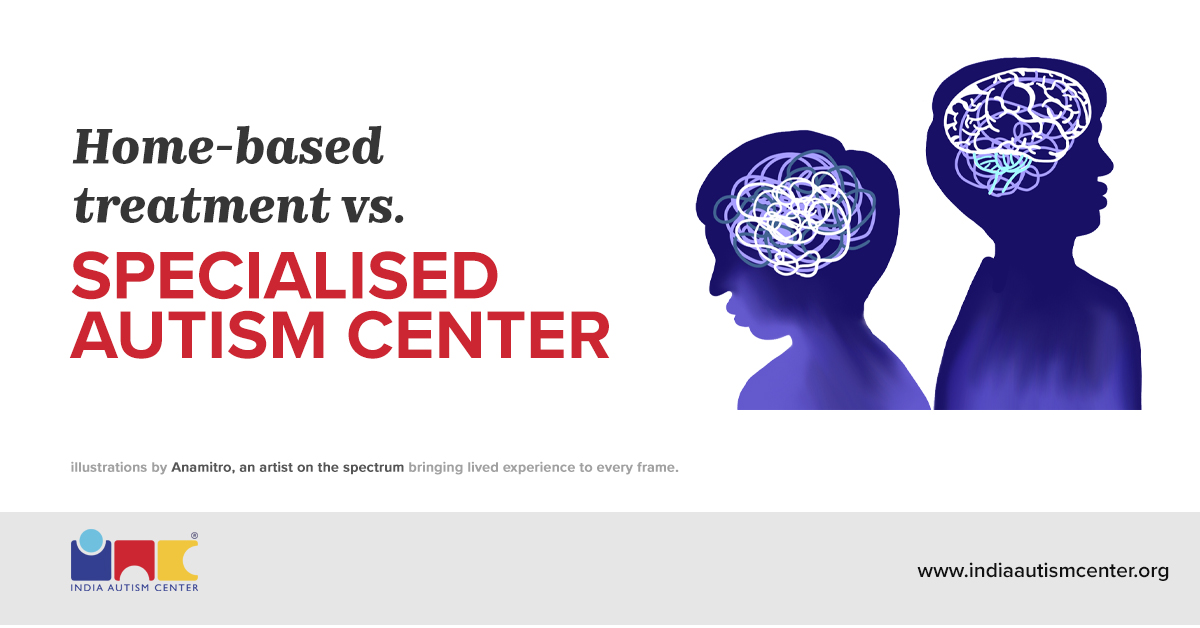
When your child is diagnosed with autism spectrum disorder (ASD), one of the first questions that comes to mind is: Which will be better, home-based treatment vs. specialised autism center?
This decision shapes your child’s daily routine, learning environment, and long-term development. Therefore, it is vital to understand the real differences between the two options.
In this guide, we explore the difference between home-based treatment and specialised autism center in detail. We compare learning settings, therapy effectiveness, and family involvement.
Understanding Autism Therapy Options
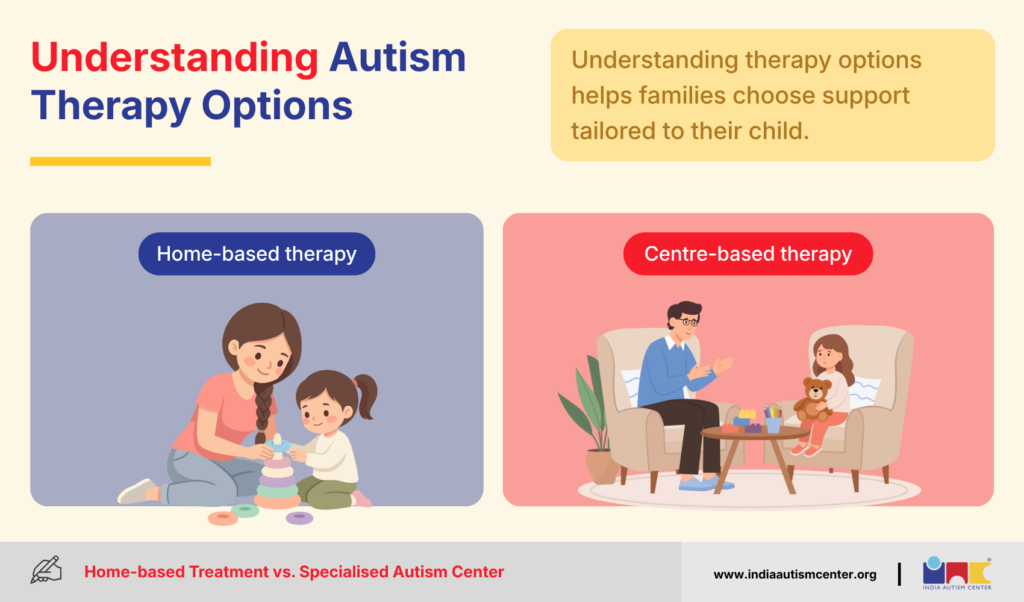
Autism therapy focuses on improving communication, behaviour, independence, and social interaction. The most common approach is Applied Behaviour Analysis (ABA). However, ABA can be delivered in two main ways:
1. Home-based therapy
2. Centre-based therapy
This leads to a frequent debate: Home-based treatment vs. Specialised Autism Center.
There is no universal answer. Every child is unique. However, understanding the strengths and limitations of each model helps you choose wisely.
What Is Home-Based Autism Therapy?
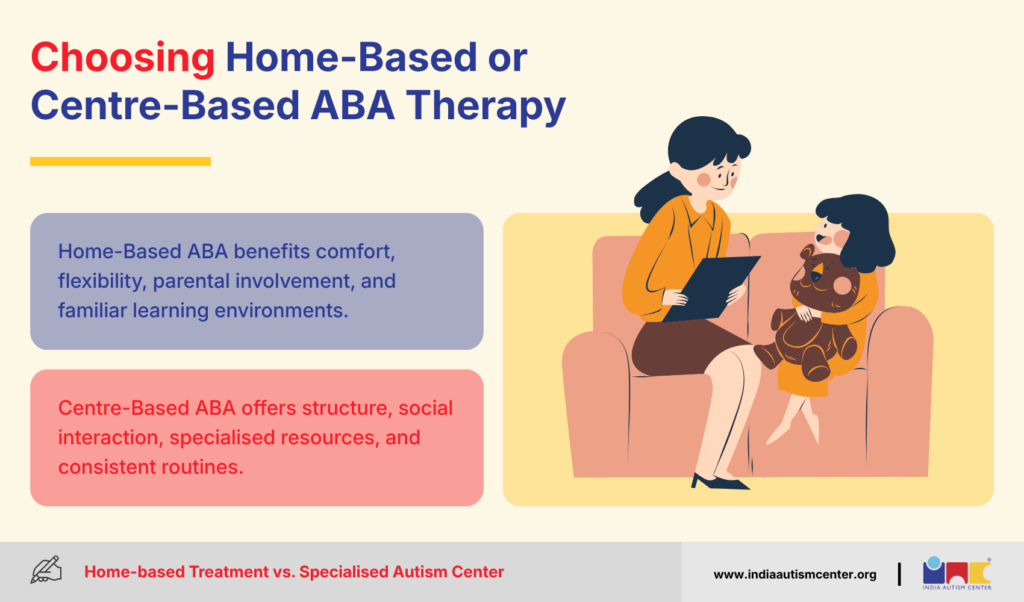
Home-based therapy means that trained therapists visit your home and work with your child in familiar surroundings.
Key Benefits of Home-Based Therapy
- Your child stays in a familiar environment
- Therapy fits naturally into daily routines
- Parents participate directly
- Skills transfer easily to real-life situations
Limitations of Home-Based Therapy
However, home therapy also has challenges:
- Fewer chances for peer interaction
- Limited access to specialised equipment
- Distractions at home can reduce focus
- Progress depends heavily on parent involvement
So, while home therapy feels comfortable, it may not offer enough structure for all children.
Want to know more? Get in touch with us.
What Is a Specialised Autism Center?
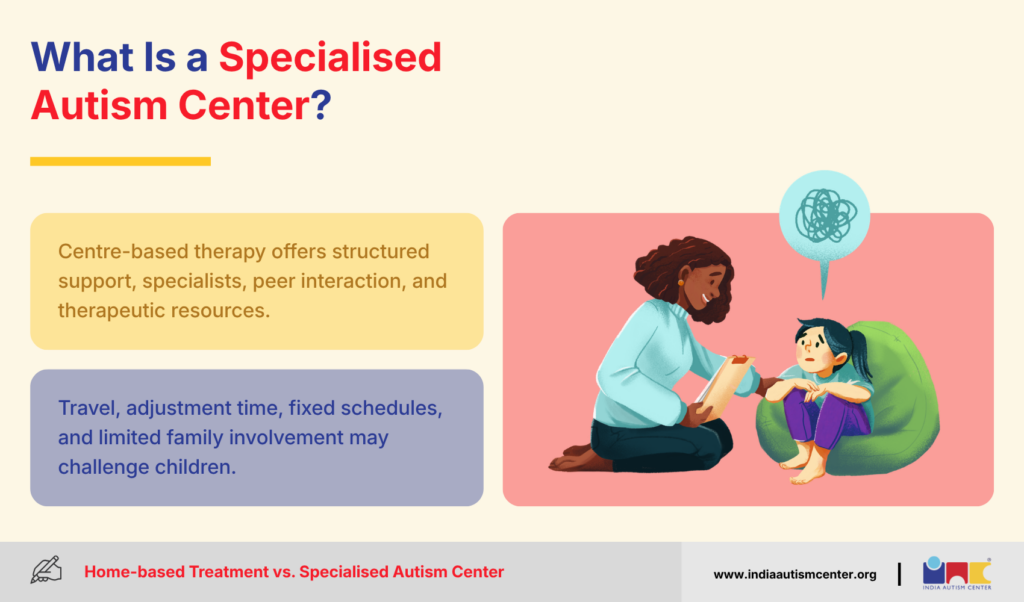
A specialised autism centre provides structured therapy in a professional environment designed specifically for autistic learners.
Advantages of Centre-Based Therapy
- Multi-disciplinary professionals in one place
- Peer interaction builds social skills
- A consistent routine improves behaviour
- Advanced tools and therapy rooms
- Strong monitoring and data tracking
Challenges of Centre-Based Therapy
However, centre-based care also has drawbacks:
- Travel time can be tiring
- Children may take time to adjust
- Less spontaneous family involvement
- Fixed schedules may limit flexibility
So, when comparing Differences Between Center-Based and Home ABA, we see trade-offs rather than winners.
📥 Free download: Printable daily routine chart for autistic children
Home-Based Treatment vs. Specialised Autism Center: A Direct Comparison
| Aspect | Home-Based Treatment | Specialised Autism Center |
|---|---|---|
| Learning Environment | Therapy takes place in a familiar home setting, which feels safe and comfortable for the child. | Therapy happens in a structured, controlled environment designed specifically for learning and behaviour management. |
| Social Interaction | Interaction is mainly with parents and therapists, so peer exposure is limited. | Children interact with other autistic peers daily, which supports social skill development. |
| Parent Involvement | Parents take an active role in therapy sessions and daily skill practice. | Parents are involved through reviews and guidance, but not usually present during sessions. |
| Routine and Structure | Daily routine is flexible and depends on family schedules. | Sessions follow a fixed timetable, which builds consistency and discipline. |
| Therapy Intensity | Usually fewer structured therapy hours per day. | Offers longer and more intensive therapy programmes. |
| Resources and Equipment | Limited to what is available at home. | Access to specialised tools, therapy rooms, and learning aids. |
| Skill Generalisation | Skills are practised directly in real-life home situations. | Skills are first learnt in therapy rooms and then transferred to home settings. |
| Distraction Level | More distractions from family members, TV, or household noise. | Fewer distractions due to controlled and purpose-built spaces. |
| Best Suited For | Younger children, children with high anxiety, or families who can participate actively. | Children who need structured learning, social exposure, and multi-disciplinary support. |
Want to know more? Get in touch with us.
Role of India Autism Center
At India Autism Center (IAC), we understand that every child has different needs. Therefore, we do not promote a one-size-fits-all model.
Instead, we offer:
- Evidence-based therapy
- Individualised treatment plans
- Professional therapists and educators
- Family counselling and training
- Structured centre-based programmes
- Support for home-based continuity
We evaluate your child first. Then, we recommend the most suitable model.
When Home-Based Treatment Works Best
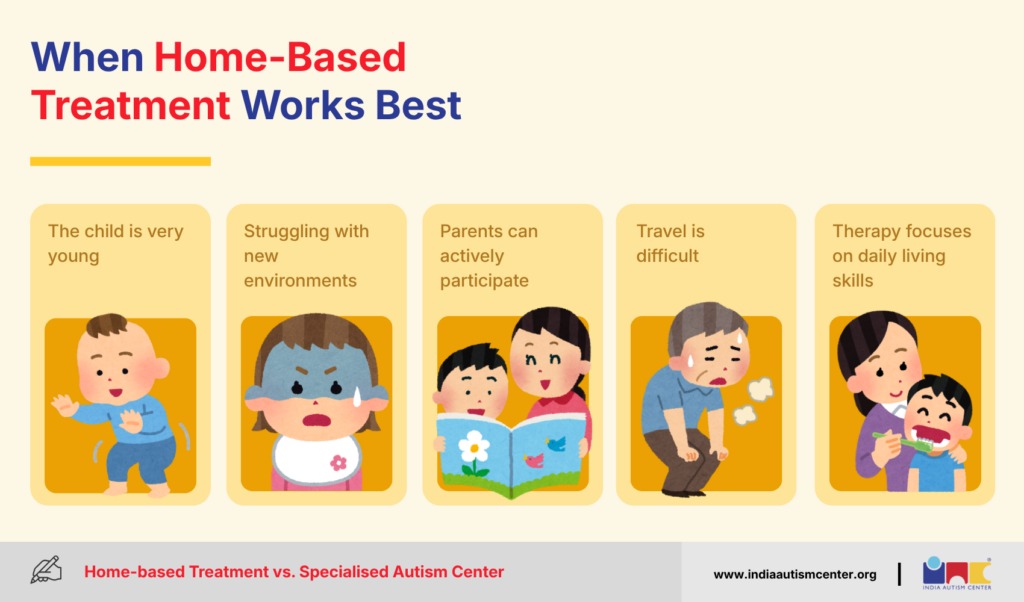
Home-based therapy works well when:
- The child is very young
- The child struggles with new environments
- Parents can actively participate
- Travel is difficult
- Therapy focuses on daily living skills
If you want an in-depth guide on autism therapies at home, you can read this blog.
When Centre-Based Therapy Works Best
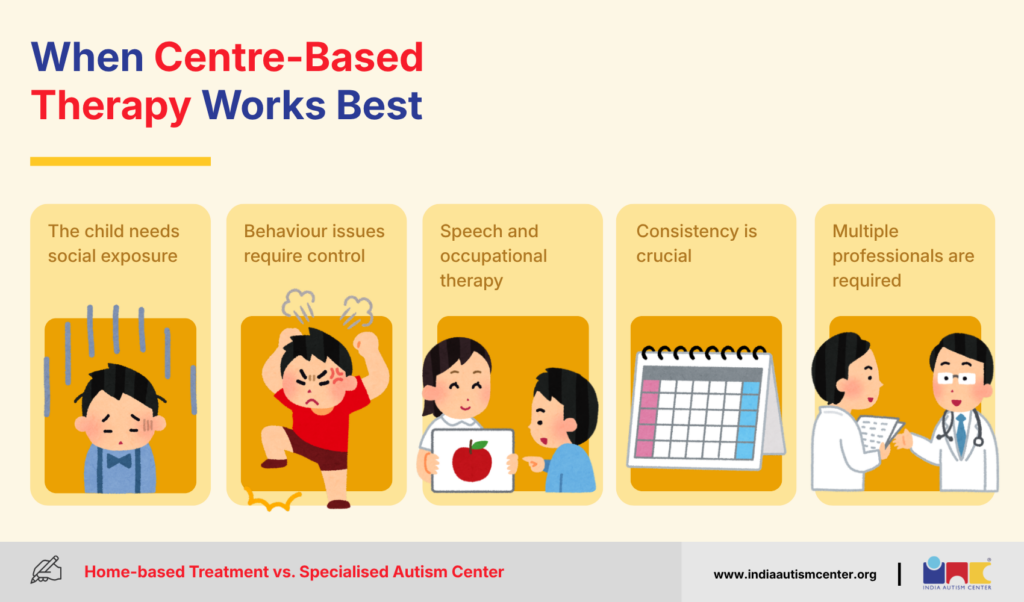
Centre-based therapy works best when:
- The child needs social exposure
- Behaviour issues require structured control
- Speech and occupational therapy are needed
- Consistency is crucial
- Multiple professionals are required
Choosing Home-Based or Centre-Based ABA Therapy
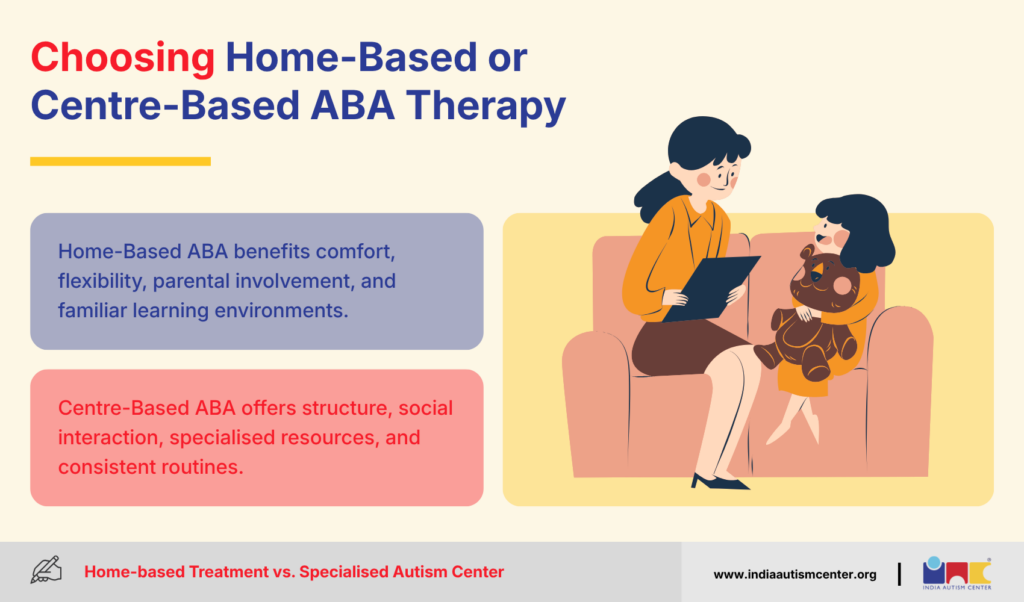
Choosing between the two options requires honest reflection. Ask yourself:
- Does my child enjoy social interaction?
- Can I participate daily?
- Does my child need structured learning?
- Is travelling manageable?
- What are my child’s sensory needs?
These answers will guide you to make a more suitable decision.
Why Families Trust IAC
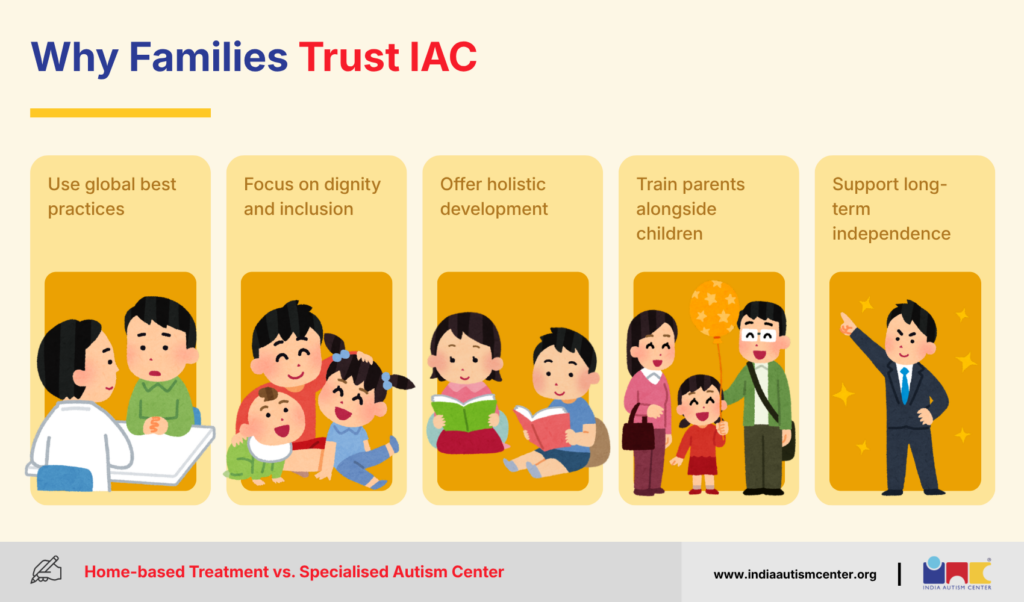
India Autism Center stands out because we:
- Use global best practices
- Focus on dignity and inclusion
- Offer holistic development
- Train parents alongside children
- Support long-term independence
We do not just provide therapy. We build learning ecosystems.
📥 Free download: Printable daily routine chart for autistic children
Conclusion
The debate around Home-based treatment vs. Specialised Autism Center will continue. However, informed parents make confident decisions.
Home therapy offers familiarity and flexibility. Centre therapy offers structure and social exposure.
At India Autism Center, our goal is simple: To help every child reach their fullest potential.
If you are unsure about choosing Home-based vs. Center-based therapy, professional guidance can make all the difference.
Frequently Asked Questions (FAQs)
What is the difference between home-based treatment and a specialised autism center?
Home-based treatment happens in the child’s home with parent involvement, while a specialised autism center offers structured therapy, peer interaction, and professional facilities.
Is home-based ABA therapy better than centre-based ABA therapy?
Home-based ABA therapy is helpful for comfort and daily life skills, but center-based ABA therapy provides stronger structure and social learning. The best choice depends on your child’s needs.
How do I choose between home-based and center-based ABA therapy?
Choosing home-based vs. center-based ABA therapy depends on your child’s age, behaviour, sensory needs, family involvement, and access to specialised services.
Can home-based and center-based ABA therapy be combined?
Yes. Many families use a blended approach where skills are taught at a specialised autism center and practised through home-based therapy for better long-term outcomes.
Disclaimer: This article is intended for educational and informational purposes only. It is not a substitute for professional medical advice, diagnosis, or treatment. If you are pregnant or have concerns about medication use during pregnancy, please consult a qualified healthcare provider. If your child has received an autism diagnosis and you have questions about causes or support, please reach out to a trained specialist or an autism-focused organisation for guidance.
For expert insights, support services, and inclusive learning initiatives, visit the India Autism Center.