 Donate now
 Get a Call Back
 MENU
MENU 22 MIN READ
 SHARE
SHARE


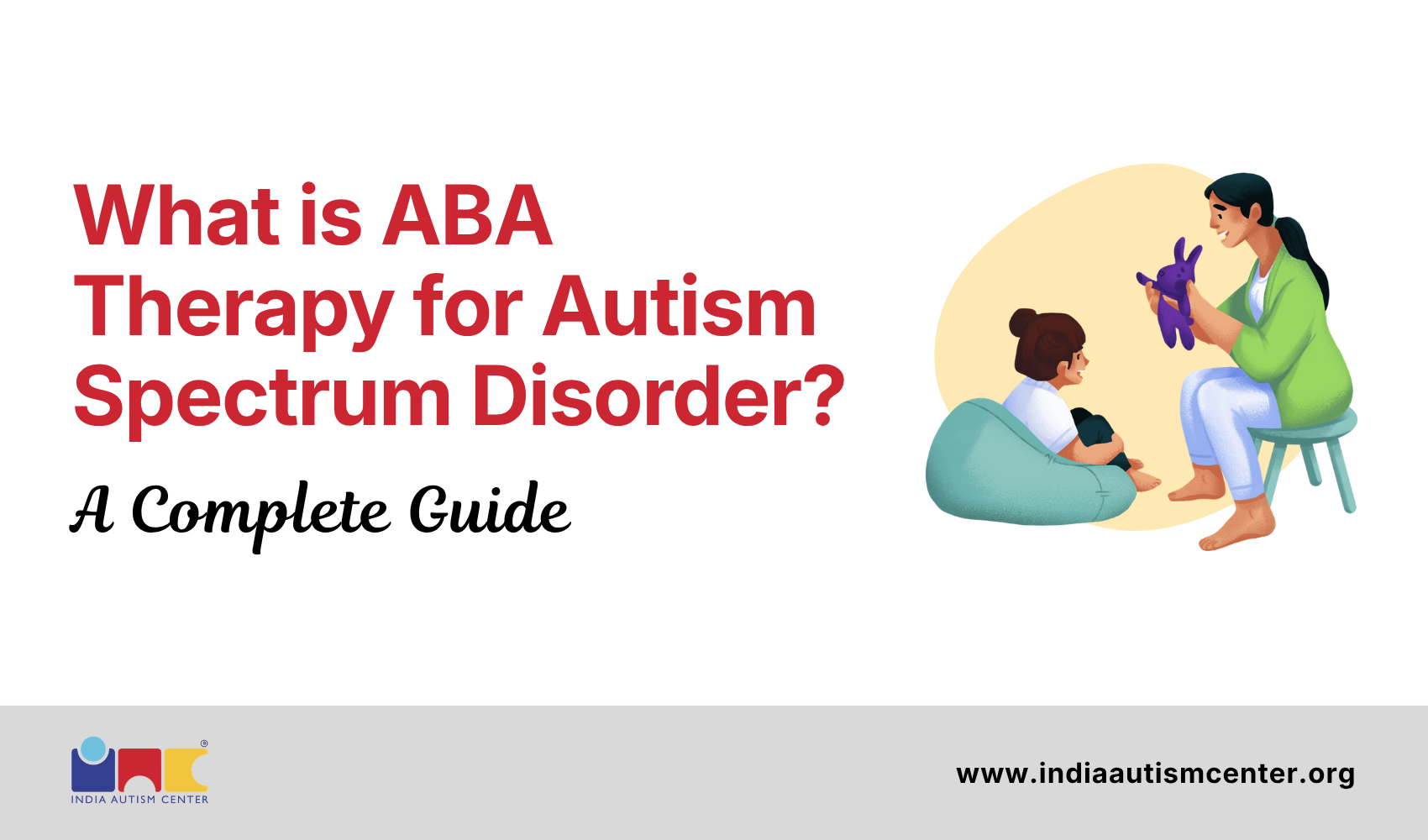
The day your child receives an autism diagnosis, the world narrows to a single, terrifying question: What do I do now? For most Indian families, that moment is followed by a flood of conflicting advice – from relatives, from Facebook groups, from well-meaning neighbours who “know someone whose child recovered completely.” The overwhelm is real. The confusion is real. And the fear that you might make the wrong choice for your child is very real.
Here is the reassurance you need: there is a clear, evidence-backed starting point. Applied behavior analysis – commonly called ABA – is the most rigorously studied intervention for autism spectrum disorder in the world. It is not a miracle cure. But it is a systematic, compassionate framework that has helped thousands of children build communication, independence, and life skills.
This guide explains exactly what it is, how it works, and what Indian families specifically need to know before they begin.
Understanding Applied Behaviour Analysis
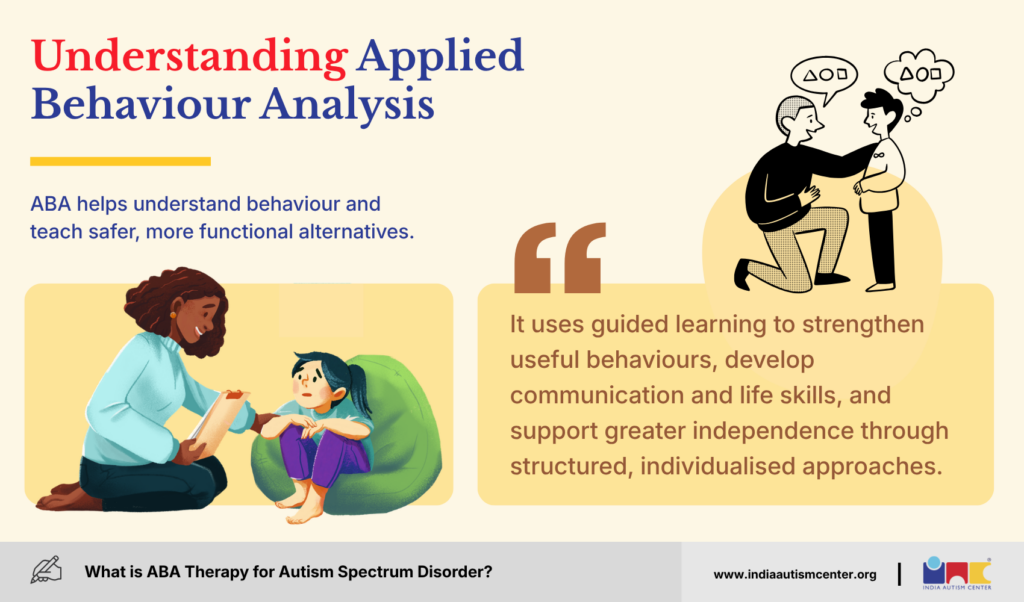
ABA therapy is the study of how behaviour works in real-life situations. It is a gentle, ethical, and effective approach that can help a person on the spectrum function independently.
ABA therapy works on the principle that children learn different behaviours, and since they learn them over time, it is possible to alter or strengthen them in positive ways. It is more of a guided-learning approach grounded in applied behaviour analysis.
It is important to understand that a child on the spectrum is not misbehaving; they are trying to communicate. ABA is a science-backed approach that helps decode what the child is trying to communicate and teaches a clear, safe, and more functional alternative.
Applied behaviour analysis online programmes can be helpful to children on the spectrum by:
- Improving social interaction.
- Helping the children to learn new skills.
- Helping the child learn self-care, chores, and other life skills.
- Improving attention, learning, and memory.
- Helping reduce aggression, self-injury, and meltdowns.
📥 Free download: Printable daily routine chart for autistic children
The Science Behind ABA: The A-B-C Framework
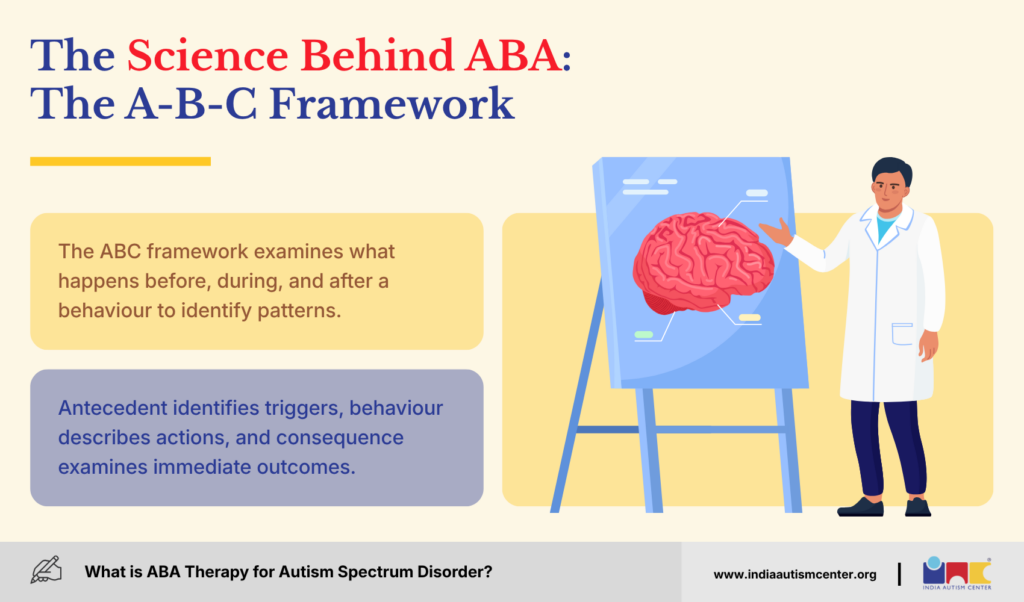
To understand how applied behavior analysis works, you need to understand one core idea: the A-B-C framework. Every behaviour – helpful or challenging – can be understood through three components.
- A – Antecedent: What happens before the behaviour. The trigger, the setting, the instruction, or the event that comes just before.
- B – Behaviour: The observable action itself. What the child actually does.
- C – Consequence: What happens after the behaviour. The response from the environment – a parent’s reaction, access to a toy, escape from a demand.
Let us make this concrete with an example that will feel familiar to many Indian families.
Scenario: It is dinner time. Amma has made dal-chawal and placed it in front of seven-year-old Arjun. Arjun does not want dal-chawal tonight. He starts crying loudly and pushing the plate away.
- Antecedent: The plate of dal-chawal is placed in front of Arjun.
- Behaviour: Arjun cries and pushes the plate.
- Consequence: Amma, worried he will hurt himself, removes the plate and offers him biscuits instead.
What has Arjun learned? That crying and pushing gets him what he wants. The behaviour worked. So it will happen again – and probably more intensely next time.
This is not Arjun being “naughty.” This is Arjun communicating the only way he currently knows how. Autism behaviour analysis helps therapists and families decode this pattern. Once we understand the ABC, we can redesign the consequence – and more importantly, teach Arjun a better way to communicate his preference. Perhaps he learns to point to a picture card, or use a simple phrase like “no, thank you.” The challenging behaviour loses its function. The new skill takes its place.
This is the engine that drives all of applied behavior analysis therapy. Understanding the ABC helps therapists design precise, individualised interventions – not guesswork, but a structured response to a specific communication need.
ABA Methodologies: The Three Core Approaches
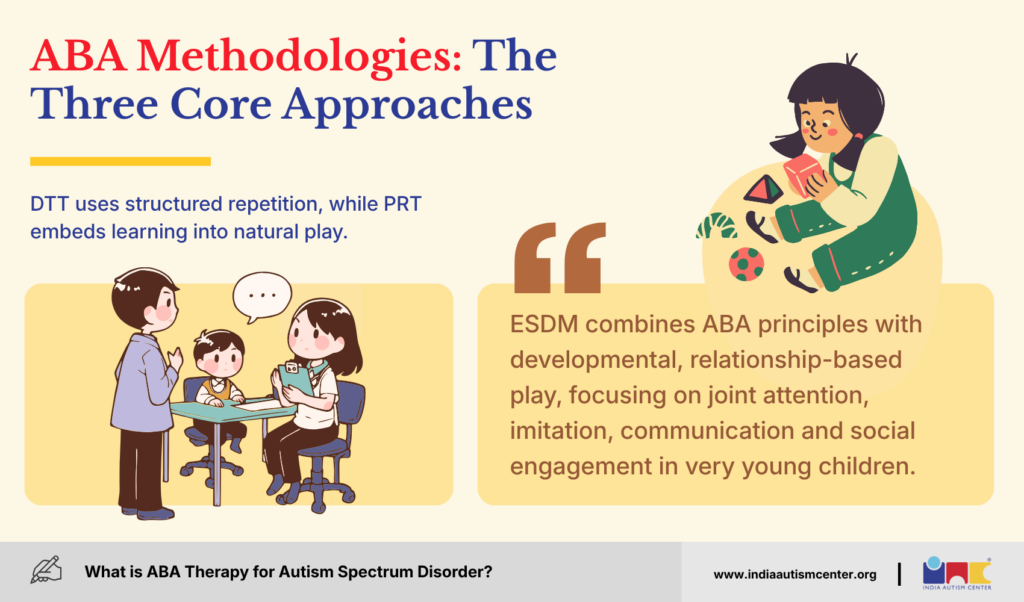
Applied behavior analysis is not one-size-fits-all. Depending on your child’s age, profile, and goals, a qualified therapist will draw from different ABA-based methodologies. Here are the three most widely used.
Discrete Trial Training (DTT)
Discrete Trial Training is the most structured form of ABA. In DTT, the therapist breaks a skill down into very small, discrete steps and teaches each step in a clear, repeated sequence: instruction → child’s response → consequence (reinforcement or correction).
A typical DTT trial might look like this: the therapist holds up a picture of a ball and says, “What is this?” The child says “ball.” The therapist immediately says “Great job!” and gives the child a sticker or a brief play break. Then the trial repeats.
DTT is particularly effective for children who are just beginning to learn language, for teaching foundational academic concepts, or for building skills that require a lot of repetition to master. It works best in a structured, distraction-free setting – often a tabletop format. It suits younger children (typically ages 2–5) who need intensive, focused teaching to build a skill base from scratch.
Pivotal Response Treatment (PRT)
Pivotal Response Treatment takes a very different approach. Instead of structured table-top trials, PRT embeds learning into the child’s natural play and daily routines. The therapist follows the child’s lead – if the child is interested in toy cars, the learning happens through the toy cars.
PRT targets “pivotal” areas of development – motivation, self-management, responsiveness to multiple cues – on the theory that improving these core areas produces broad improvements across many skills simultaneously.
PRT is ideal for children who have some foundational skills but need to generalise them to real-world, spontaneous situations. It tends to feel less like “therapy” and more like engaged, purposeful play. Parents find it easier to implement at home, which is a significant advantage for Indian families where home-based practice is often the primary support between centre sessions. [LINK: autism therapies at home]
Early Start Denver Model (ESDM)
The Early Start Denver Model is specifically designed for very young children – typically ages 12 months to 5 years – and is one of the most evidence-rich [early intervention](LINK: early intervention) approaches available. ESDM combines the rigour of ABA with relationship-based, developmental principles drawn from child psychology.
In ESDM, therapy happens within warm, playful, back-and-forth interactions between the child and therapist (or parent). The focus is on building joint attention, imitation, communication, and social engagement – the foundational skills that underpin all later learning.
ESDM is particularly suited to toddlers who have just received a diagnosis and whose families want to begin intensive, play-based support immediately. A 2010 randomised controlled trial published in Pediatrics found that children who received ESDM for two years showed significantly greater gains in IQ, language, and adaptive behaviour compared to children in community-based programmes.
How Applied Behaviour Analysis Therapy Works?
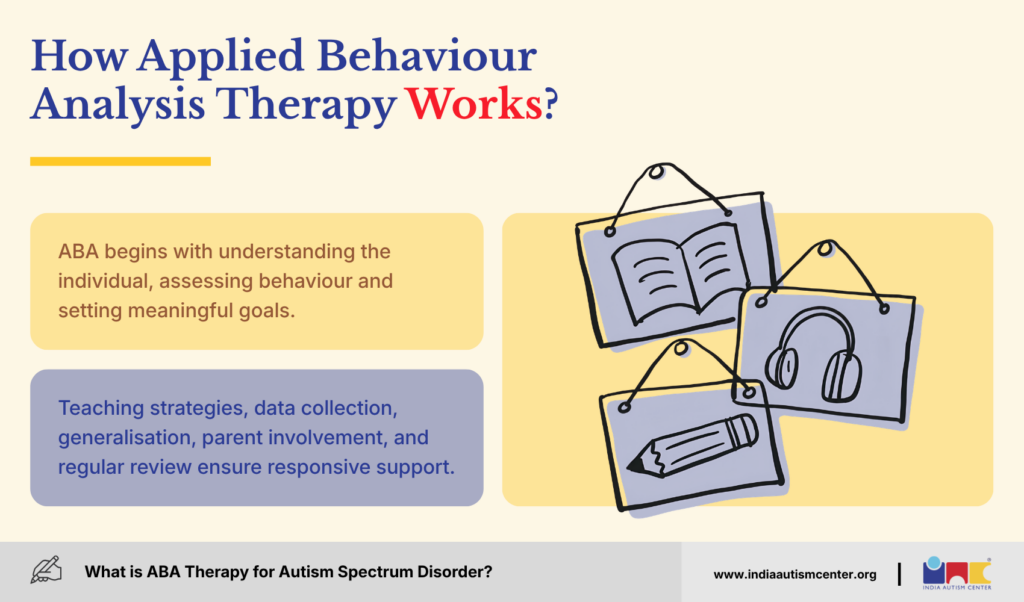
It is easier to understand applied behaviour analysis therapy once you see how it works. Applied behaviour analysis training is not a single technique or a fixed routine. It is a structured yet very flexible process that works. Careful observation, data, and collaboration between therapists and parents guide it.
The primary focus is to help the individual learn meaningful skills that improve daily life. It helps reduce behaviours that often lead to frustration, distress, or limited independence. Let us understand how ABA therapy actually works step by step:
Step 1: Getting to Know the Individual
The first step is to understand the person, not just their behaviour. Before beginning teaching, a qualified professional (usually a Board Certified Behaviour Analyst) observes the child in their natural setting, such as home or school.
The professional also speaks to the parent or caregiver to understand the concerns. They also review the developmental history, routines, and daily challenges. All these things ensure that applied behaviour analysis therapy works around the children’s real lives, not just based on labels or assumptions.
Step 2: Functional Behaviour Assessment (FBA).
The next step is to identify why a certain behaviour occurs. A functional behaviour assessment looks at different aspects, such as:
- What triggers a certain behaviour in the child?
- What does the behaviour look like in clear and observable terms?
- What happens immediately after the behaviour?
By understanding such patterns, it is easier to apply behaviour-analytic interventions that help address the course of behaviour.
Step 3: Designing an ABA Therapy Plan.
After the assessment is complete, the professionals create a personal therapy plan. This therapy plan is like a roadmap for better learning and processing. The ABA therapy plan outlines:
- The skills that the child needs to learn include communication, social skills, independence, and emotional regulation.
- Reduction or replacement of specific behaviours if needed.
- The teaching approach that suits the learner’s capabilities and style.
- On what basis will progress be measured and reviewed?
To bring great results, every goal in applied behaviour analysis therapy needs to be specific, realistic, and meaningful.
Step 4: Structures and Natural Methods to Teach
This is the most visible part of ABA therapy. It is where the learning happens day by day. Based on the child’s needs, the professionals create strategies. Some of the most common strategies include:
- Positive Reinforcement: When the child displays a helpful behaviour, rewarding it encourages them. It can be praise, access to a favourite activity, or a favourite toy. This helps motivate the child to continue learning without pressure.
- Prompting and Fading: At first, they offer the child support to succeed. Then gradually reduce the support so they are more independent when doing a task.
- Task Analysis: Even everyday tasks, such as getting dressed or brushing their teeth, are further broken into smaller steps. Since the steps become more manageable, they feel less overwhelming.
- Natural Environment Teaching (NET): Children learn skills through everyday activities, making learning feel relevant and practical.
Step 5: Data Collection
One key defining feature of applied behaviour analysis online training programmes is that progress is always measured. In every session, the therapist collects different data, such as:
- How often does the behaviour occur?
- How often does the child on the spectrum need support?
- How independently is a skill performed?
- How consistent is the progress?
Collecting different data helps professionals identify areas that need support, understand which approach is working, and adjust strategies to ensure approaches remain effective and individualised.
Support is always evidence-based, which is a major reason parents often explore the question, “What is ABA therapy?”
Step 6: Generalising Skills Across Settings
For optimum results, it is important to learn skills across various settings. A key goal of applied behaviour analysis therapy is generality. It ensures that skills and learning remain consistent at home, school, and even in community settings.
Example: When the child learns to ask for help during applied behaviour analysis therapy sessions, it supports them in using the same skill with parents, teachers, and friends. It ensures that progress is visible and leads to real-world independence.
Step 7: Involving Parents
It is important to note that parents and caregivers can play an essential role in the success of ABA therapy. Therefore, applied behaviour analysis online programmes often include:
- Parent coaching sessions
- Guidance in reinforcing skills at home
- Support with managing routines and transitions
When parents get actively involved and trained, the collaboration will ensure consistency. It eventually supports skill development even after ABA therapy hours end, especially in applied behaviour analysis in home settings.
Step 8: Reviewing and Adapting
ABA therapy is not static. As the child grows, their needs change. Hence, the goals also need updating; the teaching approach is then open for alteration, and making adjustments in support levels becomes easier.
This flexibility makes applied behaviour analysis equally effective for autism and ADHD across different life stages.
Who Delivers ABA Therapy? Understanding BCBA and RBT Roles
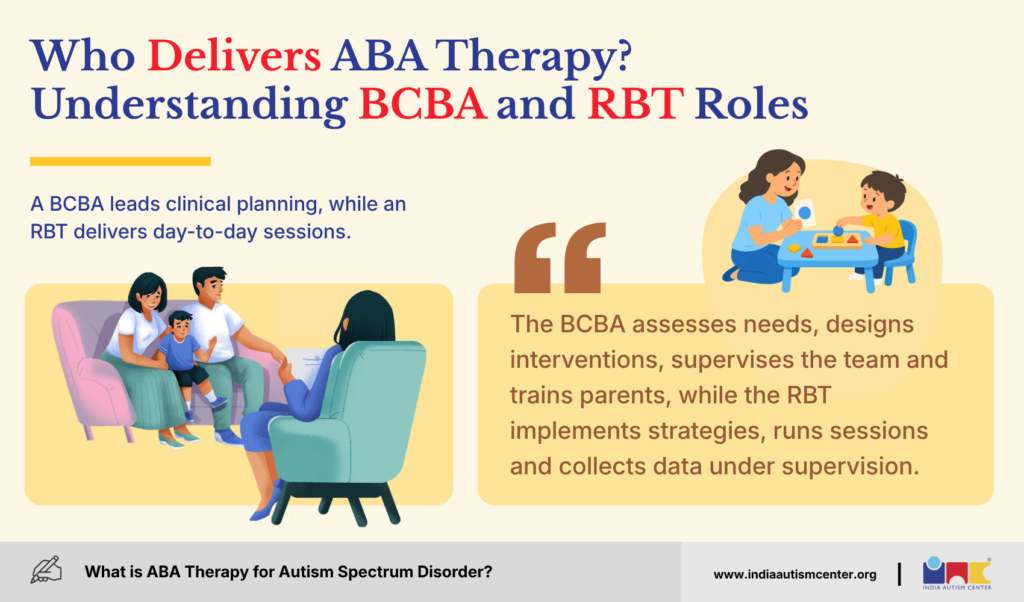
The quality of ABA therapy depends enormously on who is delivering it. Understanding the professional roles involved will help you ask the right questions.
What is a BCBA (Board Certified Behavior Analyst)?
A Board Certified Behavior Analyst (BCBA) is the gold standard credential in applied behavior analysis. To earn this certification, a professional must:
- Hold a master’s degree or higher in behaviour analysis, psychology, or a related field
- Complete 2,000 hours of supervised fieldwork
- Pass the BCBA examination administered by the Behavior Analyst Certification Board (BACB)
- Maintain the certification through ongoing professional development
The BCBA is the clinical lead. They conduct the initial assessment, design the Behaviour Intervention Plan, set the goals, supervise the therapy team, analyse the data, and make all clinical decisions. They are also responsible for parent training.
In any reputable ABA programme, a BCBA should be overseeing your child’s case – not just a behaviour therapist working without qualified supervision.
What is an RBT (Registered Behavior Technician)?
A Registered Behavior Technician (RBT) is a paraprofessional who delivers the day-to-day ABA sessions directly with the child. RBTs complete a 40-hour training programme, pass a competency assessment, and work under the close supervision of a BCBA.
Think of the BCBA as the architect and the RBT as the skilled builder who carries out the plan on the ground. The RBT runs the sessions, collects the data, and implements the strategies designed by the BCBA. They do not make independent clinical decisions – that responsibility stays with the supervising BCBA.
Finding Qualified ABA Providers in India
Here is the honest picture: India has very few BACB-certified BCBAs. As of 2025, the BACB’s public registry lists fewer than 100 certified BCBAs based in India – a significant gap given the country’s population and the estimated 1 in 68 prevalence of autism.
What this means in practice is that most Indian ABA centres use behaviour therapists who have been trained locally – through workshops, university programmes, or on-the-job training – rather than through the formal BCBA pathway. This does not automatically mean the therapy is poor. Many Indian behaviour therapists are highly skilled and dedicated. But the variability is real, and families need to evaluate providers carefully.
Questions to ask any ABA provider in India:
- Is there a BCBA (or internationally trained equivalent) supervising the programme?
- Can I see my child’s written Behaviour Intervention Plan?
- How is progress measured, and how often will I receive a written report?
- What is the therapist-to-child ratio during sessions?
- How are parents trained and involved?
- What happens if my child is not making progress?
Red flags to watch for:
- No written assessment or individualised plan
- Therapists who cannot explain why they are using a particular strategy
- No data collection or progress reporting
- Centres that promise specific outcomes in specific timeframes
- Programmes where parents are excluded from the process
Myths and Facts About ABA Therapy: Separating Assumptions from Reality
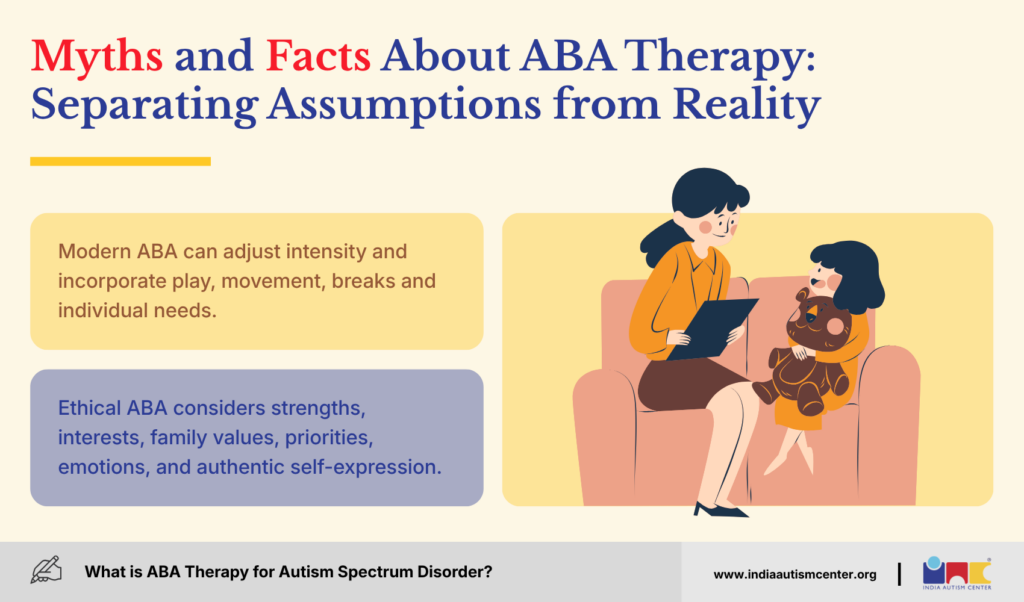
People often misunderstand Applied Behaviour Analysis, and there is also not much discussion about it. When parents hear about ABA therapy or an applied behaviour analysis online training programme, it is usually via social media or second-hand opinions; the data and descriptions are often outdated, or they cannot reflect how professionals practise modern applied behaviour analysis for ADHD.
However, for parents to make an informed decision, they must move past assumptions and examine what ABA therapy is today. So here we are, breaking down the most common assumptions and myths.
Myth 1: ABA therapy is too intense
Fact: The techniques and strategies used in applied behaviour analysis therapy are not based on a fixed formula.
In fact, they are as per the child’s needs. Some children see improvement from more structured support, while others seem to thrive with fewer hours. Modern applied behaviour analysis therapy aims to adjust session length and frequency and to incorporate play, movement, and breaks.
Also, the therapy respects when there are signs of stress or fatigue. Thus, ABA therapy feels supportive and not exhausting.
Myth 2: ABA is only for autism
Fact: While applied behaviour analysis autism support is the most well-known application, ABA is not limited to autism. ABA therapy is also beneficial for other conditions like ADHD, anxiety, trauma, or substance abuse recovery.
Applied behaviour analysis training is a framework for understanding behaviour, not a diagnosis-specific intervention.
Myth 3: ABA is the same for every child
Fact: Applied behaviour analysis therapy uses an individualised approach. Not all applied behaviour analysis online programmes look the same.
It is important to know that ethical ABA therapy is as follows:
- The child’s strengths and interests
- Family values and cultural context
- Real-life priorities, not generic checklists
ABA therapy focuses on having personalised plans for daily living, social skills, and communication.
Myth 4: ABA ignores emotions
Fact: Applied behaviour analysis programmes do not ignore emotion; they work around it.
Applied behaviour analysis at home or the training centre focuses on observable behaviour because it is measurable and also changeable. Ethical applied behaviour analysis therapy recognises the behaviour and the emotions behind it, such as anxiety, frustration, or overwhelm.
So, instead of labelling emotions, ABA works to reduce situations that cause distress, teaches coping and regulation skills, and increases a child’s ability to communicate their emotions.
Myth 5: ABA is forcing a child to behave “normally:
Fact: Modern and improved applied behaviour analysis therapy and programmes are not about forcing a child to mask who they are.
Who Can Benefit From ABA? What Does Research Say?
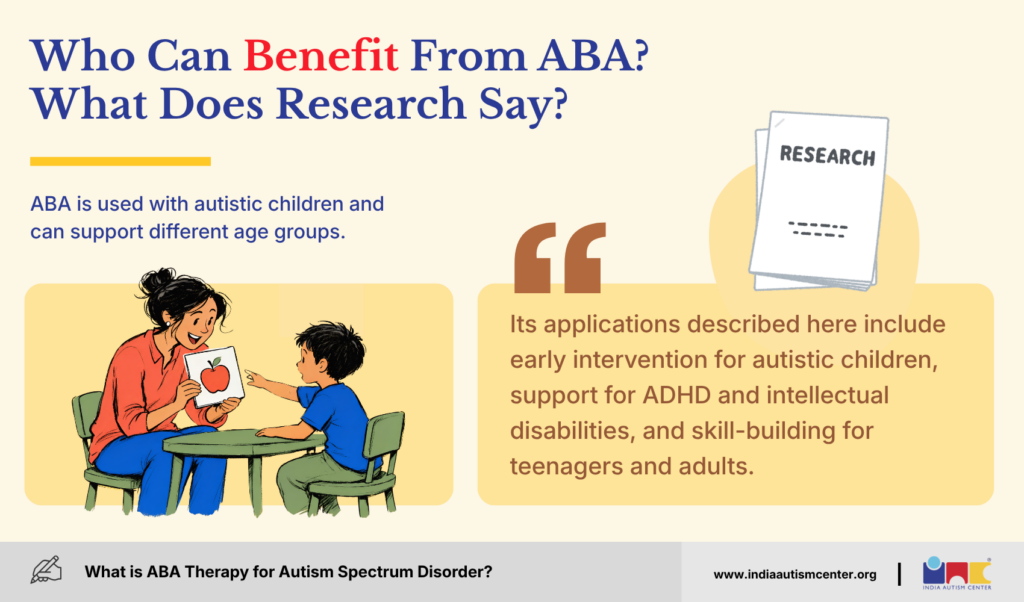
Applied behavior analysis is not exclusively for autism – though applied behavior analysis for autism is its most well-known and extensively researched application.
Children with Autism: The Primary Application
The evidence base for ABA in autism is the strongest of any behavioural intervention. The landmark Lovaas (1987) study found that early, intensive ABA led to significant improvements in language, learning, and adaptive behaviour in young autistic children. Decades of subsequent research have confirmed and refined these findings.
The earlier, the better. The window between ages 2 and 6 is considered optimal for ABA-based early intervention. During these years, the brain’s neuroplasticity is at its peak – meaning it is most responsive to structured learning experiences. Children who begin intensive ABA before age 4 consistently show greater gains in communication and adaptive skills than those who start later. This does not mean ABA is ineffective after age 6 – it absolutely is not – but early intervention changes outcomes in ways that later intervention simply cannot replicate. [LINK: early intervention]
Children and Adults with ADHD and Intellectual Disabilities
ABA is also effective for children with ADHD, where it can help build attention, reduce impulsive behaviour, and establish consistent routines. For individuals with intellectual disabilities or global developmental delays, ABA’s structured, individualised approach allows therapists to work at each person’s pace – building practical life skills without rushing or overwhelming.
Research published in Research in Autism Spectrum Disorders demonstrates meaningful improvements in social interaction and communication for individuals with intellectual disabilities who receive ABA-based support.
Teenagers and Adults
Applied behavior analysis is not just for young children. Teenagers can benefit from ABA-based social skills training, emotional regulation support, and preparation for school inclusion or vocational settings. Adults on the spectrum can use ABA principles to build workplace behaviours, manage daily living tasks more independently, and improve social communication.
The goals look different at different life stages – but the underlying science is the same.
ABA Therapy in India: What Indian Families Need to Know
This is the section most guides skip. Let us be direct about the Indian reality.
Availability of ABA Therapy in India
ABA therapy is available in India, but access is uneven. Major metropolitan cities – Bengaluru, Mumbai, Delhi, Chennai, Hyderabad, Kolkata, and Pune – have a growing number of centres offering ABA-based programming. Smaller cities and rural areas have far fewer options, and many families in these regions rely on online or hybrid programmes.
The scarcity of BACB-certified BCBAs (fewer than 100 in the entire country as of 2025) means that most programmes are delivered by locally trained behaviour therapists. Quality varies significantly between centres. Some are excellent; others are not. The questions listed in the previous section will help you tell the difference.
India Autism Center offers structured ABA-based programming designed specifically for the Indian context – with an emphasis on family involvement, culturally relevant goals, and ongoing progress monitoring. [LINK: India Autism Center ABA services]
Families should ask centres about:
- Package pricing or monthly rates (often more economical than per-session billing)
- Parent training components (which reduce the total hours of paid therapy needed)
- Government schemes – some state governments offer disability support allowances that can partially offset costs
Choosing the Right Residential Care Facility for Autistic Adults: Questions to Ask
Ask about a trial period before signing a long-term contract.
Start with your developmental paediatrician or child psychiatrist. They will often have a referral network of local ABA providers.
Check the BACB’s certification registry; search by country (India) to find any BCBA-certified professionals near you.
Contact autism parent networks – groups like the Autism Society of India or local parent communities on Facebook often maintain updated lists of recommended providers in specific cities.
Visit the centre before committing. Observe a session if possible. Ask to speak with the supervising clinician. Trust your instincts – a good centre will welcome your questions.
What to Consider Before Starting ABA Therapy
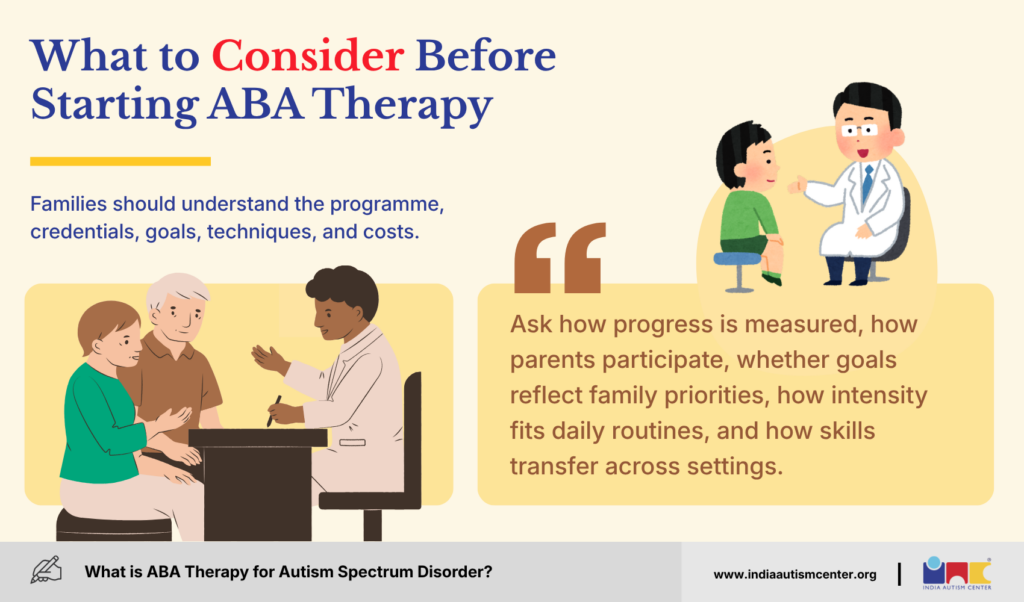
Starting ABA therapy is a significant commitment – of time, money, and emotional energy. Going in with clear eyes makes all the difference.
The debate around applied behavior analysis continues to evolve. Critics have raised important questions about whether ABA, in some implementations, pressures autistic individuals to suppress natural behaviours. These concerns are worth taking seriously. But they are also a reason to choose a good ABA programme – not a reason to avoid ABA altogether. The difference between ethical, modern ABA and outdated, compliance-focused ABA is real, and families can learn to tell them apart.
Before you begin, ask these questions:
- About credentials: Does the programme have a BCBA (or equivalent) supervising the clinical work? Ask for their name and credentials.
- About the assessment: What does the initial assessment involve? How long does it take? What information will it produce?
- About the written plan: Will you receive a written Behaviour Intervention Plan? Can you review and discuss it before therapy begins?
- About progress measurement: How is progress tracked? How often will you receive a written progress report? What happens if a goal is not being met?
- About goals: Are the therapy goals aligned with what matters most to your family right now – not just what the centre typically works on?
- About techniques: What specific strategies will be used with your child? Why are they appropriate for your child’s profile?
- About your role: How will you be trained and involved? Good ABA treats parents as co-therapists, not spectators.
- About intensity and schedule: How many hours per week are recommended? How does this fit with your family’s routine and your child’s stamina?
- About cost and flexibility: What is the total cost? Is there a written contract? What happens if you need to pause or change the programme?
- About generalisation: How will skills be transferred to home, school, and community settings?
One more thing: trust your instincts. If a centre makes you feel like an outsider in your own child’s therapy, find another one.
Conclusion
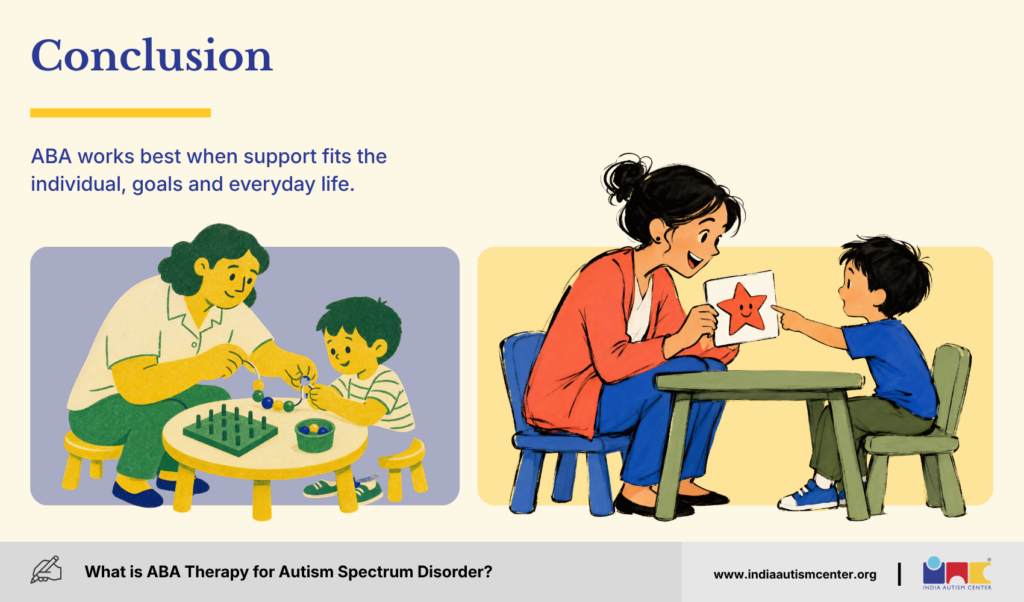
Now you see that the applied behaviour analysis definition is more than just a therapy; it is a way to understand behaviour and make meaningful changes. It is about observing, learning, and building skills that lead to a more independent and, more importantly, a fulfilling life.
Whether it is improving communication, reducing challenging behaviours, or helping someone grow, applied behaviour analysis for adults or children is not age-specific. If you are considering applied behaviour analysis programmes, remember that it is all about what fits the person. Get clear on your goals, stay involved, and trust that with the right approach, change is within reach.
Frequently Asked Questions
What is applied behaviour analysis (ABA)?
Applied behaviour analysis, or ABA therapy for ASD, is a science-based, research-informed approach that studies how behaviour is learned and how it can be positively shaped. It primarily focuses on understanding why certain types of behaviour occur and on developing practical skills that improve communication, independence, and daily functioning.
How does autism spectrum disorder ABA therapy help children?
Autism spectrum disorder ABA therapy helps children build communication, social, emotional, and daily living skills. It reduces frustration by teaching children clearer ways to express needs and cope with changes in routine.
What is the difference between ABA and other behavioural therapies?
Unlike many therapies, applied behaviour analysis therapy is highly data-driven. Progress is measured continuously, and strategies are adjusted based on evidence, ensuring therapy remains personalised and effective.
What are the 7 dimensions of applied behaviour analysis?
The 7 dimensions of applied behaviour analysis are: applied, behavioural, analytic, technological, conceptually systematic, effective, and generality. Together, they ensure ABA is meaningful, measurable, and transferable to real life.
What does an applied behaviour analysis technician do?
An applied behaviour analysis technician works directly with the child or adult who is on the spectrum, delivering therapy sessions under supervision. They help practise skills, record progress, and maintain consistency across sessions.
Can applied behaviour analysis help adults?
Yes. Applied behaviour analysis for adults supports workplace behaviour, independence, social communication, and emotional regulation. Goals are self-directed and respect adult autonomy.
Disclaimer: This article is intended for educational and informational purposes only. It is not a substitute for professional medical advice, diagnosis, or treatment. If you are pregnant or have concerns about medication use during pregnancy, please consult a qualified healthcare provider. If your child has received an autism diagnosis and you have questions about causes or support, please reach out to a trained specialist or an autism-focused organisation for guidance.
For expert insights, support services, and inclusive learning initiatives, visit the India Autism Center.