 Donate now
 Get a Call Back

 MENU
 11 MIN READ
 SHARE


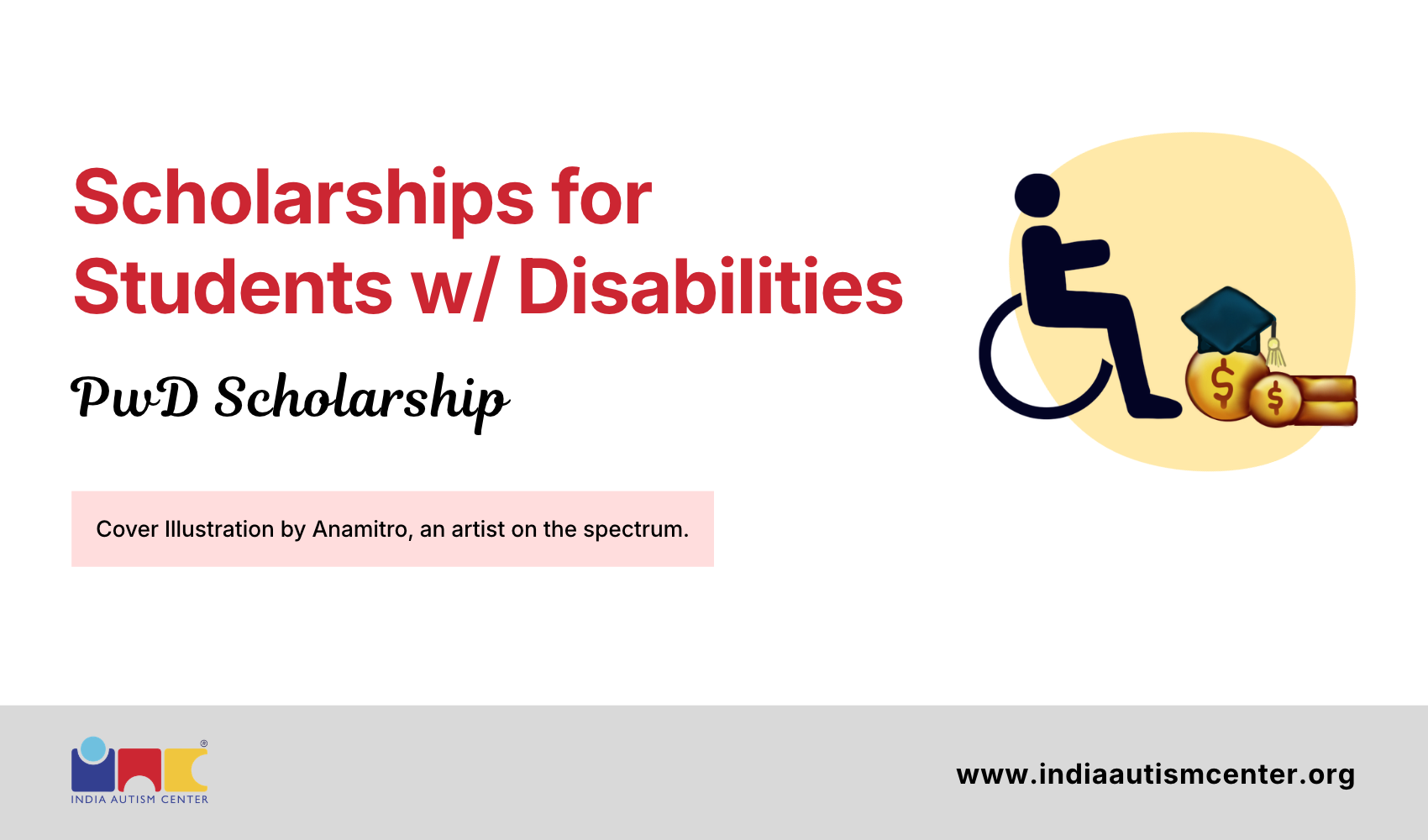
Access to quality education should not depend on a student’s physical, intellectual or developmental abilities or financial circumstances. However, the additional costs associated with assistive devices, accessible learning resources, transport and specialised support can make education challenging for many families.
Under Section 32 of the Rights of Persons with Disabilities (RPwD) Act, 2016, government and government-aided higher education institutions must reserve a minimum of 5% of seats for persons with benchmark disabilities.
Alongside these provisions, several scholarships for students with disabilities help make education more affordable and accessible.
This guide explores the available scholarships, eligibility requirements, financial benefits and application process for students with disabilities in India.
What Are Scholarships for Students with Disabilities?
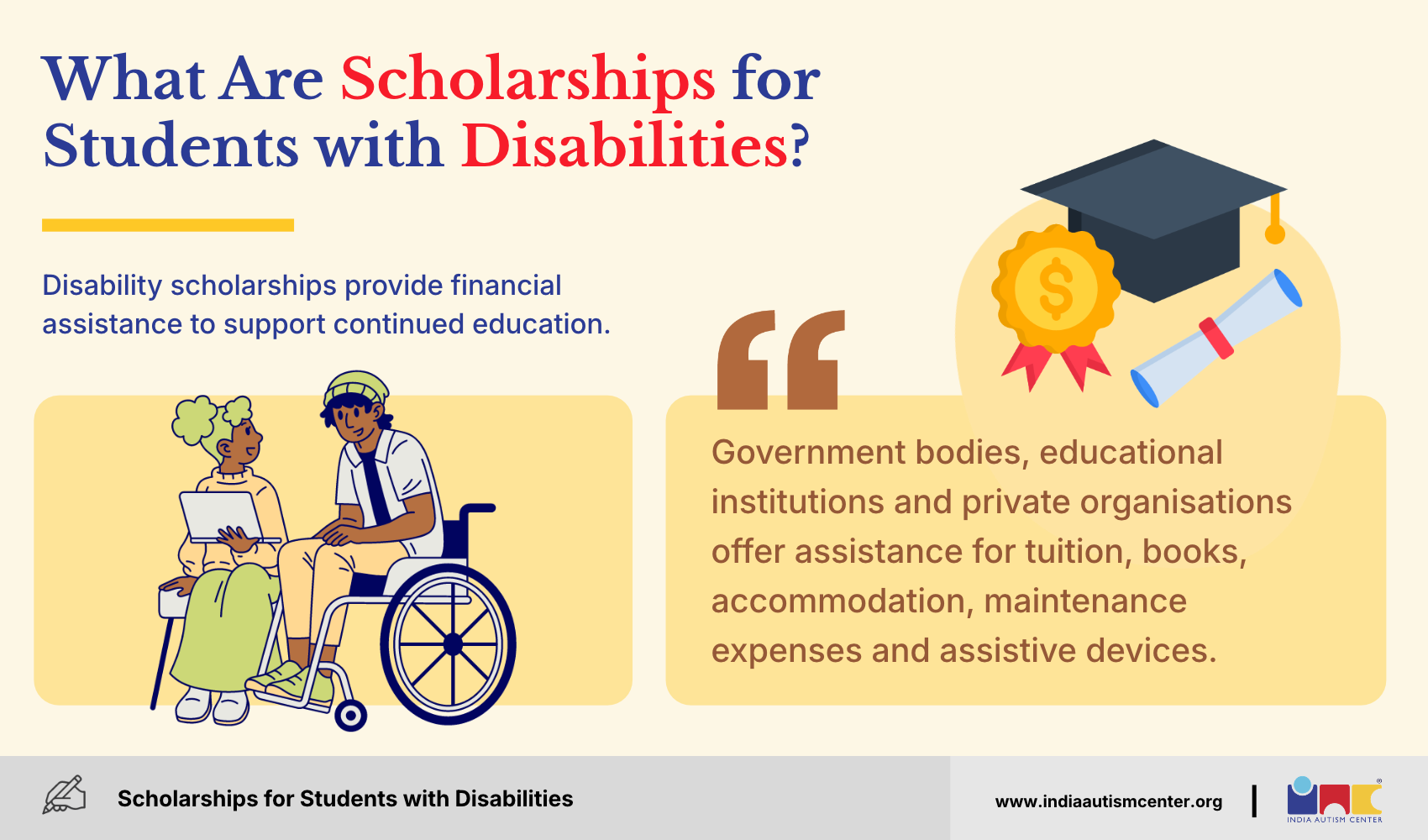
Scholarships for students with disabilities are essentially financial assistance programmes designed to help learners with recognised disabilities continue their education without facing excessive financial pressure. These programmes are offered by the Central Government, State Governments, educational institutions and private organisations.
The assistance may cover tuition fees, admission charges, books, stationery, accommodation, maintenance expenses and assistive devices. Some scholarships support students in secondary education, while others are specifically designed for undergraduate, postgraduate and research programmes.
In India, the Department of Empowerment of Persons with Disabilities (DEPwD), working under the Ministry of Social Justice and Empowerment, administers several government scholarship schemes. These programmes aim to improve access to education and encourage students to pursue their academic and professional goals.
Major Government Scholarships for Students with Disabilities
The Central Government’s umbrella scholarship scheme includes different components based on the student’s educational level and requirements. Here are the main programmes worth exploring.
1. Pre-Matric Scholarship for Students with Disabilities
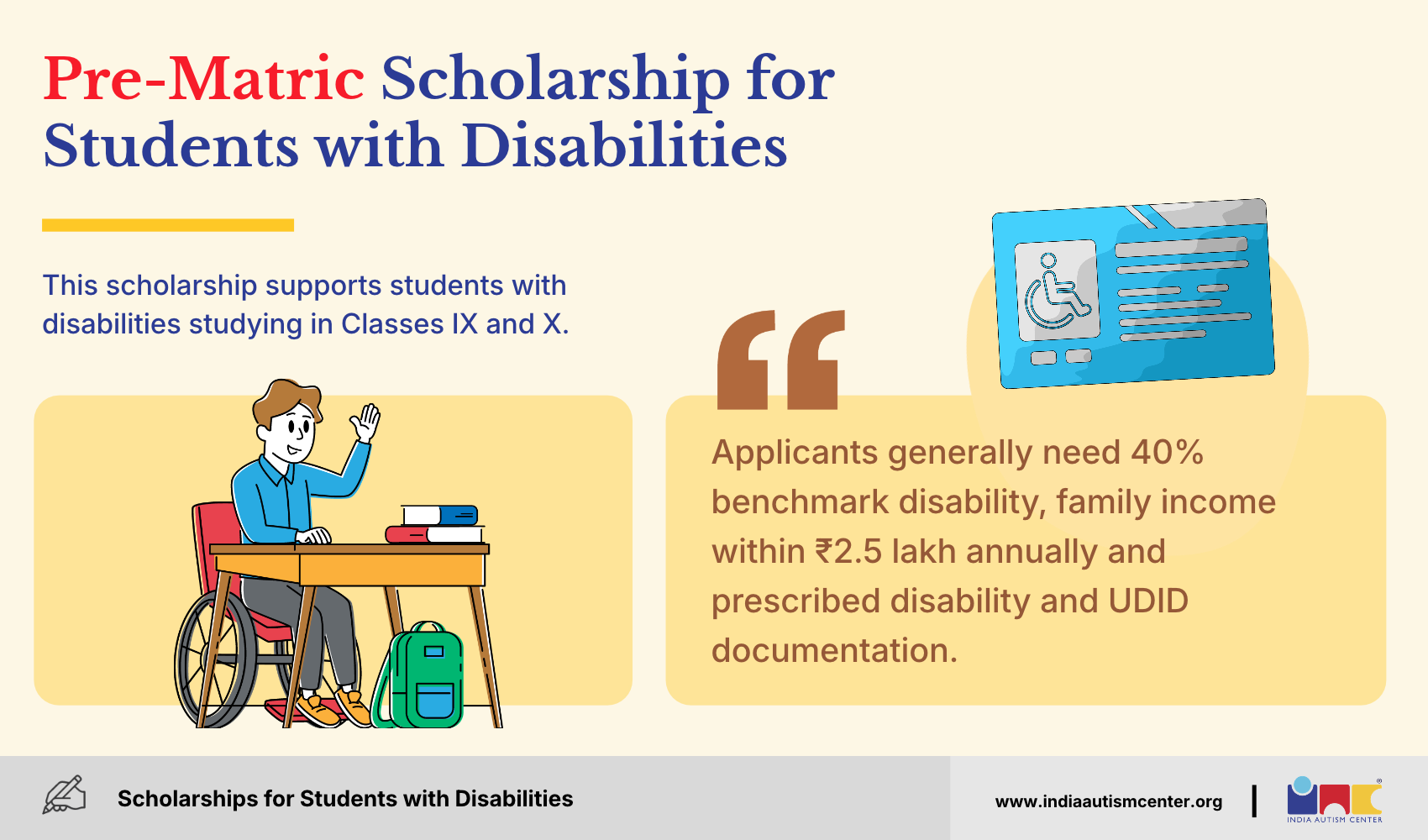
This scholarship supports students studying in Classes IX and X. Its primary objective is to reduce the financial burden of secondary education and prevent students from discontinuing their studies.
Eligibility:
- The applicant must be an Indian citizen with at least a 40% benchmark disability.
- The student must be enrolled in Class IX or X in a recognised school.
- Annual family income must not exceed ₹2.5 lakh.
- A valid disability certificate and prescribed Unique Disability ID (UDID) documentation are required.
- The applicant must satisfy the scheme’s conditions regarding other scholarships or stipends.
Financial assistance:
| Benefit | Day Scholar | Hosteller |
|---|---|---|
| Monthly maintenance allowance | ₹500 | ₹800 |
| Annual book grant | ₹1,000 | ₹1,000 |
| Disability allowance | ₹2,000–₹4,000 annually | ₹2,000–₹4,000 annually |
The disability allowance depends on the prescribed disability category. Students with visual impairment or intellectual disabilities receive ₹4,000 annually, while those in other eligible disability categories receive ₹2,000.
2. Post-Matric Scholarship for Students with Disabilities
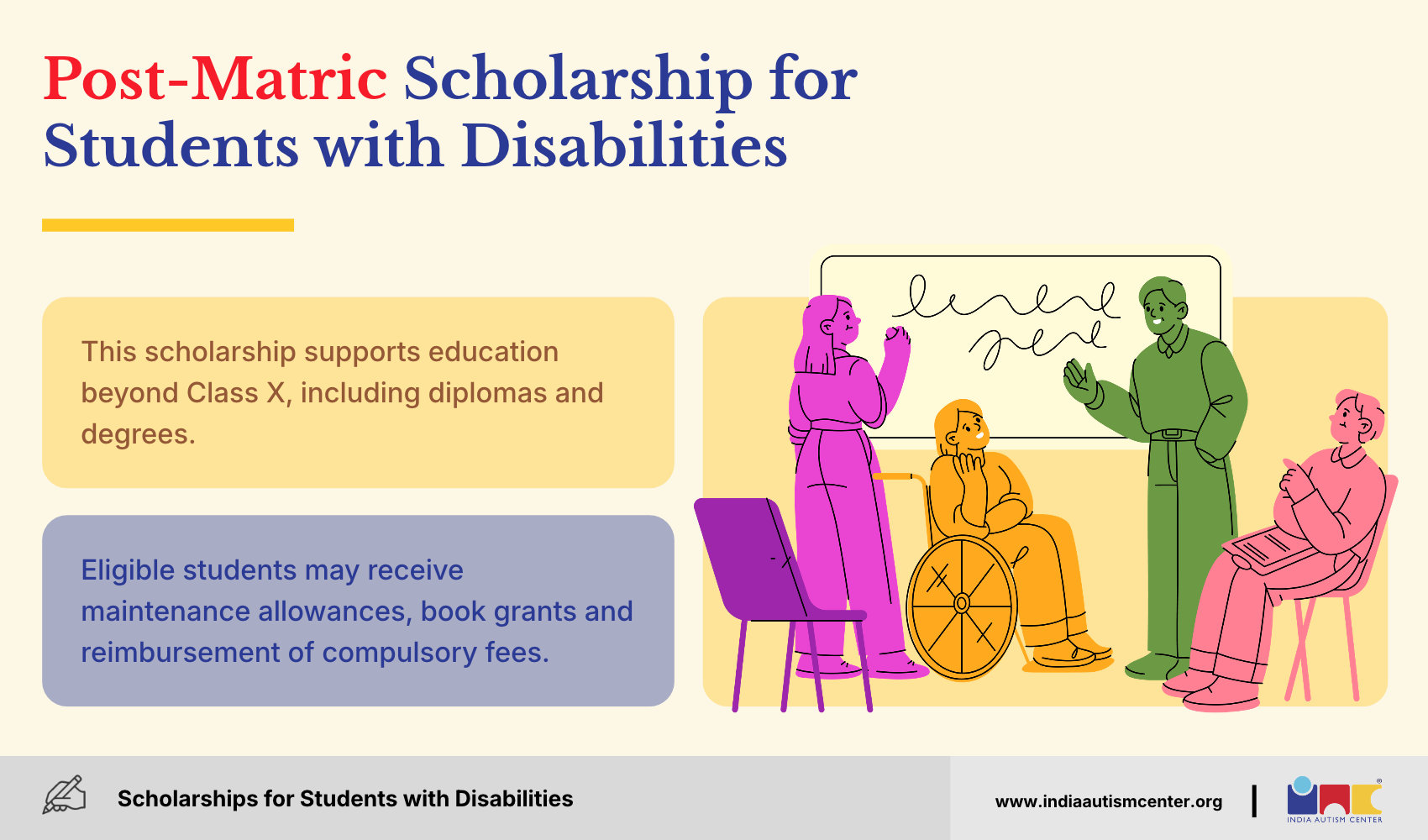
The Post-Matric Scholarship supports students pursuing education after Class X. It covers Classes XI and XII, recognised diploma programmes, undergraduate degrees and postgraduate courses.
Eligibility:
- The applicant must be an Indian citizen with a disability of at least 40%.
- The student must be enrolled in an eligible recognised course.
- Annual family income must not exceed ₹2.5 lakh.
- The applicant must have the prescribed disability and UDID documentation.
- Other scholarship and stipend restrictions apply.
Financial assistance:
- Monthly maintenance allowance of ₹750 for day scholars and ₹1,600 for hostellers.
- Annual book allowance of ₹1,500.
- Disability allowance of ₹2,000–₹4,000 annually, depending on the disability category.
- Reimbursement of eligible compulsory non-refundable fees, subject to a prescribed annual ceiling of ₹1.5 lakh.
This scheme is particularly useful for students planning to pursue higher secondary education, professional diplomas or university degrees.
3. Top Class Education Scholarship for Students with Disabilities
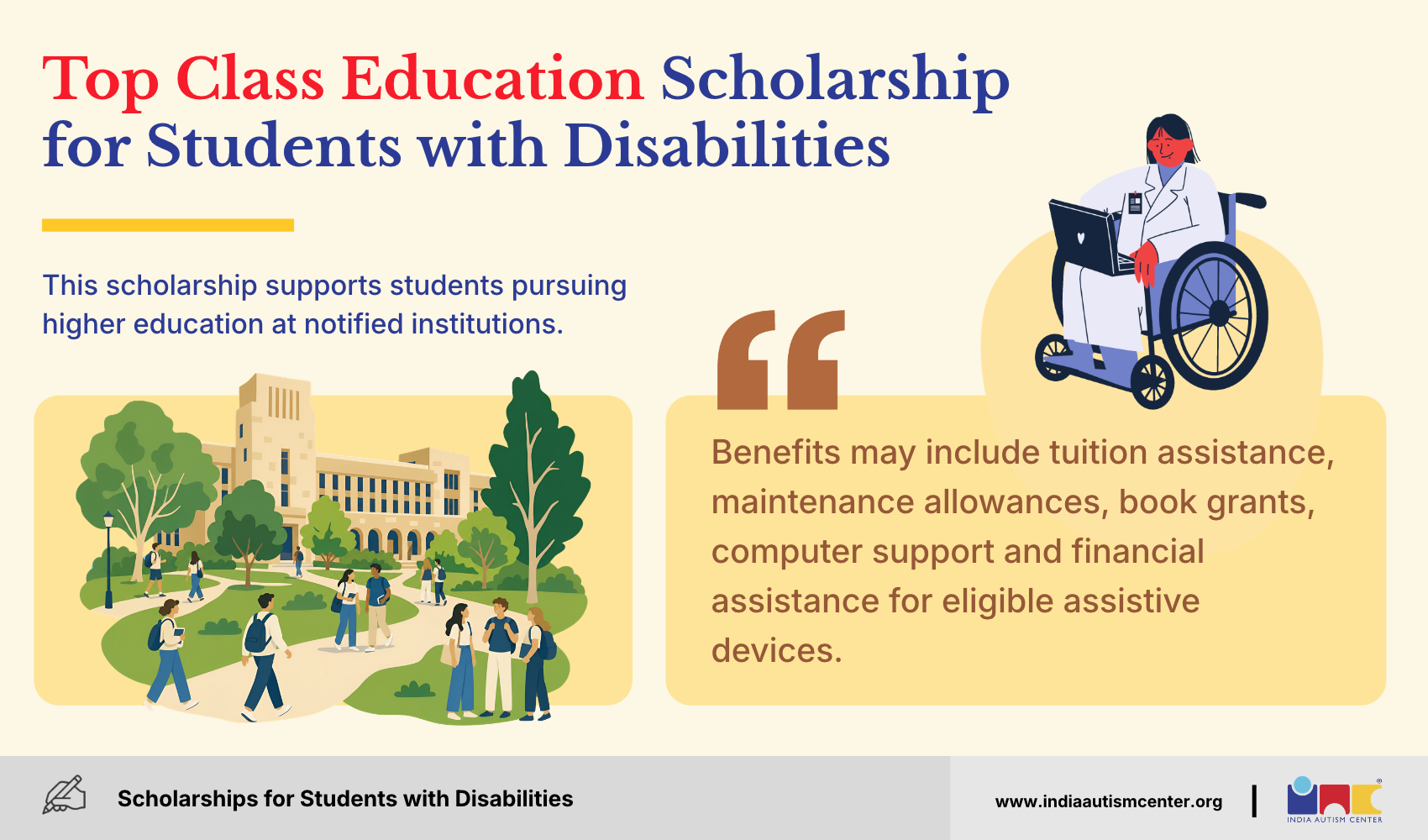
Students seeking admission to higher education can explore the Top Class Education Scholarship. It supports eligible students enrolled in graduate, postgraduate and diploma programmes at institutions notified under the scheme.
Eligibility:
- The applicant must be an Indian citizen with at least a 40% benchmark disability.
- The annual income of the family must not exceed ₹8 lakh.
- The applicant must secure admission at an institution notified under the scheme.
- Prescribed UDID and disability documentation must be available.
- The applicant must meet conditions related to other scholarships and stipends.
Financial assistance includes:
- Tuition and admission fee support of up to ₹2 lakh annually.
- Monthly maintenance allowance of ₹1,500 for day scholars and ₹3,000 for hostellers.
- Special disability allowance of ₹2,000 per month.
- Books and stationery allowance of ₹5,000 annually.
- One-time assistance of up to ₹45,000 for a computer.
- Assistance of up to ₹30,000 for eligible aids and assistive devices.
This is one of the important disability scholarships for college students, particularly those pursuing higher education at selected institutions.
4. National Fellowship for Persons with Disabilities
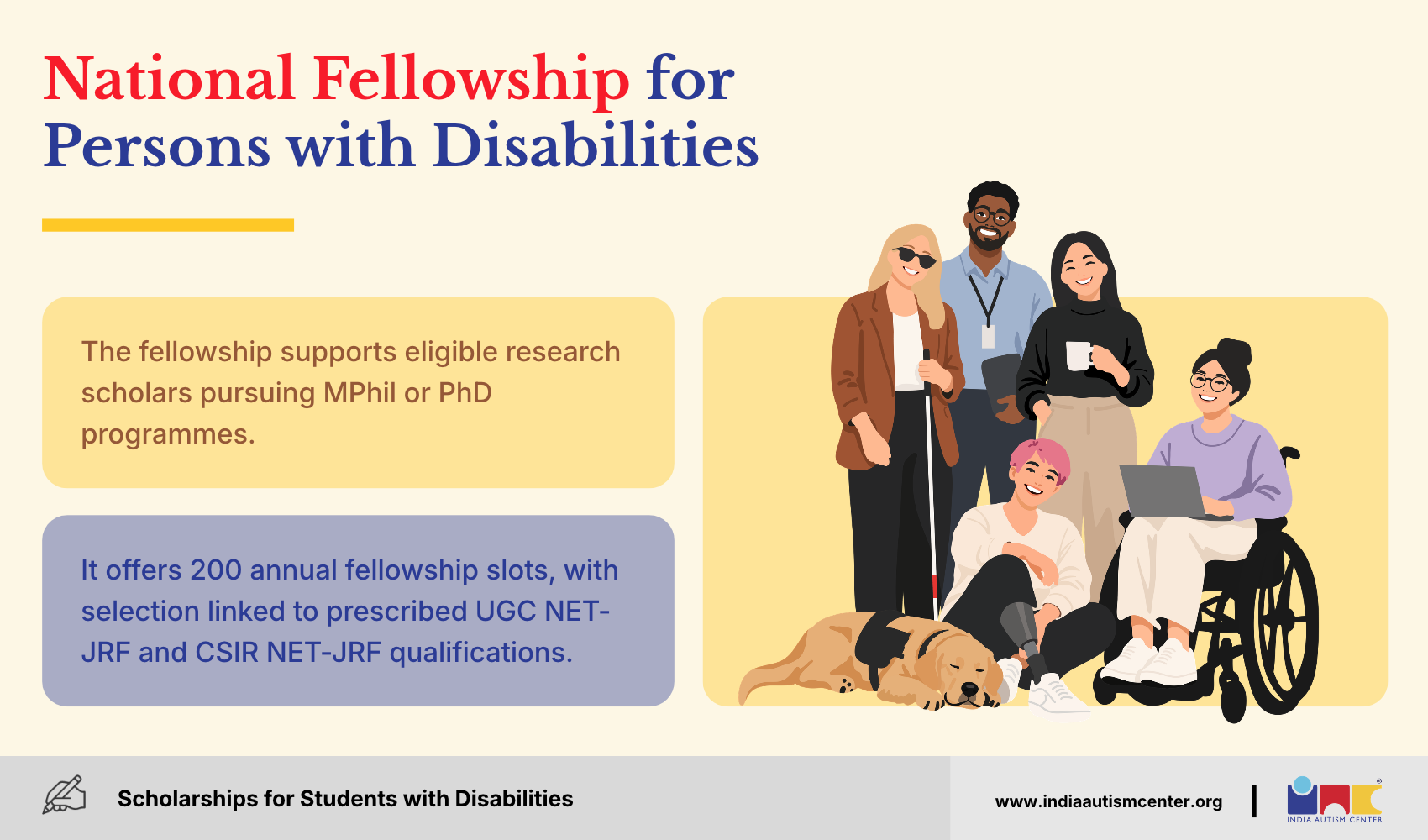
Students interested in academic research can explore the National Fellowship for Persons with Disabilities (NFPwD). The programme supports eligible candidates pursuing research leading to an MPhil or PhD at Indian universities, subject to the applicable University Grants Commission (UGC) regulations and scheme guidelines.
The scheme provides fellowship assistance to selected research scholars. It has 200 fellowship slots annually, with selection linked to the prescribed UGC National Eligibility Test (NET) Junior Research Fellowship and Council of Scientific and Industrial Research (CSIR) NET-JRF qualifications.
Unlike the pre-matric and post-matric scholarships, the National Fellowship does not have a family income ceiling under the published scheme framework. Applicants must check the latest selection, admission and disability certification requirements before applying.
5. National Overseas Scholarship for Students with Disabilities
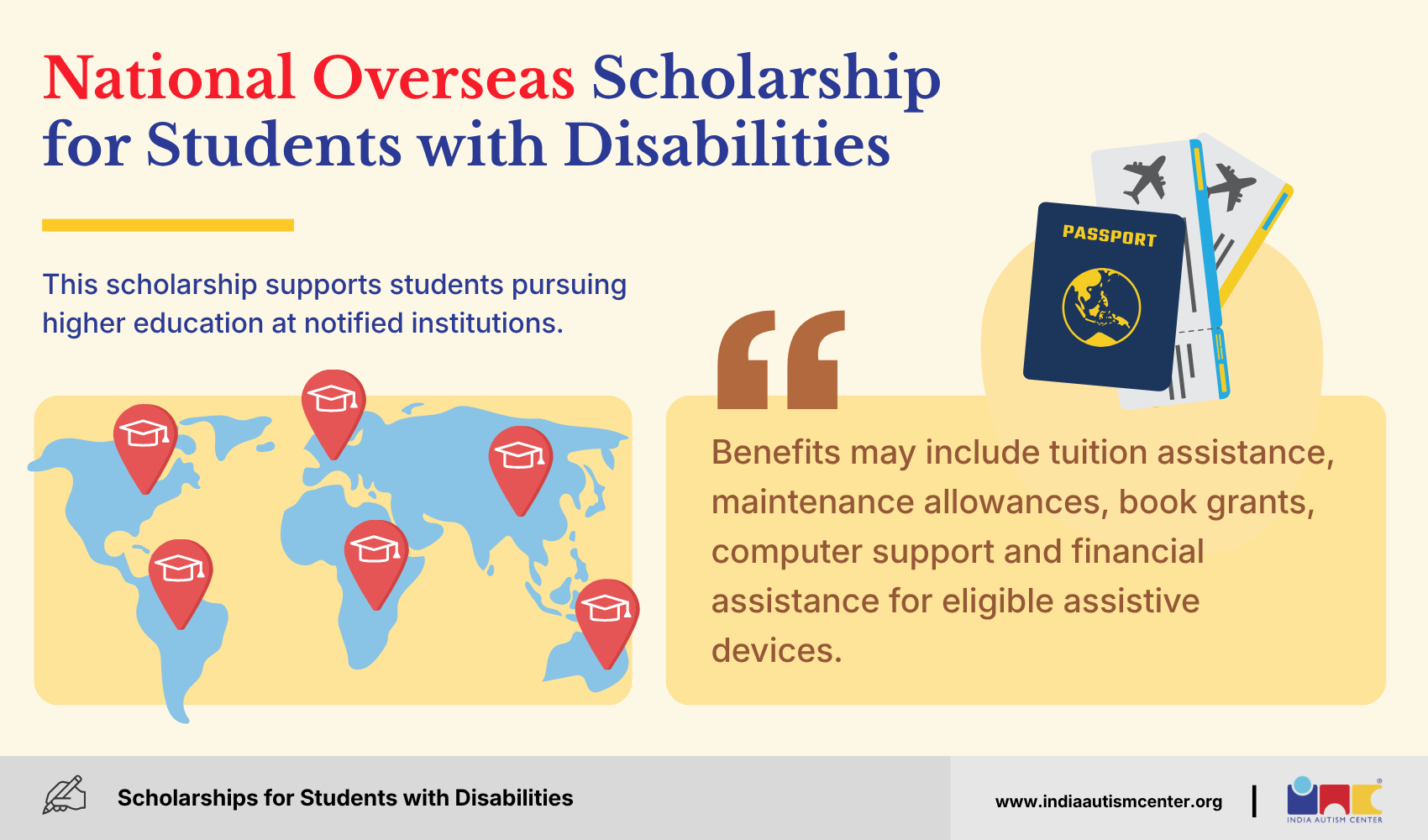
Students planning to pursue higher education abroad can explore the National Overseas Scholarship. It supports eligible students undertaking Master’s degree or PhD programmes at recognised foreign universities in approved fields.
Depending on the applicable guidelines, financial assistance may cover tuition fees, maintenance expenses, contingency allowances and other approved costs.
Applicants must meet the prescribed disability, academic, family income and admission requirements. Since overseas scholarship conditions and selection procedures can change, students should refer to the latest DEPwD notification before applying.
Other Financial Assistance for Disabled Students in India
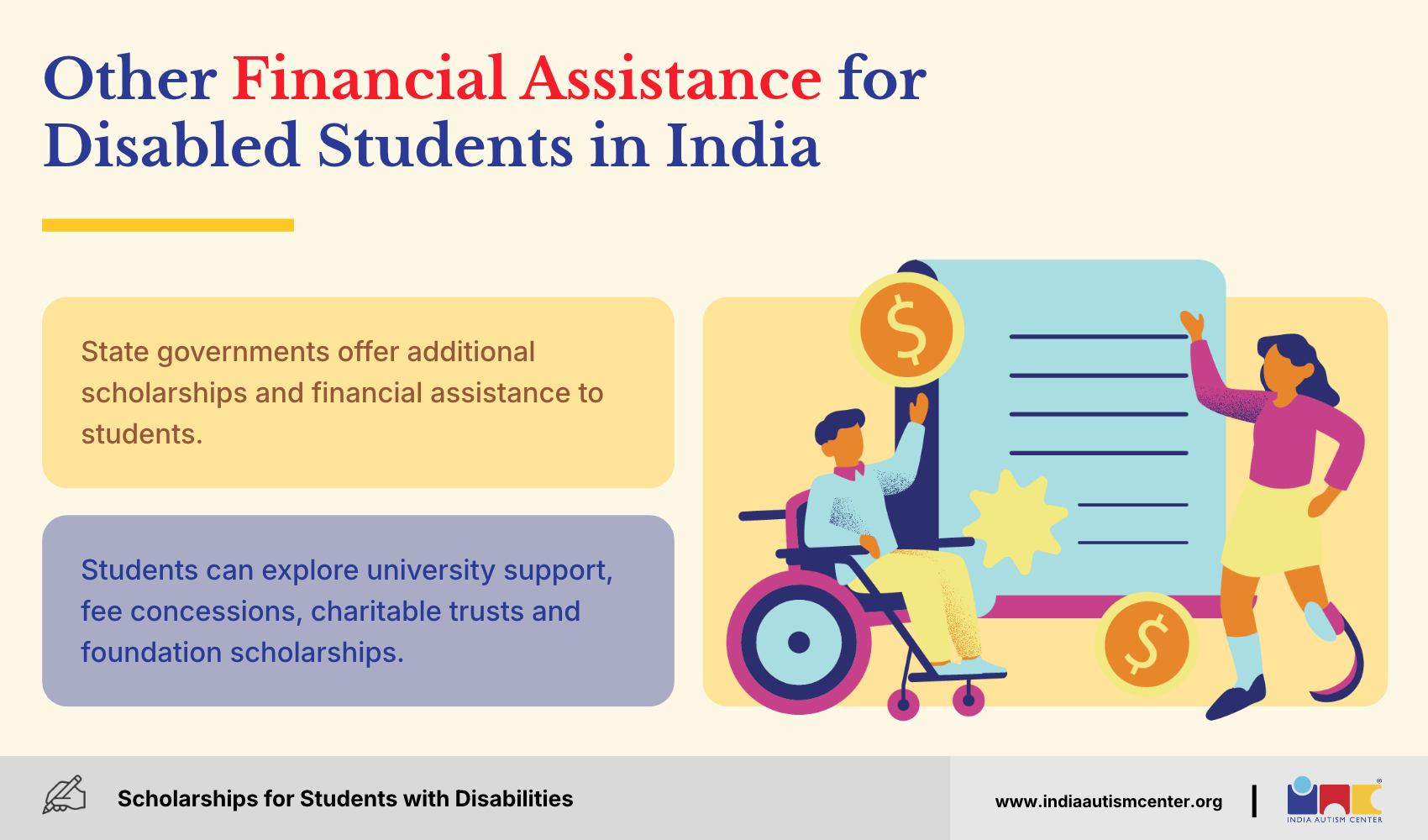
Apart from Central Government schemes, students should explore state-level scholarships and assistance programmes. These are particularly useful because eligibility requirements and benefits can differ across states.
For instance, Maharashtra offers a State Pre-Matric Scholarship for Disabled Persons. Eligible students studying in Classes I to X can explore this scheme through the state’s disability welfare department.
Students can also enquire about:
- State government post-matric scholarships.
- Financial assistance offered by universities and colleges.
- Fee concessions and education support from charitable trusts.
- Private foundation scholarships for students with disabilities.
- Institutional support for assistive technology and accessible learning resources.
These options can provide additional financial assistance for disabled students in India, depending on the student’s location, educational level and eligibility.
Who Is Eligible for a PwD Scholarship in India?
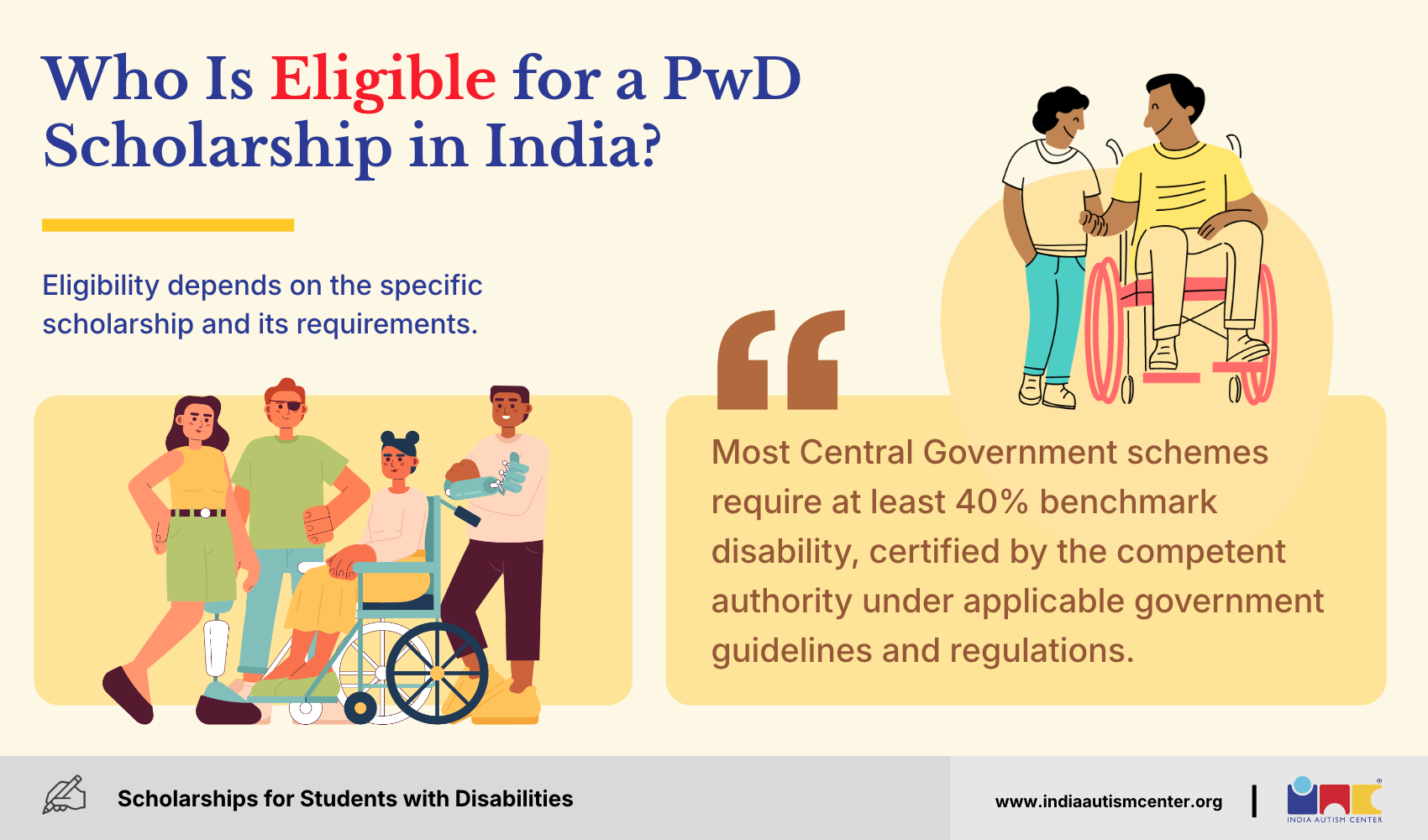
The eligibility for PwD scholarship programmes depends on the individual scheme. However, most Central Government scholarships for students with disabilities require applicants to have at least a 40% benchmark disability.
Under the RPwD Act, 2016, benchmark disability refers to a specified disability assessed at 40% or more, as certified by the competent authority.
The Act recognises 21 specified disabilities, including:
- Autism Spectrum Disorder (ASD)
- Intellectual disability
- Specific learning disabilities, including dyslexia
- Cerebral palsy
- Blindness and low vision
- Hearing impairment
- Locomotor disability
- Speech and language disability
- Multiple disabilities
- Mental illness
A diagnosis alone does not automatically establish scholarship eligibility. For example, a student with autism or Attention Deficit Hyperactivity Disorder (ADHD) must meet the applicable disability assessment and certification requirements.
ADHD is not separately listed among the 21 specified disabilities, so a diagnosis should not be assumed to qualify a student for a benchmark-disability scholarship.
How to Apply for Scholarships for Students with Disabilities?
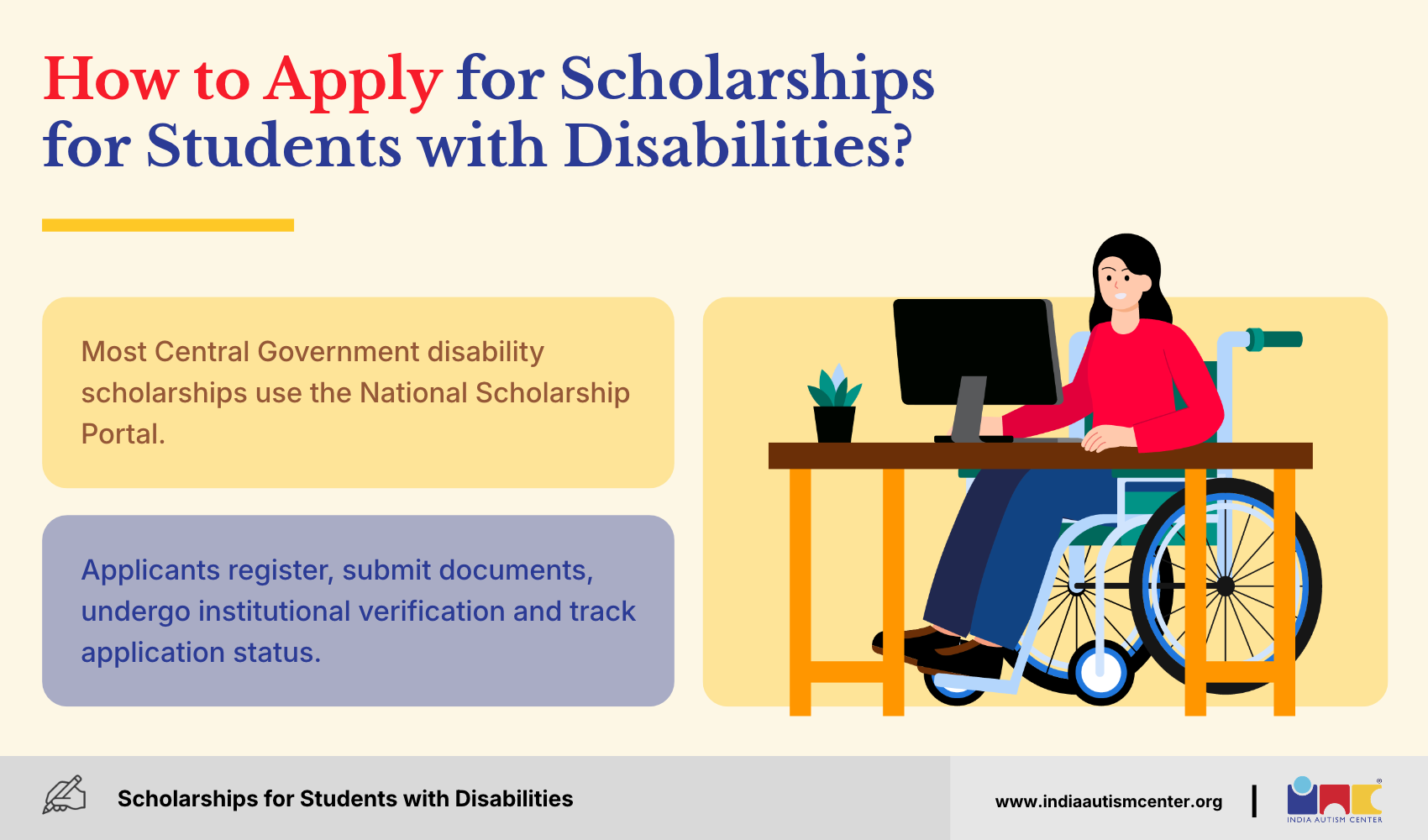
Most Central Government scholarships for students with disabilities are available through the National Scholarship Portal (NSP). The application process usually includes the following steps:
1. Identify the right scholarship: Visit the NSP and check the schemes listed under the Department of Empowerment of Persons with Disabilities. Choose the programme that matches the student’s current educational level.
2. Complete One-Time Registration (OTR): Register on the portal using the prescribed identity verification process. An OTR number is generated for scholarship applications.
3. Fill in the application form: Provide accurate personal, academic, disability and bank account details. Make sure that the information matches the supporting documents.
4. Upload the required documents: Submit the disability certificate, UDID details, income certificate, academic records and other documents requested under the scheme.
5. Complete institutional verification: The application is checked by the educational institution and designated government authorities. Students should follow up if any information or document needs correction.
6. Track the application: Regularly check the application status on the portal. Once approved, scholarship payments are generally transferred through Direct Benefit Transfer (DBT), using the Public Financial Management System (PFMS).
Application deadlines differ by scheme and academic year. Students should check the NSP for the latest opening dates, closing dates and verification deadlines.
How Can Students Improve The Chances of Receiving a Scholarship?
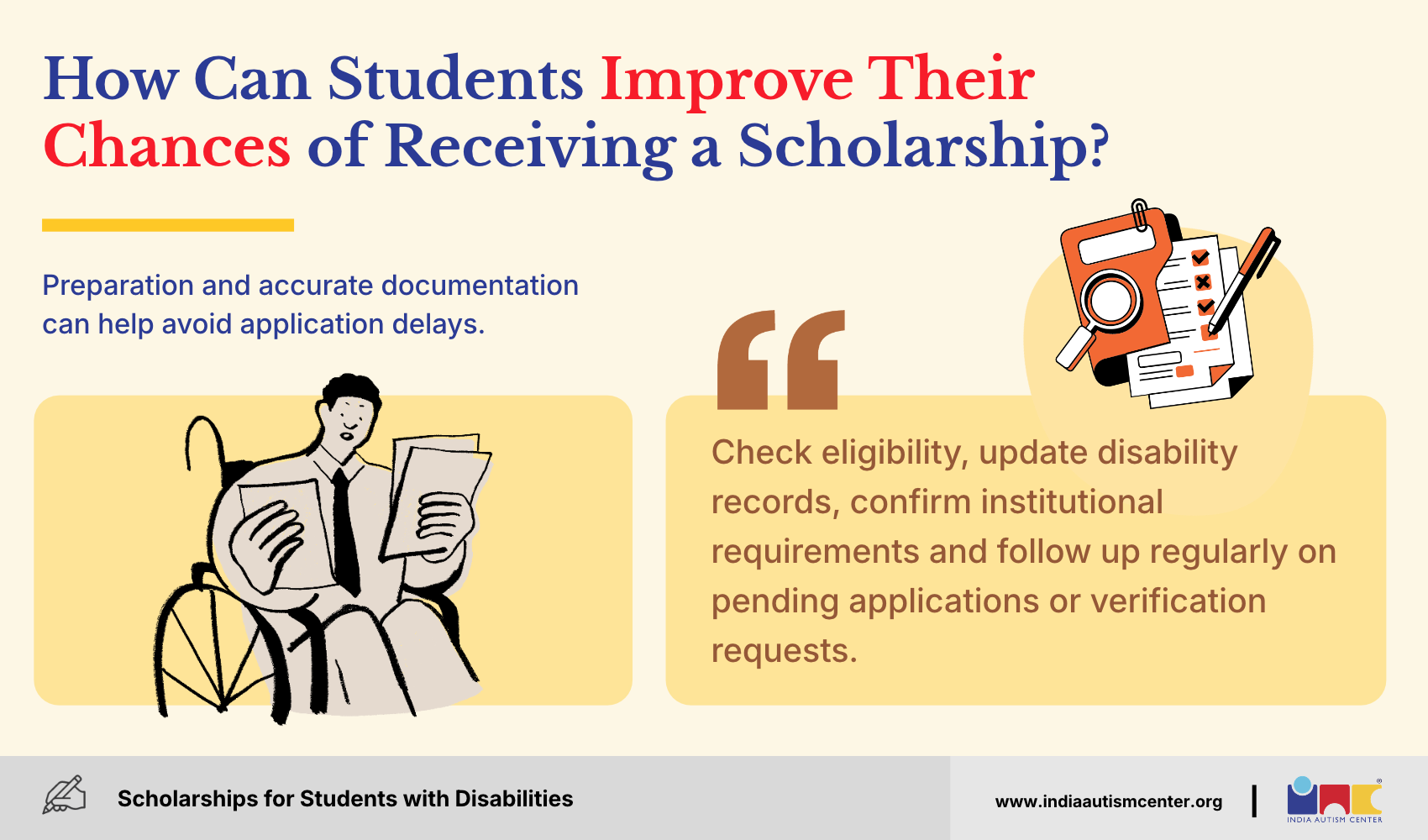
Meeting the primary eligibility requirements is the first step. Students and parents should also pay attention to the application process in order to avoid unnecessary delays or rejection.
A few practical steps can help:
- Apply early: Starting the application process before the deadline gives families enough time to arrange documents and complete verification.
- Keep disability records updated: Ensure that the disability certificate and UDID information are accurate and meet the scheme requirements.
- Check institutional eligibility: Some scholarships are restricted to students admitted to notified institutions. Confirm this before accepting admission.
- Understand the financial conditions: Check family income limits, fee reimbursement ceilings and restrictions on receiving multiple scholarships.
- Follow up regularly: Contact the school, college or relevant department if the application remains pending or requires clarification.
Parents can also help students identify suitable courses, accessible institutions and available educational support. This is particularly important for learners who may require additional assistance with communication, academic participation or daily activities.
Why Is Inclusive Education Important Alongside Financial Assistance?
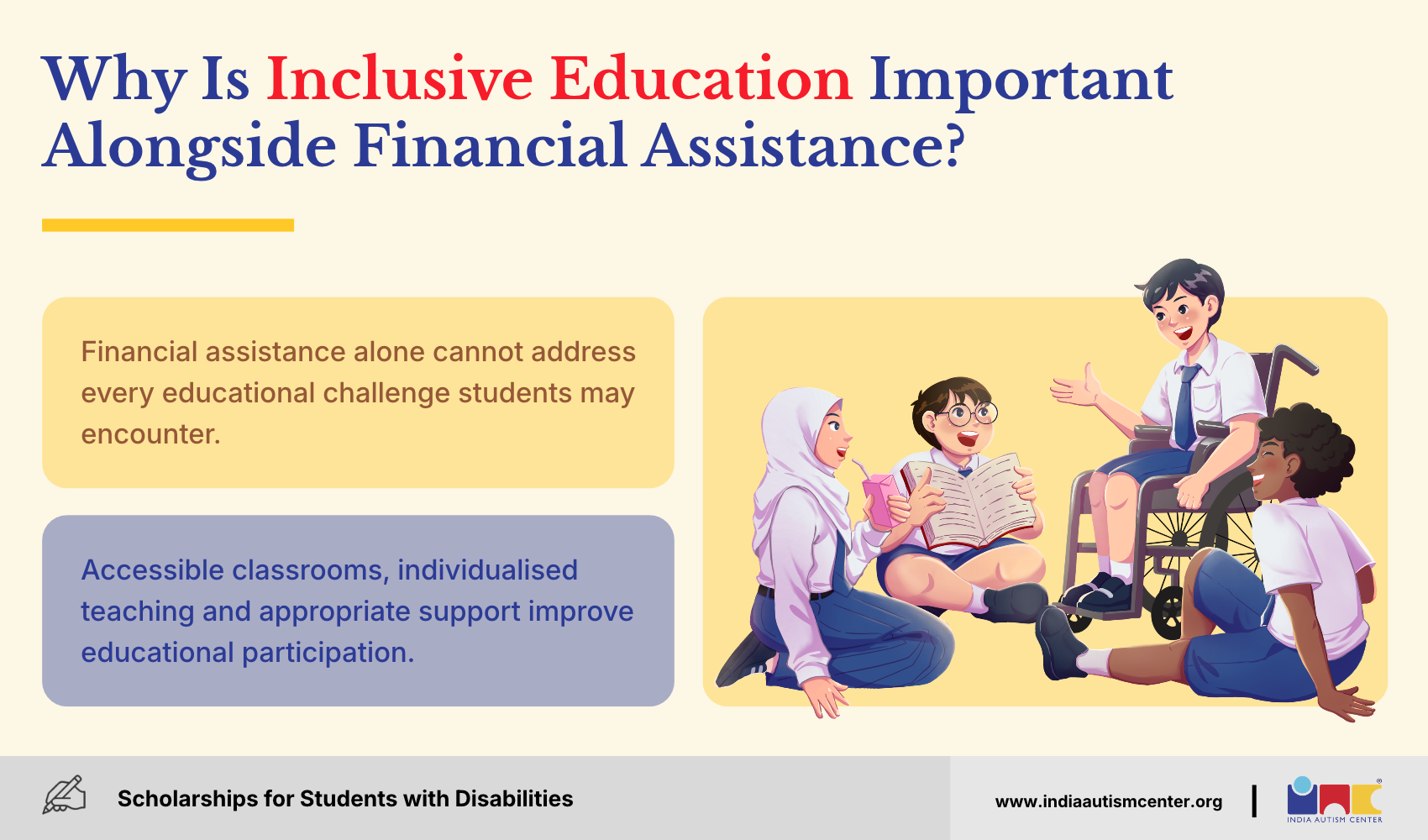
Scholarships can reduce educational expenses, but financial support alone cannot address every challenge a student with a disability may face.
For example, students with ASD may benefit from structured learning environments, predictable routines and appropriate communication support. Those with dyslexia may require accessible reading materials and specialised teaching strategies. Students with ADHD may benefit from classroom adjustments that support attention, organisation and task management.
Understanding individual learning requirements is therefore essential. Parents and educators can explore areas such as inclusive education, sensory processing and speech and language therapy to understand the different forms of support that may improve educational participation.
The Rights of Persons with Disabilities Act (RPwD), 2016, also requires educational institutions to provide inclusive education and reasonable accommodation. Section 32 specifically provides for at least 5% reservation in government and government-aided higher education institutions for persons with benchmark disabilities.
Access to appropriate autism therapies, early intervention and individualised educational support can further help learners develop their abilities and participate more confidently in academic environments.
How India Autism Center Supports Individuals with Autism and Their Families
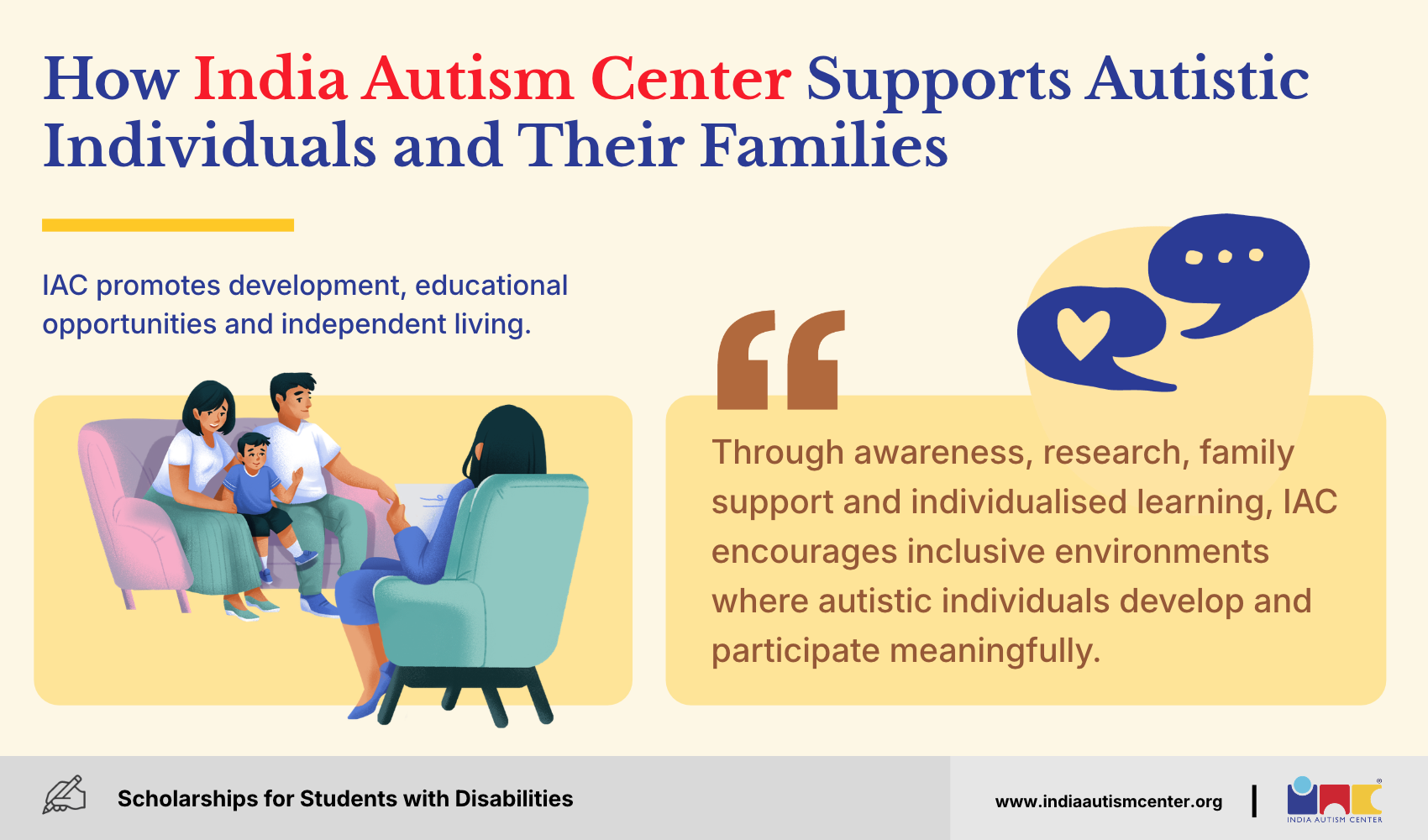
At India Autism Center (IAC), we recognise that access to education, appropriate developmental support and opportunities for independent living are essential for individuals with autism.
Financial assistance can help families manage educational expenses, while awareness of autism, early intervention and individualised learning approaches can address different developmental and educational needs. We believe every individual deserves opportunities to learn, develop necessary life skills and participate meaningfully in society.
Through awareness, research, family support and a commitment to inclusive environments, India Autism Center aims to contribute towards a society where individuals on the autism spectrum can access the opportunities and support they need to thrive.
Conclusion
Scholarships for students with disabilities can make education more accessible by reducing financial barriers and creating opportunities for academic and professional growth. From secondary education scholarships to postgraduate assistance and research fellowships, several government programmes meet different educational needs.
Students and parents should understand eligibility requirements, keep disability documentation current and regularly check official portals for application updates. Combining financial assistance with accessible learning environments and appropriate educational support can help students with disabilities pursue their aspirations with greater confidence.
Frequently Asked Questions
1. What are the best scholarships for students with disabilities in India?
Major options include the Pre-Matric Scholarship, Post-Matric Scholarship and Top Class Education Scholarship, administered by the Department of Empowerment of Persons with Disabilities. Research students can also explore the National Fellowship for Persons with Disabilities.
2. Who is eligible for a PwD scholarship in India?
Most Central Government disability scholarships require applicants to be Indian citizens with at least 40% benchmark disability. Other conditions may include family income limits, academic qualifications, admission to a recognised institution and valid disability documentation.
3. Can students with autism apply for disability scholarships?
Yes. Autism Spectrum Disorder is one of the 21 specified disabilities recognised under the RPwD Act, 2016. However, students generally need an officially assessed benchmark disability of at least 40% to qualify for the Central Government schemes discussed above. Other scheme-specific conditions also apply.
4. Can students with ADHD apply for scholarships for disabled students?
Students with ADHD may explore relevant educational assistance programmes. However, ADHD diagnosis alone does not automatically establish eligibility for government PwD scholarships. Applicants must meet the applicable disability assessment and certification requirements.