 Donate now
 Get a Call Back
 MENU
MENU 11 MIN READ
 SHARE
SHARE


As per the latest records, there are more than 2.68 crore disabled persons. Even when the number is so huge, awareness of available support remains significantly low. It has also been found that over 42% of eligible persons with disabilities do not apply for government benefits simply because they are unaware of the schemes.
These facts make one thing for sure: The families of disabled persons are not always lacking support; they are, in reality, lacking access to information.
Whether you’re a caregiver of a child with autism, someone with a locomotor disability, or an adult seeking financial independence, this guide ensures that you not only know the schemes but also fully understand how they can improve your daily life.
Today, we will provide a detailed, up-to-date list of government schemes for persons with disabilities in India.
The Complete List of Government Schemes for Disabled Persons in India (2026)
Finding the right support for disability can be quite overwhelming. Several disabled persons and their families are missing out on available government support. This updated list of government schemes for persons with disabilities in India (2026) brings together all major welfare initiatives.
Especially when you are the parent or a primary caregiver of a kid who has autism spectrum disorder, an adult with a disability, or a caregiver who is looking for proper guidance, this guide simplifies the landscape so you can finally understand and claim the support you deserve.
1. NIRAMAYA Health Insurance Scheme – Healthcare Safety Net
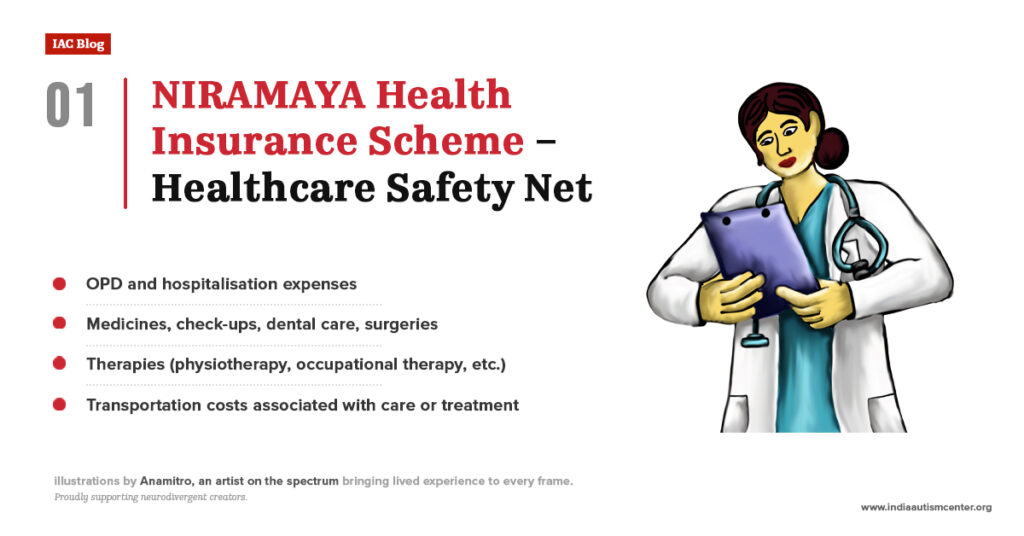
When it comes to support for people with disabilities, health insurance is more than just an option; it is a necessity, a health insurance scheme exclusively for PwDs that provides coverage for a wide variety of medical needs.
There is no need for pre-insurance medical tests. Irrespective of age or disability type, there is only one time premium. This ensures that medical emergencies don’t become financial disasters.
What the Scheme Covers:
- OPD and hospitalisation expenses
- Medicines, check-ups, dental care, surgeries
- Therapies (physiotherapy, occupational therapy, etc.)
- Transportation costs associated with care or treatment
Who Can Apply:
Persons with disabilities (autism, cerebral palsy, intellectual disability, multiple disabilities) with a valid disability certificate and UDID/enrollment number.
2. VIKAAS Daycare Scheme – Daytime Care, Therapy & Skill Building
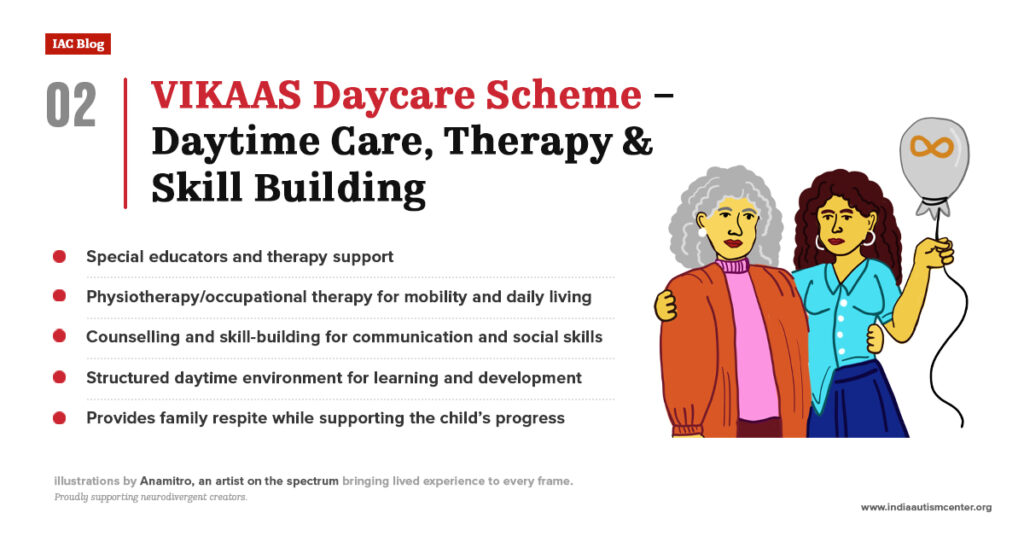
Besides early intervention, children with disabilities can benefit from schemes like day care. There are daycare centres run by certified organisations that aim to provide therapy, education, and social & life-skills training during daytime hours.
For families seeking assistance for disabled persons while balancing other responsibilities, VIKAAS ensures children get needed support without needing full-time institutionalisation.
What the Scheme Covers:
- Special educators and therapy support
- Physiotherapy / occupational therapy for mobility or daily-living support
- Counselling & skill-building to improve communication, daily living, and social skills
- Structured environment for growth and learning during the day hours
- Gives family members respite while ensuring the child’s growth and learning
Who Can Apply:
Children/young persons (10+ years), with autism, cerebral palsy, intellectual disability, or multiple disabilities. The applicant mustn’t already be enrolled in other residential schemes such as GHARAUNDA or SAMARTH.
3. GHARAUNDA (Group-Home for Adults) – Long-Term Care & Support
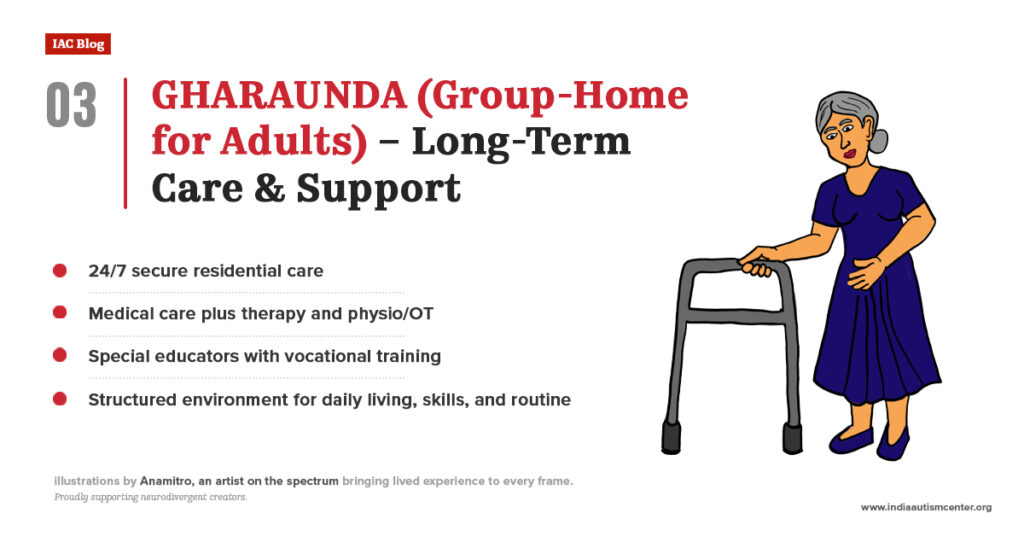
GHARAUNDA is a scheme that provides a safe, lifelong group home for adults with disabilities under the umbrella of the relevant national disability legislation.
It is one of the most stable government facilities for disabled persons, ensuring long-term inclusion, dignity, and independence for adults who may not be able to live independently.
What the Scheme Covers:
- Secure residential home providing 24/7 care.
- Access to medical care, therapy, physiotherapy/occupational therapy.
- Special educators, vocational/pre-vocational training for skill development.
- A structured, supportive environment that helps people build daily living and vocational skills, social interaction, and meaningful routine.
Who Can Apply:
Adults (18+ years) with disabilities such as autism, cerebral palsy, intellectual disability, including intellectual retardation, or multiple disabilities.
4. SAMARTH Respite & Residential Care – Temporary Shelter and Support
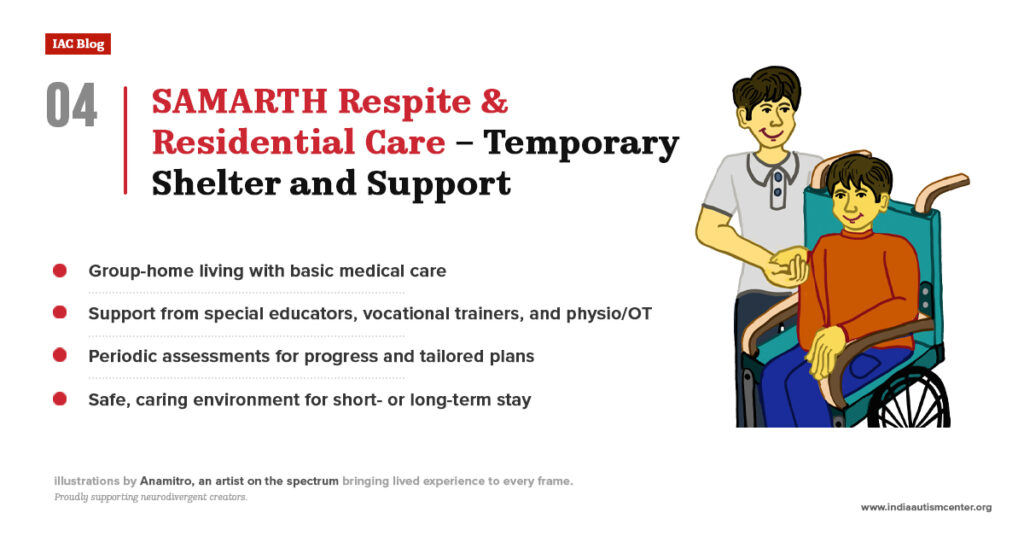
SAMARTH aims to offer residential or respite care and assistance for disabled persons; it is particularly helpful for orphans, abandoned persons, PwDs from low-income backgrounds, or families in crisis. It serves as a critical government facility for people with disabilities, offering meaningful respite, especially when family support is absent or temporary relief is needed.
What the Scheme Covers:
- Group-home style living with basic medical care
- Support from special educators, vocational trainers, therapists (physio / occupational) to improve physical functionality and daily-living skills
- Periodic assessments can help to monitor progress and offer tailored support plans
- Safe, caring environment for those needing temporary or long-term residential support
Who Can Apply:
Persons with autism, cerebral palsy, or other disabilities, as per the relevant disability act, especially those not under other long-term or daycare schemes for disabled people in India, such as Disha, Vikaas, or Gharaunda scheme, are at the same time.
5. Deendayal Disabled Rehabilitation Scheme (DDRS) – Rehabilitation & Inclusion Funding

This is a flagship centrally sponsored program that aims to support NGOs/voluntary organisations that work for PwDs. DDRS helps build infrastructure and services for rehabilitation and inclusion through financial grants and other forms of aid.
By funding grassroots organisations, DDRS strengthens the network of government facilities for people with disabilities across the country, thereby increasing reach, quality, and sustainability.
What the Scheme Covers:
- Establishment and maintenance of special schools, vocational training centres
- Early intervention centres for children with developmental delays
- Infrastructure improvements (ramps, toilets, and other accessible facilities) are made in disability-support institutions.
- Rehabilitation services: therapy, counselling, skill training, inclusion programmes
- Community-based rehabilitation and inclusive social initiatives
Who Can Apply:
NGOs must be registered under the PwD Act/Trusts Act/Societies Act and must have at least 2 years of experience delivering disability-related services. They must also meet the government’s infrastructure, staff, and service-quality standards to receive funding.
6. SAHYOGI Care-Associate Training Scheme – Skilled Caregiver Training
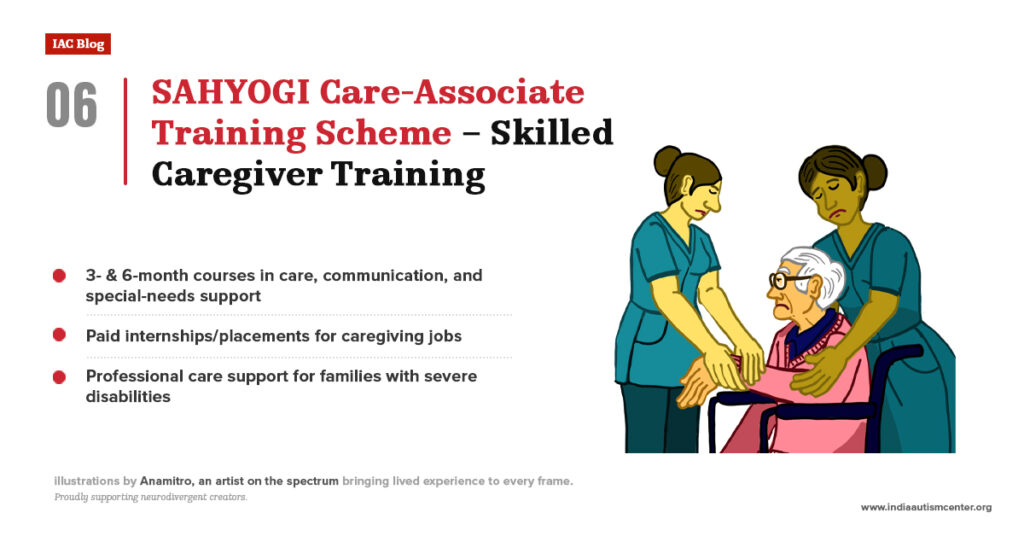
A training scheme that builds a network of trained caregivers (care associates) across India to support PwDs and their families. By enhancing the availability and quality of care, this scheme for disabled people in India significantly enhances day-to-day support, enabling PwDs to lead more independent, dignified lives, and reduces the burden on families.
What the Scheme Covers:
- Basic (3-month) and advanced (6-month) courses covering first-aid, basic care, communication skills, special needs support (for autism, CP, etc.)
- Paid internships/placements, enabling livelihood opportunities while meeting demand for caregiving professionals
- Empowers families by offering professional-grade care support, especially beneficial when managing severe disabilities
Who Can Apply:
People aged roughly 18 to 35 years, with a minimum of 8th-grade education, who wish to become care associates. Also aimed at parents/guardians seeking training.
7. Indira Gandhi National Disability Pension Scheme (NSAP) – Financial Support for Vulnerable Adults
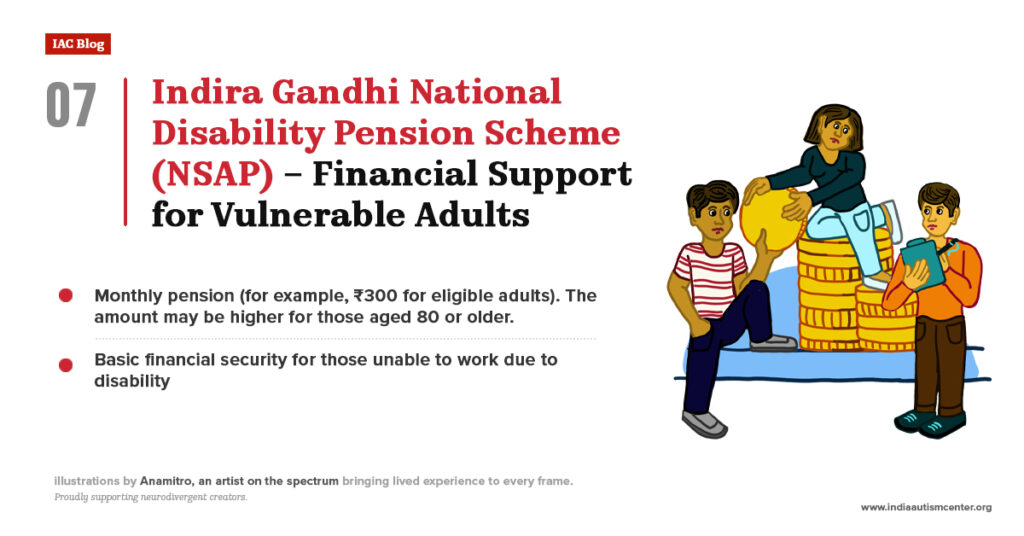
A pension scheme offering monthly financial aid to adults (18–79 years) with severe disabilities (≥ 80%) and living below the poverty line (BPL), helping them meet basic needs.
This is a foundational social security net, a core example of how the Indian state provides assistance for disabled persons who are economically marginalised, allowing them dignity and basic financial support.
What the Scheme Covers:
- Monthly pension (for example, ₹300 for eligible adults). The amount may be higher for those aged 80 or older.
- Basic financial security for those unable to work due to disability
Who Can Apply:
- The applicant must be a person with a severe or multiple disability (typically 80% or above), and belong to a household under the Below Poverty Line (BPL) classification.
- The eligible age group is 18 to 79 years (some state-specific norms may apply).
8. Welfare Schemes for Persons with Disabilities – Allowances, Incentives, Scholarships & Travel Support
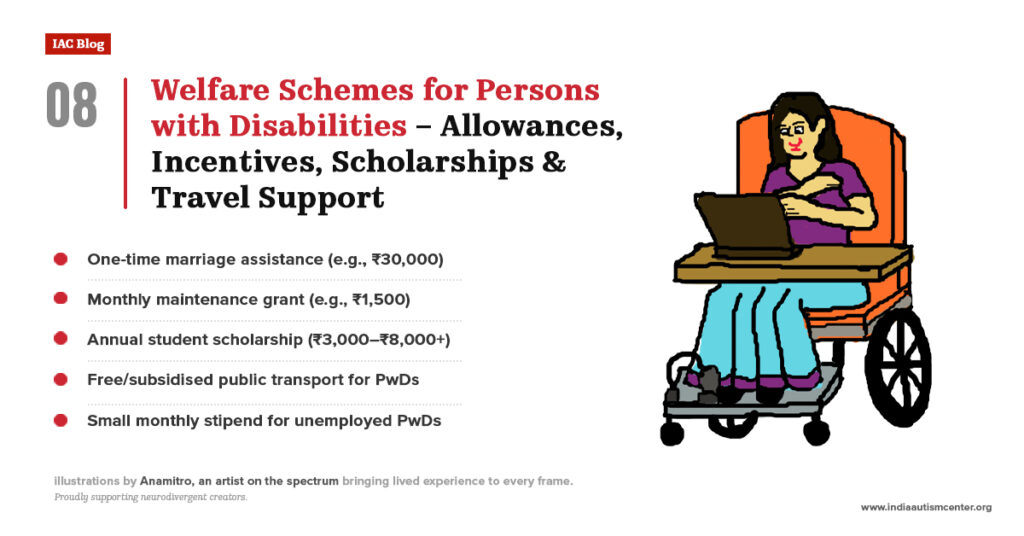
This is a government scheme in India for people with disabilities that offers multiple welfare benefits to improve financial security, social inclusion, and access to opportunities for PwDs.
These schemes give real-world, everyday assistance for disabled persons, helping them lead a dignified life with social participation, mobility, education, and financial stability.
What the Scheme Covers:
- A one-time amount (for example, ₹30,000) to support disabled persons upon marriage, acknowledging their right to a dignified social life.
- A monthly maintenance grant is provided (e.g., ₹1,500) for individuals with certain disabilities that can help them with everyday needs.
- An annual scholarship (₹3,000–₹8,000 or more) for disabled students ensures continuity in education.
- Free or subsidised public transport for PwDs holding a valid disability certificate improves mobility and access.
- For unemployed persons with disability (meeting certain criteria), a small stipend (e.g., ₹400–₹1,000/month) is offered to support basic needs while they seek work or training.
Who Can Apply:
Applicants need to have a disability certificate. For unemployment allowance, the applicant must be aged 18 to 48, registered as unemployed, and have a 10th-grade education.
9. ADIP Scheme (Full Form – Assistance to Disabled Persons for Purchase/Fitting of Aids & Appliances) – Assistive Devices & Mobility Support
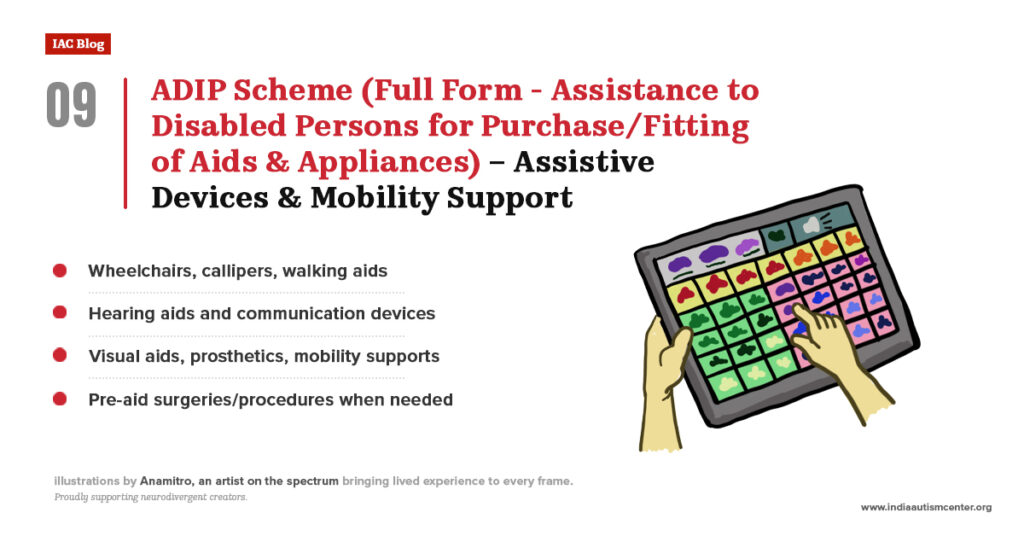
ADIP helps persons with disability acquire essential certified aids and appliances which can help in enhancing mobility, independence, communication, and daily living capabilities. For many PwDs, assistive devices are a gateway to independence.
ADIP brings those within reach, thereby reducing caregivers’ burden and increasing the person’s ability to lead a more self-reliant, active life.
What the Scheme Covers:
- Wheelchairs, callipers, walking aids, orthopaedic devices
- Hearing aids, assistive devices for speech/communication (very relevant for autism/intellectual disability)
- Visual aids, prosthetics, mobility supports
- Pre-aid surgeries or procedures when required for proper use of devices (e.g., orthopaedic)
Who Can Apply:
Indian citizens with at least 40% disability, certain income thresholds, and who have not received similar assistance in recent years.
10. BADHTE KADAM – Awareness, Inclusion & Community Sensitisation Programme
BADHTE KADAM is a scheme to promote social awareness, community interaction, and inclusion of PwDs. It is helping change attitudes, reduce stigma, and build inclusive societies.
Access to government facilities for disabled persons is only part of the journey. For real social empowerment, public attitudes must shift. BADHTE KADAM works prominently for that, making inclusion part of the mainstream social fabric, and not just some policy documents.
What the Scheme Covers:
- Supports community sensitisation efforts through campaigns, workshops, and awareness drives
- Encourages inclusive policies in local communities, schools, and workplaces
- Spreads knowledge about disability rights, support schemes, and social inclusion
Who Can Apply:
Registered organisations (under the National Trust) working for persons with autism, cerebral palsy, intellectual disability, or multiple disabilities.
Conclusion
Disabled people need as much assistance as possible. Empowering persons with disabilities isn’t just a government responsibility; it’s a collective step that is taken toward a more inclusive India where everyone gets a fair opportunity. The government has a wide range of schemes in place offering financial aid, healthcare support, education benefits, and rehabilitation services. Every eligible individual can access opportunities to improve their quality of life.
Being aware of and understanding the key details of these schemes for the disabled in India is the first step towards accessing their benefits. Encourage, apply, and help someone claim the support they deserve. India’s progress depends on inclusion, and inclusion begins with awareness.
Frequently Asked Questions
What are the major government schemes for disabled persons in India?
There are several key disability welfare and government schemes that a person with disability can avail themselves of in India, including the Deendayal Disabled Rehabilitation Scheme (DDRS), the Indira Gandhi National Disability Pension Scheme (IGNDPS), the ADIP Scheme, Scholarships for Students with Disabilities, the UDID initiative, and Skill Development for PwDs. These schemes provide financial assistance, rehabilitation support, mobility aids, education grants, and livelihood opportunities.
Who is eligible for government disability benefits in India?
To be eligible, an individual must have a benchmark disability of 40% or more, possess a valid Disability Certificate/UDID card, and meet specific income, age, or category-based criteria depending on the scheme.
What documents are required to apply for schemes for disabled persons in India?
Common documents to apply for different government schemes for disabled persons include:
- Disability Certificate or UDID
- Aadhaar Card
- Income Certificate
- Age Proof
- BPL Card (if applicable)
- Bank account details
- Passport-sized photographs
What is the UDID card, and why is it mandatory?
The UDID (Unique Disability ID) card creates a national registry of PwDs. It removes the need for multiple disability documents. It also ensures quick access to any scheme for the handicapped in India. With UDID, beneficiaries can apply for pensions, aids, transportation concessions, and education benefits seamlessly.
For expert insights, support services, and inclusive learning initiatives, visit the India Autism Center.