 Donate now
 Get a Call Back
 MENU
MENU 11 MIN READ
 SHARE
SHARE


When it comes to offering support to a loved one who has developmental disabilities, it is a journey that requires immense emotional strength and significant financial planning. In India, many families face the challenge of managing high costs for therapies, specialised doctor visits, and long-term medical care.
To make healthcare more affordable yet accessible, the Indian government introduced the Niramaya Health Insurance Scheme, a dedicated initiative to ensure that individuals with disabilities receive quality care without financial hardship.
This program is more than just a policy; it is a lifeline designed specifically for individuals with Autism, Intellectual Disability, Cerebral Palsy, and Multiple Disabilities. As of now, there are more than 47,000 beneficiaries who are enrolled in the Niramaya scheme, where the government dedicated over ₹13.87 crore in the recent financial year.
Today, we will explain what the Nirmaya government scheme is, how it works, who can apply, what benefits it offers, and how to use your Nirmaya health card.
What is the Niramaya Scheme?
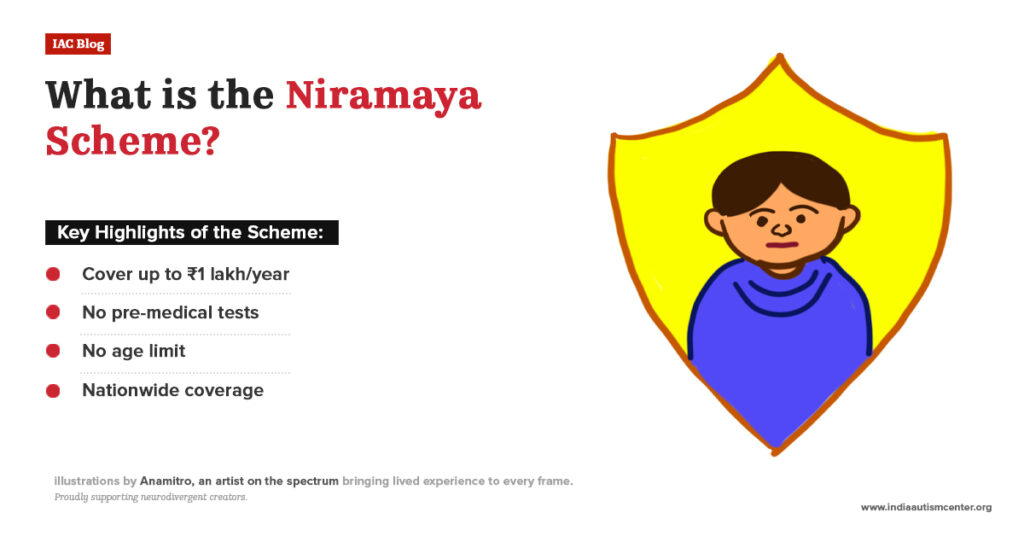
The Niramaya scheme is a unique health insurance program designed to provide affordable, accessible healthcare. Unlike most private insurance plans, which may exclude developmental conditions or charge very high premiums, Niramaya Insurance is built to be inclusive.
Key Highlights of the Scheme:
- Coverage Amount: It offers a total insurance cover of up to ₹1,00,000 (1 Lakh) per year.
- No Pre-Medical Tests: You do not need any medical checkups before joining.
- All Ages Welcome: There is no age limit; children and adults are both covered.
- Nationwide Access: The scheme is available nationwide, enabling families to seek treatment in their home cities.
The primary goal of the Niramaya health insurance scheme is to improve the quality of life for persons with disabilities (PwDs) by ensuring that there are no financial barriers that prevent them from accessing appropriate treatment at the right time.
Who is Eligible for Niramaya Health Insurance?
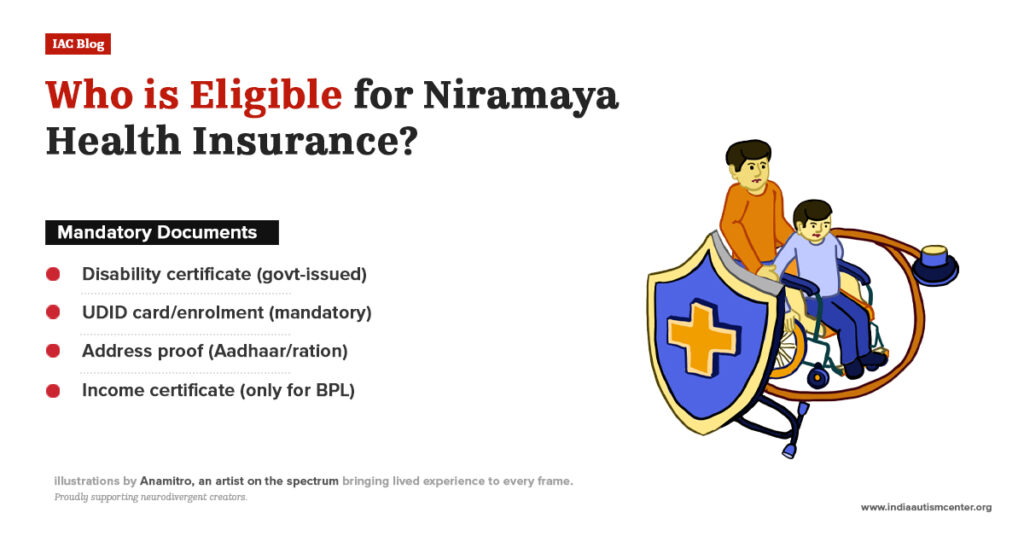
The scheme is specifically for individuals covered by the National Trust Act of 1999. To apply for a Niramaya health card, the person must be diagnosed with at least one of the following:
- Autism Spectrum Disorder: A condition which essentially affects how a person communicates and interacts with others.
- Cerebral Palsy: A group of disorders which primarily affects a person’s ability to move around as well as maintain balance.
- Intellectual Disability: This involves challenges with learning, problem-solving, and daily living skills.
- Multiple Disabilities: When a person has a combination of two or more of the disabilities mentioned above.
Mandatory Documents
To enrol, you must provide:
- Disability Certificate: It is a certificate that is issued by a government hospital or competent authority.
- UDID Card: A Unique Disability ID (UDID) or enrollment number is now mandatory for all applications.
- Address Proof: such as an Aadhaar card or a ration card.
- Income Certificate: Only required if you are applying under the BPL (Below Poverty Line) category.
Benefits of Niramaya Health Insurance
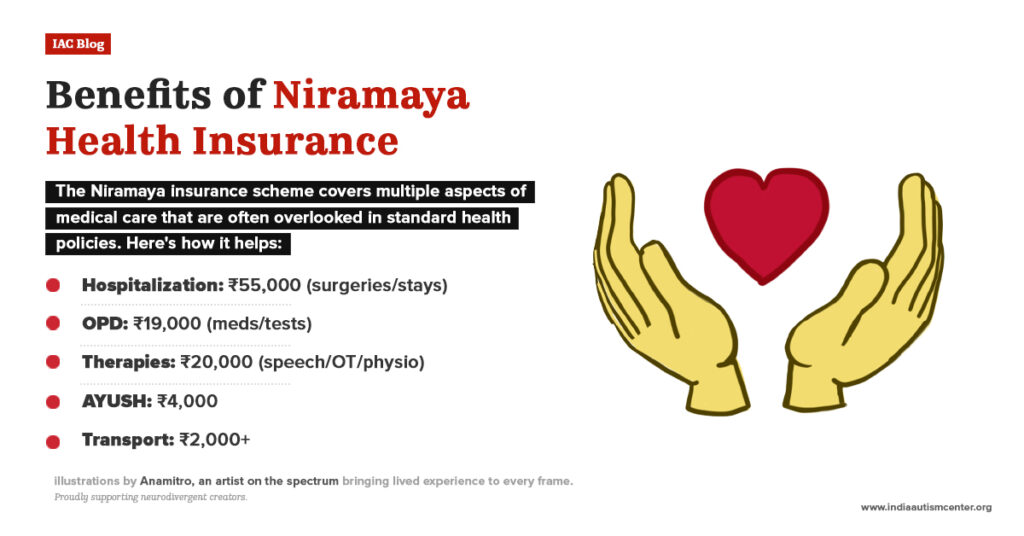
The Niramaya insurance scheme covers multiple aspects of medical care that are often overlooked in standard health policies. Here’s how it helps:
Comprehensive Coverage (Up to ₹1,00,000 per Year)
The table below shows how the ₹1,00,000 limit is distributed:
| Coverage Type | Sub-Limit | Purpose |
| Hospitalization | ₹55,000 | Corrective surgeries for disability, non-surgical stays |
| Outpatient Department (OPD) | ₹19,000 | Medicines, diagnostics, pathology |
| Ongoing Therapies | ₹20,000 | Speech, occupational, physiotherapy |
| Alternative Medicine (AYUSH) | ₹4,000 | Ayurveda, homoeopathy, etc |
| Transport Costs | ₹2,000+ | Travel to/from medical centres |
How to Apply for the Niramaya Health Card?
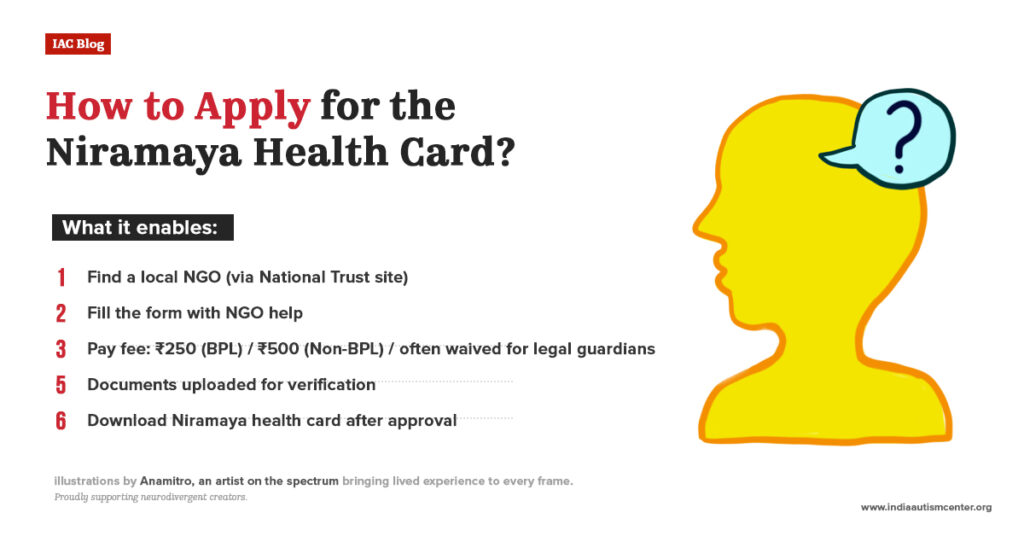
Applying for the Niramaya health card is usually done through a Registered Organisation (RO). These are NGOs or local centres that work with the National Trust.
Step-by-Step Enrollment Process:
Step 1: Find a Local NGO:
Visit the National Trust website to find a registered centre near you.
Step 2: Complete the Form:
The NGO will assist you in completing the application form.
Step 3: Pay the Fee: * BPL Families:
Pay a one-time fee of ₹250.
- Non-BPL Families: Pay a fee of ₹500.
- Legal Guardians: If the person is under a court-appointed legal guardian, the fee is often waived.
Step 4: Verification:
The NGO uploads your documents online for government approval.
Step 5: Niramaya Health Card Download:
Once approved, you can do a Niramaya Health Card download from the National Trust portal. This digital card is your proof of insurance.
How to File a Niramaya Claim?
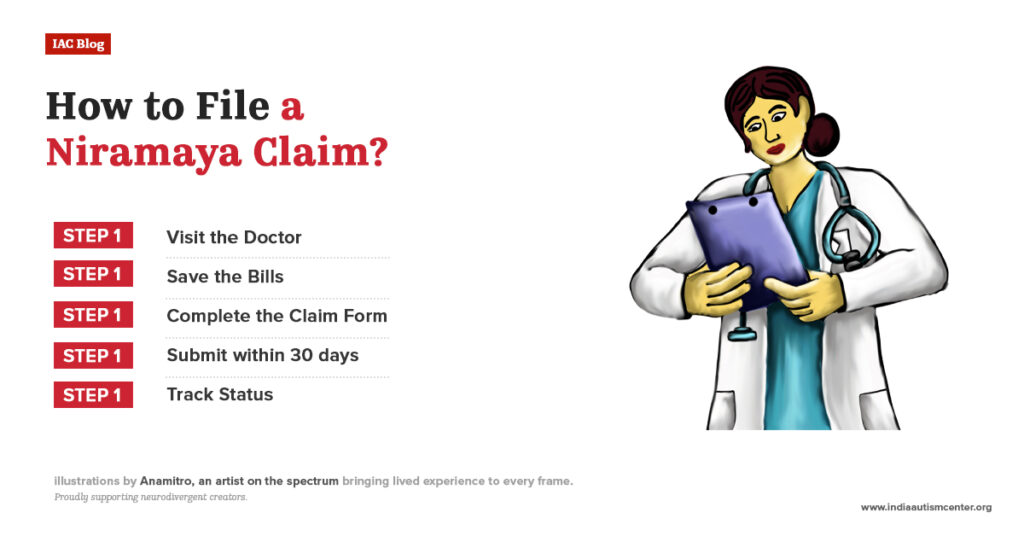
The Niramaya health insurance scheme is a “Reimbursement” plan. This means the government does not pay the hospital directly. You pay first, and the government reimburses you later.
Here is the claim process:
Step 1: Visit the Doctor:
Go to any doctor or hospital of your choice.
Step 2: Save the Bills:
Keep all original bills, prescriptions, and reports.
Step 3: Complete the Claim Form:
Download the form from the TPA (Third-Party Administrator) website, such as MediAssist or Raksha TPA.
Step 4: Submit within 30 days:
You must send your documents within 30 days of the treatment or hospital discharge.
Step 5: Track Status:
Use your ID to check the Niramaya claim status online.
If you want to have a successful claim process, follow the tips below:
- Prescriptions: For therapy, you need a new prescription from your doctor every six months.
- Original Documents: Always send original bills. The insurance company will not accept photocopies.
- Bank Details: It is important to ensure that your bank account is properly linked to the Aadhaar details for seamless payments.
What Is a Niramaya Health Card?
A Niramaya Health Card is an official digital identity card issued to beneficiaries enrolled under theNiramaya Health Insurance Scheme. This proves that Niramaya Health Insurance covers a person with a disability and is eligible to receive medical benefits and reimbursements under the scheme.
What Does a Niramaya Health Card Do?
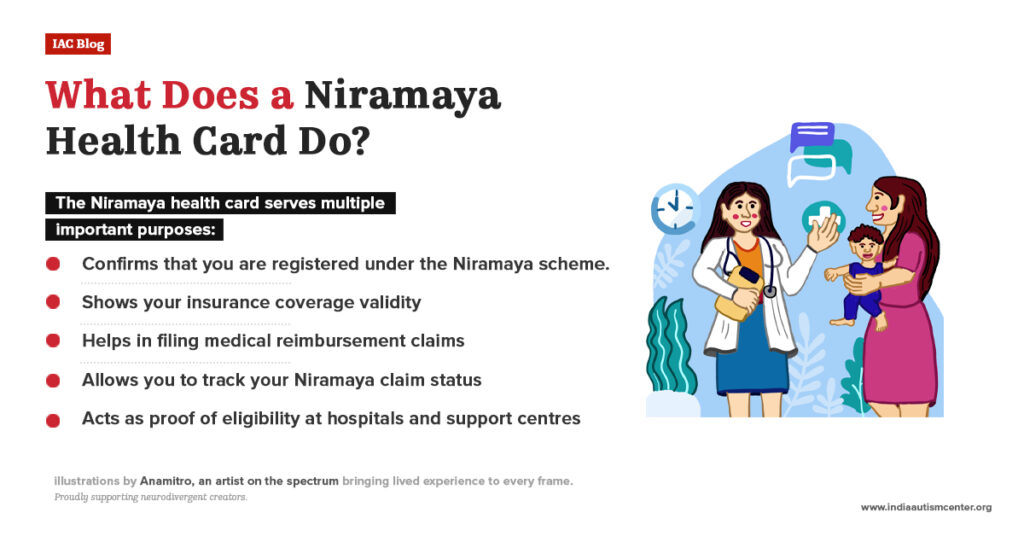
The Niramaya health card serves multiple important purposes:
- Confirms that you are registered under the Niramaya scheme.
- Shows your insurance coverage validity
- Helps in filing medical reimbursement claims
- Allows you to track your Niramaya claim status
- Acts as proof of eligibility at hospitals and support centres
What Information Is Printed on the Card?
A typical Niramaya health card contains:
- Beneficiary’s name
- Unique Niramaya ID
- Date of birth
- Disability category
- Policy validity period
- Photograph
- Registered Organisation (RO) details
How to Download Niramaya Health Card?
To get your Niramaya health card download, follow these steps:
- Visit the National Trust e-card portal
- Enter your application number or registered details
- Verify with OTP
- Download the PDF card
- Save or print it
Staying Protected: The Renewal Process
The Niramaya health insurance policy follows the financial year cycle. It simply means every policy, regardless of when you signed up, officially ends on March 31st each year. To ensure your loved one continues to get medical support, you must renew the policy annually. Think of it as a yearly health check for your insurance. Doing it on time prevents any “gap” where you might have to pay for expensive treatments entirely out of your own pocket.
Niramaya Health Card Renewal Online: Step-by-Step
The National Trust has made the renewal process simpler by allowing Niramaya health card renewals online. The renewal window typically opens on February 1st each year for the upcoming policy period (April to March).
To renew online, follow these simple steps:
- Visit the Portal: Go to the official National Trust website and navigate to the ‘Niramaya’ section.
- Enter Details: You will need to provide the beneficiary’s Application ID, UDID number, and Date of Birth.
- Update Information: If there have been any changes, such as a new home address or updated bank details for reimbursements, you can update them here.
- Fee Payment: Pay the renewal fee using a debit card, credit card, or UPI.
Renewal Fee Structure
The renewal cost is significantly lower than the initial registration fee, making it very affordable for long-term care:
- BPL Families: The renewal fee is usually just ₹50.
- Non-BPL (APL) Families: The renewal fee is ₹250.
- Legal Guardians: If a person is under a court-appointed legal guardian (other than the natural parents), the renewal is often free.
It is very important to complete the Niramaya health card renewal online before the March 31st deadline. If you miss this date, the policy is considered “lapsed.” A lapse will result in loss of coverage, additional hassle with a new application, and the need to start the process over.
Common Reasons for Niramaya Claim Rejection (And How to Avoid Them)
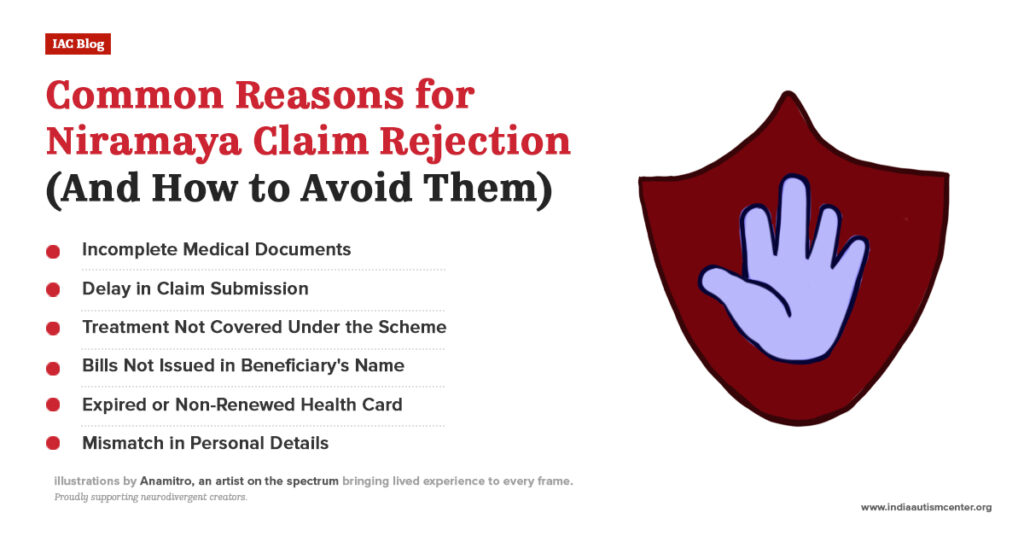
Many Niramaya claims are rejected not because the treatment was wrong, but because of small mistakes in documents, timing, or forms. Understanding the common reasons that lead to rejection can help you protect your reimbursement and avoid unnecessary stress.
Here are the main reasons for claim rejection:
- Incomplete Medical Documents
One of the most common reasons why the claim is rejected is missing paperwork. If hospital bills, doctor’s prescriptions, test reports, or discharge summaries are not submitted together, the claims are often not verified. Make sure all papers are ready.
- Delay in Claim Submission
Niramaya claims must be submitted within the prescribed time limit, typically 30 days from the date of treatment. If documents are submitted late, the claim may be rejected automatically. Begin the claim process once the treatment is complete.
- Treatment Not Covered Under the Scheme
Some medical expenses are not included under the Niramaya scheme, such as cosmetic procedures, experimental treatments, or unapproved therapies. If you claim such services, they may be rejected. Ensure that the treatment is covered in the policy.
- Bills Not Issued in Beneficiary’s Name
If hospital or pharmacy bills are issued in the parent’s name or someone else’s name instead of the beneficiary, the claim may be denied. The insurance is linked to the person with disability, so all documents must match their details. Always ensure that the bills are in the beneficiary’s name.
- Expired or Non-Renewed Health Card
A Niramaya Health Card must be renewed every year. If your card has expired and treatment is taken during that period, the insurance is considered inactive. In such cases, claims are not accepted. Renew the card on time.
- Mismatch in Personal Details
Small differences in name spelling, date of birth, ID number, or bank details can lead to rejection. When the details on the claim form do not match those on the health card or records, verification becomes difficult. Cross-check all the information before submitting the claim.
- Missing Doctor’s Signature or Hospital Stamp
Claims without proper authentication are often rejected. If documents like prescriptions, discharge summaries, or medical certificates do not have the doctor’s signature or hospital seal, they are considered unofficial documents. Ensure that all papers are signed and stamped adequately.
- Submission of Photocopies Instead of Originals
In most cases, original bills and receipts are required for reimbursement. Submitting only photocopies may lead to rejection. Originals prove that the expense was actually paid. Keep photocopies as records.
- Claim Amount Exceeding Sub-Limits
Niramaya insurance has separate limits for OPD, therapies, hospitalisation, and other services. If you claim more than the allowed limit in any category, the excess amount may be rejected. Always keep track of and plan expenses better.
- Incorrectly Filled Claim Forms
Many claims fail because the form is filled out incorrectly. Missing signatures, blank fields, wrong dates, or incorrect claim categories can delay or cancel processing. It is best to take the time to fill out the form carefully.
Conclusion
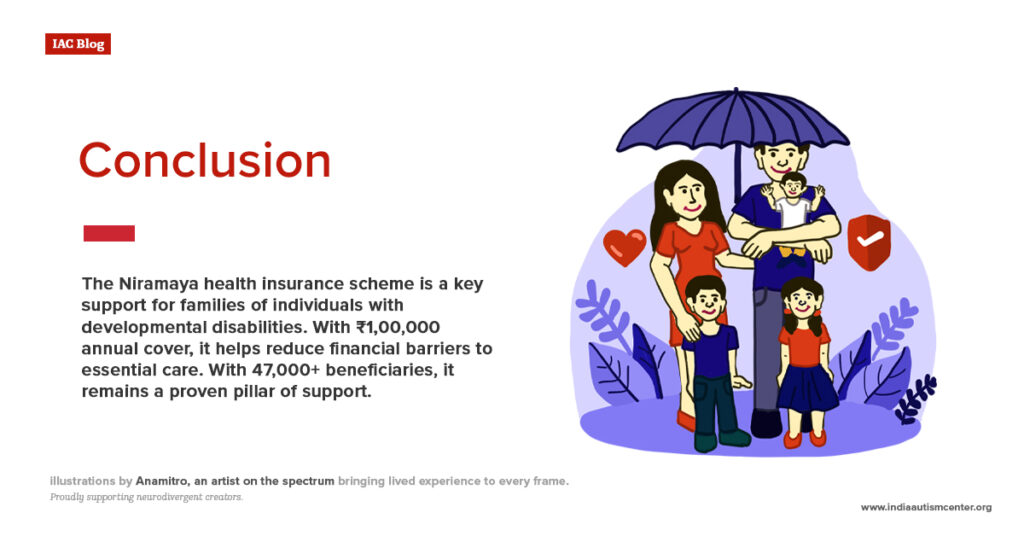
The Niramaya health insurance scheme is an important lifeline for families supporting individuals with developmental disabilities. Providing an annual cover of ₹1,00,000 ensures that financial limits do not stand in the way of essential care. With more than 47,000 beneficiaries already benefiting, the Niramaya scheme is without a proven pillar of support for the community.
For parents and caregivers, staying organised, renewing the health card on time, and understanding the claim process are just as important as seeking good medical care. When you follow the rules and prepare your documents properly, Niramaya truly becomes the strong support system it is meant to be.
A small effort in managing your Niramaya health card today provides a lasting safety net for your family’s well-being.
Frequently Asked Questions
What is the Niramaya Health Insurance Scheme?
The Niramaya Health Insurance Scheme is a government-backed policy that provides medical coverage up to ₹1 lakh per year for persons with disabilities, including autism, cerebral palsy, and intellectual disability.
How can I apply for the Niramaya scheme?
You can apply through a Registered Organisation (RO) approved by the National Trust by submitting your documents and paying the required premium.
How to download the Niramaya health card online?
You can download your Niramaya health card from the National Trust portal by entering your application number and registered mobile number for verification.
Who is eligible for Niramaya health insurance?
Any person diagnosed with autism, cerebral palsy, intellectual disability, or multiple disabilities and holding a valid disability certificate can apply. There is no age limit; children, adults, and senior citizens are all eligible.
What happens if my Niramaya card expires?
If your card expires and is not renewed, your insurance becomes inactive. Any medical expenses incurred during this period will not be reimbursed, even if you renew later.