Category: Saamavesh

  • Legal Guardianship: A Comprehensive Guide (2026)

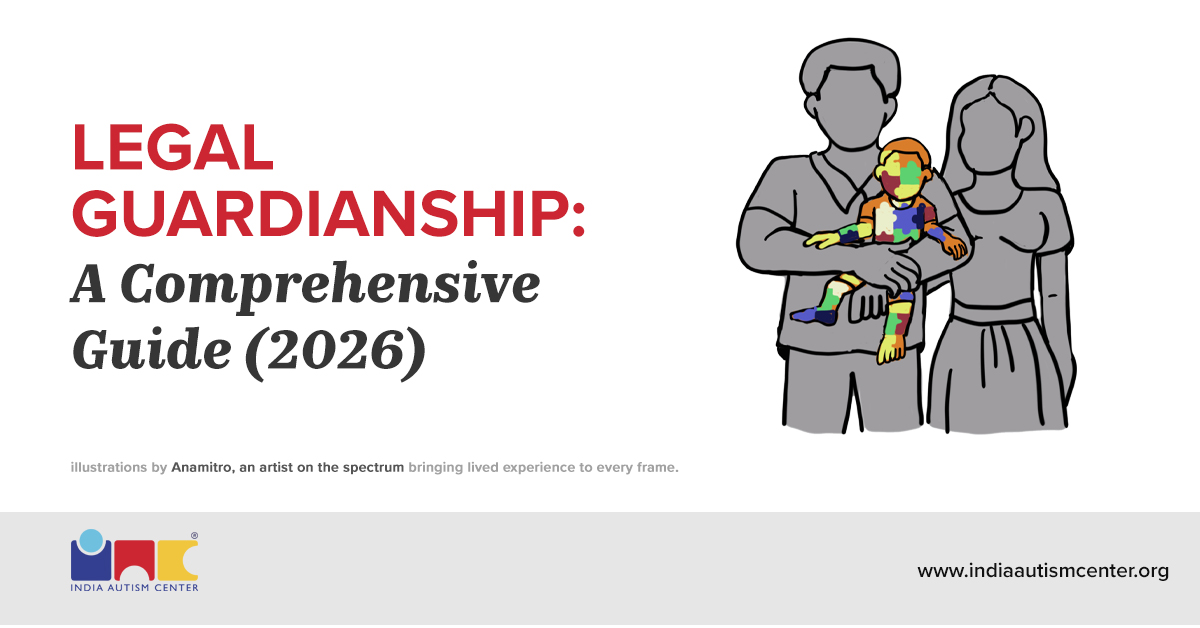
    Legal Guardianship: A Comprehensive Guide (2026)

    For many families raising children with developmental disabilities, there is a question that quietly sits in the background for years: “What will happen to my child when I am no longer here?” This is where legal guardianship becomes critically important.

    Legal guardianship is a structured legal mechanism that ensures individuals who require support in decision-making continue to receive care, protection, and advocacy throughout their lives. In India, this framework is supported by the National Trust Act, 1999, which was established to protect and empower persons with Autism, Cerebral Palsy, Intellectual Disability, and Multiple Disabilities.

    Organisations like India Autism Center (IAC) are working to create sustainable systems of care that address not only current needs but also long-term concerns for individuals with autism and their families.

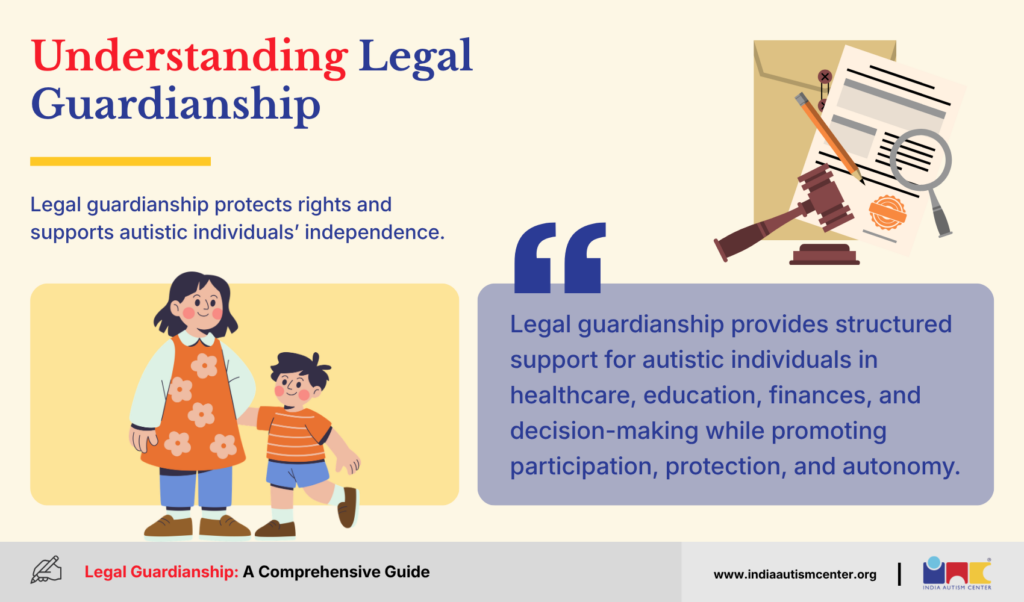
    Understanding Legal Guardianship

    Legal guardianship is a formal legal arrangement where a responsible individual or organisation is appointed to make certain decisions on behalf of a person with disability who may require assistance in managing aspects of their life.

    This does not mean the individual loses their identity or dignity. Instead, guardianship provides support for complex decisions while protecting the rights and interests of the person.

    A legal guardian may assist in matters such as:

    • Medical and healthcare decisions
    • Educational and vocational planning
    • Financial and property management
    • Accessing government welfare schemes
    • Legal representation in official matters

    The fundamental objective of legal guardianship is to safeguard the well-being and rights of individuals who may not always be able to make fully independent decisions.

    Why Legal Guardianship Matters

    While many individuals with disabilities can lead independent and fulfilling lives, some may require assistance in specific areas. Legal guardianship ensures that such individuals receive the support they need while protecting them from potential risks.

    Below are some of the key reasons legal guardianship is important.

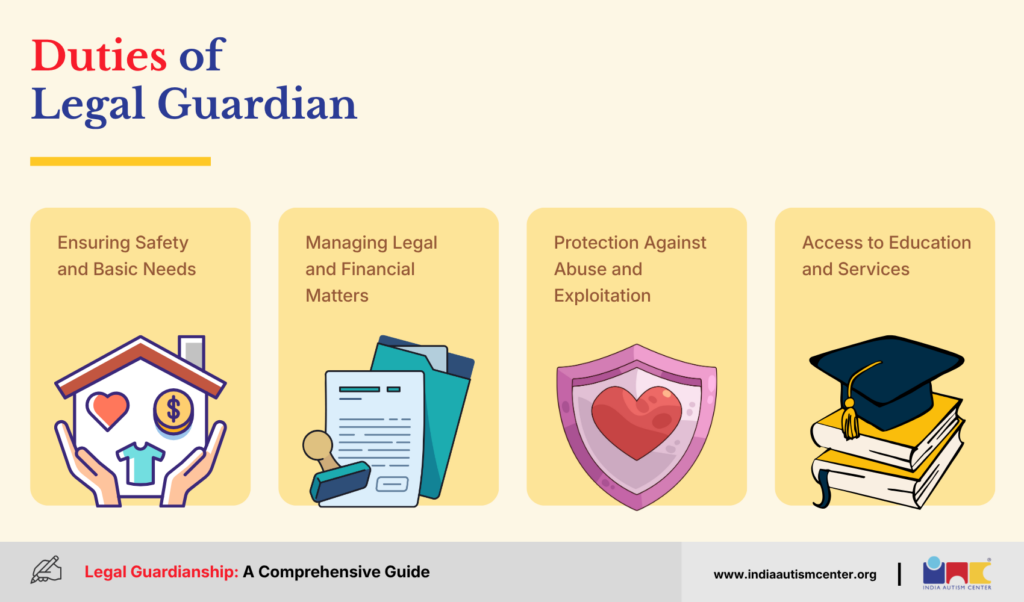
    1. Ensuring Safety and Basic Needs

    A legal guardian ensures the individual has access to essential needs such as:

    • Safe housing
    • Nutritious food
    • Healthcare and therapy
    • Emotional support

    Guardians help create a stable environment where individuals can thrive.

    2. Managing Legal and Financial Matters

    Many legal or financial decisions require formal representation. A legal guardian may help manage:

    • Bank accounts
    • Property ownership
    • Legal documentation
    • Government benefits and pensions

    These responsibilities ensure that the individual’s assets and rights are protected.

    3. Protection Against Abuse and Exploitation

    Unfortunately, individuals with disabilities may be vulnerable to neglect or financial exploitation. Legal guardianship acts as a protective framework that safeguards them from harm.

    4. Access to Education and Services

    Guardians help individuals access critical services such as:

    • Educational programs
    • Skill development training
    • Healthcare services
    • Rehabilitation and therapy

    Institutions such as the India Autism Center are designed to provide integrated support systems that help individuals develop skills and live fulfilling lives.

    Want to know more? Get in touch with us.

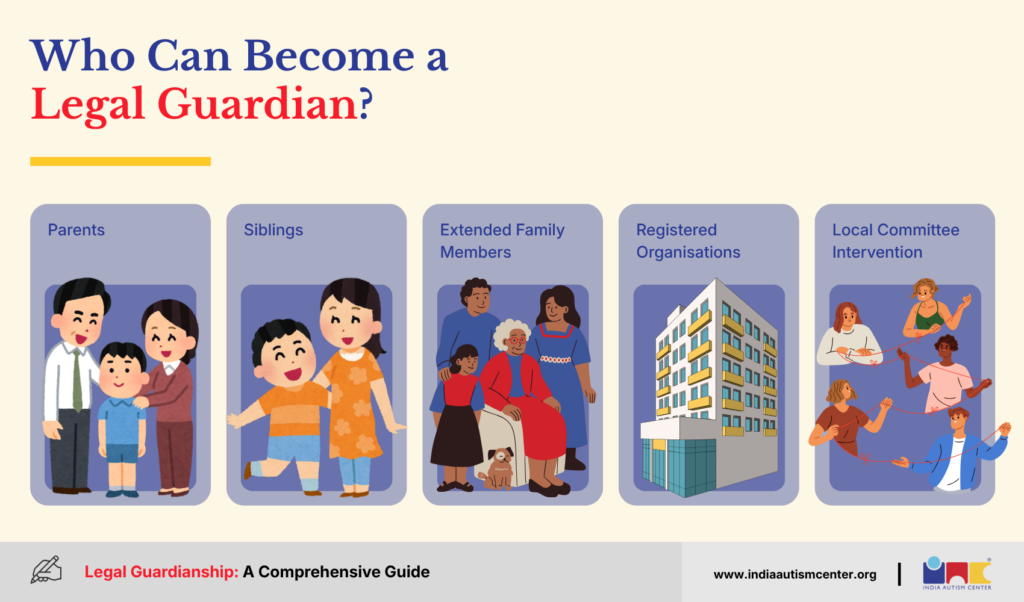
    Who Can Become a Legal Guardian?

    The National Trust framework recognises that the responsibility of guardianship may fall on different individuals or organisations depending on the circumstances.

    1. Parents

    Parents are typically the natural guardians and are usually the first to take responsibility for their child’s well-being.

    Both parents can apply jointly, or one parent may apply individually if the other is unavailable due to circumstances such as death or separation.

    2. Siblings

    In cases where parents are unable to continue guardianship, brothers or sisters may apply to become legal guardians.

    Siblings often understand the personal needs of the individual and may continue the caregiving role.

    3. Extended Family Members

    If parents and siblings are not available, close relatives such as uncles, aunts, or cousins may step in to provide guardianship support.

    4. Registered Organisations

    Sometimes families do not have relatives who can take on long-term responsibility. In such cases, registered organizations recognized by the government may serve as legal guardians.

    Institutions that specialise in disability care often provide structured environments with trained professionals and supportive communities.

    5. Local Level Committee Intervention

    If no guardian is available, the Local Level Committee (LLC) established under the National Trust Act may appoint a registered organization to take responsibility for the individual.

    This ensures that no person with disability is left without support.

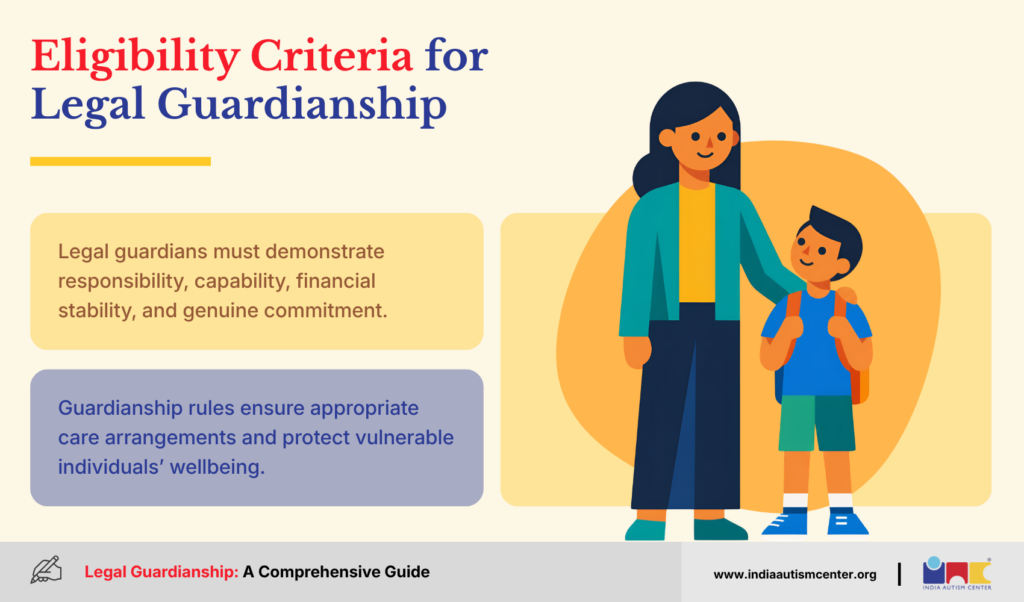
    Eligibility Criteria for Legal Guardianship

    Not everyone can become a legal guardian. The law outlines specific requirements to ensure the guardian is capable of responsibly managing the role.

    A guardian must generally:

    • Be a citizen of India
    • Have no criminal background
    • Be mentally capable of making responsible decisions
    • Be financially independent
    • Demonstrate a genuine commitment to the well-being of the individual

    These safeguards ensure that guardianship responsibilities are entrusted only to reliable and responsible individuals.

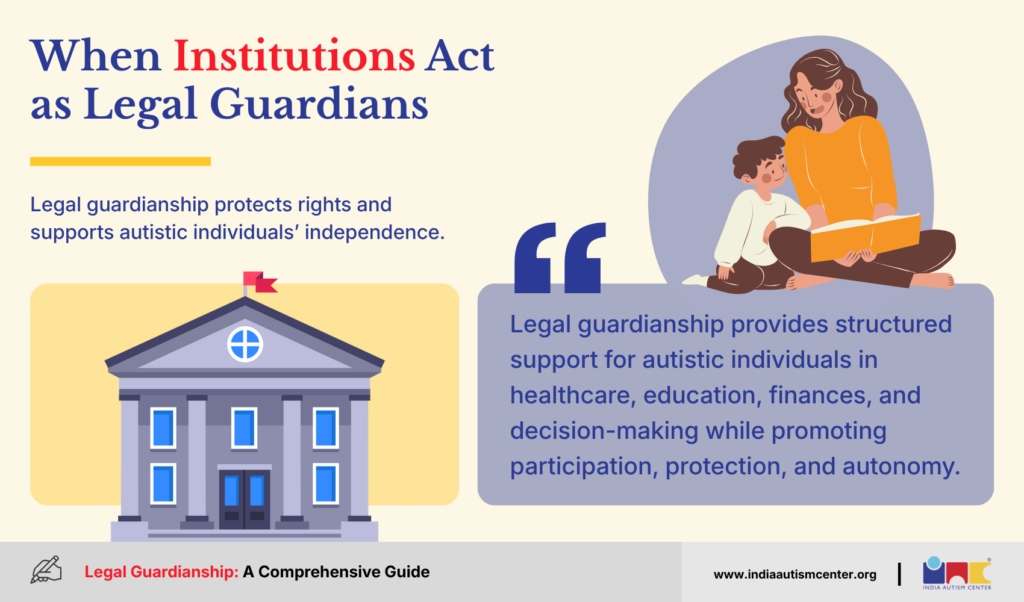
    When Institutions Act as Legal Guardians

    In certain cases, a registered institution may become the legal guardian of an individual with disability.

    For an organisation to qualify for legal guardianship:

    • It must be officially registered and legally recognised
    • It should have experience in disability care and rehabilitation
    • It must provide adequate facilities for safety, care, and support

    India Autism Center aims to create a holistic ecosystem that includes education, therapy, residential care, and community engagement.

    Such institutions can provide long-term support systems that extend beyond the lifespan of parents or immediate caregivers.

    Want to know more? Get in touch with us.

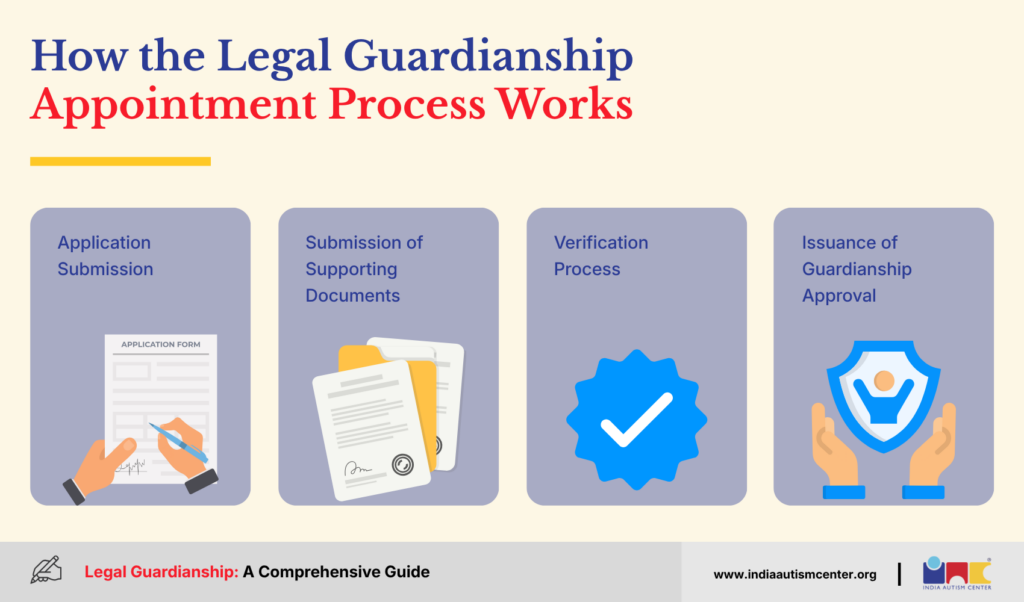
    How the Legal Guardianship Appointment Process Works

    The appointment of a legal guardian follows a structured legal process designed to ensure transparency and accountability.

    Step 1: Application Submission

    The process begins with submitting a guardianship application to the Local Level Committee (LLC) using the prescribed form.

    This application includes details about:

    • The person with disability
    • The proposed guardian
    • The nature of support required

    Step 2: Submission of Supporting Documents

    Applicants must provide documents such as:

    • Disability certificate issued by a recognised authority
    • Proof of identity and residence
    • Birth certificate
    • Details of property or assets (if applicable)

    These documents help the committee assess the situation and determine the appropriate guardian.

    Step 3: Verification Process

    A verification team reviews the application and may include:

    • Government officials
    • Representatives from disability organizations
    • Parent advocacy groups

    They evaluate whether the proposed guardian meets the eligibility criteria and has the ability to fulfill their responsibilities.

    Step 4: Issuance of Guardianship Approval

    If the committee is satisfied, it issues official confirmation granting legal guardianship.

    This formal appointment legally authorises the guardian to act on behalf of the individual in specified areas.

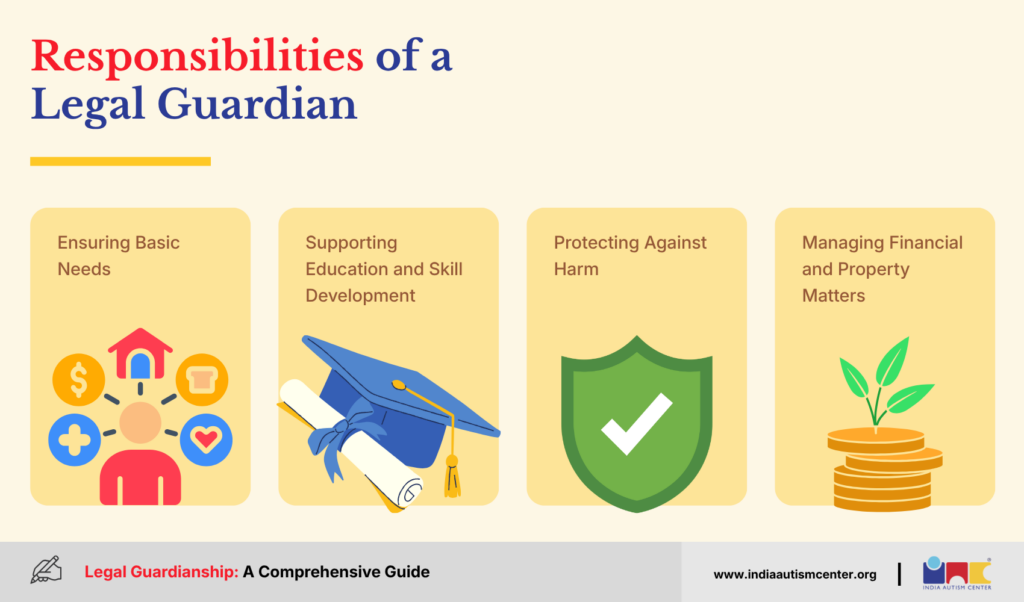
    Responsibilities of a Legal Guardian

    Being appointed as a legal guardian is a serious responsibility that requires commitment, transparency, and ethical decision-making. Key responsibilities include:

    Ensuring Basic Needs

    Guardians must ensure that the individual receives:

    • Food and nutrition
    • Safe housing
    • Appropriate clothing
    • Healthcare and therapy

    Supporting Education and Skill Development

    Guardians should encourage the individual to participate in:

    • Educational programs
    • Vocational training
    • Recreational activities

    These activities help improve the quality of life and foster independence.

    Protecting Against Harm

    Guardians must protect the individual from:

    • Physical abuse
    • Emotional neglect
    • Financial exploitation

    Managing Financial and Property Matters

    If the individual owns property or financial assets, the guardian must manage them responsibly and transparently.

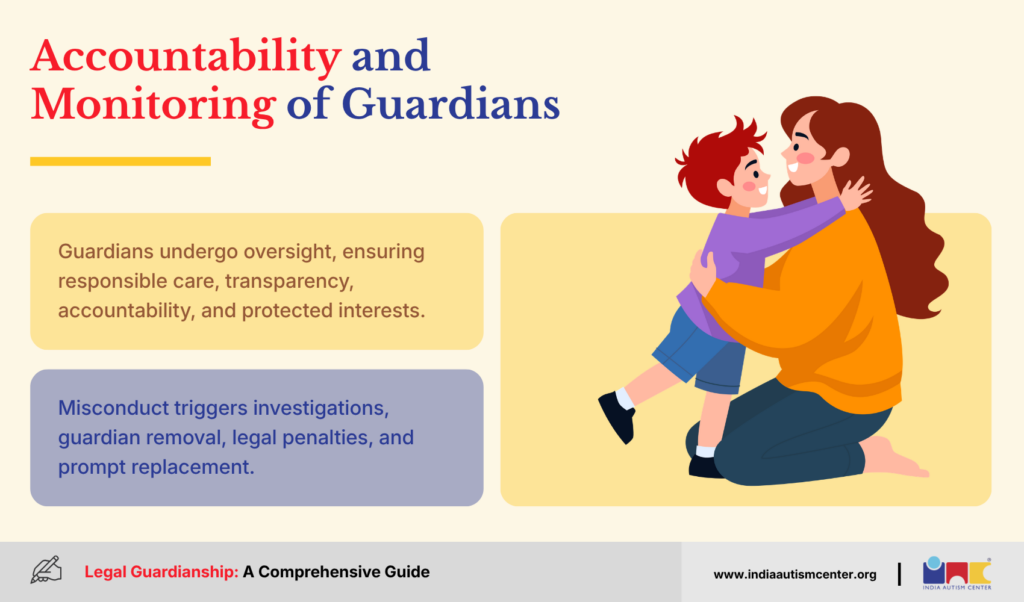
    Accountability and Monitoring of Guardians

    Legal guardianship is closely monitored to prevent misuse of authority.

    Annual Reporting

    Guardians are required to submit annual reports detailing financial transactions and property management.

    This ensures transparency and protects the interests of the individual.

    Regular Oversight

    The Local Level Committee monitors guardianship arrangements to ensure that the individual is receiving proper care and support.

    Legal Action in Case of Misconduct

    If misuse of authority or negligence is discovered, the guardian may face:

    • Removal from guardianship
    • Legal penalties
    • Appointment of a replacement guardian

    When Can a Legal Guardian Be Removed?

    A guardian may be removed if they:

    • Abuse or neglect of the individual
    • Misuse of financial assets
    • Fail to fulfil their responsibilities
    • Act against the interests of the individual

    Complaints can be filed with the Local Level Committee, which will investigate the matter and take appropriate action.

    Want to know more? Get in touch with us.

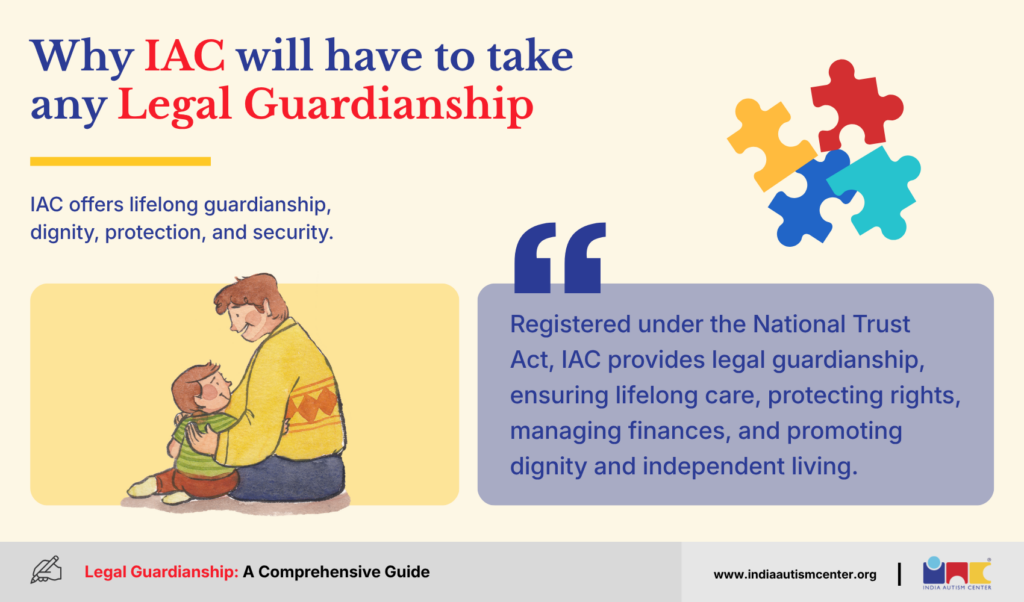
    Why IAC will have to take any Legal Guardianship

    One of the biggest fears among parents of children with autism is the uncertainty of the future.

    Who will care for their child after they are gone?

    Institutions dedicated to autism support are increasingly developing long-term solutions that address this concern.

    India Autism Center, for instance, is working toward building a sustainable community ecosystem where individuals with autism can live, learn, work, and thrive even when their parents are no longer able to support them.

    Through structured programs, residential facilities, and long-term planning, such institutions aim to create a future where individuals with autism can live with dignity and independence.

    How IAC Will Take The Legal Guardianship Under This Act

    1. IAC will first have to get registered under this act
    2. Apply to the LLC to take the legal guardianship of the resident, availing the facility of IAC
    3. IAC may appoint a designated person/position/person to act on IAC’s behalf as a legal guardian for all subsequent applications. Note – this is subject to LLC approval

    Responsibility of IAC as a Legal Guardian

    • Ensure the resident gets proper food, clothing, shelter, and healthcare.
    • Oversee their education, recreational activities, etc.
    • Protect them from abuse, neglect, or exploitation.
    • Manage financial and property matters responsibly.
    • Comply with rules framed under the National Trust Act

    Conclusion

    This policy aims to provide clear guidelines for appointing and monitoring legal guardians to ensure that individuals with Autism, Cerebral Palsy, Mental Retardation, and Multiple Disabilities are cared for with respect, dignity, and fairness. It emphasises accountability and safeguards their rights while promoting their well-being.

    This approach aligns with The National Trust Rules, 2000 and ensures a transparent and compassionate system for legal guardianship.

    Frequently Asked Questions (FAQs)

    Is it mandatory and absolutely necessary that a legal guardian be appointed for each person with disability?

    Though it is not mandatory to apply for legal guardianship of a person with disability, since the National Trust Act, 1999 has made provision for such appointment it is always advantageous to apply for legal guardianship under the provisions of the said Act. Such occasion may arise when a person with disability has to deal with issues related to himself, his interests and his properties and since he/she may not always be able to take appropriate decisions in those respects, it would be in the best interests if represented by a legal guardian in such matters. 

    Elaboration of Section 14(3) of NT Act read with Form B under National Trust Rules

    Does the Local Level Committee have any inherent powers as the Courts have?

    A friend of a person with disability cannot apply for guardianship but he can be appointed as a guardian if a parent or a sibling or a relative recommends / applies for the appointment of such a person as legal guardian.

    Can a minor act as a guardian?

    A “minor” is a person who has not completed 18 years of age. Such minor cannot act as guardian of a person with disability under the National Trust’s Regulations.

    Can an application for guardianship be made for a ward who lives abroad? 

    No. It would not be possible for a Local Level Committee to appoint a guardian who is living abroad since applicability of National Trust Act is the whole of India under Section 1(2) of the Act. As per Section 17(1)(iii)(a) of National Trust Rules the person whose name has been suggested for appointment as guardian should be a citizen of India. Further under the Trust’s Regulation 12(6), both the guardian and the ward must be living within the jurisdiction of the Local Level Committee

    What is the position of a ‘testamentary guardian’ appointed under a ‘Will’?

    It is open to a parent to appoint a guardian for his minor child (who may also be a person with disability) under a ‘Will’ or other testamentary instrument. Where such testamentary guardian has been appointed there is intended to be the legal guardian under the National Trust Act. The LLC may take into consideration the facts and circumstances of the testamentary guardianship.

    Can separate guardians be appointed for the care of the person and for the care of the property of a person with disability? 

    Yes, it is possible that guardians are appointed separately for the care of the person and for the care of the property of the person with disability. However, the Local Level Committee will look into all the facts and circumstances of the case before taking such a decision. 

    Can a foreigner apply for guardianship? 

    No, a person who is not a citizen of India cannot apply for guardianship of a person with disability in India under the Trust’s Rules Section 17(1)(iii)(a). 

    What will happen if the guardian is convicted by a court of law and sent to prison or develops serious incapacity to discharge his duties or develops interests adverse to that of the ward or leaves the district permanently or becomes bankrupt?

    In all of these circumstances, the guardian will be liable to be removed and the Local Level Committee will have to appoint another guardian. It may also place the ward in the charge of an eligible person or institution till a guardian is appointed on regular basis.

     Can a Local Level Committee vary the powers of a guardian after appointing one? 

    The Local Level Committee can vary the powers of a guardian after having appointed him but this will depend upon the developments and the circumstances of a given case and should be properly illustrated. 

    Since Local Level Committee has no powers of Court, will it have any power over third parties? Can it summon other persons or take evidence as courts can do? 

    In order to consider applications for guardianship impartially and fairly, a Local Level Committee may call for other persons and take their evidence or hear them depending upon the facts and circumstances of the case. In the event a third person called by the Committee does not appear, it will have to do without the appearance of such person as it has no powers to enforce such presence. The Committee can also take affidavits by way of evidence from witnesses and applicants and allow cross-examination by objectors to guardianship applications. 

    For expert insights, support services, and inclusive learning initiatives, visit the India Autism Center.
  • Financial Planning Guide for Parents of Children with Special Needs

    Financial Planning Guide for Parents of Children with Special Needs

    If you are the parent of a child with special needs, you carry a weight that most other parents don’t. You think about tomorrow, next year, and decades from now. You worry about who will care for your child when you are no longer around. These thoughts can keep you awake at night.

    This guide is here to help you turn those worries into a plan. Financial planning for a child with special needs is not just about money. It is about love, security, and peace of mind. It is about ensuring that your child’s future is safe, dignified, and happy, no matter what.

    We have taken expert advice and broken it down into simple, actionable steps. Everything is written from an Indian perspective, using Indian terms, and keeping Indian families and their unique challenges in mind.

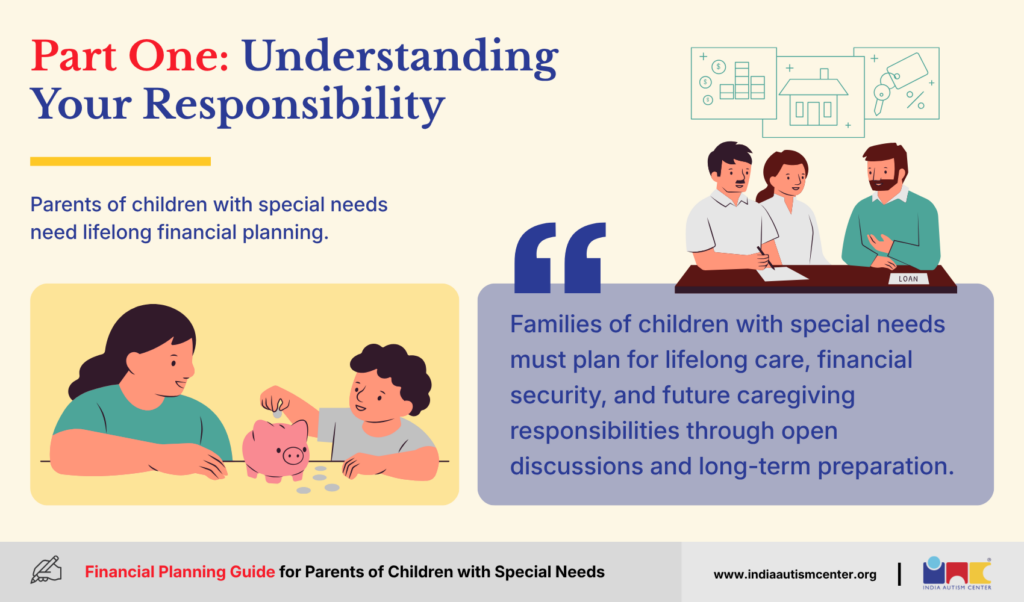
    Part One: Understanding Your Responsibility

    The Two-Lifetime Reality

    In a typical Indian family, parents work hard, save money, and hope their children will grow up, get jobs, get married, and support them in their old age. The financial plan is simple: earn, save, spend on children’s education and marriages, and then retire.

    Your situation is different. Your child with special needs may always need some level of support. They may never be able to earn a full income or manage money independently. This means your financial plan must cover not just your own lifetime, but your child’s entire lifetime after you.

    This is called Two-Generation Planning:

    • Your lifetime: The years you are earning, saving, and directly caring for your child.
    • Your child’s lifetime (after you): The decades when your child will need financial support from the assets you leave behind.

    This is a big responsibility, but it is not impossible. Thousands of Indian parents have done it. You can too.

    Have the Difficult Conversations

    Before you open any bank account or buy any insurance policy, you must sit down with your spouse and family and have an honest conversation.

    Questions to Discuss:

    • Who will care for our child if something happens to both of us?
    • Are our parents, siblings, or other relatives willing and able to take on this responsibility?
    • How much money will our child need each month for the rest of their life?
    • Where will our child live as an adult? With family? In a group home? In supported living?

    These conversations can be emotional. That is okay. But do not avoid them. Talking openly is the first step toward building a secure future.

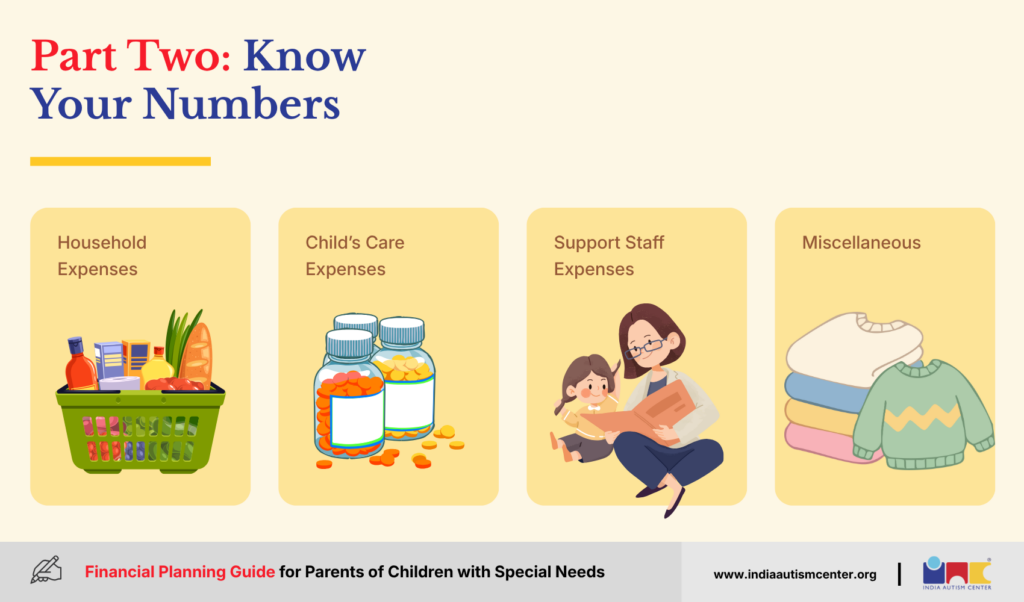
    Part Two: Know Your Numbers

    Track Every Rupee You Spend Today

    You cannot plan for the future if you do not understand your present. The first practical step is to write down exactly what you spend every month.

    Get a notebook or open a simple spreadsheet. Write down:

    1. Household Expenses:
      • Rent or home loan EMI
      • Groceries and food
      • Electricity, water, gas, internet bills
      • Transport (fuel, auto, bus, train)
      • Mobile phone and entertainment
    2. Child’s Care Expenses:
      • School fees (special school or inclusive school)
      • Therapy costs (speech therapy, occupational therapy, physiotherapy, behavioural therapy, counselling)
      • Medicines, supplements, and doctor visits
      • Therapist travel costs (if they come home)
      • Special equipment (hearing aids, glasses, mobility aids, communication devices)
    3. Support Staff Expenses:
      • Salary for a nanny, caregiver, or personal assistant
      • Any training costs for caregivers
    4. Miscellaneous:
      • Clothing and personal items for your child
      • Hobbies, activities, and outings
      • Any alternative therapies or treatments

    Want to know more? Get in touch with us.

    Why This Matters:

    You cannot know how much to save for the future if you don’t know how much you spend today. This exercise also helps you spot areas where you might be able to save a little.

    Imagine Your Child’s Future Needs

    Now, think ahead. Your child’s needs will change as they grow. Try to imagine what their life might look like at different stages.

    Age 0-10 Years:

    • Focus on early intervention, therapy, and special education.
    • Expenses: Therapies, specialists, school, equipment.

    Age 10-18 Years:

    • Focus on life skills, social skills, and transition planning.
    • Expenses: Continued therapy, vocational training, assistive technology, and possibly a personal assistant.

    Age 18-30 Years:

    • Focus on adulthood, day programs, supported employment, or sheltered workshops.
    • Expenses: Day centre fees, job coach, continued therapy, social activities.

    Age 30+ Years:

    • Focus on long-term care, housing, and quality of life.
    • Expenses: Supported living or residential care, full-time carers, medical care, leisure activities.

    For Each Stage, Ask Yourself:

    • Where will my child live?
    • Who will care for them?
    • What will they do during the day?
    • What medical and therapy needs will they have?
    • How much will all of this cost at today’s prices?

    This is not about predicting the future perfectly. It is about thinking ahead so you can plan.

    Part Three: Building Your Financial Foundation

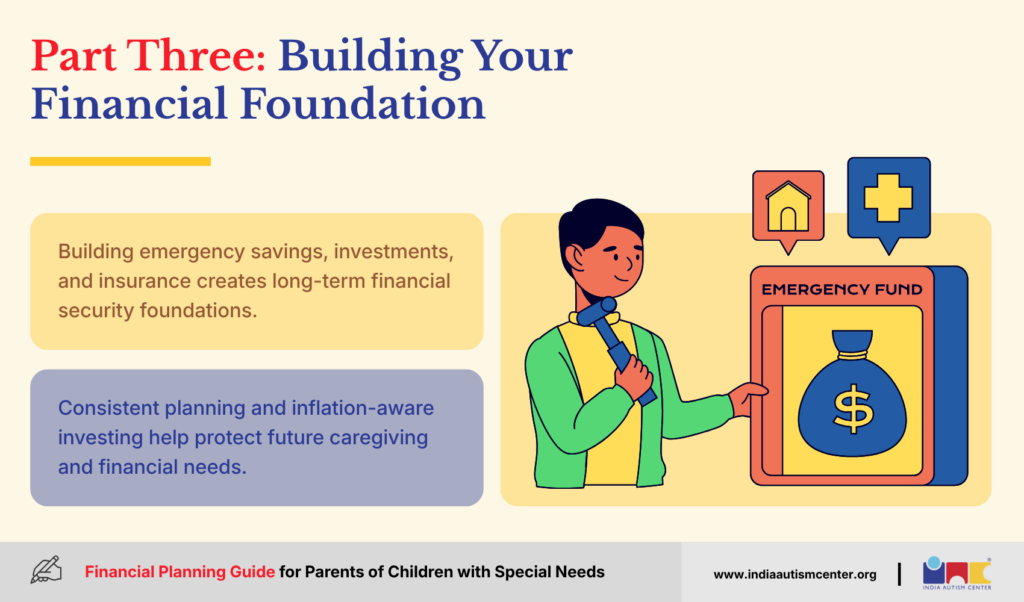
    Create Your Emergency Fund (Your First Priority)

    Before you invest in anything, before you think about the stock market, you must build an emergency fund. This is the most important financial step you will take.

    What is an Emergency Fund?

    It is a pot of money set aside ONLY for unexpected emergencies. Not for a new TV. Not for a family wedding. Only for true crises.

    Why Do You Need One?

    Children with special needs can have unpredictable health issues. Therapies may need to be added suddenly. A caregiver may quit. You may lose your job. Your emergency fund ensures that when life throws a curveball, you do not have to sell your investments or borrow money at high interest rates.

    How Much Should You Save?

    Aim for 6 to 12 months of your TOTAL monthly expenses (everything you wrote down in Chapter 3). If your family spends ₹50,000 per month, your emergency fund target is ₹3,00,000 to ₹6,00,000.

    Where to Keep It:
    This money must be SAFE and EASILY ACCESSIBLE. Do not invest it in the stock market. 

    Keep it in:

    • A savings bank account (preferably one with decent interest)
    • A liquid mutual fund (very safe, can be withdrawn in 1-2 days)
    • Fixed deposits with easy withdrawal options

    How to Build It:

    • Set up an automatic monthly transfer from your salary account to a separate savings account.
    • Start small. Even ₹500 or ₹1000 a month adds up over time.
    • Do not touch this money for anything other than real emergencies.

    Want to know more? Get in touch with us.

    Understand Your Investments

    Once your emergency fund is in place, you can start thinking about long-term investments. This is the money that will grow over decades and eventually support your child.

    The Problem with Keeping All Money in Fixed Deposits:
    Many Indian parents feel safe keeping all their money in Fixed Deposits (FDs), PPF, or savings accounts. This feels safe because the money does not lose value in rupees. But it does lose value in what it can BUY. This is called inflation.

    What is Inflation?

    In simple words, prices go up every year. A ₹100 therapy session today may cost ₹200 in 10 years. If your money only grows at 5% in an FD, but inflation is 6%, you are actually losing purchasing power.

    To beat inflation, you need some investments that can grow faster than inflation.

    Investment Options in India:

    1. For Short-Term Needs (0-3 Years):
      • Savings Account
      • Liquid Mutual Funds
      • Short-Term Fixed Deposits
    2. For Medium-Term Needs (3-10 Years):
      • Debt Mutual Funds
      • Balanced Mutual Funds (mix of debt and equity)
      • Fixed Maturity Plans (FMPs)
      • Recurring Deposits (RDs) for disciplined saving
    3. For Long-Term Needs (10+ Years):
      • Equity Mutual Funds (Stocks): These are essential for long-term growth. They can go up and down in the short term, but over 10-20 years, they have historically given much higher returns than FDs.
        • Options: Large-cap funds (safer), Mid-cap funds (higher risk), Small-cap funds (highest risk), Index funds (simple, low-cost).
      • Public Provident Fund (PPF): Very safe, tax-free, but the money is locked for 15 years. Good for very long-term, safe savings.
      • Sukanya Samriddhi Yojana (if you have a daughter): Excellent interest rate and tax benefits.
      • National Pension System (NPS): Good for retirement planning, with tax benefits.
      • Direct Stocks: Only if you have the knowledge and time to research.

    A Simple Investment Approach:

    • Do not try to get rich quick. Avoid tips and shortcuts.
    • Invest every month through a Systematic Investment Plan (SIP) in mutual funds.
    • Choose 2-3 good diversified equity funds for long-term growth.
    • Increase your SIP amount every year as your income grows.
    • Be patient. Let compounding do its magic.

    What is Compounding?

    Think of it like a snowball rolling down a hill. It starts small, but as it rolls, it picks up more snow and grows bigger and bigger. With investing, your money earns returns. Those returns earn returns. Over time, the growth becomes exponential.

    Example:
    If you invest ₹5,000 per month in an equity fund that gives an average 12% return per year:

    • In 10 years, you will have about ₹11.5 lakhs.
    • In 20 years, you will have about ₹50 lakhs.
    • In 30 years, you will have about ₹1.76 crores.

    This is the power of starting early and staying consistent.

    Want to know more? Get in touch with us.

    Insurance – Your Safety Shield

    Insurance is not an investment. It is protection. It ensures that if something happens to you, your child’s future is not destroyed.

    Types of Insurance You Need:

    1. Term Life Insurance (Essential):
      • This pays a large lump sum to your family if you die during the policy term.
      • It is the cheapest and purest form of life insurance.
      • How much do you need? Calculate the total amount your child will need for their lifetime. This could be ₹1 crore, ₹2 crores, or more. Buy term insurance for that amount.
      • Important: Buy term insurance from a reputable company. Do not mix it with investment plans (like ULIPs or money-back policies) unless you have fully understood them and have a specific need.
    2. Health Insurance (Essential):
      • Medical costs in India are rising fast. A single hospitalisation can wipe out years of savings.
      • Buy a comprehensive health insurance policy for yourself, your spouse, and your child.
      • For your child with special needs: Be very careful. Read the policy wording to understand what is covered and what is excluded. Some policies may exclude pre-existing conditions or certain treatments. You may need to look for specialised policies or be prepared to cover some costs out-of-pocket.
      • Consider a “super top-up” plan for additional coverage at a lower cost.
    3. Critical Illness Insurance:
      • This pays a lump sum if you are diagnosed with a specified critical illness (like cancer, heart attack, stroke).
      • This money can be used for treatment, for modifying your home, or for hiring extra care for your child while you recover.
    4. Personal Accident Insurance:
      • Provides coverage in case of accidental death or disability.

    A Note on Insurance for Your Child:

    In India, it is difficult to get comprehensive health insurance that fully covers all the needs of a child with special needs. This is a reality you must accept. Your financial plan must include a significant amount of money set aside specifically for future medical expenses. Insurance is a help, but it is not a complete solution.

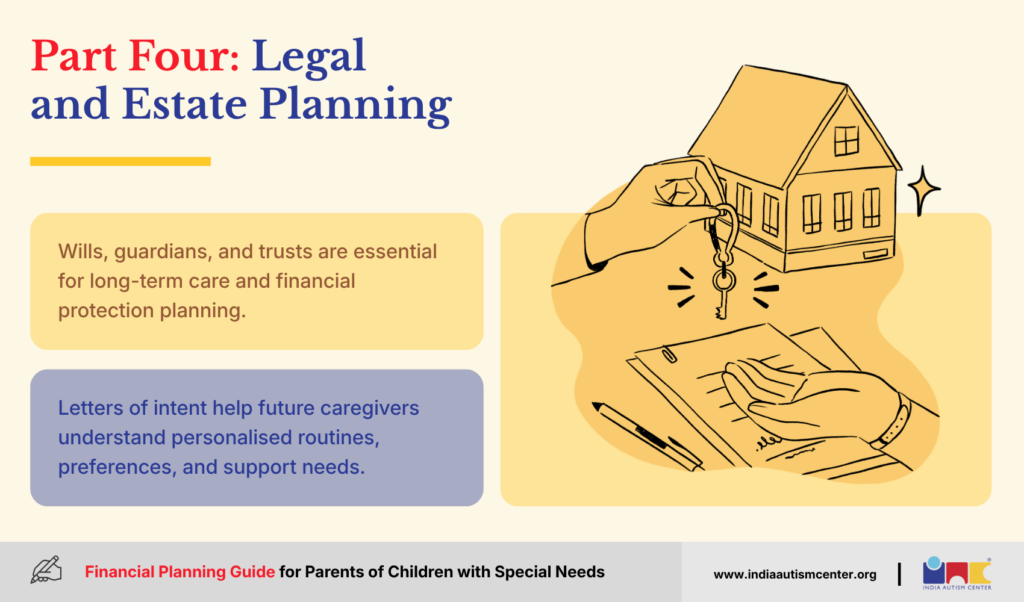
    Part Four: Legal and Estate Planning

    Write a Will – It Is Not Optional

    If you die without a will (called dying “intestate”), Indian law decides who gets your property. For a child with special needs, this can be a disaster. Your assets could go to relatives who may not care for your child as you would wish. There could be disputes. Your child could be left with nothing.

    What a Will Allows You to Do:

    • Decide exactly who gets your property and money.
    • Appoint a guardian for your child (if they are minors).
    • Appoint trustees to manage money for your child’s benefit.
    • Create a trust within your will to protect your child’s inheritance.

    You must consult a lawyer to write a proper will. Do not use a “will kit” or try to do it yourself.

    Appoint Guardians and Trustees

    Guardian: A guardian is the person who will take physical care of your child if you die while your child is still a minor (under 18). Choose someone who:

    • Loves your child.
    • Is willing and able to take on this responsibility.
    • Is likely to be alive and healthy for many years.
    • Shares your values and beliefs about care.

    Discuss this with the person before naming them in your will.

    Trustees: A trustee is a person or an institution (like a bank or a trust company) that will manage the money you leave for your child. This is especially important if your child cannot manage money themselves. You can set up a Private Trust specifically for your child’s benefit. The trust holds your assets, and the trustees use the money to pay for your child’s care according to your instructions.

    You can appoint:

    • Family members you trust.
    • Close friends.
    • A professional trustee (like a chartered accountant or a lawyer).
    • A corporate trustee (like a bank’s trust department).

    Having both a loving guardian and financially responsible trustees ensures your child is cared for personally and financially.

    Write a Letter of Intent

    This is not a legal document, but it is priceless. It is a letter to your child’s future caregivers, explaining everything they need to know.

    What to Include:

    • About Your Child: Their personality, likes, dislikes, routines, fears, and joys. What makes them laugh? What calms them when they are upset?
    • Daily Life: Morning routine, meal preferences, bathroom needs, bedtime routine.
    • Communication: How does your child communicate? Do they use words, signs, pictures, or a device? What do different sounds or behaviours mean?
    • Medical Information: Diagnoses, allergies, medications, doctors, hospitals.
    • Care Needs: Detailed instructions on personal care, supervision needs, and any special handling.
    • Education and Day Activities: What does your child enjoy doing? What programs do they attend?
    • Important People: Names and contact details of family, friends, therapists, and anyone important in your child’s life.
    • Financial Information: Details of the trust, bank accounts, insurance policies, and benefits.
    • Your Hopes and Wishes: What kind of life do you dream of for your child? What values do you want their caregivers to uphold?

    Keep this letter with your will and update it every few years.

    Want to know more? Get in touch with us.

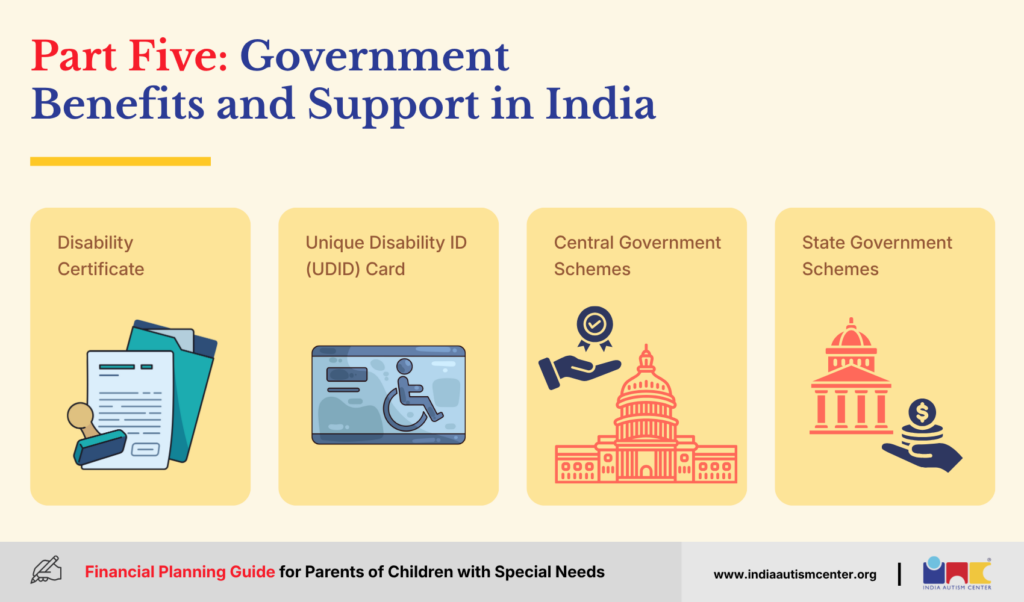
    Part Five: Government Benefits and Support in India

    The Indian government and various state governments have schemes to support persons with disabilities and their families. These benefits can be a crucial part of your financial plan.

    1. Disability Certificate:

    • The first step is to obtain a disability certificate from a government hospital or a certified medical authority.
    • This certificate is the key to accessing most government schemes.

    2. Unique Disability ID (UDID) Card:

    • Register for a UDID card. It is a nationwide database and card that simplifies access to benefits.

    3. Central Government Schemes:

    • National Trust Schemes:
      • Niramaya Health Insurance Scheme: Provides health insurance coverage for persons with autism, cerebral palsy, mental retardation, and multiple disabilities. Premium is subsidised. This is a very important scheme to look into.
      • Gharaunda (Group Home Scheme): Provides funding for group homes for adults with disabilities.
      • Vikaas (Day Care Scheme): Provides day care and respite care for families.
      • Samarth (Respite Care Scheme): Provides short-term care to give families a break.
    • Scholarships for Persons with Disabilities:
      • The Department of Empowerment of Persons with Disabilities (DEPwD) offers scholarships for students with disabilities for school and higher education.
    • Income Tax Exemptions:
      • Under Section 80DD of the Income Tax Act, you can claim a deduction for expenses incurred on the medical treatment, training, and rehabilitation of a dependent with a disability. The amount depends on the severity of the disability (40% or 80%).
      • You can also claim a deduction for payments made to a specified scheme for the maintenance of a dependent with a disability.
    • Concessions in Travel:
      • Persons with disabilities are often eligible for concessions on Indian Railways and some state transport buses. The disability certificate is required.

    4. State Government Schemes:

    Each state in India has its own schemes, which may include:

    • Monthly pension for persons with disabilities.
    • Financial assistance for purchasing assistive devices (tricycles, hearing aids, etc.).
    • Marriage assistance schemes.
    • Housing schemes.

    How to Find Information:

    • Visit the website of your State Social Welfare Department.
    • Visit the website of the Department of Empowerment of Persons with Disabilities (disabilityaffairs.gov.in).
    • Contact local NGOs working in the disability sector. They often have up-to-date information on schemes.
    • Approach your local District Disability Rehabilitation Centre (DDRC).

    Important: Government schemes change. Benefits you are eligible for today may not exist in 20 years. Do not rely entirely on government support. Use it as a helpful addition to your own savings, not as your main plan.

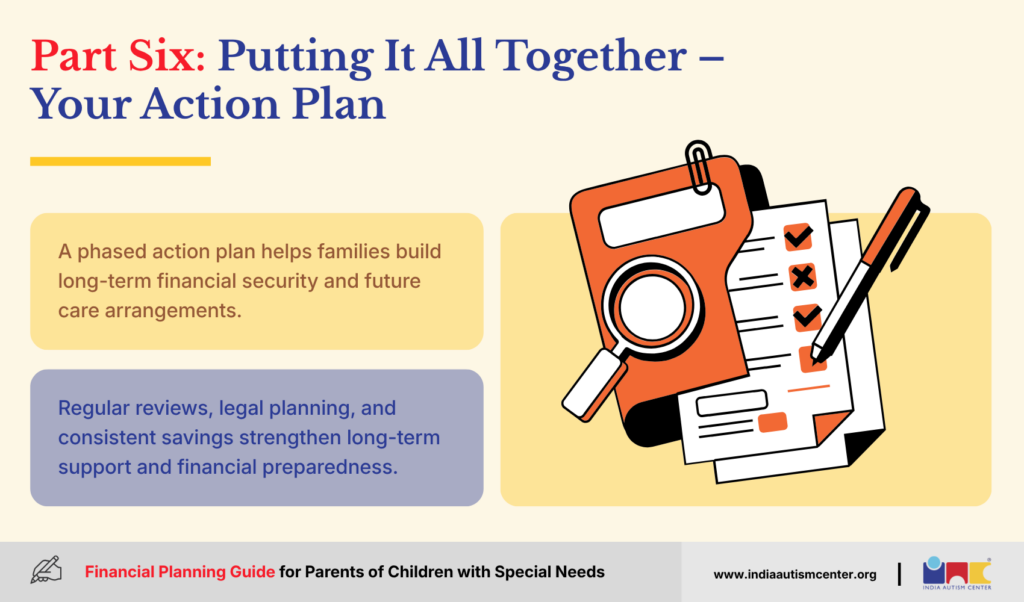
    Part Six: Putting It All Together – Your Action Plan

    You have learned a lot. Now it is time to act. Here is a step-by-step plan you can start today.

    Phase 1: Immediate Steps (This Month)

    • Have the family conversation: Talk to your spouse and close family about long-term plans for your child.
    • Track your expenses: Write down every rupee you spend for one month.
    • Open a separate savings account: This will be the beginning of your emergency fund.
    • Set up a small SIP: Even ₹500 per month in a diversified equity fund is a start.
    • Check your insurance: Do you have term life insurance? Health insurance? If not, start researching.

    Phase 2: Next 3-6 Months

    • Build your emergency fund: Aim for at least 3 months’ expenses, then work toward 6-12 months.
    • Apply for a disability certificate and UDID card: If you haven’t already.
    • Research government schemes: Find out what your state and central government offer.
    • Meet a fee-only financial adviser: Look for one who understands special needs planning. Ask them to help you create a comprehensive plan.
    • Meet a lawyer: Discuss writing a will and setting up a trust.

    Phase 3: Within the Year

    • Write your will: Get it done by a lawyer. Do not delay.
    • Set up a trust: If appropriate for your situation, work with your lawyer to create a trust for your child.
    • Write your Letter of Intent: Start with a few pages and build on it over time.
    • Increase your SIP: If you got a raise, increase your monthly investment amount.
    • Review all insurance: Make sure your coverage is adequate.

    Phase 4: Ongoing (Every Year)

    • Review your financial plan: Set a date each year (e.g., your child’s birthday) to review everything.
    • Update your budget: Check if your expenses have changed.
    • Adjust for inflation: Increase your savings goals to account for rising costs.
    • Review your will and trust: Ensure they still reflect your wishes. Update your Letter of Intent.
    • Check your investments: Are they on track? Do you need to rebalance?
    • Celebrate your progress: You are doing something incredibly important. Be proud.

    Conclusion: You Are Building a Legacy of Love

    Financial planning for a child with special needs can feel overwhelming. There are numbers to calculate, forms to fill, and difficult decisions to make. But always remember what this is really about.

    You are not just saving money. You are building a future where your child is safe, happy, and loved, even when you are not there. Every rupee you save, every policy you buy, every conversation you have is an act of love.

    There will be good days and hard days. Some months you will save more, some months less. That is okay. The important thing is to keep going. Start where you are. Use what you have. Do what you can.

    You can do this. And you do not have to do it alone. Reach out to professionals, connect with other parents, and use the resources available.

    Your child’s future is bright because you are planning for it.

    Please Note: This guide is for educational purposes only and does not constitute financial or legal advice. Please consult qualified professionals for advice tailored to your personal situation. The projections and figures presented in this document are purely illustrative and for planning purposes only. Actual outcomes may differ materially based on market performance, economic conditions, and other prevailing market dynamics.

    For expert insights, support services, and inclusive learning initiatives, visit the India Autism Center.
  • Key Factors to Consider When Selecting an Autism Therapy Center

    Key Factors to Consider When Selecting an Autism Therapy Center

    Selecting the right autism therapy centre can feel confusing and emotional. You want the best support for your loved one. You want progress, dignity and hope. And you want confidence that today’s choice will make a real difference tomorrow.

    In this guide, I’ll walk you through everything you should consider when selecting an autism therapy centre. I’ll also explain how the India Autism Center (IAC) supports you through every step.

    Whether you are just starting your search or narrowing down options, this guide will help you make an informed and hopeful decision.

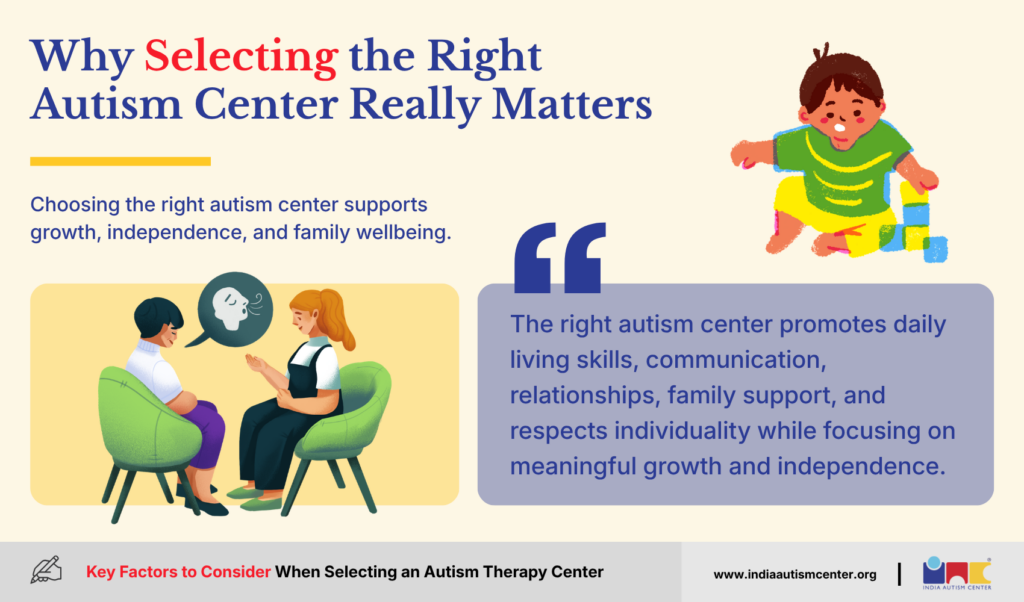
    Why Selecting the Right Autism Center Really Matters

    Choosing a centre is a big decision. It affects your loved one’s day-to-day life, their long-term development, and your peace of mind. The right centre can help someone flourish. The wrong one can lead to stress, frustration, or stagnation.

    Autism isn’t a medical condition that needs “fixing”. It is a form of neurodiversity. Your goal, and IAC’s goal, is to support meaningful growth and independence — not promise “miracle cures”.

    In short, the right centre will:

    • Build skills for daily living
    • Encourage communication and relationships
    • Respect individuality and dignity
    • Offer support for families too

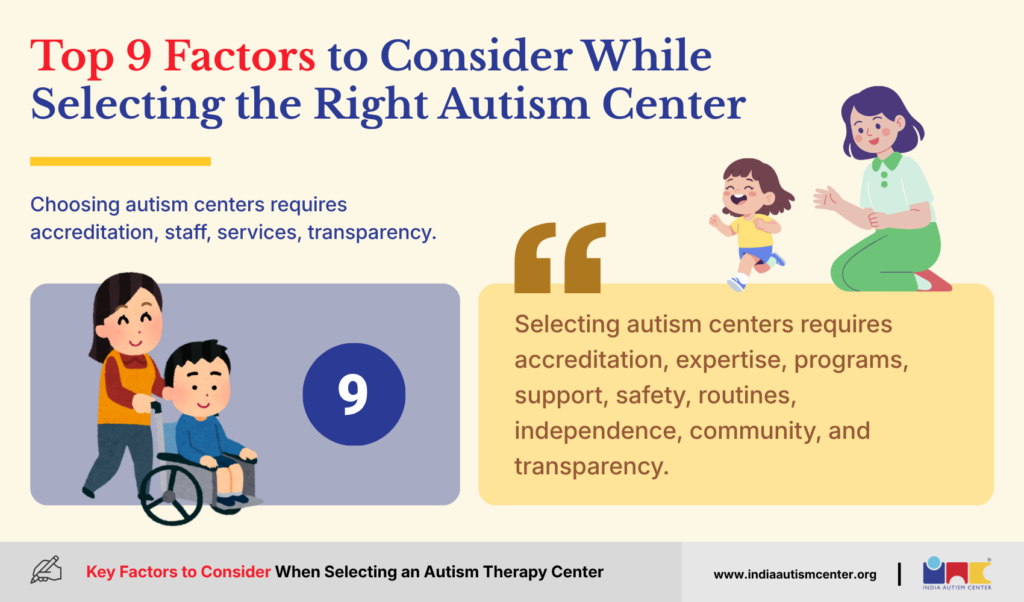
    Top 9 Factors to Consider While Selecting the Right Autism Center

    1. Accreditation and Reputation

    You should always begin your search by checking each centre’s accreditation and reputation. These are the first indicators of quality and professionalism.

    Accreditation means the centre meets recognised standards. This ensures your loved one is in a safe and structured place. Accreditation also means trained staff, regulated procedures, and accepted care standards.

    Online reviews and testimonials are powerful too. Read them carefully. What do other families say about their experiences? Consistent positive feedback shows a reliable track record.

    At India Autism Center, we prioritise transparency and integrity. You can find honest reviews and feedback from families who have experienced our services. We also openly discuss our methods, progress goals, and what you can expect along the way.

    2. Specialised Programs and Therapeutic Services

    Every person’s needs are different — your centre must reflect that

    Autism is a spectrum. No two people have the same strengths, challenges, or needs. That’s why any centre you consider must offer individualised programs.

    Look for centres that provide:

    • Speech and language therapy
    • Occupational therapy
    • Behaviour support
    • Social skills development
    • Sensory support

    A strong centre will combine therapies to suit each person. The goal is progress in communication, daily tasks, social engagement, emotional understanding, and self-confidence.

    At IAC, we build personalised care plans. Every individual’s journey starts with a detailed assessment. We adapt therapy as progress unfolds.

    3. Qualified and Experienced Management and Members of Staff

    Every person’s needs are different — your centre must reflect that

    Autism is a spectrum. No two people have the same strengths, challenges, or needs. That’s why any centre you consider must offer individualised programs.

    Look for centres that provide:

    • Speech and language therapy
    • Occupational therapy
    • Behaviour support
    • Social skills development
    • Sensory support

    A strong centre will combine therapies to suit each person. The goal is progress in communication, daily tasks, social engagement, emotional understanding, and self-confidence.

    At IAC, we build personalised care plans. Every individual’s journey starts with a detailed assessment. We adapt therapy as progress unfolds.

    Want to know more? Get in touch with us.

    4. Family Involvement and Support Services

    You are part of the journey — not standing on the outside

    Family involvement should be a central part of any autism programme. A centre that encourages family engagement helps the individual feel more grounded.

    This means:

    • Regular family updates and meetings
    • Parent education and training
    • Workshops and community support
    • Opportunities for shared activities

    At IAC, family support is core to how we work. We know how hard this journey can be. We stand beside you with counselling, training, and shared experiences.

    Our Samaavesh campus even allows families to stay on-site, reducing disruption to home life while offering consistent support services.

    We strive to provide families with the right emotional support and skills required to effectively support the autistic person and navigate the challenges associated with the disorder. 

    Samaavesh, our residential complex, has two residential programs and one daycare program. The family homes and daycare units are designed to allow families to move onto the campus and make it their home, while the impacted individual attends daycare services and returns home to their family at night, all without leaving the campus.

    5. Safe, Structured and Sensory-Friendly Environment

    For someone with autism, environments matter a lot. Too much noise, bright lights, or chaos can overwhelm sensory systems. That’s why your autism centre must provide a calm, sensory-friendly setting.

    Key environmental features include:

    • Low sensory triggers
    • Clear routines and schedules
    • Safe indoor and outdoor spaces
    • Colour tones that soothe, not overwhelm

    At India Autism Center, we design our physical space with sensory sensitivity in mind. Most people feel calmer, more engaged, and less stressed when their environment respects their sensory needs.

    6. Structured Daily Routine and Activities

    Predictability brings comfort and confidence

    Routine isn’t boring here. A structured schedule helps autistic individuals feel safe. It also supports consistent development.

    Great centres include:

    • Predictable therapy schedules
    • Fixed meal and rest times
    • Recreational activities
    • Group and individual sessions

    A balanced day supports:

    • Emotional regulation
    • Cognitive learning
    • Social confidence

    Every person thrives when there’s a rhythm to the day.

    At IAC, we implement structured routines that support growth and joy. We blend therapeutic activities with leisure, creativity, and social connection.

    7. Life Skills, Independence and Long-Term Development

    A centre shouldn’t just support today — it should build tomorrow

    A strong autism programme teaches:

    • Personal hygiene skills
    • Daily living routines
    • Money management
    • Social independence
    • Work-related confidence

    Therapy isn’t just about immediate needs. It’s about creating future stability and dignity.

    At IAC, we prepare each person for a life as independent as possible. This is life skills training turned into real confidence.

    If you are still confused about how to decide the right residential center, then read the blog on Choosing the Right Residential Care Facility for Autistic Adults.

    8. Community Integration and Social Development

    Integration into community life matters. Centres with activities like:

    • Group outings
    • Social skills groups
    • Community projects
    • Vocational opportunities

    help individuals grow socially and emotionally.

    At IAC, we encourage everyone to engage. We help build social skills that create friendships, confidence, and belonging.

    9. Legal, Ethical and Financial Transparency

    When you’re selecting the right autism centre, you must check:

    • Legal registration
    • Care standards compliance
    • Fee details
    • Long-term sustainability plans

    Only work with centres that are transparent about finances and long-term commitments. Hidden costs or vague information are warning signs.

    India Autism Center is transparent about costs, services, and future planning. No surprises. Just commitment and clarity.

    Want to know more? Get in touch with us.

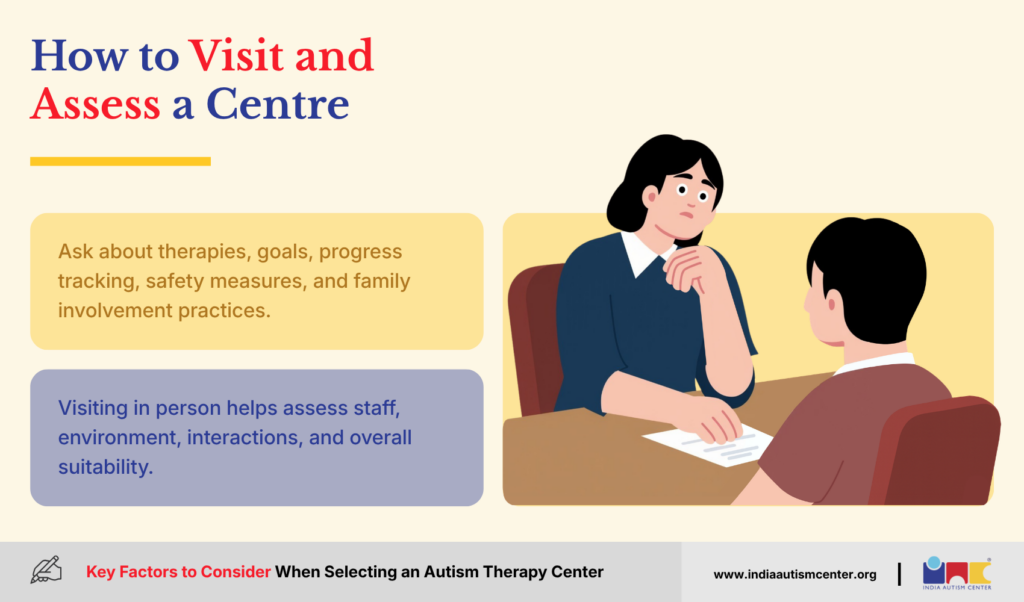
    How to Visit and Assess a Centre

    What to ask when you go there in person

    1. “What therapies are included in care?”
    2. “How do you plan individual goals?”
    3. “What progress indicators do you use?”
    4. “How does the centre involve families?”
    5. “What safety systems are in place?”
    6. “Can I meet the therapists?”

    A personal visit tells you a lot. Trust your instincts.

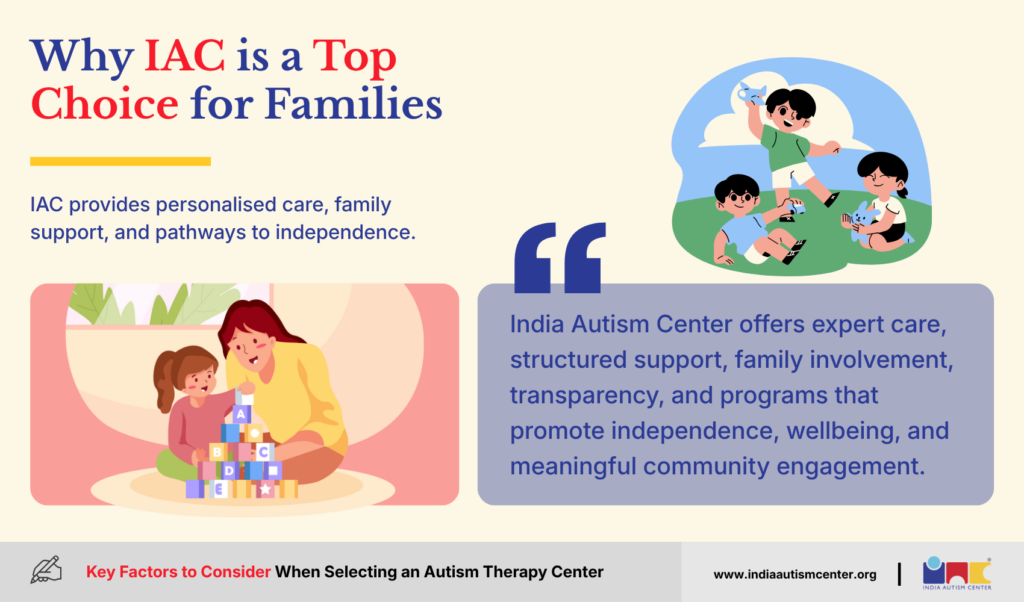
    Why IAC is a Top Choice for Families

    When it comes to selecting the right autism centre, India Autism Center stands out because:

    • It offers personalised care plans for everyone.
    • It prioritises family support and involvement.
    • Staff are trained experts in autism care.
    • IAC builds sensory-friendly, structured environments.
    • The centre prepares individuals for independence.
    • It ensures transparent communication and progress tracking.
    • IAC supports community integration and emotional well-being.

    Conclusion

    Selecting the right autism centre is emotional, demanding — but it’s also hopeful. When you take time to research and ask questions, you make choices that can shape your loved one’s future.

    Remember:

    • Look for qualifications, not promises.
    • Demand transparency, not vague answers.
    • Choose support, not only therapy.
    • Pick a centre that welcomes your whole family.

    And if you’re still unsure — reach out. Centres like India Autism Center are ready to talk with you, guide you, and walk beside you.

    Frequently Asked Questions (FAQs)

    Why is selecting the right autism center so important?

    Selecting the right autism center is crucial because it directly affects an individual’s development, emotional well-being, and independence. The right center offers personalised care, qualified professionals, and a supportive environment that helps autistic individuals build essential life and communication skills.

    What should I look for when selecting the right autism center for my child or adult family member?

    When selecting the right autism center, you should look for qualified staff, individualised therapy plans, family involvement, safe and sensory-friendly facilities, and transparent progress tracking. It is also important to choose a center that focuses on long-term development and independence.

    How does India Autism Center (IAC) help families in selecting the right autism center?

    India Autism Center (IAC) supports families by offering structured, evidence-based programmes, multidisciplinary therapy teams, and continuous family guidance. IAC also provides assessments, progress monitoring, and a supportive residential and day-care environment designed specifically for autistic individuals.

    Can an autism center help improve independence and daily living skills?

    Yes, a good autism center focuses on more than therapy alone. It helps individuals develop daily living skills such as self-care, communication, social interaction, and vocational abilities. Selecting the right autism center ensures that these skills are taught in a structured and supportive setting.

    For expert insights, support services, and inclusive learning initiatives, visit the India Autism Center.

  • Choosing the Right Residential Care Facility for Autistic Adults: Questions to Ask

    Choosing the Right Residential Care Facility for Autistic Adults: Questions to Ask

    Choosing a home for your autistic adult child or loved one is one of the most emotional and important decisions you will ever make. You want safety, dignity and independence. That is exactly why selecting the right autism residential care facility matters so much.

    In this guide, I will walk you through everything you need to know about choosing the right autism residential center. I will also explain how India Autism Center (IAC) supports families in making this transition easier and more meaningful.

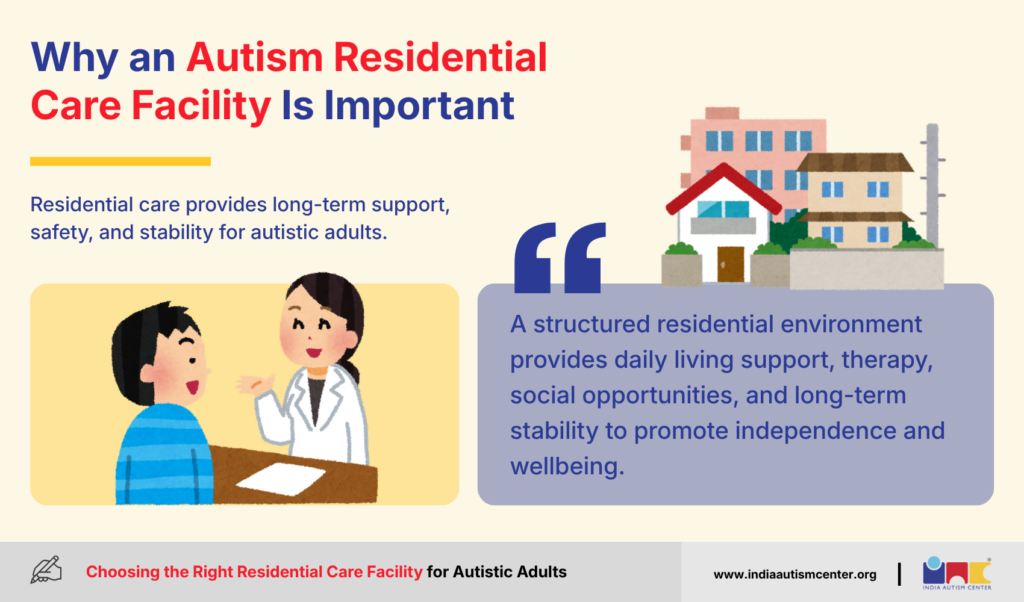
    Why an Autism Residential Care Facility Is Important

    An autism residential care facility is more than just accommodation. It is a structured living environment designed to meet the emotional, social, medical, and daily living needs of autistic adults. Many individuals on the spectrum need ongoing support even after school years are over. However, parents also age. Responsibilities change. Life situations evolve.

    That is where residential care becomes essential. It offers:

    • A safe and supervised living space
    • Daily life skill training
    • Therapy and health support
    • Social engagement opportunities
    • Long-term stability

    When you focus on choosing the right autism residential center, you are planning not just for today but for decades to come.

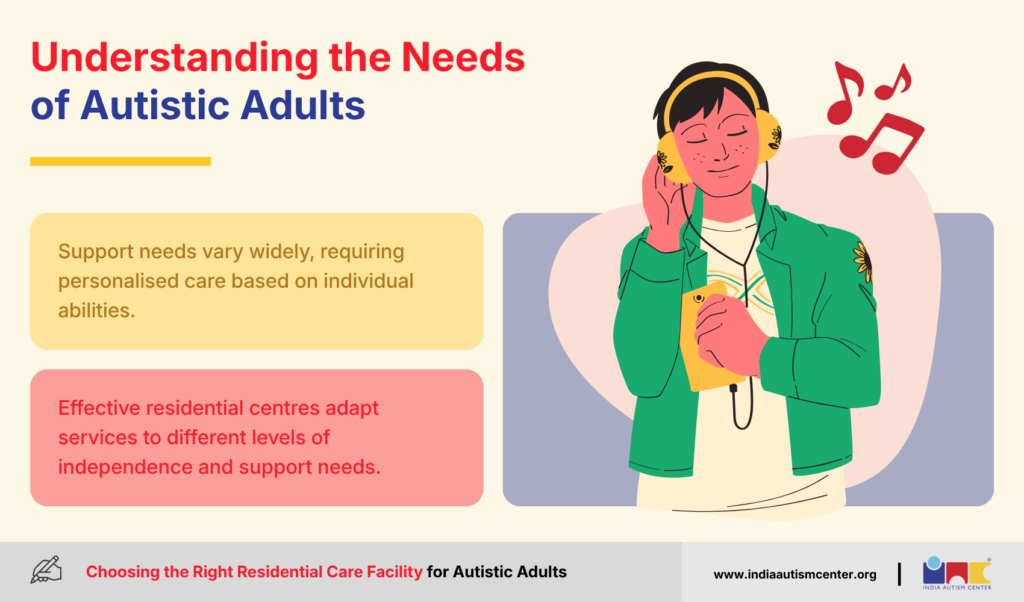
    Understanding the Needs of Autistic Adults

    Before you begin choosing the right autism residential center, you must clearly understand your loved one’s needs. Autism is a spectrum condition. No two individuals are the same. Some adults are highly independent. Others need continuous assistance.

    Ask yourself:

    • Can my child manage personal hygiene independently?
    • Do they need help with communication?
    • Are there behavioural challenges?
    • Do they require medical supervision?
    • What level of social interaction suits them?

    An effective autism residential care facility tailors its services to different levels of support. It does not follow a one-size-fits-all model.

    Want to know more? Get in touch with us.

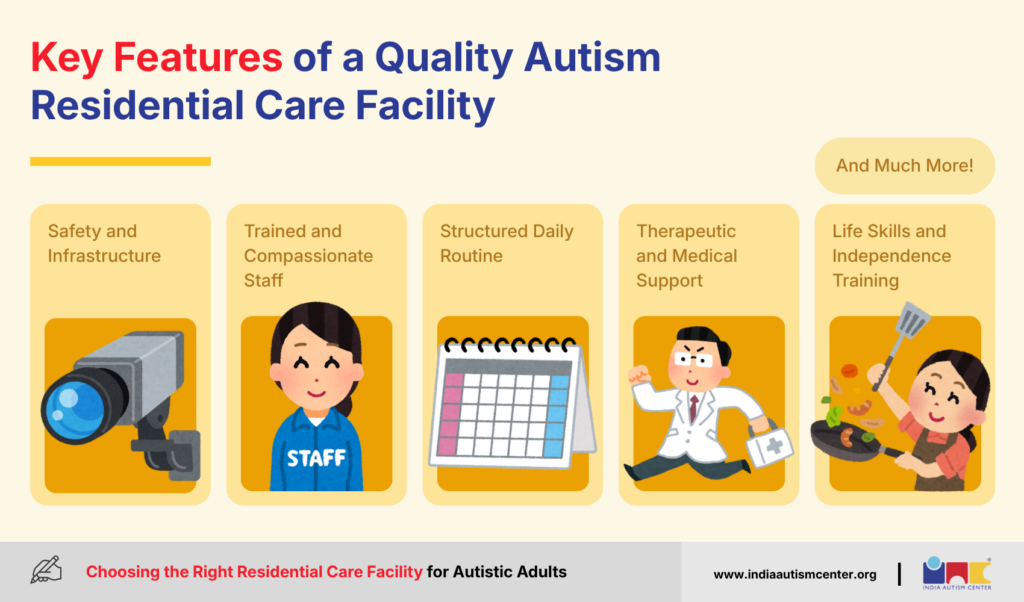
    Key Features of a Quality Autism Residential Care Facility

    1. Safety and Infrastructure

    Safety is non-negotiable. A good residential care home for autism must have:

    • Secure boundaries
    • Sensory-friendly spaces
    • Emergency response systems
    • Clean and accessible rooms

    At India Autism Center, the infrastructure is designed keeping sensory sensitivities in mind. Lighting, colours, and layouts reduce stress and confusion.

    2. Trained and Compassionate Staff

    Staff quality defines the quality of life in a residential facility. Caregivers should be trained in:

    • Autism behavior management
    • Communication strategies
    • De-escalation techniques
    • Personal care assistance

    IAC focuses on continuous staff training. This ensures residents are not only cared for but also understood.

    3. Structured Daily Routine

    Routine brings comfort. A predictable schedule helps autistic adults feel secure. A good autism residential home offers:

    • Fixed meal times
    • Therapy sessions
    • Recreational activities
    • Rest periods

    4. Therapeutic and Medical Support

    A reliable autism residential care facility must provide or coordinate:

    • Occupational therapy
    • Speech therapy
    • Behavioral therapy
    • Psychiatric and medical care

    At IAC, therapy is not optional. It is part of everyday life. Each resident receives individualised care plans based on their abilities and goals.

    5. Life Skills and Independence Training

    Residential care should not mean lifelong dependence. It should promote independence.

    A strong autism residential care facility teaches:

    • Personal hygiene
    • Dressing and grooming
    • Cooking and food handling
    • Money management
    • Basic work skills

    6. Social and Emotional Development

    Loneliness is a serious concern for autistic adults. A well-designed residential home encourages:

    • Group activities
    • Sports and fitness
    • Art and music programs
    • Peer interaction

    7. Family Involvement and Transparency

    You should never feel disconnected. A responsible autism residential home allows:

    • Regular visits
    • Progress updates
    • Family counseling
    • Open communication

    8. Legal, Ethical, and Financial Considerations

    While choosing, you must also check:

    • Legal registration
    • Care standards compliance
    • Financial transparency
    • Long-term sustainability

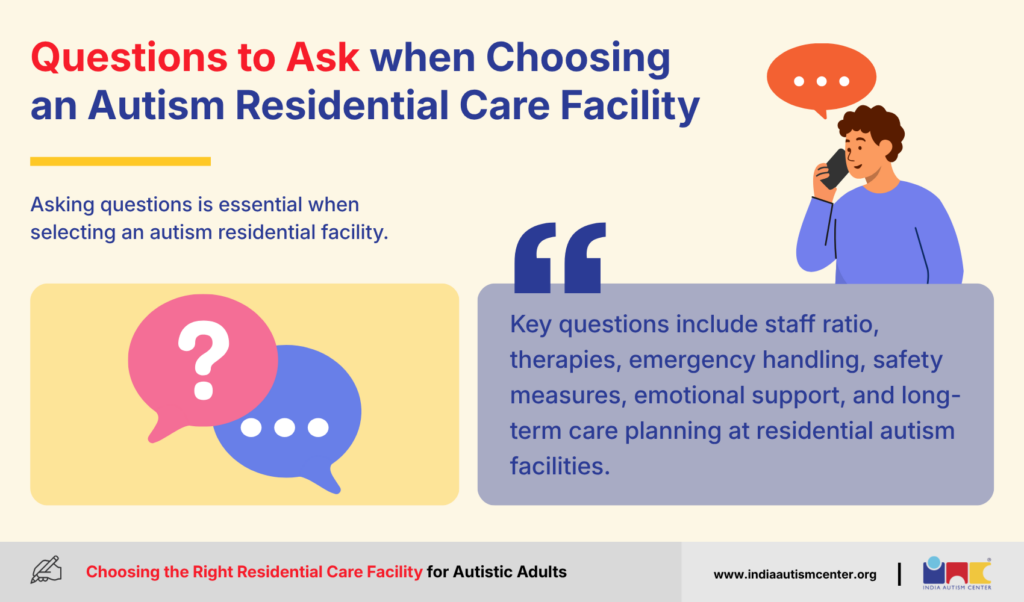
    Questions to Ask When Choosing the Right Autism Residential Care Facility

    When visiting an autism residential facility, ask these questions:

    1. What staff-to-resident ratio do you maintain?
    2. What therapies are included?
    3. How do you handle medical emergencies?
    4. What safety measures are in place?
    5. How do you support emotional well-being?
    6. What is the long-term care plan?

    Want to know more? Get in touch with us.

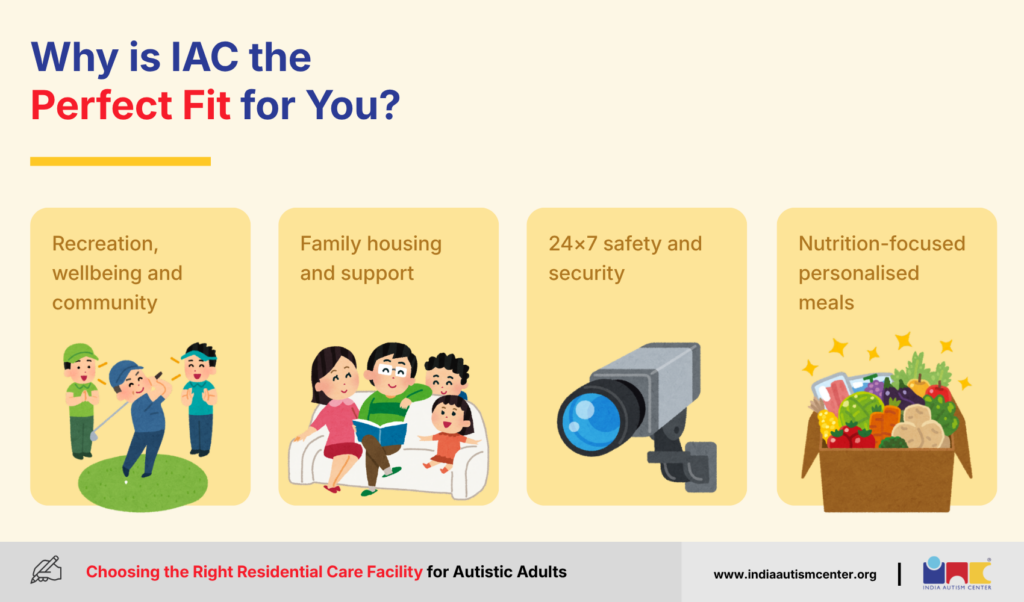
    Why is IAC the Perfect Fit for You?

    1. We are focused on the happiness and well-being of our residents. We believe recreational activities play a crucial role in the quality of life and mental health of autistic individuals. From art and music therapy to outdoor activities and sports. We have it all. Our recreational programmes are structured to promote a sense of belonging and community. It’s an excellent way for our residents to develop emotional bonds, friendships, and fun hobbies.
    2. We understand the importance of family. Our specialised residential facilities for families of autistic individuals help foster a supportive and comfortable living environment. We are aware and sensitive to the challenges that caregivers of autistic individuals face. Our facilities also include a Parents’ Housing Block. Families of autistic individuals can make this their home and enjoy the full support of the IAC family. 
    3. We value the safety of every individual who is part of the IAC family. We have 24×7 patrolling and CCTV surveillance. Once you are a part of the IAC family, your safety is our concern. Not yours. 
    4. We take nutrition therapy very seriously. At IAC, we fully recognise the importance of nutrition therapy for autism disorder. Our kitchen services and nutrition experts take care that mealtimes are customised, nutritious and stress-free. We promise to make every effort to optimise our residents’ gut microbiota. Nutrition therapy is as much a part of our interventions as any other therapy. 

    Conclusion

    Autism residential center is not just about infrastructure. It is about trust, dignity. It is about lifelong care.

    An ideal autism home offers safety, therapy, independence training, and emotional support. It respects individuality and nurtures potential.

    At India Autism Center, residential care is not the end of a journey. It is the beginning of a meaningful and supported adult life.

    If you are planning for your child’s future, start today. Visit facilities. Ask questions. Compare services. And remember, choosing wisely today ensures peace of mind tomorrow.

    Frequently Asked Questions (FAQs)

    What is an Autism Residential Care Facility?

    An autism residential care facility is a specialised living environment that provides long-term housing, therapy, and daily life support for autistic adults.

    When should I consider choosing a residential home?

    You should consider it when your child reaches adulthood or when home care becomes difficult to manage safely and effectively.

    How does India Autism Center support residential care?

    India Autism Center offers structured residential programs with therapy, vocational training, and medical support for lifelong care.

    What should I prioritise when choosing an autism residential center?

    You should prioritise safety, trained staff, therapy access, emotional well-being, and long-term sustainability.

    For expert insights, support services, and inclusive learning initiatives, visit the India Autism Center.
  • Comprehensive Autism Care Facilities in India (Updated)

    Comprehensive Autism Care Facilities in India (Updated)

    When you are searching for reliable support for a loved one with autism, the journey often feels overwhelming. You might ask yourself: Where do I find the right autism care facilities? What services are truly helpful? What will the long-term future look like?

    If you’ve asked these questions, you’re not alone. Many families in India face similar concerns. The good news is that autism care facilities are evolving fast. Today, you can find structured environments, trained professionals, and dedicated communities that truly understand autism.

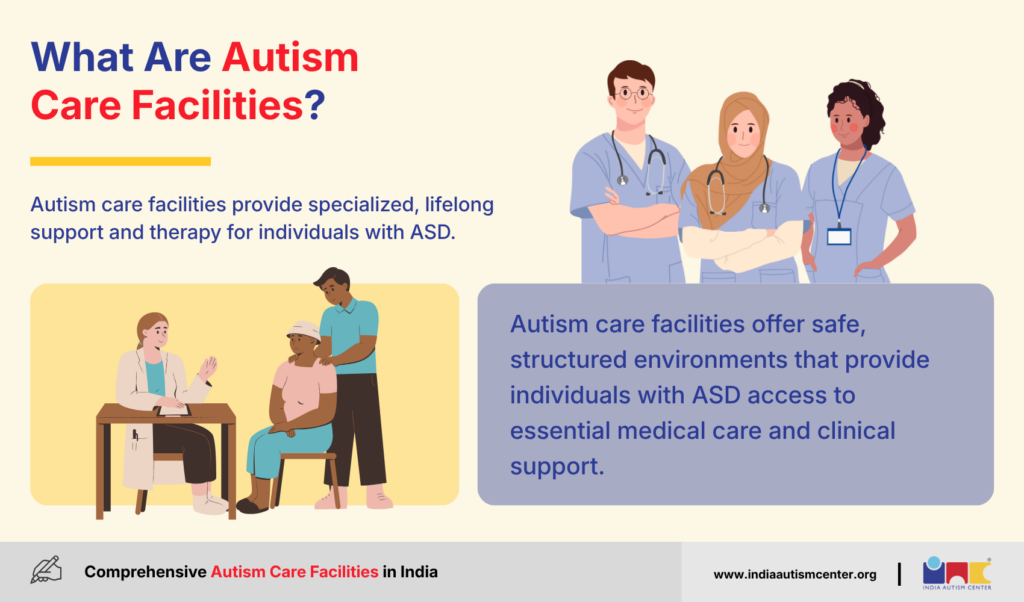
    What Are Autism Care Facilities?

    Simply put, autism care facilities are specialised centres designed to support people with Autism Spectrum Disorder (ASD). These facilities offer targeted services to help individuals grow, learn essential life skills, and live with dignity.

    These services may include:

    • Therapy and skill-building
    • Safe and structured environments
    • Clinical support and medical access
    • Social, recreational and vocational programs
    • Long-term residence or community living options

    The idea is not just therapy — it’s holistic and life-long support.

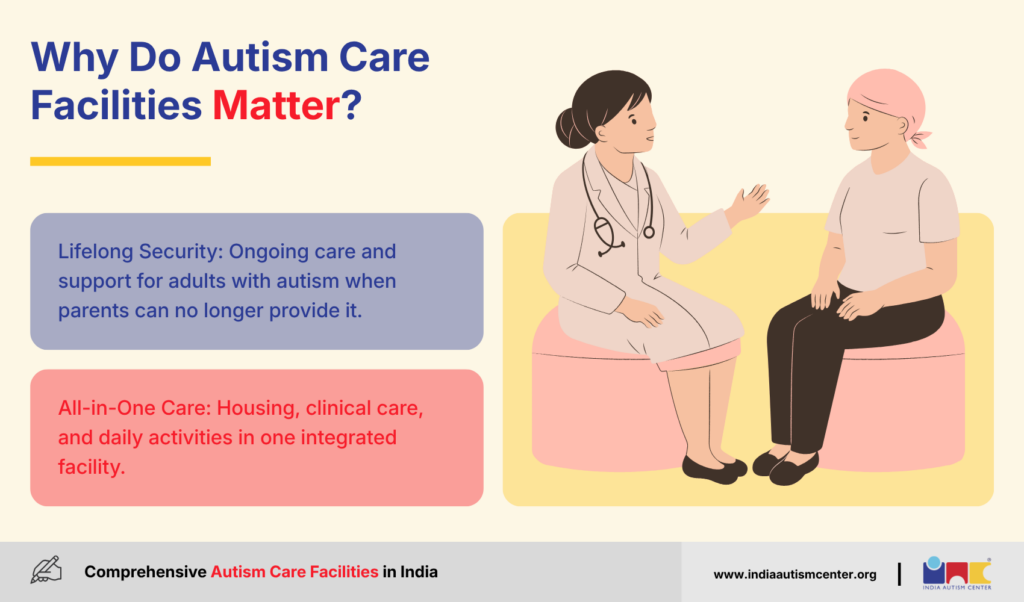
    Why Do Autism Care Facilities Matter?

    When I talk with families, one concern comes up again and again: What happens when parents grow older or are no longer around?

    This is where autism residential facilities become crucial. They offer a secure future, with continuity of care and a structured environment where adults with autism can live meaningfully.

    Most traditional systems quickly become fragmented — clinical care might be in one place, daycare in another, and no one looks at the big picture. That’s why comprehensive facilities are vital.

    Want to know more? Get in touch with us.

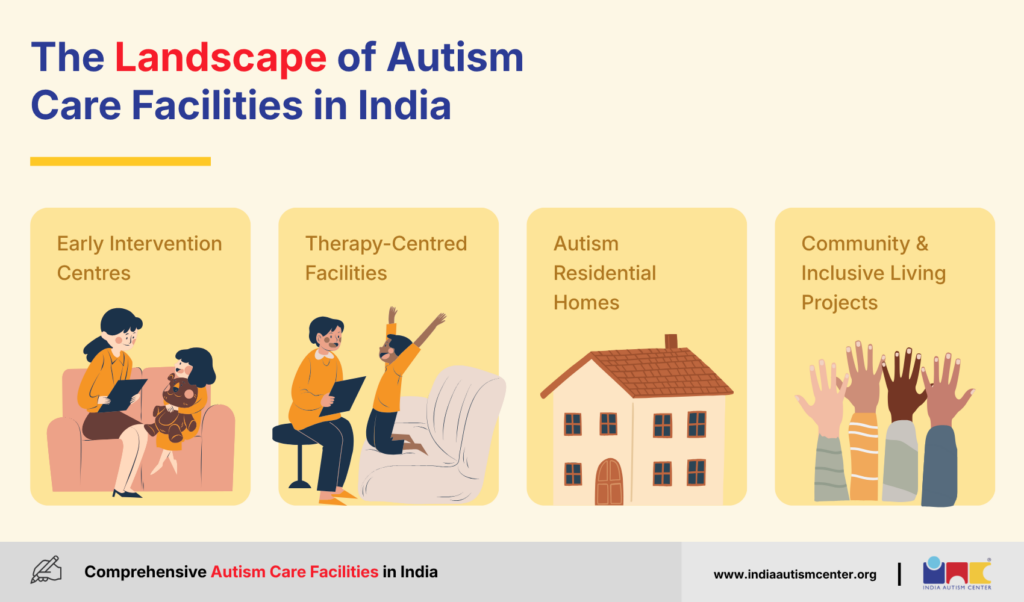
    The Landscape of Autism Care Facilities in India

    Over the past decade, more parents, professionals, and advocates have worked to expand autism infrastructure in India. But the reality remains that resources are still limited compared to other countries.

    We now see a range of support options:

    1. Early Intervention Centres

    These focus on young children and help families with early assessments and therapies like speech, occupational therapy, and behavioural support.
    They improve communication, behaviour, and social skills.

    2. Therapy-Centred Facilities

    Many centres in cities like Kolkata, Delhi, and Hyderabad specialise in evidence-based interventions such as Applied Behaviour Analysis (ABA), sensory integration therapy, and social skills groups. These support continuous growth throughout childhood and adolescence.

    3. Autism Residential Homes

    These facilities offer 24/7 living support for adolescents and adults who require ongoing care. They offer structured routines, personal safety, independence training, and opportunities for social interaction. This is especially crucial for individuals who may not thrive in unstructured environments.

    4. Community & Inclusive Living Projects

    Some newer facilities emphasise community integration, life skills training, and vocational outcomes so that adults with autism can meaningfully participate in society.

    Despite this growth, India still needs more structured, well-equipped and holistic autism care facilities in India, particularly for adult support.

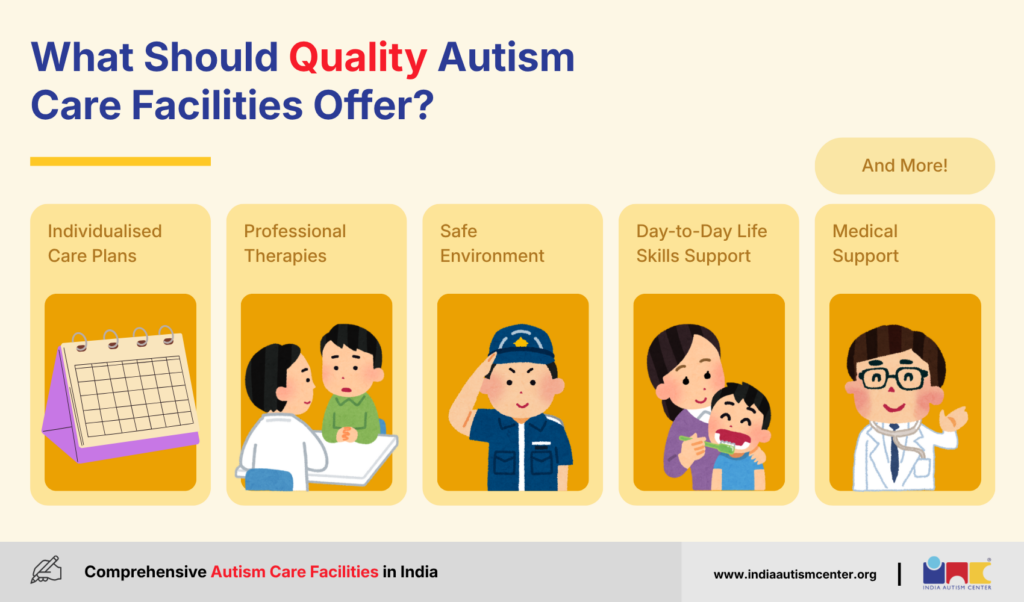
    What Should Quality Autism Care Facilities Offer?

    Whether you’re evaluating centres for your child or loved one, certain services are essential:

    Individualised Care Plans

    No two people with ASD are the same. A great facility evaluates needs and tailors plans accordingly.

    Professional Therapies

    These include behavioural therapy, speech and language therapy, occupational therapy, social skills training, and alternative holistic interventions.

    Safe Environment

    Security, supervision, and safety-focused design are core features of reputable facilities.

    Day-to-Day Life Skills Support

    Daily routines, personal care, community participation, and life skills matter just as much as therapy.

    Medical Support

    Ready access to healthcare professionals, ambulance services, and continuous medical monitoring when needed.

    Recreational Activities

    Engagement through art, music, sports, and vocational opportunities builds confidence and joy.

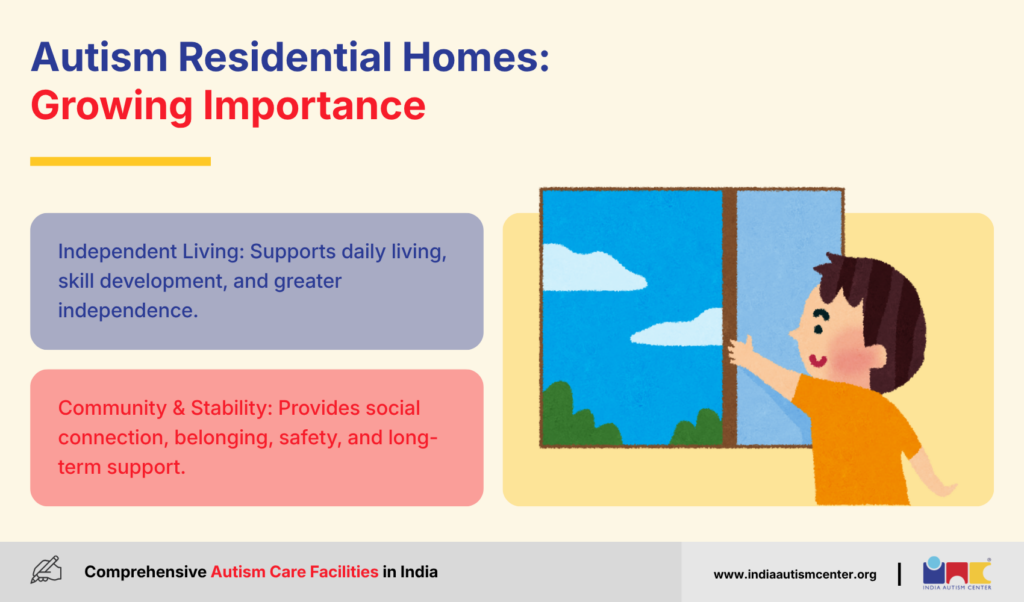
    Autism Residential Homes: Growing Importance

    For many families, the biggest question is what comes after schooling ends. That’s where autism care facilities play a key role.

    These homes offer:

    • Supported daily living
    • Social inclusion opportunities
    • Skill development for independence
    • Emotional and community connection
    • Long-term stability and safety

    Ultimately, a residential home isn’t just a “place to stay” — it’s a place to grow, belong, and thrive.

    Want to know more? Get in touch with us.

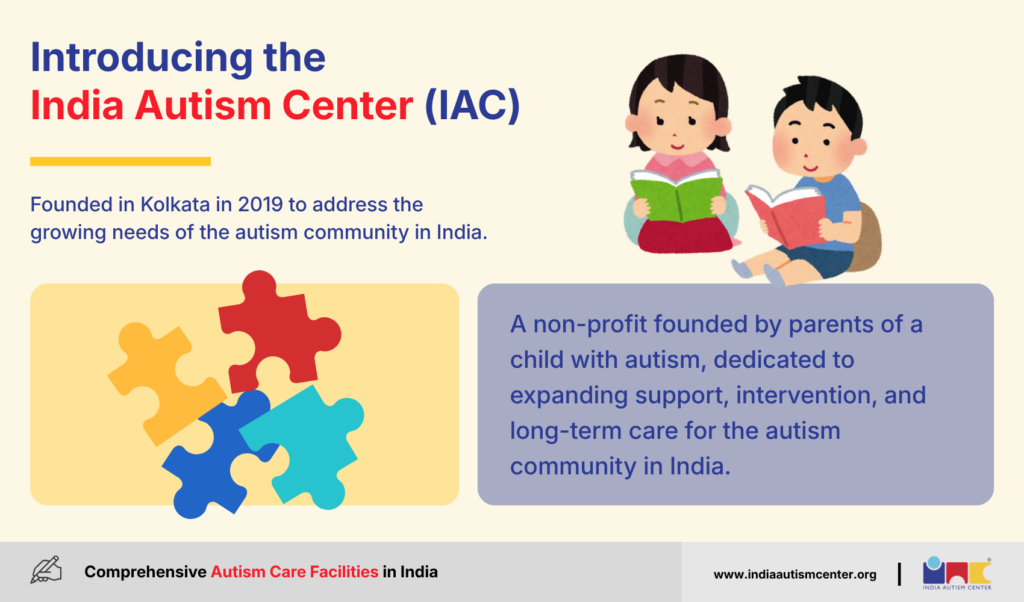
    Introducing the India Autism Center (IAC)

    We are a non-profit organisation based in Kolkata, founded in 2019. The incentive behind establishing the India Autism Center was personal since our founders, Mr Suresh Somani and his wife, Mrs Namita Somani, are parents to a child with Autism Spectrum Disorder.

    The challenges and struggles they faced while parenting a child with a neurodevelopmental disorder led to Mrs Namita Somani setting up the Amrit Somani Memorial Center in 2008.

    While providing interventions to 100+ special students, it came to our notice that the increasingly urgent and critical needs of the ASD community in India were far beyond what ASMC could take on.

    This led to the birth of the India Autism Center and our journey towards becoming the best autism center in India to provide autism intervention.

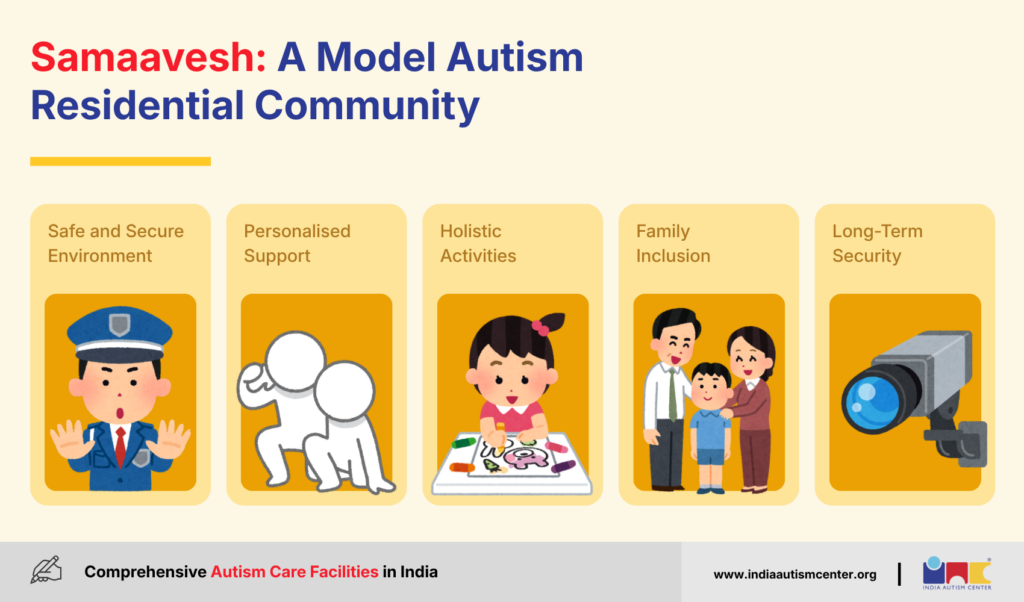
    Samaavesh: A Model Autism Residential Community

    One of the standout initiatives by IAC is Samaavesh — a purpose-built residential campus dedicated to individuals with autism and related conditions. It’s more than a home; it’s a community designed with care and growth in mind.

    Safe and Secure Environment

    The campus prioritises safety with trained caregivers, supervision, and infrastructure that supports the well-being of residents.

    Personalised Support

    IAC builds individualised care plans for each resident with input from clinicians and specialists.

    Holistic Activities

    Residents engage in daily routines that mix clinical therapy with recreation, wellness, vocational experience, and community living.

    Family Inclusion

    A unique part of IAC’s model is the Family Living Program, where families can stay together while accessing on-site care.

    Long-Term Security

    IAC offers guidance on legal guardianship, financial planning, and trust formation — so families can secure future care for their loved ones.

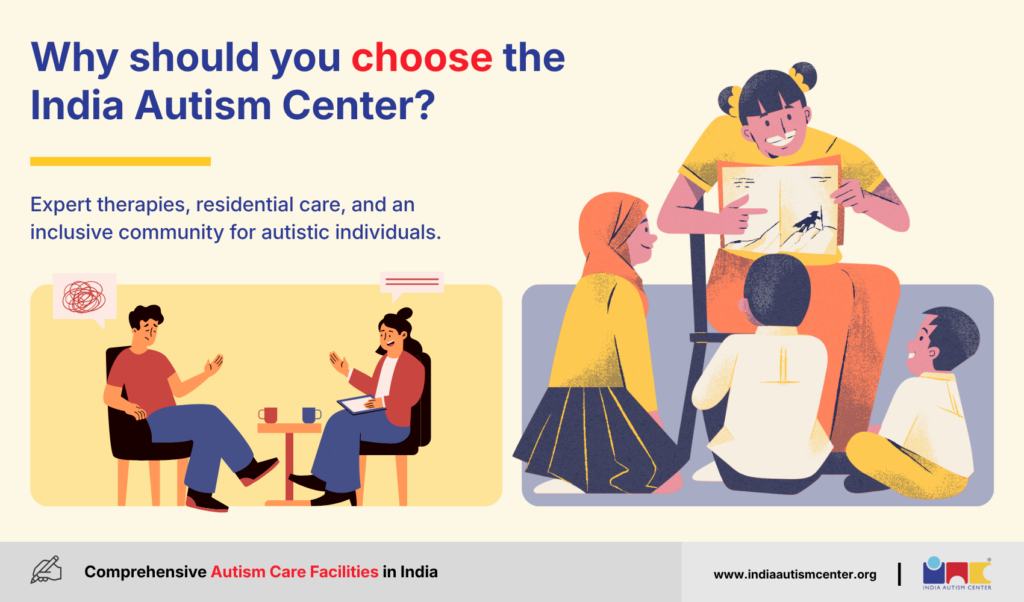
    Why should you choose the India Autism Center?

    When you’re choosing a facility or support system, it helps to know what sets one apart.

    Here’s what IAC brings to the table:

    • We offer a wide range of clinical interventions that are essential for the holistic development of autistic individuals.
    • Not only do we prioritise occupational therapy, which is aimed at learning essential life skills and encouraging independence, but our experts are trained to work with individuals to boost their sensory integration, motor skills and other fine skills.
    • We aim to offer various types of interventions and therapies, including clinical and therapeutic. Our in-house faculty of experienced teachers and therapists will work to empower those with ASD. At the same time, our 24/7 medical facilities and multiple housing units on the campus will create a supportive and safe environment.
    • We dedicatedly support the autistic individual and enable their parents, teachers and caregivers with the required skills and tools. The goal is to optimise the autistic individual’s ecosystem
    • Our residential programmes will include family housing and daytime support.

    We strive to create a community at our autism center that can address the real problems faced by families impacted by ASD. “Samaavesh”- a residential campus is currently being built to create a space where boundaries between families and their children on the spectrum are broken.

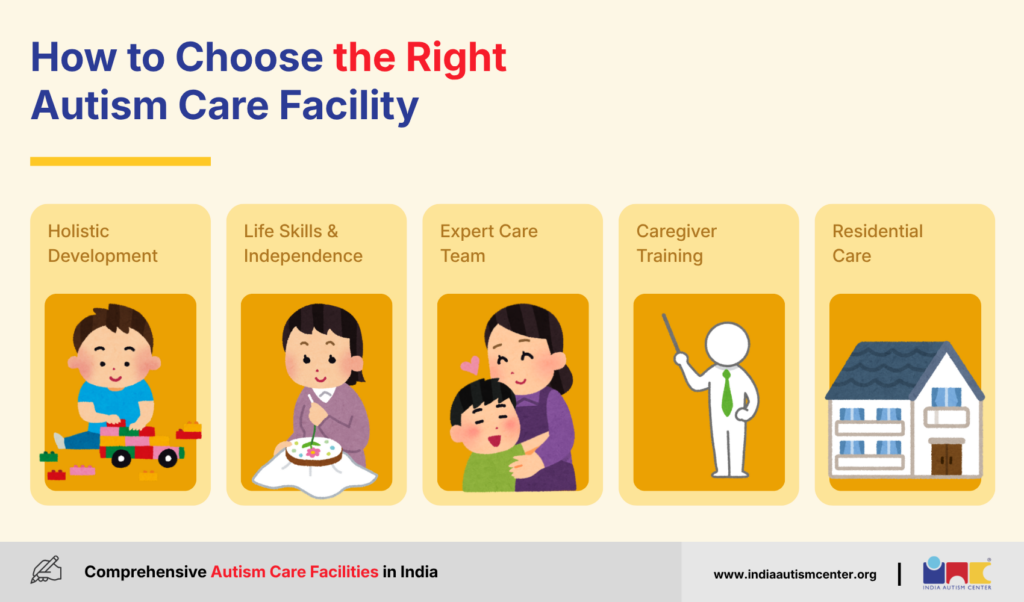
    How to Choose the Right Autism Care Facility

    When you look for autism residential facilities in India, keep these tips in mind:

    • Visit and observe the environment.
    • Ask about personalised care plans.
    • Check for trained staff and qualified therapists.
    • Learn about daily routines and life-skills support.
    • Understand safety and medical support.
    • Ask about community and family engagement.
    • Check long-term planning options — especially if you’re thinking about adulthood.

    Conclusion

    Autism Care Facilities are more than buildings. They are communities of support, learning, safety, and opportunity. Whether it’s specialised therapy centres or Autism Residential Homes, these institutions are essential to ensuring a fulfilling life for individuals with autism.

    Today, organisations like the India Autism Center are redefining what care looks like in India. From residential communities like Samaavesh to professional training and research, IAC is helping families find confidence, stability, and hope.

    If you are exploring Autism Care Facilities in India, start with a clear understanding of your goals, your loved one’s needs, and what quality care should encompass. Then connect with centres that mirror your values and provide evidence-based, compassionate support.

    Frequently Asked Questions (FAQs)

    What are Autism Care Facilities, and how do they help?

    Autism Care Facilities are specialised centres that support individuals with Autism Spectrum Disorder across different life stages. They provide therapies, structured routines, life-skills training, medical support, and safe environments. These facilities help individuals build independence, improve communication, and live with dignity while also supporting families.

    Are there reliable Autism Care Facilities in India?

    Yes, there are growing numbers of Autism Care Facilities in India, especially in major cities. These include therapy centres, day programs, and Autism Residential Homes for long-term support. Organisations like the India Autism Center (IAC) offer comprehensive care models that combine residential living, therapy, training, and community engagement.

    Who should consider Autism Residential Homes?

    Autism Residential Homes are ideal for adolescents and adults with autism who need continuous support, structured living, and long-term security. Families often consider residential homes when independent living is challenging or when planning for the future care of their loved ones.

    How does the India Autism Center (IAC) support individuals and families?

    The India Autism Center (IAC) provides holistic autism care through residential communities, professional training, research, and family-centred programs. IAC focuses on personalised care, safety, skill development, and long-term planning to ensure individuals with autism can live meaningful and supported lives.

    For expert insights, support services, and inclusive learning initiatives, visit the India Autism Center.
  • Safe and Supportive Residential for Autism: Assisted Living & Residential Environment

    Safe and Supportive Residential for Autism: Assisted Living & Residential Environment

    When you have a child or adult with autism, one of the biggest questions you may ask is: Where and how to find a safe and supportive residential facility for autism? For many families, this leads to exploring assisted living, residential campuses for autism, and environments designed specifically for neurodiverse individuals.
    In this guide, I’ll walk you through everything you need to understand about creating and choosing a safe and supportive residential for autism

    I’ll also show you how the India Autism Center (IAC) is making such supportive environments a reality.

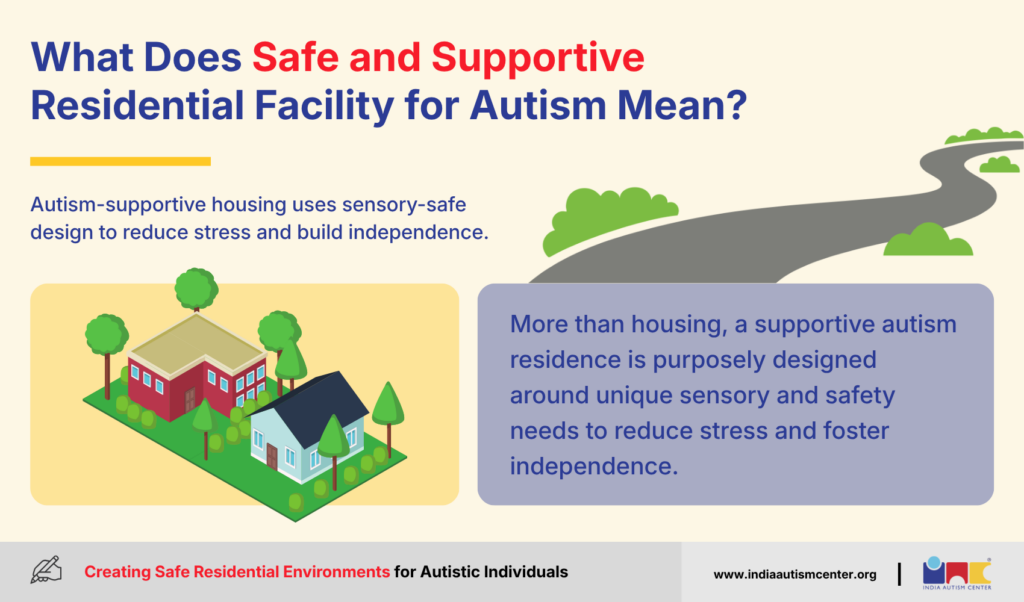
    What Does Safe and Supportive Residential Facility for Autism Mean?

    When we talk about a safe and supportive residential facility for autism, we aren’t just talking about four walls and a roof. We are talking about environments built around sensory needs, safety, comfort, connection, and independence.

    Since people with autism experience the world differently. Sounds, lights, textures, people, schedules, and everyday things that neurotypical people may take for granted can become sources of stress or confusion for autistic individuals.

    That means good residential spaces, whether in your home, an assisted living community, or a dedicated campus, must be designed with these differences in mind.

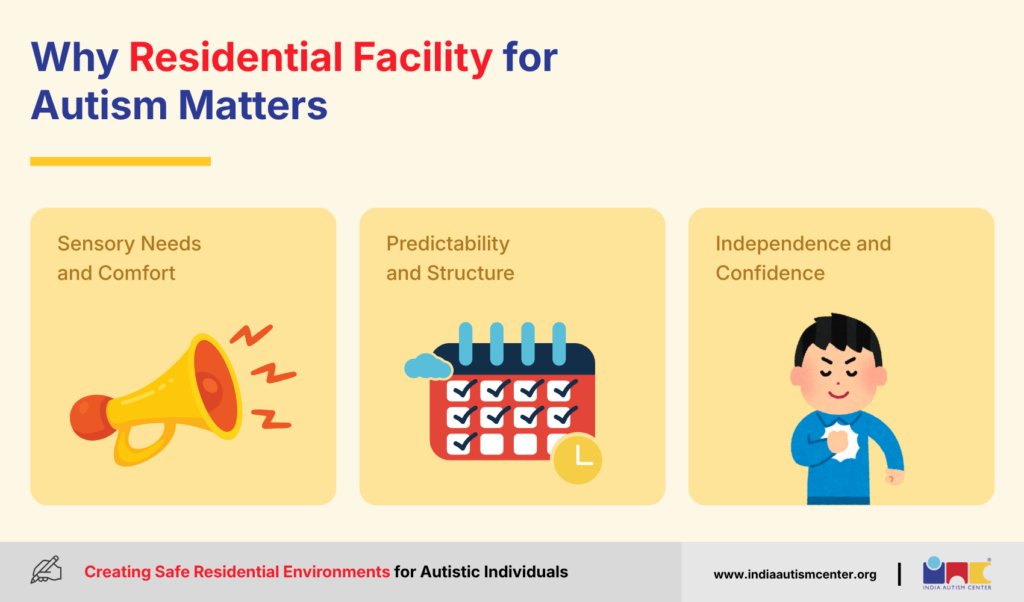
    Why Residential Facility for Autism Matters

    Before deciding where the best place for an autistic person to live, it’s important to understand why these environments are different:

    1. Sensory Needs and Comfort

    Most individuals with autism spectrum disorder (ASD) have sensory differences. They may be:

    • Sensitive to certain sounds
    • Visually affected by bright lighting
    • Distressed by sudden movements or loud noises
    • Calmed by routines and predictable spaces

    That is why spaces with quiet rooms, low sensory stimulation, and clear layouts make a big difference. Loud or chaotic spaces often cause anxiety or discomfort. Well-designed environments can reduce those stressors and help your loved one thrive.

    2. Predictability and Structure

    People with autism usually function best in settings with routine, order, and clarity. That’s why so many families ask:

    A structured environment with consistent staff, clear routines, and predictable activities helps reduce anxiety and supports independence. This becomes especially important when transitioning from childhood living arrangements to adulthood.

    3. Independence and Confidence

    Real independence isn’t about doing everything without help. It’s about being safe, supported, and able to make choices. The right residential environment encourages independence while still providing care and support when needed.

    Whether it’s vocational activities, daily life skills, or communication training, the right space helps your loved one grow and gain confidence.

    Want to know more? Get in touch with us.

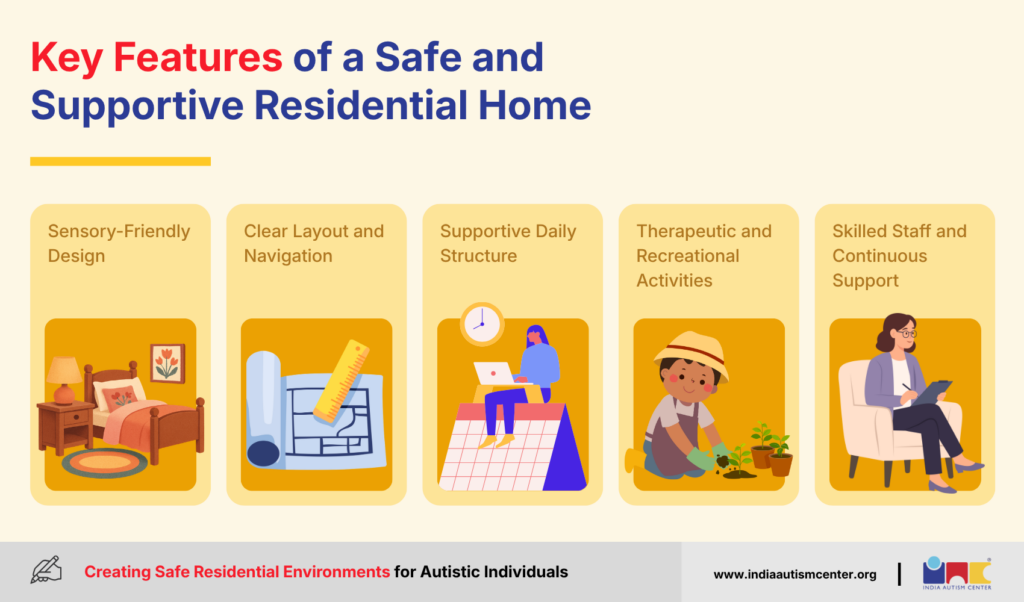
    Key Features of a Safe and Supportive Residential Home

    Let’s break down exactly what makes a home or residential campus truly suitable for autistic individuals.

    1. Sensory-Friendly Design

    Rooms and outdoor spaces should be calm, quiet, and predictable. This means:

    • Minimal clutter
    • Soft lighting
    • Reduced noise levels
    • Calm colour schemes
    • Areas free from sudden sensory triggers

    So, these considerations prevent sensory overload and help your loved one focus on what matters most: living comfortably and meaningfully each day.

    2. Clear Layout and Navigation

    Simple and intuitive floor plans help autistic individuals move around with confidence. Signage, wayfinding tools, and visual cues help people navigate independently.

    This should be part of any residential campus for autism or a supportive community. It reinforces autonomy while reducing confusion and frustration.

    3. Supportive Daily Structure

    Supportive residential settings balance structure with flexibility. Which means:

    • Daily routines with consistent schedules
    • Structured mealtimes
    • Therapy at scheduled times
    • Free time for hobbies and social interaction

    4. Therapeutic and Recreational Activities

    High-quality residential facilities, such as those provided by India Autism Center, include programs that are part of life—not extras. Activities like:

    • Art and music therapy
    • Gardening and outdoor games
    • Occupational therapy
    • Swimming
    • Drama and social bonding sessions

    are all woven into daily life to support both enjoyment and development.

    5. Skilled Staff and Continuous Support

    A safe and supportive residential care for autism must have trained professionals who understand autism deeply. This includes:

    • Therapists
    • Caregivers trained in sensory needs
    • Medical staff on site or available quickly
    • Support for communication differences

    Not to mention these ongoing support builds trust and helps residents explore independence confidently.

    Want to know more? Get in touch with us.

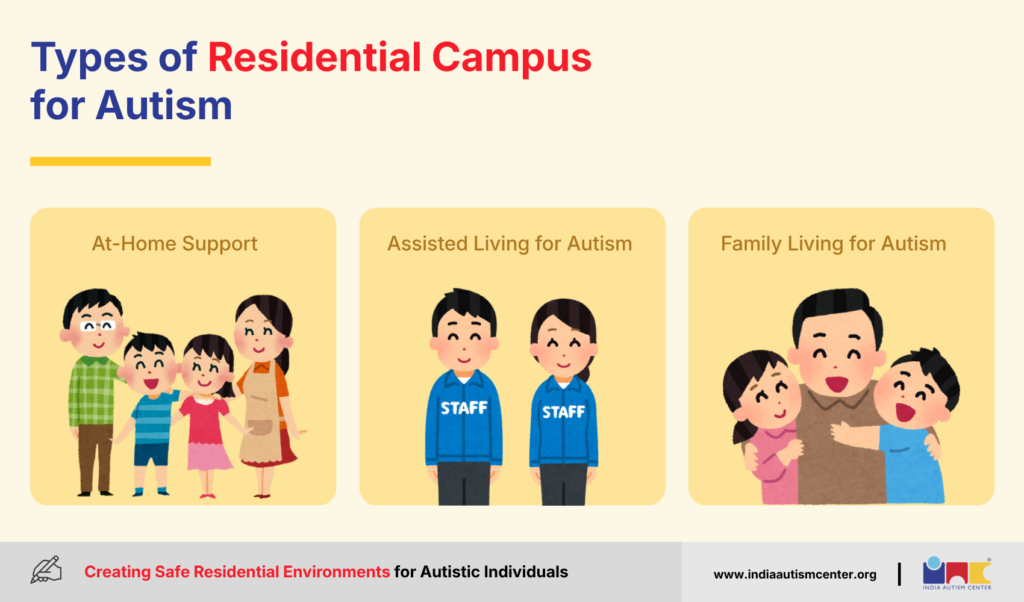
    Types of Residential Campus for Autism

    Now that we know what good design looks like, let’s explore the types of residential environments you might consider:

    1. At-Home Support

    Many families choose to create a safe residential campus environment within their own home. Features might include:

    • Sensory-friendly rooms
    • Visual schedules
    • Low-stimulus areas
    • Family-supported routines

    This is especially common for younger children or adults who prefer familiar surroundings.

    2. Assisted Living for Autism

    Assisted living gives individuals support with daily tasks while allowing them autonomy. It is perfect for people who are ready to live outside the family home but still need reliable daily care.

    In assisted living environments tailored for autism, there might be:

    • Support staff available 24/7
    • Personalised care plans
    • Assistance with life skills

    This setup can be ideal for individuals transitioning into adulthood. It bridges the gap between full dependency and complete independence.

    3. Family Living for Autism

    A purpose-built residential campus for autism focuses entirely on peace of mind for neurodiverse individuals and their families. Family living is designed from the ground up to support:

    • Sensory needs
    • Safety and security
    • Personal growth

    This is where places like India Autism Center’s Samaavesh step in. It is built with holistic care in mind, combining living spaces, therapies, vocational training, and social opportunities all in one campus.

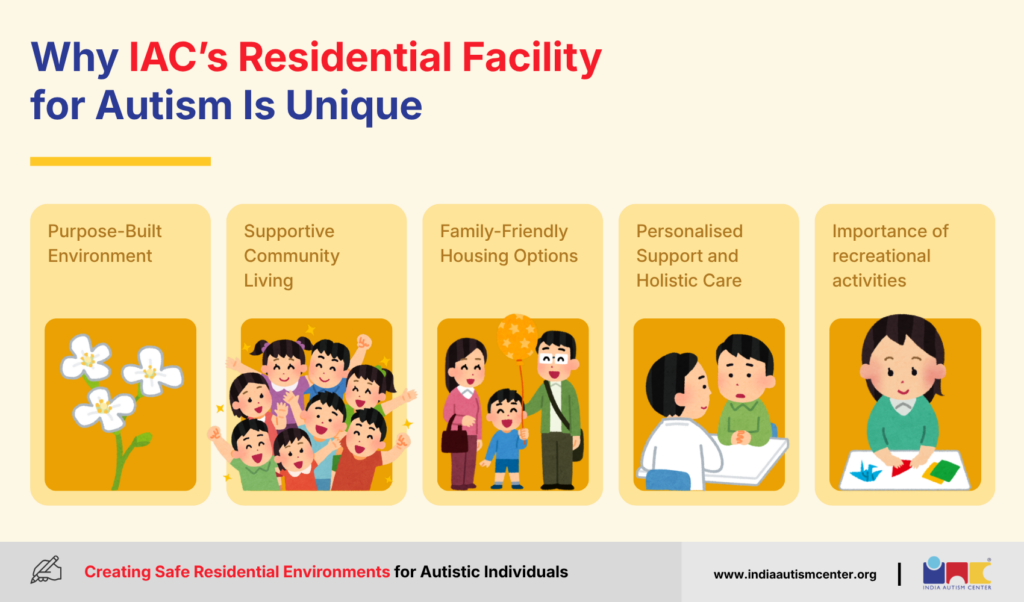
    Why IAC’s Residential Facility for Autism Is Unique

    Here’s what makes the India Autism Center stand out:

    Purpose-Built Environment Just Outside Kolkata

    IAC’s residential campus, called Samaavesh, is designed specifically for autistic individuals. It lies in a quiet, peaceful setting close to nature—perfect for minimising sensory stress and providing a calm atmosphere that families dream about.

    Supportive Community Living

    In the first place, at IAC, residents are part of a community. They live in homes that are designed with sensory needs in mind. These aren’t just bedrooms—they are spaces that help your loved one feel understood, safe, and supported every day.

    Family-Friendly Housing Options

    IAC even offers family living options, where parents or relatives can stay within the same residential ecosystem. So in this way, your autistic family member has continuity of care and connection, without daily travel stress.

    Personalised Support and Holistic Care

    The IAC team builds personalised plans for every resident. These include:

    • Occupational therapy
    • Speech and language support
    • Vocational training
    • Recreational programs
    • Medical care with 24/7 emergency support

    Importance of recreational activities in a residential facility for autism

    At IAC, we also recognise the importance of recreational activities in a residential facility for autism. Together with art and music therapy, we offer a wide range of fun activities, including outdoor pursuits. Hobbies play a pivotal role in improving the quality of life of autism-impacted individuals. 

    Focus on Independence and Growth

    Not only will your loved one live at IAC, but they will grow and evolve. With life skills training, real-life experiences, and opportunities to build confidence every day, IAC empowers residents to set and reach their life goals.

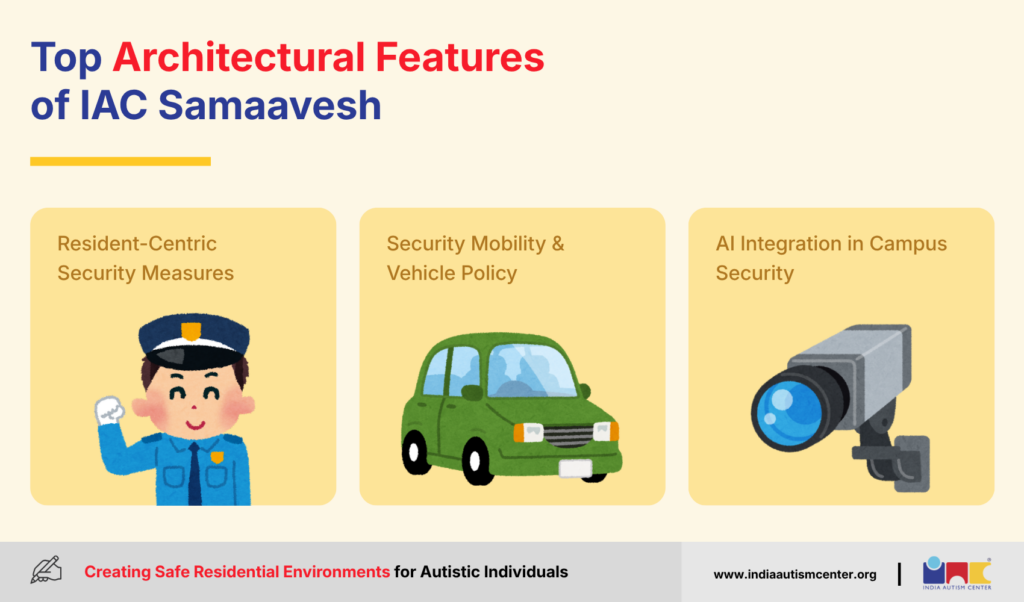
    Top Architectural Features of IAC Samaavesh

    Resident-Centric Security Measures

    • Vehicle restrictions within residential and care zones
    • Secured zones and time-restricted access to sensitive areas
    • Soft, quiet, and intrusion-free security movement
    • AI-assisted event detection with human validation

    Security Mobility & Vehicle Policy

    • Silent, predictable, and non-threatening mobility
    • Limited diesel/petrol vehicles inside resident zones
    • No sirens, horns, reverse beepers, or public address (PA) systems

    AI Integration in Campus Security

    • AI video analytics on CCTV & thermal cameras
    • Human vs animal differentiation
    • Crowd build-up, loitering & intrusion detection

    Choosing the Right Residential Facility for You

    When you ask “Where is the best place for an autistic person to live?”, the answer depends on individual needs and family preferences. But here’s a checklist that can help you decide:

    • Is the environment quiet and sensory-friendly?
    • Are the staff trained in autism and communication support?
    • Is there a structured yet flexible daily routine?
    • Are recreational and therapeutic activities included?
    • Is there strong safety and security?
    • Can the family stay connected or even live nearby?

    Hence, we believe that recreational programmes are not just time fillers. They are an important part of autism therapy. These activities also help in forming friendships and bonds. An important social activity, again integral to autism therapy.

    Conclusion

    Choosing a safe and supportive residential facility for autism is one of the most important decisions you will make for your loved one’s future. Whether you start with home adaptations, explore assisted living, or choose a dedicated residential campus for autism, remember this:

    Supportive environments do more than house a person—they nurture growth, empower independence, and celebrate individuality.

    With this in mind, at the India Autism Center, we believe that every individual deserves a place where they can feel secure, valued, and understood. Through thoughtful design, caring professionals, and a community-centric approach, we make that belief real for every resident and family

    Frequently Asked Questions (FAQs)

    What is a safe and supportive residential facility for autism?

    A safe and supportive residential for autism is a living environment designed to meet the sensory, emotional, and daily living needs of autistic individuals. It focuses on safety, predictable routines, sensory-friendly spaces, trained caregivers, and opportunities for independence. These homes help individuals feel secure while supporting their growth and well-being.

    Where is the best place for an autistic person to live?

    The best place for an autistic person to live depends on their individual needs, age, and level of independence. Some thrive at home with support, while others benefit from assisted living or a residential campus for autism. Purpose-built facilities like those developed by India Autism Center (IAC) offer structured care, therapy, and community living in a safe and calm environment.

    How is assisted living different from a residential facility for autism?

    Assisted living supports individuals who can manage some daily activities independently but still need help with routines, safety, or healthcare. A residential facility for autism is more specialised. It is designed specifically for autistic individuals and includes sensory-friendly infrastructure, autism-trained staff, therapy services, and structured daily programs tailored to neurodiverse needs.

    Is there a safe residential home for an autistic child in Kolkata?

    Yes, the India Autism Center (IAC) offers a thoughtfully designed residential campus for autism near Kolkata. It provides a safe, inclusive, and supportive living environment with therapy, education, vocational training, and medical support. IAC focuses on long-term care, independence, and quality of life for autistic individuals and peace of mind for families.

    For expert insights, support services, and inclusive learning initiatives, visit the India Autism Center

Privacy Overview

This website uses cookies so that we can provide you with the best user experience possible. Cookie information is stored in your browser and performs functions such as recognising you when you return to our website and helping our team to understand which sections of the website you find most interesting and useful.