Category: Training Courses

  • Why Autism Training is Important for Educators

    Why Autism Training is Important for Educators

    As educators, you help others learn, grow, and find their place in the world. But what happens when a child’s learning needs are different from those of their peers? Without the right tools and understanding, you and your school may struggle to support neurodiverse learners effectively. That’s why autism training for educators is not just beneficial — it’s essential.

    In this blog, I’ll walk you through what autism training is, why it matters in the classroom, and how it transforms both teaching and learning. I’ll also break down practical strategies you can use right now in your school or classroom.

    What Is Autism Training for Educators?
    Autism training for educators is structured learning designed to help teachers understand autism spectrum disorder (ASD) and adapt their teaching to meet the needs of autistic students. It provides strategies for recognising behaviours, managing sensory needs, encouraging communication and building inclusive classrooms.

    You might think this sounds like academic training, but it’s much more. It’s about seeing each child as a whole person and discovering ways to make your teaching more effective for them.

    When I first encountered structured autism training, I noticed a shift in how I approached learning environments. It moved me from guessing what autistic children needed to confidently choosing strategies that work.

    Why Autism Training Matters in Education
    In schools today, autistic learners are becoming more common. They may be eager to participate but overwhelmed by sensory input, social challenges, or communication differences. Yet many teachers still feel uncertain about how to support them.

    Research shows that without proper training, teachers can misread behaviours, miss opportunities to help, and unintentionally exclude students from full participation. Understanding autism isn’t about lowering expectations — it’s about meeting needs so students can demonstrate their true potential.

    Let’s break down how autism training makes a real difference.

    Key Reasons to Invest in Autism Training for Educators
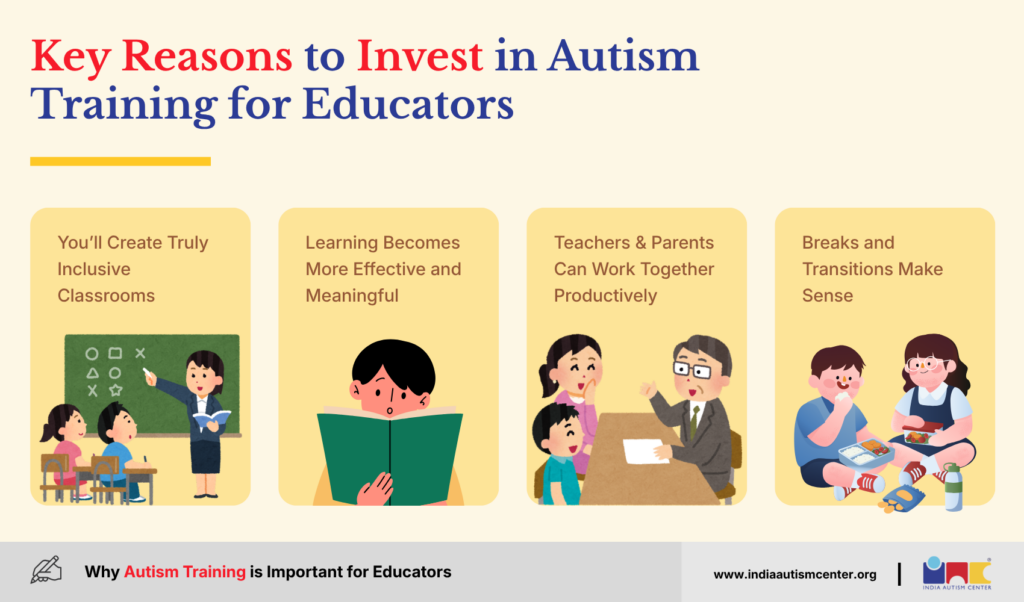
    1. You’ll Create Truly Inclusive Classrooms

    Autism training helps teachers design learning spaces where students feel safe and comfortable. This isn’t just about physical access — it’s about emotional and cognitive support too. In an inclusive classroom, every learner feels recognised, respected and ready to engage.

    Effective autism training teaches you to recognise sensory triggers, adjust lighting or noise levels, and shape lessons in ways that reduce anxiety.

    This transforms school from a place of overwhelm into a place of belonging.

    2. Learning Becomes More Effective and Meaningful

    When you understand how autistic learners process information, you can tailor your teaching accordingly. For example, some students may thrive with visual schedules, while others prefer quiet corners to regroup.

    These strategies are rooted in autism training principles that emphasise clarity, structure and support — not mere accommodation.

    Instead of guessing what a student needs, you’ll make informed changes that improve focus, engagement, and confidence in learning.

    3. Teachers and Parents Can Work Together Productively

    Autism training equips you to collaborate with parents in ways that matter. You and a child’s caregivers become partners in learning, not separate voices in different worlds.

    You’ll learn how to share observations clearly and build shared expectations. Together, you can create strategies that work at home and at school, reinforcing progress in a consistent way.

    Partnership strengthens trust — and that’s vital for every child’s learning journey.

    4. Breaks and Transitions Make Sense

    Autistic learners often benefit from pauses during the school day. These don’t disrupt learning — they support it.

    Autism training teaches you to recognise when a child needs a break and how to use calming sensory activities effectively. This could be anything from a quiet walk to noise-cancelling headphones for sensitive moments.

    These breaks aren’t optional extras — they help reduce overwhelm and boost readiness to learn.

    Autism Training Helps You Understand Diverse Behaviour
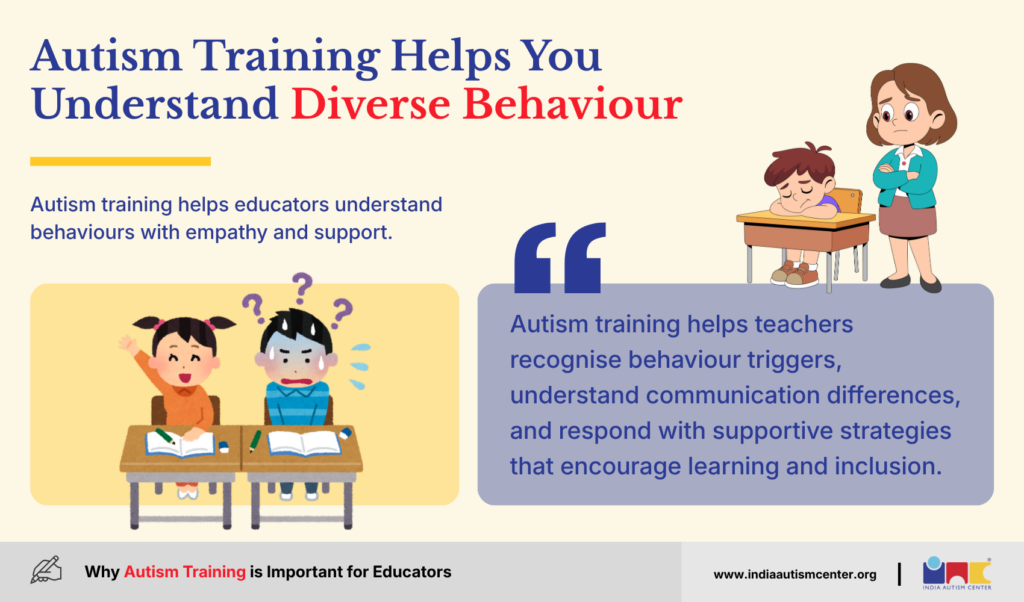
    You might already see behaviours in class that don’t fit typical moulds — avoiding eye contact, repetitive movements, or frustration with changes in routine. With autism training, you begin to understand these not as “problems” but as meaningful communication.

    Training helps you identify behaviour triggers and respond in ways that support learning rather than shame or correction.

    When you understand the why behind behaviours, you can act with empathy and clarity.

    How Autism Training Improves Communication Skills
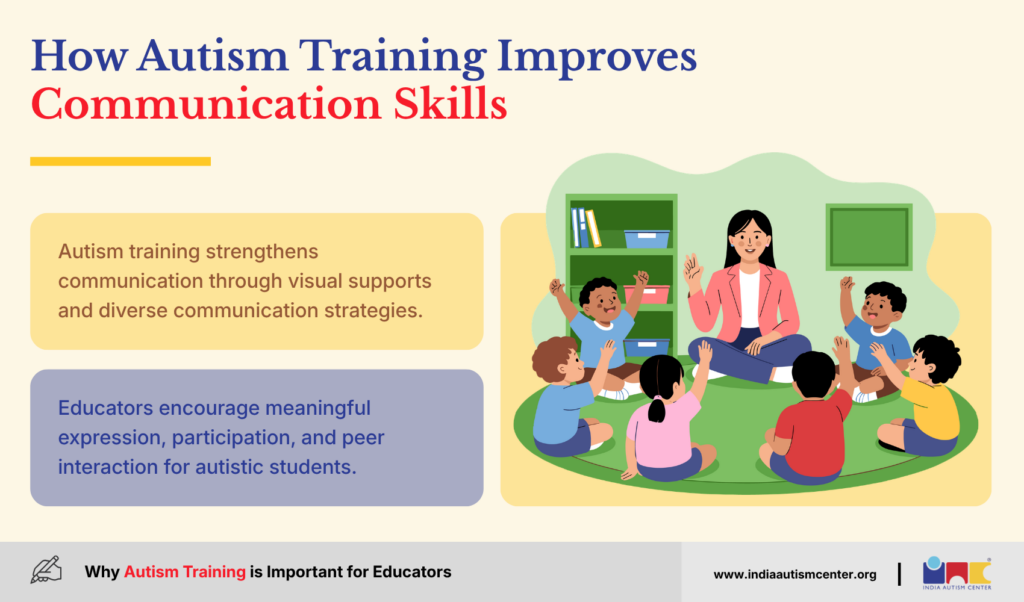
    Communication looks different for each learner. Some students speak fluently but struggle socially. Others might need assistive tools or alternative methods to express themselves.

    Autism training gives you insight into:

    • Recognising non-verbal cues
    • Using visual supports to clarify instructions
    • Encouraging peer communication in structured ways

    This enriches your teaching and gives autistic students louder voices in the classroom.

    Making Lessons Sensory-Friendly
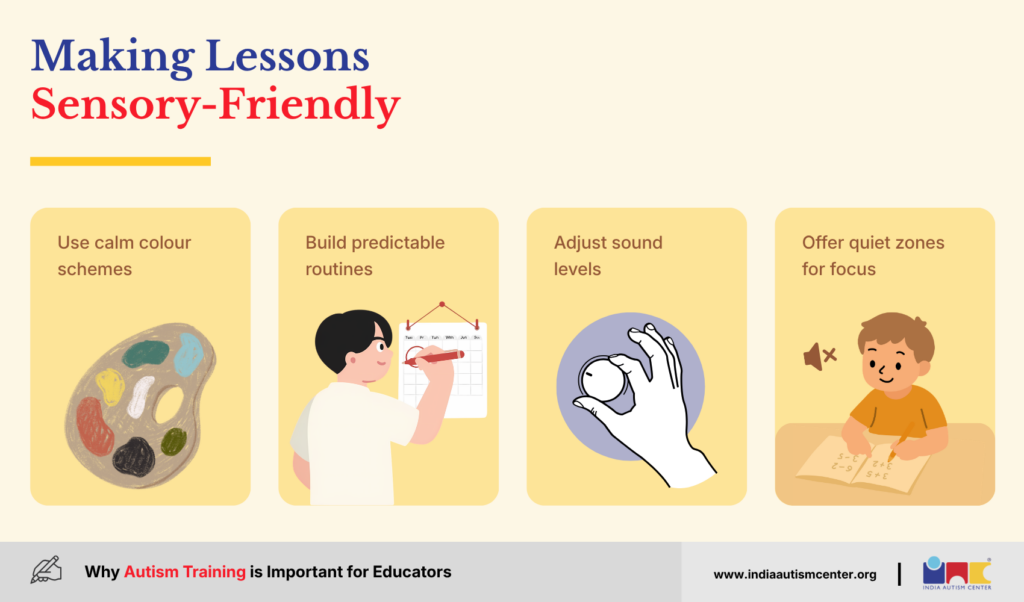
    Autistic students often have unique sensory needs. Loud bells, bright lights or crowded hallways can become obstacles to learning.

    In autism training, you learn to:

    • Use calm colour schemes
    • Build predictable routines
    • Adjust sound levels
    • Offer quiet zones for focus

    These adjustments boost comfort and allow students to engage more fully. Small changes can make a big difference to participation.

    Practical Strategies You Can Apply Today
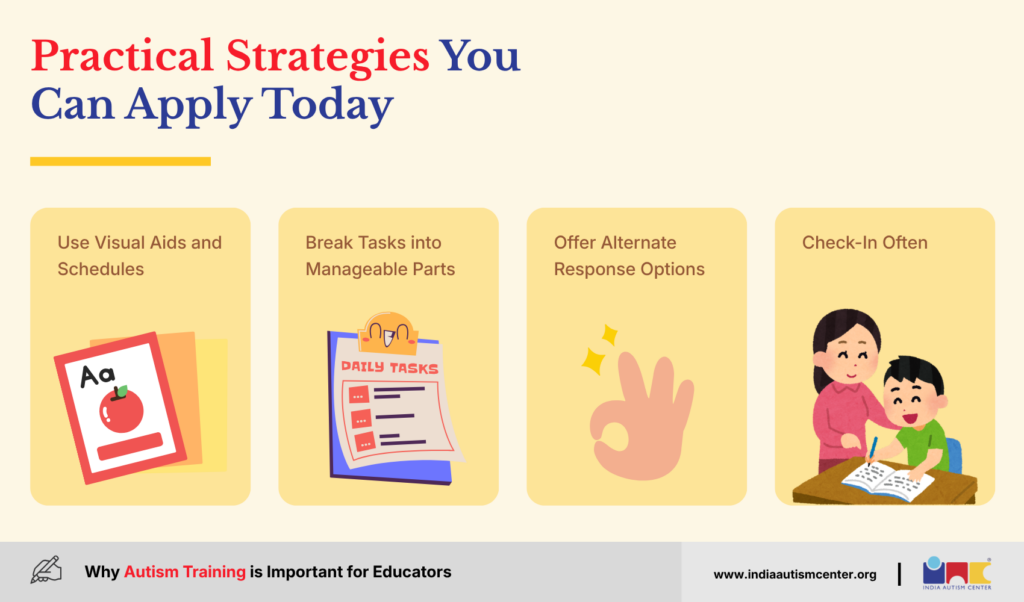
    Here are evidence-based techniques drawn from effective autism training that you can use right now:

    Use Visual Aids and Schedules

    Visual cues help many autistic learners understand routines and expectations without constant verbal prompts.

    Break Tasks into Manageable Parts

    Avoid overload by dividing lessons into smaller, achievable steps.

    Offer Alternate Response Options

    Not all students communicate best by speaking — some use symbols, gestures or assistive tech.

    Check-In Often

    Brief, supportive check-ins help you gauge emotional readiness and avoid frustration.

    These small, intentional practices can transform learning experiences.

    Autism Training and Behaviour Support
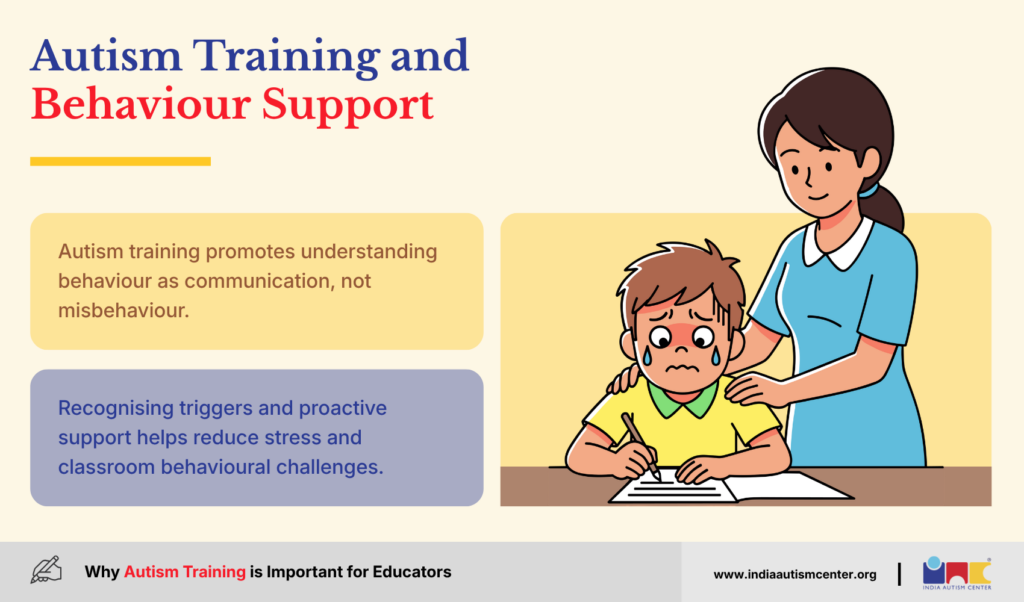
    Autistic learners sometimes express stress through behaviour. Autism training helps you see these behaviours as communication, not misbehaviour.

    This allows you to:

    • Respond calmly
    • Identify triggers
    • Use proactive strategies
    • Reduce incidents through structure and support

    It’s not behaviour control — it’s behaviour understanding.

    Integrating Autism Training into School Culture
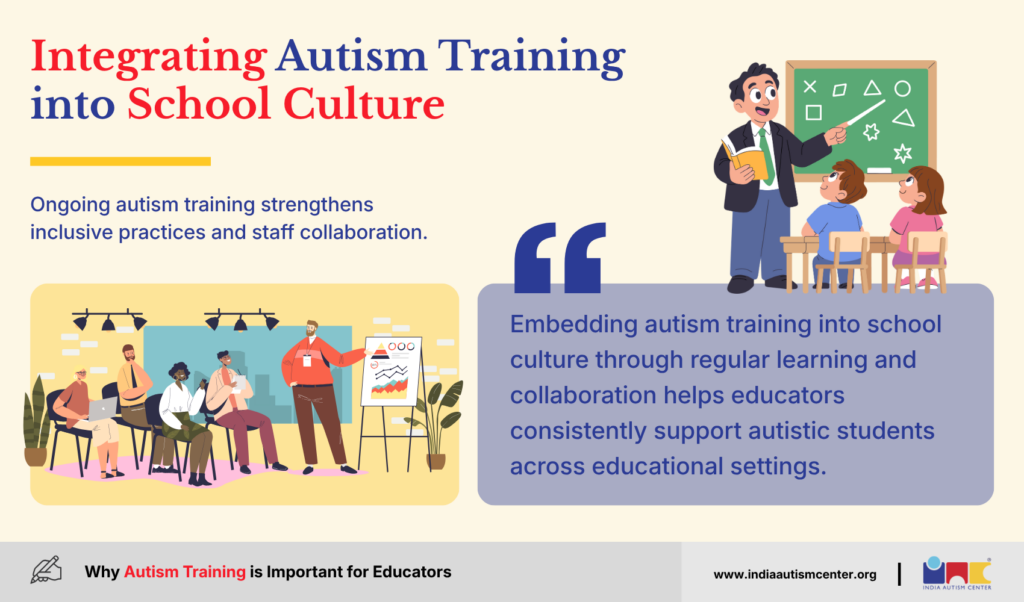
    To be truly effective, autism training shouldn’t be a one-off workshop. It needs to be part of your school’s ongoing professional development plan.

    You can:

    • Provide regular training sessions for all staff
    • Offer autism training to support staff, like aides and bus staff
    • Build learning communities where teachers share autism-related strategies

    Conclusion
    Autism training for educators isn’t an optional add-on — it’s a foundation for equitable education. When you understand autism, you empower learners, build confidence and strengthen your teaching practice.

    You don’t need to wait for perfection. Start by learning, then applying, reflecting, and growing. The more you engage with autism training, the more confident and effective your classroom becomes.

    Empowered teachers create empowered learners. And that’s the heart of education.
  • Best Training Courses for Autism Caregivers

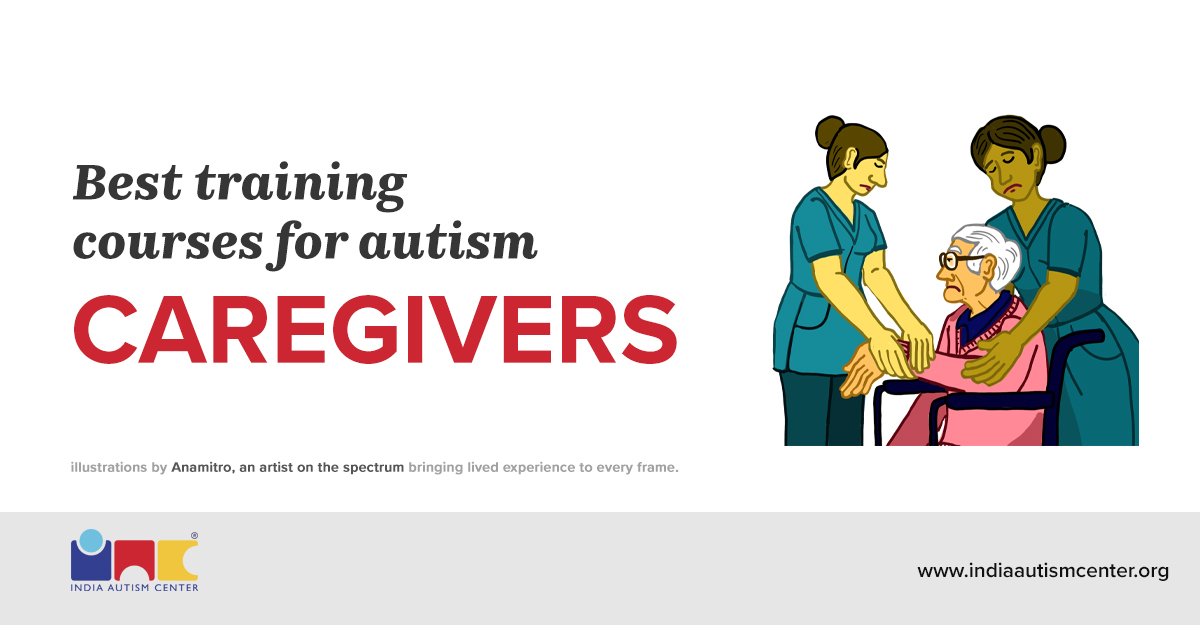
    Best Training Courses for Autism Caregivers

    Caring for an autistic individual in India comes with both unique challenges and rewarding experiences. As awareness about autism increases, so does the demand for skilled and informed caregivers. Choosing the best training courses for autism caregivers is the first step towards providing structured, compassionate, and effective support.

    It is crucial to provide effective care. Fortunately, many autism certificate programs in India cater to autism caregivers, offering valuable insights and practical strategies. 

    In this blog, we will explore some of the best training courses for autism caregivers available in India.

    India Autism Center (IAC) – Kolkata

    The India Autism Center’s training wing, Manan, offers one of the best training courses for autism caregivers, designed for professionals and caregivers. Our comprehensive courses, Junior Primary Support Staff and Senior Primary Support Staff, cover a range of critical topics, including therapies and activities of daily living (ADL). It also covers the role of caregivers in promoting development and independence. 

    We developed our Junior Primary Support Staff course in-house, and it is a first-of-its-kind program certified by the Rehabilitation Council of India (RCI).

    IAC emphasises evidence-based practices, providing participants with the tools to make informed decisions on various therapies and support systems. The training programs also focus on building inclusive environments and improving outcomes for individuals with autism. 

    Have a look at our Training Programs.

    National Institute of Mental Health and Neurosciences (NIMHANS) – Bengaluru

    NIMHANS, one of India’s leading institutions in mental health and neuroscience, offers specialised autism courses with certificates for caregivers. The institute provides a range of courses, focusing on early intervention, behaviour management, and communication strategies for children with autism.

    NIMHANS also emphasises the importance of understanding the cultural context in which autism is addressed in India, making their courses particularly relevant for Indian caregivers.

    Action for Autism – Delhi

    Action for Autism (AFA) is an organisation dedicated to improving the lives of individuals on the spectrum and their families.
    AFA offers various training programs, including Bachelor of Education – Special Education Autism Spectrum Disorder (BEd SpEd ASD).

    This autism training program is designed to equip caregivers with practical tools and strategies for supporting the development of children with autism. AFA also offers short-term and customised training options for those who cannot apply for the full-time degree.

    Communication DEALL – Bengaluru

    Communication Developmental Eclectic Approach to Language Learning (DEALL) is a well-known early intervention program for children with communication disorders, including autism.

    But the best part is – this program offers manuals and assessment tools for parents and caregivers. And these work as private autism training programs. That’s because these manuals and tools focus on early identification and intervention strategies in great detail. They give important insights to improve your autistic kid’s developmental skills. You can buy these materials directly on their website.

    Tata Institute of Social Sciences (TISS) – Mumbai

    The Tata Institute of Social Sciences (TISS) offers a range of programs in disability studies and rehabilitation (including autism). You can apply to the Centre for Disability Studies and Action. It is designed for both professional caregivers and family members.
    The course helps understand the diverse needs of people with disabilities and how to apply practical solutions at different levels.

    It teaches skills for creating inclusive environments and making sure people with disabilities have better access to opportunities.
    The course also focuses on building self-awareness and developing empowering, collaborative practices for working with people with disabilities.

    Spastics Society of Karnataka (SSK) – Bengaluru

    The Spastics Society of Karnataka (SSK) offers multiple training programs for parents, caregivers, and professionals working with children with autism and other developmental disorders.

    Their D.Ed Spl. Ed Intellectual and Developmental Disabilities is an autism certificate program by the RCI.  SSK focuses on practical, hands-on training, including how to create supportive home environments, manage challenging behaviours, and use communication aids. The program also guides access to government schemes and services available to children with disabilities in India.

    Institute for Remedial Intervention Services (IRIS) – Chennai

    IRIS in Chennai offers training to professionals, parents and educators in dealing with developmental and behavioural disorders such as autism.

    They work to raise awareness about autism and the needs of children with special needs in India by building facilities and training teachers who will work in special education.

    Behaviour Momentum India (BMI) – Bengaluru

    Behaviour Momentum India (BMI) started as an initiative to help improve the quality of life for those on the spectrum. Now they are a 100+ team making this goal a reality.

    As a part of their mission, they offer comprehensive autism training programs for parents and caregivers. BMI’s Parent Training Program is designed to teach caregivers how to implement ABA strategies at home, helping to reinforce positive behaviours and reduce challenging ones.

    Conclusion

    Being an autism caregiver in India requires a combination of knowledge, patience, and compassion. 

    The autism courses with certificates listed above give a lot of resources to help you become a more effective and confident caregiver. Whether you’re looking for basic understanding or advanced strategies, these courses provide the tools you need to support individuals with autism in their journey toward greater independence and well-being. 

    Investing in your education as a caregiver is one of the most important steps you can take for the person you’re caring for. It will also benefit your personal and professional growth.

  • Training Therapists for Autism: Essential Skills and Techniques

    Training Therapists for Autism: Essential Skills and Techniques

    The most important qualities a special educational teacher can bring to the table are – heart and authenticity.

    Having said that, we cannot stop there.

    There are other qualities and skills that you need to gain, if you aspire to become an autism therapist. You need to enrol in a top-notch academy, in order to learn the necessary skills and techniques. You need to master the necessary autism courses for professionals.

    Other than family members, the people who have the most impact on a neurodivergent individual’s life are their teachers and their therapists. It is a high-value vocation that comes with great responsibility. 

    A competent autism therapist who has received valuable autism training who can transform and empower the lives of so many autistic children and influence the individual’s future.

    That is why it is so important for any aspiring therapist in this field to be trained by the right academy. An institute that offers legitimate and scientifically sanctioned autism courses for professionals. 

    IAC Autism Training Center

    At IAC’s Autism Training Centre, our sincere ambition is to produce elite autism therapists—therapists trained in the latest science-backed intervention techniques—game  changers who will make a real difference in the neurodivergent universe. 

    We have an all-encompassing suite of Learn Autism courses for professionals. These autism courses have been specially tailored. We have an autism training course for everyone in the neurodiverse ecosystem. Whether they are folks with disabilities who want to take it up or  outside professionals wishing to take it up as a career or not . Or the families and support systems of autism-impacted individuals. 

    Our online autism training courses promise to empower you with all the knowledge and expertise you require for autism intervention therapies. Our autism courses are, of course,  backed by experience, research and innovation in the field. 
    We offer a range of autism courses, including diploma and certificate programs. These cover every aspect of autism care, whether it’s basic foundational knowledge and training or highly advanced insights.

    Some of our basic courses are:

    1. Foundation Certificate Course– This course is highly helpful, for family members who hope to support their autistic relatives better. Or an aspiring autism therapist, who’s getting started on their journey. It is a compulsory course, for anyone who wishes to move on to more advanced courses. 
      Eligibility criteria includes: Age: 18+. Education- Class 12 pass, or Graduate in any subject.
    2. Level 1: Behaviour Support Staff Course(ASD)- This is the foundation support course.
      Eligibility: Graduate in any subject.
      Duration: 180 hours.
    3. Level 2: Behaviour Associate (ASD)- This is a foundation support course that is a level higher.
      Eligibility: Graduate in any subject.
      Duration: 180 hours. 
    4. Level 3: Behaviour Technician for ASD(Special Educator)- This is a more advanced course.
      Eligibility- Graduate in any field.
      Duration: Foundation Certificate course+180 days (360 hours).
    5. Level 4: Behaviour Specialist (ASD)- This is an advanced course.
      Eligibility- Either Postgraduate with RCI licence/RCI registered intervention specialist+ 2 years of experience in the disability field.
      Duration: Foundation Certificate course + 180 days (360 hours).

    Visit https://indiaautismcenter.org/autism-training-academy/ for more. 

    Autism courses online

    We also offer a variety of autism training courses that are available online. 

    1. Autism courses for parents– Parents are the heroes in every autism-impacted individual’s story. At IAC, we salute them and recognize their challenges and needs. Our autism training course for parents empowers them with all the knowledge and practical tools they require. Necessary information to better support their child’s journey, as well as their own. 
    2. Autism training for teachers– Our autism courses for teachers focus on enabling them to create an inclusive and appropriate learning environment. Sensory activities, communication techniques, and individualised educational plans. These are some of the tools we train our teachers to include in their arsenal. We do our best to empower teachers. Enabling them to help maximise every autistic child’s potential. 
    3. Autism training courses for professionals- These are our more specialised courses. Whether it’s speech therapy or occupational therapy, we aim to provide niche expertise to professionals. Give them the skills to cater to every role in the autism care sector. Our mission is to enable professionals to deliver top-tier care and support to autistic individuals. 

    We’re also excited to announce that we’re also exploring the launch of a course created by autistics, for autistics, to help individuals better understand and navigate their diagnosis with lived experience at the core.

    Conclusion

    At IAC our primary goal has always been to create a safe, supportive, and productive environment for autism impacted individuals and families. An ecosystem that takes care of their every need and helps them achieve their full potential. Therapists and teachers are of course an integral part of such an ecosystem. 

    We hope that through our autism training programmes and courses, we can build a world-class team of therapists. A team that will have a positive impact on the quality of life of neurodivergent individuals. And also help them achieve their future goals. A collaborative community that encourages empathy, supports and empowers every autistic  individual to lead their best lives. 

Privacy Overview

This website uses cookies so that we can provide you with the best user experience possible. Cookie information is stored in your browser and performs functions such as recognising you when you return to our website and helping our team to understand which sections of the website you find most interesting and useful.