 Donate now
 Get a Call Back
 MENU
MENU 11 MIN READ
 SHARE
SHARE


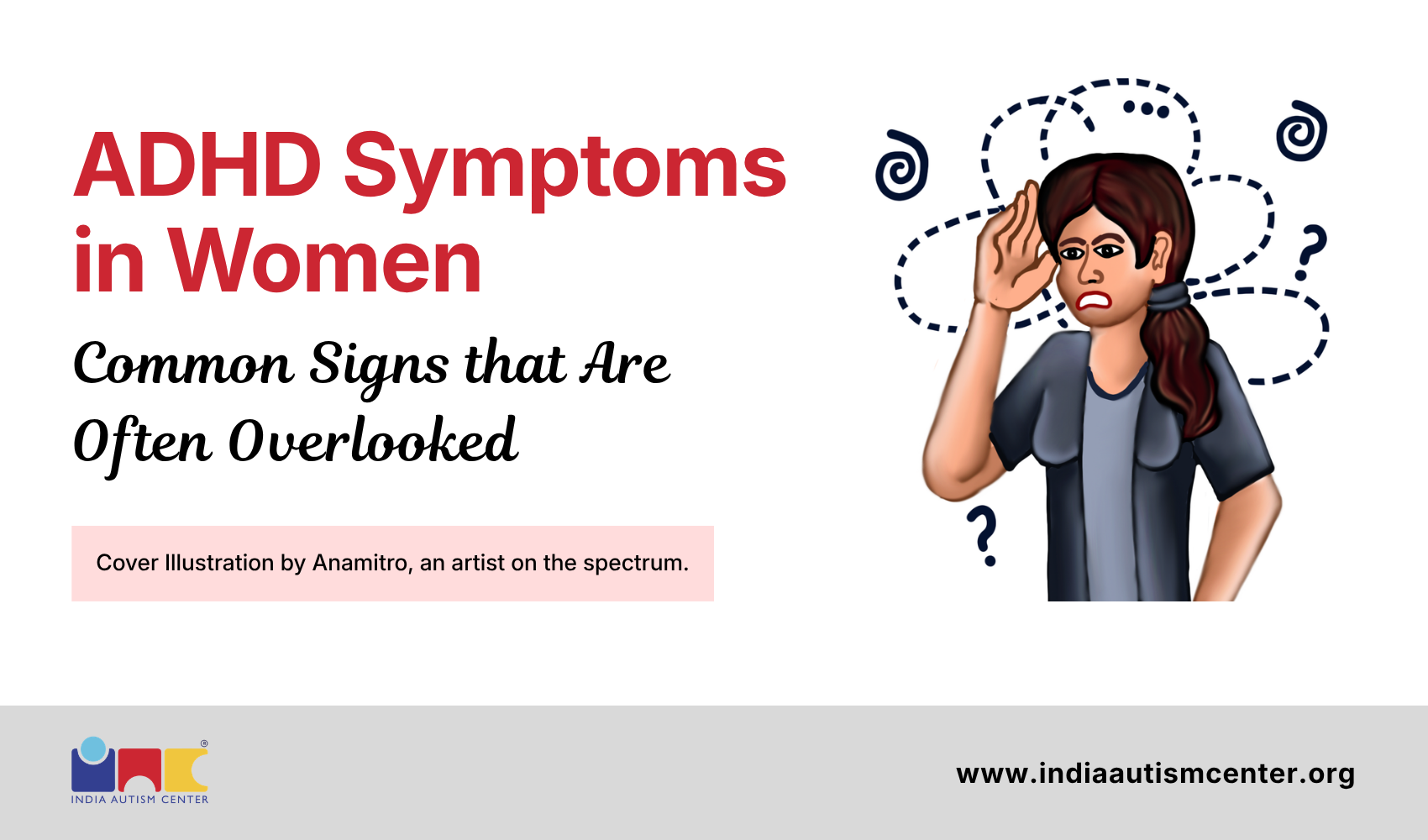
Attention-deficit/hyperactivity disorder (ADHD) is often associated with hyperactive children, but that image does not fully reflect how the condition can appear in women. In the US, 55.9% of adults with ADHD reported receiving their diagnosis at age 18 or older, showing how frequently ADHD is recognised only in adulthood.
For women, difficulties may be less outwardly disruptive and can instead involve attention, organisation, time management and emotional regulation.
Understanding the common ADHD symptoms in women can help distinguish persistent patterns from occasional forgetfulness or stress and encourage appropriate professional assessment when difficulties begin to affect everyday life.
What Are the Common ADHD Symptoms in Women?
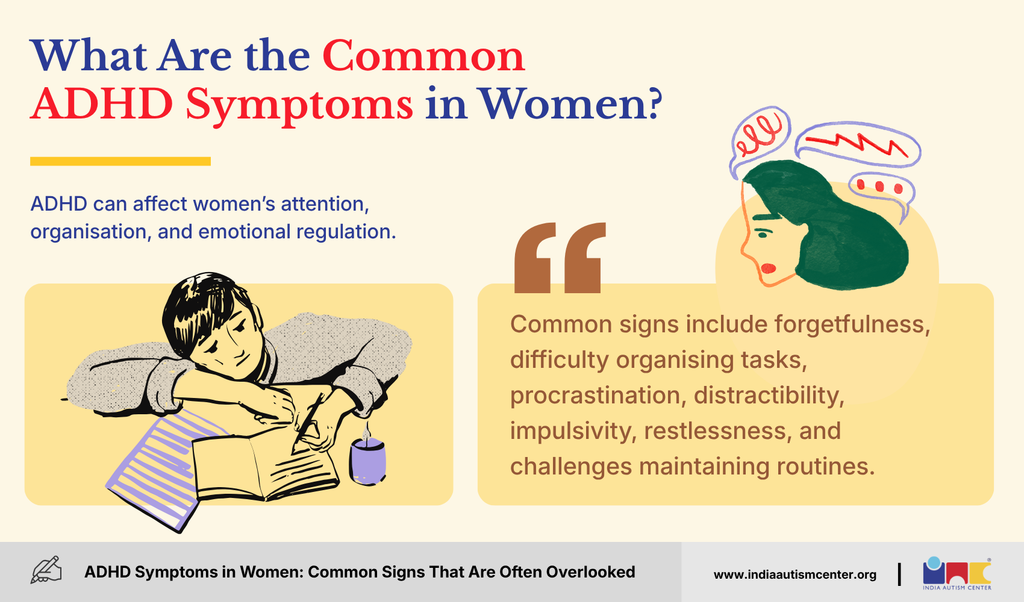
ADHD is a neurodevelopmental condition involving persistent patterns of inattention and/or hyperactivity and impulsivity. Although the underlying diagnostic criteria are the same, symptoms can appear and affect daily life very differently from person to person.
A recent systematic review examining ADHD presentation in females found that, in adulthood, females with ADHD were more likely to report being easily distracted, having difficulty organising tasks, mind-wandering, and certain forms of impulsive speech. The review also identified greater reported impact on home life.
Common ADHD symptoms in women may include:
- Frequently losing or misplacing things
- Forgetting appointments, commitments or instructions
- Difficulty organising tasks and responsibilities
- Problems estimating or managing time
- Procrastinating even when a task is important
- Being easily distracted
- Starting tasks but struggling to complete them
- Interrupting or speaking before thinking
- Feeling physically or mentally restless
- Difficulty maintaining routines
- Making impulsive decisions
- Becoming intensely absorbed in particularly interesting activities
Having one or two of these experiences does not mean someone has ADHD. What matters is the overall pattern, how long it has been present, and whether it causes meaningful difficulties in everyday functioning.
10 ADHD Symptoms in Women that Are Often Overlooked
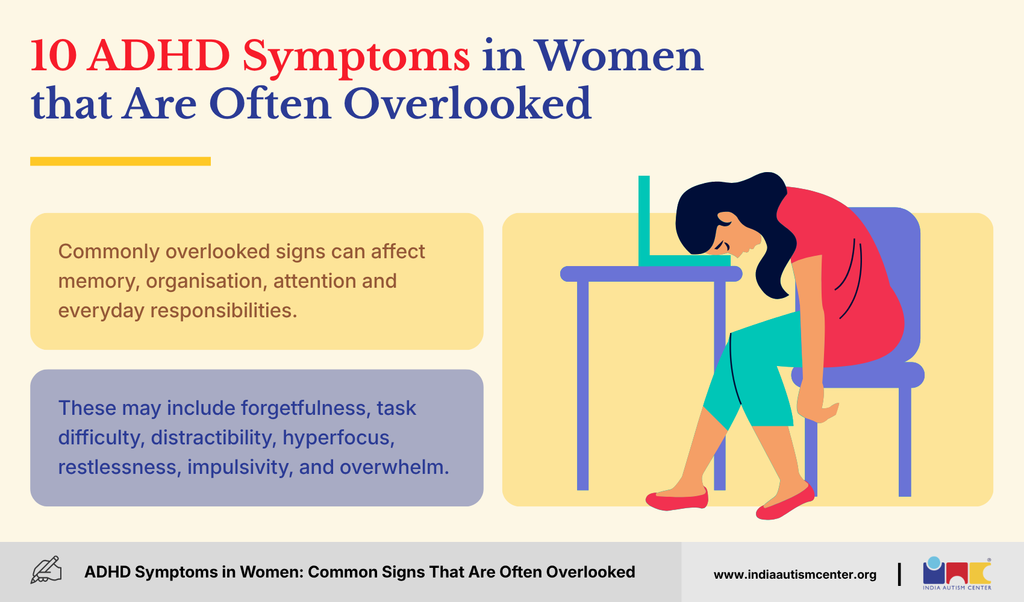
1. Chronic forgetfulness
Forgetfulness is one of the more familiar ADHD symptoms in women, but it can easily be dismissed as carelessness.
A woman may remember an important event but forget where she put something, miss a deadline, overlook a message, or lose track of an instruction shortly after hearing it. These difficulties can become especially noticeable when several responsibilities must be managed simultaneously.
Working memory is relevant here because it helps us temporarily hold and use information while completing a task. Difficulties with attention and working memory can make everyday activities feel unnecessarily complicated.
2. Difficulty organising everyday responsibilities
Organisation involves much more than keeping a tidy diary.
Someone may struggle to decide what to do first, break a large task into manageable steps, or keep track of several commitments at once. This is closely related to executive functioning, which includes mental processes involved in planning, organising, initiating and regulating behaviour.
Executive dysfunction is therefore an important concept when understanding ADHD in adult women, although executive-function difficulties can occur in other conditions as well.
A woman may know exactly what she needs to do but still find it unusually difficult to translate that knowledge into consistent action.
3. Procrastination and difficulty starting tasks
One of the more frustrating ADHD symptoms in adult women can be knowing that something needs to be done but being unable to start it.
This is not necessarily a lack of motivation. Tasks that are repetitive, lengthy, unclear or insufficiently stimulating may be particularly difficult to initiate.
A common pattern is delaying a task for days and then completing it rapidly when a deadline creates enough urgency. Over time, this can lead to stress, disrupted sleep and exhaustion.
4. Easily becoming distracted
Difficulty sustaining attention is a central feature of ADHD.
Distractions may come from external sources such as conversations, notifications or background sounds. They can also be internal, such as unrelated thoughts or daydreaming.
The problem is not necessarily an inability to concentrate. Someone with ADHD may concentrate extremely well on one activity and struggle considerably with another.
This difference matters because ADHD involves difficulty regulating attention, not simply having too little attention.
5. Hyperfocus and difficulty switching attention
Hyperfocus is frequently discussed in relation to ADHD. It describes periods when a person becomes deeply absorbed in an activity and finds it difficult to shift attention elsewhere.
For example, someone may spend hours working on an interesting project while forgetting to eat, respond to messages, or attend to another responsibility.
Hyperfocus itself is not a formal diagnostic criterion for ADHD. It is better understood as a commonly reported experience associated with difficulties regulating attention.
6. Internal restlessness rather than obvious hyperactivity
Hyperactivity does not always look like constant physical movement, particularly in adults.
Some women may experience internal restlessness, fidget frequently, talk excessively, find sitting quietly uncomfortable, or feel a strong need for stimulation.
This can be one of the less obvious adult ADHD symptoms in women because the person may not appear outwardly hyperactive.
A recent systematic review of ADHD presentation in females also identified excessive talking and blurting out answers among symptoms more frequently endorsed by females with ADHD in adulthood.
7. Poor time management
A person may underestimate how long an activity will take, lose track of time while concentrating or realise too late that they have left insufficient time for a task.
This can result in repeated lateness, rushed work and missed appointments.
Time-management difficulties can become especially challenging for adult women managing several roles simultaneously. Work, household responsibilities, education, relationships and caring responsibilities can all compete for attention.
8. Difficulty maintaining routines
A woman may create detailed plans and genuinely intend to follow them but struggle to maintain the routine consistently.
She might organise her week carefully and then find that one unexpected event disrupts the entire schedule.
This inconsistency can confuse other people. It can also be frustrating for the individual because she may know she can be organised in certain situations.
The difference is often between being able to organise something occasionally and being able to regulate that behaviour consistently.
9. Impulsivity
Impulsivity can appear in subtle ways in adult women.
It may involve interrupting conversations, responding before someone has finished speaking, making spontaneous purchases, changing plans suddenly, or acting on an idea without fully considering the consequences.
Impulsivity is not present to the same degree in everyone with ADHD, and its impact can vary depending on the person’s circumstances.
10. Feeling overwhelmed by everyday demands
A combination of distractibility, executive dysfunction, forgetfulness and time-management difficulties can make ordinary responsibilities feel overwhelming.
A woman may function very effectively during a crisis but struggle with routine tasks that require sustained attention and self-management.
Over time, repeatedly feeling behind can affect confidence and wellbeing. However, these experiences should not automatically be attributed to ADHD. Anxiety, depression, chronic stress, sleep problems and other conditions can produce overlapping difficulties.
Why Is ADHD in Women Often Missed?
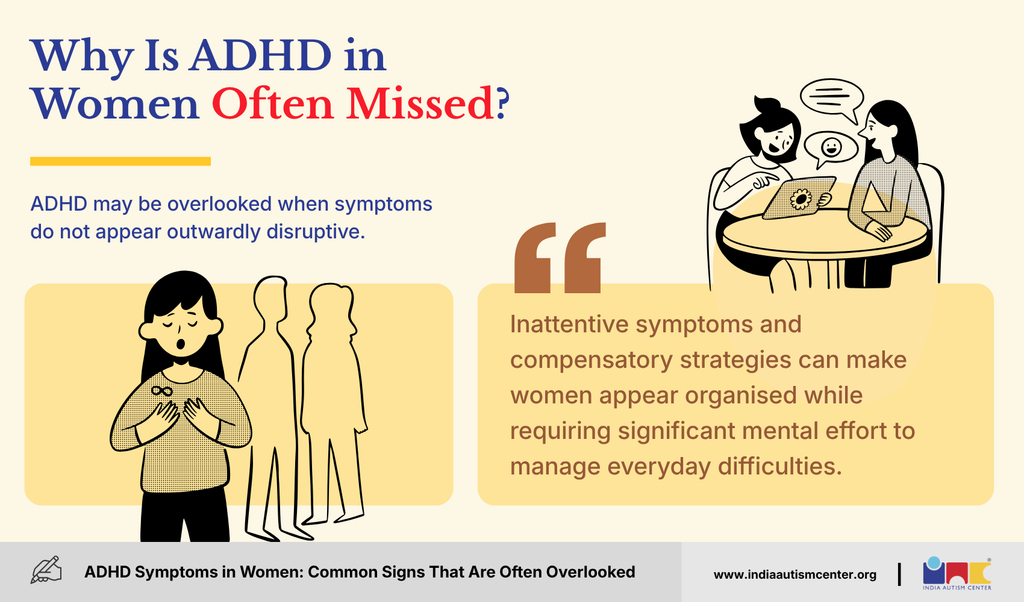
One of the main reasons ADHD in women can go unrecognised is that symptoms do not always fit the stereotypical image of hyperactive behaviour.
Girls and women may have less disruptive difficulties, particularly when inattentive symptoms are prominent. NICE specifically notes that ADHD is thought to be under-recognised in girls and women, who may be less likely to be referred for assessment and more likely to have undiagnosed ADHD or receive another diagnosis.
Some women also develop strategies that compensate for their difficulties. Calendars, alarms, detailed lists, rigid routines and considerable extra effort may allow someone to appear highly organised while requiring substantial mental energy to maintain that appearance.
This can contribute to delayed recognition.
Masking is also relevant when discussing neurodevelopmental conditions. Although masking is widely discussed in relation to autism in women, people may use compensatory strategies for ADHD as well. Learning about masking can therefore help explain why visible functioning does not always reflect the effort involved.
Can Hormonal Changes Affect ADHD Symptoms in Women?
Research into ADHD and hormonal changes in women is developing rapidly.
A 2025 systematic review examined 11 studies investigating ADHD symptoms in relation to sex hormones and hormonal life stages. The authors found suggestive evidence of an association between hormonal changes and ADHD symptoms, particularly around puberty and the menstrual cycle, but also noted that the available studies were limited and varied considerably in their methods and participants.
This means women should be cautious about assuming that hormonal fluctuations directly cause ADHD or that every change in symptoms has a hormonal explanation.
However, tracking changes in concentration, attention or other ADHD symptoms across the menstrual cycle may provide useful information to discuss with a healthcare professional.
How Is ADHD Diagnosed in Adult Women?
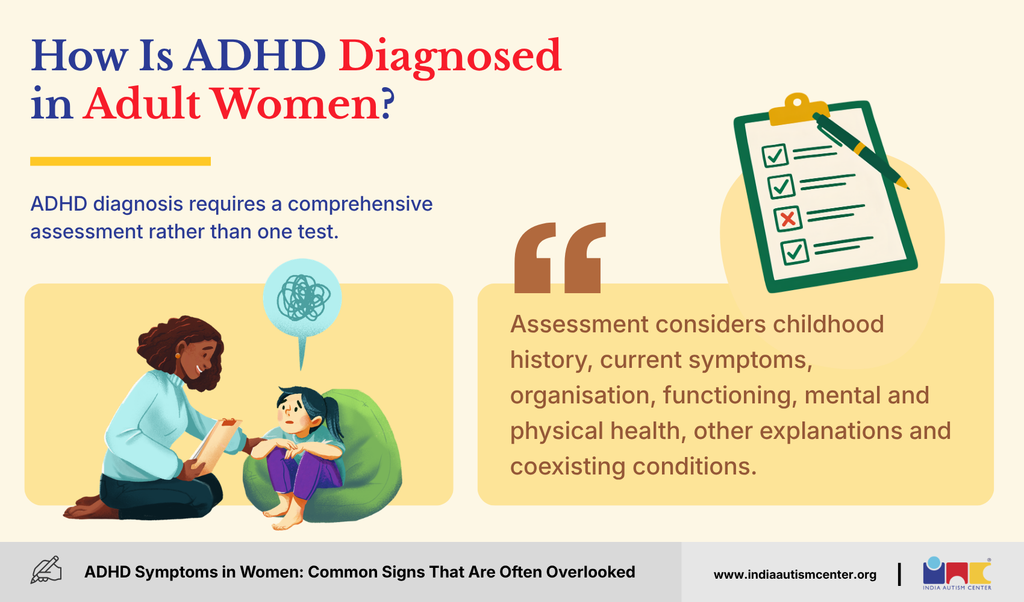
No single blood test, scan or questionnaire can diagnose ADHD.
A proper assessment considers symptoms, developmental history and the effect of those symptoms across different areas of life. An appropriately qualified specialist should make the diagnosis after a comprehensive clinical and psychosocial assessment, rather than relying solely on rating scales.
An assessment may explore:
- Childhood behaviour and school experiences
- Current patterns of attention and impulsivity
- Organisation and time management
- Academic or occupational functioning
- Family and relationship experiences
- Mental and physical health
- Other possible explanations for the symptoms
- Coexisting conditions
For ADHD, symptoms must reflect a longstanding pattern that began during childhood, even if nobody recognised them as ADHD at the time.
This is particularly important for women who receive an assessment later in life. Childhood reports, family recollections or examples of longstanding difficulties may provide useful information.
An online ADHD test can be a useful starting point for recognising possible patterns, but it cannot diagnose ADHD.
What Should Women Do If They Recognise These Signs?
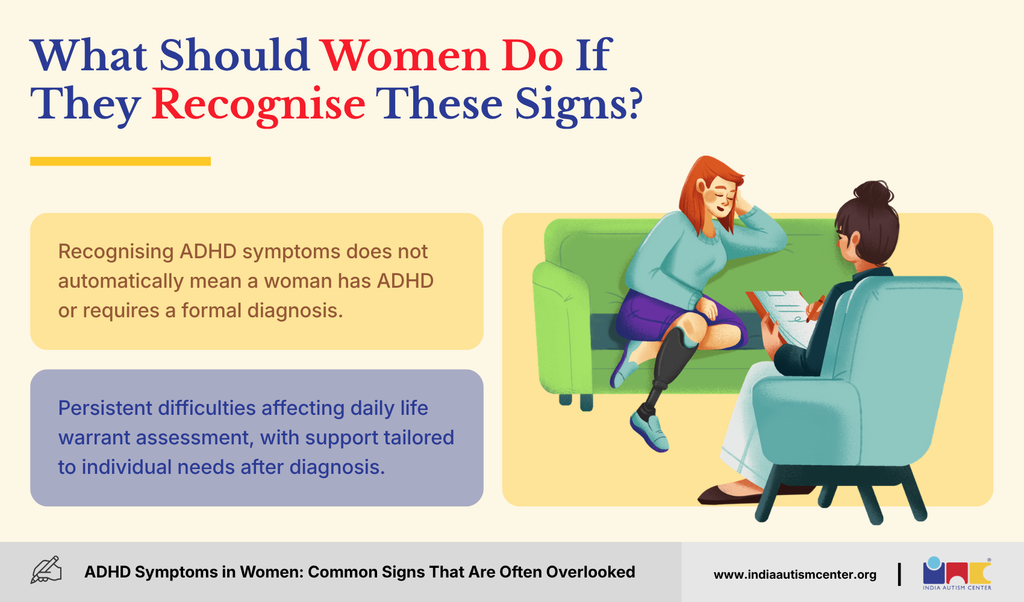
Recognising several ADHD symptoms does not automatically mean that a woman has ADHD.
If difficulties have been persistent and are affecting work, education, relationships or everyday responsibilities, speaking to a qualified professional experienced in ADHD assessment is an appropriate next step.
Keeping a short record of difficulties before an appointment can help. Note examples of missed deadlines, forgetfulness, problems initiating tasks, impulsive behaviour or difficulties managing time. Looking back at childhood experiences can also be useful.
Following diagnosis, support is individualised. Depending on a person’s needs, it may involve medication, psychological interventions, behavioural strategies, practical organisational systems and reasonable adjustments in educational or workplace settings.
The goal is not simply to reduce a list of symptoms. It is to understand how the person’s difficulties affect everyday functioning and identify appropriate support.
How India Autism Centre Helps Build Better Understanding
India Autism Centre takes a person-centred approach to neurodevelopmental conditions, recognising that ADHD and autism can look different from one individual to another.
Understanding a diagnosis requires more than matching someone to a checklist. Developmental history, communication, behaviour, attention, executive functioning, sensory experiences and individual support needs all provide important context.
IAC’s educational resources can help families and individuals explore subjects such as ADHD in girls, autism in women, masking, executive dysfunction, sensory processing and the overlap between ADHD and autism.
This broader understanding can help readers recognise patterns without making assumptions based on stereotypes. When concerns persist, professional assessment remains essential for understanding an individual’s specific needs.
Conclusion
ADHD symptoms in women can be easy to overlook because they do not always resemble the stereotypical image of hyperactivity. Persistent forgetfulness, difficulty organising tasks, procrastination, distractibility, time-management problems, internal restlessness and impulsivity can all affect daily life, particularly when several responsibilities compete for attention.
Recognising these patterns is not the same as diagnosing ADHD. A proper assessment considers the person’s developmental history, symptoms, functioning and other possible explanations. For women who have spent years compensating for difficulties without understanding why, recognising the possibility of ADHD can be an important first step towards appropriate professional support.
Frequently Asked Questions
1. What are the most common ADHD symptoms in women?
Common symptoms include distractibility, forgetfulness, disorganisation, difficulty starting or completing tasks, poor time management, impulsivity and restlessness. The exact combination varies between individuals.
2. Can women have ADHD without being physically hyperactive?
Yes. ADHD can involve predominantly inattentive symptoms. Hyperactivity may also show up as internal restlessness, excessive talking, or difficulty staying still rather than obvious physical activity.
3. Is hyperfocus an official ADHD symptom?
People with ADHD commonly report Hyperfocus, but it is not one of the formal diagnostic criteria. It generally refers to becoming deeply absorbed in an interesting or rewarding activity.
4. Can ADHD be diagnosed for the first time in adulthood?
Yes. ADHD begins during childhood, but many people are not diagnosed until adulthood. In 2023 US data, 55.9% of adults with a current ADHD diagnosis reported receiving that diagnosis at age 18 or older.
5. Can ADHD symptoms be mistaken for anxiety?
Yes. Both ADHD and anxiety can involve concentration difficulties, restlessness, and feeling overwhelmed. However, they are different conditions and require appropriate assessment.