 Donate now
 Get a Call Back
 MENU
MENU 12 MIN READ
 SHARE
SHARE


For an autistic child, the right support can make everyday communication, learning, participation and independence more achievable. Evidence-based interventions can help develop communication and social skills, while rehabilitation may also address areas such as self-care, behaviour, movement, education and participation in community life.
The World Health Organization emphasises that these interventions should be tailored to an individual’s needs and preferences, with support extending across different stages of life. This makes choosing an autism centre in West Bengal an important decision for families.
Rather than focusing only on the therapies offered, it is worth considering whether the centre has qualified professionals, individualised goals, family involvement and a clear focus on skills that can be carried into everyday life.
Today, we will look at the top autism therapy centres in Kolkata and West Bengal, and how you can finalise the best one.
Top Autism Therapy Centres in West Bengal
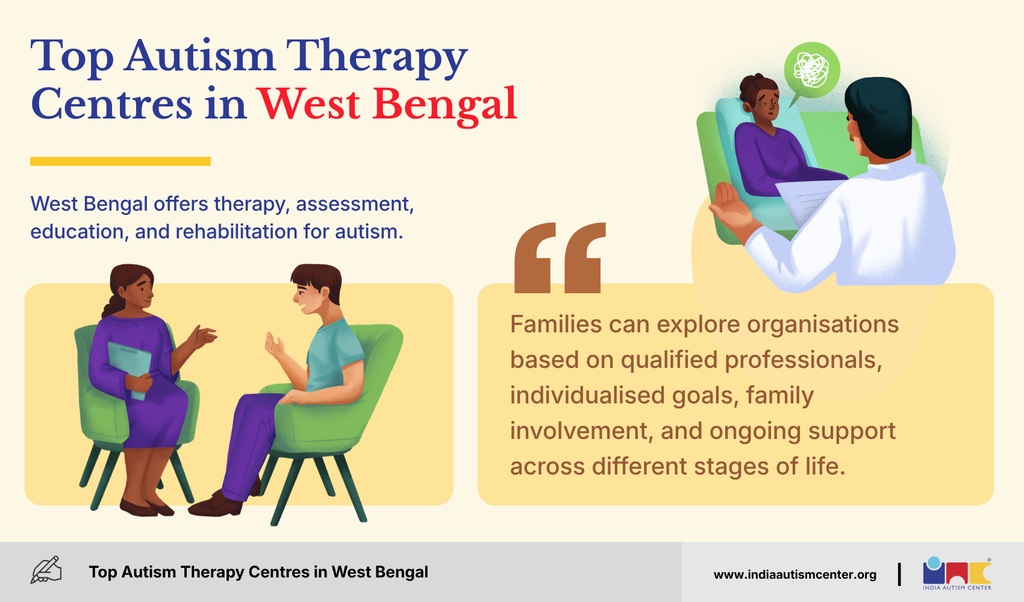
West Bengal has a growing network of organisations supporting autistic children and adults through therapy, special education, assessment, rehabilitation and skill development. The following are some notable organisations that families can consider when exploring an autism centre in Kolkata and the wider West Bengal region.
1. India Autism Center
India Autism Center (IAC) takes a broader approach to autism support, with its work extending beyond conventional therapy towards residential care, professional training and research. Its developing campus at Sirakol near Kolkata is centred around Samaavesh, a residential initiative intended to provide long-term support for autistic individuals.
IAC’s model is structured around three interconnected areas:
- Samaavesh: A residential campus designed around long-term care and support for autistic individuals.
- Manan: The professional training initiative, which focuses on developing a trained workforce for autism support.
- Khoj: The research initiative, which focuses on building culturally relevant evidence around autism in India.
This wider ecosystem is particularly relevant for families thinking about autism support across different stages of life. Instead of viewing intervention as something limited to childhood therapy sessions, IAC’s approach considers education, skill development, residential support, professional capacity building and research as interconnected parts of the autism ecosystem.
2. Autism Society West Bengal
Autism Society West Bengal (ASWB) is a parent-led organisation providing a range of services for autistic individuals and their families. Its current services include counselling and assessment, early intervention, therapy, mental health and wellness programmes, as well as specialised programmes such as Dikshan and Aarahon.
One feature families may find particularly useful is its emphasis on parental involvement. ASWB follows an “Open Door Policy”, under which at least one parent is expected to be present during assessment, intervention or therapy sessions, unless an autistic adult chooses otherwise.
Its multidisciplinary team includes:
- Clinical psychologists
- RCI-certified special educators
- Occupational therapists
- Speech therapists
For families looking for an autism therapy centre in Kolkata where therapy is combined with family participation and multidisciplinary support, ASWB can be one organisation to explore.
ASWB is also an RCI-approved institution for special education training. The RCI’s 2026 list records the organisation under institute code WB040 and includes an approved D.Ed. Special Education programme in Autism Spectrum Disorder.
3. Pradip Centre for Autism Management
Pradip Centre for Autism Management is another established autism-focused organisation in Kolkata. The Rehabilitation Council of India lists it under institute code WB018 and records its D.Ed. Special Education programme in Autism Spectrum Disorder.
Its inclusion in the RCI’s approved-institution records is particularly relevant for families evaluating the wider autism support ecosystem because the availability of recognised professional training contributes to developing a qualified workforce.
The Autism Society of India’s directory also lists Pradip Centre for Autism at Canal South Road, Kolkata.
Families considering the centre should directly enquire about its current therapy services, assessment process, professionals involved, age groups served and availability, as these details can change over time.
4. Amrit Somani Memorial Centre
Amrit Somani Memorial Centre is another organisation listed by the Autism Society of India in Kolkata. The centre is located on Sarat Bose Road and focuses on intervention for children with autism and other developmental needs.
When evaluating a centre such as this, parents should look beyond the presence of a particular therapy and understand how intervention is structured around individual goals. For example, families can ask whether communication, self-care, classroom participation and social skills are assessed separately and how progress is documented.
This is important because an effective programme should not simply consist of repeated therapy sessions. The skills being developed should ideally have a clear connection with the child’s everyday life.
5. Manovikas Kendra
Manovikas Kendra, a rehabilitation and research institute in Kolkata, is also included in the Autism Society of India’s directory of therapy centres and schools.
Its rehabilitation-oriented setting makes it relevant for families considering support that extends beyond a single type of therapy. Depending on the individual’s requirements, families can enquire about services related to education, communication, occupational needs, psychological support and rehabilitation.
For parents of older children and young adults, another important consideration is whether a centre can support the transition towards greater independence. This can include functional academics, vocational preparation, community participation and daily living skills.
Therefore, when comparing an autism treatment centre in Kolkata, it is useful to ask not only what support is available today, but also whether the centre can accommodate changing needs as the individual grows.
6. Roshnai Autism Centre
Roshnai Autism Centre is another Kolkata-based organisation that families can explore. The centre is listed among local autism-support organisations and provides services focused on children with developmental and special educational needs.
Families considering Roshnai or similar autism centres in Kolkata should discuss the specific areas in which their child requires support before enrolling. This could include:
- Speech and communication
- Occupational and sensory needs
- Special education
- Behavioural support
- Social interaction
- Functional and daily living skills
The important consideration is whether these services are integrated into a coherent support plan. For example, a speech therapy goal should ideally complement educational and home-based communication goals rather than operate independently.
Which Therapies Are Commonly Offered at Autism Centres?
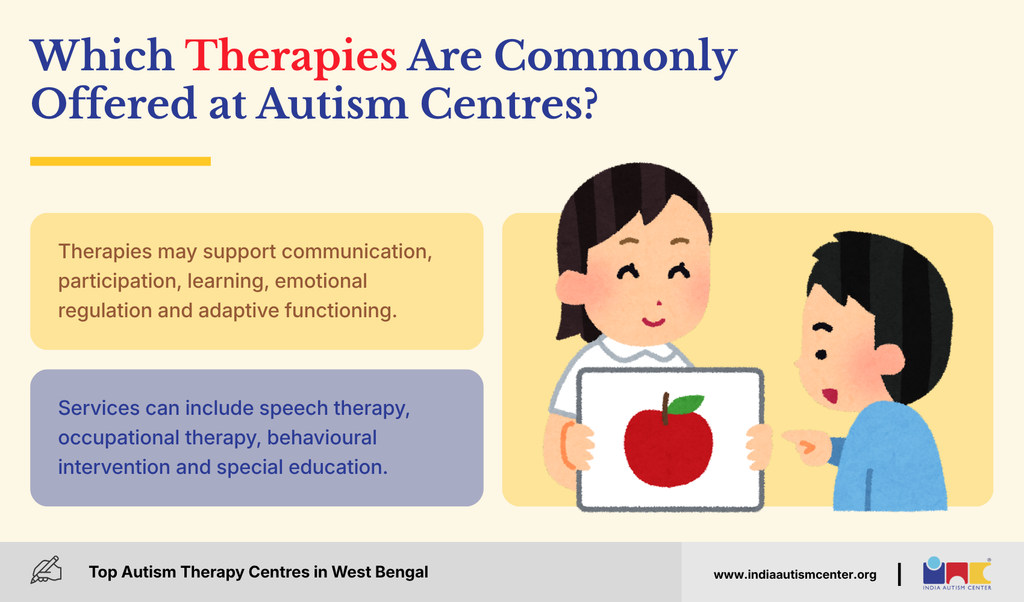
Different therapies can be appropriate for different autistic people. The purpose of intervention is generally to support communication, participation, learning, emotional regulation, adaptive functioning and quality of life rather than to make an autistic person appear non-autistic.
WHO states that evidence-based psychosocial interventions can improve communication and social skills and positively affect the well-being and quality of life of autistic people and their caregivers.
Depending on individual needs, an autism therapy centre in Kolkata may offer or coordinate the following:
Speech and Language Therapy
Speech and language therapy addresses more than spoken words. It can support receptive language, expressive communication, pragmatic or social communication and functional communication.
For a non-speaking individual, the goal may involve alternative communication rather than simply encouraging speech. AAC can include gestures, communication boards, picture systems or electronic devices.
IAC’s guide to speech and language therapy for autism discusses how communication goals can be personalised according to an individual’s abilities and needs.
Occupational Therapy
Occupational therapy can address fine motor skills, self-care, functional activities and sensory processing. For example, therapy may support dressing, feeding, handwriting, grooming or participation in school activities.
Behavioural Intervention
Behavioural approaches may be used to teach specific skills, increase functional behaviours and address behaviours that interfere with participation or quality of life.
ABA is one approach used by some autism centres. Families should ask exactly what the programme targets, how goals are selected and how progress is measured.
NICE recommends psychosocial interventions for behaviour that challenges after potential physical, mental health, communication and environmental triggers have been considered. It also recommends clearly defined targets, systematic measurement and attention to quality-of-life outcomes.
Special Education
Special education can support academic learning, communication, classroom participation, functional academics and adaptive skills. A good educational programme should consider the learner’s strengths and learning style rather than relying on a fixed curriculum.
Sensory Support
Some autistic individuals experience differences in how they respond to sounds, touch, movement, light, smells, tastes or internal bodily sensations.
Sensory support should be individualised. A sensory activity that helps one person may be uncomfortable or unhelpful for another.
Life Skills and Vocational Training
For older children, teenagers and adults, intervention should increasingly include practical skills. These can include:
- Personal hygiene and grooming
- Cooking and household routines
- Money and time concepts
- Travel and community safety
- Workplace behaviour
- Vocational skills
- Social and leisure participation
This is an area that families should consider when comparing an autism treatment centre in Kolkata. Early therapy is important, but planning for adulthood is equally significant.
How Should Parents Compare Autism Centres in Kolkata?
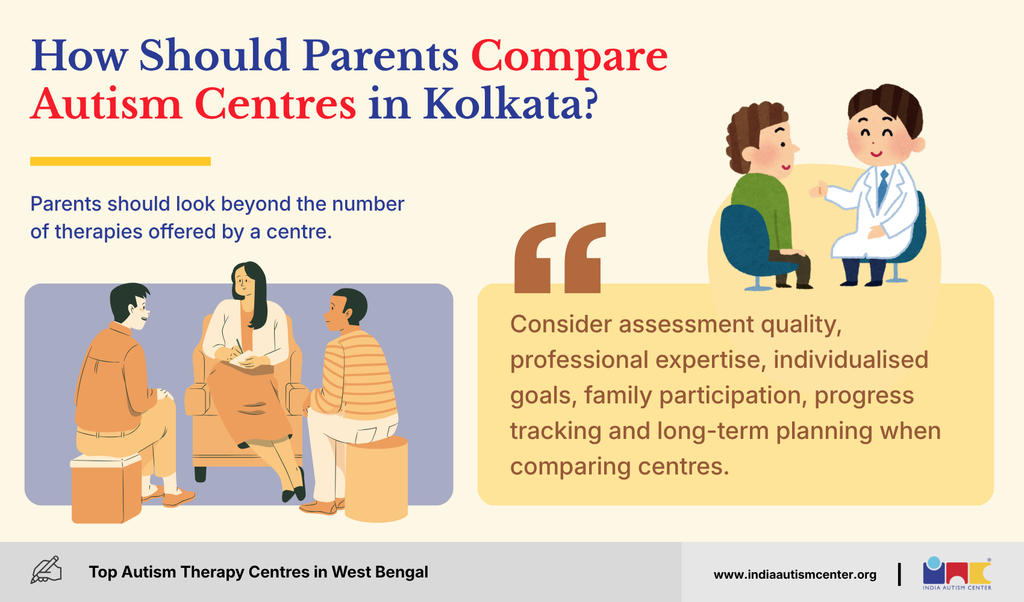
When comparing an autism centre in Kolkata, it can be tempting to focus on the number of therapies available. However, more therapies do not necessarily mean better support. A better approach is to understand why a particular therapy has been recommended and what functional goal it is intended to address.
Parents can compare centres based on:
- Assessment: Does the centre carry out a detailed assessment before recommending intervention?
- Professional expertise: Who will provide the therapy, and what are their relevant qualifications and registrations?
- Individualisation: Are goals tailored to the child’s abilities, needs, preferences and developmental stage?
- Family participation: Are parents given practical strategies that can be continued at home?
- Progress tracking: Does the centre establish measurable goals and review progress periodically?
- Functional outcomes: Are skills being developed for use at home, school and in the community?
- Long-term planning: Can the support evolve as the child moves towards adolescence and adulthood?
These factors can help families distinguish between simply finding a nearby autism therapy centre in Kolkata and finding one that fits the individual’s actual support needs.
It is also worth remembering that the most appropriate centre may change over time. A child who initially requires substantial communication and early intervention support may later need greater emphasis on academics, self-care, social participation or vocational skills. A centre that recognises this progression can help create a more sustainable support pathway.
Questions to Ask Before Choosing an Autism Centre in Kolkata
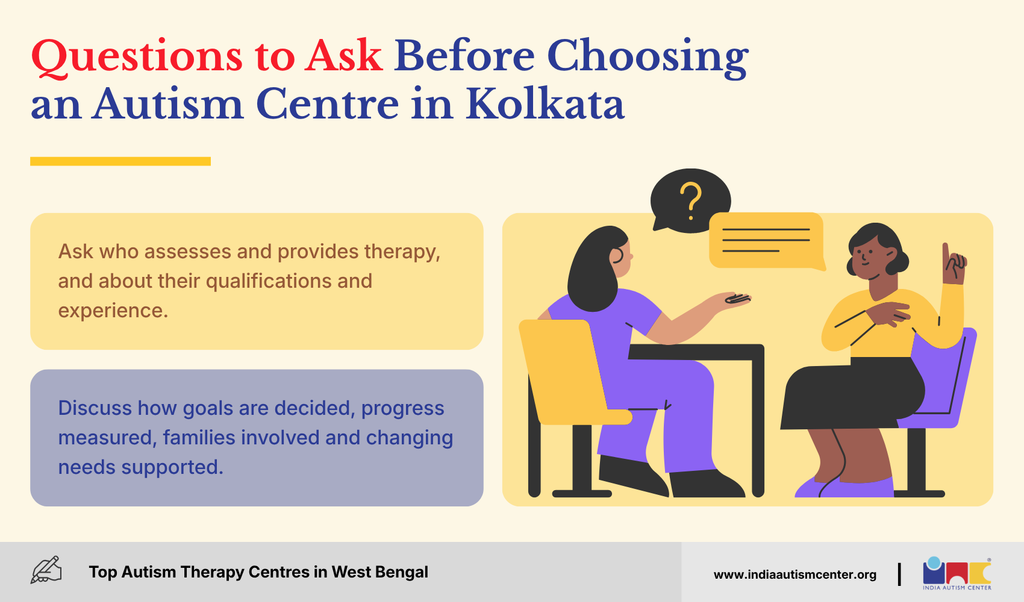
Visiting a centre before enrolling can help families understand whether its approach fits their expectations.
Ask:
- Who will assess my child?
Find out whether appropriately qualified professionals conduct assessments and whether referrals are made when another specialist is required.
- Who will provide therapy?
Ask about the qualifications, professional registration and relevant autism experience of therapists and educators.
- How are goals decided?
Goals should be based on the person’s needs and functional priorities rather than a standard package.
- How is progress measured?
Ask whether the centre uses baseline information, regular reviews and observable outcomes.
- How involved are parents?
Family participation can help skills generalise from therapy into everyday life.
- What happens when needs change?
Support should evolve as the person develops. A plan for a preschool child will not necessarily remain appropriate during adolescence.
- Does the centre support school and community participation?
Skills become meaningful when they can be used outside the therapy room.
- What support is available for older children and adults?
Families should consider vocational preparation, independent living, community participation and long-term planning rather than focusing exclusively on early childhood.
Conclusion
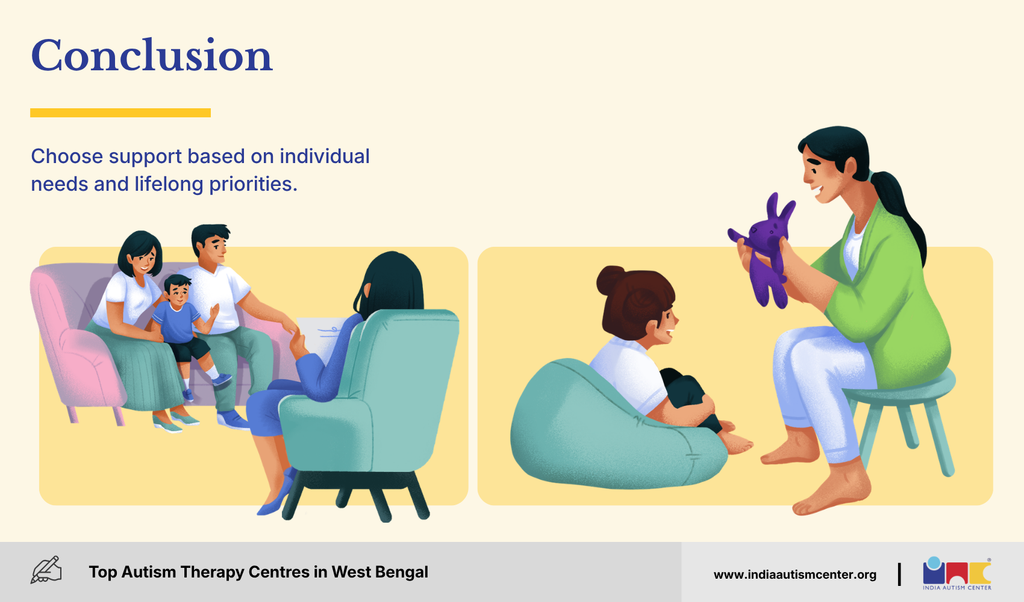
Choosing among autism centres in Kolkata is ultimately about finding the right fit for the individual’s needs, not simply selecting the centre with the longest list of therapies. A suitable programme should combine qualified professionals, personalised goals, regular progress assessment and opportunities to apply skills in everyday settings.
Families should also consider accessibility, parent involvement, communication support, education and long-term independence when evaluating an autism therapy centre in Kolkata. Since support needs can evolve with age and development, the ideal centre should be able to adapt its approach over time.
By asking the right questions and focusing on meaningful outcomes such as communication, participation, confidence and independence, families can make a more informed decision and create a support pathway that contributes positively to the individual’s quality of life.
Frequently Asked Questions
How do I choose the right autism centre in Kolkata for my child?
Look for a centre that begins with an individual assessment and develops therapy goals around your child’s communication, learning, sensory, behavioural and daily living needs. Also check professional qualifications, parent involvement, progress tracking and whether support can adapt as your child develops.
Can an autism centre in Kolkata provide both assessment and therapy?
Some centres provide both assessment and intervention, while others specialise primarily in therapy, education or rehabilitation. Before enrolling, confirm who conducts the assessment, their professional qualifications and whether the centre provides referrals when additional specialist evaluation is required.
Does every child attending an autism treatment centre in Kolkata need ABA?
No. Applied Behaviour Analysis is one approach that may be used for particular goals, but it is not necessary for every autistic child. Families should understand what behaviours or skills the programme targets, how progress will be measured and whether the approach is appropriate for their child’s needs.
How can I tell whether an autism centre in Kolkata is providing individualised therapy?
Ask whether the centre conducts an individual assessment, establishes personalised goals and reviews those goals regularly. Be cautious of programmes where every child follows exactly the same therapy schedule regardless of age, abilities, communication style or support requirements.
Should I choose an autism centre near my home or travel farther for specialised therapy?
Both factors matter. Regular intervention can require consistent attendance, making travel time important for families. However, a centre with specialised expertise may be worth considering if it addresses a specific need that is not readily available nearby. Compare professional expertise, therapy goals, continuity and practical accessibility together.