 Donate now
 Get a Call Back
 MENU
MENU 20 MIN READ
 SHARE
SHARE


When it comes to bilingualism and autism, many parents ask the same question: “Will learning two languages confuse my autistic child?”
Well, some professionals suggest sticking to one language. Others encourage bilingual exposure. This uncertainty can feel overwhelming. I want to reassure you from the start: bilingualism and autism can work together — when done thoughtfully and with the right support.
In this blog, I will explain:
- What the research actually says about bilingualism in autism spectrum disorder (ASD)
- The real impact of bilingualism on autistic children – positive and challenging
- How AAC fits in for minimally verbal children
- Six common myths – and the evidence that dismantles them
- How to get your child assessed properly as a bilingual learner
- Ten practical, actionable tips you can start using this week
- How India Autism Center (IAC) supports bilingual autistic children
Understanding Bilingualism and Autism
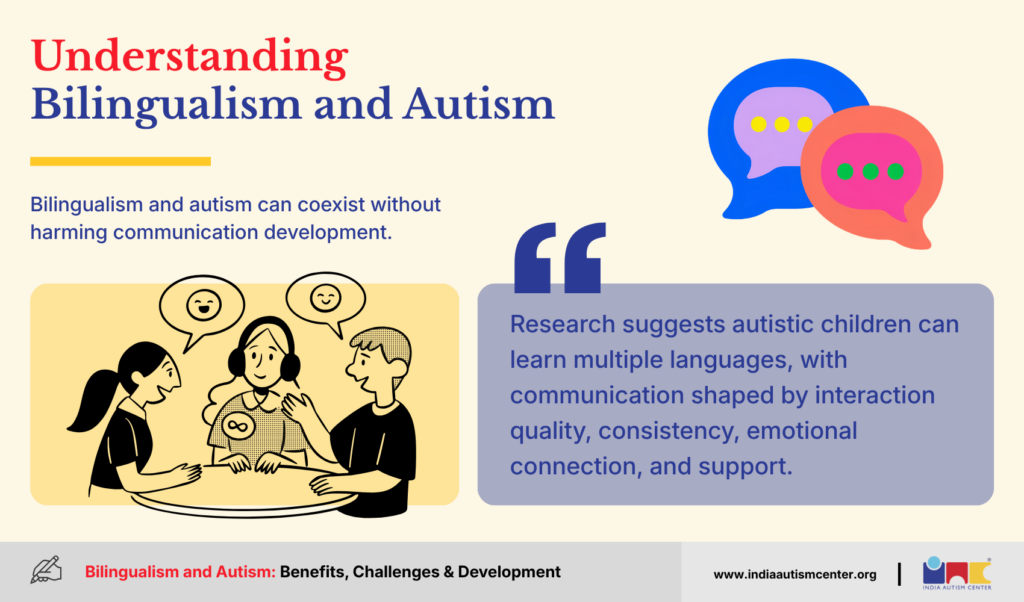
Bilingualism simply means using or learning two languages regularly. In India, this is not unusual – it is the norm. Your child may hear Bengali at home, Hindi in the neighbourhood, and English at school. That is not a problem to be solved. That is a rich linguistic environment.
Here is a number worth holding onto: over 43% of the global population is bilingual or multilingual. Monolingualism is actually the exception, not the rule. The idea that a child must grow up with only one language to thrive is a Western clinical assumption that does not reflect how most of the world – including most of India – actually lives.
Autism affects communication, social interaction and language processing. Because of this, many parents worry that two languages will slow speech development or increase confusion. That worry is understandable. But the evidence does not support it.
However, research by PubMed shows that:

Autistic children can learn two languages without harming their communication development.
In fact, bilingualism and autism do not conflict. Instead, language development depends more on:
- Quality of interaction
- Consistency
- Emotional connection
- Professional support
Not on the number of languages alone.
One more important context: more than 30% of autistic children are minimally verbal – meaning they use fewer than 20 functional words. For these children, the question of bilingualism does not disappear. It becomes even more important to address, especially when Augmentative and Alternative Communication (AAC) is part of the picture. We will come back to this.
Want to know more? Get in touch with us.
What Does Research Say About Bilingualism in Autism Spectrum Disorder?
When we talk about bilingualism in autism spectrum disorder, we rely on growing global research. Studies comparing monolingual and bilingual autistic children show something important:
- Bilingual autistic children do not have worse language outcomes
- They do not show higher levels of confusion
- They can differentiate between languages
- They can develop vocabulary in both languages over time
Some children may speak later. Others may mix languages at first. This is also seen in non-autistic bilingual children.
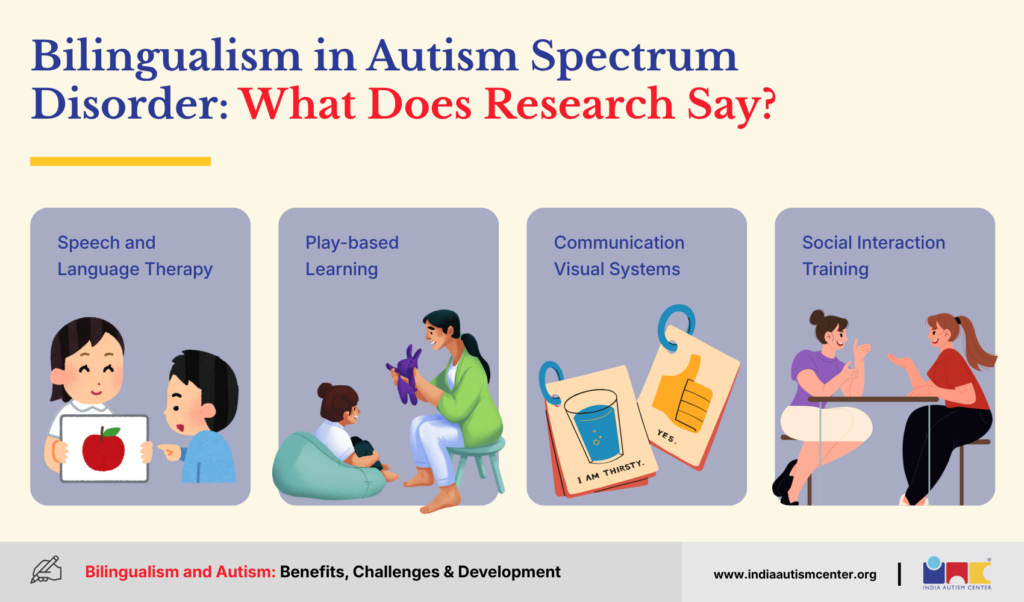
What truly matters is how language is taught and used. At India Autism Center (IAC), therapists use structured methods such as:
Speech and Language Therapy
Speech and language therapy helps autistic children build vocabulary, understand instructions and use words meaningfully. In bilingualism and autism, therapists support language development in both languages by strengthening comprehension, pronunciation and functional communication.
Play-based Learning
Play-based learning uses games, toys and daily activities to teach language in a natural and enjoyable way. For children experiencing bilingualism in autism spectrum disorder, play helps them connect words with actions and emotions across both languages without pressure.
Visual Communication Systems
Visual communication systems use pictures, symbols and visual schedules to support understanding and expression. These tools are especially useful in reducing confusion and improving the impact of bilingualism on autistic children who process visual information better than spoken words.
Social Interaction Training
Social interaction training focuses on teaching children how to start conversations, take turns and respond appropriately to others. This approach strengthens real-life communication skills and helps children manage bilingualism and autism in school and community settings.
What About Minimally Verbal Children? AAC and Bilingualism
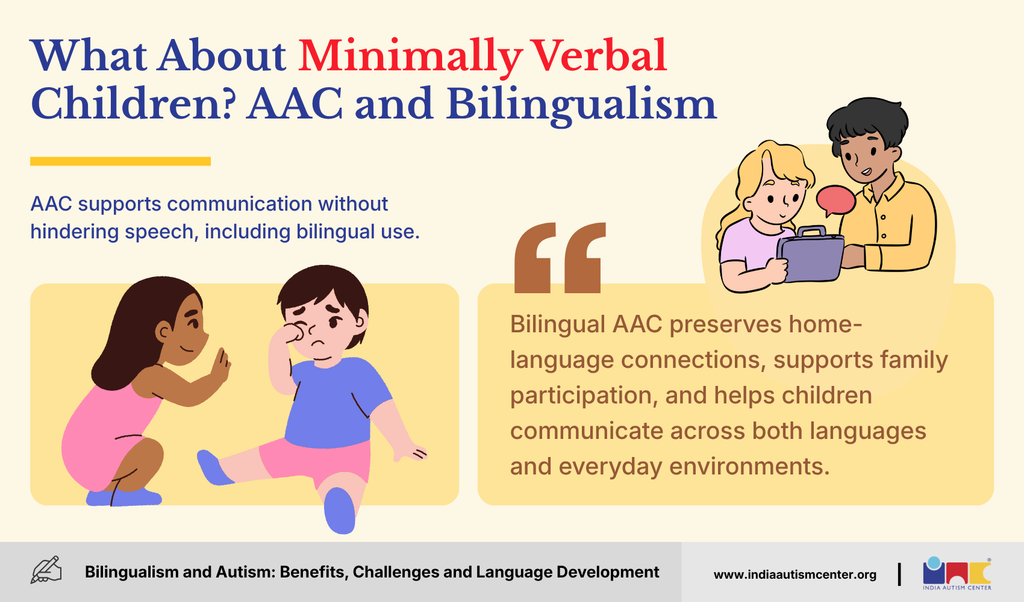
If your child is minimally verbal – using very few spoken words – you may feel that the bilingualism conversation does not apply to you. It absolutely does.
AAC (Augmentative and Alternative Communication) includes picture boards, communication apps, speech-generating devices and sign-supported communication. And here is what the research shows clearly:
AAC does not block speech development. A review of 12 studies found that AAC interventions did not impede speech production – in fact, most studies reported increased speech alongside AAC use. A 2024 scoping review in the Augmentative and Alternative Communication journal found that bilingual AAC use was not harmful and could improve self-identity and caregiver participation.
What does this mean practically?
- AAC devices and boards can be set up in two languages. Many modern communication apps allow bilingual vocabulary sets – your child can access words in both Bengali and English on the same device.
- Do not abandon your home language because your child uses AAC. If your family speaks Marathi at home, keep speaking Marathi. Your child’s AAC system should reflect their full linguistic world, not just the language of the therapy room.
- Bilingual AAC supports family connection. When grandparents can interact with a child through a shared home language on an AAC device, that is not a complication – that is a lifeline.
The guidance from ASHA (American Speech-Language-Hearing Association) is unambiguous: assessment and communication support should be provided in the child’s heritage language or other mode of communication, in the form most likely to yield accurate information about what the child knows and can do.
At IAC, we work with families to ensure AAC systems reflect both languages used at home, so that bilingual autism benefits extend to every child – including those who are minimally verbal.
Impact of Bilingualism on Autistic Children
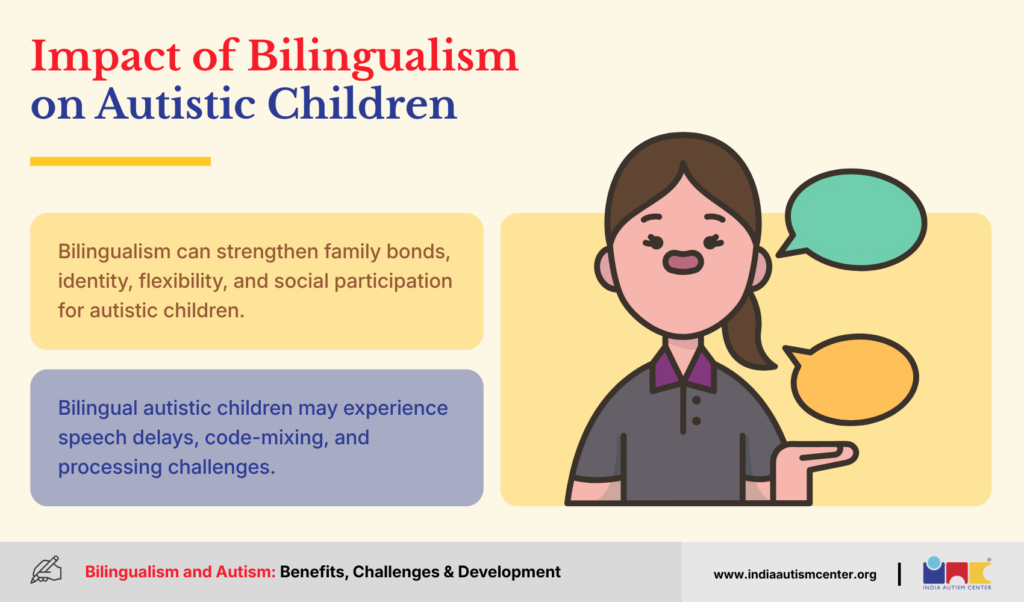
The impact of bilingualism on autistic children is not the same for every child. It depends on several important factors, such as:
- Their cognitive level affects how easily they process and remember language.
- Their sensory profile, as some children are sensitive to sounds or struggle with auditory input.
- Their family environment, including how often and how naturally both languages are used at home.
- The support system available, such as access to trained therapists and structured intervention.
Because of these differences, bilingualism can bring both positive outcomes and certain challenges. Understanding both sides helps families make informed decisions.
Positive Impact
1. Stronger family bonds
When a child understands and uses the family’s natural language, communication within the household becomes easier and more meaningful. This allows grandparents, relatives and caregivers to interact with the child in a warm and familiar way. As a result, emotional connections grow stronger, and the child feels more included in everyday family life.
2. Better cultural identity
Language plays a key role in shaping identity. A bilingual autistic child who learns both the home language and the community language can feel connected to both worlds. This helps the child take part in cultural traditions, social gatherings and community activities, reducing feelings of isolation and strengthening their sense of belonging.
3. Cognitive flexibility
Switching between two languages encourages the brain to adapt and organise information more efficiently. This process may help improve attention, problem-solving skills and mental flexibility. For some autistic children, this can support better focus and improved ability to shift between tasks or ideas.
4. Social participation
Bilingualism can allow autistic children to communicate in different environments, such as at home, in school and in public settings. This makes it easier for them to join group activities, interact with peers and respond appropriately in social situations. As communication improves, confidence and independence may also increase.
Possible Challenges
1. Slower expressive speech at first
Some autistic children may take longer to develop spoken language when learning two languages at the same time. They may understand more than they can express, or use fewer words initially. This does not mean bilingualism is harmful; rather, it shows that the child may need extra time, repetition and structured support.
2. Code-mixing
Children may combine words from both languages within the same sentence. This behaviour is common in bilingual development and is not a sign of confusion. It usually reflects the child’s attempt to communicate using all the language tools available to them. With consistent exposure and guidance, children often learn to separate the two languages more clearly over time.
3. Higher processing load
Learning and managing two languages can place additional demands on memory and attention. For autistic children who already face challenges with processing information, this may require carefully planned teaching strategies. Visual supports, routine-based learning and simplified language input can reduce overload and make learning more manageable.
This is why professional guidance is essential. India Autism Center provides customised language programmes that take into account each child’s cognitive abilities, sensory needs and family background. Through structured therapy and family involvement, IAC helps ensure that bilingualism becomes a supportive tool rather than a source of difficulty for autistic children.
Want to know more? Get in touch with us.
Benefits of Bilingualism and Autism
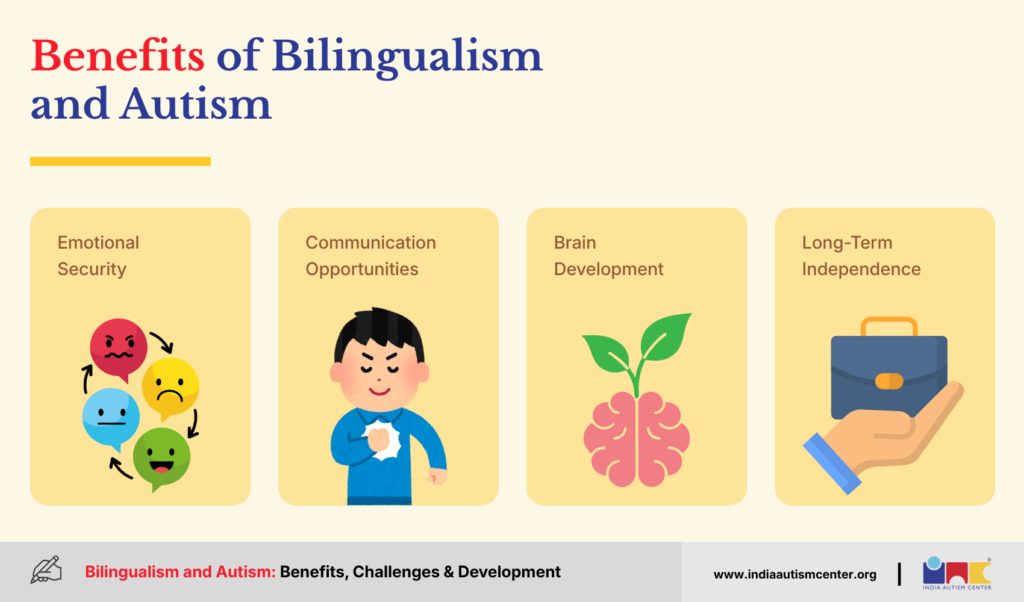
Let us look closely at the benefits of bilingualism in autism when learning is guided properly.
1. Emotional Security
When you speak to your child in your most comfortable language, your tone, emotions and expressions become natural. This helps your child feel safe and understood.
IAC therapists encourage parents to:
- Speak in their strongest language
- Use daily routines as teaching moments
- Build language through shared experiences
2. Communication Opportunities
Learning two languages increases the number of people your child can communicate with. This builds:
- Confidence
- Social awareness
- Interaction skills
3. Brain Development
Language exposure activates different parts of the brain. For autistic children, this can support:
- Attention
- Memory
- Symbolic thinking
4. Long-Term Independence
Bilingual skills can help later in:
- Education
- Employment
- Community participation
Challenges in Bilingualism and Autism
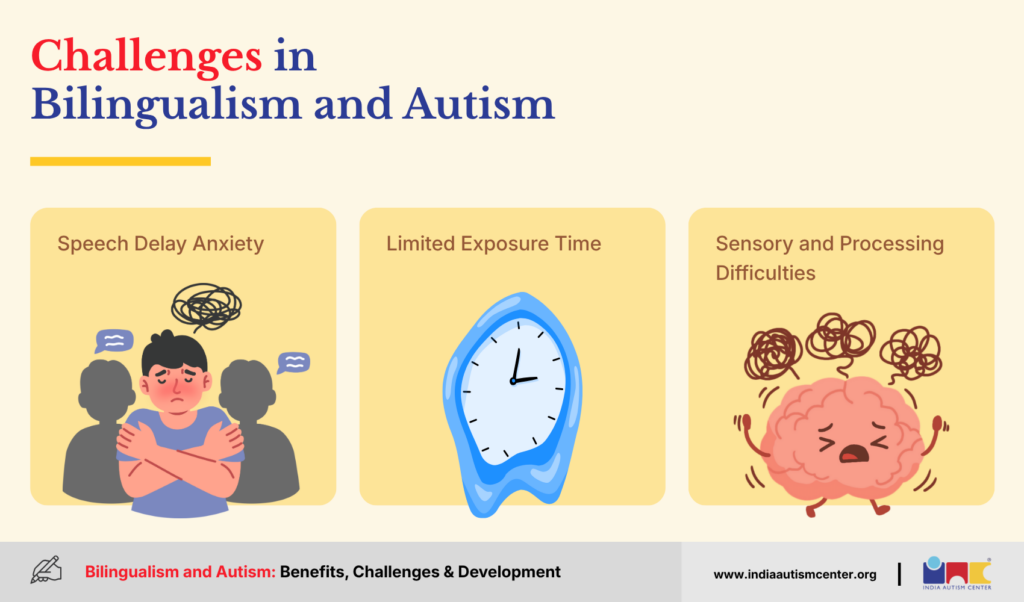
While bilingualism offers advantages, it also presents challenges that must be addressed properly.
1. Speech Delay Anxiety
Parents often worry when their child speaks later than their peers. When two languages are involved, this worry can increase.
However, delay does not mean failure. It means:
- The child needs structured input
- Visual cues
- Repetition
- Motivation-based learning
IAC monitors language milestones carefully and adapts intervention plans accordingly.
2. Limited Exposure Time
Children need enough exposure to both languages. If one language dominates too much, the second language may remain weak.
Therapists at IAC help families create:
- Balanced exposure plans
- Daily language routines
- Play-based bilingual activities
3. Sensory and Processing Difficulties
Some autistic children struggle with:
- Sound sensitivity
- Auditory processing
- Verbal overload
In such cases, bilingualism must be introduced gradually. IAC uses:
- Visual supports
- Augmentative communication
- Structured language environments
Want to know more? Get in touch with us.
6 Common Myths About Bilingualism and Autism – Debunked
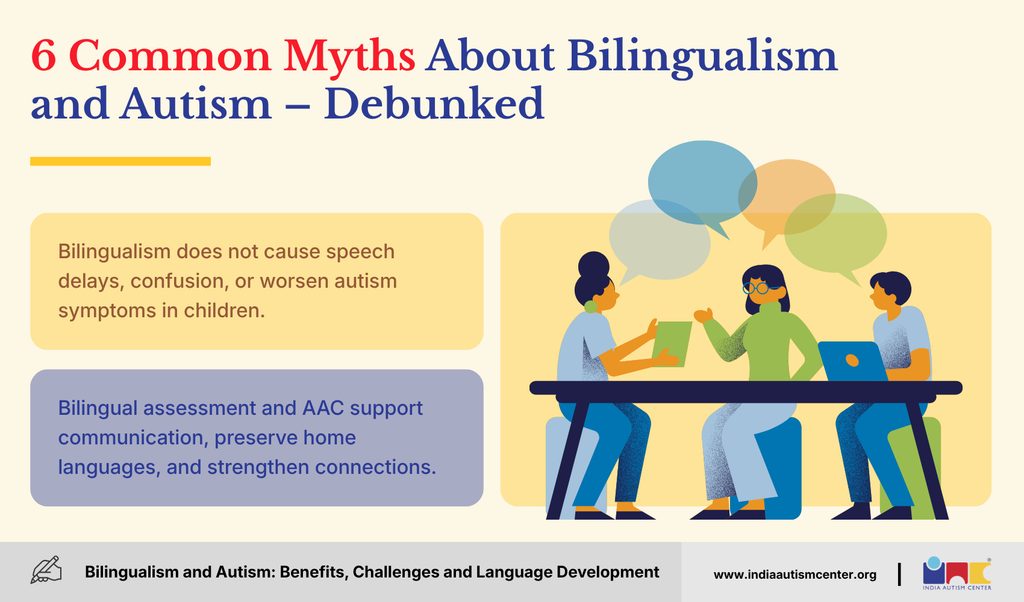
These myths are widespread. They cause real harm – they lead families to abandon their home language, disconnect from their culture and make decisions based on fear rather than evidence. Let us address them directly.
MYTH 1: Bilingualism causes speech delay in autistic children.
FACT: Autism affects language development. Bilingualism does not. A 2024 systematic review on PubMed (pubmed.ncbi.nlm.nih.gov/38065434/) found clear consensus that bilingualism does not add extra difficulty to language development in children with ASD. Any speech delay observed in bilingual autistic children is attributable to autism – not to the number of languages.
MYTH 2: Two languages confuse autistic children.
FACT: Autistic children can differentiate between languages. Digard et al. (2023) in Frontiers in Psychiatry (frontiersin.org) specifically identified this as a long-standing misconception with no supporting evidence. Code-mixing – using words from both languages in one sentence – is a normal stage of bilingual development, not a sign of confusion.
MYTH 3: Parents should only speak one language to an autistic child.
FACT: This advice is unfounded, as Digard et al. (2023) explicitly state. The Hanen Early Language Program (hanen.org) confirms there is no evidence to support telling families to drop their home language. Speaking your most natural language is better for your child – because your emotional expressiveness, your warmth and your fluency come through most authentically in the language you know best.
MYTH 4: Bilingualism worsens autism symptoms.
FACT: There is no evidence that bilingual exposure increases the severity of autism characteristics. A 2023 study (PubMed, pubmed.ncbi.nlm.nih.gov/37937530/) found that bilingual autistic children performed comparably to – and in some areas better than – monolingual autistic peers. Garrido et al. (2024) in ScienceDirect similarly found no detrimental effect of bilingualism on autism symptom severity.
MYTH 5: Assessments only need to be done in one language.
FACT: Assessing a bilingual child in only one language systematically underestimates their true abilities. ASHA’s guidelines state clearly that assessment should be conducted in both languages whenever possible, using culturally appropriate methods. A child who knows “paani” in Hindi and “water” in English has full knowledge of that concept – a monolingual English assessment will not capture that. Always request bilingual assessment or an interpreter.
MYTH 6: AAC and bilingualism don’t mix.
FACT: They mix very well. A 2024 scoping review in the Augmentative and Alternative Communication journal (tandfonline.com) found that bilingual AAC use was not harmful and actively supported caregiver participation and self-identity. AAC devices can be configured in two languages. Families should not abandon their home language simply because a child uses AAC.
How to Assess a Bilingual Autistic Child
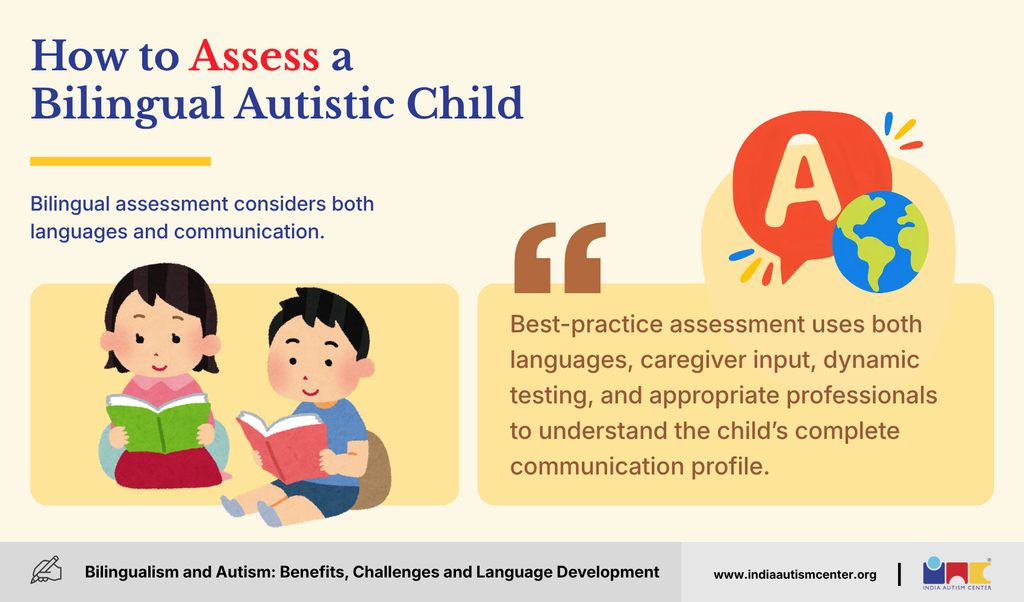
Assessment is where bilingual children are most frequently let down – and where getting it right matters most.
Monolingual assessments underestimate bilingual children. A child’s language knowledge is distributed across both languages. Assessing in only one language gives you an incomplete picture. A child who scores low on an English vocabulary test may have strong vocabulary in Bengali – and vice versa. Single-language scores, measured against monolingual norms, routinely misrepresent what bilingual children actually know and can do.
What best practice looks like:
- Assessment conducted in both languages whenever possible
- Use of a bilingual SLP (speech-language pathologist) or a trained interpreter who understands autism
- Language samples collected in both home and school languages
- Dynamic assessment – looking at what the child can do with support, not just what they can do independently
- Caregiver interview about home language use: which language is used by whom, how often, in what contexts
What to tell the assessor about your home language:
When you bring your child for an assessment, share this information proactively:
- Which languages are spoken at home, and by whom
- Which language your child responds to most readily
- Whether your child uses any words, phrases or communication in the home language that they do not use in English
- Any AAC systems currently in use, and in which language(s) they are configured
At IAC, every child undergoes an individualised language assessment that takes their full bilingual profile into account – not just their performance in a single language.
10 Practical Tips for Parents Raising a Bilingual Autistic Child
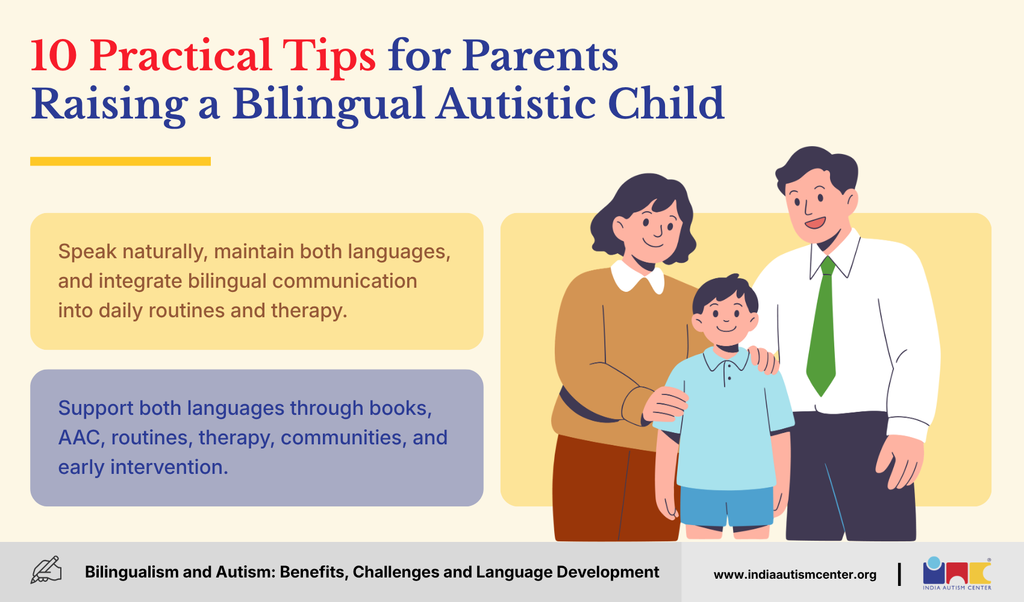
These are not abstract recommendations. These are things you can do starting today.
Tip 1: Speak the Language You Are Most Comfortable With
Your child needs your warmth, your expressiveness and your natural communication – not a performance in a second language. If you think in Bengali, feel in Bengali, dream in Bengali – speak Bengali to your child. The quality of your interaction matters far more than which language you choose.
Tip 2: Ensure Regular, Consistent Exposure to Both Languages
Consistency is the engine of language learning. Create predictable daily routines where both languages appear naturally – perhaps one language at mealtimes, another during play, or one parent consistently uses one language. It does not need to be rigid, but it should be regular.
Tip 3: Work with a Bilingual Speech-Language Pathologist
If possible, find an SLP who speaks your home language or who has experience working with bilingual families. If a bilingual SLP is not available, ask for an interpreter to be present during sessions. Your home language is not a barrier to therapy – it is part of the therapy.
Tip 4: Read to Your Child in Both Languages
Books are one of the richest sources of vocabulary and sentence structure. Read in your home language and in English. Use picture books with simple, repeated language. Let your child see that both languages live on the page – and in your voice.
Tip 5: Use AAC in Both Languages If Your Child Is Minimally Verbal
If your child uses an AAC device or picture board, set it up in both languages. Work with your therapist to ensure the vocabulary reflects the words your child hears at home, not just at school. A child who hears “khaana” at home should be able to find “khaana” on their device.
Tip 6: Celebrate Communication in Either Language – Never Correct the Language
If your child says “paani please” – that is a complete, functional, beautiful communicative act. Respond to the meaning. Expand on it. Never correct the language choice. The goal is communication, not linguistic purity. Every attempt in either language deserves acknowledgement and celebration.
Tip 7: Bring the Home Language Into Therapy Sessions
Do not leave your home language at the door of the therapy room. Share songs, rhymes, stories and phrases from your home language with your child’s therapist. Ask them to incorporate familiar home-language vocabulary into sessions. Therapy that reflects your child’s full world is more effective therapy.
Tip 8: Use Visual Supports and Routines in Both Languages
Label objects around the house in both languages. Create visual schedules that use words from both languages alongside pictures. Routines – morning routine, mealtime, bedtime – are powerful language-learning moments. When both languages appear consistently in those routines, both languages become part of your child’s world.
Tip 9: Connect with Bilingual Autism Communities and Support Groups
You are not alone in navigating this. Seek out parent communities – online or in person – where other families are raising bilingual autistic children. Shared experience is one of the most powerful sources of practical wisdom. IAC’s parent network is one place to start.
Tip 10: Do Not Wait – Early Bilingual Exposure Alongside Early Intervention Gives the Best Outcomes
The research is detailed: early intervention produces the best outcomes in autism. And bilingual exposure, started early and supported consistently, gives your child the fullest possible communicative foundation. Do not delay bilingual exposure waiting for your child to “master” one language first. Start now, with support.
Strategies for Supporting Bilingualism in Autism Spectrum Disorder
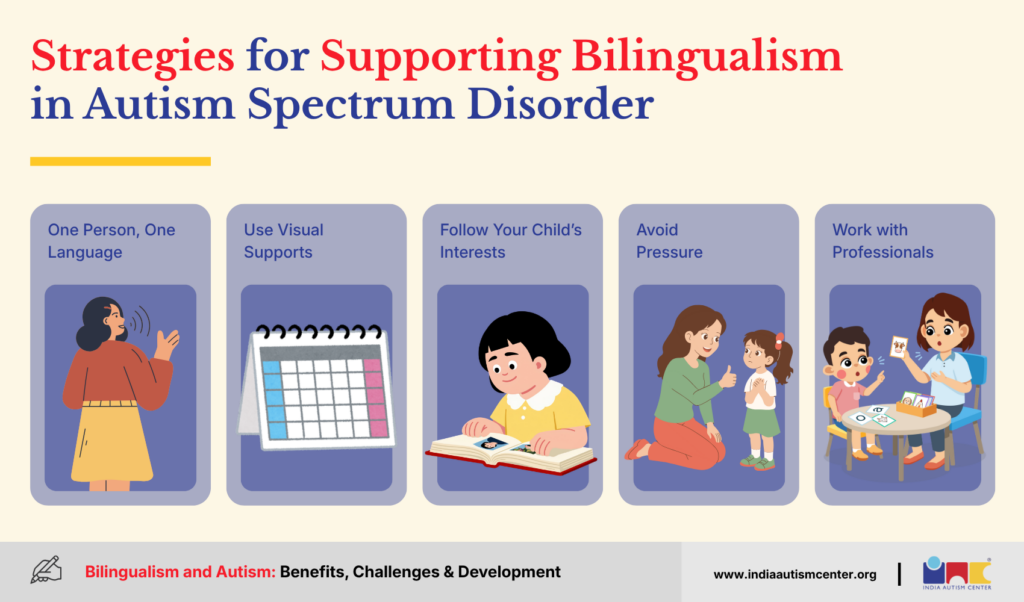
Here are practical ways you can support bilingualism in autism spectrum disorder at home and in therapy.
1. One Person, One Language
You may choose to:
- Speak one language consistently
- Let another caregiver use a different language
This reduces confusion and supports clarity.
2. Use Visual Supports
Pictures, objects and gestures strengthen understanding.
IAC uses:
- Visual schedules
- Picture exchange systems
- Storyboards
These tools support bilingual comprehension.
3. Follow Your Child’s Interests
Language grows faster when linked to interests. If your child loves trains, animals or music, use those topics in both languages.
4. Avoid Pressure
Forcing speech can increase anxiety. Instead:
- Model language
- Encourage attempts
- Praise communication efforts
5. Work with Professionals
Speech therapists trained in autism understand:
- How to structure bilingual input
- When to focus on one language first
- How to generalise skills across languages
This is where IAC plays a vital role.
Role of IAC in Supporting Bilingualism and Autism
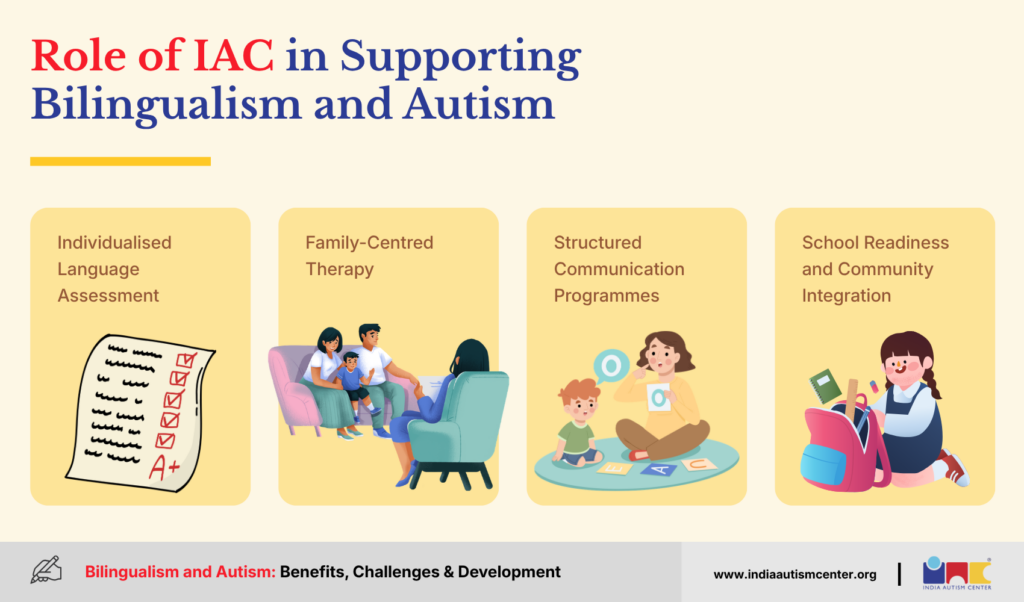
At India Autism Center, bilingualism is not seen as a barrier. It is seen as part of a child’s identity.
IAC supports bilingual autistic children by:
1. Individualised Language Assessment
Each child undergoes:
- Speech and language evaluation
- Cognitive assessment
- Sensory profiling
This helps therapists decide:
- Which language to prioritise
- How to introduce the second language
- What strategies to use
2. Family-Centred Therapy
IAC involves parents directly. Families are guided on:
- How to talk to their child
- Which language to use
- How to build routines at home
Therapy continues beyond the centre.
3. Structured Communication Programmes
IAC integrates:
- Speech therapy
- Behavioural intervention
- Occupational therapy
- Social communication training
This multi-disciplinary approach supports bilingual language growth.
4. School Readiness and Community Integration
Children learn language for:
- Classroom participation
- Peer interaction
- Daily life skills
This improves independence and confidence.
Common Myths About Bilingualism and Autism
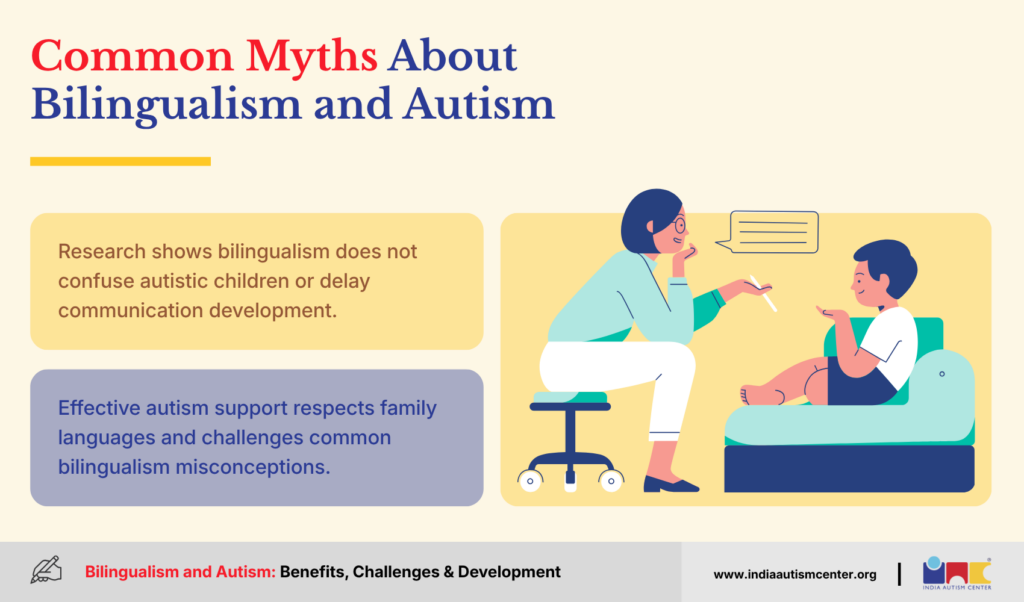
Myth 1: Two languages will confuse my child
Fact: Children can separate languages naturally with time and exposure.
Myth 2: My child should master one language before learning another
Fact: Learning two languages together does not harm language development.
Myth 3: Bilingualism causes speech delay
Fact: Autism, not bilingualism, affects language speed.
Myth 4: Therapy must be only in English
Fact: Therapy works best when it respects the family’s language and culture.
IAC challenges these myths through education and evidence-based practice.
Conclusion
Bilingualism and autism can work well together when language learning is planned and supported properly. The key is not to limit a child to one language, but to introduce both languages in a structured and meaningful way. Consistent use of language at home, combined with professional guidance, helps children develop communication skills without feeling overwhelmed.
India Autism Center (IAC) supports bilingual development by creating individualised language programmes based on each child’s abilities and family language environment. Through therapy, parent training and visual communication strategies, IAC ensures that bilingualism strengthens connection, learning and independence rather than becoming a challenge.
With the right approach, bilingualism becomes a practical solution for improving communication and inclusion in autistic children.
Frequently Asked Questions
Can bilingualism and autism work together without confusing a child?
Yes, bilingualism and autism can work together successfully when both languages are introduced in a structured and supportive way. Research shows that autistic children can learn two languages without harming their communication development, especially when guided by speech and language professionals.
What does research say about bilingualism in autism spectrum disorder?
Studies on bilingualism in autism spectrum disorder indicate that learning two languages does not negatively affect language or cognitive development. Autistic children exposed to more than one language can develop communication skills similar to those of monolingual autistic children when proper support is provided.
What is the impact of bilingualism on autistic children’s language development?
The impact of bilingualism on autistic children depends on factors such as their cognitive abilities, sensory needs and family environment. While some children may take longer to express themselves verbally, bilingual exposure can strengthen social connection, cultural identity and long-term communication opportunities.
How does India Autism Center (IAC) support bilingualism and autism?
India Autism Center (IAC) supports bilingualism and autism through individualised speech and language therapy, family-centred intervention and structured communication programmes. IAC helps children learn and use language in meaningful ways across both home and social settings, ensuring that bilingualism becomes a strength rather than a challenge.
Disclaimer: This article is intended for educational and informational purposes only. It is not a substitute for professional medical advice, diagnosis, or treatment. If you are pregnant or have concerns about medication use during pregnancy, please consult a qualified healthcare provider. If your child has received an autism diagnosis and you have questions about causes or support, please reach out to a trained specialist or an autism-focused organisation for guidance.
For expert insights, support services, and inclusive learning initiatives, visit the India Autism Center.