 Donate now
 Get a Call Back
 MENU
MENU 15 MIN READ
 SHARE
SHARE


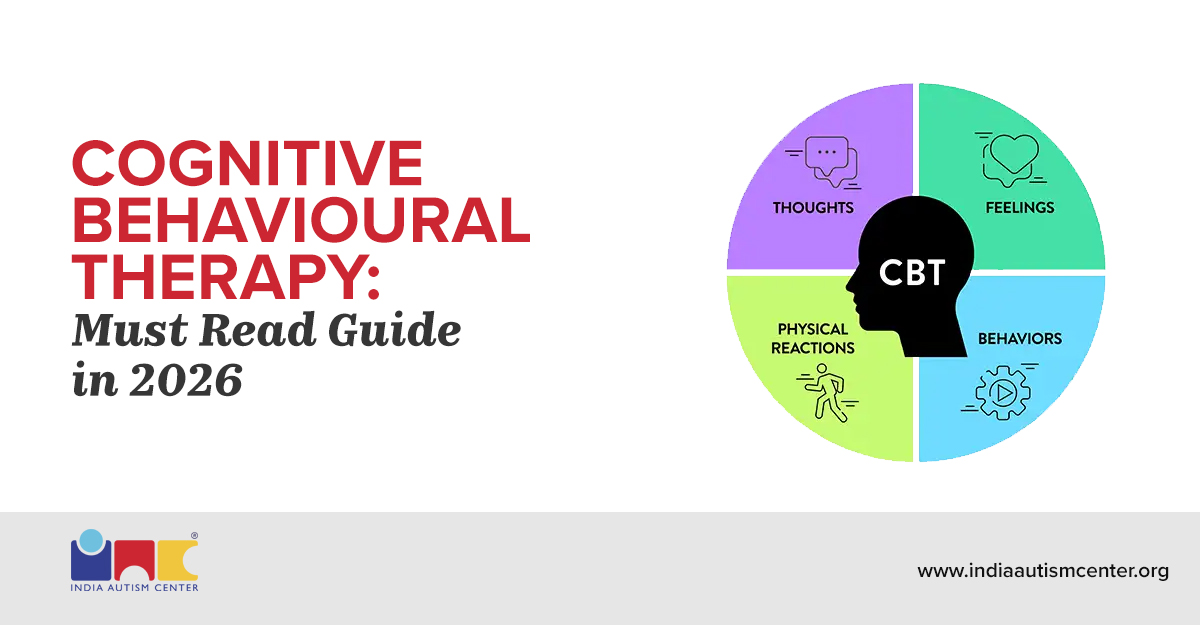
If you’ve ever found yourself thinking, “Why do I keep reacting this way?” or “How can I help my child manage emotions better?” — you’re not alone. I hear this often from parents, caregivers, and individuals navigating emotional or behavioural challenges. That’s where cognitive behavioural therapy (CBT) becomes a powerful, practical solution.
In this comprehensive guide, I’ll walk you through what cognitive behavioural therapy is, how it works, and how it connects with neurodevelopmental disorders like autism, Attention-deficit/hyperactivity disorder (ADHD), and learning difficulties.
What Is Cognitive Behavioural Therapy and Why Does It Work for Children?
Before we talk about techniques, let’s get clear on the cognitive behavioural therapy definition.
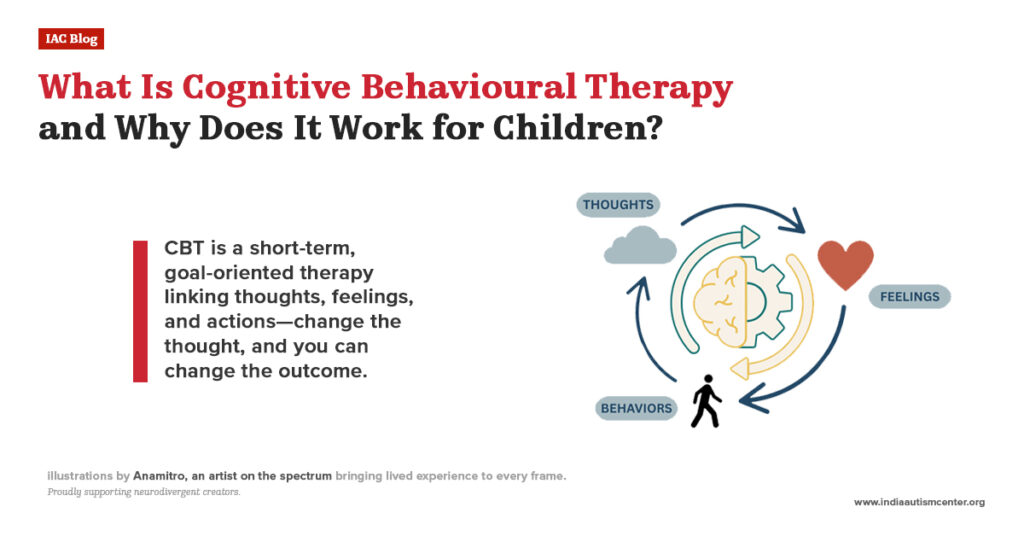
Cognitive behavioural therapy is a short-term, goal-oriented form of therapy that examines the relationship between thoughts, feelings, and behaviours. The core idea is simple but powerful: Your thoughts shape your feelings, and your feelings shape your actions. Change the thought, and you can change the entire chain reaction.
The CBT Triangle Explained (Thoughts → Feelings → Actions)
Imagine a triangle with three corners:
- Thoughts (what you say to yourself internally)
- Feelings (emotions like fear, anger, sadness, or excitement)
- Actions (what you actually do, like hiding, yelling, or asking for help)
Here’s how it plays out for a child who’s scared of the dark:
- Thought: “There’s something under my bed.”
- Feeling: Terror, racing heart, sweaty palms.
- Action: Screaming for mom, refusing to sleep alone, lying rigid in bed.
Now watch what happens when we change the thought:
- New Thought: “I checked under the bed with Dad. There’s nothing there. I am safe.”
- New Feeling: Calm, relaxed, sleepy.
- New Action: Closing eyes, falling asleep, staying in bed all night.
That’s cognitive behavioural therapy in a nutshell. And when you teach this framework to children, you give them a superpower: the ability to become their own thought detectives.
How Children’s Brains Process CBT Differently Than Adults
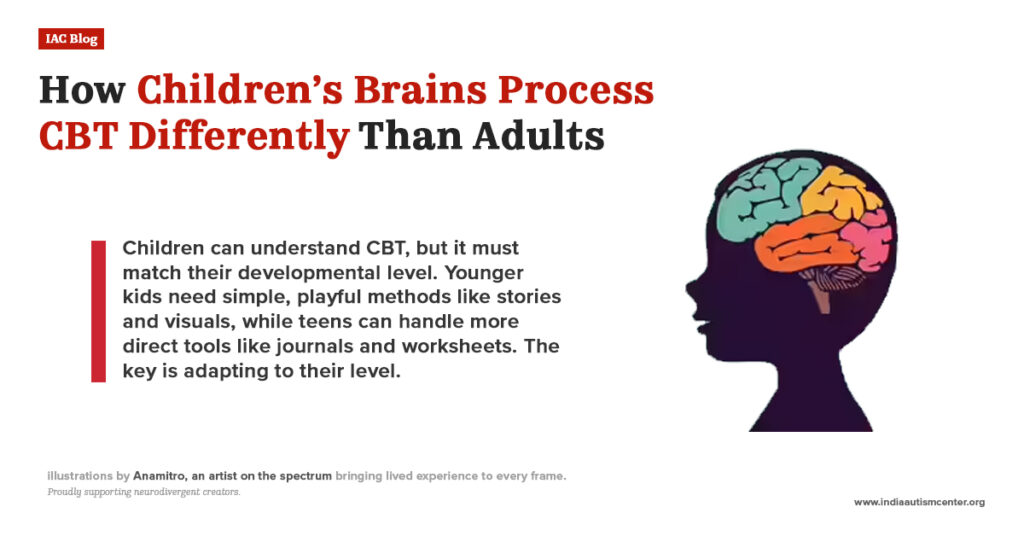
Might you be wondering: Can my 7-year-old really understand this?
The answer is yes—but with one important caveat. Children’s prefrontal cortexes (the “logic center” of the brain) are still developing. That means they struggle with abstract reasoning. So you can’t just hand them a textbook on cognitive behavioural therapy.
Instead, you adapt, use stories, drawings, puppets, and games. You call negative thoughts “thought monsters” or “brain bugs.” You make it concrete, visual, and playful.
For teenagers, you can be more direct. Teens have better abstract thinking skills, so you can introduce worksheets, journals, and digital apps. But the principle remains the same: meet the child where they are developmentally.
Evidence-Based Success Rates for Childhood Anxiety, OCD, and Anger
See, cognitive behavioural therapy isn’t a fad. It’s one of the most researched psychological treatments in existence.
Here’s what the data shows:
- Anxiety disorders: Up to 60% of children show significant improvement after 8–12 sessions of CBT.
- OCD: CBT with Exposure and Response Prevention (ERP) works for 70 – 80% of pediatric patients.
- Anger and aggression: CBT reduces disruptive behaviors by 40 – 50% compared to no treatment.
These aren’t guesses. These are numbers from peer-reviewed studies. So when someone asks, “Does cognitive behavioural therapy work?”—you can answer with confidence: Yes!
Want to know more? Get in touch with us.
5 Core CBT Techniques Every Parent Can Use at Home
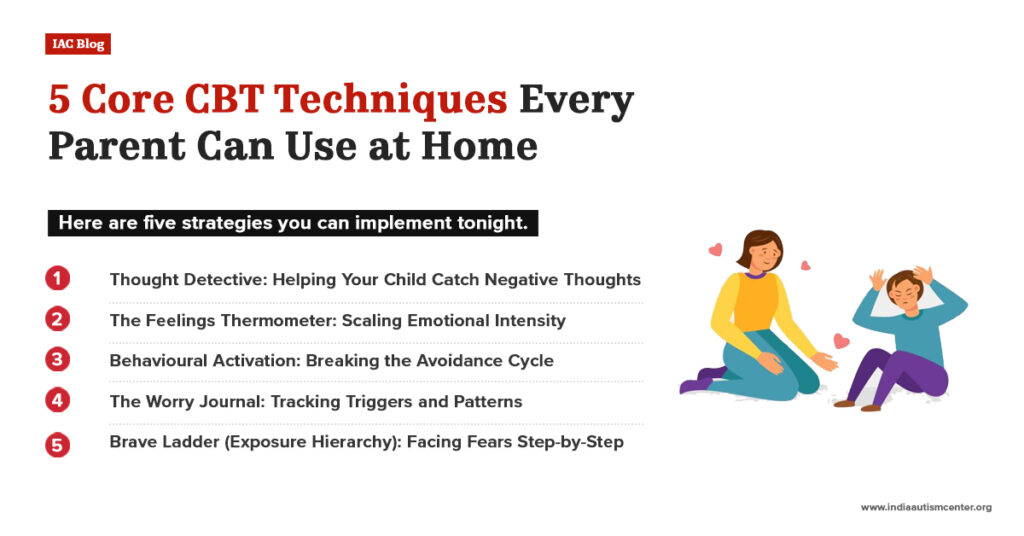
Now let’s get practical. You don’t need a therapist in the room to start using cognitive behavioral therapy techniques. Here are five strategies you can implement tonight.
1. Thought Detective: Helping Your Child Catch Negative Thoughts
This is the foundation of everything.
What to do: Teach your child that thoughts are not facts. Just because they think something terrible will happen doesn’t mean it will.
How to explain it: Say, “Your brain has a detective agency. Sometimes the detective makes mistakes. Let’s catch those mistakes together.”
Questions to ask your child:
- What’s the evidence that this scary thing will happen?
- What’s the evidence that it won’t happen?
- What would you tell a friend who had this same thought?
Example: Your daughter thinks, “Nobody likes me at school.” You ask for evidence. She says, “Lily didn’t sit next to me at lunch.” Then you ask for evidence against: “But Emma saved you a seat yesterday, right? And you played tag with three kids at recess.”
Suddenly, the original thought doesn’t hold up.
2. The Feelings Thermometer: Scaling Emotional Intensity
Young children struggle to describe emotions. They only know “fine” or “terrible.” The Feelings Thermometer gives them a scale from 1 to 10.
How to make one: Draw a large thermometer on paper. Color the bottom green (1–2: calm/happy). Move to yellow (3–5: worried/frustrated). Then orange (6–8: very upset). Finally, red (9–10: explosive panic).
How to use it: Use when your child is calm; practice rating different situations. “How many points would you give a small spider? Then, when they’re upset, ask: “Where are you on the thermometer right now?”
This does two things. First, it gives you objective data. Second, it forces the child to pause and self-reflect, which alone lowers the intensity.
3. Behavioural Activation: Breaking the Avoidance Cycle
Anxiety and depression feed on avoidance. The more your child avoids the scary thing (school, social events, homework), the bigger that thing becomes in their mind.
Behavioural activation is the opposite: you deliberately engage in positive or neutral activities even when you don’t feel like it.
How to do it at home: Create a “brave choices” chart. Every time your child does something they were afraid of (asking a question in class, going to a birthday party), they earn a sticker. After five stickers, they get a small reward.
Real-world example: One parent I worked with had a son who refused to order his own food at restaurants. They started small: first, he just made eye contact with the waiter. Next, he whispered his order to mom, who repeated it. Finally, he ordered a single drink by himself. Each step earned points. Within three weeks, he was ordering full meals.
4. The Worry Journal: Tracking Triggers and Patterns
You cannot fix what you do not measure.
What to do: Buy a simple notebook. Label it “My Worry Journal.” Every evening, ask your child to write (or draw) three things:
- What made me worried today?
- What did I think would happen?
- What actually happened?
Why this works: Over time, patterns emerge. Your child will see, with their own eyes, that 90% of their predicted disasters never come true. That’s not you telling them—that’s data telling them. And data is hard to argue with.
5. Brave Ladder (Exposure Hierarchy): Facing Fears Step-by-Step
This is the gold standard for treating phobias and severe anxiety. But you have to do it carefully.
How to build a Brave Ladder:
- List everything your child is afraid of related to one specific trigger (e.g., dogs).
- Rank each item from least scary (1) to most scary (10).
- Start at #1 and don’t move up until your child feels comfortable.
A common example is the Brave Ladder for fear of dogs. This is just for understanding. You can pick anything for this:
| Step | Task | Scary Rating |
| 1 | Look at a cartoon picture of a dog | 2 |
| 2 | Look at a real photo of a small dog | 3 |
| 3 | Watch a 10-second video of a calm dog | 4 |
| 4 | Stand 10 feet away from a real dog on a leash | 6 |
| 5 | Stand 3 feet away from the same dog | 7 |
| 6 | Pet the dog for 2 seconds with your hand | 9 |
| 7 | Pet the dog for 10 seconds | 10 |
Golden rule: Never force the next step. Let your child control the pace. Celebrate every small victory.
Want to know more? Get in touch with us.
Age-by-Age Guide: Adapting CBT for Preschoolers, School-Age Kids, and Teens
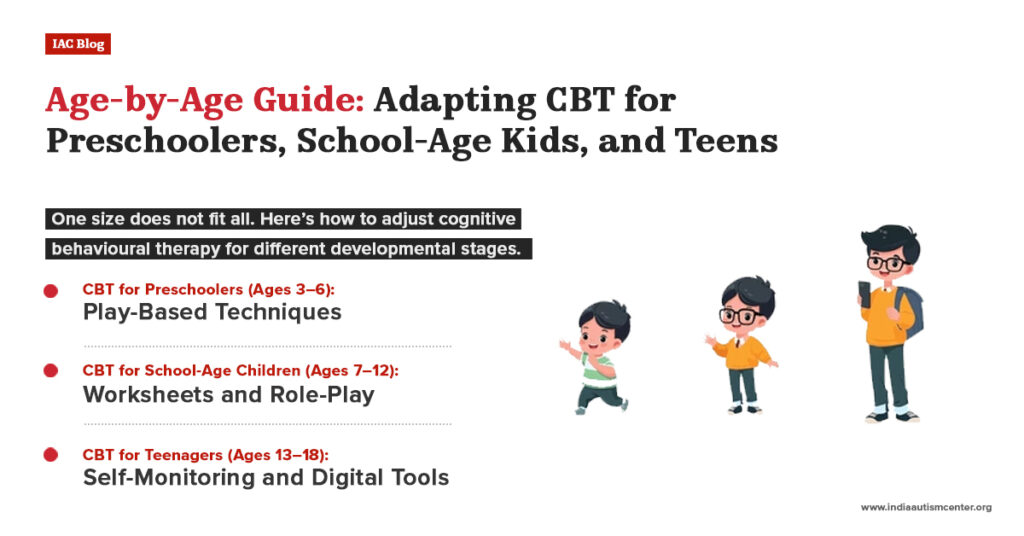
One size does not fit all. Here’s how to adjust cognitive behavioural therapy for different developmental stages.
CBT for Preschoolers (Ages 3–6): Play-Based Techniques
At this age, abstract thinking is almost nonexistent. So you don’t lecture. You play.
What works:
- Puppet shows: Have a brave puppet and a scared puppet talk through problems.
- Drawing feelings: “Draw a picture of your anger. What colour is it? Does it have teeth?”
- Monster spray: Fill a spray bottle with water and lavender. Call it “worry spray.” Let your child “spray away” fears before bed.
What doesn’t work: Worksheets, logic debates, or asking “Why do you feel that way?” (They don’t know why. They’re just 4 years old.)
CBT for School-Age Children (Ages 7–12): Worksheets and Role-Play
This is the sweet spot. Kids this age love structure, games, and earning rewards.
What works:
- Printable cognitive behavioural therapy worksheets (free online)
- Role-playing difficult conversations with stuffed animals
- The “Worry Box”: Decorate a shoebox. Write worries on slips of paper. “Lock” them inside at bedtime.
Pro tip: Use their interests. If they love superheroes, frame CBT as “training your brain to defeat the worry villain.”
CBT for Teenagers (Ages 13–18): Self-Monitoring and Digital Tools
Teens value autonomy. They also live on their phones. Use that to your advantage.
What works:
- CBT apps like MindShift, Woebot, or Sanvello
- Digital mood trackers (Daylio, Moodnotes)
- Letting them lead their own therapy sessions (with your support)
What to avoid: Nagging, checking their journal without permission, or forcing them to talk “on your schedule.” Teens will shut down fast.
Common Childhood Conditions CBT Treats Most Effectively
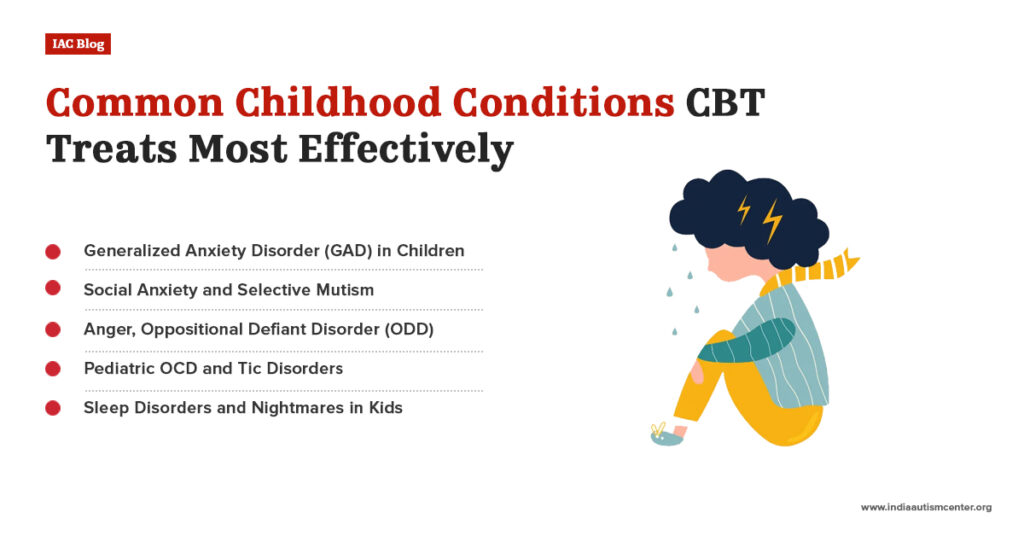
Let me be clear: cognitive behavioural therapy isn’t a magic wand. But for the following conditions, it’s often the first-line treatment recommended by pediatric psychologists.
Generalized Anxiety Disorder (GAD) in Children
Symptoms: Constant worrying about school, family health, natural disasters, or performance. Physical symptoms like headaches and fatigue.
How CBT helps: Thought challenging reduces catastrophic predictions. Relaxation techniques (deep breathing, progressive muscle relaxation) lower physical arousal.
Social Anxiety and Selective Mutism
Symptoms: Extreme fear of embarrassment or judgment. Some children speak normally at home but go completely silent at school (selective mutism).
How CBT helps: Brave Ladders slowly expose the child to social situations. Role-play builds conversational confidence.
You can read our blog on Social Skills Development in Autism | 5 Proven Approaches (2026).
Anger, Oppositional Defiant Disorder (ODD), and Impulse Control
Symptoms: Frequent tantrums, arguing, blaming others, deliberately annoying people.
How CBT helps: Teaches “stop and think” skills. Replaces aggressive actions with verbal expression (“I’m angry because…”).
CBT for Pediatric OCD and Tic Disorders
Symptoms: Repeated unwanted thoughts (obsessions) and rituals (compulsions). Tics are sudden, repetitive movements or sounds.
How CBT helps: A specialized form called Exposure and Response Prevention (ERP) teaches the child to feel the urge to perform a ritual—but not do it. Over time, the urge fades.
Sleep Disorders and Nightmares in Kids
Symptoms: Difficulty falling asleep, frequent night waking, terrifying dreams.
How CBT helps: Stimulus control (only using bed for sleep), bedtime routine adjustments, and “dream rescripting” (rewriting the nightmare’s ending with a positive twist).
Want to know more? Get in touch with us.
How to Find a Qualified Child CBT Therapist
At some point, you might decide: I need professional help. That’s wise. Here’s exactly how to search for “cognitive behavioural therapy near me” and find someone great.
10 Questions to Ask a Potential Therapist
Before you book a session, call or email these questions:
- Do you have specific training in cognitive behavioural therapy for children?
- How many children with my child’s condition have you treated?
- Do you involve parents in the sessions?
- Will you give us “homework” to practice between sessions?
- How do you measure progress?
- What happens if my child refuses to talk?
- Do you offer teletherapy (video sessions)?
- What’s your cancellation policy?
- How much does each session cost?
- Do you accept our insurance?
Red Flags: When CBT Isn’t Being Done Properly
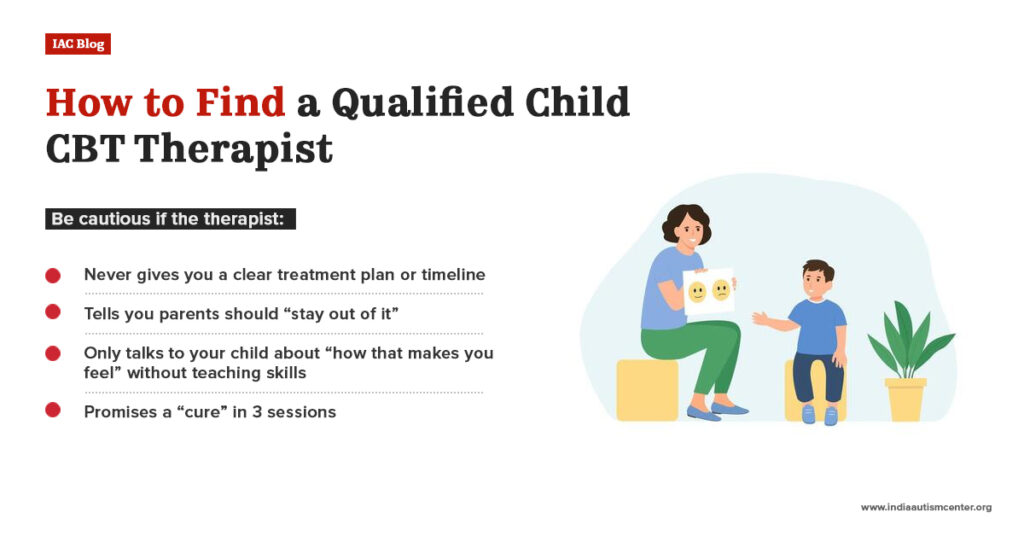
Be cautious if the therapist:
- Never gives you a clear treatment plan or timeline
- Tells you parents should “stay out of it”
- Only talks to your child about “how that makes you feel” without teaching skills
- Promises a “cure” in 3 sessions
Real cognitive behavioural therapy is structured, goal-oriented, and transparent. If something feels off, trust your gut.
Parent-Led CBT vs. Professional Therapy: What’s Best for Your Family?
You might be wondering: Can I just do this myself?
The answer: Sometimes yes, sometimes no.
When You Can Successfully Use DIY CBT Techniques
Try home-based CBT first if:
- Your child has mild anxiety (worries less than 1 hour/day)
- The problem is recent (started within the last few months)
- Your child is cooperative and willing to try
- You have the time and patience to practice daily
Signs Your Child Needs a Professional
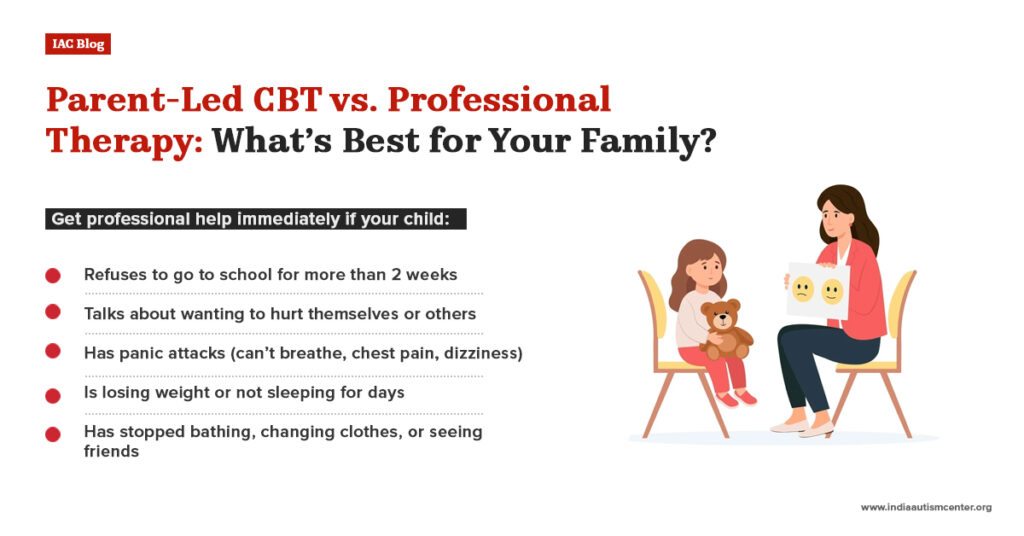
Get professional help immediately if your child:
- Refuses to go to school for more than 2 weeks
- Talks about wanting to hurt themselves or others
- Has panic attacks (can’t breathe, chest pain, dizziness)
- Is losing weight or not sleeping for days
- Has stopped bathing, changing clothes, or seeing friends
Combining Home Practices with Weekly Therapy for Faster Results
Here’s the secret: The best outcomes happen when parents and therapists work together.
In weekly therapy, the child learns skills. At home, you reinforce those skills. You become the coach, not the therapist. You practice the Brave Ladder, the Feelings Thermometer, and celebrate the small wins.
When you search for “where can I get cognitive behavioural therapy,” ask the provider: “Do you offer parent training sessions?” If yes, jump on it.
7 Common Mistakes Parents Make with CBT (And How to Avoid Them)
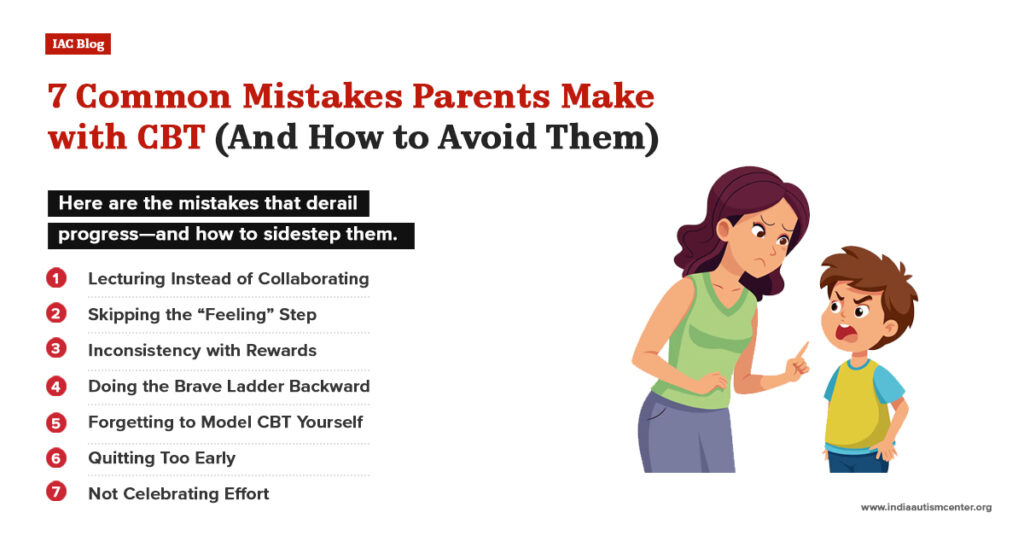
I’ve seen hundreds of families try cognitive behavioural therapy. Here are the mistakes that derail progress—and how to sidestep them.
Mistake #1: Lecturing Instead of Collaborating
Wrong: “You’re being irrational. There’s nothing to be afraid of. Stop it.”
Right: “I see you’re scared. Let’s figure this out together. What’s your brain telling you right now?”
Mistake #2: Skipping the “Feeling” Step
Wrong: “Just go to the party. You’ll be fine.”
Right: “First, let’s name what you’re feeling. Scared? Nervous? Okay, now let’s rate it on the thermometer.”
Mistake #3: Inconsistency with Rewards
Wrong: Praising bravery one day, ignoring it the next.
Right: Same reward system. Same expectations. Every. Single. Day.
Mistake #4: Doing the Brave Ladder Backward
Wrong: Starting with the scariest task (step 10) and being shocked when your child melts down.
Right: Step 1 only. Master it. Then step 2.
Mistake #5: Forgetting to Model CBT Yourself
Wrong: “Do as I say, not as I do.”
Right: Narrate your own thought process. “Mommy is worried about her presentation tomorrow. Let me check the evidence…”
Mistake #6: Quitting Too Early
Wrong: Stopping after two good days.
Right: CBT takes 8–12 weeks minimum. Old habits die hard. Stick with it.
Mistake #7: Not Celebrating Effort
Wrong: Only praising the final outcome.
Right: “I’m so proud of you for trying step 4, even though you were scared. That took real courage.”
Conclusion
Cognitive behavioural therapy isn’t a mystery. It’s a practical, evidence-based framework that shows your child how thoughts create feelings, and feelings create actions. You now know the cognitive behavioral therapy definition, the core techniques, and exactly how to do cognitive behavioral therapy at home.
You’ve seen the age-by-age adaptations. You’ve learned when to search for “cognitive behavioral therapy near me” and when to trust your own parenting skills. And you have a list of common mistakes to avoid.
So here’s my challenge to you.
Pick just one technique from this guide. The Feelings Thermometer. The Thought Detective questions. A single rung on a Brave Ladder. Try it tonight. Not tomorrow. Not “when things calm down.” Tonight.
Because here’s the truth I’ve learned from working with hundreds of families: The parents who see the biggest changes aren’t the smartest or the wealthiest. They’re the ones who start.
Frequently Asked Questions (FAQs)
Can I do CBT with my child without a therapist?
Yes, for mild to moderate issues. The techniques I shared above (Thought Detective, Feelings Thermometer, Brave Ladder) are safe and effective for home use. However, if your child has a diagnosed mental health condition or is in crisis, please consult a professional.
What’s the difference between CBT and play therapy?
Play therapy uses toys, art, and sand trays to help young children express emotions indirectly. CBT is more structured and skills-based. For children under 6, play therapy is often preferred. For children 7 and older, CBT is typically more effective for specific problems like anxiety or anger.
Does my child have to talk about trauma for CBT to work?
No. While some forms of CBT address traumatic memories (Trauma-Focused CBT), standard CBT focuses on current thoughts, feelings, and behaviours. Your child never has to relive painful memories unless you and the therapist agree that the approach is necessary.
What age is appropriate for cognitive behavioral therapy?
Cognitive behavioural therapy can be used for children as young as 5–6 years old, with techniques adapted to their developmental level. It is effective for teenagers and even adults, making it a versatile, lifelong skill.
For expert insights, support services, and inclusive learning initiatives, visit the India Autism Center.