 Donate now
 Get a Call Back
 MENU
MENU 17 MIN READ
 SHARE
SHARE


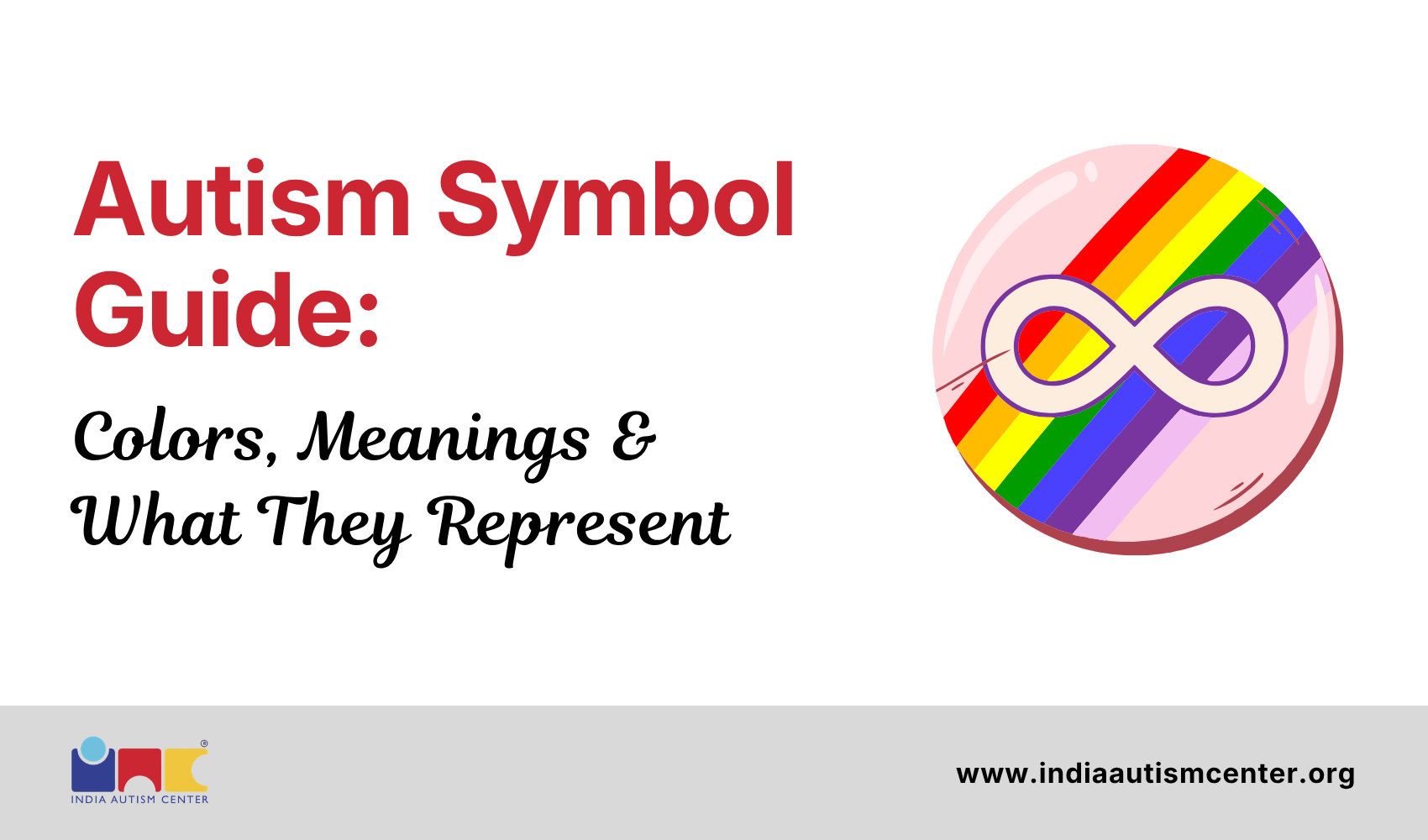
There is no single, universally agreed autism symbol. The puzzle piece (1963) was the first, but many autistic adults now prefer the infinity symbol or rainbow as more affirming alternatives. Autism colours range from blue (awareness) to gold (acceptance) to rainbow (neurodiversity). Understanding what each symbol and colour means helps parents, educators, and advocates communicate with greater respect and accuracy.
Every parent who has attended an autism awareness event has seen the imagery: puzzle pieces on banners, blue lights on buildings, rainbow ribbons on lapels. But what do these symbols actually mean? And which ones do autistic people themselves prefer?
The autism symbol landscape has shifted dramatically over the past two decades. What began as a single puzzle piece in 1963 has grown into a rich, sometimes contested vocabulary of colours and icons – each carrying a distinct message about identity, acceptance, and belonging. According to the World Health Organisation, approximately 1 in 127 people worldwide is on the autism spectrum. In India, diagnoses are rising steadily, yet misconceptions about autism persist in many communities.
The History of Autism Symbols
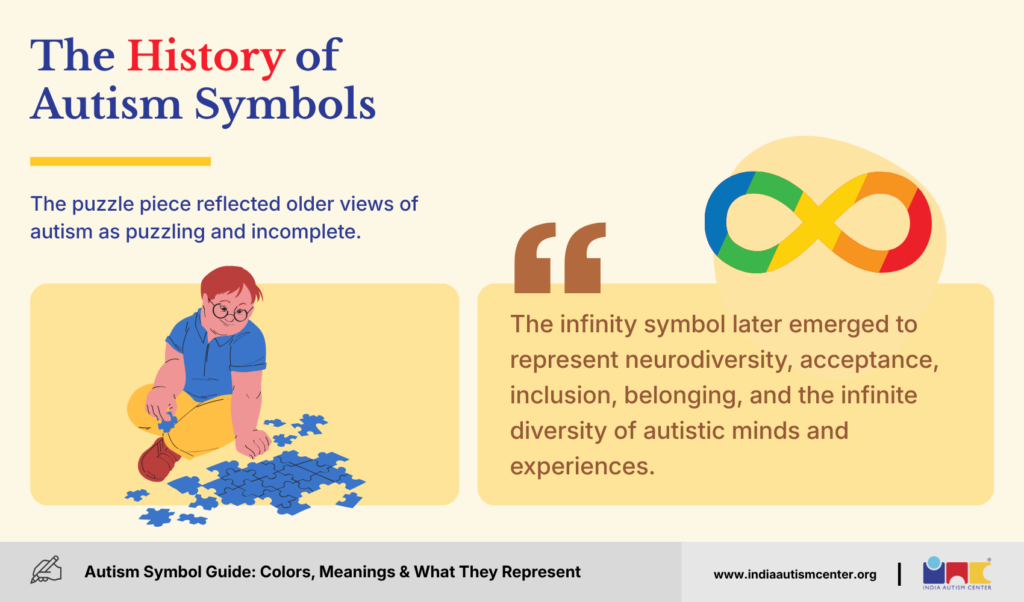
The puzzle piece was created in 1963 by the National Autistic Society (UK), then known as the National Society for Autistic Children. The designer, Gerald Gasson, chose a puzzle piece with a weeping child at its centre – a choice that reflected the era’s view of autism as a tragic, “puzzling” condition that needed to be solved.
The Autism Society of America later adopted a variation of the puzzle piece, cementing it as the dominant autism symbol for decades. For many families in the 1970s, 1980s, and 1990s, it was the first symbol that gave them access to a community, resources, and recognition.
But the framing was always problematic. A puzzle piece implies something is missing. It suggests that an autistic person is incomplete – a problem to be solved rather than a person to be understood.
Today, a significant number of autistic self-advocates reject the puzzle piece for exactly this reason. The “missing piece” metaphor feels dehumanising. It centres the discomfort of non-autistic people rather than the dignity of autistic ones.
The Shift to the Infinity Symbol
From the early 2010s onward, a new autism symbol gained ground: the infinity symbol – a figure-eight lying on its side, with no beginning and no end. Unlike the puzzle piece, it carries no suggestion of incompleteness. Instead, it represents the infinite diversity of autistic minds and the idea that autism is a natural, lifelong part of human variation.
The shift from puzzle piece to infinity symbol is not just aesthetic. It reflects a deeper philosophical move – from “awareness” (knowing autism exists) to autism acceptance (respecting autistic people as they are).
Why Autism Colours and Symbols Matter?
Autism is a neurodevelopmental condition affecting communication, behaviour, sensory processing, and social interaction. The WHO’s 2021 global estimate puts prevalence at 1 in 127 individuals – and that figure is almost certainly an undercount in countries like India, where diagnostic infrastructure is still developing and stigma delays many families from seeking assessment.
Symbols and autism colours matter because they:
- Raise public awareness – a recognisable symbol can open a conversation in a classroom, a workplace, or a doctor’s waiting room
- Create visibility during awareness campaigns, school events, and public advocacy
- Allow autistic individuals to express identity and pride – wearing a gold infinity pin is an act of self-affirmation, not just a gesture for others
- Shape how society perceives autism – positively or negatively, depending on the symbol chosen
When chosen thoughtfully, autism symbols and colours promote understanding rather than stereotypes.
Autism Symbol Comparison: Every Major Symbol Explained
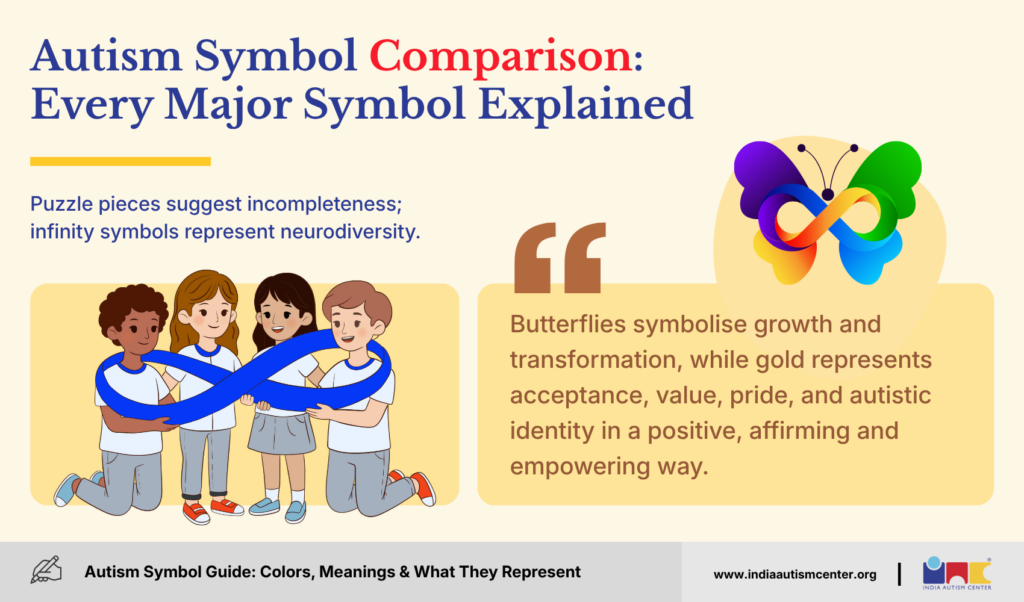
Here is a side-by-side look at the major autism symbols in use today.
| Symbol | Also Known As | Colours Used | What It Represents | Community Sentiment |
|---|---|---|---|---|
| Puzzle Piece | Jigsaw piece, puzzle ribbon | Blue, multicolour | Autism as a “puzzling” condition; used by older organisations | Mixed – many autistic adults reject it; some families still identify with it |
| Infinity Symbol | Rainbow infinity, gold infinity | Rainbow, gold, red | Infinite brain diversity; neurodiversity; no beginning or end | Widely preferred by autistic self-advocates and the neurodiversity movement |
| Butterfly | Butterfly autism symbol | Rainbow, multicolour | Transformation, growth, hope; no two butterflies identical | Popular with parents of young children and early intervention centres |
| Awareness Ribbon | Puzzle ribbon | Blue, multicolour | Solidarity during awareness campaigns; puzzle-piece pattern | Broadly recognised; associated with April campaigns |
| Rainbow Spectrum | Autism rainbow | Full spectrum | The breadth of the autism spectrum; diversity of experience | Growing adoption by schools, advocacy groups, and families |
| Gold / “Go Gold” | Gold infinity, Au symbol | Gold | Acceptance, value, excellence; Au = first two letters of “autism” | Strongly preferred by acceptance-focused advocates |
The trend is clear. Symbols rooted in the awareness era (puzzle piece, blue ribbon) are giving way to symbols rooted in the acceptance era (gold, rainbow infinity). The language has shifted too – many advocates now prefer “Autism Acceptance Month” over “Autism Awareness Month,” and that shift is reflected in the symbols people choose to wear and display.
Decoding Autism Colours: What Do They Represent?
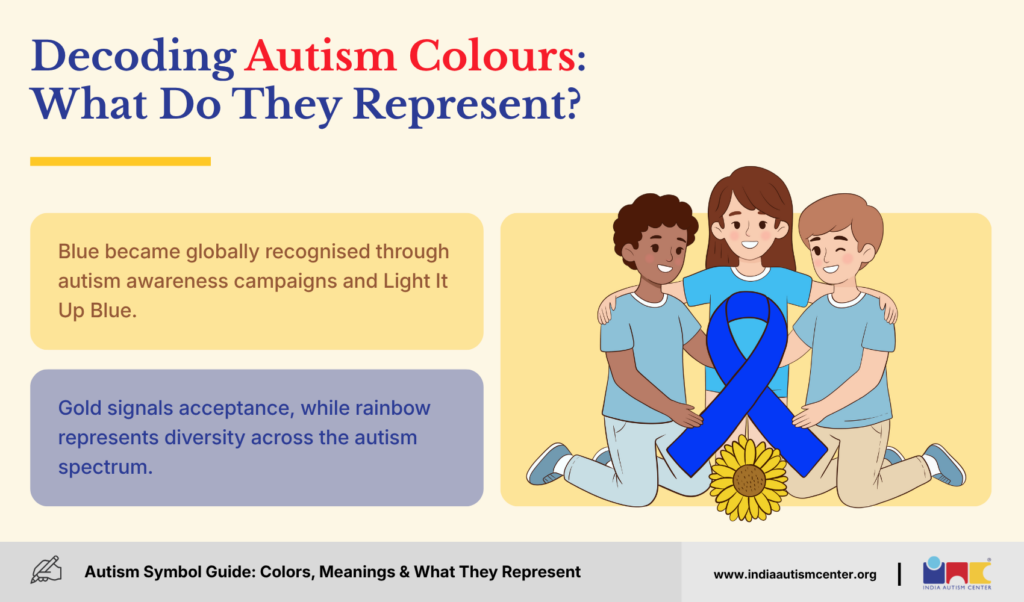
If you have ever searched online for “What colour is for autism?”, you might have found different answers. This is because different campaigns use different colours to send specific messages. Let’s break down the most common autism awareness colours.
The Autism Blue Colour
For most of the late 20th century, autism blue was the dominant colour. It was popularised globally by Autism Speaks’ “Light It Up Blue” campaign, launched in 2010 to coincide with World Autism Awareness Day on 2 April – a date officially designated by the United Nations General Assembly in 2007 (first observed in 2008).
Blue was chosen to convey calmness, trust, and authority. Landmarks around the world – including the Empire State Building and the Eiffel Tower – have been lit blue on 2 April.
The problem? Blue was originally chosen partly because early research focused almost exclusively on autistic boys. As awareness grew that autism affects girls, women, and non-binary individuals in equal measure, the exclusively male associations of blue began to feel exclusionary. Many autistic women and gender-diverse people have moved away from blue precisely because it does not reflect their experience.
Blue remains the most globally recognised autism awareness colour, but it is no longer the whole story.
The “Go Gold” Movement
Gold is the most compelling colour story in the autism world. In chemistry, the symbol for gold is Au – the first two letters of “autism.” That simple coincidence became the foundation of the “Go Gold” movement, which emerged from autistic-led community spaces around 2011–2012.
The autism gold colour carries a message that blue does not: acceptance over awareness. Awareness says “autism exists.” Acceptance says “autistic people are valuable exactly as they are.”
Gold also carries connotations of excellence and worth – a deliberate counter-narrative to the deficit-focused framing of older autism campaigns. When you see a gold infinity pin, it is a statement: this person is not a puzzle to be solved. They are gold.
The Vibrant Autism Rainbow
The autism rainbow is arguably the most accurate visual metaphor for autism. Because autism is a spectrum – not a single, fixed presentation – no two autistic people are alike. A rainbow, with its continuous blending of colours, captures that diversity better than any single hue.
The autism rainbow is increasingly adopted by schools, university disability services, and advocacy organisations that want to signal genuine inclusion. It aligns naturally with the neurodiversity movement, which holds that neurological differences are a normal part of human variation, not defects to be corrected.
In India, we are seeing more schools and parent groups adopt rainbow imagery as they move from a medical-model framing of autism toward a rights-based, identity-affirming one.
Red – Autism in a Different Light
Some campaigns use red for autism – particularly those focused on urgency, action, and policy change. Red is less common than blue, gold, or rainbow, but it appears in certain advocacy contexts where the goal is to signal that more needs to be done: more funding, more research, more inclusive education. It is worth knowing about, even if it is not the dominant colour in most communities.
The Puzzle Piece Autism Symbol – History and Controversy
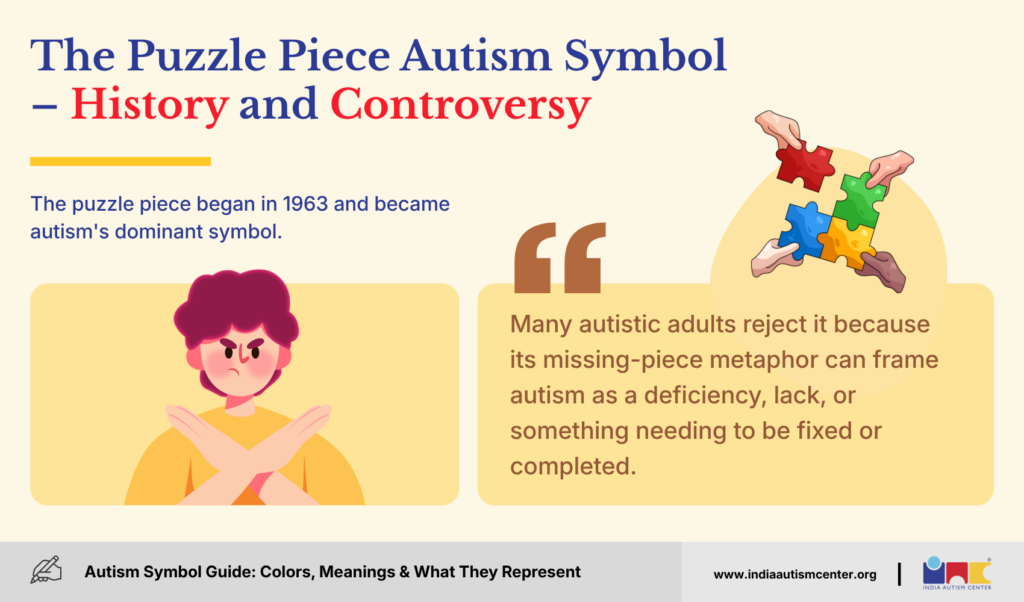
The puzzle piece autism symbol deserves its own section, because the debate around it is ongoing and genuinely complex.
The 1963 Origin
The puzzle piece was designed in 1963 by Gerald Gasson for the UK’s National Autistic Society. The original logo showed a puzzle piece with a weeping child – a design that reflected the prevailing view of autism at the time as a mysterious, distressing condition. The Autism Society of America later adopted a colourful puzzle-piece ribbon, which became the most widely recognised autism symbol worldwide.
For decades, the puzzle piece was the symbol that opened doors. It appeared on fundraising materials, school resources, and awareness campaigns. For many families, especially those who received a diagnosis in the 1980s or 1990s, it was the first visual language they had for their child’s experience.
Why Many Autistic Adults Reject It
The criticism is not new, but it has grown louder as autistic self-advocates have gained more platforms. The core objection: a puzzle piece implies something is missing. It frames autism as a deficiency – a condition that needs to be completed, fixed, or solved. The original weeping child imagery made this framing explicit.
Many autistic adults find the puzzle piece dehumanising. It centres the perspective of non-autistic observers (“autism is puzzling to us”) rather than the experience of autistic people themselves. Organisations like the Autistic Self Advocacy Network (ASAN) have moved away from it entirely.
Why Some Families Still Use It
At the same time, many families – particularly those who have been in the autism community for a long time – still identify with the puzzle piece. For them, it represents a history of advocacy, community-building, and hard-won resources. Dismissing it entirely can feel like erasing that history.
The honest position is this: the puzzle piece is not universally accepted, and it is not universally rejected. What matters is understanding why some people find it harmful, and making an informed choice about whether to use it.
The Butterfly Autism Symbol: A Sign of Growth and Hope
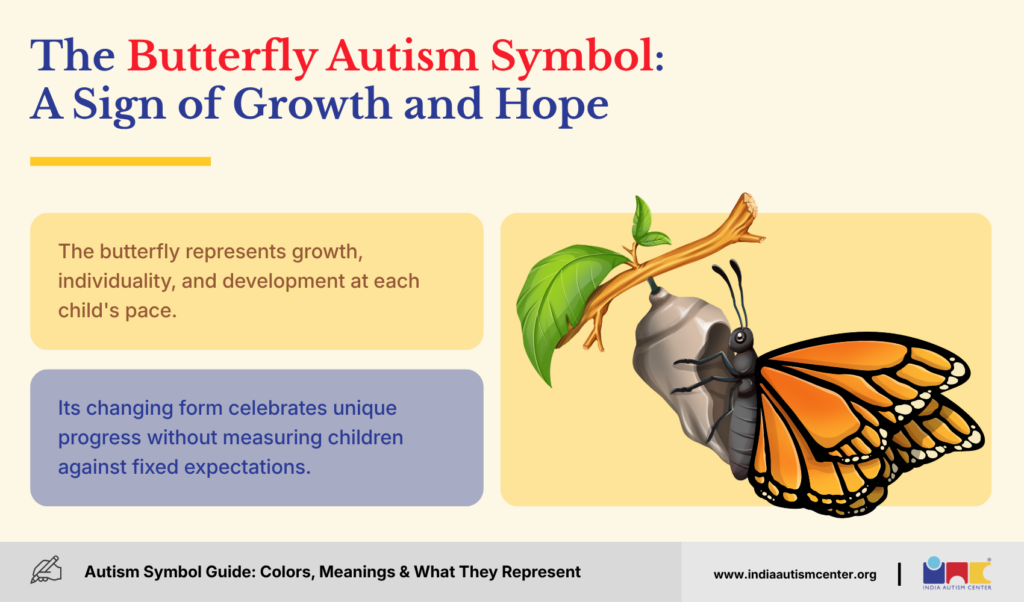
The butterfly autism symbol is one of the most emotionally resonant icons in the autism community – and one of the most popular with parents of young children.
The metaphor is straightforward: a caterpillar enters a cocoon and emerges as a butterfly. The transformation is not linear, it is not predictable, and the result is something beautiful that could not have been anticipated from the beginning. This maps onto the experience of many autistic children with striking accuracy.
No two butterflies have the same wing pattern. No two autistic children have the same profile of strengths, challenges, and ways of experiencing the world. The butterfly symbol holds both of these truths at once.
Early intervention centres in particular have embraced the butterfly autism symbol because it gives families a hopeful, forward-looking frame. If a child is non-verbal at age three but begins to communicate meaningfully at age six, that is their “butterfly moment” – a transformation that happened at its own pace, in its own time, and on its own terms.
Teachers use the butterfly in classroom displays to create environments where every child’s unique development is celebrated rather than measured against a fixed norm. It is a symbol that says: your child is not behind. They are becoming.
Infinity Symbol and Neurodiversity: Accepting the Differences
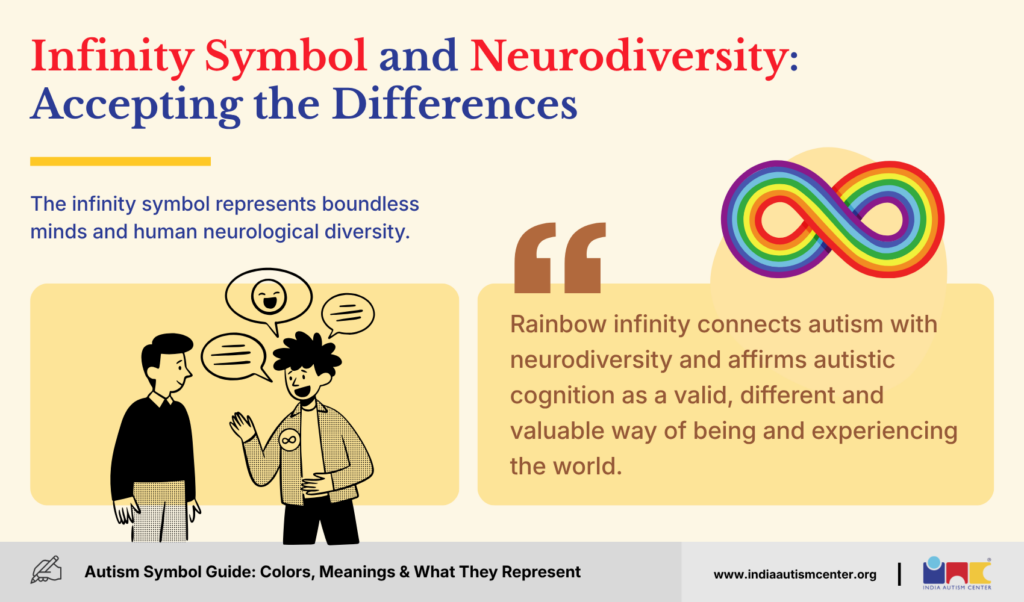
The infinity symbol for autism – a figure-eight lying on its side – has become the emblem of the neurodiversity movement, and it is easy to see why.
A figure-eight has no beginning and no end. It loops continuously, suggesting that there is no fixed point at which “normal” ends and “different” begins. Applied to autism, it represents the infinite variety of ways the human brain can work – and the idea that autistic cognition is not a broken version of neurotypical cognition, but a genuinely different, valid way of being.
The rainbow infinity symbol adds another layer: it links autism to the broader neurodiversity movement, which includes ADHD, dyslexia, dyspraxia, and other neurological differences. The rainbow colours signal intersectionality – the recognition that neurodivergent identities overlap with other aspects of identity, including gender, culture, and disability.
Autistic self-advocates prefer the infinity symbol over the puzzle piece for a clear reason: it does not imply incompleteness. It does not suggest that autistic people need to be fixed. It says, simply, that their minds are boundless.
In India, the infinity symbol is gaining ground in urban autism communities and among younger parents who have engaged with international autistic-led advocacy. It is the symbol we expect to see far more of in the years ahead.
The Autism Awareness Ribbon: A Sign of Growth and Hope
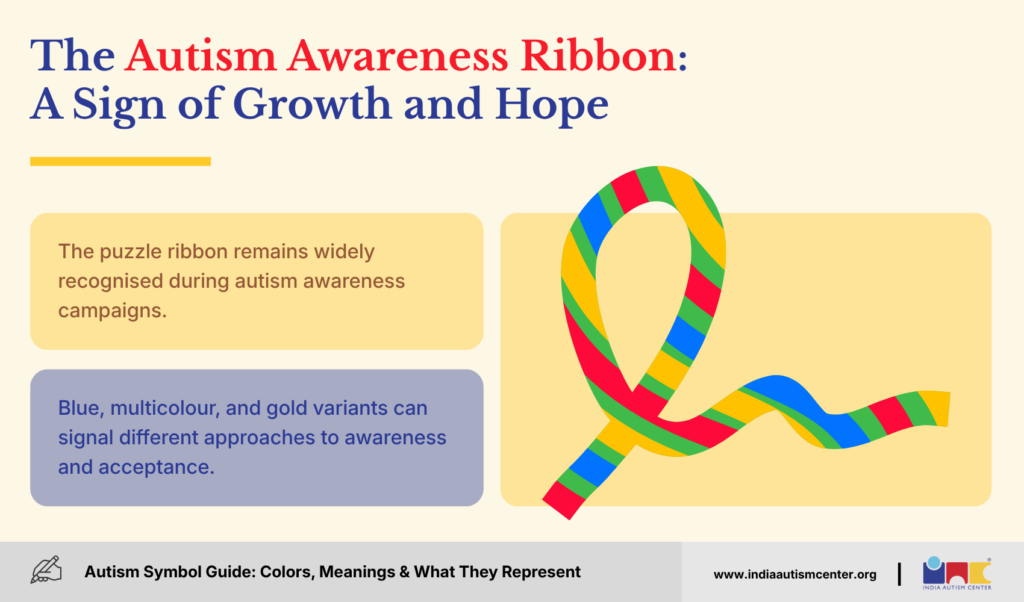
The autism awareness ribbon is the puzzle-piece ribbon – a ribbon shape filled with a colourful jigsaw pattern. It is one of the most immediately recognisable autism symbols in the world, particularly during April awareness campaigns.
Colour variants and what they signal:
- Blue puzzle ribbon – traditional awareness, most associated with Autism Speaks and the “Light It Up Blue” campaign
- Multicolour puzzle ribbon – broader community representation, signals that autism affects people of all backgrounds and genders
- Gold ribbon – acceptance-focused, used by advocates who want to signal the shift from awareness to acceptance
How to wear or use it respectfully:
- Wear it as a conversation starter, not a substitute for education
- If someone asks what it means, be ready to explain the difference between awareness and acceptance
- Consider pairing it with a gold or rainbow element to signal that your support extends beyond April
- Listen to autistic people in your community about which symbols they find affirming
The ribbon remains a widely understood shorthand for autism solidarity. Used thoughtfully, it can open important conversations.
What Colour Is Autism Awareness Today?
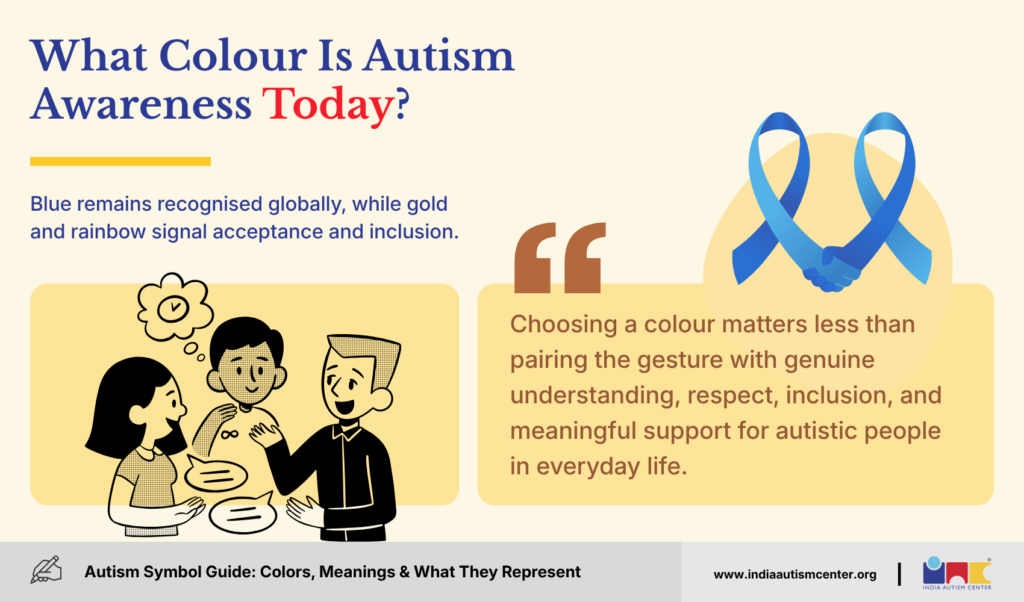
The honest answer to “what colour is autism awareness?” is: it depends on what you mean by awareness.
Here is how the colour landscape has evolved:
Blue (awareness era, 1990s–2010s): Blue was the dominant autism awareness colour for two decades. It raised global visibility for autism through campaigns like “Light It Up Blue.” It remains the most widely recognised colour internationally, and it is still used on World Autism Awareness Day, 2 April – the UN-designated observance that has been observed annually since 2008.
Gold (acceptance era, 2011–present): The autism gold colour emerged from autistic-led communities as a direct response to blue. Where blue signals “we know autism exists,” gold signals “we value autistic people.” The “Go Gold” movement has grown steadily, particularly among autistic self-advocates and families who prioritise acceptance over awareness.
Rainbow (neurodiversity era, 2010s–present): The autism rainbow has become the dominant symbol for organisations and individuals who want to represent the full spectrum of autistic experience. It is increasingly used in schools, universities, and workplaces as a signal of genuine inclusion.
Practical guidance for April 2: There is no wrong answer. Wearing blue signals solidarity with global awareness campaigns, gold signals acceptance and respect for autistic identity. Wearing rainbow signals neurodiversity and inclusion. Many people now combine all three. What matters most is that the symbol you choose is accompanied by genuine understanding – not just a gesture.
April is widely called “Autism Awareness Month,” but a growing number of organisations – including many autistic-led groups – now prefer “Autism Acceptance Month” as a more accurate description of what the community actually needs.
Choosing the Right Symbol: A Guide for Parents
There is no single “correct” autism symbol. That can feel frustrating when you are trying to do the right thing for your child. But the absence of a single answer is actually the point – autism is a spectrum, and the diversity of symbols reflects the diversity of the community.
Here are three questions worth asking before you choose a symbol:
1. Whose perspective does this symbol centre? Does it reflect how autistic people see themselves, or how non-autistic people see autism? Symbols that centre autistic experience – like the infinity symbol or the butterfly – tend to be more affirming.
2. What message do I want to send? Awareness (blue) says “this condition exists and deserves attention.” Acceptance (gold, rainbow) says “these people deserve respect and inclusion.” Both matter, but they are different messages.
3. Have I listened to autistic voices? The most important question. In India, a growing community of autistic self-advocates – including adults who were diagnosed as children in the 1990s and 2000s – are actively shaping local conversations about symbols, language, and representation. Their preferences deserve weight.
A note on the Indian context: autism advocacy in India has historically been led by parents and professionals rather than autistic people themselves. That is changing. Autistic-led groups are emerging in cities like Bengaluru, Mumbai, Delhi, and Kolkata, and their perspectives on symbols and language are increasingly visible online and in advocacy spaces. Engaging with these voices is not just respectful – it makes your advocacy more effective.
Common Misunderstandings About Autism, Colours, and Symbols
Autism colours and symbols are often well-intended, but they are frequently misunderstood. These misunderstandings can lead to confusion for parents and, at times, even unintentionally reinforce stereotypes. Getting clarity on these points can help families and communities use autism representation more thoughtfully.
1. There is only one colour for autism
Many people believe there is a single colour for autism, usually blue. In reality, there are multiple autism colours, each representing different ideas such as awareness, acceptance, and neurodiversity.
2. Blue represents all autistic individuals
The autism blue colour is widely used for awareness, but autism affects people of all genders and backgrounds. Blue does not reflect the full diversity of the autism spectrum.
3. All autism symbols are universally accepted
Not all autism symbols are viewed the same way. While there are parents out there who still prefer the puzzle piece, many autistic adults prefer symbols like the infinity sign or the autism rainbow that focus on acceptance rather than confusion or deficiency.
4. Using a symbol automatically shows understanding
Only wearing or sharing autism awareness colours or symbols does not always mean someone understands autism. Actual support comes essentially from respectful behaviour, inclusion, and, more importantly, listening to autistic voices.
5. Symbols are permanent and cannot change
Autism representation evolves as understanding grows. Newer symbols for autism, such as the infinity symbol or the butterfly autism symbol, reflect a shift toward dignity, growth, and acceptance.
Understanding the misconceptions above can greatly help parents and communities in choosing autism colours and symbols that genuinely support inclusion and respect.
Conclusion
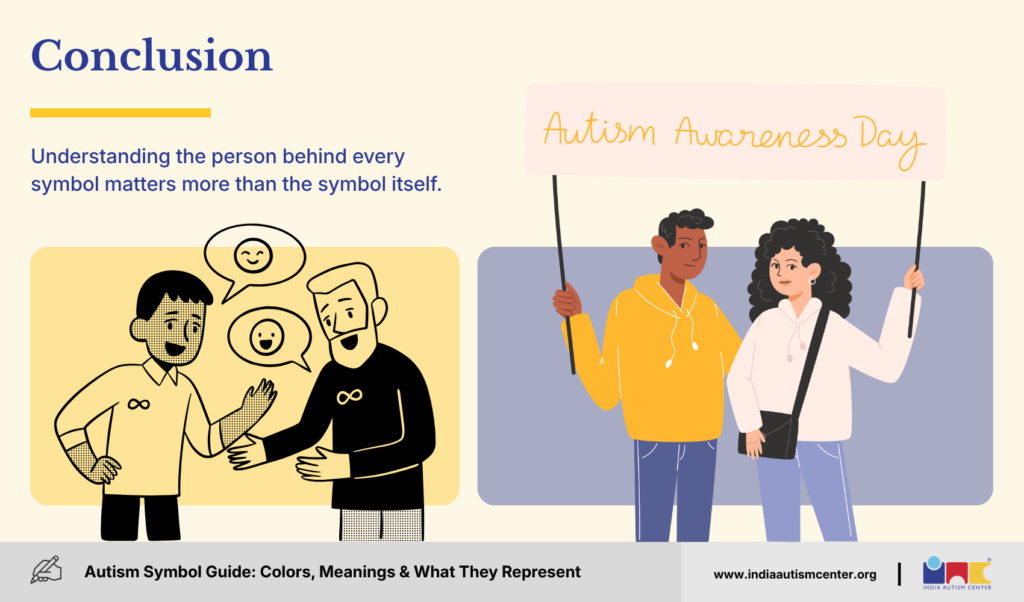
While autism colours and icons are helpful tools for communication, the most important thing is the person behind the symbol. Whether you feel a connection to the butterfly autism symbol or you prefer the traditional autism blue colour, the goal is the same. We all want a world where every child is loved, supported, and given the chance to live a full life.
Organisations like the India Autism Centre work hard to provide the resources and therapy needed to support this growth. Learning about the colour spectrum for autism is a great first step in your journey. When parents understand these autism symbols, they can help others better understand their children, too.
By using simple language and positive icons, we can replace fear with understanding and “awareness” with true belonging.
Frequently Asked Questions
What colour is autism awareness?
Traditionally, blue is considered the colour of autism awareness, especially during Autism Awareness Month in April. However, many people now prefer other colours that focus on acceptance rather than awareness alone.
Why do many families prefer the autism rainbow?
Many families prefer the autism rainbow because it feels more inclusive and positive. It reflects individuality and avoids focusing only on the challenges.
Why is the infinity symbol often shown in rainbow colours?
Rainbow colours highlight diversity and inclusion. Together, the infinity symbol and autism rainbow emphasise acceptance and respect for all autistic individuals.
Should parents follow trends when choosing autism symbols?
Parents do not need to follow trends. It is more important to choose symbols that feel respectful and align with their child’s needs and values.
Is using autism colours enough to support autistic people?
No. Using colours or symbols helps start conversations, but real support comes from acceptance, inclusion, education, and appropriate services.