 Donate now
 Get a Call Back
 MENU
MENU 22 MIN READ
 SHARE
SHARE


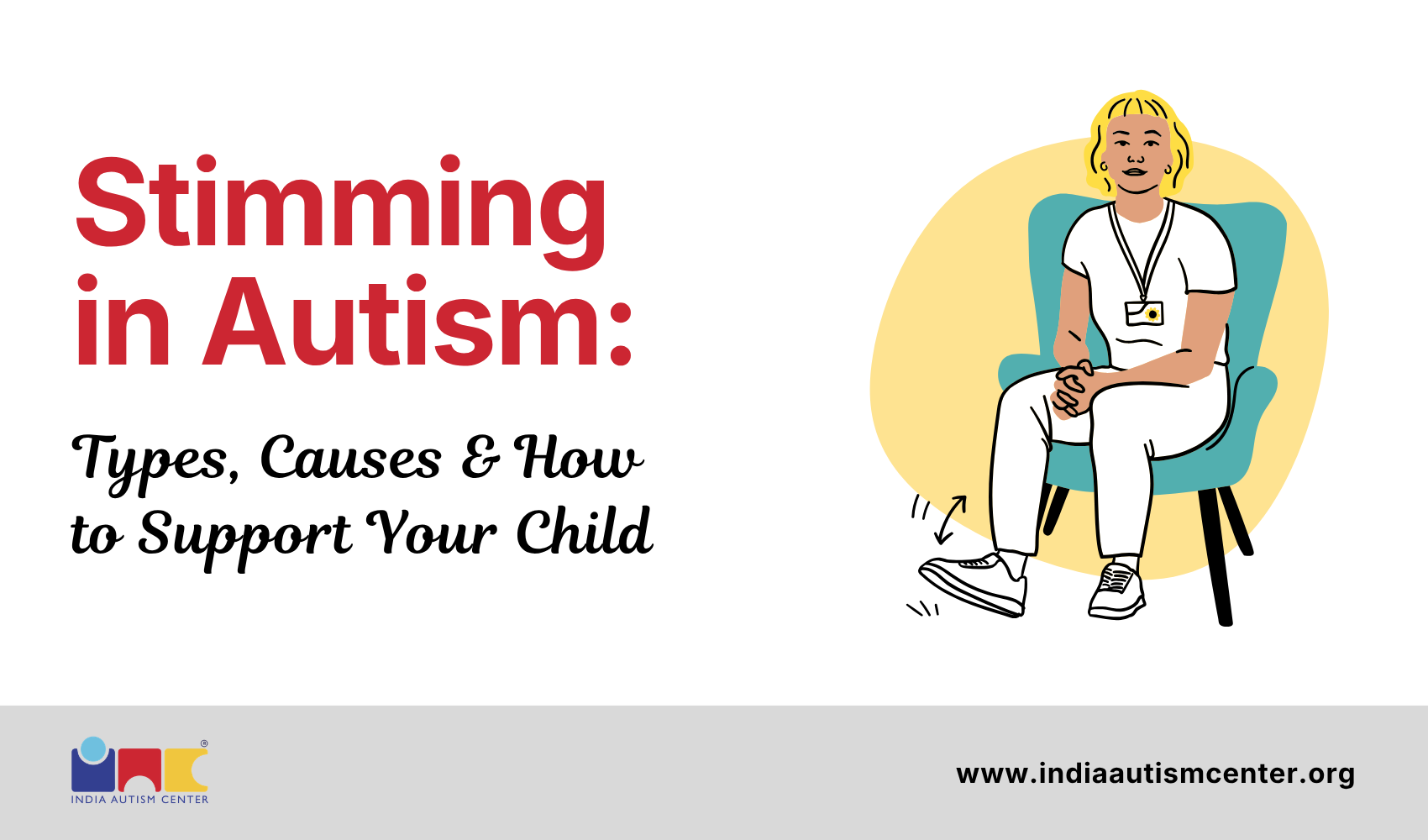
Understanding autism stimming becomes important because when you first notice your child repeating certain movements or sounds, you may feel worried or confused.
You might ask yourself, “Why is my child doing this?” or “Is this behaviour linked to autism?”
In this guide, we explain what stimming in autism spectrum disorder (ASD) means, why it happens, common examples, and whether you should try to stop it.
What Is Stimming in Autism Spectrum Disorder?
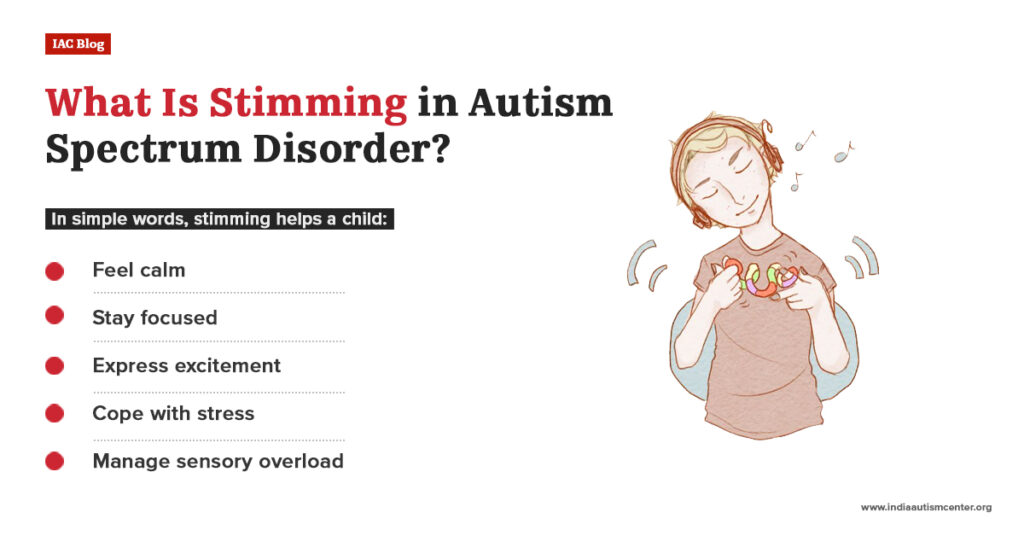
Stimming in autism refers to self-stimulating behaviours. These are repetitive movements, sounds, or actions that help a person regulate their emotions or sensory input.
In simple words, stimming helps a child:
- Feel calm
- Stay focused
- Express excitement
- Cope with stress
- Manage sensory overload
Stimming is common in autistic individuals, but it can also appear in people without autism.
So, what is stimming in autism spectrum disorder? It is a natural coping strategy that supports emotional and sensory balance.
📥 Free download: Printable daily routine chart for autistic children
Is Stimming Always Related to Autism?
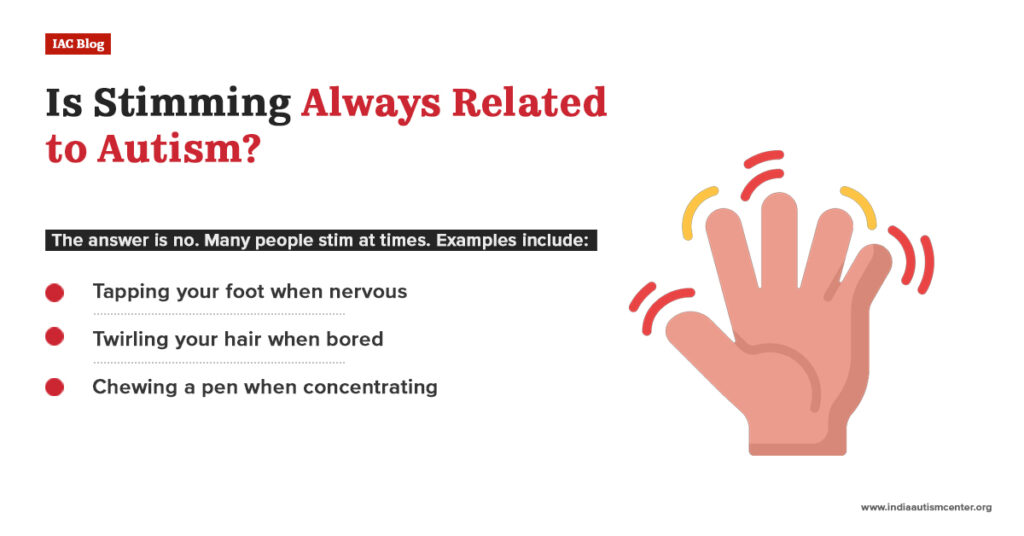
A common question parents ask is: “Is stimming always related to autism?”
The answer is no.
Many people stim at times. Examples include:
- Tapping your foot when nervous
- Twirling your hair when bored
- Chewing a pen when concentrating
However, in autism:
- Stimming happens more often
- It may look more noticeable
- It may be more intense
So while stimming is strongly linked with autism, not all stimming means autism, and not all autistic stimming is a problem.
Read our detailed article on Autism and Stimming: What Parents Need to Know
Want to know more? Get in touch with us.
Why Do Children with Autism Stim?
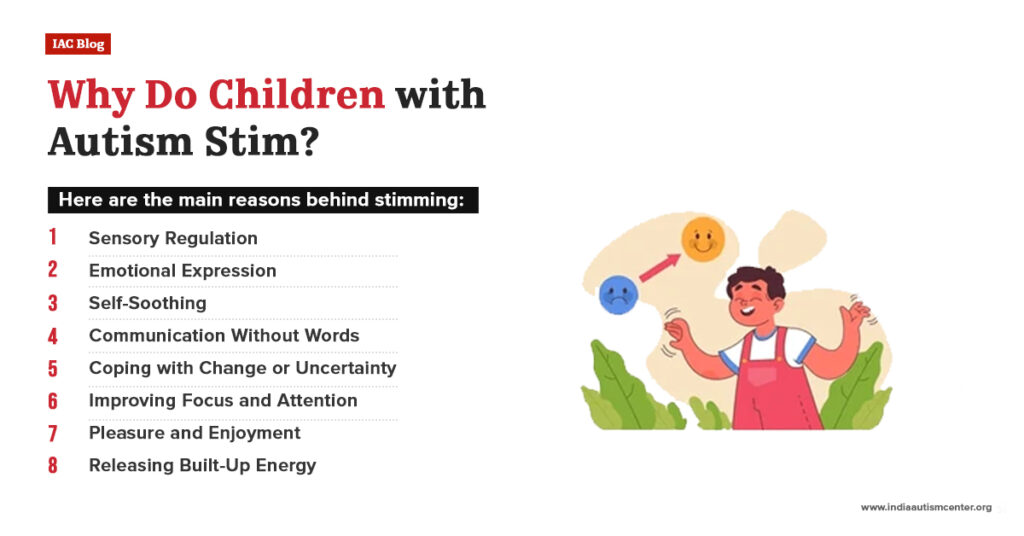
Children with autism stim because their brains process feelings and sensory information differently. Autism stimming helps them manage their body, emotions, and environment. It is not random behaviour. It has a purpose.
Here are the main reasons behind stimming:
1. Sensory Regulation
Many autistic children experience sounds, lights, smells, or touch more strongly than others. Stimming helps them control these sensations. For example, rocking or hand flapping may help block out loud noise or bright light.
2. Emotional Expression
Some children find it hard to explain how they feel using words. Stimming becomes their way to show emotions such as happiness, fear, anger, or excitement. In this way, autism stimming examples can act like emotional language.
3. Self-Soothing
Stimming often works like a calming tool. When a child feels anxious or overwhelmed, repeating a movement or sound helps their body relax and feel safe again.
4. Communication Without Words
When speech is limited, stimming can send a message. For example, increased stimming may mean the child is tired, stressed, or needs a break. So, what is stimming in autism spectrum disorder? It is also a form of non-verbal communication.
5. Coping with Change or Uncertainty
Changes in routine can feel frightening for autistic children. Stimming helps them cope when something feels unpredictable or unfamiliar.
6. Improving Focus and Attention
Some children stim to help their brain concentrate. A small movement, such as tapping or rocking, can help them stay engaged with learning or listening.
7. Pleasure and Enjoyment
Not all stimming happens because of stress. Sometimes children stim simply because it feels good or fun.
For example, spinning or watching moving objects can be enjoyable.
8. Releasing Built-Up Energy
Stimming can help release physical tension or excess energy, especially when a child has been sitting still for too long.
Important Point for Parents
Stimming is not bad behaviour. It is a coping strategy. Before asking how to reduce stimming behaviors in autism, we must understand why the child is stimming.
Instead of asking:
“How do I stop this?”
We should ask:
“What is my child feeling or experiencing right now?”
Autism Stimming Examples
Autism stimming can look different from one child to another. These behaviours involve repeated movements, sounds, or actions that help the child regulate emotions or sensory input. Understanding these autism stimming examples helps us respond with support instead of fear.
Below are the main types of stimming, with easy explanations.
1. Motor (Movement-Based) Stimming
This type involves body movements that are repeated again and again. Examples include hand flapping, rocking, spinning, jumping, or pacing. These movements help the child release energy or feel calm.
2. Vocal Stimming
This includes repeated sounds or words. Examples are humming, making clicking noises, repeating certain words, or echoing phrases. This type of autism stimming may help the child feel relaxed or focused.
3. Visual Stimming
This involves looking at objects or lights in a repetitive way.
Examples include staring at ceiling fans, watching spinning toys, or moving fingers in front of the eyes. These actions help control visual input.
4. Tactile (Touch-Based) Stimming
This relates to the sense of touch. Examples include rubbing fabrics, scratching surfaces, touching textured objects, or tapping the skin. It helps the child feel grounded and secure.
5. Oral Stimming
This involves the mouth and chewing behaviours. Examples include chewing toys, biting clothes, licking objects, or sucking on fingers. This type of stimming helps with self-soothing and sensory regulation.
6. Auditory Stimming
This focuses on sound. Examples include repeating noises, tapping objects to hear the sound, or listening to the same sound again and again. It helps the child manage how they hear their environment.
7. Object-Based Stimming
This involves using objects in a repetitive way.
Examples include spinning wheels, lining up toys, or flicking strings. These actions provide comfort and predictability.
Want to know more? Get in touch with us.
Important Understanding for Parents
These autism stimming examples are not meaningless habits. They serve important purposes such as:
- calming the body
- expressing emotions
- coping with stress
- managing sensory overload
When we ask what stimming is in autism spectrum disorder, the answer is simple: It is a natural way for the child to regulate their feelings and senses.
When Do These Behaviours Need Support?
Stimming may need guidance only when:
- It causes physical harm
- It stops learning or communicating
- Puts the child at risk
- Leads to social isolation
In such cases, the focus is not punishment but learning how to reduce stimming behaviours in autism safely by offering better coping tools.
Is Autism Stimming Harmful?
In most cases, autism stimming is not harmful. It is a natural way for autistic children to manage their feelings and sensory experiences. Stimming often helps them stay calm, feel safe, and cope with their surroundings.
So, when we ask, “Is stimming always related to autism?” or “Is stimming dangerous?”, the answer is usually no. Stimming is often helpful rather than harmful.
When Stimming Is Not Harmful
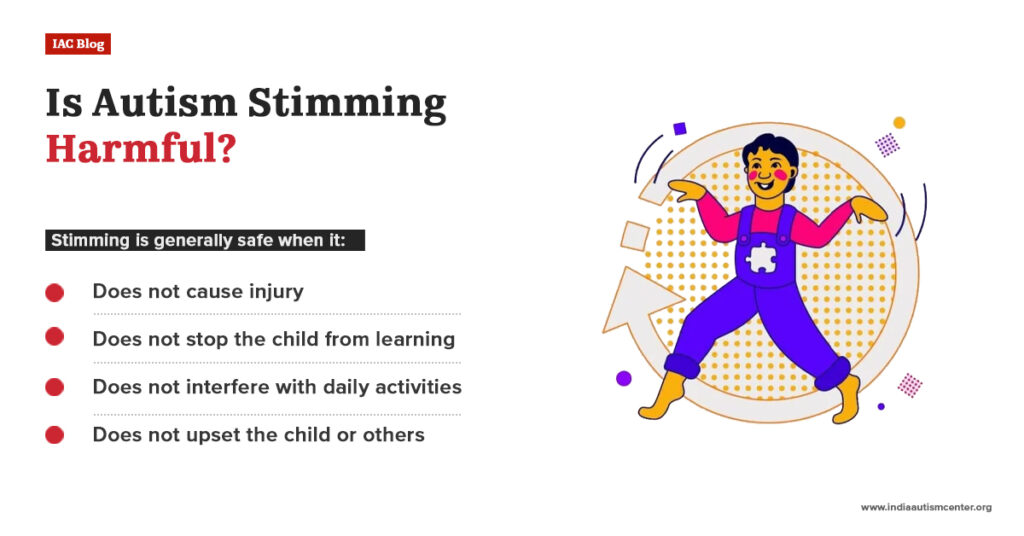
Stimming is generally safe when it:
- does not cause injury
- does not stop the child from learning
- does not interfere with daily activities
- does not upset the child or others
For example, hand flapping, rocking, or humming may simply help the child feel relaxed or focused. These types of autism stimming examples support emotional balance and self-regulation.
When Stimming Can Become a Concern
Stimming may need attention when it:
- causes physical harm (such as head banging or skin picking)
- affects speech or social interaction
- prevents the child from taking part in school or play
- becomes more intense over time
- puts the child in unsafe situations
In these cases, the behaviour is not “bad”, but it shows that the child may be overwhelmed, anxious, or unable to cope with their environment.
Why We Should Not Automatically Stop Stimming
Trying to stop all stimming can:
- increase anxiety
- remove a coping method
- lead to emotional distress
- cause new problem behaviours
This is why the treatment of stimming in autism does not aim to remove stimming completely. Instead, it focuses on:
- understanding the cause
- reducing harmful stims
- teaching safer alternatives
- improving emotional regulation
Supportive Approach for Parents
Instead of asking,
“How do I stop this behaviour?”
We should ask,
“What is my child trying to manage or communicate?”
Before thinking about how to reduce stimming behaviors in autism, we should:
- Observe when it happens
- Look for emotional or sensory triggers
- Provide calm and safe coping tools
This helps the child feel understood rather than controlled.
Want to know more? Get in touch with us.
How to Reduce Stimming Behaviours in Autism Safely
Before we try to reduce any behaviour, we must understand one thing: autism stimming is a coping tool, not a bad habit. Our goal is not to remove stimming completely. Instead, we help the child use safer and more appropriate ways to regulate emotions and sensory needs.
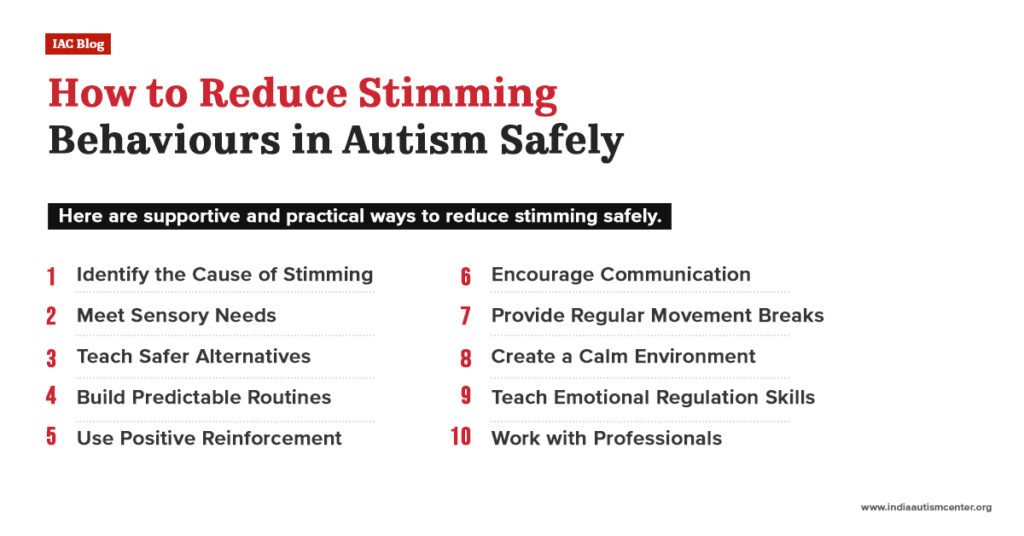
Here are supportive and practical ways to reduce stimming safely.
1. Identify the Cause of Stimming
We should observe when stimming happens and what comes before it. Your child may stim due to stress, excitement, boredom, or sensory overload. Once we know the trigger, we can respond in a better way.
2. Meet Sensory Needs
Many stimming behaviours happen because the child’s sensory system is overwhelmed or under-stimulated. We can provide sensory tools such as soft toys, textured objects, or quiet spaces to help balance their sensory input.
3. Teach Safer Alternatives
If a stim is harmful, we replace it with a safer behaviour rather than stopping it suddenly. For example, instead of head banging, we can teach squeezing a cushion or holding a stress ball.
4. Build Predictable Routines
Uncertainty increases anxiety and stimming. When we use clear routines and visual schedules, the child feels safer and needs fewer self-soothing behaviours.
5. Use Positive Reinforcement
We should praise and reward calm behaviour and safe coping skills. This helps the child learn better ways to manage emotions without feeling punished.
6. Encourage Communication
Some stimming happens because the child cannot express needs using words. We can teach simple gestures, pictures, or communication tools so they can say when they feel tired, scared, or overstimulated.
7. Provide Regular Movement Breaks
Children often stim when they have too much energy or have been sitting still for too long. Short movement breaks help release tension and reduce the need for repetitive actions.
8. Create a Calm Environment
Too much noise, light, or activity can increase autism stimming. We can reduce background noise, use soft lighting, and limit sudden changes to make the space more comfortable.
9. Teach Emotional Regulation Skills
Children need help understanding and managing their feelings. Simple breathing exercises, calm-down corners, or quiet time can reduce anxiety-based stimming.
10. Work with Professionals
Therapists can assess why stimming happens and design personalised strategies. This is an important part of the treatment of stimming in autism, especially when behaviours affect safety or learning.
Important Reminder for Parents
When we think about how to reduce stimming behaviours in autism, we must remember:
- Not all stimming should be reduced
- Only harmful or disruptive stims need guidance
- The child still needs a way to self-regulate
When we understand autism stimming, we realise it is not bad behaviour. It is a way your child manages emotions and sensory experiences. Our role is to guide and support, not to control or shame.
Below is a clear guide on what we should and should not do.
What Parents Should Do
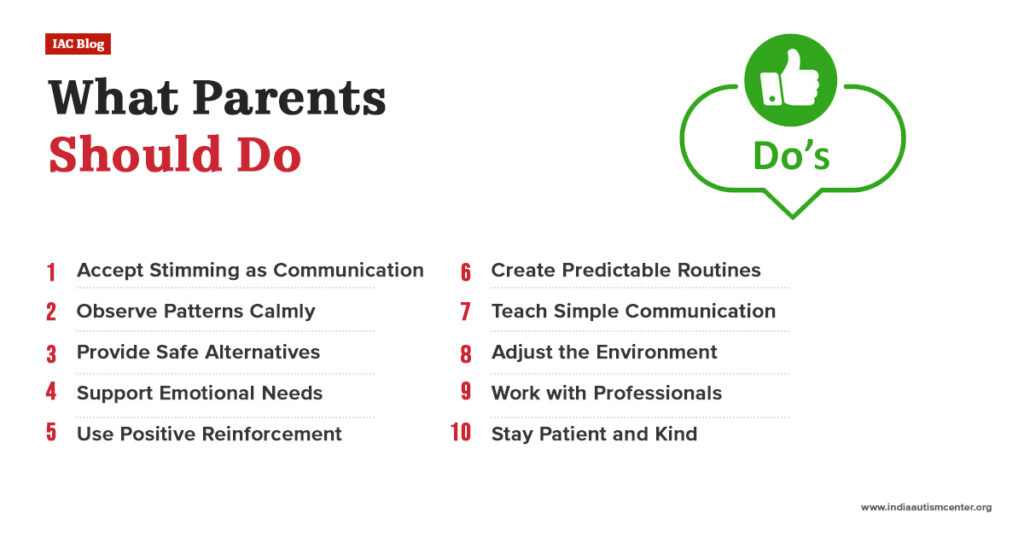
1. Accept Stimming as Communication
We should see stimming as a message, not a mistake. It tells us how the child feels inside, such as stress, excitement, or overload.
2. Observe Patterns Calmly
We need to notice when stimming happens, where it happens, and what happens before it. This helps us understand the trigger behind the behaviour.
3. Provide Safe Alternatives
If a stim is harmful, we should gently replace it with a safer option, such as squeezing a ball instead of hitting or chewing a toy instead of biting clothes.
4. Support Emotional Needs
We should help the child feel secure by offering comfort, quiet time, or reassurance when they seem overwhelmed.
5. Use Positive Reinforcement
We must praise and encourage calm behaviour and healthy coping skills. This builds confidence and reduces stress-based stimming.
6. Create Predictable Routines
Consistent routines make children feel safe. When anxiety is lower, the need for self-soothing behaviours also becomes lower.
7. Teach Simple Communication
We should help the child express needs using words, pictures, or gestures, so stimming is not their only way to communicate.
8. Adjust the Environment
We can reduce noise, strong light, or crowds when possible. A calmer environment lowers sensory overload and stimming intensity.
9. Work with Professionals
Therapists can guide us in the treatment of stimming in autism by creating personalised strategies for the child’s needs.
10. Stay Patient and Kind
Progress takes time. We must remember that the child is learning skills, not misbehaving on purpose.
What Parents Should Not Do
If you are reading this, chances are you have watched your child rock back and forth during a crowded family gathering, or bang their head against the wall after a long school day, and felt a knot of worry in your stomach. That worry is completely valid. You are not overreacting. You are paying attention – and that is exactly what your child needs.
Here is the truth, though: autism stimming is not a flaw to be fixed. It is a coping tool. A child who flaps their hands or hums repeatedly is not misbehaving. They are managing a nervous system that experiences the world far more intensely than most of us can imagine. Our goal, then, is not to silence that coping tool. It is to make sure it stays safe, does not block learning, and – where needed – gets channelled into something that works even better.
With that framing in mind, here are ten practical, evidence-informed ways to reduce stimming behaviours in autism safely, followed by clear guidance on when to bring in professional support.
1. Identify the Cause of Stimming
Every stim has a story. Before you can change the behaviour, you need to read that story.
Observe your child closely for a week. Note when the stimming happens, where it happens, and what immediately precedes it. You may notice a clear pattern – for example, your child starts spinning in circles every afternoon when the pressure cooker goes off in the kitchen, or begins rocking intensely just before a maths test at school.
Common triggers include sensory overload, boredom, excitement, hunger, fatigue, and transitions between activities. In many Indian households, Diwali or wedding season – with their firecrackers, loud music, and unpredictable crowds – can spike stimming significantly. That is not a coincidence. That is your child’s nervous system working overtime.
Try this: Keep a simple trigger diary for seven days. Write down the time, the environment, what happened just before, and what the stim looked like. Patterns will emerge faster than you expect.
Do not do this: Do not assume the stim is random or attention-seeking before you have tracked it. Acting on assumptions leads to the wrong response.
2. Meet Sensory Needs in Autism
Many stimming behaviours exist because the child’s sensory system is either overwhelmed or starved of input. This is one of the most direct ways to address sensory needs in autism.
A child who chews their collar all day may need more oral sensory input. One who rocks constantly may need more proprioceptive (deep pressure) feedback. Meeting these needs proactively – before the child reaches overload – can reduce stimming dramatically.
Try this: Introduce a small “sensory toolkit” at home. This could include a chewable silicone pendant, a weighted lap pad, a textured stress ball, or a small trampoline for jumping. Offer these tools during known high-stress periods, such as homework time or before a family outing.
Do not do this: Do not wait for the stim to escalate before offering the tool. Proactive sensory support works far better than reactive management.
3. Teach Safer Alternatives
If a stim is physically harmful – head banging, skin picking, biting themselves – the priority is to replace it with a safer behaviour that meets the same sensory need. Stopping it cold without offering an alternative is like removing a pressure valve without releasing the pressure.
For example, a child who bangs their head against a wall may be seeking deep pressure on the skull. A safer alternative could be pressing their forehead firmly into a large cushion, or wearing a snug-fitting hat. A child who bites their hand might accept a chewy toy instead.
Many parents in India feel embarrassed when their child head-bangs in a temple or at a relative’s home. The instinct is to physically restrain the child. Instead, carry a small, firm cushion in your bag. When you sense the stim building, offer the cushion quietly. It redirects without a scene.
Try this: For each harmful stim, identify what sensory input it provides (pressure, vibration, pain relief, etc.) and find one safer object that delivers something similar. Work with a therapist to confirm the match.
Do not do this: Do not physically restrain or hold the child’s hands down. This increases panic and can make the behaviour more intense.
4. Build Predictable Routines
Uncertainty is one of the biggest drivers of anxiety-based stimming in autism. When a child does not know what comes next, their nervous system goes on high alert – and stimming is how they self-soothe through that alert state.
Predictable routines act like a map. They tell the child’s brain: you are safe, you know what is happening, you do not need to brace yourself.
School exam seasons, summer vacations that disrupt daily schedules, or sudden changes like a grandparent’s visit can all destabilise a child’s routine. During these periods, parents often report a spike in stimming. A simple visual schedule – pictures or written steps showing the day’s plan – can buffer that anxiety significantly.
Try this: Use a whiteboard or printed picture cards to display the day’s routine each morning. Even if the content changes, the ritual of reviewing the schedule together creates predictability. Apps like Choiceworks (available on iOS and Android) can help.
Do not do this: Do not spring surprises, even pleasant ones like a surprise trip to the park. Give at least 10–15 minutes of advance notice for any change.
5. Use Positive Reinforcement
When a child manages to use a safer alternative or gets through a stressful situation without escalating, that moment deserves genuine acknowledgement. Positive reinforcement is not bribery – it is the brain’s learning mechanism.
Praise needs to be specific and immediate. “Good boy” is vague. “I noticed you squeezed your stress ball instead of hitting the wall – that was brilliant” is specific and teaches the child exactly what to repeat.
Try this: Build a simple reward chart. For younger children, stickers work beautifully. For older children, a points system redeemable for screen time or a favourite activity can be highly motivating. Keep the bar achievable – reward effort, not perfection.
Do not do this: Do not withhold rewards as punishment for stimming. That conflates two separate issues and increases anxiety, which will increase stimming.
6. Encourage Communication
A significant portion of stimming happens because the child cannot find words for what they are experiencing. When a child cannot say “this room is too loud and I need to leave,” the body says it instead – through rocking, humming, or covering their ears.
Teaching even basic communication – a gesture, a picture card, a simple phrase – gives the child a more efficient tool than stimming to signal their state.
Many Indian families rely heavily on verbal communication and may not have encountered AAC (Augmentative and Alternative Communication) tools. Picture Exchange Communication System (PECS) cards, which can be printed at home, or simple apps like Proloquo2Go or LetMeTalk (free on Android) can open a communication channel that dramatically reduces distress-driven stimming.
Try this: Teach your child two or three key phrases or picture cards: “too loud,” “I need a break,” “I am scared.” Practise them during calm moments so they are available during stressful ones.
Do not do this: Do not assume that because a child is non-verbal, they cannot communicate. Every child can learn some form of expression with the right support.
7. Provide Regular Movement Breaks
Children with autism often stim more intensely when they have been sedentary for too long. The body builds up tension, and stimming is the release valve. Scheduled movement breaks prevent that build-up from reaching a tipping point.
This is especially relevant in Indian school settings, where children are often expected to sit still for 40–45 minutes at a stretch. Many mainstream schools are not yet equipped to offer structured movement breaks, which means parents need to build this into the home routine.
Try this: Every 20–30 minutes during homework or structured activity, offer a 5-minute movement break. Options include jumping on a small trampoline, doing 10 star jumps, carrying a heavy bag of books (proprioceptive input), or a short walk. These are not rewards – they are neurological necessities.
Do not do this: Do not cancel movement breaks as a consequence for bad behaviour. That removes a regulatory tool and makes the next hour harder, not easier.
8. Create a Calm Environment
Too much noise, harsh lighting, strong smells, or visual clutter can push a child’s sensory system past its threshold – and autism stimming escalates in response. Modifying the environment is one of the fastest and most underused strategies available to Indian parents.
Many Indian homes are multi-generational and genuinely noisy – TV running in the background, relatives visiting, pressure cookers, mixers, and traffic outside. None of this is anyone’s fault. But for a child with heightened sensory needs, it is a constant assault. Even small changes make a measurable difference.
Try this: Designate one corner of the house as a “calm corner” – a low-stimulation space with soft lighting (a simple lamp rather than a tube light), a bean bag or floor cushion, and a few favourite sensory objects. Let the child go there whenever they need to regulate. This is not a time-out; it is a refuelling station.
Do not do this: Do not dismiss environmental modifications as impractical. Even closing a door, switching off one TV, or drawing a curtain can lower the sensory load enough to make a difference.
9. Teach Emotional Regulation Skills
Children with autism often have difficulty recognising what they are feeling and even more difficulty knowing what to do about it. Emotional regulation skills – the ability to notice, name, and manage emotions – are learnable. They just need to be taught explicitly, step by step.
Simple techniques include belly breathing (breathe in for 4 counts, hold for 2, out for 6), the “5-4-3-2-1” grounding exercise (name 5 things you can see, 4 you can touch, etc.), and using an emotion chart to point to how they feel.
Try this: Practise one calming technique together every day during a calm moment – not during a meltdown. The brain cannot learn new skills when it is in crisis. Repetition during calm periods means the skill becomes automatic when it is needed most.
Do not do this: Do not introduce a new calming technique for the first time during a meltdown. It will not work, and both of you will feel like failures.
10. Work with Professionals
Home strategies are powerful, but they work best when they are designed alongside a qualified professional who has assessed your specific child. When stimming is frequent, intense, or causing harm, professional support is not optional – it is essential.
A good therapist will assess the function of each stim, identify the sensory and emotional triggers, and design a personalised plan. This is the backbone of any serious approach to how to control stimming in a way that is both safe and sustainable.
Try this: Ask your child’s paediatrician for a referral to an occupational therapist or developmental paediatrician as a first step. Be specific: describe the stims, their frequency, and any safety concerns.
Do not do this: Do not try to implement a full behaviour management programme from a YouTube video alone. Without professional assessment, you risk targeting the wrong behaviour or missing an underlying medical cause.
Conclusion
When we understand what stimming is in autism spectrum disorder, we stop seeing it as a problem and start seeing it as communication.
Instead of asking, “How do we stop this?”, we should ask: “What is my child trying to tell me?”
By learning the meaning behind autism stimming examples, we create safer, kinder, and more supportive environments for autistic children.
Stimming is not a flaw. It is a coping tool. And with the right guidance, it can become a strength rather than a struggle.
Important Reminder for Parents
1. When thinking about how to reduce stimming behaviors in autism, keep these three principles close:
2. Not all stimming should be reduced. Safe stims that help your child regulate are doing their job.
3. Only harmful or significantly disruptive stims need active guidance. The bar is safety and functioning, not social appearance.
4. Your child still needs a way to self-regulate. If you reduce one stim without offering an alternative, another will take its place.
Understanding autism stimming means recognising it as communication, not misbehaviour. Your role is to guide and support – not to control or shame. Every step you take to understand your child’s sensory world is a step toward a calmer, more connected life for both of you.
Frequently Asked Questions (FAQs)
What is stimming in autism spectrum disorder?
Stimming in autism refers to repetitive movements, sounds, or actions that help an autistic person regulate emotions and sensory input. In autism, stimming behaviours help reduce anxiety, express feelings, and cope with overwhelming environments. Stimming is a natural coping strategy, not bad behaviour.
Is stimming always related to autism?
No, stimming is not always related to autism. Many people stim when they feel nervous, bored, or excited, such as tapping a foot or biting a pen. However, in autism, stimming tends to happen more often and may look more noticeable or intense.
What are some common autism stimming examples?
Common autism stimming examples include hand flapping, rocking, spinning, humming, repeating words, chewing objects, staring at lights, and rubbing textures. Each child shows stimming differently, depending on their sensory needs and emotions.
How can we reduce stimming behaviors in autism safely?
When thinking about how to reduce stimming behaviors autism, the goal is not to stop stimming completely. We should first understand the cause, then offer safer alternatives, sensory tools, and calm routines. Support from therapists is often part of the treatment of stimming in autism, especially if the behaviour causes harm or affects learning.
For expert insights, support services, and inclusive learning initiatives, visit the India Autism Center.