 Donate now
 Get a Call Back
 MENU
MENU 27 MIN READ
 SHARE
SHARE


How to handle autism meltdown is one of the most common and grave concerns of both parents and caregivers. Autism meltdowns can feel overwhelming for both the child and the caregiver. Many parents worry that they are doing something wrong when their child suddenly cries, screams, or loses control.
However, an autism meltdown is not a tantrum. It is usually a response to overwhelming stress, sensory overload, or emotional distress.
In this guide, we will help you understand autism meltdowns, learn how to calm an autistic meltdown, and discover practical strategies to handle autism meltdowns effectively.
What is an Autism Meltdown?
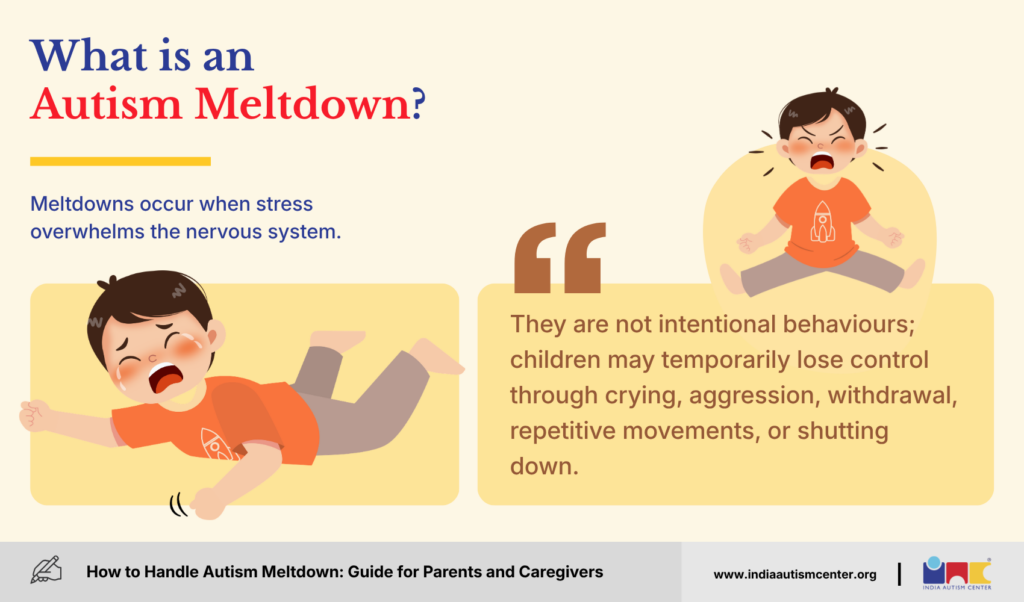
An autism meltdown is an intense emotional reaction that occurs when a person with autism becomes overwhelmed by sensory input, emotions, or environmental stress.
Unlike tantrums, meltdowns are not intentional behaviours used to get attention or achieve something. Instead, they happen when a child’s nervous system becomes overloaded, and they cannot regulate their emotions.
During an autism meltdown, a child may temporarily lose control of their behaviour.
Common behaviours during an autism meltdown include:
- Crying or screaming loudly
- Hitting, kicking, or throwing objects
- Running away or hiding
- Repetitive movements such as rocking or flapping
- Covering ears or eyes
- Shutting down and becoming unresponsive
Every autistic child is different. Therefore, the intensity and signs of an autism meltdown may vary.
Why Meltdowns Happen: The Neuroscience Behind Autism Meltdowns
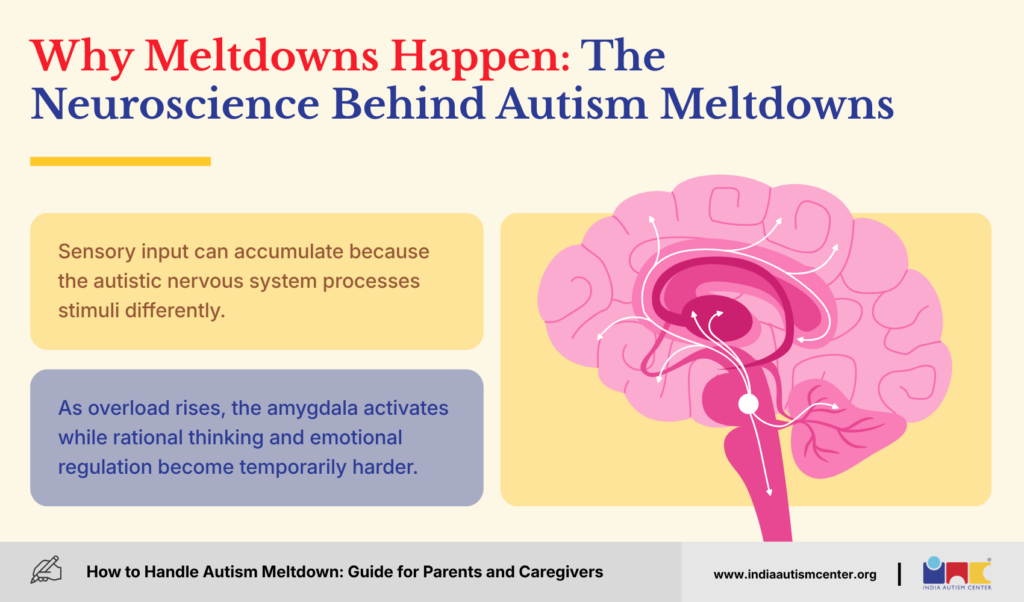
A meltdown is not a choice. It is a neurological event – and understanding why it happens at the level of the brain changes everything about how caregivers respond.
Atypical Neural Connectivity and Sensory Processing
Research published on NCBI shows that autistic individuals possess neurons with a higher level of connectivity compared to non-autistic people. This atypical neural architecture has a direct consequence for sensory processing: the autistic nervous system receives and transmits sensory information differently, and often more intensely, than a neurotypical one.
In a neurotypical brain, a process called habituation means that repeated stimuli gradually fade into the background. Think of the ticking of a clock – within minutes, most people stop consciously registering it. The autistic brain frequently does not habituate in the same way. Research published in PubMed suggests that for many autistic individuals, the ticking clock remains as loud and intrusive on the hundredth tick as it was on the first.
This means sensory input does not fade – it accumulates. Sound, light, texture, smell, and social demands stack on top of each other, pushing the nervous system steadily toward overload.
The Amygdala and the Prefrontal Cortex
When sensory accumulation reaches a tipping point, the amygdala – the brain’s threat-detection centre – becomes hyperactivated. It reads the overload as danger and triggers a full stress response: elevated heart rate, muscle tension, shallow breathing, and a flood of stress hormones.
At the same time, the prefrontal cortex – the part of the brain responsible for rational thinking, emotional regulation, and decision-making – is temporarily overridden. The child or adult cannot “think their way out” of the meltdown because the very brain region needed for that task has been effectively taken offline.
What This Feels Like From the Inside
A landmark study by Lewis and Stevens (2022), which interviewed 32 autistic adults about their lived experience of meltdowns, found that participants described the experience as a whole-body event. Physical precursors included blurred vision, heightened muscle temperature, flushed cheeks, and tense shoulders. Cognitively, participants reported difficulty thinking, finding words, and recalling simple information – all consistent with prefrontal suppression under acute stress.
One participant described it as being “crushed by the sensory and informational overload.” Another said, “I lose the ability to think clearly. My head feels foggy and muddled.”
Understanding this is not a behavioural choice but a neurological event fundamentally changes how caregivers respond. Punishment, reasoning, and demands for self-control are not just unhelpful during a meltdown – they are neurologically impossible to respond to.
📥 Free download: Printable daily routine chart for autistic children
Autism Meltdown vs Tantrum: Understanding the Difference
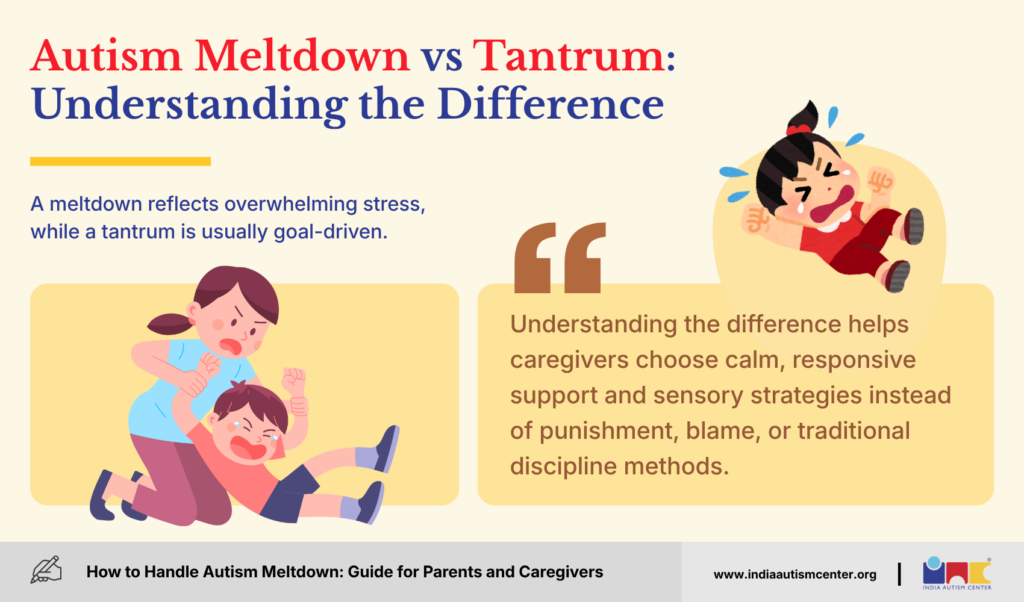
A tantrum is usually a goal-driven behaviour. Children may throw a tantrum when they want something, such as a toy, attention, or permission to do something. In most cases, the child still has some level of control over their behaviour and may stop once their demand is met or when they realise the behaviour is not working.
An autism meltdown, on the other hand, is not intentional. It happens when the child becomes overwhelmed by sensory input, emotional stress, or frustration.
During a meltdown, the child’s nervous system becomes overloaded, and they temporarily lose the ability to regulate their emotions or behaviour. This is why traditional discipline strategies that work for tantrums often do not work for autism meltdowns.
Understanding this distinction helps parents respond with support, patience, and calming strategies instead of punishment.
Want to know more? Get in touch with us.
Key Differences Between Autism Meltdowns and Tantrums
| Behaviour Aspect | Autism Meltdown | Tantrum |
| Primary Cause | Sensory overload, emotional overwhelm, sudden routine changes, or communication difficulties | Frustration over not getting something they want |
| Level of Control | The child has very little control and may feel completely overwhelmed | The child usually has some control over their behaviour |
| Purpose | No specific goal; it is a stress response | Often used to get attention, an object, or a desired outcome |
| Awareness of Environment | The child may become less aware of surroundings and unable to process instructions | The child is often aware of others and may look to see if someone is reacting |
| Duration | May continue until the child’s nervous system calms down | Usually ends once the child gets what they want or realises the behaviour is ineffective |
| Response That Helps | Calm support, reducing sensory input, and helping the child regulate emotions | Consistent boundaries and behavioural guidance |
Read our article on Autism Meltdown in Different Age Groups.
Common Triggers of Autism Meltdowns
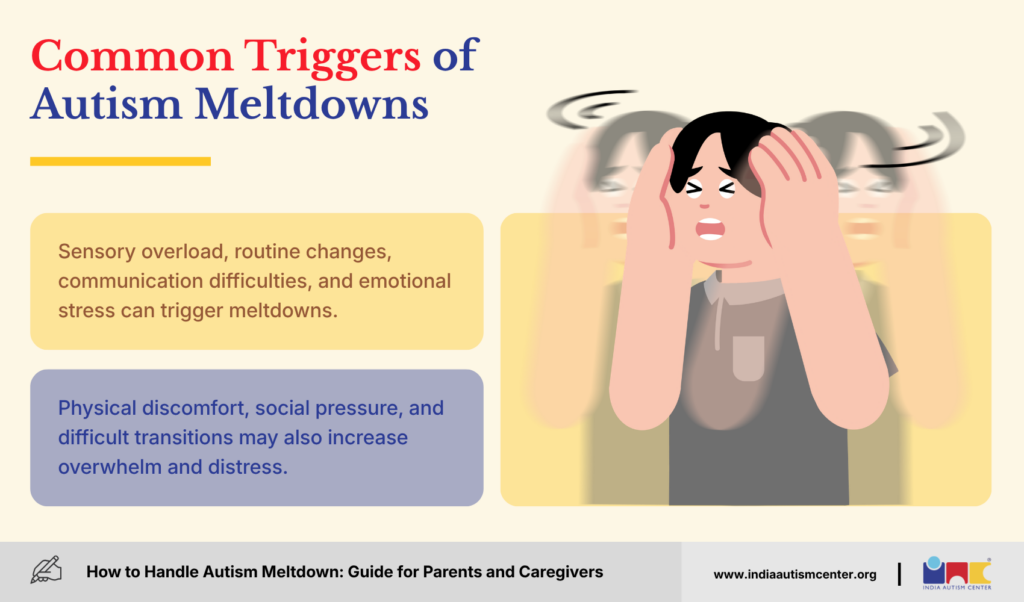
Understanding the triggers behind an autism meltdown is one of the most important steps when learning how to handle autism meltdown situations effectively. Meltdowns rarely occur without a reason. In most cases, they are the result of the child becoming overwhelmed by internal or external stressors.
Every autistic child has different sensitivities and experiences. Therefore, triggers may vary from one child to another. However, several common factors frequently contribute to meltdowns.
1. Sensory Overload
Many autistic individuals experience heightened sensitivity to sensory input. Sounds, lights, textures, smells, or crowded environments may feel much stronger and more overwhelming to them than they do to others.
For example, loud music, bright fluorescent lighting, strong food smells, or busy public places can quickly overload the sensory system. When too much sensory information enters the brain at once, the child may struggle to process it, which can lead to an autism meltdown.
Creating sensory-friendly environments and reducing unnecessary stimulation can make it easier to handle autism meltdowns and prevent them from occurring frequently.
2. Sudden Changes in Routine
Children with autism often rely on structured routines because predictability helps them feel safe and secure. When a routine changes unexpectedly, it can cause confusion, anxiety, and emotional stress.
For instance, a cancelled outing, a different classroom activity, or a sudden change in daily plans may disrupt the child’s sense of control. Without time to mentally prepare for the change, the child may feel overwhelmed and experience a meltdown.
Using visual schedules, giving advance warnings, and explaining transitions clearly can help reduce anxiety and prevent autism meltdowns caused by routine disruptions.
3. Communication Difficulties
Many autistic children face challenges when expressing their needs, feelings, or discomfort. They may know what they want but struggle to communicate it clearly using words or gestures.
When a child cannot express hunger, pain, frustration, or confusion, the internal stress may build up over time. Eventually, this frustration can lead to an autism meltdown as the child attempts to release overwhelming emotions.
Encouraging alternative communication methods, such as visual supports, communication boards, or simple gestures, can help reduce frustration and make it easier to handle autism meltdowns related to communication barriers.
4. Emotional Overload
Autistic children may find it difficult to process and regulate strong emotions such as anger, excitement, disappointment, or anxiety. When several emotions occur at the same time, the child may struggle to cope.
For example, a child might feel excited about an activity but also anxious about the unfamiliar environment. These mixed emotions can overwhelm their emotional regulation system.
When emotions build up faster than the child can manage them, the brain may respond with an autism meltdown as a way to release that pressure.
Teaching emotional awareness and simple calming strategies can help children gradually learn how to calm an autistic meltdown and regulate emotions more effectively.
5. Physical Discomfort
Physical needs often play a larger role in meltdowns than many caregivers realise. Factors such as hunger, fatigue, illness, or pain can reduce a child’s ability to cope with stress.
For instance, a child who is tired after a long school day may find it harder to manage sensory input or emotional challenges. Similarly, discomfort from tight clothing, temperature changes, or illness may contribute to frustration.
When physical discomfort combines with other triggers, the child may reach a breaking point that results in an autism meltdown.
Maintaining regular meals, ensuring adequate rest, and paying attention to signs of discomfort can help reduce these triggers and make it easier to handle autism meltdowns calmly and proactively.
6. Social and Environmental Stress
Social situations can sometimes feel confusing or overwhelming for autistic children. Busy classrooms, unfamiliar people, or situations with unclear expectations may create anxiety.
For example, a crowded birthday party or a noisy playground may involve too many interactions and sensory inputs at once. The child may struggle to process social cues while also managing environmental stress.
When these pressures build up, the child may experience an autism meltdown as their brain attempts to cope with the overload.
Preparing children for social situations and providing breaks during activities can help them manage stress and reduce the likelihood of meltdowns.
7. Transitions Between Activities
Transitions can be challenging for many autistic children because they require shifting attention from one activity to another. This shift may feel abrupt or confusing, especially if the child is deeply focused on a preferred activity.
For instance, stopping playtime to start homework or leaving the park earlier than expected may cause distress. Without preparation, these transitions may trigger resistance or emotional overwhelm.
Providing countdown warnings, visual timers, or transition cues can help children prepare mentally and make it easier to handle autism meltdowns during activity changes
Read Early Signs of an Autism Meltdown: A Family Guide.
The Rumble Stage: Recognising Early Warning Signs Before a Meltdown
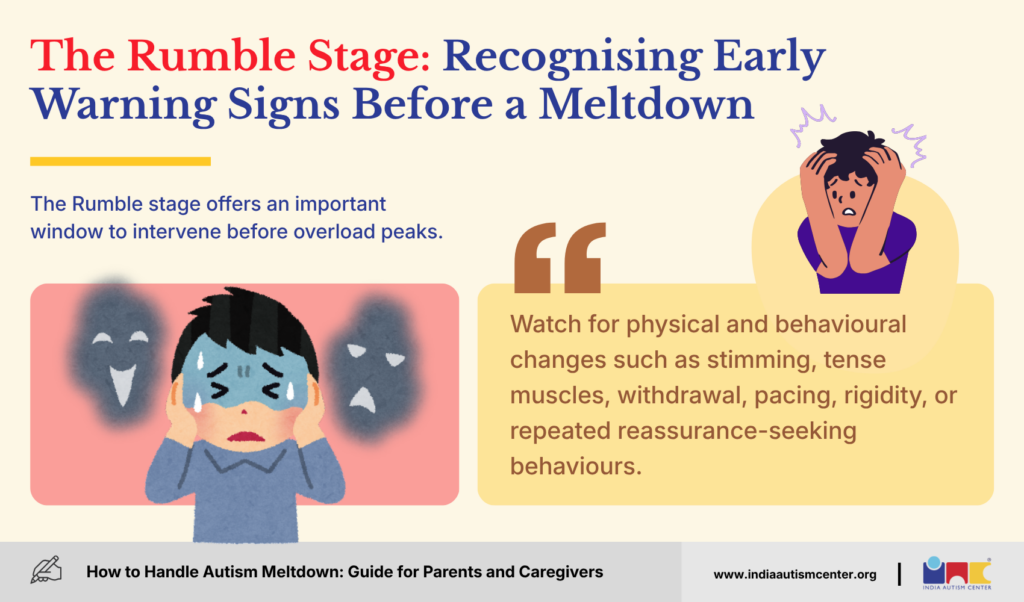
The single most effective thing a caregiver can do is intervene before the meltdown reaches full intensity. That window exists – but it requires knowing what to look for.
The Three-Stage Model: Rumble → Rage → Recovery
Autism meltdowns typically follow a recognisable arc:
- Rumble – the build-up phase, where distress signals appear but the nervous system has not yet reached full overload
- Rage – the peak of the meltdown, where the child has lost regulatory control
- Recovery – the gradual return to baseline, which can take 20 minutes to several hours
The Rumble stage is the intervention window. Once the Rage stage begins, the priority shifts to safety and containment. Intervening at the Rumble stage – by reducing demands, moving to a quieter space, or offering sensory tools – can prevent the full meltdown from occurring at all.
Physical Warning Signs to Watch For
These are the body’s distress signals, not defiance:
- Flushed face or visibly warm cheeks
- Tense muscles, hunched or raised shoulders
- Increased or intensified stimming (rocking, hand-flapping, pacing)
- Shallow, rapid breathing
- Covering ears or eyes
- Blurred or glazed expression (consistent with the sensory overload described in Lewis & Stevens, 2022)
Behavioural Warning Signs to Watch For
- Becoming unusually quiet or withdrawn
- Increased rigidity – refusing requests that are normally manageable
- Repetitive questioning or seeking reassurance repeatedly
- Pacing or inability to settle
- Reaching for a specific comfort object
Building a Personal Warning Sign Profile
Every autistic child has a unique early-warning pattern. We recommend that parents and caregivers observe and note which signs appear first for their child – before the pattern becomes obvious. Over two to four weeks of observation, a reliable individual profile typically emerges.
Practical tip: Agree on a code word or signal with your child – something simple they can say or show you to communicate “I am overwhelmed” before it escalates. Even a hand gesture or a card with a symbol works. This gives the child agency and gives you early warning.
Intervening at the Rumble stage – moving to a quiet space, reducing demands, offering a sensory tool – is far more effective than any strategy applied during the Rage stage.
Autism Meltdowns in Adults: What Changes and What Stays the Same
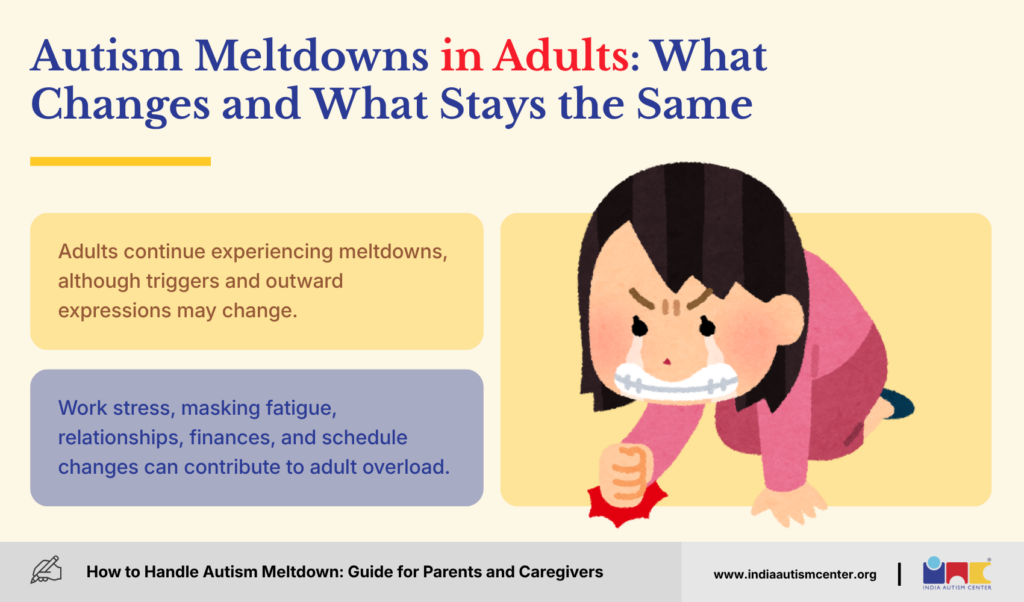
There is a persistent and damaging misconception that autism meltdowns are something children grow out of. They do not. Autistic adults – across all support needs, including those who are employed, educated, and socially capable – continue to experience meltdowns throughout their lives.
What Stays the Same
The neurological mechanism is identical at every age. The amygdala becomes hyperactivated, the prefrontal cortex is overridden, and the nervous system reaches overload. The internal experience – the blurred vision, the muscle tension, the cognitive shutdown, the loss of rational control – does not diminish simply because a person has turned 18.
Lewis and Stevens (2022) found that autistic adults described meltdowns as “distressing, scary, confusing, and intensely painful events.” Many reported that the frequency varied significantly with life circumstances: some experienced meltdowns every few hours during high-stress periods; others, once or twice a year. The common thread was that the events remained neurologically involuntary.
What Changes in Adulthood
Triggers shift. School-based triggers – loud classrooms, rigid timetables, playground noise – give way to adult stressors:
- Open-plan offices with unpredictable noise and interruptions
- Social masking fatigue – the exhaustion of suppressing autistic traits all day to appear neurotypical
- Unexpected schedule changes in professional or personal life
- Financial anxiety and the pressure of independent living
- Relationship demands and the complexity of adult social expectations
Masking becomes more sophisticated. Many autistic adults learn to suppress the external expression of a meltdown in public – holding it together at work, then experiencing a delayed meltdown at home when the social pressure lifts. This is not a sign that the meltdown was less severe; it is a sign that the person has learned to internalise at great personal cost.
Shame and self-blame intensify. Adults are expected to “have it together.” When a meltdown occurs, many autistic adults internalise it as personal failure – evidence that they are broken, weak, or incapable. Lewis and Stevens (2022) found that post-meltdown guilt, shame, and remorse were consistently reported, even when participants fully understood that the meltdown was not within their control.
Physical manifestations may become more internalised. Rather than the outward explosion more commonly seen in children, adult meltdowns may present as a shutdown – withdrawal, silence, inability to move or speak, dissociation. These internal meltdowns are invisible to observers but equally distressing to the person experiencing them.
Support Strategies for Autistic Adults
- Self-advocacy: Learning to name and communicate personal triggers to employers, partners, and family members before overload occurs
- Identifying personal triggers: Keeping a record of what precedes meltdowns (see the Meltdown Diary section below)
- Scheduled decompression time: Building deliberate recovery periods into the day – particularly after high-masking situations such as meetings, social events, or commutes
- Communicating needs to employers: Under the Rights of Persons with Disabilities (RPWD) Act 2016, autistic employees in India are entitled to reasonable workplace accommodations
This article is important for you if you have scrolled down this far, read How to Handle Autism Meltdown: Complete Guide for Parents and Caregivers
📥 Free download: Printable daily routine chart for autistic children
After the Storm: Managing Post-Meltdown Guilt, Shame, and Recovery
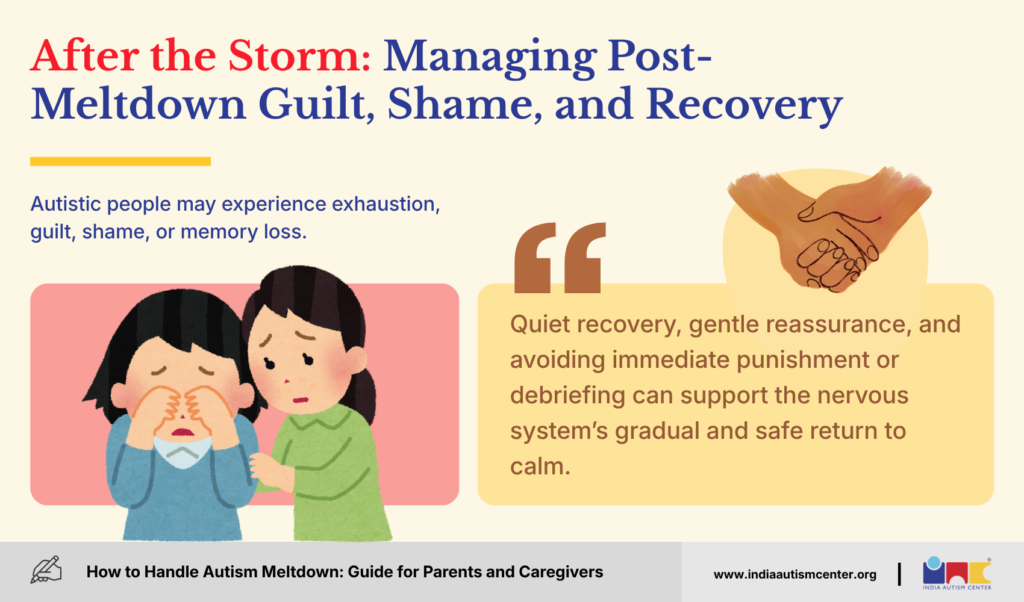
The meltdown itself is only part of the experience. What happens in the hours that follow matters just as much – for the autistic person and for the caregiver.
What the Autistic Person Experiences After a Meltdown
Lewis and Stevens (2022) found that post-meltdown experiences for autistic adults consistently included:
- Profound exhaustion – physical and cognitive fatigue that can last hours or even days
- Memory gaps – many participants could not recall what had happened during the meltdown; some described learning about their own behaviour second-hand from family members
- Intense guilt, shame, and remorse – even when the person fully understood that the meltdown was not intentional
- Negative self-worth – thoughts such as “I am worthless” or “I am broken,” which participants noted felt entirely logical during the meltdown but not outside it
For children, the post-meltdown period may look like exhaustion, tearfulness, or unusual quietness. They may not be able to articulate what happened. This is normal – the brain is still recovering.
What Caregivers Experience After a Meltdown
Caregivers are not immune to the aftermath. Emotional exhaustion, helplessness, frustration, and grief are all valid responses. Many parents describe a particular kind of loneliness – the meltdown is over, the child is resting, and the caregiver is left to process it alone.
All of these feelings are legitimate. Acknowledging them is not self-indulgent; it is necessary for sustainable caregiving.
What NOT to Do in the Immediate Aftermath
- Do not debrief immediately. The nervous system needs time to reset – attempting a conversation about what happened within minutes of a meltdown adds to the overload.
- Do not punish or demand apologies. The child or adult could not control what happened. Punishment does not prevent future meltdowns; it adds shame to an already painful experience.
- Do not replay the incident in front of the child, or discuss it with others within earshot.
What TO Do
- Allow quiet recovery time. The nervous system reset can take anywhere from 20 minutes to several hours. Offer a calm, low-stimulation environment – a favourite blanket, a quiet room, minimal talking.
- Offer comfort without overwhelming. Presence without pressure. Sit nearby. Let them know you are there.
- Check in gently once calm is fully restored – not surface calm, but genuine calm. A simple “Are you feeling better? Do you need anything?” is enough.
- For your own recovery: Step away briefly if it is safe to do so. Debrief with a partner, a trusted friend, or a parent support group. Avoid self-blame.
Using the Calm Period Constructively
Hours or even days after the meltdown – when the child is genuinely settled – is the right time to gently explore what happened. Not as a lesson or a correction, but as a collaborative conversation: “Do you remember feeling upset yesterday? What was happening just before?” Over time, this builds the child’s self-awareness and helps them identify their own early warning signs.
How to Handle Autism Meltdowns
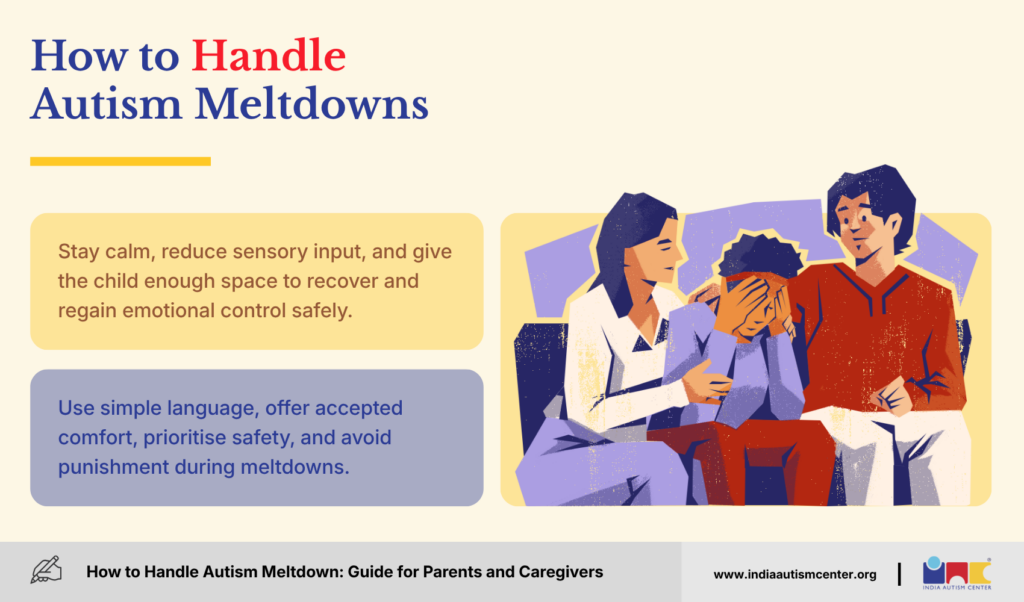
When a meltdown happens, your main goal should be to help your child feel safe and regain emotional control.
Here are practical ways to handle autism meltdowns calmly and effectively.
1. Stay Calm and Patient
Children often mirror the emotions of adults around them. If we panic or raise our voice, the situation may worsen.
Instead, take a deep breath and speak in a calm tone. Your calm presence can help your child feel safe during an autism meltdown.
2. Reduce Sensory Input
Many meltdowns occur due to sensory overload. Reducing stimulation can help calm an autistic meltdown.
You can try the following:
- Move the child to a quieter space
- Dim bright lights
- Turn off loud music or devices
- Provide noise-cancelling headphones
A calmer environment can help the nervous system settle.
3. Give the Child Space
Some children need physical space during a meltdown. Too much interaction can increase distress.
Allow your child to sit, lie down, or move around safely while they calm themselves. Stay nearby so they know you are present and supportive.
4. Use Simple and Clear Language
During an autism meltdown, the brain struggles to process complex instructions.
Use short, simple sentences such as:
- “You are safe.”
- “Let’s take deep breaths.”
- “We will sit here quietly.”
Clear communication helps reduce confusion and anxiety.
Want to know more? Get in touch with us.
5. Offer Comfort if the Child Accepts It
Some children benefit from gentle reassurance.
You can offer:
- A favourite toy or comfort object
- A weighted blanket
- Gentle pressure or a hug (if they are comfortable with touch)
However, always respect your child’s preference. Some children prefer no physical contact during an autism meltdown.
6. Ensure Safety
During intense meltdowns, children may unintentionally harm themselves or others.
Make the environment safe by:
- Moving sharp or breakable objects away
- Guiding the child to a safe area
- Staying close to prevent injury
Your priority is safety while the meltdown passes.
7. Avoid Punishment or Discipline
Punishing a child during an autism meltdown will not solve the problem. Remember, the child is not acting out intentionally.
Instead of discipline, focus on support and calming strategies.
How to Calm an Autistic Meltdown Faster
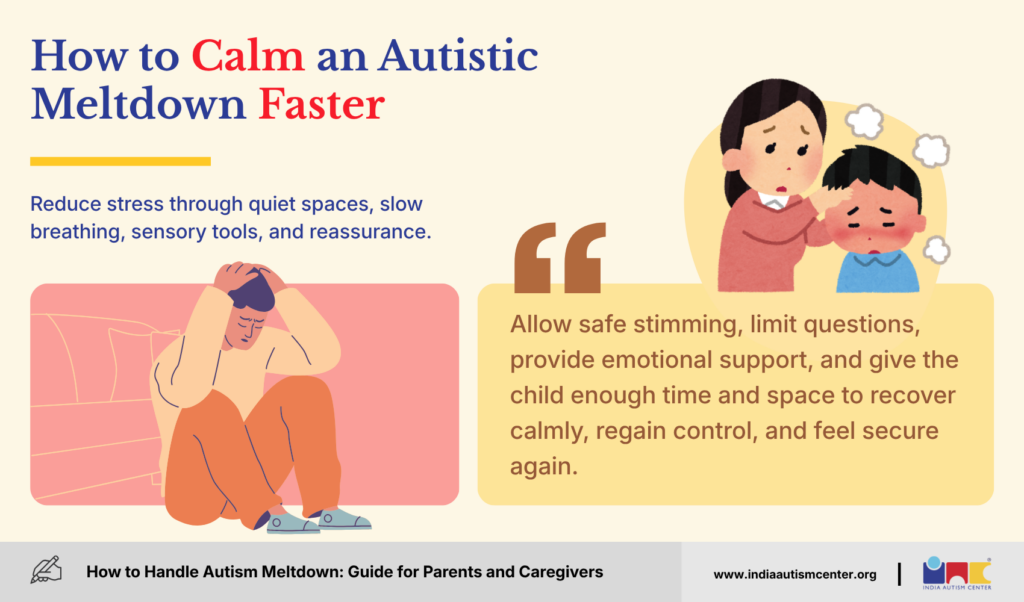
When an autism meltdown occurs, the child’s nervous system is in a state of overload. At that moment, the goal is not to reason, discipline, or correct behaviour. Instead, the focus should be on reducing stress and helping the child regain emotional control.
Although every child is different, certain strategies can help calm an autistic meltdown more quickly and safely. These techniques aim to regulate sensory input, reduce anxiety, and support the child until they feel stable again.
1. Encourage Slow and Deep Breathing
Breathing exercises can help regulate the nervous system during stressful situations. Slow breathing sends signals to the brain that the body is safe, which gradually reduces panic and emotional intensity.
You can gently guide your child by saying simple instructions such as “Breathe in slowly” and “Breathe out slowly.” Demonstrating the breathing yourself may also help the child follow your actions more easily.
Even a few deep breaths can help calm an autistic meltdown by slowing the heart rate and reducing physical tension.
2. Move to a Quiet and Safe Space
A calm environment can make a significant difference in learning to handle autism meltdowns effectively. If possible, guide the child to a quieter place where sensory stimulation is lower.
For example, you can move to a quiet room, a calm corner in the house, or a less crowded area if you are outside. Reducing loud sounds, bright lights, and visual distractions helps the brain recover from sensory overload.
This change of environment often allows the child to regain control more quickly during an autism meltdown.
3. Offer Sensory Regulation Tools
Many autistic children respond well to sensory tools that help regulate their nervous system. These tools provide controlled sensory input that can be calming and reassuring.
Examples include:
- Stress balls or fidget toys
- Weighted blankets or lap pads
- Soft textures such as sensory cushions
- Noise-cancelling headphones
These tools give the child something familiar and soothing to focus on, which may help calm an autistic meltdown faster.
4. Use Visual Supports
During an autism meltdown, verbal communication may become difficult for the child to process. Visual supports can provide clear guidance without overwhelming them with too many words.
You can use tools such as:
- Emotion charts showing different feelings
- Calm-down cards with simple instructions
- Visual routines for breathing or relaxation
Visual cues help the child understand what they can do to regulate their emotions, making it easier to handle autism meltdowns in a structured way.
5. Speak in a Calm and Reassuring Tone
Your voice and body language play a major role in how the child responds during a meltdown. If we speak loudly, show frustration, or rush the child, their stress may increase.
Instead, speak slowly and gently. Short phrases such as “You are safe,” “I am here,” or “It will be okay” can provide reassurance without overwhelming the child with information.
A calm and supportive presence can help the child feel secure while the autism meltdown gradually passes.
6. Allow Safe Stimming Behaviour
Stimming behaviours such as rocking, hand-flapping, or pacing often help autistic individuals regulate their sensory input. During an autism meltdown, these movements may increase.
As long as the behaviour is safe, it is helpful to allow the child to stim freely. These repetitive movements can help release built-up tension and support emotional regulation.
Allowing safe stimming can therefore be an effective way to calm an autistic meltdown naturally.
7. Give the Child Time to Recover
Meltdowns do not stop instantly because the brain needs time to recover from overload. Trying to rush the process or forcing the child to calm down may increase distress.
Instead, stay nearby and allow the child to regain control at their own pace. Your calm presence reassures them that they are safe and supported.
Patience is essential when learning how to handle autism meltdowns effectively, as recovery may take several minutes or sometimes longer.
8. Avoid Asking Too Many Questions
During an autism meltdown, the brain may struggle to process language and respond to questions. Asking many questions, such as “What happened?” or “Why are you upset?” can increase frustration.
Instead, focus on simple reassurance and supportive actions. You can discuss the situation later once the child has fully calmed down.
Reducing verbal pressure helps make it easier to handle autism meltdowns without adding extra stress.
9. Stay Close and Offer Emotional Support
Even if the child prefers space, knowing that a trusted caregiver is nearby can provide emotional security. Stay close enough to monitor safety, but allow the child the distance they need.
Your presence communicates support and stability, which helps the child gradually regulate their emotions.
Over time, consistent support teaches the child that meltdowns are safe moments where caregivers will help them calm autism meltdown rather than punish them.
Meltdown Diary: How to Track Triggers and Reduce Meltdown Frequency
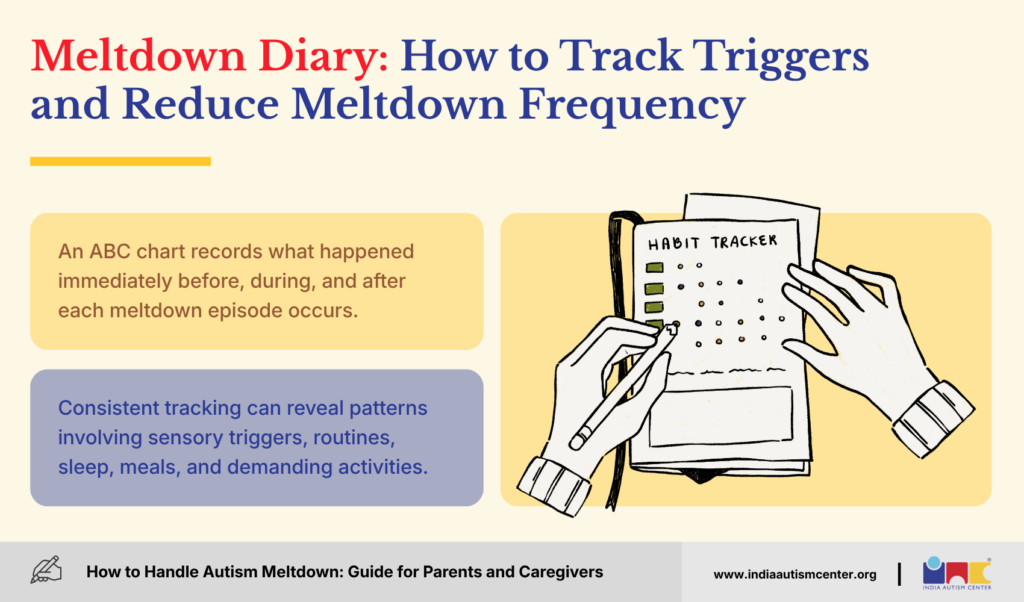
Patterns that are invisible in the moment become clear over time. A meltdown diary – sometimes called a behaviour log or ABC chart – is one of the most practical tools available to parents and caregivers.
What Is an ABC Chart?
The ABC framework stands for:
- A – Antecedent: What happened immediately before the meltdown
- B – Behaviour: What the meltdown looked like (intensity, duration, type of behaviour)
- C – Consequence/Response: What was done in response, and whether it helped
This structure, used by behaviour therapists and special educators worldwide, turns individual meltdown incidents into usable data.
What to Record After Each Meltdown
Keep entries brief – consistency matters far more than detail. Record:
1. Date, time, and location
2. What happened immediately before (the antecedent): where were you, who was present, what was the child doing?
3. What the meltdown looked like: intensity (mild/moderate/severe), duration, specific behaviours
4. What helped or did not help in the moment
5. Physical state: Had the child eaten recently? Slept well the night before? Were they unwell?
What Patterns Typically Emerge
After two to four weeks of consistent recording, patterns usually become visible. Common findings include:
- Meltdowns clustering on Monday mornings – the transition back to school after the weekend
- Meltdowns following long outings or social events, even when the child appeared to cope well at the time (a sign of delayed overload)
- A specific sensory trigger – a particular sound, texture, or smell – appearing in nearly every antecedent
- A correlation with poor sleep or missed meals
These patterns allow for proactive adjustments: schedule changes, sensory accommodations, pre-emptive calming routines, or simply building in more recovery time after demanding activities.
How to Use the Diary Effectively
- Keep it simple. A notes app on your phone works perfectly well. A dedicated notebook is fine too. The format is irrelevant; the consistency is everything.
- Share it with your child’s therapist, school, or the clinical team at India Autism Center. A well-kept meltdown diary is a powerful clinical tool – it can inform therapy goals, school accommodation plans, and sensory profiles in ways that memory alone cannot.
- Involve the child where appropriate. Older children and teenagers can sometimes contribute to the diary themselves, which builds self-awareness and a sense of agency.
What to do After an Autism Meltdown
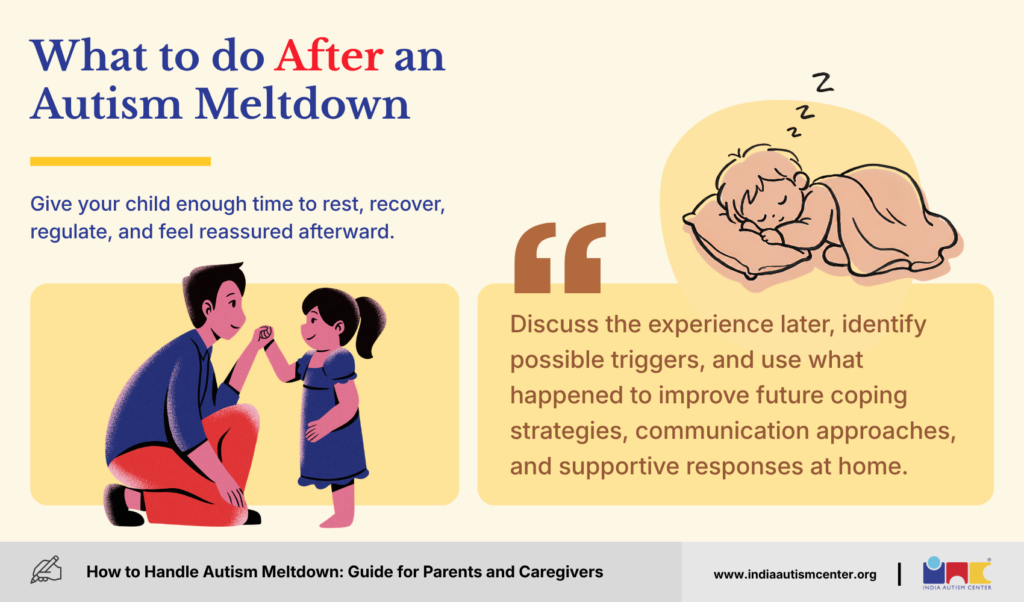
Once the meltdown ends, the child may feel exhausted, embarrassed, or confused. This is the time for gentle support.
Give Time to Recover
Allow your child to rest. Their nervous system needs time to recover after intense emotional stress.
Offer Reassurance
Let your child know they are safe and loved. Avoid criticism or blame.
Discuss the Situation Later
When your child is calm, you can talk about what happened. Try to identify triggers and discuss better coping strategies.
Adjust Future Strategies
Each meltdown teaches us something new. Use these experiences to plan better responses next time.
Want to know more? Get in touch with us.
Preventing Autism Meltdowns
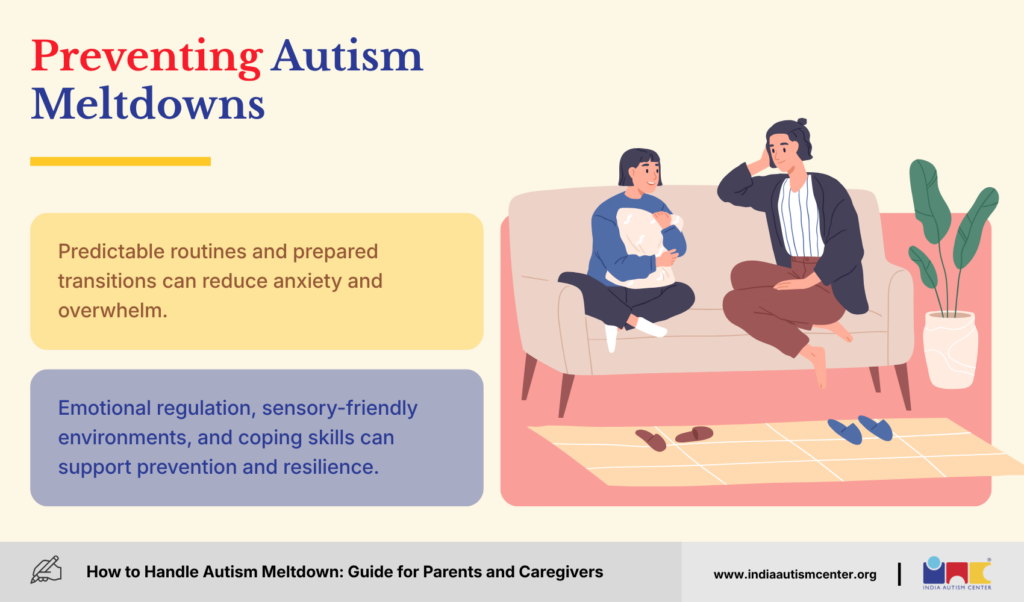
While we cannot prevent every autism meltdown, we can reduce its frequency by planning ahead. Here are some preventive strategies.
Maintain Predictable Routines
Structured routines help children feel secure and reduce anxiety.
Prepare for Transitions
Use visual schedules or reminders before changing activities.
Teach Emotional Regulation
Help your child learn words for emotions such as “frustrated”, “tired”, or “overwhelmed”.
Create a Sensory-Friendly Environment
Reduce sensory triggers at home and school whenever possible.
Build Coping Skills
Teach calming techniques such as breathing exercises, sensory breaks, or quiet time.
These strategies make it easier to handle autism meltdowns and support emotional development.
Conclusion
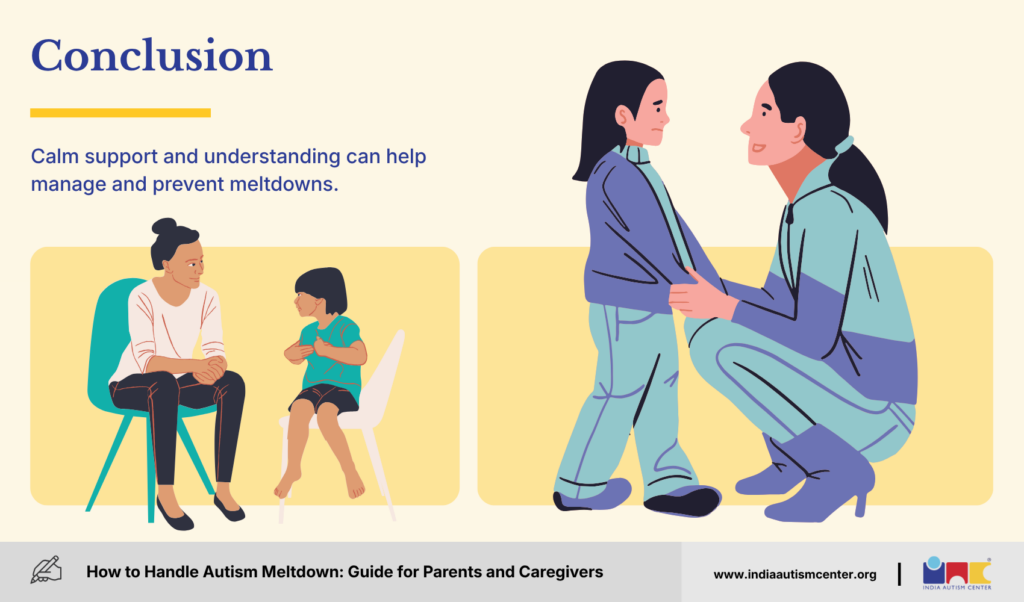
Learning how to handle autism meltdown situations calmly and effectively can make a significant difference for both parents and children.
Remember:
- An autism meltdown is a response to overwhelming stress, not bad behaviour.
- Your calm support helps your child feel safe.
- Understanding triggers can help prevent future meltdowns.
With patience, awareness, and the right strategies, we can learn how to calm an autistic meltdown and support children with autism more effectively.
Frequently Asked Questions (FAQs)
What is an autism meltdown?
An autism meltdown is an intense emotional reaction that occurs when an autistic person becomes overwhelmed by sensory input, stress, or strong emotions. During a meltdown, the child may cry, scream, withdraw, or display repetitive behaviours because their nervous system is overloaded. Unlike tantrums, meltdowns are not intentional behaviours but a response to overwhelming situations.
What causes an autism meltdown?
Several factors can trigger an autism meltdown, including sensory overload, sudden changes in routine, communication difficulties, emotional stress, or physical discomfort. Loud noises, crowded environments, unfamiliar situations, or frustration from not being able to express needs can also lead to a meltdown.
How to calm an autistic meltdown quickly?
To calm an autistic meltdown, first stay calm and create a quiet, safe environment. Reduce sensory stimulation by lowering noise and lights, and speak in short, reassuring sentences. Offering sensory tools such as a stress ball or weighted blanket may also help the child regulate their emotions more quickly.
How should parents handle autism meltdowns at home?
Parents can handle autism meltdown situations by staying patient, reducing sensory triggers, and allowing the child space to calm down. Speaking calmly, ensuring the environment is safe, and offering comfort items can help the child regain emotional control. After the meltdown, parents can gently discuss the situation to identify triggers and prevent future meltdowns.
For expert insights, support services, and inclusive learning initiatives, visit the India Autism Center.