 Donate now
 Get a Call Back
 MENU
MENU 11 MIN READ
 SHARE
SHARE


As parents, our top priorities are our children’s health and safety. From the moment a child is born, several decisions must be made to ensure the child is healthy.
One such decision is vaccination. There has been a lot of debate about whether vaccines actually work or if they are just a gimmick. Some parents even fear that the vaccine can cause diseases and even conditions like Autism.
In recent decades, a specific question has echoed through parenting forums, social media, and doctors’ offices: Do vaccines cause autism? This concern has led to many heated debates and, more importantly, a sense of anxiety for many families.
What adds to the worry is that, as per a report from the CDC, about 1 in 6 children are diagnosed with a developmental disability. Also, as per a study in 1998, it was suggested by Andrew Wakefield that autism can also be caused by vaccinations for MMR (Measles, Mumps, and Rubella) vaccine.
However, some studies explain that the MMR vaccine does not cause autism. Despite this strong evidence, confusion persists. Many parents still search for answers regarding vaccines and autism, especially after encountering conflicting information online.
Why Do People Think Vaccines Cause Autism?
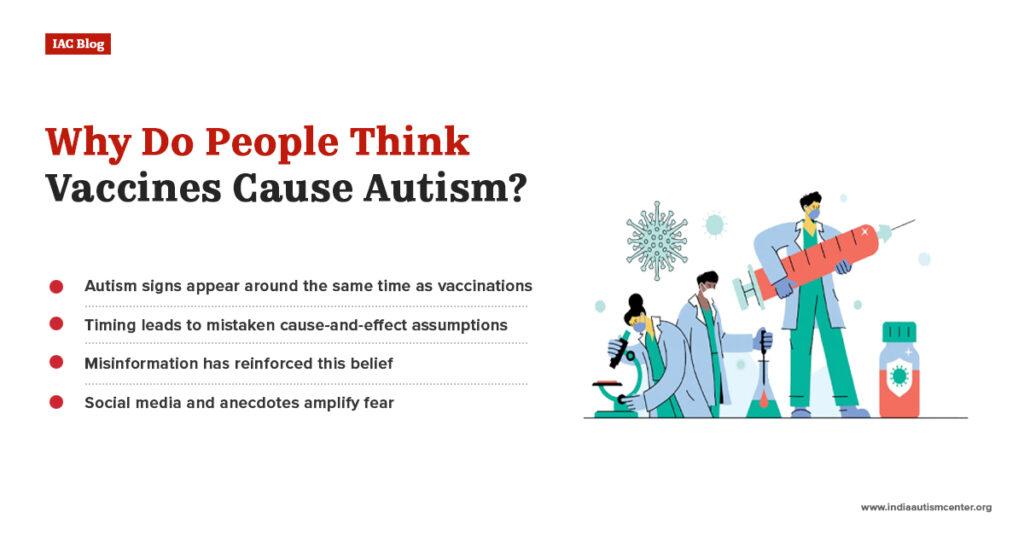
It is natural to look for a specific reason when a child receives a life-changing diagnosis. If you are wondering why people think vaccines cause autism, the answer lies in a mix of historical misinformation and the timing of childhood development.
Most children receive their primary vaccination series between birth and age 2. Coincidentally, this is the same window where the first signs of autism, like delayed speech or repetitive behaviours, become noticeable.
When two events happen at the same time, it is natural for the human brain to assume that one caused the other, even if they are unrelated.
Social media and anecdotal stories often amplify fear. Parents naturally want answers, and emotional stories can feel more convincing than data, even when they are not accurate.
Vaccines and Autism: What Science Actually Proves?
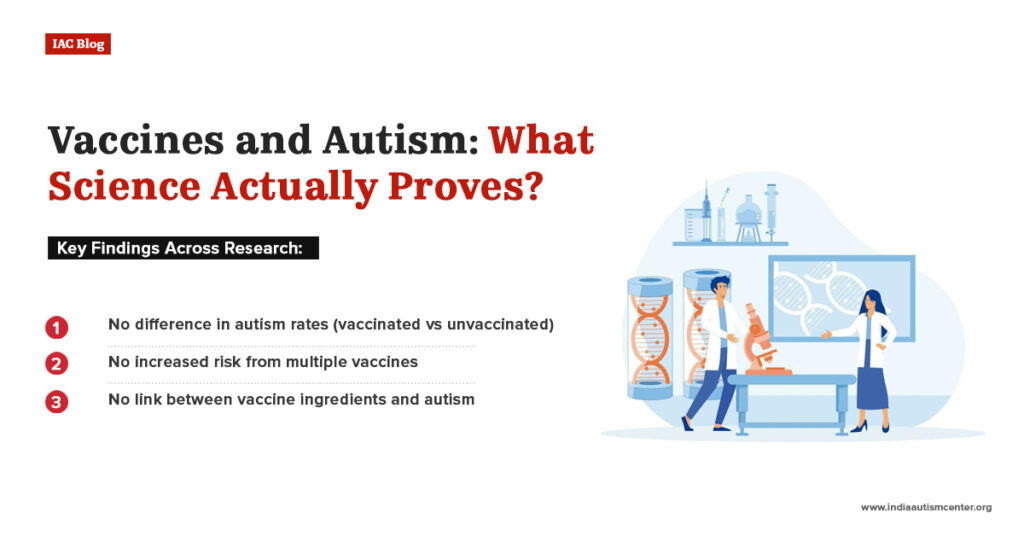
When looking at vaccines and autism, it’s important to focus on large-scale, peer-reviewed studies.
Key Findings Across Research
- No difference in the number of autism cases between vaccinated and unvaccinated children
- No increase in autism risk with multiple vaccines
- No link between vaccine ingredients (like thimerosal) and autism
Understanding Vaccine Ingredients and “Overload”
Some parents worry that even if one vaccine is safe, the sheer number of vaccines given at once might “overload” a child’s immune system. Others worry about specific ingredients, such as thimerosal or aluminium.
It is helpful to remember that a child’s immune system is incredibly resilient. From birth, babies are exposed to a plethora of bacteria and viruses in the environment, often found on their toys, in their food, and in the air they breathe.
The total number of “antigens” (the parts of a virus that trigger an immune response) in the entire childhood vaccine schedule is just a tiny fraction of what a child encounters in a single day of normal play.
Shifting the Focus: What Actually Causes Autism?
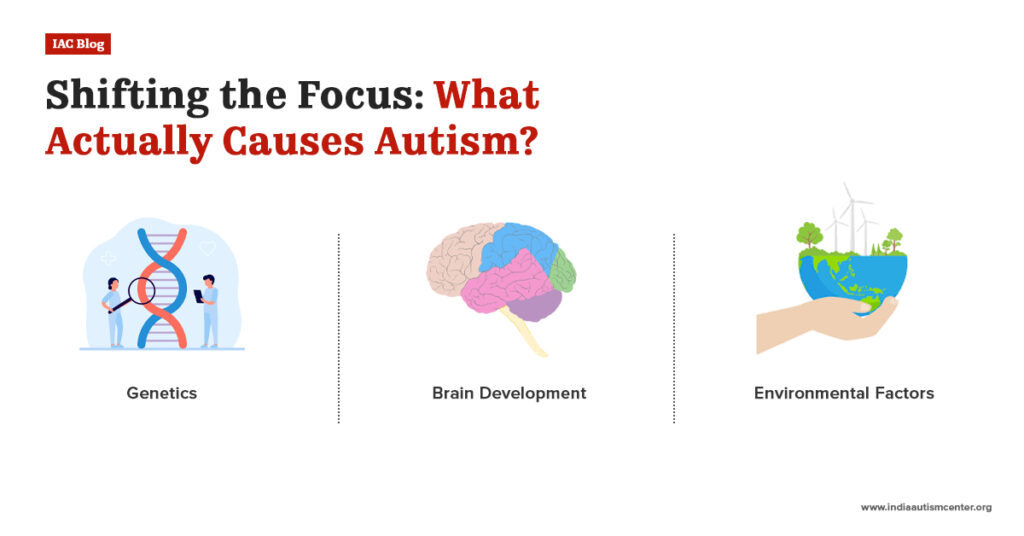
If vaccines are not the cause, what is? There is research that suggests that autism is a complex condition that is likely caused by a combination of genetic and environmental factors.
Genetics
Genetics plays the largest role in autism. Scientists have identified hundreds of specific genes and genetic mutations linked to brain development. In many cases, these mutations occur spontaneously in the egg or sperm and are not even passed down from the parents.
Brain Development
Research using advanced imaging has shown that the differences in the brain structure of autistic children are often present long before they are born. These differences occur during the second and third trimesters of pregnancy when the brain is forming its complex “wiring.” This further confirms that events after birth, such as vaccinations, are not the cause of the condition.
Environmental Factors
“Environmental” does not necessarily mean pollution. In scientific terms, it refers to events that occur in the body. Some confirmed risk factors include:
- Parental Age: Children born to older parents (both mothers and fathers) have a slightly higher risk of ASD.
- Pregnancy Complications: Premature birth, low birth weight, or certain infections during pregnancy may increase the likelihood of a child being on the spectrum.
- Spacing of Pregnancies: Having pregnancies less than one year apart has been linked to a higher risk.
When parents understand the real cause of Autism, it helps in moving away from the fear. It also helps to opt for better support for their child.
Understanding Atypical Autism Therapy
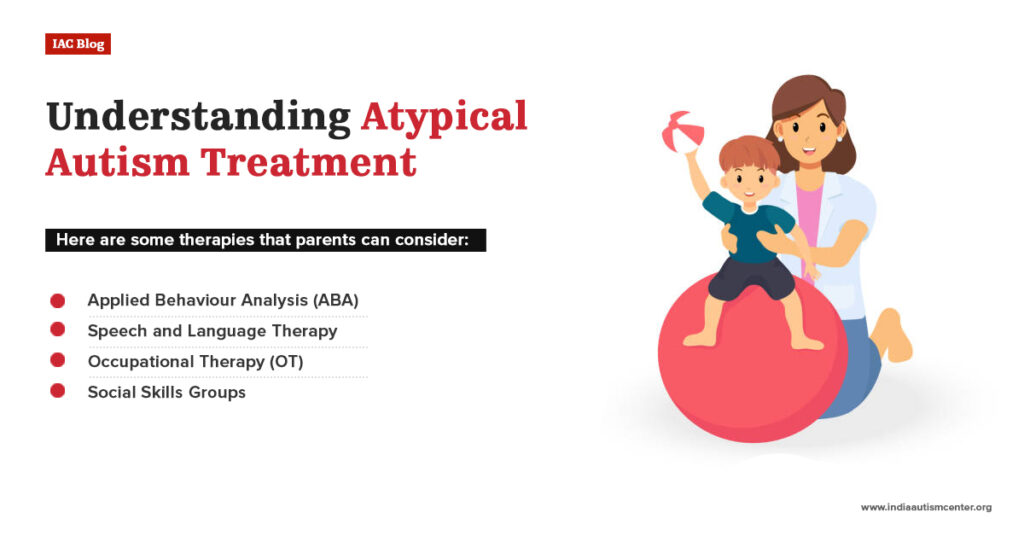
Atypical autism is part of the broad spectrum known as Autism Spectrum Disorder. When a child is diagnosed with Atypical autism, parents need to shift the focus to getting the right kind of support.
Every autistic child is unique; some may have incredible gifts in music or math, while others may struggle with basic daily tasks. The goal of any treatment is to improve the quality of life and independence.
Choosing an atypical autism therapy plan can feel overwhelming, but the most effective approach is usually early intervention.
Here are some therapies that parents can consider:
Applied Behaviour Analysis (ABA)
ABA is a widely used approach that focuses on teaching specific skills and reducing harmful or interfering behaviours. It uses positive reinforcement to help children learn how to communicate their needs.
Speech and Language Therapy
Many children on the spectrum have “social communication” challenges. A speech therapist helps them not just with the physical act of talking, but also with the nuances of conversation, such as taking turns and understanding body language.
Occupational Therapy (OT)
For children who have sensory processing issues, the world can feel like a very loud, bright, and scary place. OT helps children learn how to process sensory information so they can stay calm and focused.
Social Skills Groups
These are supervised settings where children can practice interacting with their friends in a safe environment.
It is important to remember that while there is no “cure” for autism, these therapies help children build the skills they need for a fulfilling, independent life. It is best to consult with a qualified medical professional before starting a new intervention.
Vaccination and Autism: Myths Debunked
For years, the debate around vaccines and autism has caused confusion and concern among parents. Even though there is overwhelming scientific evidence proving that vaccines are safe, myths continue to circulate, often fueled by misinformation and fear.
So let us debunk the most common myths around vaccination and autism:
| Myth | Fact |
| Myth: Giving too many vaccines at once causes autism. | Fact: A child’s immune system handles thousands of antigens daily. Vaccines are a tiny fraction of that and do not cause “overload.” |
| Myth: The “mercury” in vaccines is dangerous for the brain. | Fact: Thimerosal (ethylmercury) was removed from childhood vaccines years ago, and autism rates continued to rise regardless. |
| Myth: Natural immunity is better than vaccine-acquired immunity. | Fact: “Natural” immunity comes at the cost of the child getting sick with a dangerous disease. Vaccines provide protection without the risk of the illness. |
| Myth: My child was “fine” until they got their shots. | Fact: Autism symptoms often become visible at the same age vaccines are given, but brain differences usually begin before birth. |
Why Vaccines Still Matter?
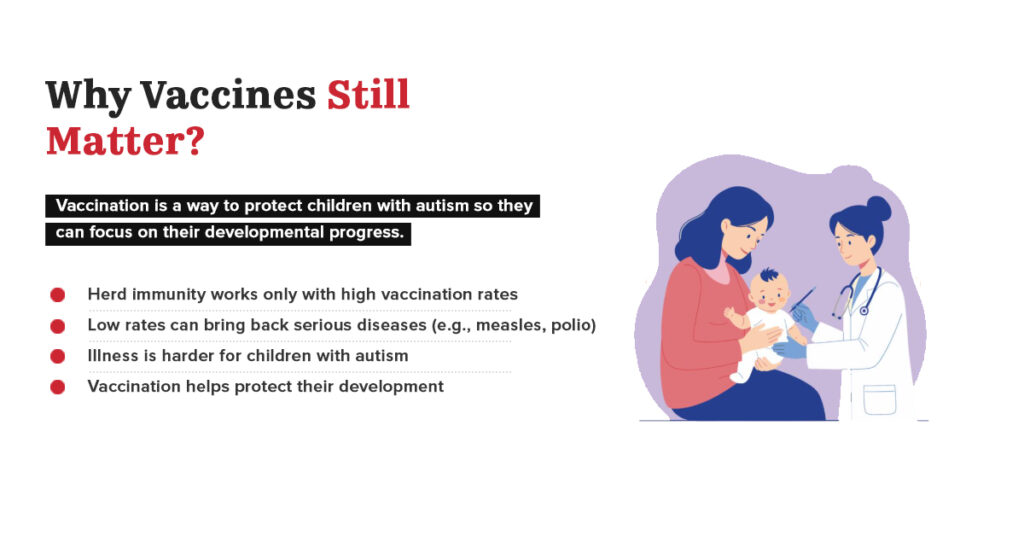
It can be tempting to think, “If so many other people are not vaccinated, why does my child need to be?” This is known as “herd immunity.” However, herd immunity only works if the vast majority of the community is protected.
If vaccination rates drop, diseases like measles or polio can make a sudden and deadly comeback. Measles, in particular, is quite contagious and can further lead to serious complications like pneumonia or brain swelling (encephalitis).
It becomes even more difficult when a child with autism contracts such a disease. Dealing with a severe physical illness on top of their sensory and communication challenges can be incredibly difficult.
In short, vaccination is a way to protect children with autism so they can focus on their developmental progress.
How Parents Can Make Informed Decisions?
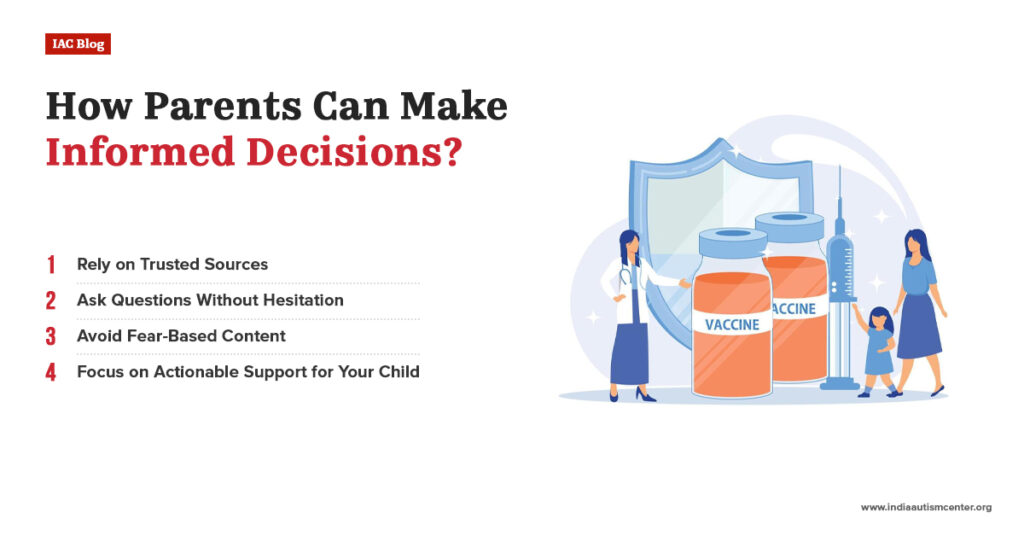
Today, parents are bombarded with information. Hence, distinguishing between a sensationalised headline and a verified medical fact can feel like a full-time job. When parents are confused about the topic of vaccines and autism, the goal is to move from a place of fear to a place of empowered understanding.
Parents need to trust their instincts and make informed decisions with the right information. By focusing on evidence-based resources and open communication, you can replace anxiety with a clear plan for your child’s health.
Here are a few steps that parents can take to make sure they make the right decision:
1. Rely on Trusted Sources
Make sure to consult trusted sources, such as paediatricians, government health organisations, or peer-reviewed studies, for advice.
For example, if a source claims that vaccines cause autism and only cites personal anecdotes or the retracted 1998 study, it is not a reliable source.
2. Ask Questions Without Hesitation
No concern is too small when it comes to your peace of mind. A good healthcare provider will never dismiss your fears; instead, they will explain the science clearly and respectfully.
Where there is confusion about the contents of the vaccines, ask for the data. A transparent conversation is the best way to dissolve the anxiety that often stems from the unknown.
3. Avoid Fear-Based Content
Misinformation often relies on emotional triggers. Anecdotes can be powerful and frightening, but they do not equal scientific evidence.
Always look for the “big picture” data over isolated, unverified stories.
4. Focus on Actionable Support for Your Child
Instead of spending emotional energy on the debunked link between vaccines and autism, redirect that focus toward high-value actions that significantly improve a child’s quality of life.
Remember:
- Early identification is the most powerful tool a parent has. It allows you to initiate interventions during the peak developmental window.
- Whether it is Speech Therapy, Occupational Therapy, or a specific atypical autism therapy like ABA, focus on methods that help your child gain independence and communication skills.
- Surrounding yourself with people who understand your journey provides the emotional resilience needed to be your child’s best advocate.
Conclusion
The question: Do vaccines cause autism? It’s more common than you think. There is scientific proof that there is no connection between vaccination and autism.
Vaccines do not cause autism. What they do is protect children from serious diseases that can have lifelong consequences. As we move forward into 2026 and beyond, our focus should shift away from baseless myth and toward what truly matters: supporting autistic individuals and their families.
This means investing in better atypical autism therapy, creating inclusive schools, and building a society where everyone, irrespective of how their brain is wired, can belong.
A diagnosis does not limit your child’s potential. With the right support, early intervention, and a healthy, vaccine-protected start in life, they can achieve amazing things.
Frequently Asked Questions
Do vaccines cause autism in children?
No, vaccines do not cause autism. Multiple large-scale studies across different countries have consistently shown no link between vaccines and autism. Health organisations worldwide strongly support vaccine safety.
Can delaying vaccines reduce autism risk?
No, delaying vaccines does not reduce the risk of autism. Instead, it leaves children unprotected against serious diseases like measles and whooping cough during a critical period of development.
Do vaccine ingredients cause autism?
No, vaccine ingredients such as thimerosal have been studied extensively and shown to be safe. Even after thimerosal was removed from most vaccines, autism rates did not decrease, proving no connection.
When do autism symptoms usually appear?
Autism symptoms typically become noticeable between 12 and 24 months. This timing overlaps with vaccination schedules, which is why some parents mistakenly link the two.
Is there a link between vaccines and atypical autism?
No. There is zero scientific evidence linking vaccines to any form of autism, including atypical autism. The causes remain rooted in genetics and brain development.
Are unvaccinated children healthier in terms of autism risk?
No, avoiding vaccines does not reduce the risk of autism. It only increases the likelihood of contracting serious and preventable diseases, which can have long-term health consequences.
For expert insights, support services, and inclusive learning initiatives, visit the India Autism Center.