 Donate now
 Get a Call Back

 MENU
 12 MIN READ
 SHARE


Dyslexia is one of the most common learning difficulties. In fact, the British Dyslexia Association estimates that approximately 1 in 10 people have dyslexia. However, it affects children in different ways.
While some children struggle to connect letters with sounds, others struggle to recognise familiar words or develop reading fluency. Understanding the types of dyslexia in children can help parents recognise these differences, identify potential warning signs and seek appropriate support.
More importantly, recognising that reading difficulties can follow different patterns can help families understand their child’s learning needs without overlooking their strengths.
Exploring the different types of dyslexia in children also offers insight into how they process written language and why their reading challenges can vary so much.
What Is Dyslexia in Children?
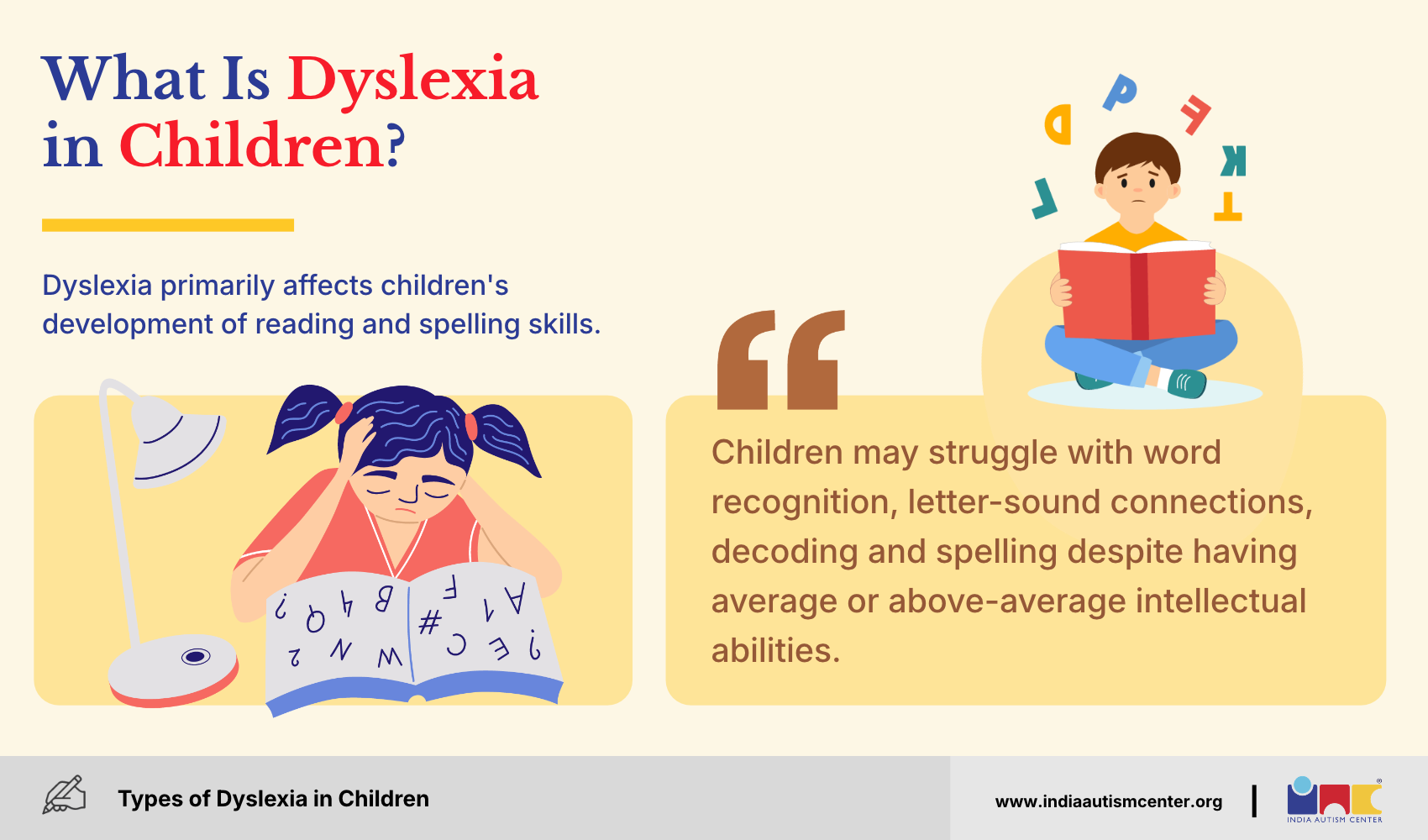
Dyslexia is classified as a learning disability that is known to primarily affect the development of reading and spelling skills. Children with dyslexia may struggle to recognise written words, connect letters to sounds, decode unfamiliar words and spell consistently. Understanding how dyslexia differs from other learning disabilities in children can help parents recognise the specific challenges their child may experience.
The International Dyslexia Association (IDA), in its revised 2025 definition, describes dyslexia as a learning disability characterised by difficulties with word-reading accuracy, speed or spelling that persist despite effective instruction. However, reading difficulties can vary in severity, and some children may experience milder challenges commonly referred to as borderline dyslexia.
Dyslexia has complex genetic, neurobiological and environmental influences. It is not caused by poor parenting, laziness, inadequate intelligence or a lack of motivation.
A child with dyslexia may have average or above-average intellectual abilities but may need different approaches to develop literacy skills. The difficulties can also vary in severity and how they present.
Importantly, dyslexia is not a uniform condition. Two children with the same diagnosis may experience very different reading challenges, depending on their individual language-processing and literacy profiles.
What Are the Different Types of Dyslexia in Children?
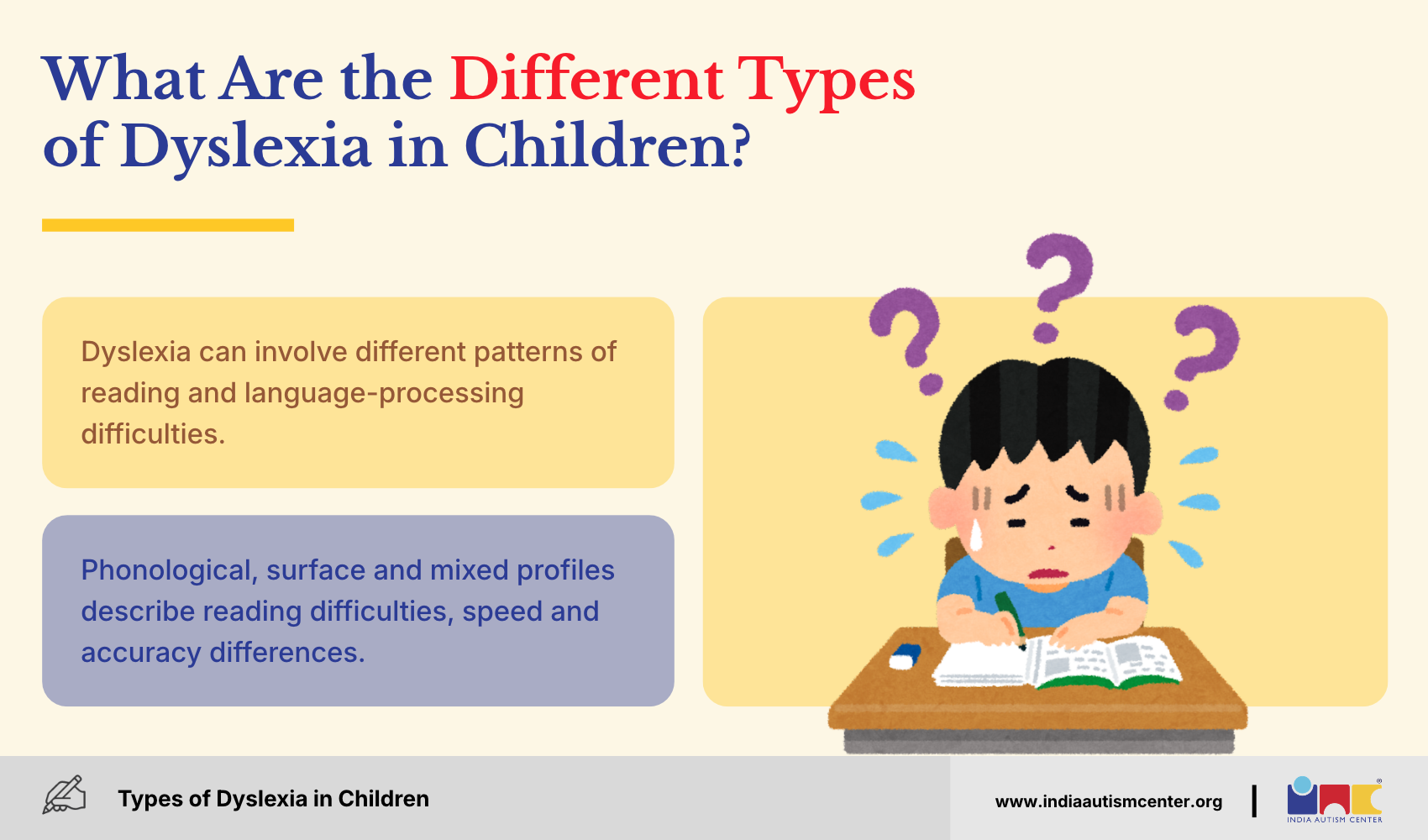
The different types of dyslexia in children are commonly described by the difficulties they experience with reading, spelling, and language processing. Phonological, surface, and mixed dyslexia are frequently discussed reading profiles.
Developmental dyslexia is a broader term for persistent reading difficulties that emerge during childhood. Some research also describes rapid naming and double-deficit profiles to explain differences in reading speed and accuracy.
These classifications are descriptive profiles rather than universally recognised, separate clinical diagnoses. Nevertheless, understanding them can help parents recognise the specific challenges their child may be experiencing.
1. Phonological Dyslexia
Phonological dyslexia occurs when a child has difficulty recognising, processing and manipulating the individual sounds within spoken words. This ability, known as phonological awareness, is essential for connecting spoken language with written letters.
Understanding phonological dyslexia in children matters because difficulties with sound recognition can affect how effectively a child learns to decode unfamiliar words.
For instance, a child may recognise the word “cat” after seeing it repeatedly but struggle to sound out an unfamiliar word such as “mat”.
Common characteristics include:
- Difficulty identifying individual sounds within words.
- Struggling to connect letters with their corresponding sounds.
- Finding it challenging to blend sounds to form complete words.
- Difficulty recognising rhyming words or breaking words into syllables.
- Guessing unfamiliar words instead of sounding them out.
- Inconsistent spelling, particularly when writing unfamiliar words.
Example: When asked to read “ship”, a child may struggle to identify and blend the sounds represented by the letters.
Structured phonics instruction, phoneme identification exercises, and sound-blending activities can help strengthen these foundational literacy skills.
2. Surface Dyslexia
Surface dyslexia involves difficulty automatically recognising familiar written words, particularly those with irregular spelling patterns.
In children with surface dyslexia, the primary difficulty is often not understanding basic letter-sound relationships but developing automatic recognition of familiar words. Children may successfully sound out regular words but struggle with words whose pronunciation cannot be easily worked out through conventional phonics rules.
Examples include English words such as “one”, “said”, “yacht”, and “enough”.
Common signs include:
- Difficulty recognising familiar words quickly.
- Misreading words with irregular spelling patterns.
- Attempting to pronounce words strictly according to their individual letters.
- Slow reading despite having basic phonics knowledge.
- Difficulty developing automatic word recognition.
Example: A child may attempt to pronounce “said” as “say-ed” because they are applying familiar letter-sound rules rather than recognising the word.
Repeated exposure to irregular words, guided reading and activities that strengthen orthographic recognition can help children develop more accurate and fluent reading skills.
3. Mixed Dyslexia
Mixed dyslexia describes a reading profile involving characteristics of both phonological and surface dyslexia. Children may struggle with sound-based decoding and recognising familiar written words.
This combination can make reading particularly challenging because it affects more than one process involved in word recognition.
Common characteristics include:
- Difficulty connecting letters with sounds.
- Struggling to decode unfamiliar words.
- Poor recognition of frequently encountered words.
- Slow and effortful reading.
- Frequent spelling mistakes.
- Difficulty maintaining reading accuracy.
Example: A child may struggle to sound out an unfamiliar word such as “plant” and also have difficulty recognising an irregular word such as “enough”.
A structured literacy programme that addresses phonological awareness, decoding, spelling, and word recognition can help children develop these skills progressively.
4. Developmental Dyslexia
Developmental dyslexia in children refers to persistent difficulties in acquiring reading and spelling skills as they grow. Unlike acquired dyslexia, which develops after brain injury or neurological damage, developmental dyslexia becomes apparent during the learning-to-read process.
It involves differences in language and literacy processing. Children may struggle to develop phonological awareness, decode words, recognise spelling patterns, and read fluently.
Some common signs include:
- Difficulty learning letter names and sounds.
- Delayed development of reading skills.
- Persistent spelling difficulties.
- Slow reading and difficulty recognising words.
- Trouble remembering verbal information and sequences.
- Difficulty reading unfamiliar words independently.
Developmental dyslexia can present through different reading profiles, including phonological, surface or mixed difficulties. Its presentation may also change as children grow and receive appropriate literacy instruction.
Early identification and targeted educational support can help children strengthen their reading abilities and reduce the impact of persistent literacy difficulties.
5. Double-Deficit Dyslexia
Double-deficit dyslexia describes a reading profile in which a child experiences difficulties with both phonological processing and rapid automatised naming (RAN).
Children with both difficulties may struggle to decode unfamiliar words and quickly recognise familiar ones. This can affect reading accuracy and speed.
Double-deficit dyslexia is a research-based description of a reading profile, not a universally recognised diagnostic category.
What Are the Signs of Dyslexia in Children?
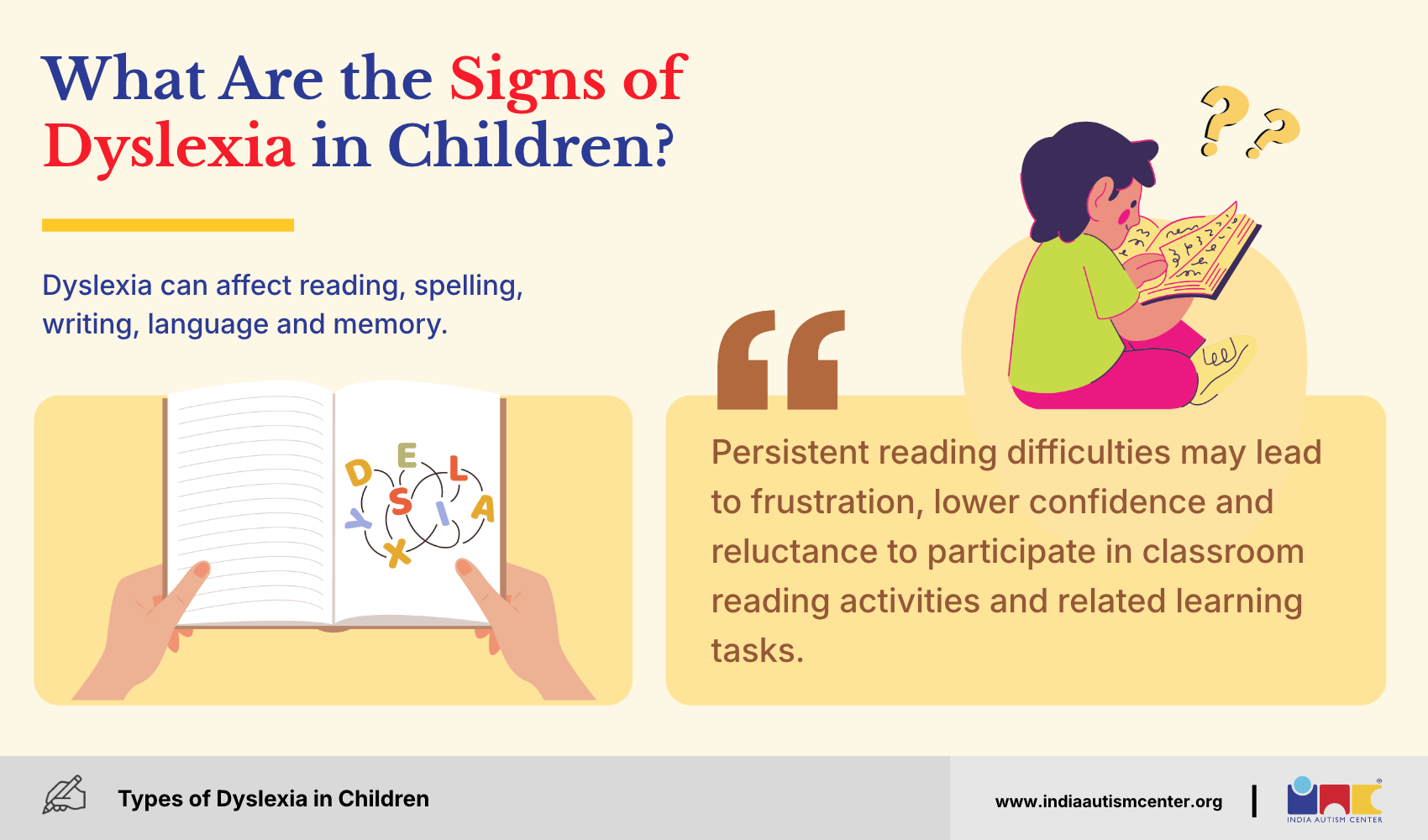
Knowing what the signs of dyslexia in children are can help parents understand when their child may need additional learning support. However, dyslexia symptoms in kids don’t always appear the same way. Some children struggle with letter recognition and phonics, while others have difficulty with spelling, reading speed, and word recognition.
The signs may also change as children progress through different stages of education.
| Area of Development | Common Signs |
|---|---|
| Reading | Slow reading, difficulty sounding out words and frequent misreading |
| Spelling | Inconsistent spelling and difficulty remembering familiar words |
| Language | Difficulty identifying rhyming words and remembering word sequences |
| Writing | Frequent spelling errors and difficulty organising written information |
| Memory | Difficulty remembering instructions and verbal information |
| Learning | Avoiding reading activities and taking longer to complete literacy tasks |
Some children may also experience frustration, low confidence or anxiety because classroom reading activities require considerably more effort.
However, one or two of these difficulties do not automatically indicate dyslexia. Parents should look for persistent patterns that continue despite appropriate teaching and practice.
How to Identify Dyslexia in Children?
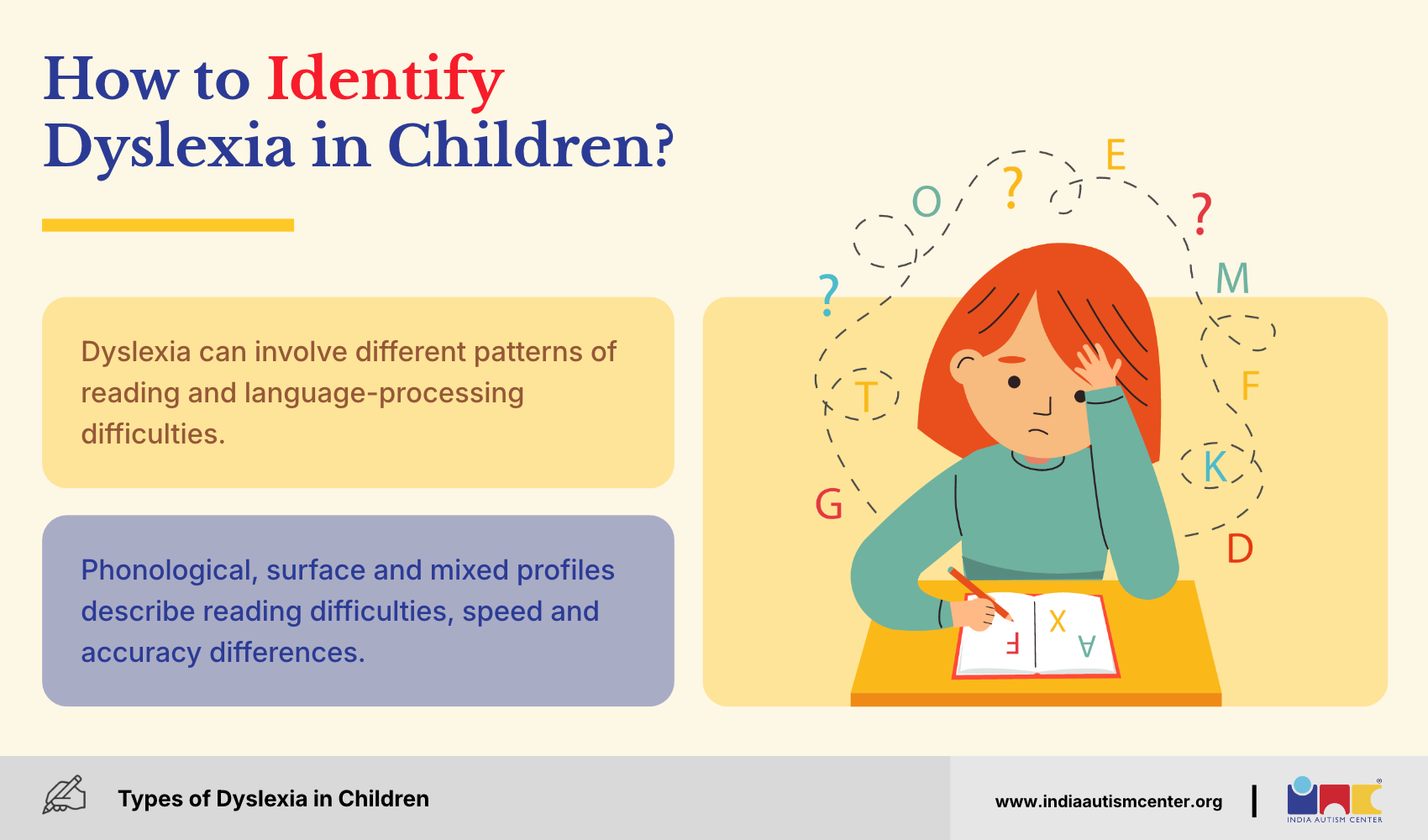
Parents often wonder how to identify dyslexia in children, particularly when their child struggles with reading despite regular practice. While occasional spelling mistakes or slow reading are common during early learning, persistent difficulties with decoding, word recognition and spelling may warrant further evaluation.
The following steps can help parents decide when to seek professional guidance.
1. Observe Early Language and Reading Development
Notice whether your child struggles to recognise letters, identify sounds, remember familiar words or understand rhyming patterns. These may indicate difficulties with foundational literacy skills.
2. Monitor Reading and Spelling Progress
Look for persistent difficulties with decoding, word recognition, spelling and reading speed. Consider whether your child is progressing as expected despite regular practice and appropriate teaching.
3. Speak to Teachers
Teachers can offer valuable insights into classroom performance, reading development and the child’s response to different teaching methods. They may also identify areas where the child needs additional learning support.
4. Consult a Qualified Professional
A comprehensive assessment by a suitably qualified psychologist or specialist experienced in specific learning difficulties can help determine whether a child has dyslexia.
Depending on the child’s needs, the assessment may examine:
- Phonological awareness and sound processing.
- Word recognition and decoding abilities.
- Reading accuracy and speed.
- Spelling and written language skills.
- Working memory and processing speed, where relevant.
- Developmental, family and educational history.
Hearing, vision, language proficiency, attention, and previous access to effective instruction may also need consideration.
Screening tools can identify children who may need further evaluation, but screening alone cannot confirm dyslexia. Parents should not delay seeking guidance until a child falls significantly behind academically.
What Causes Dyslexia in Children?
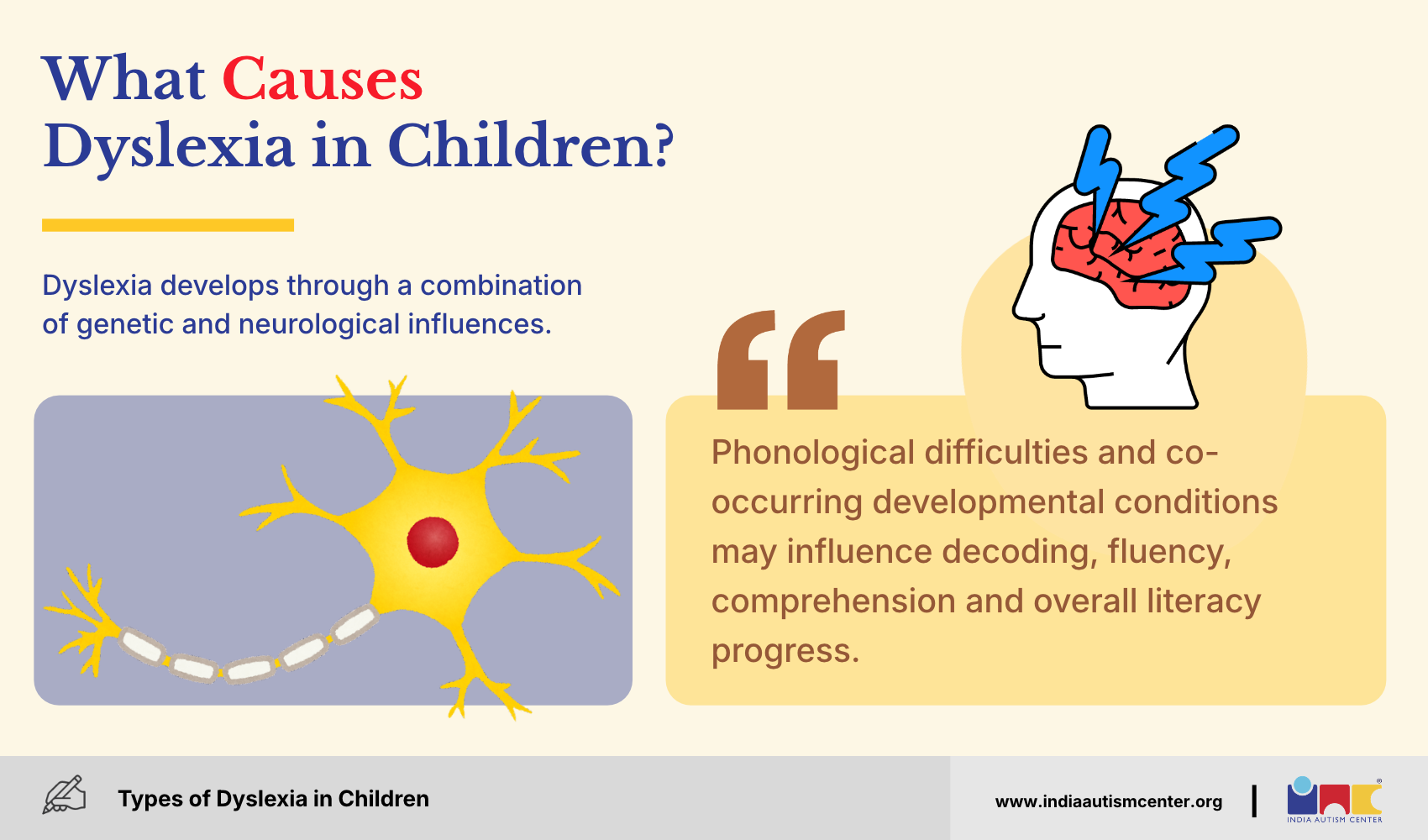
No single cause can explain why a child has dyslexia. Research indicates that it develops through a combination of genetic, neurological and environmental influences.
1. Genetic factors: Dyslexia can run in families. Children with a parent or sibling who has dyslexia may have a higher likelihood of experiencing similar reading difficulties. However, family history does not guarantee that a child will develop dyslexia.
2. Neurological differences: Research indicates that individuals with dyslexia may process certain language and literacy-related information differently. These differences can affect how the brain connects spoken sounds with written symbols.
3. Phonological processing difficulties: Some children find it difficult to identify, remember and manipulate speech sounds. This can interfere with learning letter-sound relationships, decoding unfamiliar words and spelling.
4. Co-occurring developmental conditions: Dyslexia can occur alongside conditions like Attention Deficit Hyperactivity Disorder (ADHD), Autism Spectrum Disorder (ASD) and Developmental Language Disorder (DLD). These are distinct conditions and require appropriate assessment.
It is also important to distinguish dyslexia from reading difficulties associated with limited literacy instruction or learning a new language.
How Can Parents Support Children with Dyslexia?
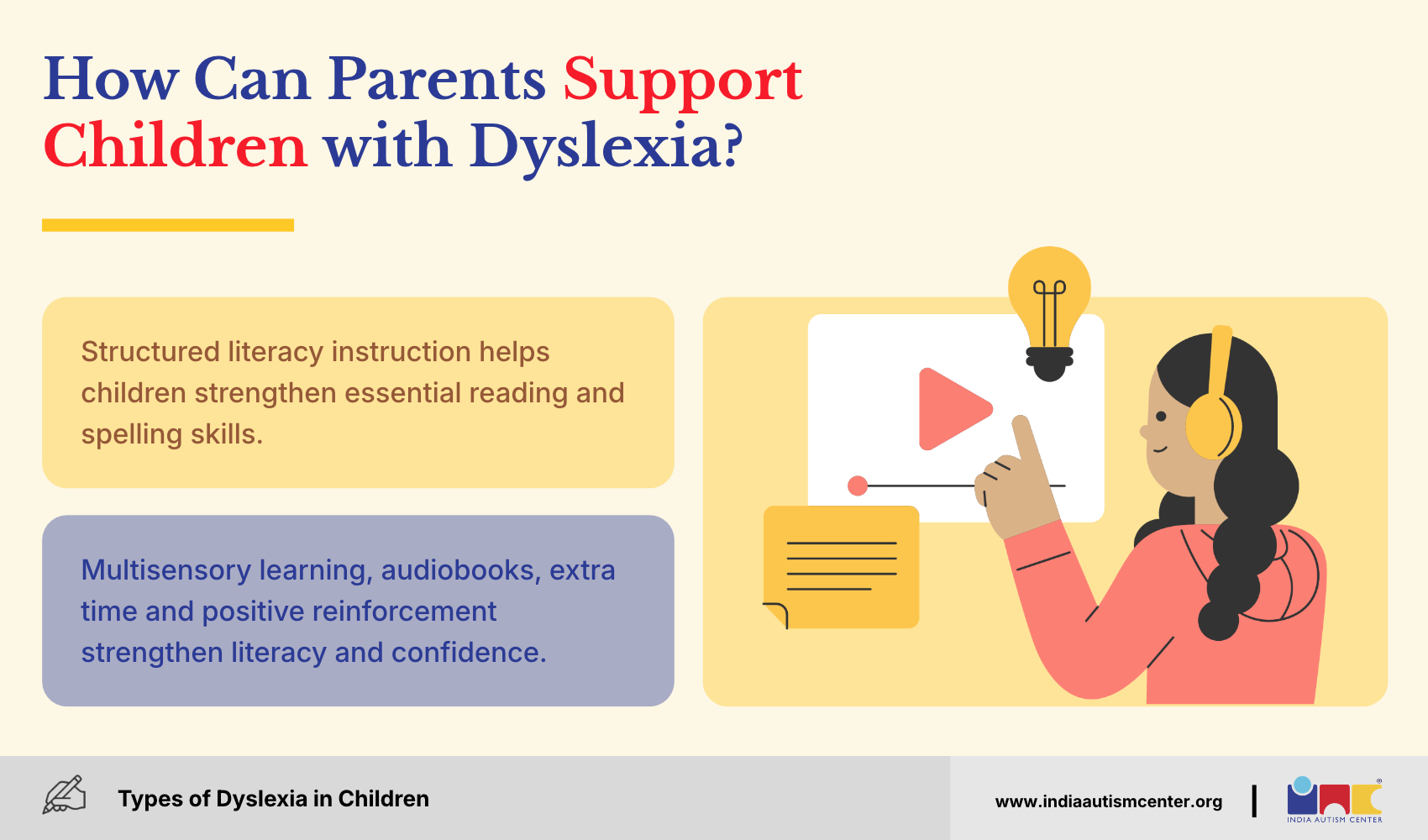
Although dyslexia is a lifelong learning difference, appropriate educational support can help children develop stronger reading, writing and spelling skills.
Some practical approaches include:
- Structured literacy instruction: Use explicit, systematic teaching that covers phonemic awareness, phonics, decoding, spelling and reading fluency.
- Multisensory learning: Combine visual, auditory and tactile activities to reinforce letter-sound relationships.
- Audiobooks and text-to-speech: Help children access age-appropriate educational material while continuing to develop independent reading skills.
- Additional learning time: Allow extra time for reading assignments and written activities where appropriate.
- Positive reinforcement: Recognise progress, celebrate achievements and avoid comparing the child’s performance with classmates.
Parents should communicate regularly with teachers and specialists to monitor progress as well as adapt learning strategies as needed.
Can Dyslexia Occur Alongside Autism or ADHD?
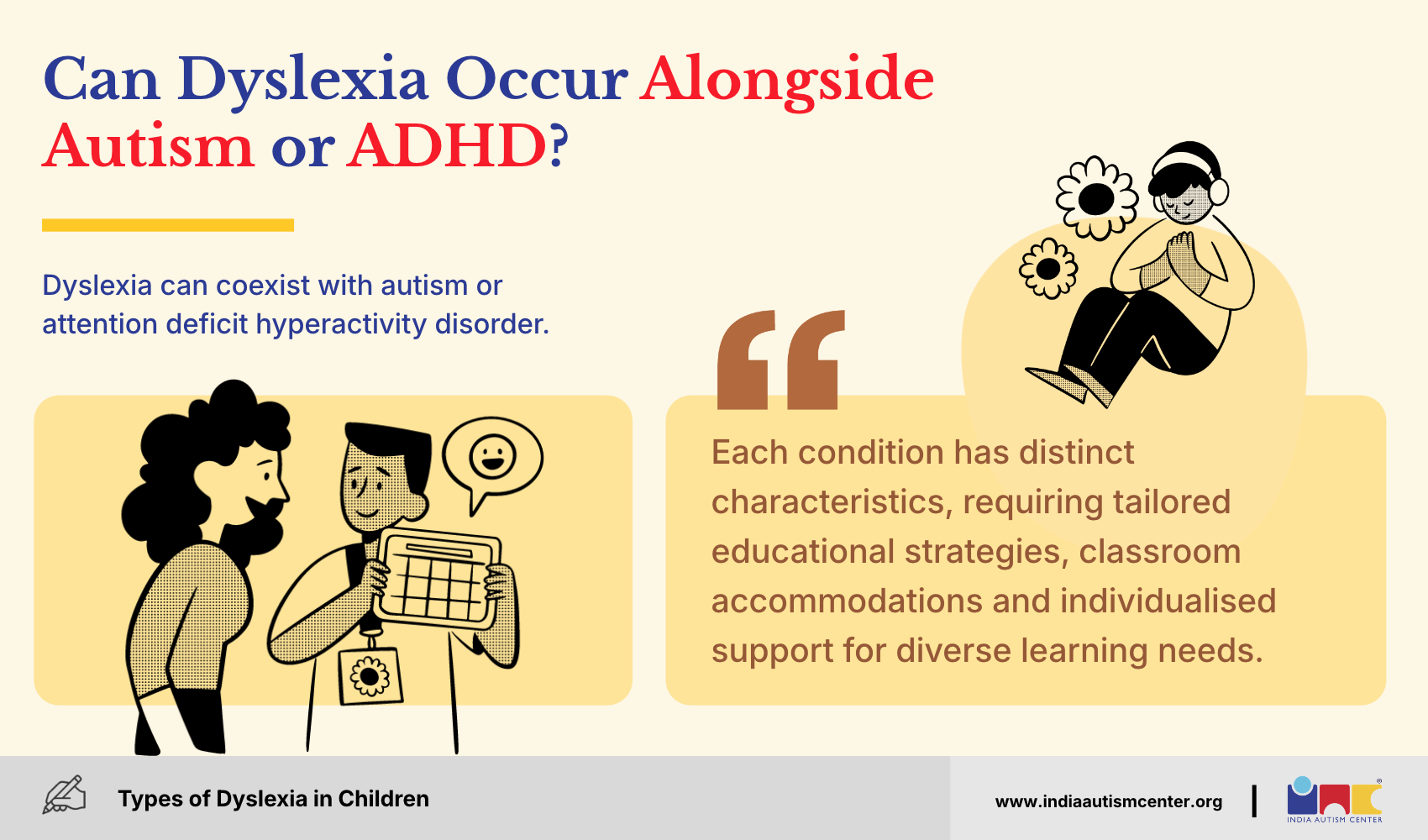
Yes. Dyslexia can coexist with Autism Spectrum Disorder or even along with Attention Deficit Hyperactivity Disorder, although these are separate developmental conditions.
An autistic child may experience differences in communication, social interaction and sensory processing while also having difficulties with reading and spelling.
Similarly, a child with ADHD may struggle with attention, organisation and completing reading activities alongside independently identifiable dyslexia.
Understanding these distinctions matters because each child’s support needs can differ. A child with dyslexia may benefit from structured phonics instruction, while a child with co-occurring ADHD may additionally need classroom adjustments that support attention and task completion.
How India Autism Center Supports Children with Different Learning Needs
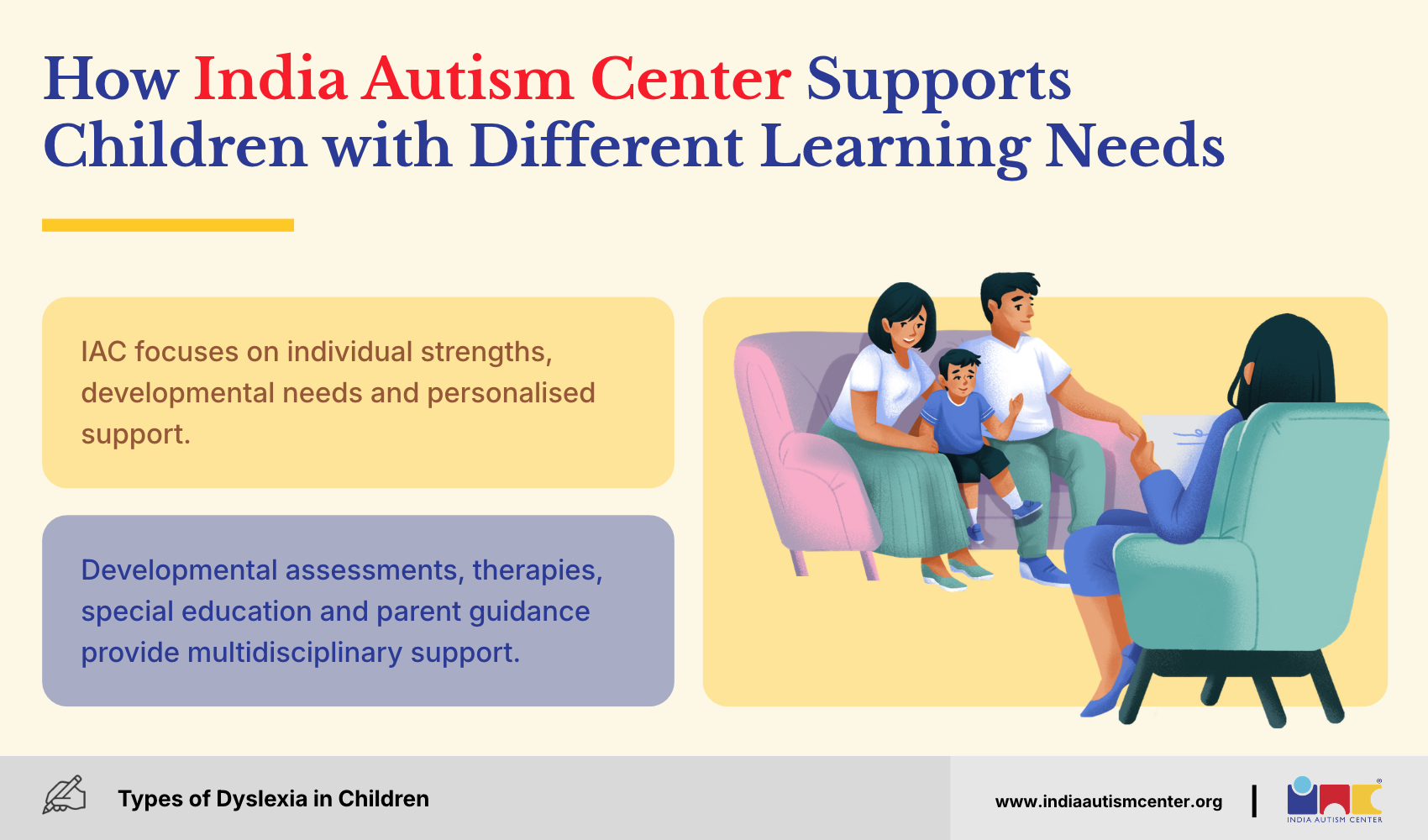
Every child has a unique developmental and learning profile. At India Autism Center (IAC), we focus on understanding individual strengths, identifying developmental needs, and providing personalised support.
Although dyslexia is distinct from autism, children may experience overlapping developmental or learning differences that benefit from multidisciplinary support. Depending on individual needs, developmental assessments, speech and language therapy, occupational therapy, special education and parent guidance can support a broader plan.
Through professional collaboration and family involvement, IAC aims to help children develop essential skills, build confidence and participate more meaningfully in everyday learning.
Conclusion
Understanding the types of dyslexia in children is an important step towards recognising their individual learning needs. While some children struggle with phonological awareness, others find familiar word recognition, spelling or reading speed more challenging.
Recognising these differences, understanding the signs and seeking an appropriate assessment can help parents make informed decisions about support.
With structured literacy instruction, consistent encouragement, and suitable educational adjustments, children with dyslexia can strengthen their reading abilities, build confidence, and make meaningful academic progress.
Frequently Asked Questions
1. What are the different types of dyslexia in children?
Phonological, surface, and mixed dyslexia are commonly described reading profiles. Developmental dyslexia is a broader term for persistent reading difficulties that emerge during childhood. Double-deficit dyslexia describes a profile involving difficulties with both phonological processing and rapid naming.
2. At what age can dyslexia be identified?
Early warning signs may appear in preschool, but dyslexia is often identified when formal reading instruction begins. Consider assessment as soon as persistent difficulties become apparent.
3. Can a child have more than one type of dyslexia?
Yes. Children can experience a combination of phonological and surface reading difficulties. Their reading profiles may also change as they develop and receive appropriate instruction.
4. Does dyslexia affect intelligence?
No. Dyslexia does not indicate low intelligence. Children with dyslexia can have average or above-average intellectual abilities.
5. Is dyslexia the same as a speech or language disorder?
No. Dyslexia primarily affects reading and spelling, whereas speech and language disorders affect spoken communication and language development. However, these difficulties can sometimes coexist.