 Donate now
 Get a Call Back

 MENU
 12 MIN READ
 SHARE


A shared smile during play, pointing to a favourite toy, or taking turns with a parent may seem like small, everyday moments. However, these interactions can lay the foundation for meaningful communication.
A 2015 randomised controlled study published in the National Library of Medicine involving 86 autistic toddlers aged 22 to 36 months found that a 10-week parent-training intervention improved joint engagement, with benefits maintained at a six-month follow-up. The findings explain the importance of interaction and play in early communication development.
With the right autism speech therapy activities, parents can turn everyday experiences into opportunities for children to express themselves, understand language, and connect with others.
Why Are Speech Therapy Activities Important for Autistic Children?
Imagine a child who wants their favourite toy but cannot communicate what they need. They might point to it, make a sound, pull an adult’s hand, or become frustrated. These behaviours can be attempts to communicate, even without spoken words.
Kids who have Autism Spectrum Disorder (ASD) tend to have various ways of understanding and expressing communication. Some speak in sentences but find conversations challenging, while others use single words, repeated phrases, gestures, pictures or communication devices.
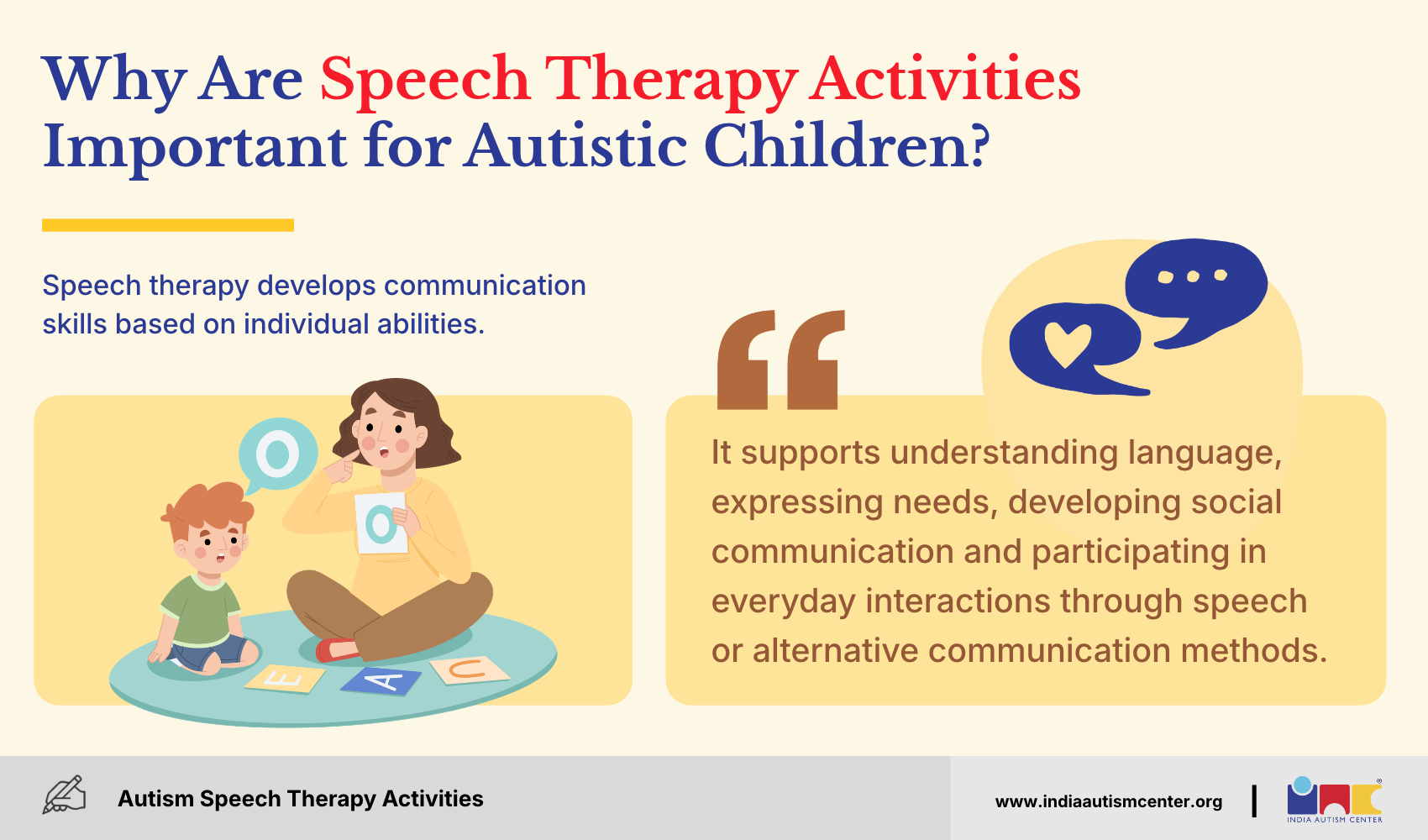
Speech and language therapy (SLT) helps children develop communication skills according to their individual abilities and needs.
Depending on the child’s communication profile, therapy may focus on:
- Receptive language: Understanding words, instructions, questions and conversations.
- Expressive language: Communicating thoughts, needs and preferences through speech or alternative methods.
- Social communication: Initiating interactions, sharing information and participating in conversations.
- Speech production: Developing speech sounds, pronunciation and clarity where appropriate.
- Functional communication: Asking for help, expressing discomfort, making choices and communicating everyday needs.
The objective is not to make every child speak in the same way. It is to help each child find reliable and meaningful ways to communicate.
15 Autism Speech Therapy Activities That Make Learning More Engaging
Speech therapy does not always have to involve flashcards, worksheets or structured lessons. A favourite toy, a picture book or even a game of bubbles can become an opportunity to practise communication.
The following speech therapy activities for autistic children can be adapted to different developmental levels, interests and communication abilities.
A. Activities to Build the Foundations of Communication
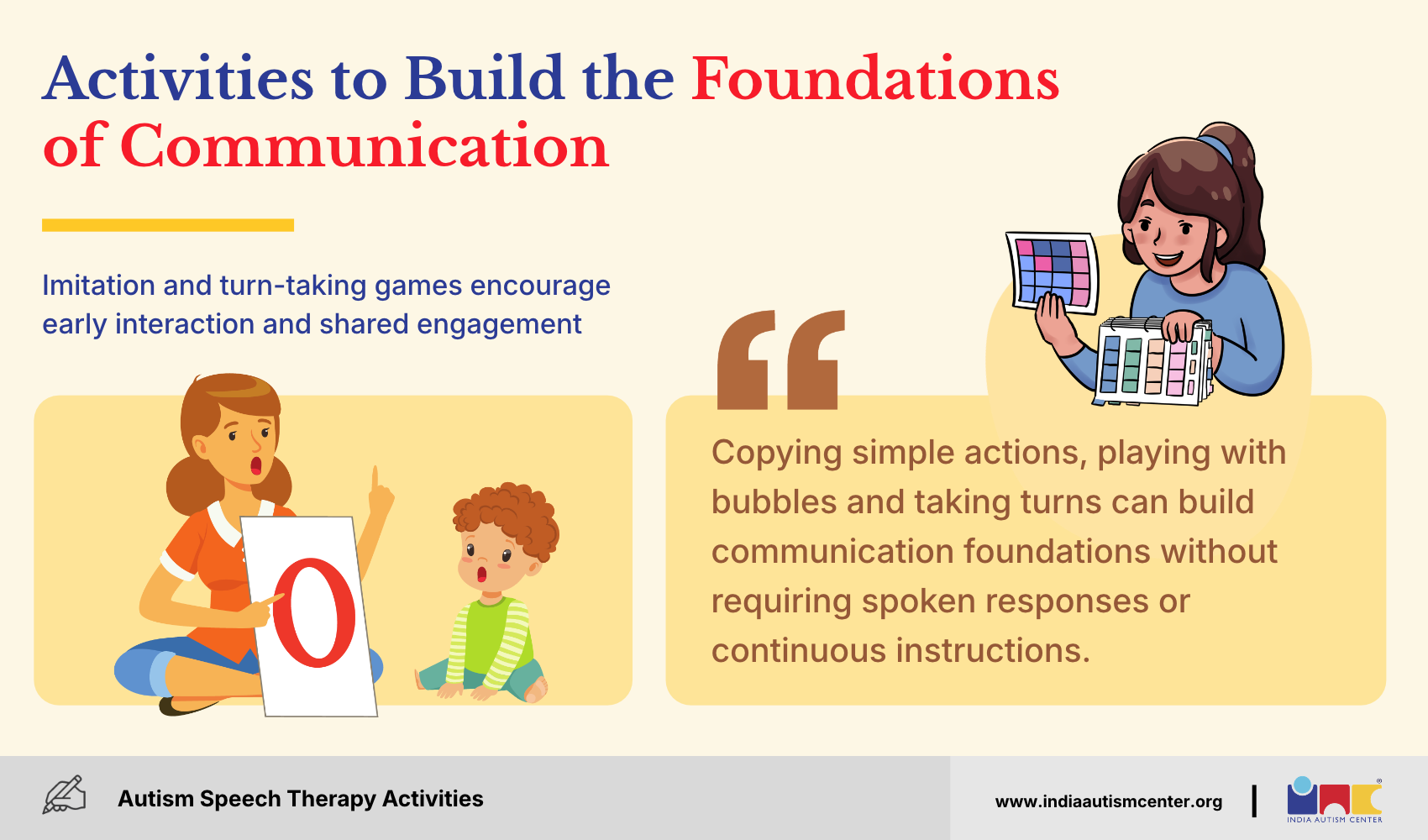
Before focusing on words and sentences, children may benefit from opportunities to engage, imitate and interact with others. These activities help build the foundations of communication.
1. Follow the Leader: Imitation Games
Children often learn by observing and responding to actions around them. Start with simple movements such as clapping, tapping a table, waving or rolling a ball. Demonstrate an action and give the child time to respond. You can also reverse the activity by copying something the child does independently.
For example, if the child taps a toy, tap your own toy in response. This creates an opportunity for shared interaction without requiring the child to follow instructions continuously.
What it supports: Imitation, shared engagement, attention and early communication.
2. Bubble Time: Encouraging Requests
A few bubbles can create several communication opportunities. Blow bubbles for a few seconds, pause and wait to see whether the child indicates that they want more. Model expressions such as “More bubbles”, “Pop” and “Big bubbles”.
Accept pointing, gestures, sounds, picture selections or spoken requests. Avoid withholding the activity for long periods to encourage a response.
What it supports: Requesting, anticipation, turn-taking and intentional communication.
3. My Turn, Your Turn: Turn-Taking Games
Roll a ball, stack blocks or take turns putting pieces into a puzzle. Use simple expressions such as “My turn” and “Your turn” while demonstrating the activity. Start with short exchanges and gradually extend the game as the child becomes comfortable.
Remember that turn-taking does not require eye contact or spoken responses. Focus on creating an enjoyable shared interaction.
What it supports: Reciprocal interaction, attention and understanding conversational turns.
B. Activities to Develop Vocabulary and Language Understanding
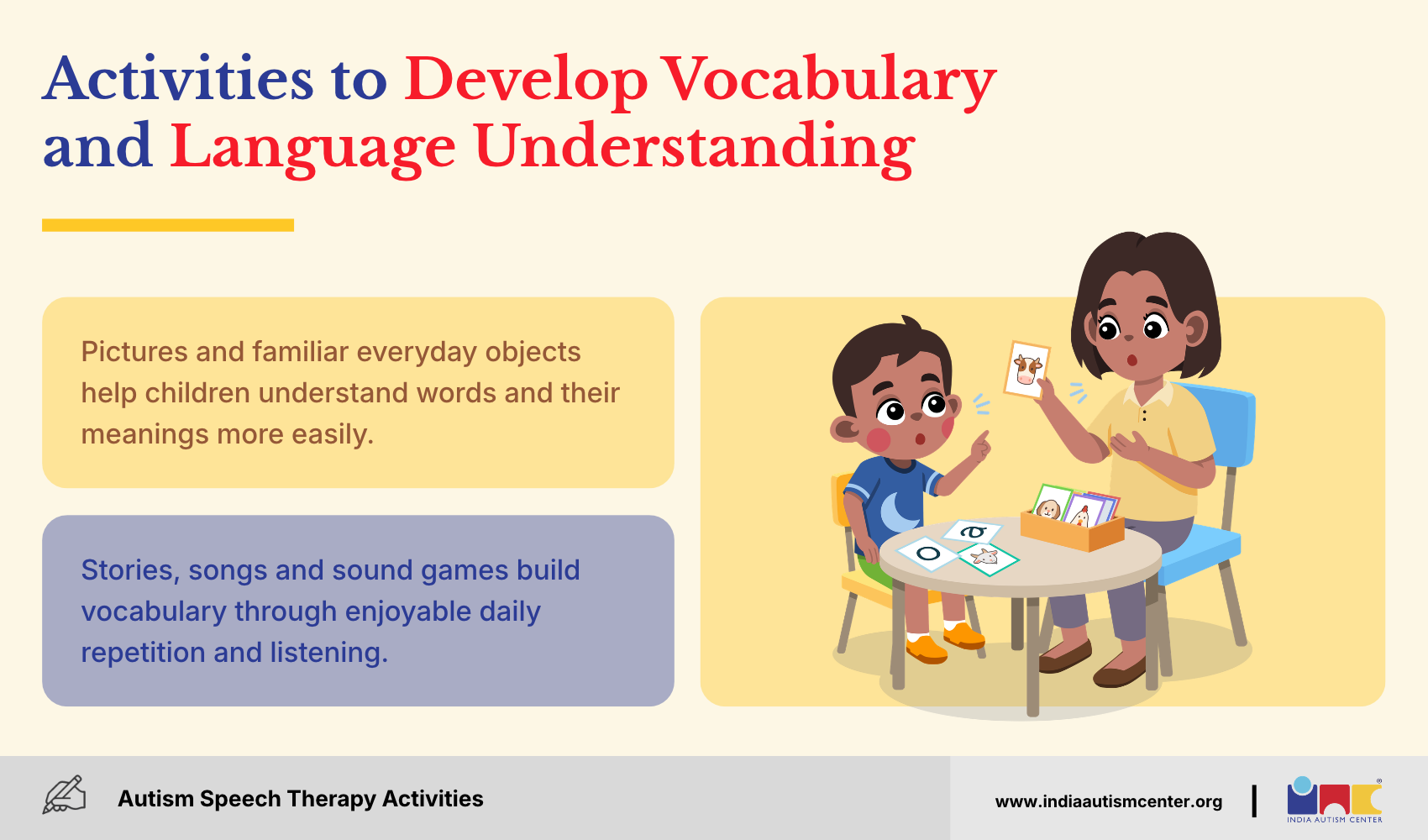
Pictures, stories, music and familiar objects can help children connect words with things they recognise. These activities introduce language in a familiar and enjoyable context.
4. Picture Cards and Object Naming
Use pictures of familiar objects such as fruits, animals, vehicles, toys and household items.
Show a picture of an apple and say “Apple”. Once the child becomes familiar with it, introduce related expressions such as “Red apple”, “Eat apple” or “Apple juice”.
You can also place two or three pictures in front of the child and encourage them to identify a familiar object. If they use Augmentative and Alternative Communication (AAC), include the relevant symbols on their communication system.
What it supports: Vocabulary, object recognition, word association and receptive language.
5. Storytime With a Twist
Instead of reading a picture book from beginning to end, make the experience interactive.
Choose a book with colourful illustrations and familiar situations. Pause to describe what is happening. For example, point to a picture of a dog and say, “The dog is running”. Encourage the child to point to familiar objects, select pictures or respond using words or AAC. Revisit favourite books to introduce repeated words and phrases.
You can also connect the story to real experiences. If the book features a cat, talk about a cat the child has seen or played with.
What it supports: Listening comprehension, vocabulary, sentence understanding and narrative skills.
6. Sing, Move and Communicate
Songs and nursery rhymes with repeated words and predictable movements can make language practice enjoyable. Try familiar action songs involving clapping, waving or jumping. Pause before a familiar action to give the child an opportunity to participate.
Children do not have to sing the words to take part. Movements, gestures and vocalisations are also meaningful ways to participate.
What it supports: Auditory attention, rhythm, imitation and vocabulary.
7. Animal and Vehicle Sound Games
Bring out toy animals, cars and trains. Introduce familiar sounds such as “Moo”, “Beep” and “Choo-choo”. Make the sounds while playing, and let the child imitate them if interested. Gradually introduce related words such as “Cow”, “Train” and “Car”.
Sound imitation can be enjoyable, but it should never become a condition for communication.
What it supports: Sound awareness, listening, imitation and early expressive communication.
C. Activities to Encourage Social and Functional Communication
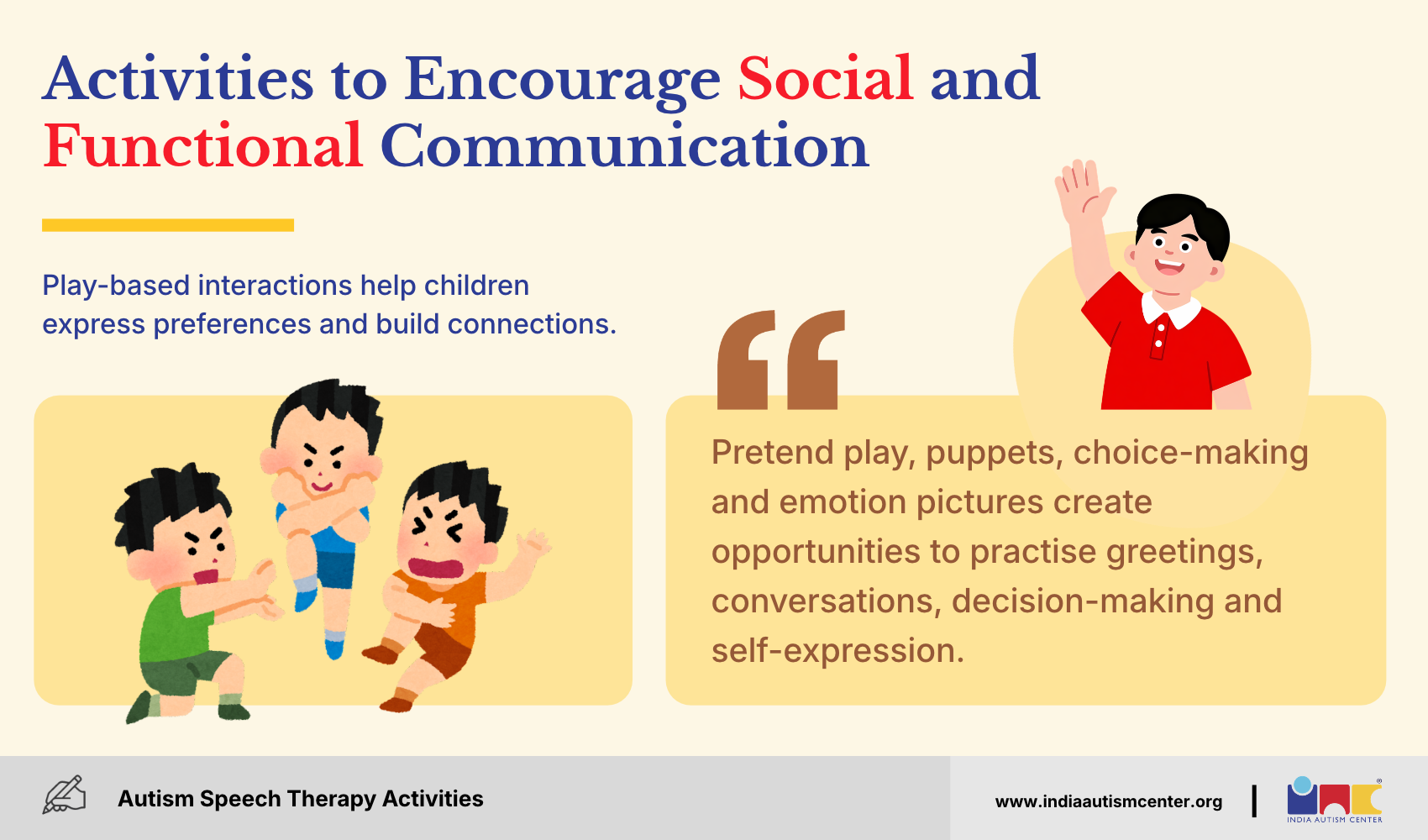
Knowing words is only one part of communication. Children also need opportunities to use language to interact with others, express preferences and participate in everyday situations.
8. Pretend Play: Create a Mini World
Set up a pretend grocery shop, kitchen, doctor’s clinic or household using toys and familiar objects. During pretend cooking, for example, introduce expressions such as “Cut the apple”, “More food” and “Give me a cup”.
Let the child decide what happens next. Following their interests often makes the interaction more engaging than directing every step.
What it supports: Functional vocabulary, imaginative play, social interaction and sentence development.
9. Puppet Conversations
Puppets can make social interaction enjoyable, particularly for children who like familiar characters. Use two puppets to demonstrate simple exchanges such as greetings, asking for a toy or taking turns. Model phrases such as “Hello”, “Let’s play” and “Your turn”.
The child can participate by moving a puppet, making sounds, speaking or selecting a message using a communication device.
What it supports: Conversation initiation, greetings, turn-taking and social communication.
10. Choose Your Favourite: Choice-Making Games
Hold up two familiar objects, such as a ball and a toy car, and ask, “Which one do you want?” Give the child time to point, reach, sign, speak or select a picture. Gradually introduce choices during meals, playtime and dressing.
Offering choices helps children communicate preferences and make everyday decisions. Respect their responses, including when they refuse an option.
What it supports: Expressive communication, decision-making and independence.
11. Learning About Emotions Through Pictures
Use picture cards or illustrated stories to introduce emotions such as happy, sad, angry and surprised.
For example, show a picture of a child receiving a present and discuss how they might feel. You can also use familiar situations to introduce words that help children express their own experiences.
Avoid assuming that facial expressions always reveal exactly how someone feels.
What it supports: Emotional vocabulary, self-expression and understanding social situations.
D. Activities to Strengthen Everyday Communication
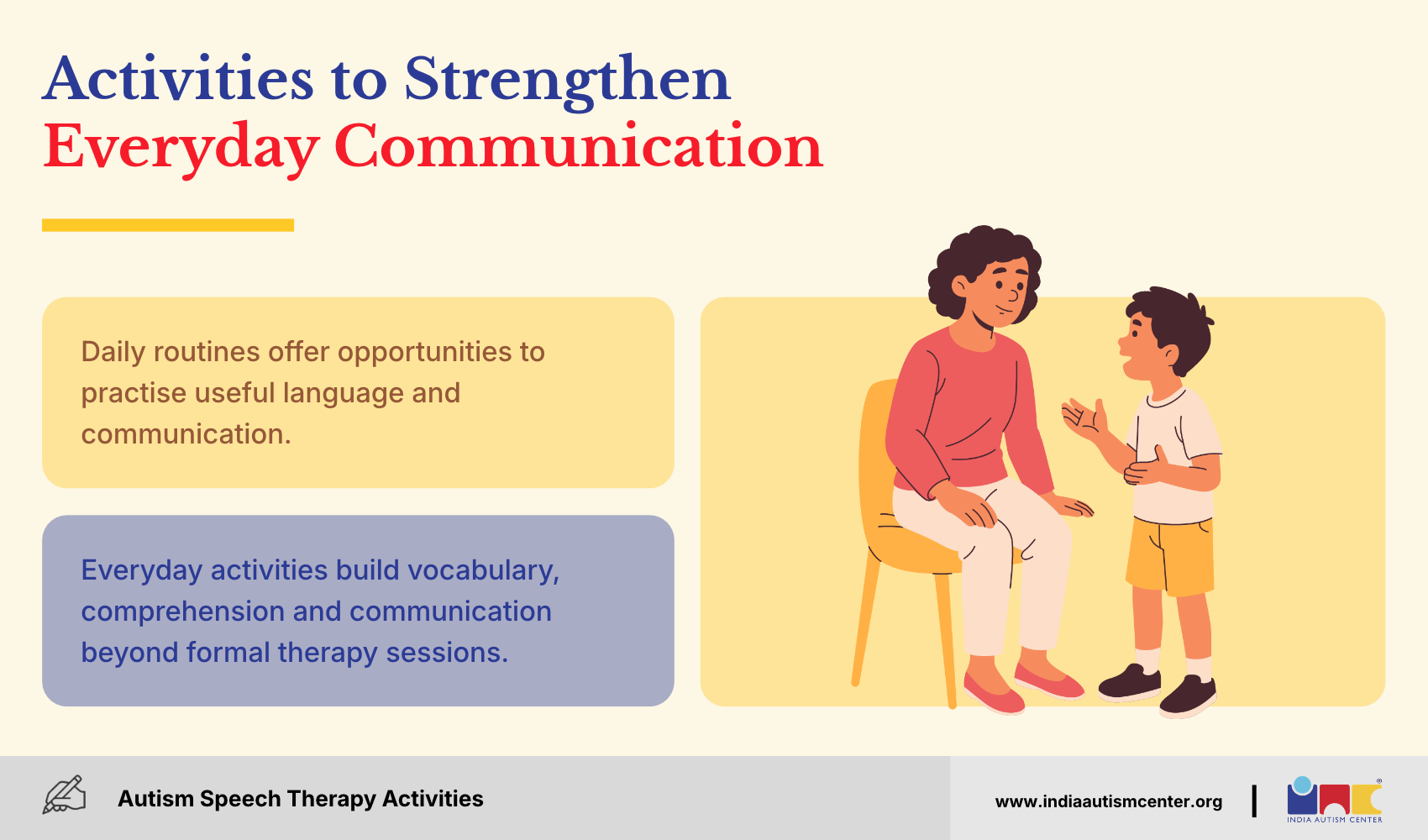
Some of the most useful speech development activities for autism can be incorporated into familiar daily routines. These exercises help children use communication skills beyond formal therapy sessions.
12. Turn Daily Routines Into Learning Opportunities
Mealtimes, dressing, bathing and shopping provide opportunities to introduce functional language.
While getting dressed, use expressions such as “Wear your shirt”, “Find your shoes” and “Shoes on”. During meals, introduce words such as “More”, “Water”, “Finished” and “Help”.
Keep the language relevant to what the child is doing, rather than introducing unrelated words.
What it supports: Functional vocabulary, comprehension and everyday communication.
13. Matching and Sorting Games
Give the child a collection of familiar objects or picture cards. Encourage them to group animals, vehicles, fruits and clothing.
Introduce descriptive words such as “Same”, “Different”, “Big” and “Small”. Start with a few objects and gradually introduce more categories.
What it supports: Vocabulary, categorisation, comprehension and conceptual understanding.
14. Water Play and Sensory Exploration
Provide cups, containers and floating toys for a supervised water-play activity.
Introduce words such as “Pour”, “Full”, “Empty”, “Wet” and “More”. Allow the child to explore at a comfortable pace and consider their sensory preferences.
What it supports: Descriptive vocabulary, requesting, action words and sensory exploration.
15. Story Sequencing With Picture Cards
Use pictures showing familiar activities, such as brushing teeth, washing hands or preparing a snack. Arrange the pictures in order and describe what happens first, next and last. Start with two or three pictures before introducing longer sequences.
Encourage the child to communicate what happens at each stage through speech, pictures or gestures.
What it supports: Sequencing, comprehension, narrative development and understanding instructions.
Language Activities for Autistic Toddlers: What Should Parents Focus On?
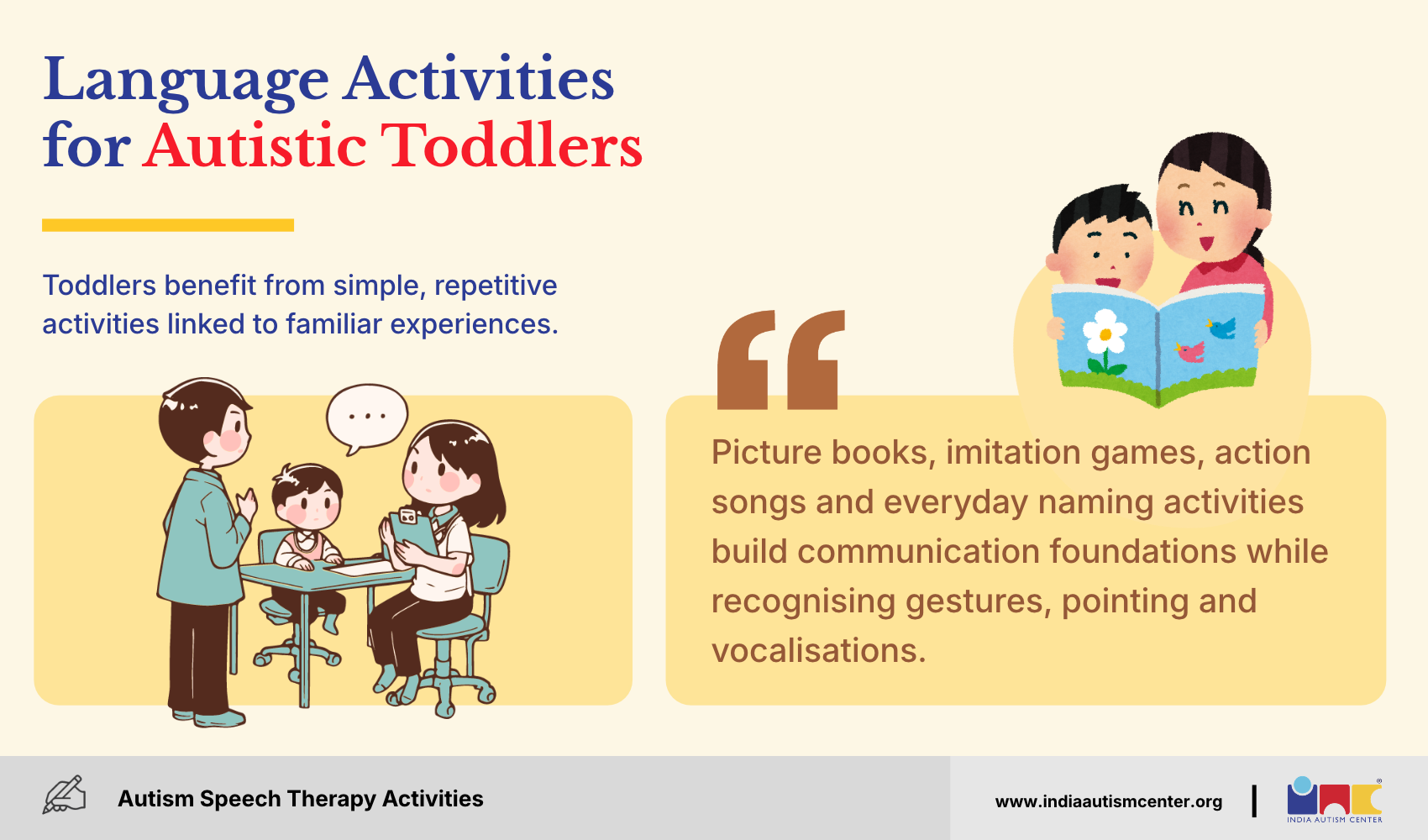
Toddlers benefit from simple, repetitive activities connected to familiar people, objects and experiences. At this stage, focus on building communication foundations rather than expecting complete sentences.
Some useful language activities for autistic toddlers include:
- Naming familiar toys, food and household objects during everyday routines.
- Reading illustrated picture books and describing familiar objects.
- Playing simple imitation and turn-taking games.
- Singing action songs and nursery rhymes.
- Encouraging requests during meals and playtime.
A parent’s role is quite vital. Parents should acknowledge all meaningful communication attempts, including pointing, gestures, vocalisations and picture selections. These are important parts of communication development.
How to Practise Autism Speech Therapy at Home?
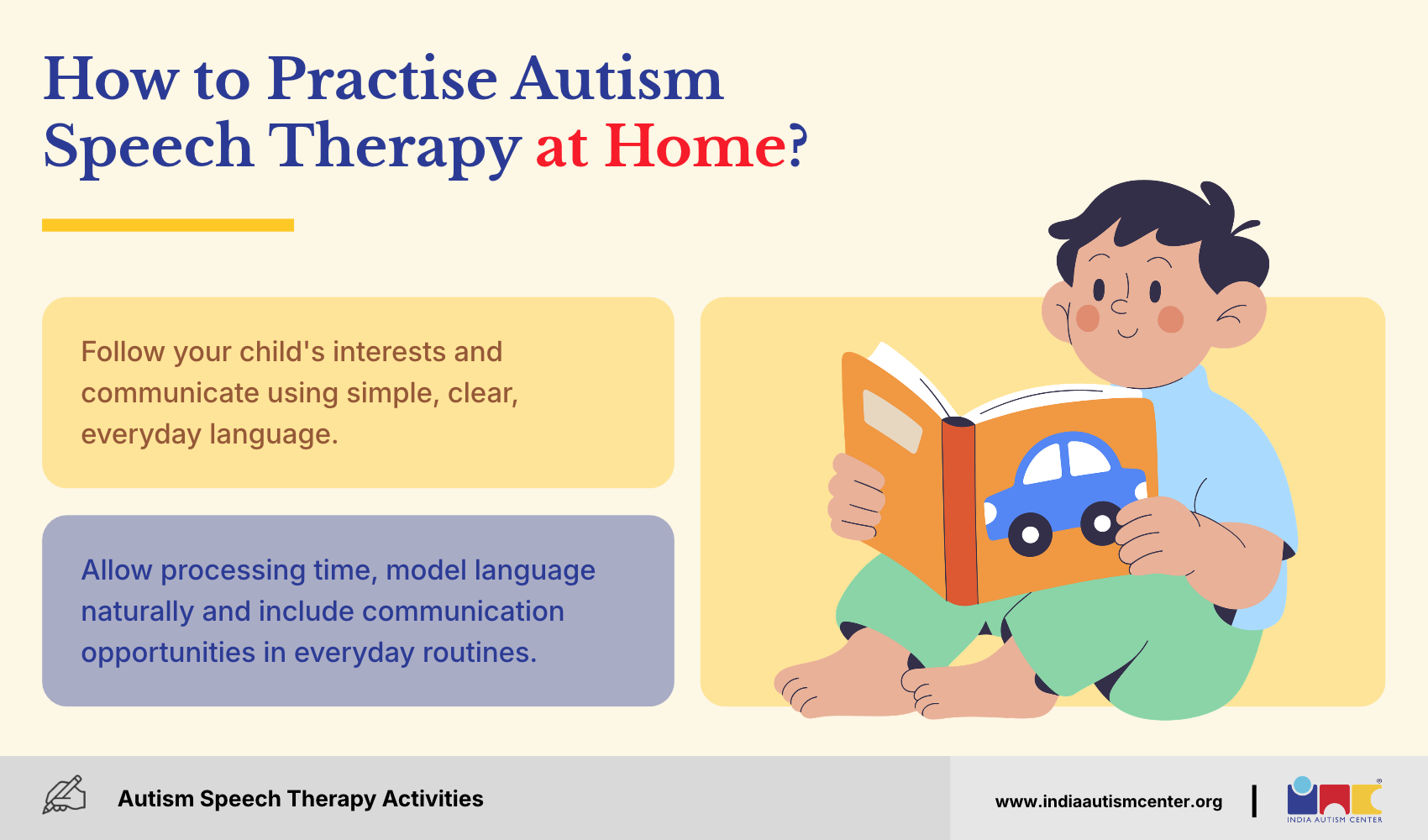
Parents often wonder whether they need special equipment or a separate room to practise speech therapy. In most cases, they can begin with activities that fit naturally into their child’s daily routine.
Here are five ways to make autism speech therapy at home more meaningful:
- Follow the child’s interests: If your child enjoys trains, use train toys to introduce words such as “Go”, “Stop”, “Fast” and “Slow”.
- Use simple, clear language: Speak in short phrases that match the child’s current understanding. Avoid giving several instructions at once.
- Pause and allow processing time: Give the child time to understand and respond instead of immediately repeating questions.
- Model language naturally: If the child says “Car”, respond with “Red car” or “Car is moving”. This introduces additional language without demanding repetition.
- Make communication part of everyday life: Use mealtimes, shopping, dressing and playtime to practise meaningful expressions.
The aim is to create opportunities for communication, not turn every interaction into a lesson. Parents should also follow the individual strategies recommended by their child’s speech and language therapist.
How India Autism Center Supports Communication Development?
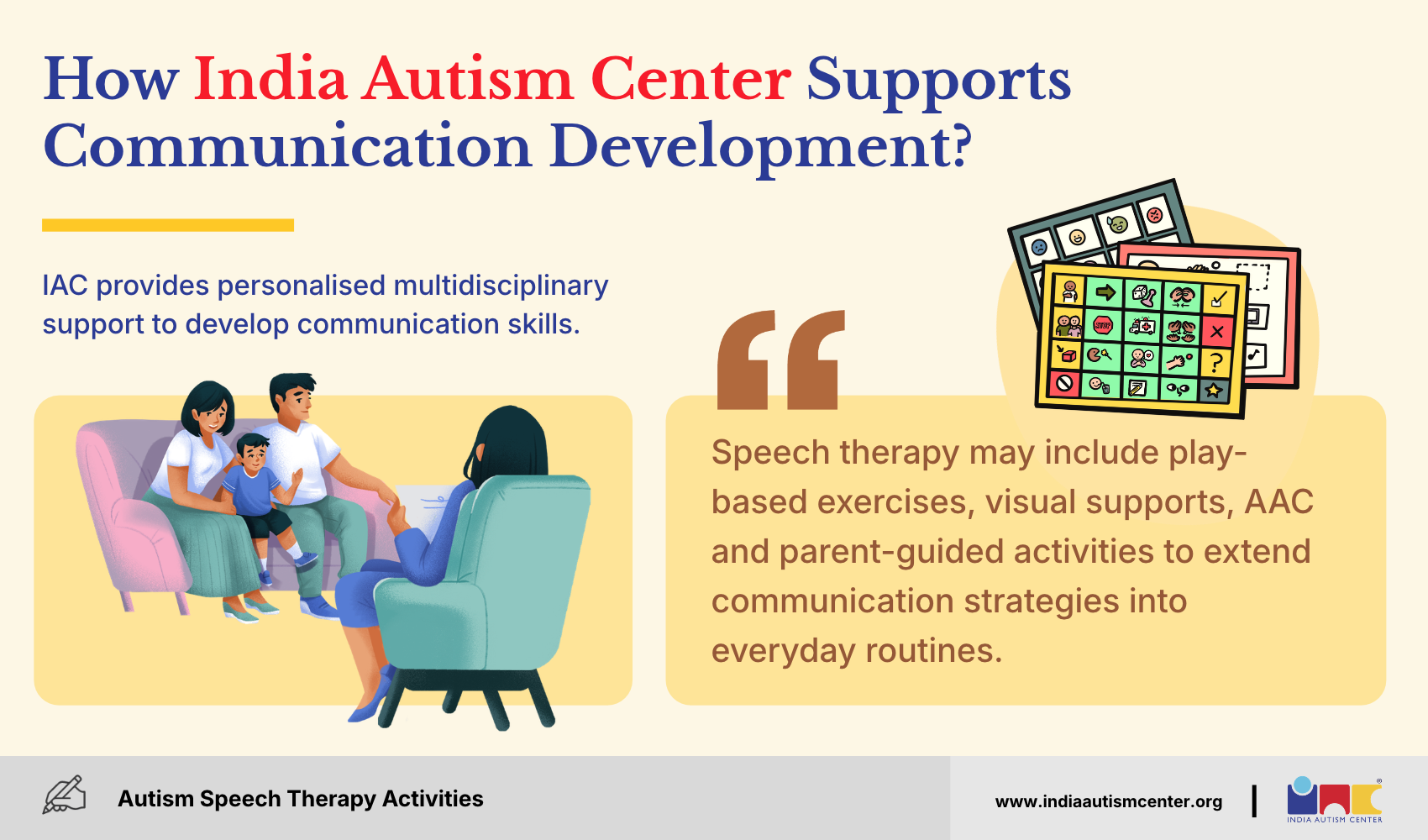
At India Autism Center (IAC), communication development is approached through individualised, multidisciplinary support. Speech and language therapy focuses on functional communication, language comprehension, expressive abilities and social interaction.
Depending on individual needs, therapists may incorporate play-based exercises, visual supports, AAC and parent-guided activities. Family involvement and early intervention are also important, helping communication strategies extend beyond formal therapy sessions into everyday routines.
The emphasis is on recognising each child’s strengths, understanding their communication needs and creating opportunities to develop greater independence and meaningful participation.
Conclusion
A favourite toy, a shared story or a simple request for more bubbles may seem like a small moment, but each can create an opportunity for communication.
The right autism speech therapy activities help children practise expressing themselves, understanding others and participating in everyday interactions. However, progress should not be measured only by the number of words a child speaks. A gesture, picture selection, sign or independently expressed preference can be just as meaningful.
With individualised therapy, patient guidance and consistent opportunities to communicate, autistic children can develop skills in ways that recognise and respect their individual strengths.
Frequently Asked Questions
1. What are the best autism speech therapy activities for children?
Picture naming, interactive storytelling, imitation games, pretend play, turn-taking, choice-making and action songs are useful activities. The most appropriate exercises depend on the child’s developmental abilities and communication goals.
2. Can I practise speech therapy activities for autistic children at home?
Yes. Parents can incorporate communication exercises into playtime, meals, dressing, reading and other daily routines. Home practice should complement professional speech and language therapy.
3. How can I encourage a non-speaking autistic child to communicate?
Introduce gestures, picture cards, communication boards, sign language or AAC devices. Follow the child’s interests, model useful communication and acknowledge every meaningful attempt to express a need or preference.
4. What are some speech therapy games for autism?
Bubble play, matching games, puppet conversations, turn-taking activities, picture naming and pretend play can provide opportunities to practise communication in an enjoyable setting.
5. How long does speech therapy usually take to show results in autistic children?
There is no fixed timeline. Progress depends on the child’s communication profile, individual goals, learning opportunities and support. Some children develop new communication skills gradually over an extended period.