 Donate now
 Get a Call Back
 MENU
MENU 21 MIN READ
 SHARE
SHARE



Did you know that the human brain processes about 80% of information through sight? Whether it is navigating a room or reading facial expressions. For autistic individuals, however, this process often works a little differently.
As per research, several children and adults with autism spectrum disorder tend to have atypical gaze patterns. These visual differences can affect communication, learning, behaviour, and even social connections.
That is why visual therapy for autism, also commonly called vision therapy for autism, is becoming an essential support system for children and adults on the spectrum.
Today, we will uncover what vision therapy for autism is, how it works, and how it can help. We will also discuss which techniques are most effective and how visual therapy contributes to skills, such as improving eye contact for autism and helping address autism-related lazy eye (amblyopia).
What Is Visual Therapy?
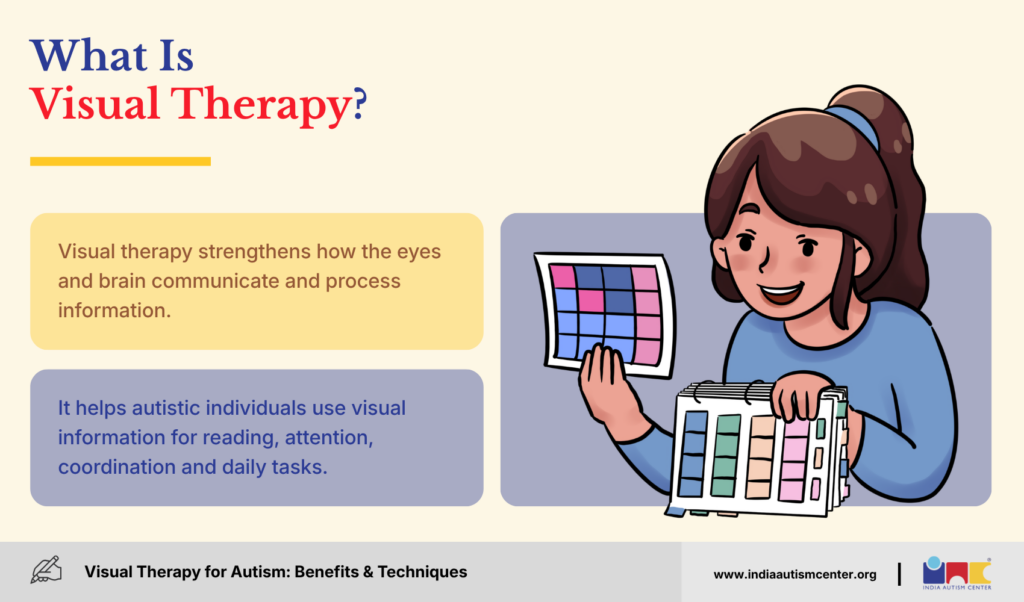
Visual therapy is a personalised program that helps strengthen the communication between the eyes and the brain. It’s not just about improving eyesight; it’s about improving how the brain uses visual information in daily life.
The eyes capture information, and then the brain interprets it. Vision therapy ensures it happens efficiently.
For autistic individuals, this can be life-changing because the vision system influences:
- Reading
- Writing
- Attention
- Social engagement
- Eye contact
- Hand-eye coordination
- Motor planning
- Spatial awareness
- Emotional regulation
Vision therapy can be helpful as the vision skills improve, making daily tasks more manageable, smoother, and less overwhelming.
📥 Free download: Printable daily routine chart for autistic children
Why Visual Challenges Are Common in Autism?
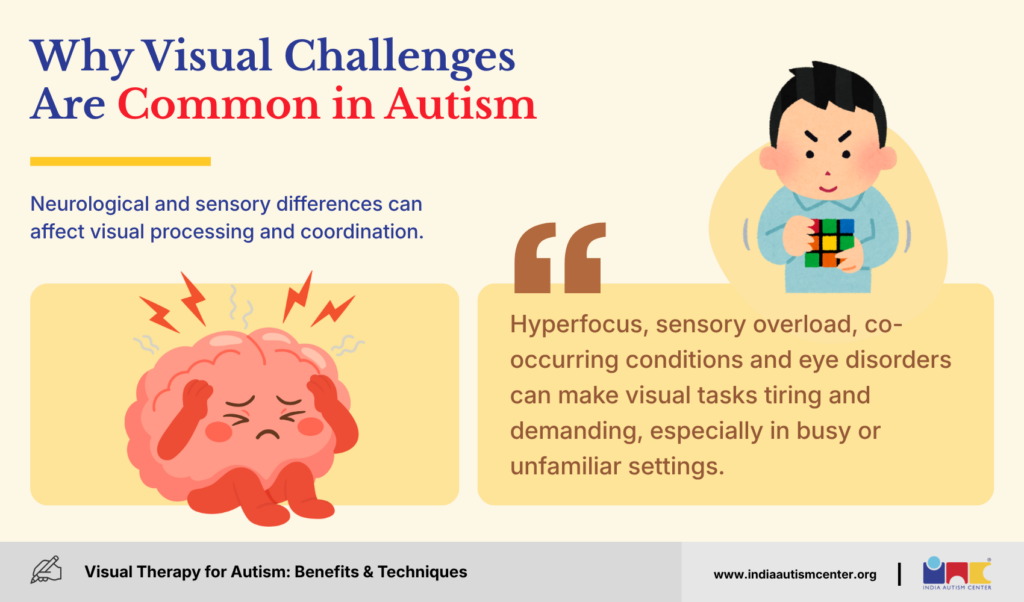
Many autistic individuals experience visual-processing differences for several neurological and sensory reasons:
- Neurological pathways develop differently: The brain regions responsible for visual attention, eye coordination, and face processing may grow at different paces.
- Hyperfocus or difficulty shifting attention: Some children can zoom in on details but struggle to shift their gaze between objects or people.
- Sensory processing differences: Bright lights, busy environments, or fast-moving visuals can make children with ASD feel overwhelmed.
- Co-occurring conditions: Certain types of developmental delays, ADHD, dyspraxia, and dyslexia are known to accompany ASD, affecting visual-motor skills.
- Higher rates of eye conditions: Conditions like strabismus, convergence challenges, and autism lazy eye (amblyopia in autistic individuals) are more frequent.
Everyday tasks can feel much more demanding when these factors are combined.
How Does Visual Therapy Support Autistic Individuals?
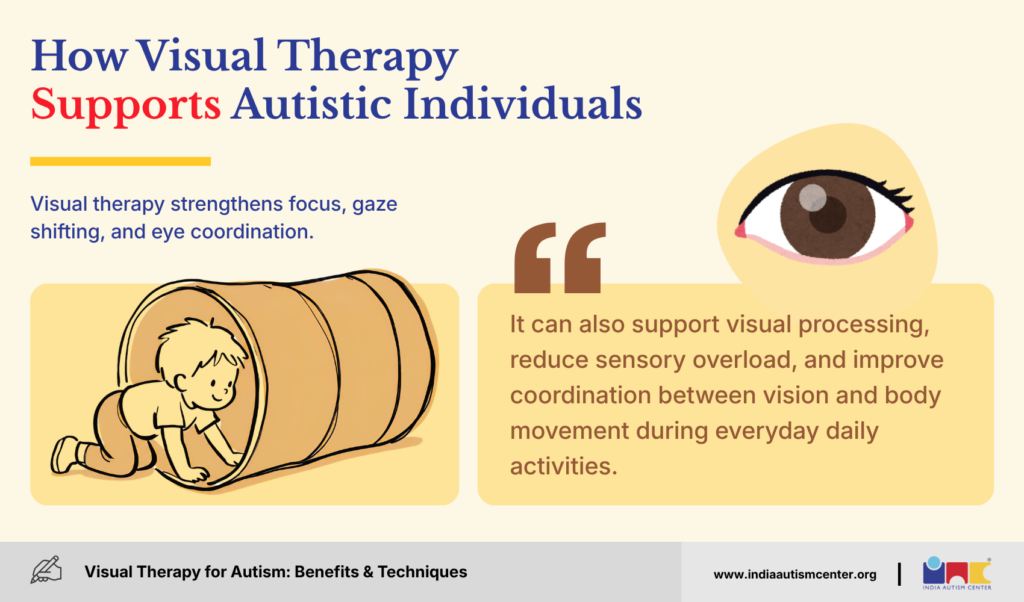
Visual therapy is more than just an eye check-up and some random exercises. Vision therapy for autism focuses on:
- Strengthening eye muscles
- Better focus
- Encouraging smooth gaze shifting
- Teaching the brain to process visual signals correctly
- Reducing visual overload
- Ensuring that coordination between body movement and vision is enhanced
- Enhancing comfort in busy visual environments
Why Do Autistic Children Respond So Well to Visual Supports?
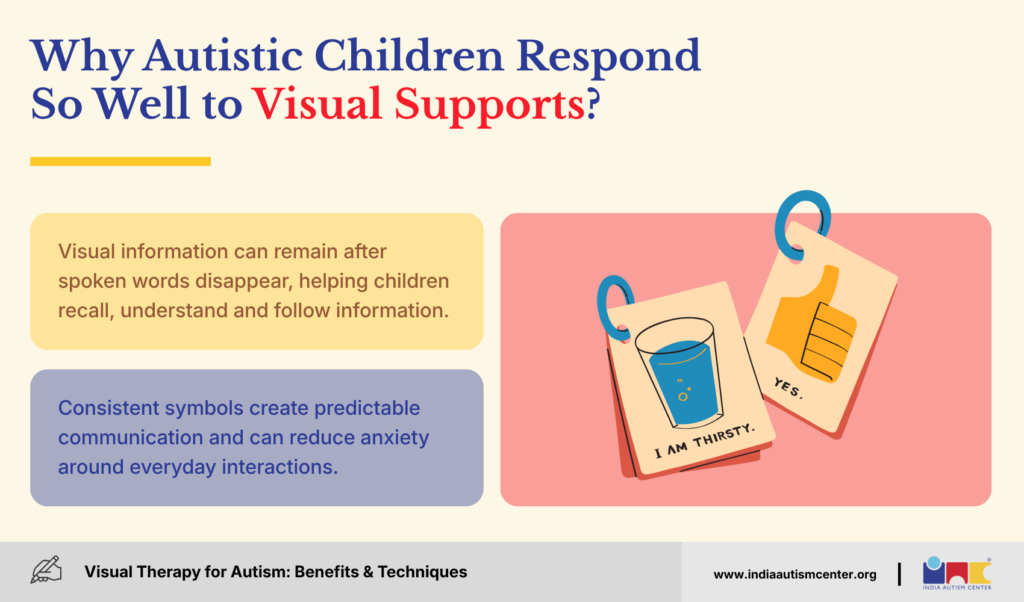
The autistic brain often processes visual information more efficiently than auditory information. Spoken words disappear the moment they are said. A picture card stays put. A child who cannot yet form a verbal sentence can still point to a card that says “I want water” or “I feel scared” – and be understood immediately.
Predictability is the other key factor. When a child knows exactly what a symbol means and that it will always mean the same thing, anxiety drops. In classrooms across India – from inclusive schools in Bengaluru to special education centres in Kolkata – speech-language pathologists and special educators use autism visual supports precisely because they create a consistent, reliable communication bridge.
6 Types of Visual Supports Worth Knowing
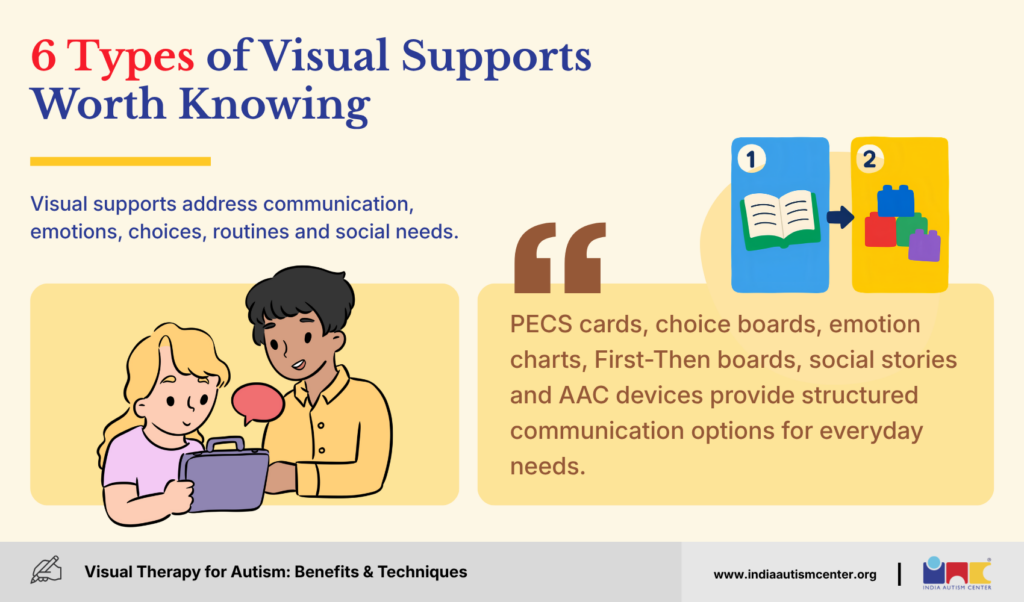
- PECS cards (Picture Exchange Communication System): A structured, 6-phase system where children learn to hand over a picture card to request something. It is designed for nonverbal or preverbal children and does not require them to recognise pictures beforehand. A child in Phase 1 might simply exchange a card for a biscuit; by Phase 6, they are constructing simple sentences.
- Choice boards: A board displaying 2–6 options (activities, foods, sensory tools) so a child can point to what they want rather than struggling to verbalise it. A choice board autism therapists use at home might show “swing,” “puzzle,” “drawing,” and “music” – giving the child agency without verbal demand.
- Emotion charts: Visual grids showing facial expressions labelled with feelings – happy, sad, angry, scared, calm. More advanced charts include nuanced emotions like “frustrated” or “overwhelmed.” In therapy settings, these charts help children identify their own emotional state and communicate it to a caregiver before a meltdown escalates.
- “First-Then” boards: The simplest visual support of all. Two images side by side: First [bath], Then [screen time]. This structure is especially effective for younger children or those who find full schedules overwhelming.
- Social stories: Short, illustrated narratives that walk a child through a specific social situation – visiting the doctor, travelling on the metro, starting a new school. They prepare the child for what will happen and how to respond.
- AAC devices: Augmentative and Alternative Communication devices range from low-tech communication boards to high-tech speech-generating tablets. A speech-language pathologist (SLP) can help you identify the right level for your child.
Who Can Benefit from Vision Therapy for Autism?
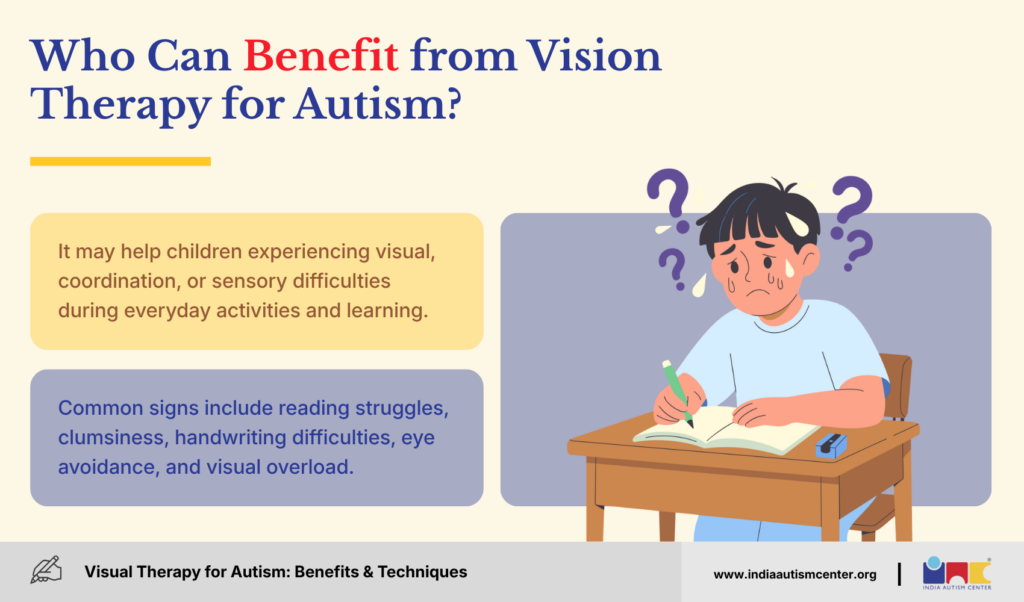
When the proper technique and visual therapy for autism are used, it can help children with autism spectrum disorder to live a better life. It is especially valuable for:
- Children avoiding eye contact
- Kids who lose their place while reading
- Children who seem “clumsy” or bump into objects
- Kids with handwriting difficulties
- Children who tilt their heads to look at objects
- Those diagnosed with autism or lazy eye
- Children with sensory overload or anxiety driven by visual input
Want to know more? Get in touch with us.
How Vision Therapy Works: Core Techniques Explained
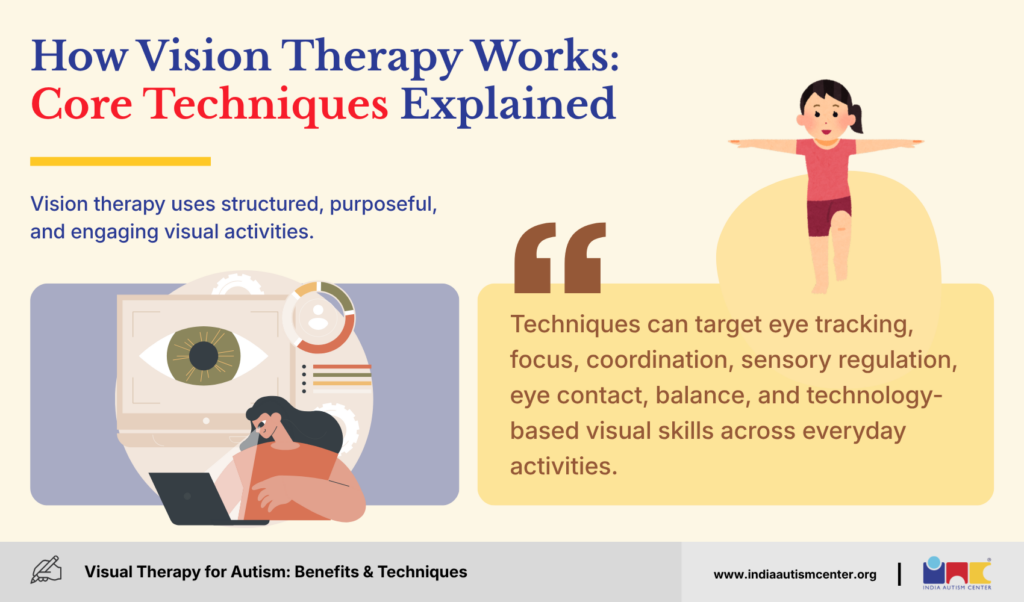
Visual or vision therapy for autism uses structured, engaging, and purposeful activities to improve the visual system. These exercises are often fun and play-based, which helps keep children motivated. If you are wondering how to improve eye contact for autism, then here are the most effective therapies that are widely used:
1. Eye-Tracking Development Exercises
These exercises teach the eyes to follow objects smoothly, as many autistic children struggle with tracking, leading their eyes to jump rather than move smoothly. It can cause problems such as difficulty copying from a board, losing place while reading, challenges with playing sports, or poor eye contact.
For this exercise, the therapists use tools like:
- Moving light pens
- Tracking balls
- Bubbles
- Flashlight following
- Computer-based eye-tracking games
These exercises teach the eyes to track objects accurately, making reading and conversation much easier.
2. Saccadic (Quick Eye Movement) Training
The term “Saccades” refers to the quick jumps your eyes make between two points. Children with saccadic difficulties may come across as inattentive, or they may be prone to losing information. Therapists use:
- Word-jump charts
- Dot-to-dot eye jumps
- Rapid pointing games
This helps improve classroom performance and conversation flow.
3. Near–Far Focus Training
Shifting the focus from near objects to far objects can often be difficult for people with ASD. Thus, training can be helpful for school tasks such as switching between a book and a board.
The tools used for this exercise include:
- Near-far charts
- Focus cards
- Digital focus training apps
This training is particularly helpful for children who experience headaches or fatigue due to frequent visual shifts.
4. Convergence and Divergence Therapy
When the eyes don’t work as a team, children may see double or feel visually confused. This vision therapy for autism helps to ensure that both eyes work in coordination. This is also the main therapy used for lazy eye in autism.
Therapists use:
- Brock String
- Barrel cards
- 3D stereoscope training
- Dot fusion cards
It helps strengthen binocular vision, improve depth perception, enhance sports performance, and reduce blurry vision.
5. Vision-Motor Integration Therapy
Visual-motor integration is important for several day-to-day activities, such as writing, eating independently, buttoning, hand-eye coordination, and participating in sports. As part of this vision therapy for autism, therapists use tools like:
- Pegboards
- Maze tracing
- Craft activities
- Ball-catching
- Pattern copying
- Tracing worksheets
This helps children coordinate what they see with what their hands do.
6. Sensory-Aware Visual Therapy
Many autistic children find bright lights, crowds, or fast visuals overwhelming. This vision therapy technique for autism aims to help children who struggle with visual overload.
As per this technique, the therapist creates a sensory-safe environment using:
- Low lighting
- Contrast-based activities
- Visual-motor calming tasks
- Slow-eye movement exercises
- Visual schedules
It helps reduce stress, improve the overall attention span, and keep children regulated.
7. Face & Eye-Contact Building Activities
Several autistic children tend to avoid eye contact, not out of defiance, but because it feels uncomfortable or overwhelming. As a parent seeking to know how to improve eye contact in autism, this technique can be quite helpful.
The therapy will include the following:
- Joint Attention Games: Pointing, showing, and sharing toys.
- Mirror Play: Helps children look at faces without pressure.
- Gaze-Following Activities: Teaching children to follow someone’s eyes to understand attention.
- Naturalistic Play: Positioning toys near the therapist’s face so the child naturally glances at them.
8. Balance, Coordination & Vestibular-Visual Integration
Children with vision-processing differences may also have difficulties with balance or body awareness. The therapy aims to ensure that vision and movement work together. The treatment includes different tools, such as:
- Balance boards
- Trampolines
- Obstacle courses
- Body tracking games
When the visual and vestibular systems align, children become more confident and coordinated.
9. Lens, Prism & Filter-Based Training
This technique is also used to treat autism, lazy eye, and reading difficulties. It is used only by developmental optometrists. The special lens and prism help to:
- Align the eyes
- Improve focus
- Reduce visual stress
- Enhance attention
- Support depth perception
10. Computer-Assisted & VR Visual Training
These exercises are engaging, motivating, and highly effective for older children and teens. Technology-based training is now widely used:
- Interactive VR visual tasks
- Eye tracking software
- Attention shift games
- Binocular VR games
Visual Aids for Autism: Tools That Make Learning Easier
If visual supports are about communication, visual aids are about learning. They are the structured, environment-based tools that make academic tasks, daily routines, and classroom instructions accessible for autistic children – particularly those who are visual learners.
The difference is subtle but important. A PECS card is a support your child uses actively to communicate. A colour-coded task card on the desk, a labelled shelf in the classroom, or a visual timer on the table – these are aids that structure the environment so the child can navigate it more independently.
How visual aids reduce cognitive load and anxiety
Autistic children often experience heightened anxiety in learning settings because the demands are unpredictable. “What comes next?” “How long will this take?” “What does the teacher want me to do?” When these questions go unanswered, the nervous system goes into alert mode – and learning stops.
Visual aids answer those questions before the child has to ask. They externalise the structure that the child’s brain is working hard to construct internally. The result: lower anxiety, better attention, and more genuine engagement with the task at hand. This is the core of visual learning autism research – the visual channel is often the most reliable route into a child’s understanding.
5 Visual Aids That Make a Real Difference
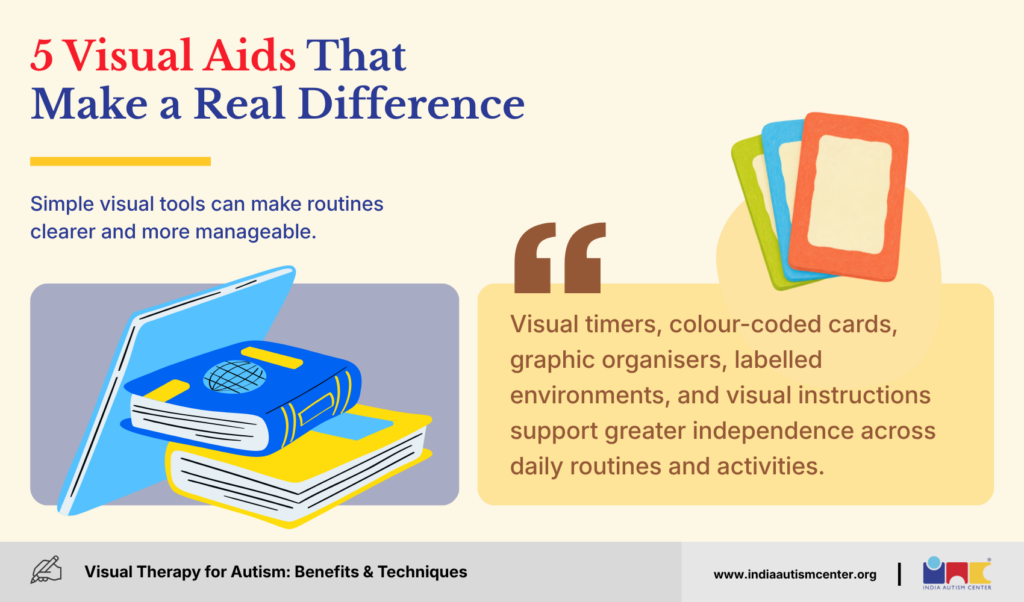
- Visual timers: A timer that shows time visually – typically as a shrinking red disc – rather than just counting down numerically. A child who cannot yet read a clock can see that “the red is almost gone, which means maths is almost over.” Time Timer is the most well-known brand internationally; in India, similar sand timers or colour-coded clock faces work just as well and cost far less. A visual timer autism specialists recommend is placed on the desk during any timed activity to reduce “how long left?” anxiety.
- Colour-coded task cards: Each subject or activity gets its own colour. Maths is blue, Hindi is yellow, art is green. In an Indian classroom where a child moves between subjects, colour-coding the notebook covers, folders, and task cards means the child can organise independently without relying on verbal reminders.
- Graphic organizers: Visual frameworks – mind maps, T-charts, story maps – that show how information connects. For a child who struggles to organise thoughts into a linear paragraph, a graphic organiser gives them a visual scaffold to work from.
- Labelled environments: Sticky labels with a word and a small picture on every shelf, drawer, and bin. A child who knows exactly where the pencils live and where finished work goes does not need to ask – and does not experience the anxiety of not knowing.
- Visual instructions: Step-by-step picture guides for tasks like handwashing, packing a school bag, or completing an art project. Placed at the point of use (a handwashing chart above the sink, a bag-packing chart near the school bag hook), these reduce the need for repeated verbal instruction.
3 things an Indian parent or teacher can do today – at minimal cost
1. Label the home environment. Print or hand-draw small picture-and-word labels for the kitchen, bathroom, and study area. Laminate with a ₹5 lamination pouch. Done in an afternoon, useful for years.
2. Make a colour-coded homework folder. Assign a colour to each subject. Use coloured sticky tape on plain folders. Costs under ₹50 and immediately reduces the “which book do I need?” confusion.
3. Use a sand timer for transitions. A 5-minute sand timer (available on Amazon India for ₹150–₹300) placed on the table before a transition – “when the sand runs out, we stop playing and get ready for dinner” – gives the child a visual, concrete warning that a change is coming.
How vision therapy amplifies the effect of visual aids
Here is where the two threads of this article come together. A child who has completed vision therapy – with improved eye tracking, better near-far focus, and reduced visual stress – is far better equipped to use visual aids effectively. Reading a task card requires smooth tracking. Scanning a labelled shelf requires accurate gaze shifting. Engaging with a graphic organiser requires sustained visual attention. Vision therapy builds the hardware; visual aids provide the software.
Visual Schedules for Autism: Building Routine and Reducing Anxiety
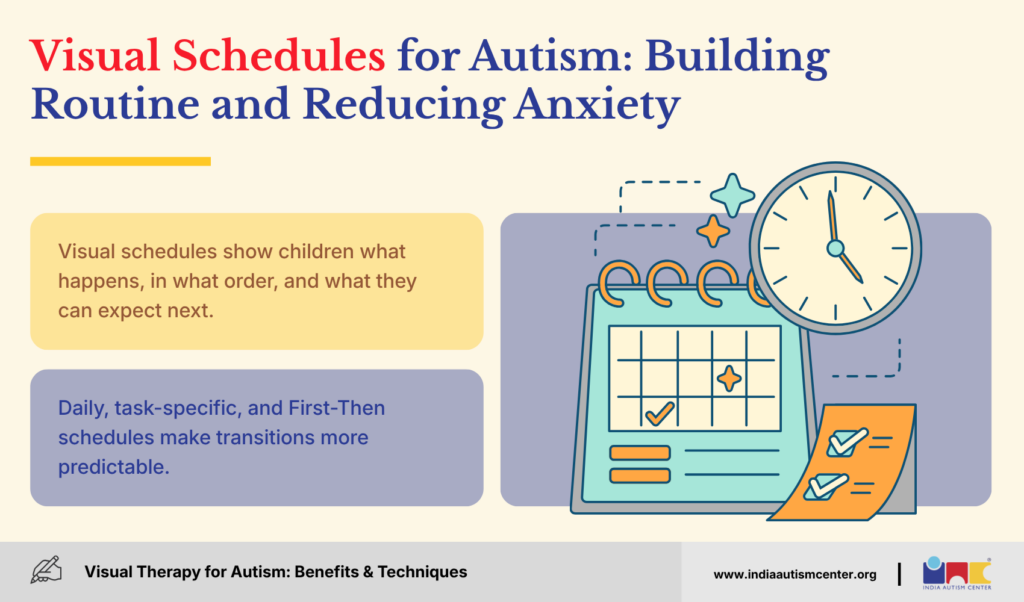
Of all the visual tools available to parents and teachers, the visual schedule is arguably the most powerful – and the most underused at home.
A visual schedule is a sequence of images, symbols, or words that shows a child what will happen and in what order. It answers the single question that drives the most anxiety in autistic children: “What comes next?”
Why predictability matters so much
Many autistic children experience transitions – moving from one activity to another, from home to school, from playtime to bath – as genuinely distressing. The distress is not defiance. It is the neurological reality of a brain that finds uncertainty hard to tolerate. A visual schedule for autism removes the uncertainty. The day stops being a series of surprises and becomes a sequence the child can see, anticipate, and prepare for.
Research consistently supports this. A 2017 study in Young Exceptional Children found that visual aids, including schedules, significantly supported positive behaviour and reduced anxiety in young autistic children. The University of Florida Center for Autism and Related Disabilities notes that visual schedules are particularly helpful during transitions – precisely the moments that trigger the most distress.
Three types of visual schedules
- Daily schedule: A full-day or half-day sequence showing every major activity from morning to bedtime (or school arrival to dismissal). Best for children who are ready to see the big picture. In an Indian home, this might run: wake up → brush teeth → breakfast → school → lunch → homework → play → dinner → bath → sleep.
- Task-specific schedule: A mini-schedule for a single routine broken into steps. A morning routine schedule might show: alarm → toilet → brush teeth → wash face → get dressed → eat breakfast → pack bag → shoes on → leave. These are placed at the point of use – the bathroom, the bedroom, the front door.
- “First-Then” schedule: The simplest version. Two images only: First [this], Then [that]. Ideal for younger children, children in early intervention, or any child who finds a longer schedule overwhelming. “First finish your dal-chawal, then you can watch Chhota Bheem” – shown as two pictures – is immediately comprehensible even without words.
How to create a visual schedule at home: step by step
Step 1 – Choose one routine to start with. Don’t try to schedule the whole day on day one. Pick the routine that causes the most friction – usually morning or bedtime – and start there.
Step 2 – Break it into 3–6 steps. Keep each step concrete and observable. “Get ready” is too vague. “Put on shoes” is perfect.
Step 3 – Choose your images. Use real photographs of your child doing each step (most effective), printed clipart, or hand-drawn pictures. For older or more advanced children, written words work too. The key is that your child can read the image reliably.
Step 4 – Make it durable. Print, laminate (or use a self-laminating pouch), and add Velcro dots so cards can be moved to a “done” pocket or envelope once completed. This physical act of moving a card gives the child a satisfying, concrete marker of progress.
Step 5 – Place it at your child’s eye level. A schedule on the fridge at adult height is not a schedule your child will use. Stick it on the bathroom wall at their eye level, or on the bedroom door at their height.
Step 6 – Model its use every day. For the first two weeks, narrate the schedule with your child: “Look, what’s next? Brush teeth. Let’s go.” Point to each card. Let the schedule give the instruction, not you. Over time, your child will begin to check the schedule independently.
Step 7 – Stay consistent. The schedule only works if it is used every day, for the same routine, in the same place. Consistency is what transforms a piece of laminated card into a genuine anchor for your child’s day.
Children who have completed vision therapy engage more effectively with visual schedules.
This is worth saying explicitly. A child whose eye tracking has been strengthened through vision therapy can scan a sequence of cards more smoothly. A child whose near-focus has improved can read the text on a task card without strain. A child whose visual attention has been trained is more likely to notice the schedule on the wall and engage with it. Vision therapy and visual schedules are not separate interventions – they reinforce each other at every step.
As we move into the conclusion of this article, it is worth holding both threads together: the clinical work of training the eye-brain connection, and the practical work of building a visual environment that meets your child where they are. Neither is sufficient alone. Together, they give autistic children the clearest possible path to independence, communication, and confidence.
Want to know more? Get in touch with us.
Benefits of Vision Therapy for Autism
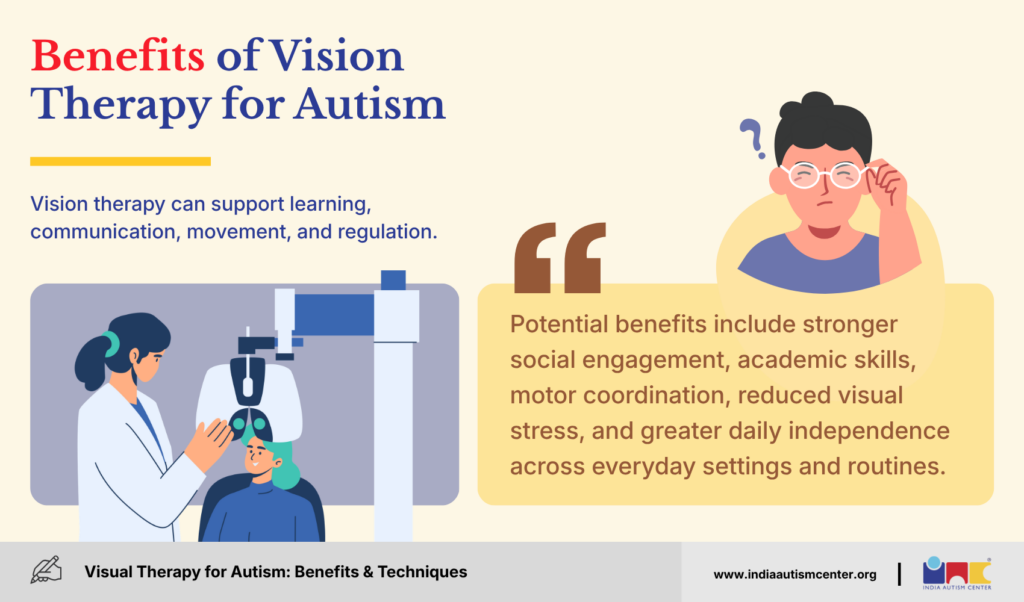
Visual therapy for autism offers several benefits, as the visual system influences communication, learning, motor skills, and emotional regulation. Here are the benefits of vision therapy for autism.
Improved Eye Contact & Social Engagement
One of the most common questions parents ask is how to improve eye contact for autism. Visual therapy supports this by strengthening eye tracking, gaze shifting, face processing, joint attention, and visual comfort during conversation.
Children gradually begin to:
- Look toward a person’s face more naturally
- Maintain brief eye contact without distress
- Understand where others are looking
- Respond better to name-calling and facial cues
Stronger Reading, Writing & Academic Skills
After vision therapy for autism, improvements often include:
- Better tracking across text
- Improved reading fluency
- Accurate copying from the board to the notebook
- Stronger letter formation
- Better spacing and writing alignment
Reduced Sensory Overload & Visual Stress
Some autistic individuals experience visual hypersensitivity to bright lights, screen glare, and crowded environments, which may feel overwhelming. Visual therapy will help to:
- Filter unnecessary visual information
- Reduce overstimulation from movement
- Improve visual attention span
- Stay calmer in busy spaces
Better Motor Skills & Body Awareness
Vision guides body movement, so when the visual system becomes stronger, physical coordination also improves. The benefits of vision therapy for autism include:
- Better balance
- Smoother walking/running
- Improved ball skills
- Stronger hand-eye coordination
- More confidence on playgrounds
More Independence in Daily Tasks
Parents often report noticeable improvements in daily functioning within months in terms of:
- Eating
- Buttoning and zipping
- Sorting objects
- Using tools correctly
- Completing homework independently
What Is Autism Lazy Eye & How Does Vision Therapy Help?
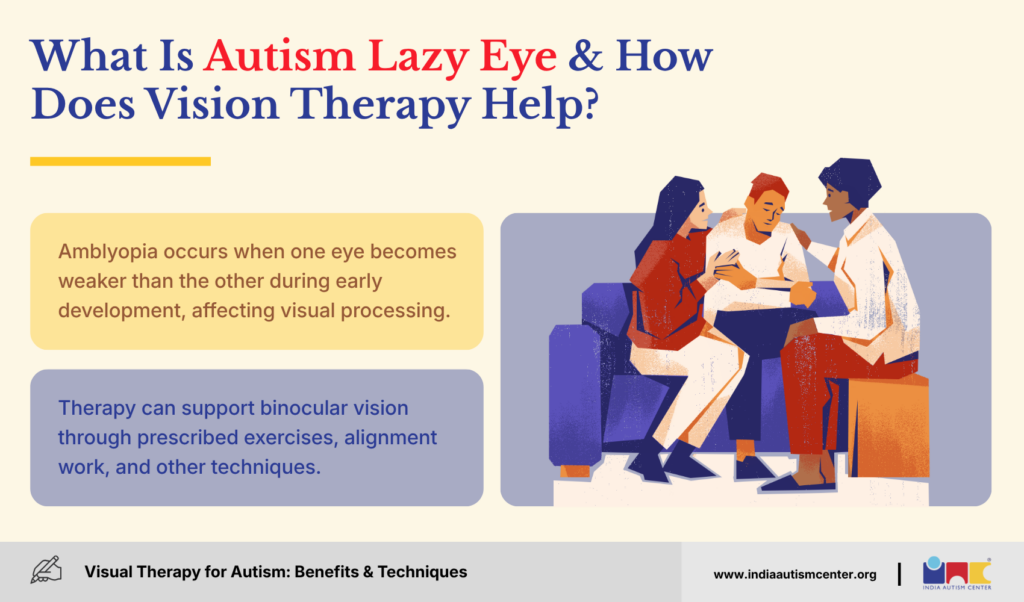
Autism lazy eye, or amblyopia, occurs in autistic individuals. Amblyopia means one eye is weaker and sends fewer signals to the brain. Children with autism are more prone to have this condition due to:
- Inconsistent gaze
- Difficulty maintaining eye alignment
- Tracking issues
- Sensory avoidance of visual tasks
How does Visual Therapy treat Autism Lazy Eye?
Visual therapy helps the brain reconnect with the weaker eye, restoring binocular vision and preventing long-term sight loss. Therapy techniques include:
- Strengthening the weaker eye
- Teaching both eyes to work together
- Prism therapy to improve alignment
- Focus-shifting activities
- Binocular games
- 3D stereoscopic exercises
- Patching (when prescribed)
Signs Your Child Might Need Vision Therapy
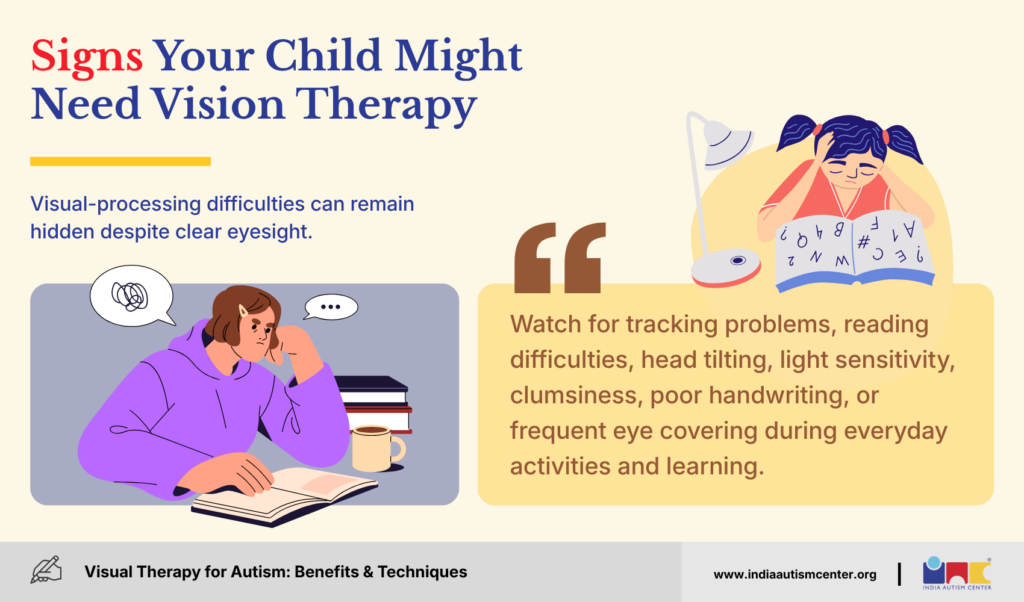
It is easy to assume that your child’s vision is perfect if they can see clearly. But visual-processing challenges are often hidden and may go undetected during a routine eye exam.
Children who have ASD often struggle with tracking, focusing, depth perception, or eye coordination without being able to explain what feels difficult. Here are some signs that you must look out for to understand if your child needs vision therapy:
- Difficulty maintaining eye contact
- Trouble following moving objects
- Loses place while reading
- Avoids puzzles or drawing
- Tilts or turns the head to focus
- Struggles with copying from the board
- Light sensitivity
- Memory difficulties
- Frequent falls or clumsiness
- Poor handwriting
- Short attention span
- Avoids face-to-face interaction
- Squints or covers one eye
Home-Based Activities to Support Visual Development
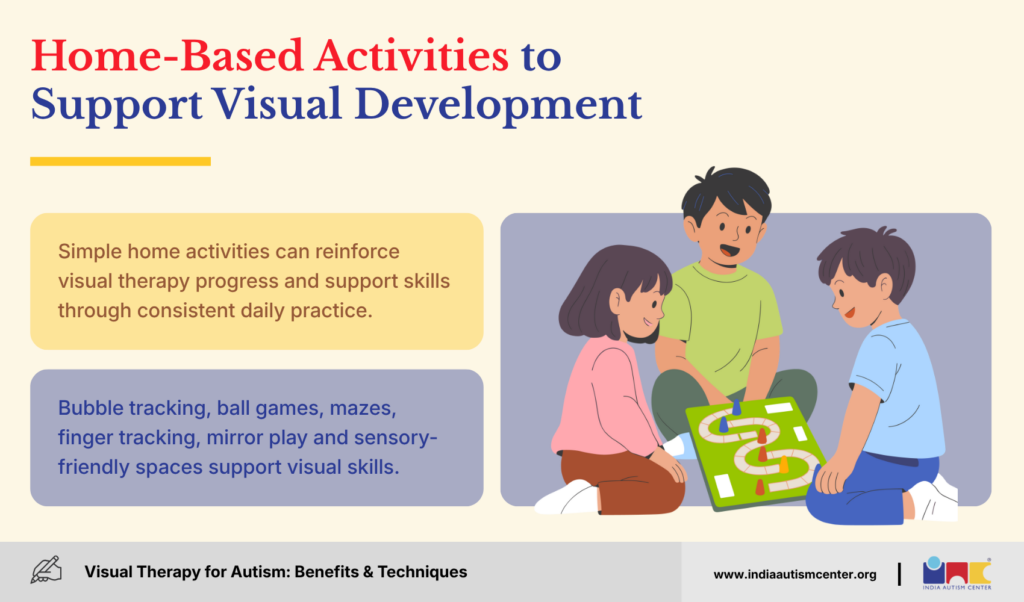
Parents play a huge role in reinforcing therapy progress at home. Here are some home-based activities that are easy to do and are also time-efficient.
- Bubble Tracking: Helps with eye pursuit and visual attention.
- Rolling Ball Games: Improves hand-eye coordination & timing.
- Mazes, Dot-to-Dot & Pattern Blocks: Strengthen vision-motor integration.
- Reading with the help of Finger Tracking: Helps children maintain place in text.
- Throw & Catch Activities: Enhance depth perception and improve ocular teaming.
- Mirror Imitation Games: Great for early social referencing and face awareness.
- Sensory-Friendly Vision Spaces: Soft lighting, clear labels, and contrast-rich visuals aim to help reduce overload.
Conclusion
Vision impacts every aspect of human life, and it is the same for children with ASD, whether it is reading and writing, eye contact, social connection, or staying regulated in sensory-rich environments. Visual therapy has been shown to deliver powerful, life-changing results.
By strengthening the communication between the eyes and the brain, vision therapy aims to help autistic individuals see, process, and respond to the world in a more comfortable way. Families who opt for structured and evidence-based visual therapies and treatment, especially through integrated centres, see remarkable progress in confidence, communication, learning, and daily independence.
Frequently Asked Questions
What is vision therapy for autism, and how does it work?
Vision therapy, also known as vision therapy for autism, is a structured program that improves coordination between the eyes and the brain. It uses exercises that strengthen tracking, focusing, eye coordination, and visual processing. Over time, children learn to interpret visual information more efficiently, which positively impacts reading, writing, social skills, and daily activities.
Can visual therapy help my child improve eye contact?
Yes. Many children avoid eye contact due to visual discomfort, not behavioural resistance. Through gentle gaze-shifting exercises, face-tracking tasks, and sensory-supported techniques, visual therapy supports the natural, pressure-free improvement of eye contact for autism.
Does vision therapy help with lazy eye in autism?
Yes. Autism lazy eye (amblyopia in autistic children) is treatable through visual therapy. Therapists strengthen the weaker eye, improve binocular vision, and retrain the brain to use both eyes together. It helps to improve depth perception and reduce long-term visual imbalance.
How long does it take to see results from vision therapy?
Most parents notice improvements within 8–12 weeks. However, children with significant vision-processing challenges or autism-related lazy eye may need 6–12 months of consistent therapy. Progress depends on regular sessions and home reinforcement.
Disclaimer: This article is intended for educational and informational purposes only. It is not a substitute for professional medical advice, diagnosis, or treatment. If you are pregnant or have concerns about medication use during pregnancy, please consult a qualified healthcare provider. If your child has received an autism diagnosis and you have questions about causes or support, please reach out to a trained specialist or an autism-focused organisation for guidance.
For expert insights, support services, and inclusive learning initiatives, visit the India Autism Center.
Useful Sources
University of Florida Center for Autism and Related Disabilities – Visual Schedules resource.