
 Donate now
 Get a Call Back
 MENU
MENU 14 MIN READ
 SHARE
SHARE



Memory plays a vital role in how we learn, communicate and manage daily life. We rely on memory to follow instructions, recall information, complete tasks and understand routines. In this blog, I will help you understand memory difficulties in autism, why they occur and how you can support your child effectively.
If you are a parent or caregiver, you may often wonder: Do autistic people struggle with memory? You might notice that your child remembers tiny details about favourite topics but forgets everyday instructions.
I will also explain how professional support from institutions like India Autism Center (IAC) can make a meaningful difference in managing autism memory problems in children.
Understanding Memory Difficulties in Autism
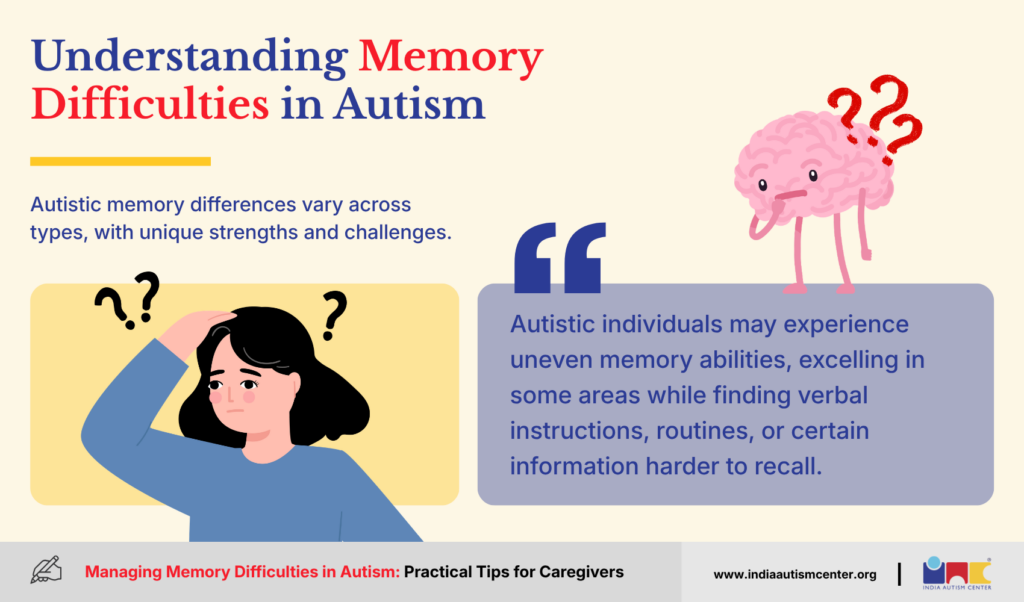
Before we explore strategies, we must understand what memory really means. Memory is not a single ability. It includes several types:
- Working memory – holding information in mind while using it
- Short-term memory – remembering something briefly
- Long-term memory – storing information over time
- Visual memory – remembering what we see
- Verbal memory – remembering spoken or written information
Autistic individuals may have genuine strengths in some of these areas and real difficulties in others. A 2023 Stanford Medicine study found that children with autism show broad memory difficulties – particularly in episodic and verbal memory – even when non-verbal intelligence is within the typical range. This tells us the challenge is specific, not global.
Your child may remember dates, facts or images with striking accuracy but struggle to recall verbal instructions or what happened at school yesterday. That uneven profile is the hallmark of memory difficulties in autism.
Do Autistic People Struggle with Memory?
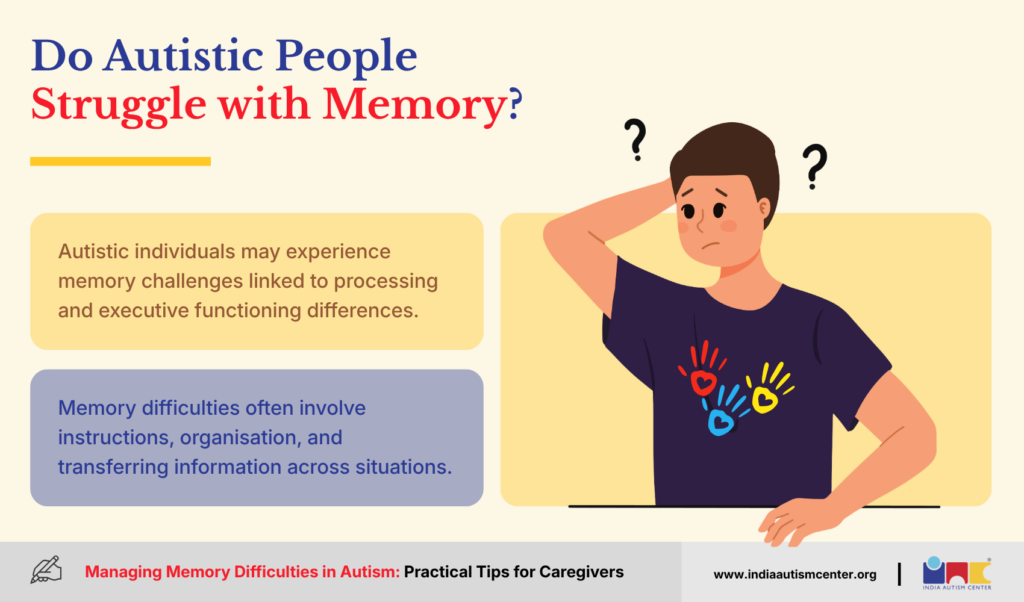
Many parents observe that their child can remember songs, numbers or cartoon dialogues perfectly but forgets simple tasks like brushing teeth or packing Many parents observe that their child can recite entire cartoon dialogues or recall the exact sequence of train stops on a route they travelled once – yet forgets simple tasks like brushing teeth or packing a school bag. This pattern is extremely common in autism memory problems in children.
Autistic individuals may struggle with:
- Remembering multi-step instructions given verbally
- Recalling information without visual cues or prompts
- Transferring a memory from one setting to another (generalisation)
- Organising information into a meaningful sequence
These challenges often relate to differences in executive functioning, attention and sensory processing – not intelligence. So when you ask, “do autistic people struggle with memory?”, the honest answer is: in specific ways, yes. But the full picture is far more interesting than that, because autism memory strengths are just as real as the difficulties.
Want to know more? Get in touch with us.
Memory Problems in Autism: Why Do They Happen?
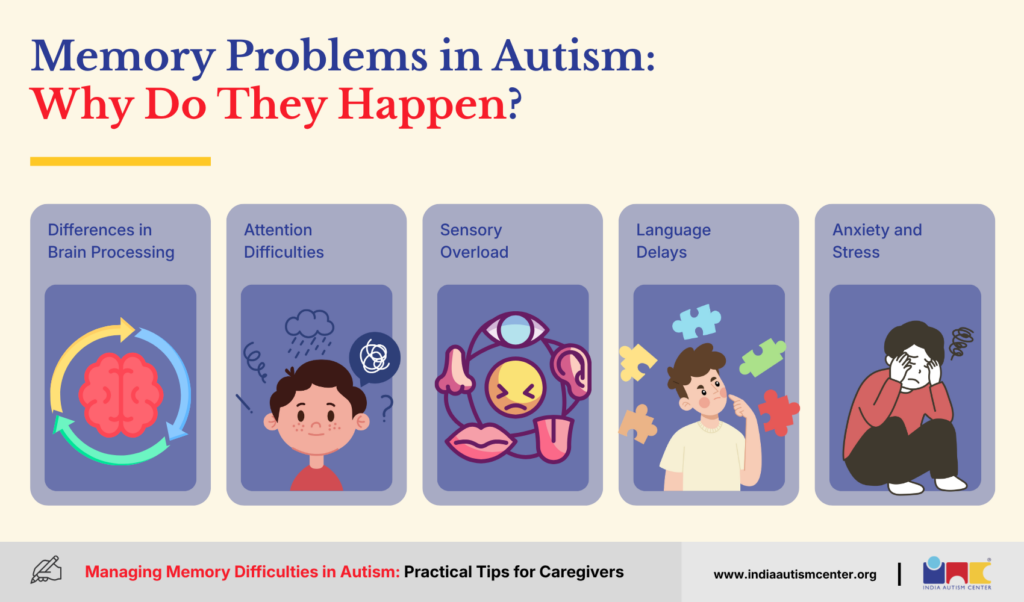
There is no single cause of memory difficulties in autism. Several factors work together:
1. Differences in Brain Processing
Autistic brains tend to process information more visually than verbally. Spoken instructions can fade quickly, while pictures or written words stay longer. This is why a verbal instruction like “tidy your room” may evaporate within seconds, while a picture checklist on the wall works reliably.
2. Working Memory Differences
Working memory in autism deserves particular attention. Rabiee et al. (2020) reviewed the evidence and found that working memory deficits are among the most consistently documented cognitive differences in autism – affecting both verbal and visuospatial working memory, and closely linked to difficulties in daily functioning and academic learning. This is not a peripheral finding; it is one of the most replicated results in autism research.
It is also worth noting that ADHD and memory difficulties frequently co-occur, since ADHD is present in a significant proportion of autistic children and compounds working memory challenges further.
3. Attention Difficulties
Memory depends on attention. If your child struggles to focus – whether because of distractibility, sensory input or anxiety – the brain may not encode information properly in the first place. You cannot recall what was never stored.
4. Sensory Overload
Noisy or visually busy environments can overwhelm the nervous system. When this happens, the brain prioritises managing sensory input over forming new memories. A classroom with flickering lights and background noise is genuinely harder to learn in for many autistic children.
5. Language Delays
If a child has limited receptive language, they may not fully understand what they are being asked to remember. The memory difficulty is downstream of a language-processing difference, not a storage problem per se.
6. Anxiety and Stress
High anxiety actively blocks memory recall. Many autistic children experience significant anxiety when routines change unexpectedly, and that anxiety narrows their cognitive bandwidth – making it harder to retrieve even well-learned information.
Autism Memory Problems in Children: Common Signs
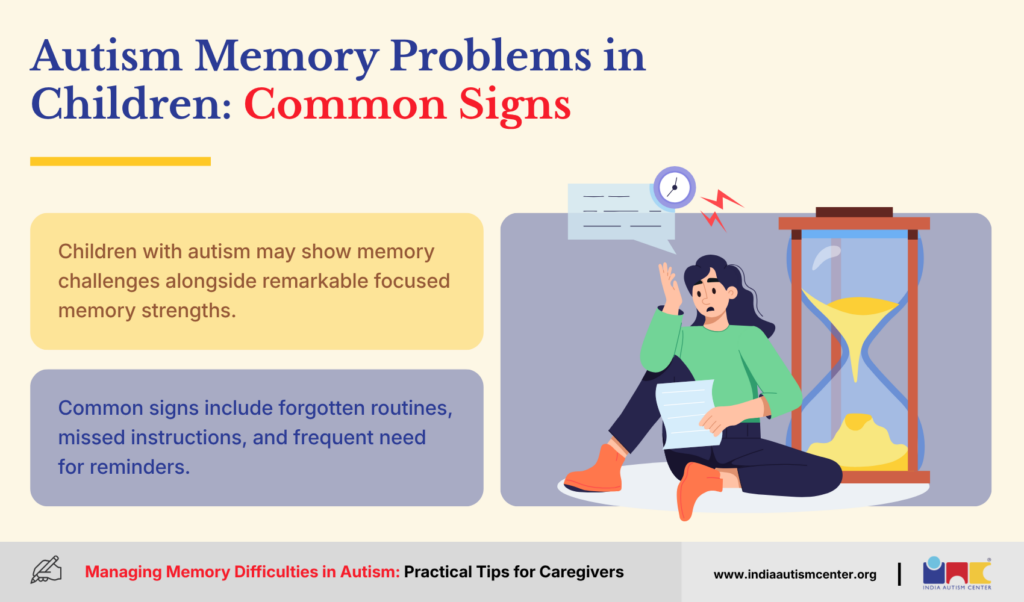
You may notice autism memory problems in children through daily behaviours such as:
- Forgetting daily routines
- Difficulty remembering instructions
- Losing track of tasks
- Trouble recalling names or words
- Struggling to remember what happened yesterday
- Needing frequent reminders
At the same time, your child may show exceptional memory for:
- Favourite topics
- Visual patterns
- Songs or videos
- Numbers or letters
This contrast is part of how memory difficulties in autism present differently from child to child.
Practical Strategies for Coping with Memory Difficulties in Autism
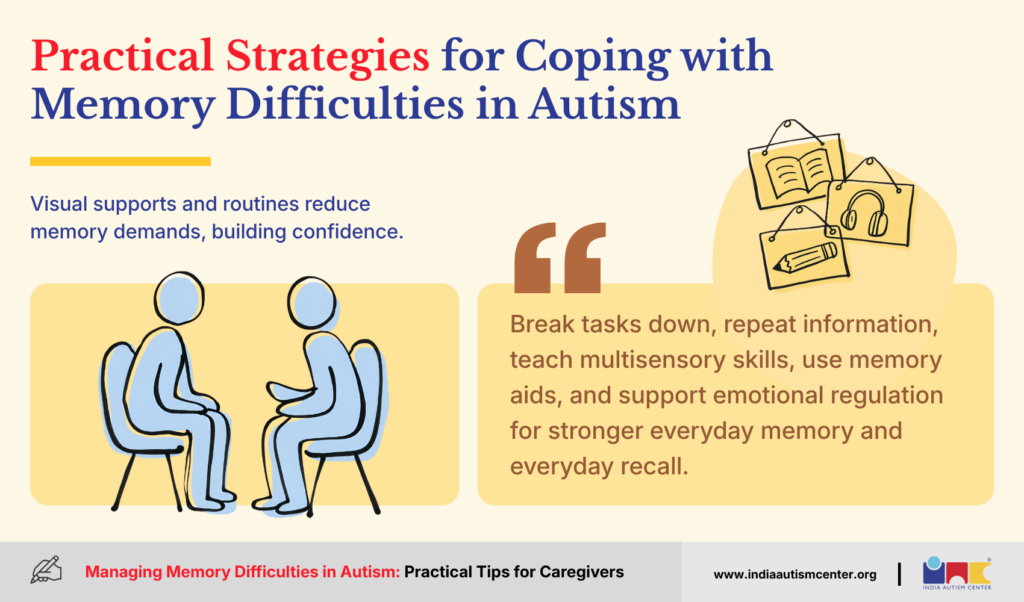
Let me share seven practical ways to support your child at home and school. These strategies work best when used consistently and with patience.
1. Use Visual Supports
Visuals reduce pressure on verbal memory. They help your child “see” what to do instead of having to hold spoken instructions in mind.
You can use:
- Picture schedules and visual timetables
- Step-by-step task charts with photographs
- Colour-coded labels on drawers and shelves
- Written checklists for morning and bedtime routines
A morning routine chart with pictures for brushing teeth, bathing and dressing can transform a chaotic start to the day into a smooth, independent sequence. This approach is central to the work at India Autism Center, where therapists design structured visual systems tailored to each child’s needs.
All you need Visual Therapy for Autism: Benefits & Techniques
2. Break Tasks into Smaller Steps
Large tasks overload working memory. Smaller steps are far easier to hold in mind and act on.
Instead of saying: “Get ready for school,” say: “Put on your uniform.” Then: “Pack your bag.” Then: “Wear your shoes.”
One instruction at a time. Clear steps reduce stress and improve success dramatically.
3. Repeat and Reinforce Information
Repetition strengthens memory pathways. This is not about drilling your child – it is about building familiarity through consistent exposure.
You can:
- Repeat instructions calmly and in the same words
- Practise skills daily in the same sequence
- Review learning frequently using spaced repetition
- Use songs or rhymes to anchor key information
Consistency builds familiarity, and familiarity builds confidence.
4. Use Multi-Sensory Teaching
Learning improves when more senses are involved simultaneously. Combining channels reduces the burden on any single memory system.
Try combining:
- Seeing – pictures, written words, demonstrations
- Hearing – spoken words, songs, audio cues
- Doing – physical actions, hands-on practice
For example, teach handwashing by showing the steps on a chart, narrating each step aloud, and guiding the physical action. At IAC, therapists use sensory-based teaching methods specifically designed to strengthen memory retention in autistic learners.
5. Build Routines and Structure
Routines reduce memory load. When actions become habits, they require far less active recall – they run almost on autopilot.
Fixed, predictable routines for:
- Morning activities
- Mealtimes
- Study time
- Bedtime
…help your child remember what comes next without having to consciously retrieve it. Predictability is not rigidity – it is scaffolding.
6. Encourage Use of Memory Aids
Memory aids act as external memory tools. Rather than making your child dependent, they empower independence.
These include:
- Reminder cards in a pocket or bag
- Phone or tablet alarms for transitions
- Checklists stuck to the desk or fridge
- Sticky notes in key locations
- Visual cues at the point of need
Teaching your child to use these tools is itself a life skill. Many successful adults – autistic and neurotypical alike – rely on external memory systems every day.
7. Support Emotional Regulation
Stress blocks memory. A calm, regulated nervous system is the foundation for learning and recall.
You can support regulation by:
- Reducing unnecessary noise and visual clutter
- Offering regular movement breaks
- Validating your child’s feelings without dismissing them
- Using relaxation strategies such as deep breathing or sensory tools
A regulated child remembers better. Full stop. Occupational therapy for sensory processing can be particularly valuable here, helping children build the self-regulation skills that underpin memory function.
The Role of Therapy in Improving Memory Difficulties in Autism

While home strategies help, professional support accelerates progress.
At India Autism Center (IAC), memory development is integrated into therapy programmes such as:
- Occupational Therapy – improves attention and sensory regulation
- Speech and Language Therapy – strengthens verbal memory
- Special Education – builds academic memory
- Behavioural Therapy – supports task completion
- Cognitive training – improves working memory
IAC follows an interdisciplinary approach. This means therapists work together to address memory difficulties holistically rather than in isolation.
Each child receives:
- Individual assessment
- Personalised goals
- Structured teaching
- Family training
- Regular monitoring
This coordinated approach makes IAC a vital support system for families managing memory problems in autism.
Memory Strengths in Autism
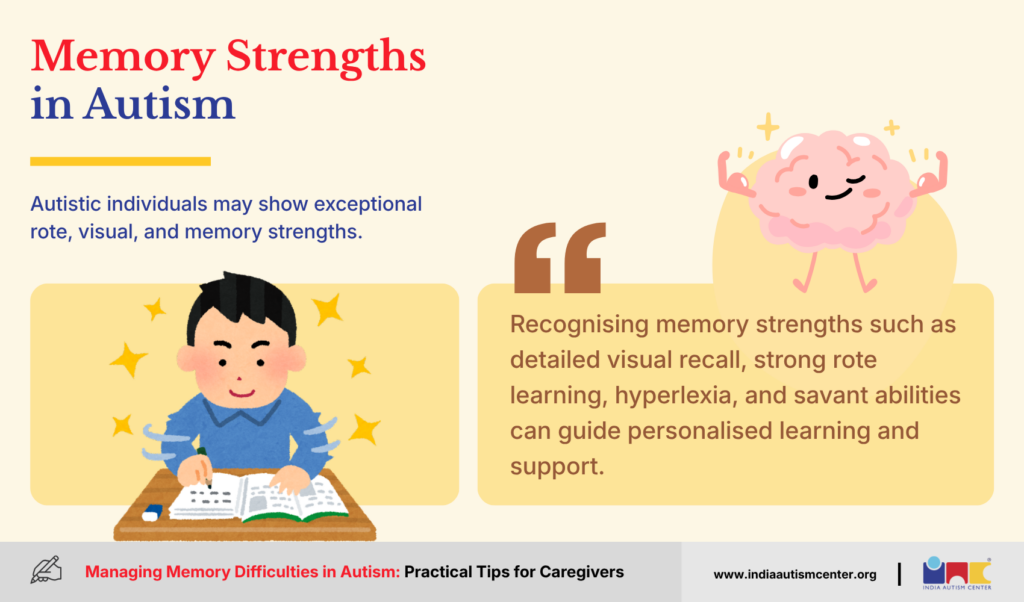
It would be incomplete – and frankly unfair – to discuss memory difficulties in autism without giving equal weight to the genuine autism memory strengths that many autistic individuals possess. These are not quirks or party tricks. They are real cognitive advantages.
Rote memory is often exceptional. Many autistic children can memorise sequences, rules, timetables and scripts with remarkable speed and accuracy. A child who struggles to recall what they had for breakfast may recite the entire dialogue of a film they watched once, months ago.
Visual-spatial memory is another area of frequent strength. Autistic individuals often remember routes, layouts, patterns and images with a level of detail that surprises others. This strength can be harnessed directly in learning – presenting information visually taps into a genuine cognitive advantage.
Hyperlexia – the ability to read and decode written text at a level well above what is expected for age – is associated with strong visual-verbal memory for written words. Children with hyperlexia often remember written information far better than spoken information.
Savant memory represents the extreme end of this spectrum. A small proportion of autistic individuals demonstrate extraordinary memory abilities in specific domains – music, mathematics, art, dates or geography. The late Stephen Wiltshire, for example, could draw entire city skylines from memory after a single helicopter flight.
The concept of autism photographic memory – sometimes called eidetic memory – is often discussed in this context. True photographic memory is rare, but many autistic people do have unusually detailed visual recall that functions similarly in practical terms.
Stanford Medicine’s 2023 research confirms this uneven profile: while episodic and verbal memory show broad difficulties, other memory systems can be intact or superior. Understanding your child’s specific memory strengths is just as important as addressing their difficulties – and a good assessment will map both.
How Memory Difficulties Affect Daily Life
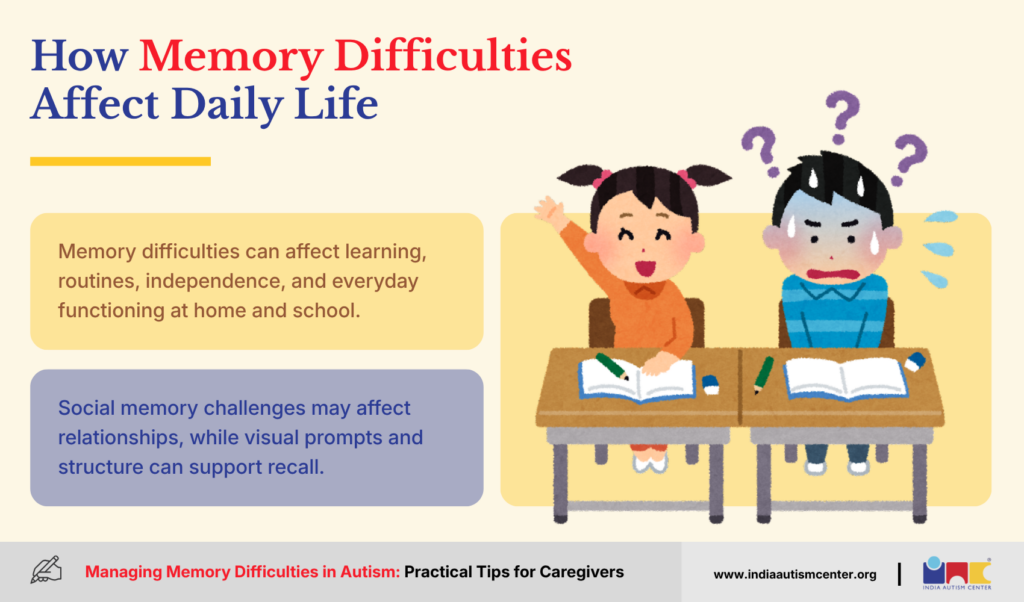
Understanding the theory is one thing. Seeing how memory difficulties in autism play out across a real day – at school, at home, in social situations – is where it becomes personal.
At School
The classroom places enormous demands on working memory. A teacher might give a three-part instruction: “Open your book to page 42, answer questions 1 to 5, and write the date at the top.” For many autistic children, the first part of that instruction has already faded by the time the third part is delivered.
Copying from the board is similarly taxing – it requires holding a chunk of text in working memory long enough to transfer it to paper, while simultaneously managing handwriting. Tests and exams add another layer: retrieval under time pressure, in an unfamiliar format, with anxiety running high.
Understanding the types of learning disability in children that can co-occur with autism helps schools put the right accommodations in place – such as written instructions, extended time, and reduced copying tasks.
At Home
At home, memory difficulties show up in the texture of daily life. A child may forget a chore they have done every day for a year. They may leave their water bottle at school repeatedly, not through carelessness but because the act of packing it requires prospective memory – remembering to do something in the future – which is particularly vulnerable in autism.
Routines that seem established can unravel when there is a small change in sequence. The child who manages their morning routine perfectly when everything is in the right place may fall apart when the toothbrush is in a different spot. This is not defiance. It is a genuine memory and flexibility challenge.
In Social Situations
Social memory is perhaps the most emotionally loaded area. Remembering names, faces and previous conversations is the glue of social relationships. Many autistic children find this genuinely difficult – not because they do not care, but because episodic memory for social events is often weaker than memory for facts or patterns.
Research by Norris et al. (2021) explored how autistic adults recall episodic memories and found that structured cuing and visual prompts significantly improved recall of social events. The same principle applies to children: helping them record and revisit social experiences – through photos, diaries or social stories – can strengthen social memory over time.
Do Autism Memory Problems in Children Improve Over Time?

Many parents worry about the future. You may ask, “Will my child always struggle with memory?”
The answer is encouraging:
With early intervention and consistent strategies, many children show significant improvement.
Memory can be strengthened through:
- Practice
- Structure
- Therapy
- Visual support
- Emotional regulation
At IAC, progress is tracked carefully, and goals evolve as children grow. Improvement may be gradual, but it is very real.
Conclusion
Memory difficulties in autism are not a sign of laziness or inability. They reflect a different way of processing the world. When you understand this, your response becomes supportive rather than corrective.
With practical strategies, emotional understanding, and professional support from institutions like India Autism Center, children with autism can develop stronger memory skills and greater independence.
You play the most important role in this journey. When you adapt the environment instead of blaming the child, learning becomes possible.
Frequently Asked Questions (FAQs)
Do autistic people struggle with memory?
Yes, some autistic people struggle with certain types of memory, especially working memory and verbal memory. However, they may have strong visual or factual memory. Memory difficulties in autism vary from person to person and depend on attention, sensory processing and learning style.
What causes memory difficulties in autism?
Memory difficulties in autism can be caused by differences in brain processing, attention challenges, sensory overload, language delays and anxiety. These factors affect how information is stored and recalled, leading to memory problems in autism, especially in daily routines and learning tasks.
What are common autism memory problems in children?
Memory difficulties in autism can be caused by differences in brain processing, attention challenges, sensory overload, language delays and anxiety. These factors affect how information is stored and recalled, leading to memory problems in autism, especially in daily routines and learning tasks.
What are common autism memory problems in children?
Parents can help by using visual schedules, breaking tasks into small steps, creating daily routines and using memory aids such as charts and checklists. Professional support from centres like India Autism Center (IAC) also helps children improve memory skills through structured therapy and personalised learning plans.
For expert insights, support services, and inclusive learning initiatives, visit the India Autism Center.