 Donate now
 Get a Call Back
 MENU
MENU 11 MIN READ
 SHARE
SHARE


Finding the right support for a child or a loved one with a disability can feel like a big challenge for many parents. Whether you are caring for a child with autism or someone with physical needs, having the right tools can make a world of difference.
In India, the government has a special and dedicated program, which is known as the Assistance to Disabled Persons for Purchase/Fitting of Aids or Appliances (ADIP scheme), to help families get the equipment they need without worrying about the cost. This program gives necessary assistance to people with disabilities, ensuring that each person gets a chance to live an independent life.
Recent studies show that there are over 26.8 million people living with disabilities in India. It is also a fact that using assistive technology for disabled children early in life can help them become much more independent as they grow up.
This detailed guide will explain to you all about the ADIP scheme, including eligibility, benefits, application process, and how it supports individuals with autism and other disabilities.
What is the ADIP Scheme?
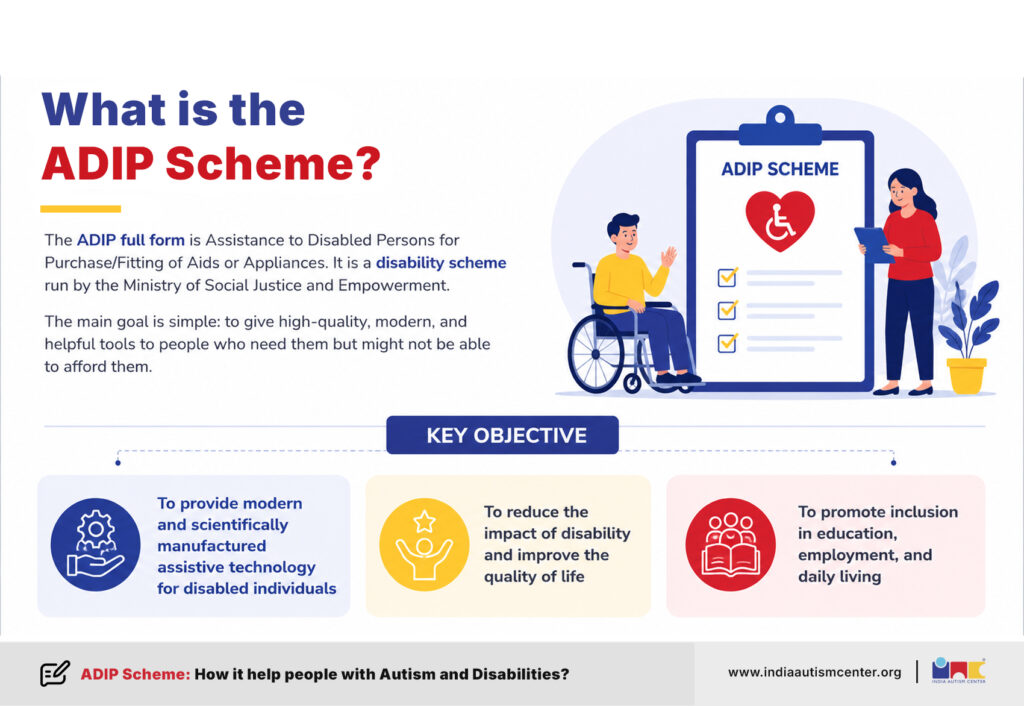
The ADIP full form is Assistance to Disabled Persons for Purchase/Fitting of Aids or Appliances. It is a disability scheme run by the Ministry of Social Justice and Empowerment. The main goal is simple: to give high-quality, modern, and helpful tools to people who need them but might not be able to afford them.
Key Objective:
- To provide modern and scientifically manufactured assistive technology for disabled individuals
- To reduce the impact of disability and improve the quality of life
- To promote inclusion in education, employment, and daily living
📥 Free download: Printable daily routine chart for autistic children
Why the ADIP Scheme Matters?
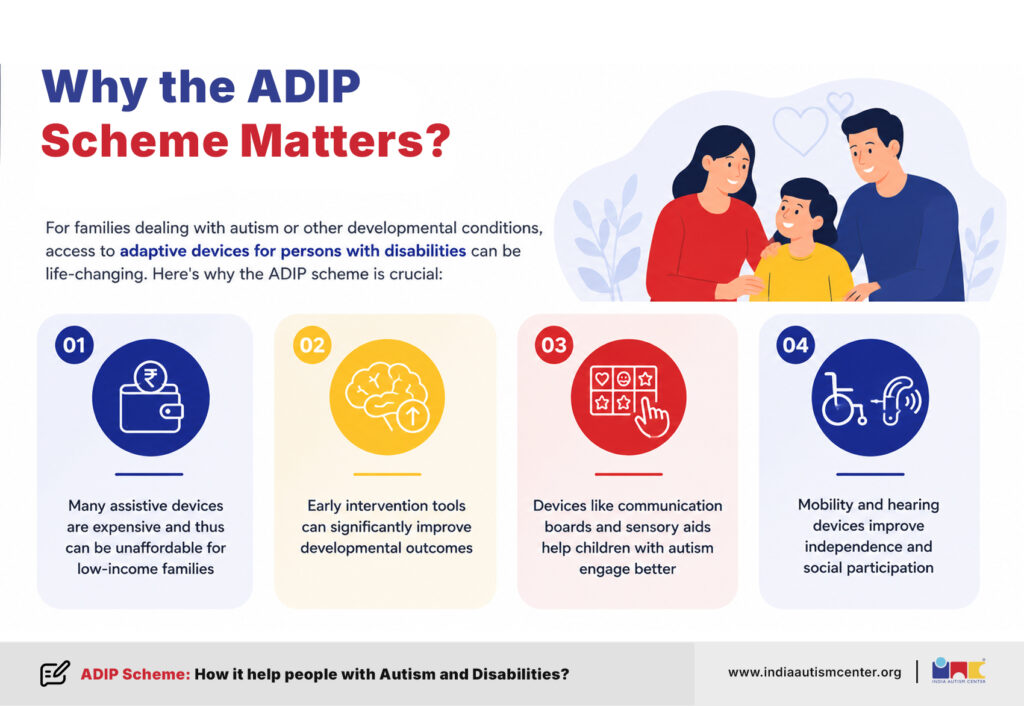
For families dealing with autism or other developmental conditions, access to adaptive devices for persons with disabilities can be life-changing. Here’s why the ADIP scheme is crucial:
- Many assistive devices are expensive and thus can be unaffordable for low-income families
- Early intervention tools can significantly improve developmental outcomes
- Devices like communication boards and sensory aids help children with autism engage better
- Mobility and hearing devices improve independence and social participation
Different Types of Assistive Devices for People with Disabilities
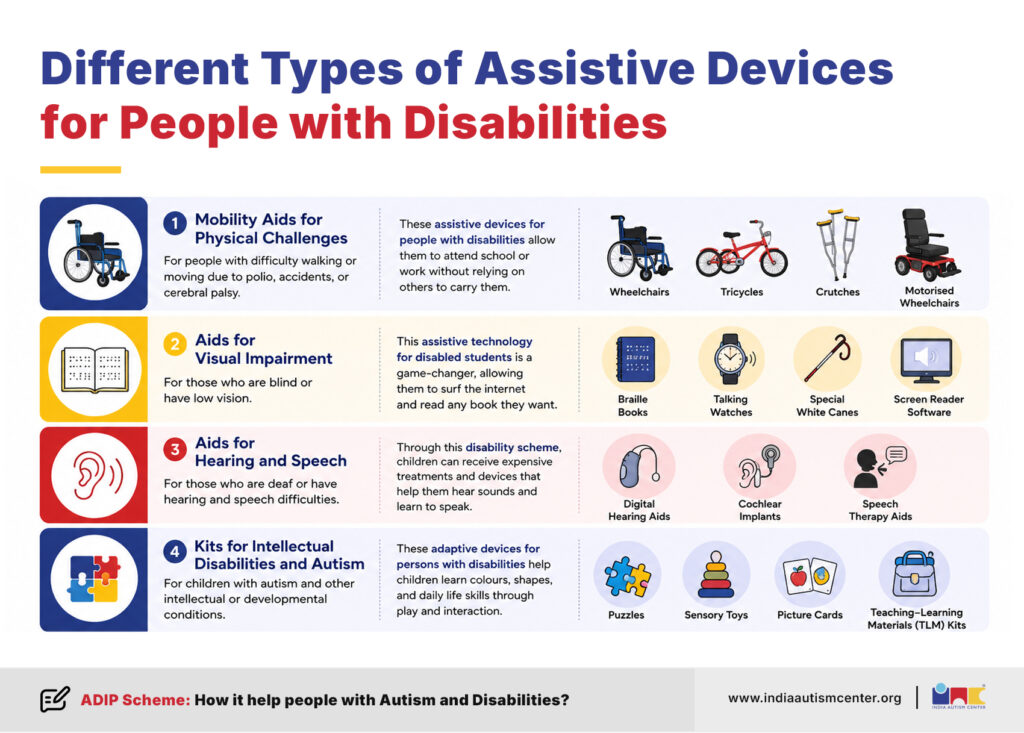
The ADIP scheme covers many different needs. Depending on what a person requires, the scheme provides different types of tools. Let’s look at them in detail.
Mobility Aids for Physical Challenges
For people who have trouble walking due to polio, accidents, or cerebral palsy, the scheme provides wheelchairs, tricycles, and crutches. For those who have great difficulty moving their arms or legs, motorised wheelchairs are also available.
These assistive devices for people with disabilities allow them to attend school or work without relying on others to carry them.
Aids for Visual Impairment
For those who are blind or have low vision, the government provides Braille books, talking watches, and special white canes. They also provide high-tech software for computers that reads text aloud.
This assistive technology for disabled students is a game-changer, allowing them to surf the internet and read any book they want.
Aids for Hearing and Speech
Digital hearing aids are very common under this disability scheme. For young children who cannot hear at all, the government even helps pay for cochlear implants.
A cochlear implant is a very expensive surgery, but through the ADIP scheme, many poor children get it for free. This helps them start hearing sounds and eventually learn how to speak.
Kits for Intellectual Disabilities and Autism
This is very important for parents of neurodivergent children. The scheme provides special kits called Teaching-Learning Materials (TLM) kits. These kits contain puzzles, sensory toys, and picture cards.
These adaptive devices for persons with disabilities are designed to help children with autism learn colours, shapes, and daily life skills through play.
How to Use the ADIP Scheme Apply Online Feature?
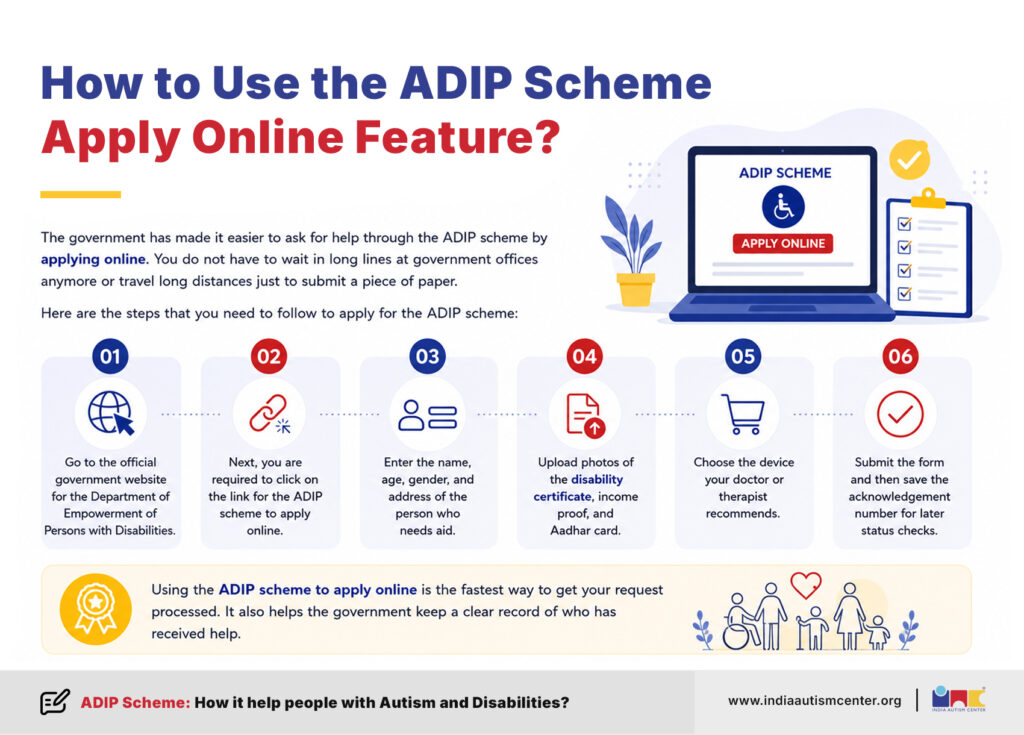
The government has made it easier to ask for help through the ADIP scheme by applying online. You do not have to wait in long lines at government offices anymore or travel long distances just to submit a piece of paper.
Here are the steps that you need to follow to apply for the ADIP scheme:
Step 1: Go to the official government website for the Department of Empowerment of Persons with Disabilities.
Step 2: Next, you are required to click on the link for the ADIP scheme to apply online.
Step 3: Enter the name, age, gender, and address of the person who needs aid.
Step 4: Upload photos of the disability certificate, income proof, and Aadhar card.
Step 5: Choose the device your doctor or therapist recommends.
Step 6: Submit the form and then save the acknowledgement number for later status checks.
Using the ADIP scheme to apply online is the fastest way to get your request processed. It also helps the government keep a clear record of who has received help.
Who Can Apply for this Scheme?
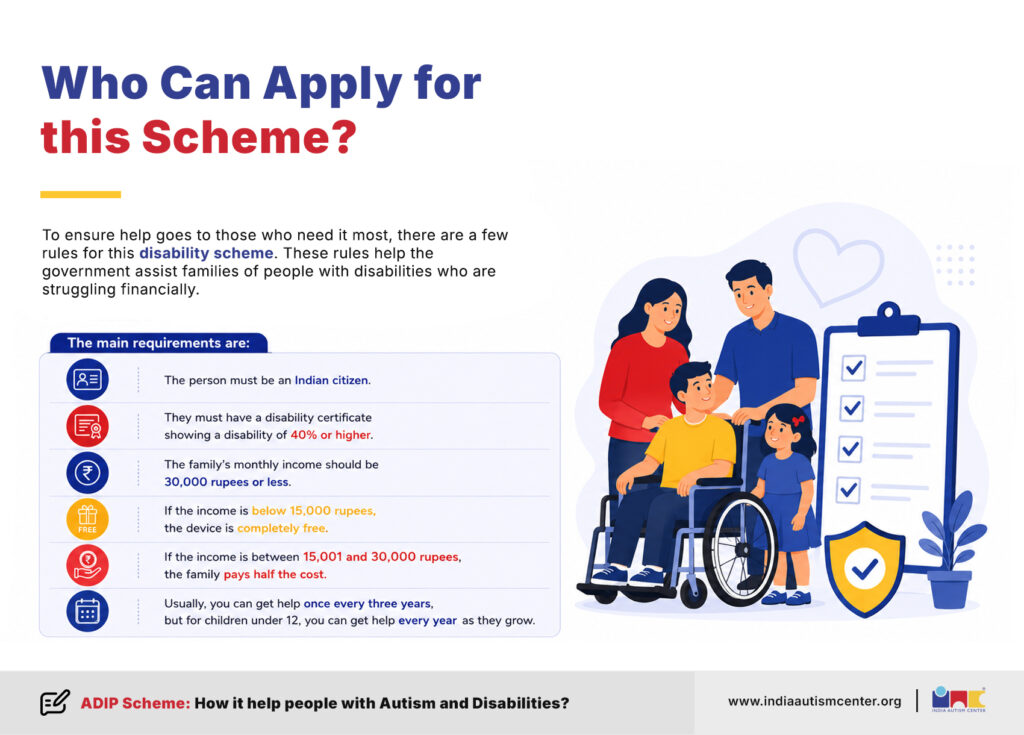
To ensure help goes to those who need it most, there are a few rules for this disability scheme. These rules help the government assist families of people with disabilities who are struggling financially.
The main requirements are:
- The person must be an Indian citizen.
- They must have a disability certificate showing a disability of 40% or higher.
- The family’s monthly income should be 30,000 rupees or less.
- If the income is below 15,000 rupees, the device is completely free.
- If the income is between 15,001 and 30,000 rupees, the family pays half the cost.
- Usually, you can get help once every three years, but for children under 12, you can get help every year as they grow.
These rules ensure that adaptive devices for persons with disabilities reach the right hands.
Want to know more? Get in touch with us.
What Documents are Needed for A Smooth Application?
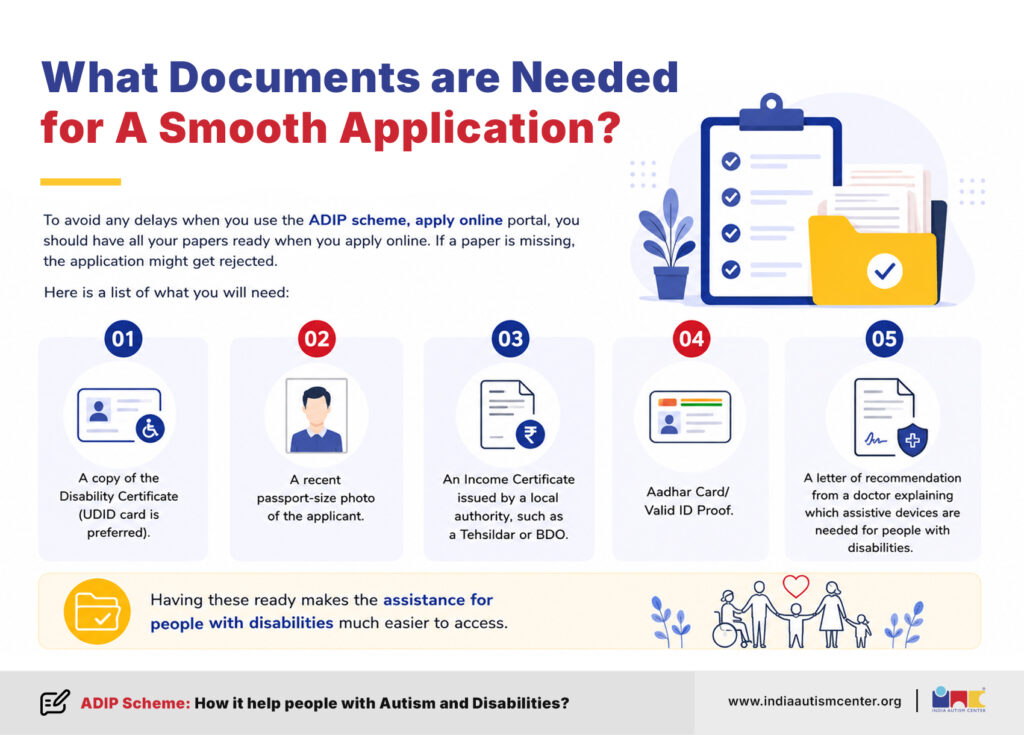
To avoid any delays when you use the ADIP scheme, apply online portal, you should have all your papers ready when you apply online. If a paper is missing, the application might get rejected.
Here is a list of what you will need:
- A copy of the Disability Certificate (UDID card is preferred).
- A recent passport-size photo of the applicant.
- An Income Certificate issued by a local authority, such as a Tehsildar or BDO.
- Aadhar Card/Valid ID Proof.
- A letter of recommendation from a doctor explaining which assistive devices are needed for people with disabilities.
Having these ready makes the assistance for people with disabilities much easier to access.
The Importance of Early Intervention
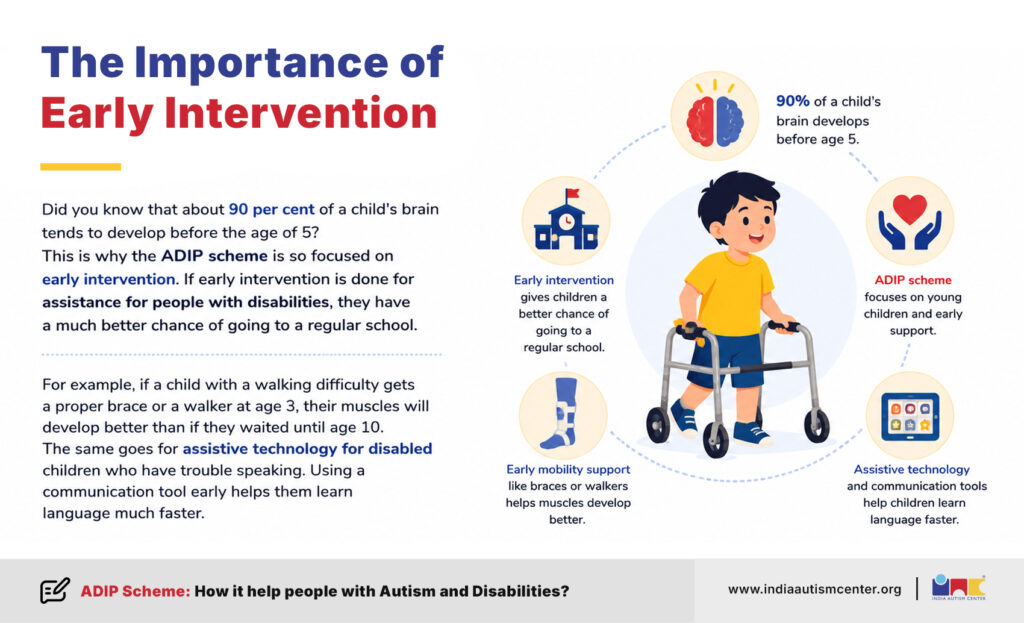
Did you know that about 90 per cent of a child’s brain tends to develop before the age of 5? This is why the ADIP scheme is so focused on young children. If early intervention is done for assistance for people with disabilities, they have a much better chance of going to a regular school.
For example, if a child with a walking difficulty gets a proper brace or a walker at age 3, their muscles will develop better than if they waited until age 10. The same goes for assistive technology for disabled children who have trouble speaking. Using a communication tool early helps them learn language much faster.
The Role of NGOs and Social Workers
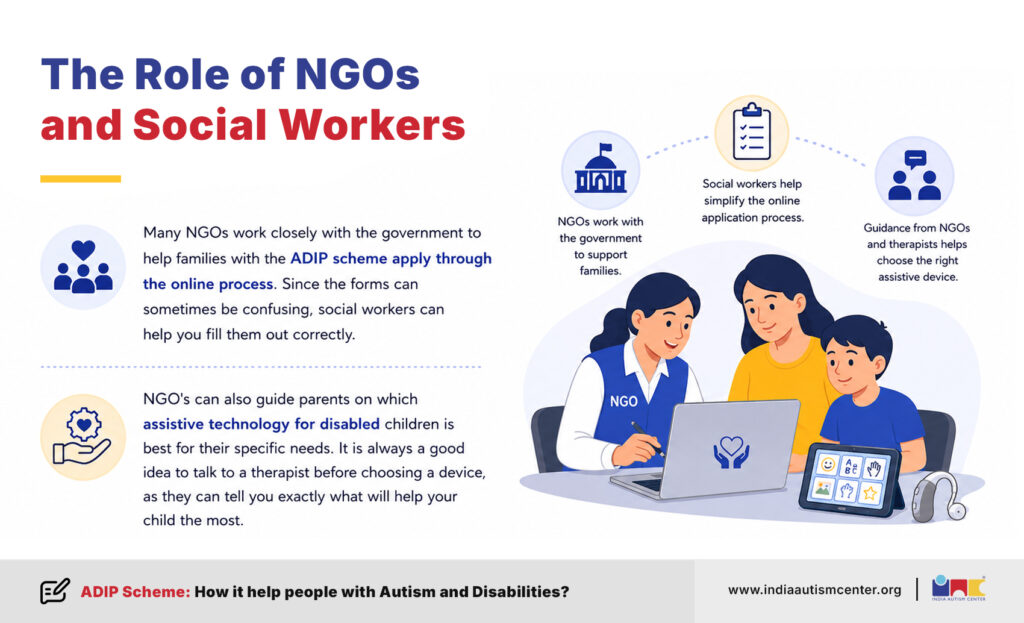
Many NGOs work closely with the government to help families with the ADIP scheme apply through the online process. Since the forms can sometimes be confusing, social workers can help you fill them out correctly.
NGO’s can also guide parents on which assistive technology for disabled children is best for their specific needs. It is always a good idea to talk to a therapist before choosing a device, as they can tell you exactly what will help your child the most.
How is Life After Receiving the Device?
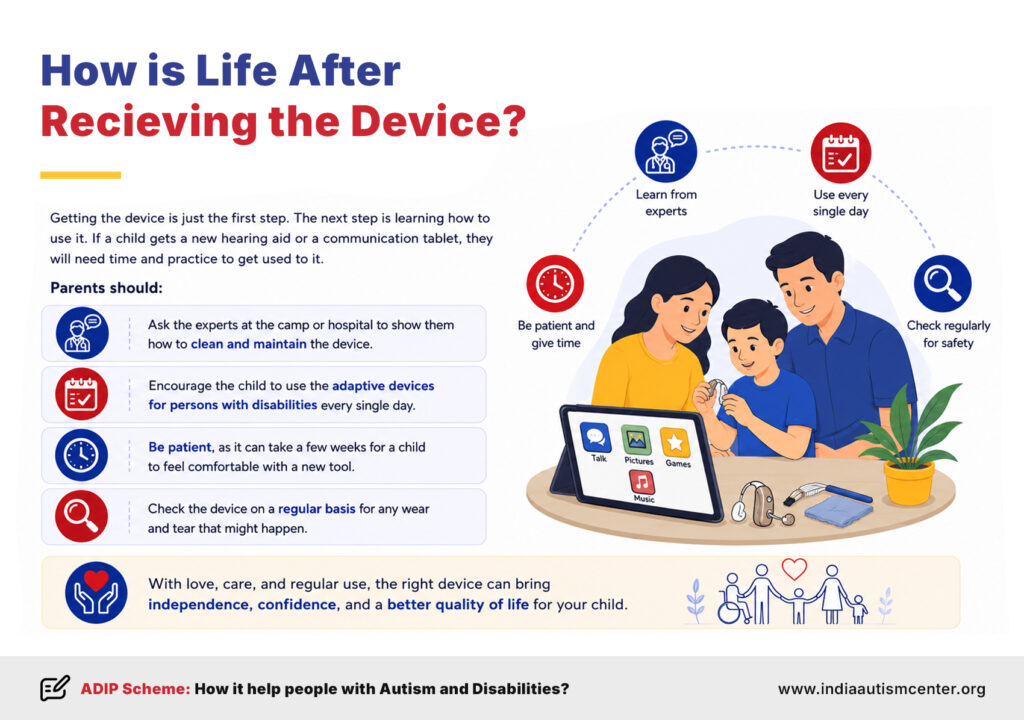
Getting the device is just the first step. The next step is learning how to use it. If a child gets a new hearing aid or a communication tablet, they will need time and practice to get used to it.
Parents should:
- Ask the experts at the camp or hospital to show them how to clean and maintain the device.
- Encourage the child to use the adaptive devices for persons with disabilities every single day.
- Be patient, as it can take a few weeks for a child to feel comfortable with a new tool.
- Check the device on a regular basis for any wear and tear that might happen.
Common Myths About the ADIP Scheme
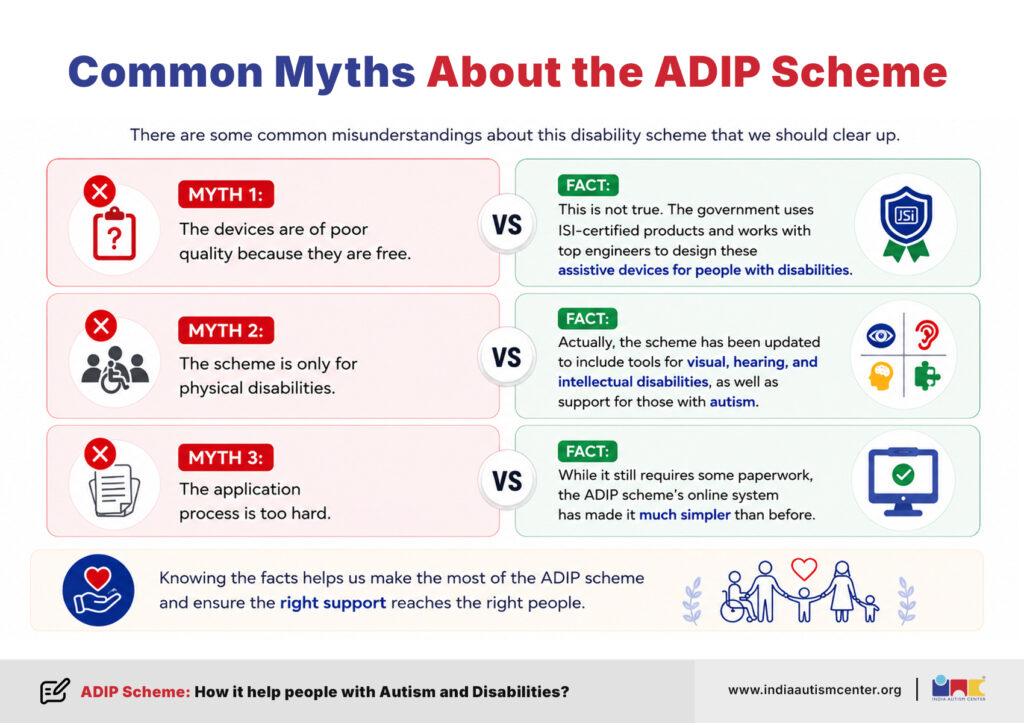
There are some common misunderstandings about this disability scheme that we should clear up.
Myth 1: The devices are of poor quality because they are free.
This is not true. The government uses ISI-certified products and works with top engineers to design these assistive devices for people with disabilities.
Myth 2: The scheme is only for physical disabilities.
Actually, the scheme has been updated to include tools for visual, hearing, and intellectual disabilities, as well as support for those with autism.
Myth 3: The application process is too hard.
While it still requires some paperwork, the ADIP scheme’s online system has made it much simpler than before.
Tips for Parents and Caregivers
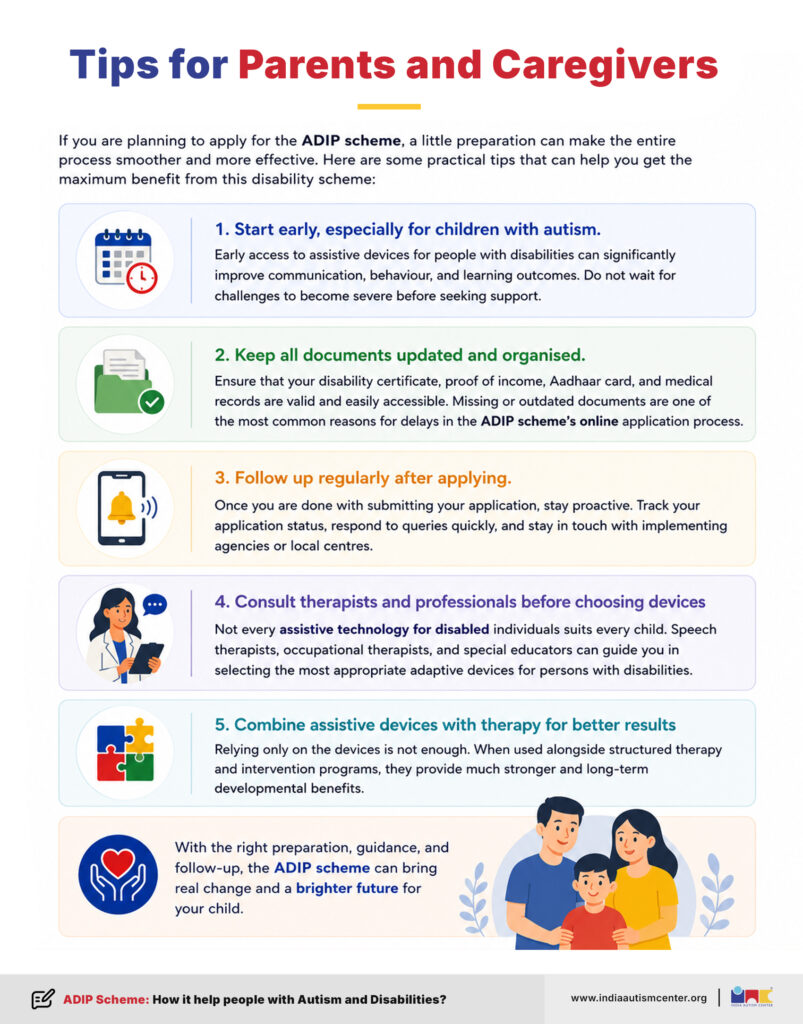
If you are planning to apply for the ADIP scheme, a little preparation can make the entire process smoother and more effective. Here are some practical tips that can help you get the maximum benefit from this disability scheme:
Start early, especially for children with autism.
Early access to assistive devices for people with disabilities can significantly improve communication, behaviour, and learning outcomes. Do not wait for challenges to become severe before seeking support.
Keep all documents updated and organised.
Ensure that your disability certificate, proof of income, Aadhaar card, and medical records are valid and easily accessible. Missing or outdated documents are one of the most common reasons for delays in the ADIP scheme’s online application process.
Follow up regularly after applying.
Once you are done with submitting your application, stay proactive. Track your application status, respond to queries quickly, and stay in touch with implementing agencies or local centres.
Consult therapists and professionals before choosing devices
Not every assistive technology for disabled individuals suits every child. Speech therapists, occupational therapists, and special educators can guide you in selecting the most appropriate adaptive devices for persons with disabilities.
Combine assistive devices with therapy for better results
Relying only on the devices is not enough. When used alongside structured therapy and intervention programs, they provide much stronger and long-term developmental benefits.
Conclusion
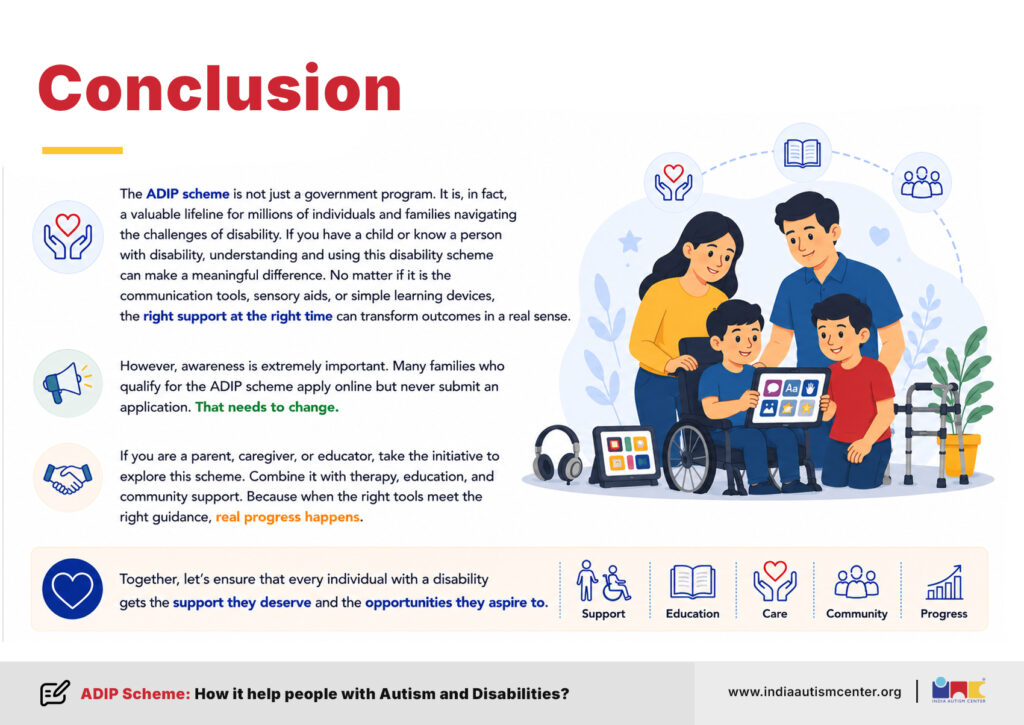
The ADIP scheme is not just a government program. It is, in fact, a valuable lifeline for millions of individuals and families navigating the challenges of disability. If you have a child or know a person with disability, understanding and using this disability scheme can make a meaningful difference. No matter if it is the communication tools, sensory aids, or simple learning devices, the right support at the right time can transform outcomes in a real sense.
However, awareness is extremely important. Many families who qualify for the ADIP scheme apply online but never submit an application. That needs to change.
If you are a parent, caregiver, or educator, take the initiative to explore this scheme. Combine it with therapy, education, and community support. Because when the right tools meet the right guidance, real progress happens.
Frequently Asked Questions
What is the ADIP scheme and who can benefit from it?
The ADIP scheme is a dedicated government disability scheme that provides assistive devices to eligible individuals with disabilities. This scheme helps in improving mobility, communication, and independence.
Who is eligible to apply for the ADIP scheme in India?
Indian citizens with at least 40% certified disability and within the prescribed income limits can apply for the adip scheme to receive assistance for people with disabilities.
What types of assistive devices are provided under the ADIP scheme?
The ADIP scheme provides assistive devices for people with disabilities, such as wheelchairs, hearing aids, communication tools, prosthetics, and other adaptive devices.
Is the ADIP scheme available for children with autism?
Yes, the AIP scheme is known to support children with autism by providing assistive technology, including communication aids, learning tools, and sensory support devices.
How long does it take to receive devices under the ADIP scheme?
The processing time for the ADIP scheme will usually vary but typically ranges from a few weeks to a few months, depending on verification, availability, and distribution schedules.
Can multiple devices be provided under the ADIP scheme?
Yes, eligible individuals can receive multiple assistive devices for people with disabilities, based on their needs and a professional assessment, under the ADIP scheme.
For expert insights, support services, and inclusive learning initiatives, visit the India Autism Center.