 Donate now
 Get a Call Back
 MENU
MENU 13 MIN READ
 SHARE
SHARE


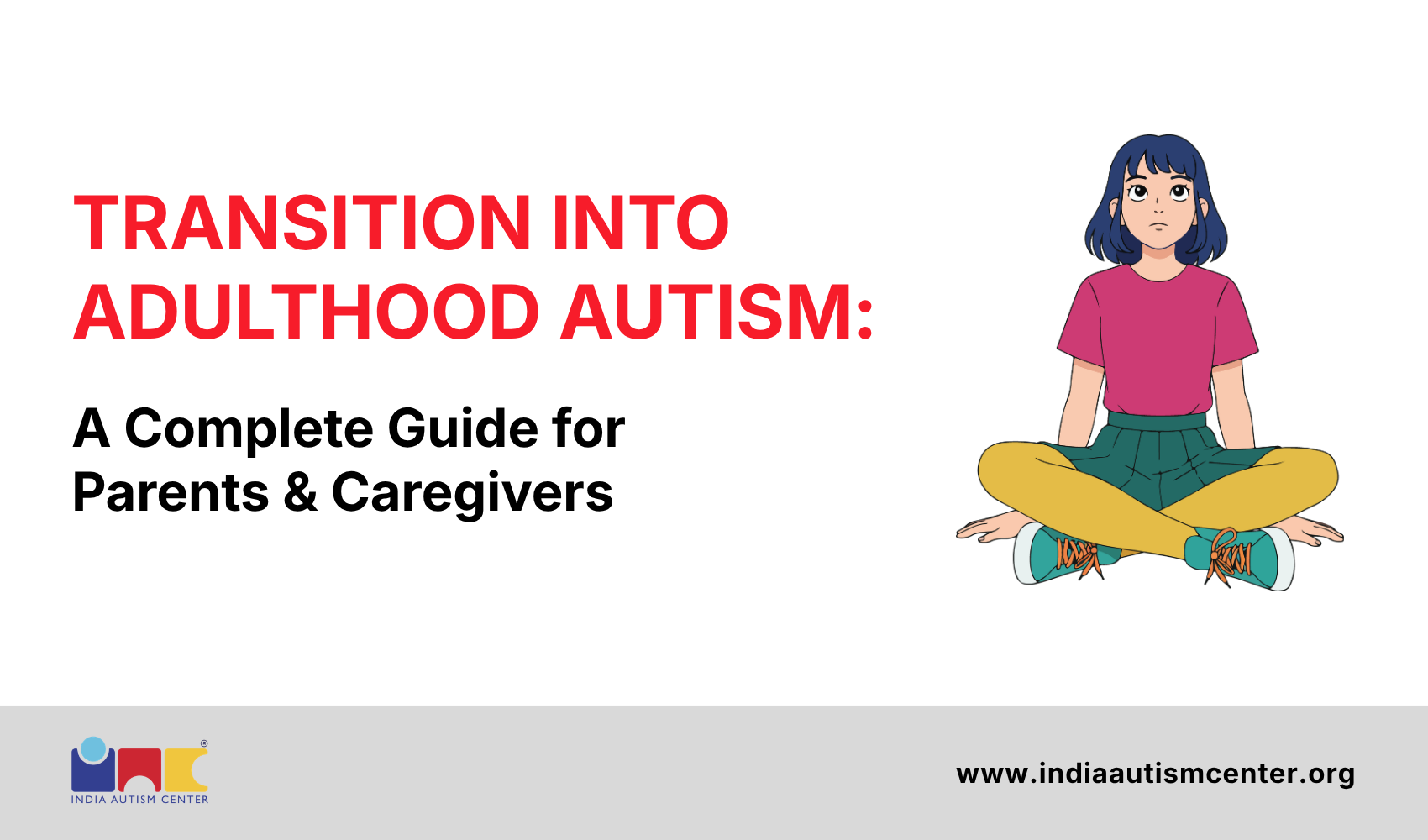
Let me guess. Your daughter just turned 16, or maybe your son is 18 and about to exit the school system. For years, you had IEP meetings, therapists, school buses, and a structured schedule. Now you look ahead, and all you worry about is autism adulthood transition.
We have been there. You are not alone.
The autism adulthood transition is one of the most overwhelming phases you will ever navigate. Why? Because the services that felt like a safety net in school simply vanish when that diploma arrives. One day, your child has a case manager. The next day, you are staring at waitlists for adult disability services.
But here is the good news. With the right transition planning, you can build a bridge. A strong, steady bridge. In this guide, I will walk you through every step. We will talk about work, college, living arrangements, doctor visits, and even how to handle meltdowns in a new environment.
Why the Autism Adulthood Transition Feels So Different from Childhood
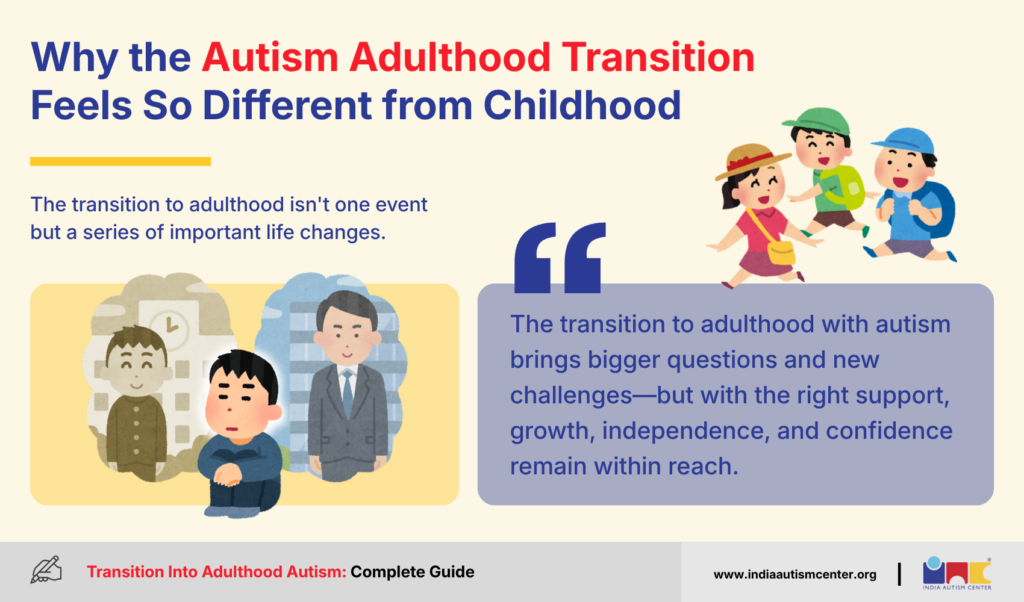
When your child was small, you focused on speech therapy, social skills groups, and surviving public meltdowns. You celebrated eye contact and a first word. That was phase one.
Now the game has changed. Suddenly, the questions are bigger.
- Will he ever hold a job?
- Can she live on her own?
- What happens when I am gone?
- Who will understand her sensory processing in adults needs in a loud workplace?
You see, the autism adulthood transition is not one event. It is a series of tectonic shifts. Health insurance, legal status, housing options, daily routines — all of these shift at once.
I want you to remember something. Your young adult is still the same wonderful person. They just need new tools. And you can help them build those tools.
Want to know more? Get in touch with us.
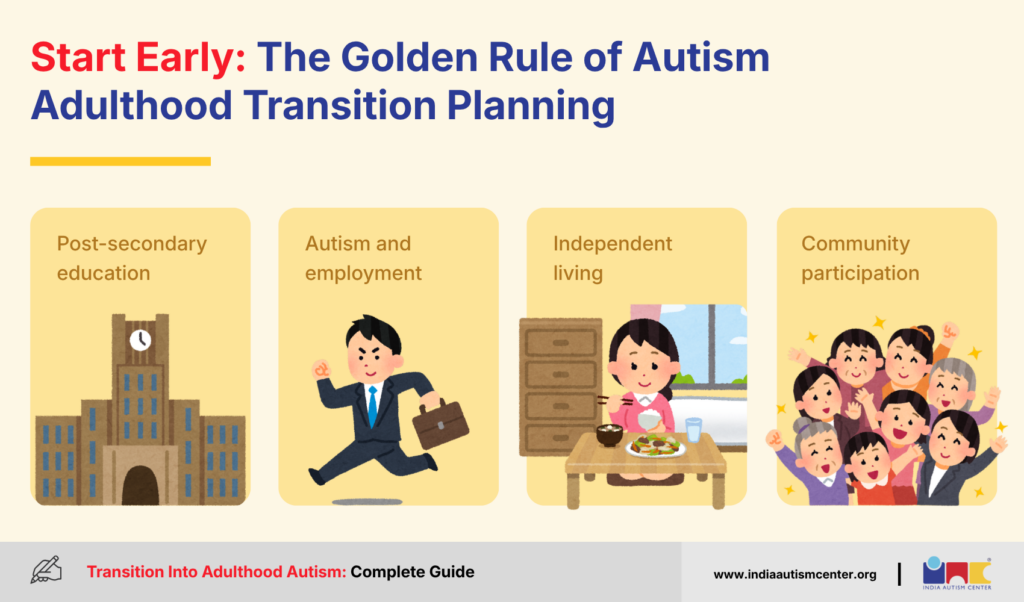
Start Early: The Golden Rule of Autism Adulthood Transition Planning
Social communication skills do not develop overnight. Neither do independent living skills. By starting early, you have years to practice small steps like ordering food, taking the bus, or filling out a job application.
What to Include in Your First Transition Meeting
When you sit down with the school team, demand a plan that covers four pillars:
1. Post-secondary education (college or trade school)
2. Autism and employment (jobs, internships, or sheltered work)
3. Independent living (apartment, group home, or supported living)
4. Community participation (friends, hobbies, transportation)
Do not let the school focus only on academics. Academics mean nothing if your child cannot navigate a grocery store or ask for help.
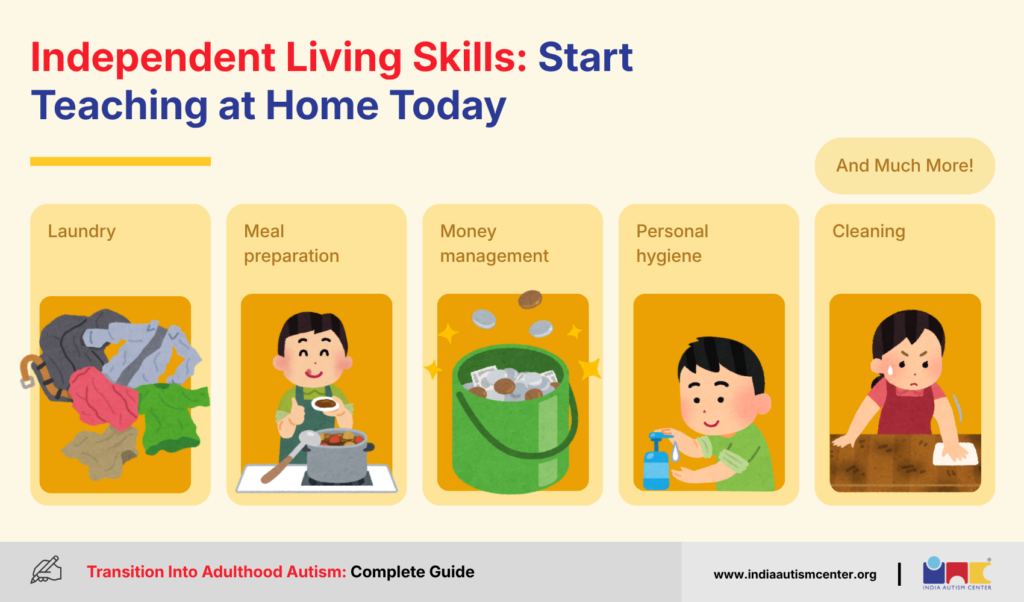
Independent Living Skills: Start Teaching at Home Today
Let me be real with you. Your child might know how to solve a quadratic equation but have no idea how to do laundry. I see this all the time.
Independent living skills are the quiet heroes of successful adulthood. You do not need a classroom to teach them. You need your kitchen, your bathroom, and your backyard.
The Top 10 Skills to Master Before Age 18
Laundry – sorting, washing, drying, folding.
Meal preparation – from microwaving a burrito to boiling pasta.
Money management – using a debit card, making change, budgeting.
Personal hygiene – showering, shaving, menstrual care, deodorant.
Cleaning – wiping counters, vacuuming, taking out trash.
Safety awareness – what to do in a fire, how to call 911.
Using public transportation – reading a bus schedule, handling delays.
Making appointments – phone calls or online forms.
Medication management – filling a pillbox, refilling prescriptions.
Emergency planning – who to call when you feel overwhelmed.
I know it feels slow. I know you have to prompt a hundred times. But every small win builds momentum. Use visual schedules, checklists, and reward systems. Be patient. Do not do it for them.
You can download the free training step-by-step guides designed to support individuals.
Sensory Processing in Adults
Here is something most professionals forget. Sensory processing in adults does not magically improve at age 21. In fact, new environments can make it worse.
A dormitory with flickering lights. An office with constant chatter. An apartment with thin walls and noisy neighbors.
When you teach independent living skills, always include sensory solutions. Noise-canceling headphones. Weighted blankets. A “sensory corner” in their future bedroom. Teach them to recognize early warning signs of overload before a meltdown starts.
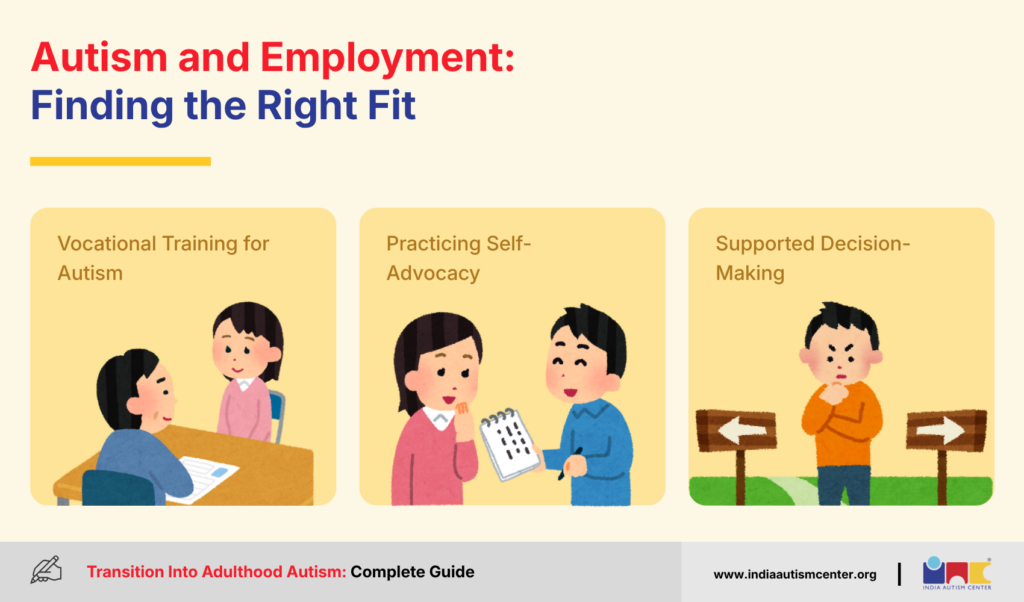
Autism and Employment: Finding the Right Fit
Let me guess. You have heard the statistics. Over 80% of autistic adults are underemployed or unemployed. Those numbers are terrifying.
But here is what they do not tell you. Many of those adults never received proper vocational training for autism. They were thrown into standard job interviews with no accommodations. They were fired for being “too blunt” or “too slow.”
You can change that narrative for your child.
Vocational Training for Autism
Not all job training is the same. Your young adult needs:
- Structured internships in high school (paid if possible)
- Job coaching from someone who understands autism
- Social scripts for common work situations (asking for help, declining extra shifts, requesting a break)
- Sensory audits of the workplace before starting
- Trial shifts where they can leave early without penalty
Look into local vocational rehabilitation agencies. They are funded by the government and often provide free job training. Also explore companies that specifically hire neurodivergent talent, such as Microsoft’s Autism Hiring Program, SAP’s Autism at Work, or Walgreens distribution centers.
Healthcare Transition: Moving from Pediatric to Adult Medicine
One of the scariest parts of the autism adulthood transition is healthcare. Suddenly, your child’s beloved developmental pediatrician says, “We only see patients up to age 21.”
Now you need to find an adult primary care doctor. And you need to teach your young adult to speak for themselves.
The Self-Advocacy Script You Need to Practice
Write down a simple script. Practice it until it feels natural.
“My name is XYZ. I have autism. Sometimes I have trouble explaining my pain. Please ask me yes or no questions. Please write down your instructions. I may need extra time to answer.”
Teach them to bring a healthcare summary card in their wallet. That card should list:
- Diagnoses (autism, anxiety, epilepsy, etc.)
- Allergies
- Current medications
- Emergency contact
- Sensory triggers (bright lights, beeping machines, etc.)
Guardianship vs. Supported Decision-Making
Here is a big legal decision. Many parents automatically assume they need full guardianship. But guardianship takes away your child’s right to make any decision about their body, money, or life.
Consider guardianship alternatives first. Supported decision-making is a legal agreement where your adult child keeps their rights but names you (and others) as helpers. They sign a document allowing you to access medical records or talk to bankers, but they still give final consent.
Only pursue full guardianship if your child truly cannot understand basic choices. And even then, make it as limited as possible. We want dignity. We want autonomy.
Want to know more? Get in touch with us.
Post-Secondary Education: College, Trade School, or Neither?
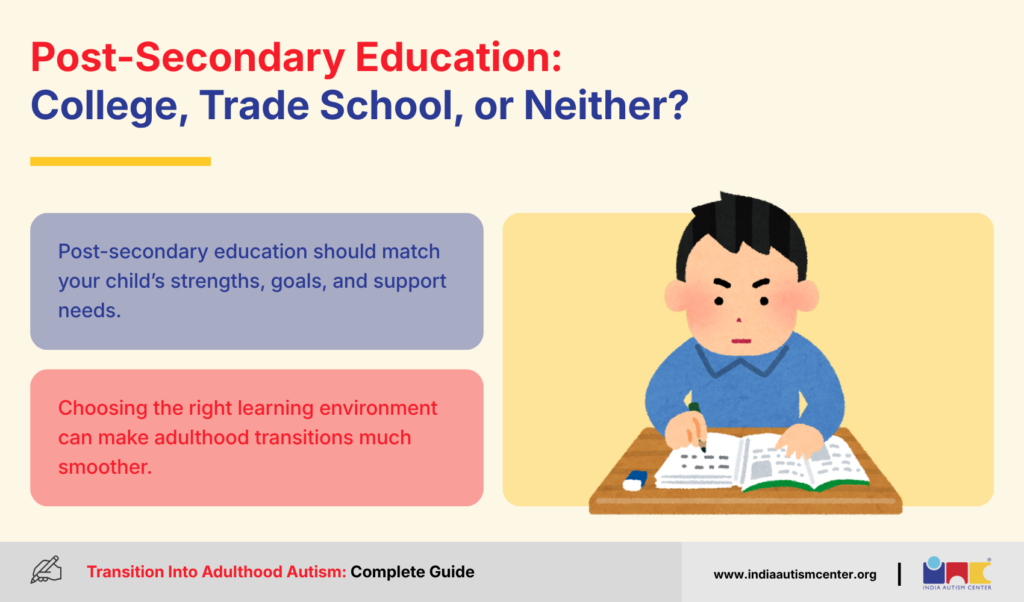
Your cousin keeps asking, “Is he going to college?” And you want to scream.
Let’s set the record straight. Post-secondary education is not a moral requirement. It is a tool. Does your child need that tool?
Signs a Traditional Four-Year College Might Work
- Reading comprehension at or near grade level
- Ability to follow a loose schedule (not minute-by-minute)
- Can handle some independent studying
- Wants to be there (not just pleasing you)
Better Options for Many Autistic Young Adults
- Community college – smaller classes, less expensive, easy to drop in and out
- Trade or vocational school – HVAC, culinary arts, medical coding (hands-on, clear rules)
- Certificate programs – digital marketing, computer repair, pharmacy technician
If your child struggles with social communication, dorm life can be a nightmare. Roommates who party until 2 AM. Cafeterias with 500 people. Large lecture halls with no structure.
Instead, start with one class. One. Then add more slowly. And register with the disability services office on day one. Ask for note-takers, extended time on tests, and permission to record lectures.
Housing: Where Will They Live?
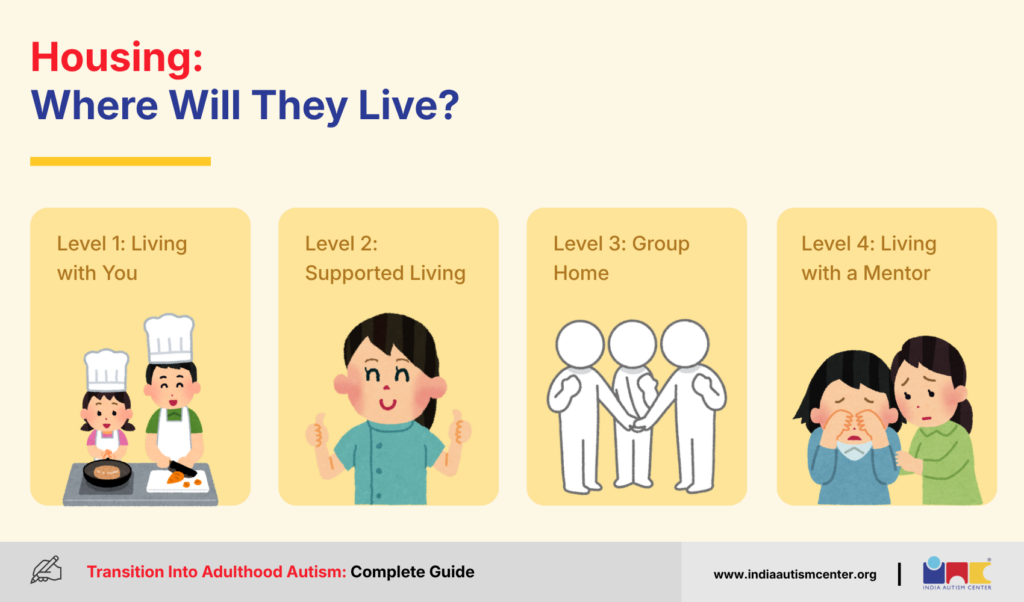
This is the question that keeps you up at night. I know.
The old model was simple: group home. But now you have many more options. Let us walk through the spectrum of independent living.
Level 1: Living with You (with adult rules)
Many autistic adults live with parents well into their 30s. That is fine. But make a formal agreement. Charge a small rent ($200/month). Assign chores. Expect them to cook one night a week. Treat them like a roommate, not a child.
Level 2: Supported Living
They have their own apartment (or a room in a shared house). A support worker visits 5–15 hours per week to help with budgeting, medical appointments, and social outings. This is often funded through Medicaid waivers.
Level 3: Group Home (now called Community Living Arrangement)
For those who need 24/7 supervision. Many group homes are terrible. Some are wonderful. You must visit often, check staffing ratios, and stay involved.
Level 4: Living with a Mentor or Peer
Some families buy a duplex. Their adult child lives in one unit; a responsible graduate student or older adult lives in the other rent-free in exchange for 10 hours of check-ins per week.
Start touring options when your child turns 16. Waitlists for adult disability housing are often 5–10 years long. Yes, years. Do not wait.
Have a look at our Residential Programs at IAC
Social Communication and Friendships as an Adult
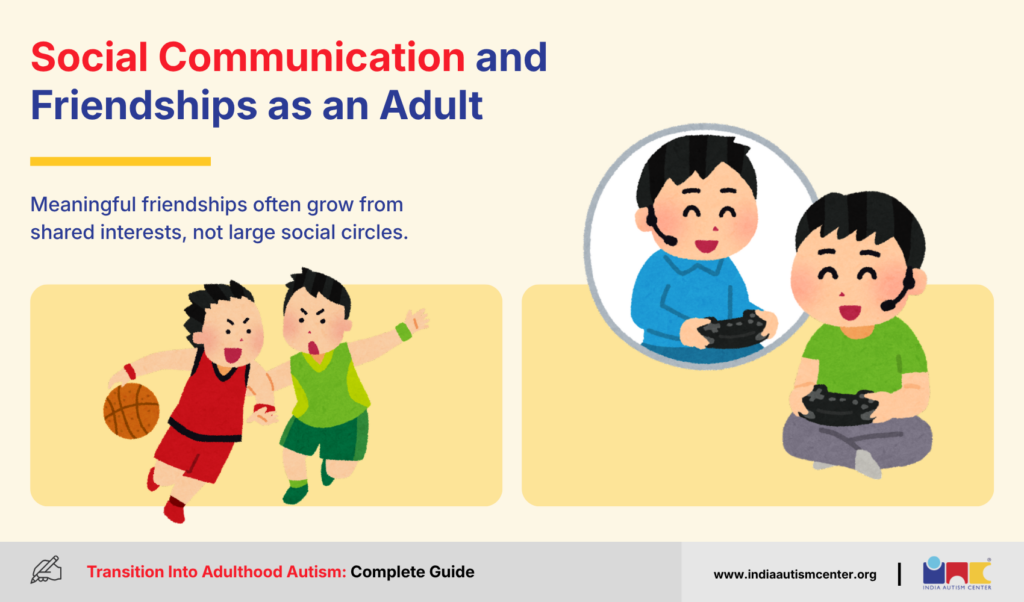
Your child may not need a huge friend group. But loneliness is real. And social communication in adulthood is trickier than in high school.
At school, peers are forced together. After graduation, no one forces anything.
How to Help Your Adult Child Build Social Connections
- Special-interest groups – Dungeons & Dragons at the local game store, train clubs, anime conventions, coding meetups. Shared interests lower the social pressure.
- Peer mentor programs – Some adult disability agencies match your young adult with a neurotypical peer for weekly coffee or walks.
- Online communities – Discord servers, Reddit forums, or video game guilds. If real-world interaction is too hard, online friendship is still real friendship.
- Volunteering – Animal shelters, food banks, or libraries. Lower stakes than a paid job.
Teach them the two-question rule for conversations: Ask someone a question. Listen to the answer. Then ask one follow-up question. Then you can talk about your special interest. That small framework prevents monologuing.
Your Emotional Health as a Parent
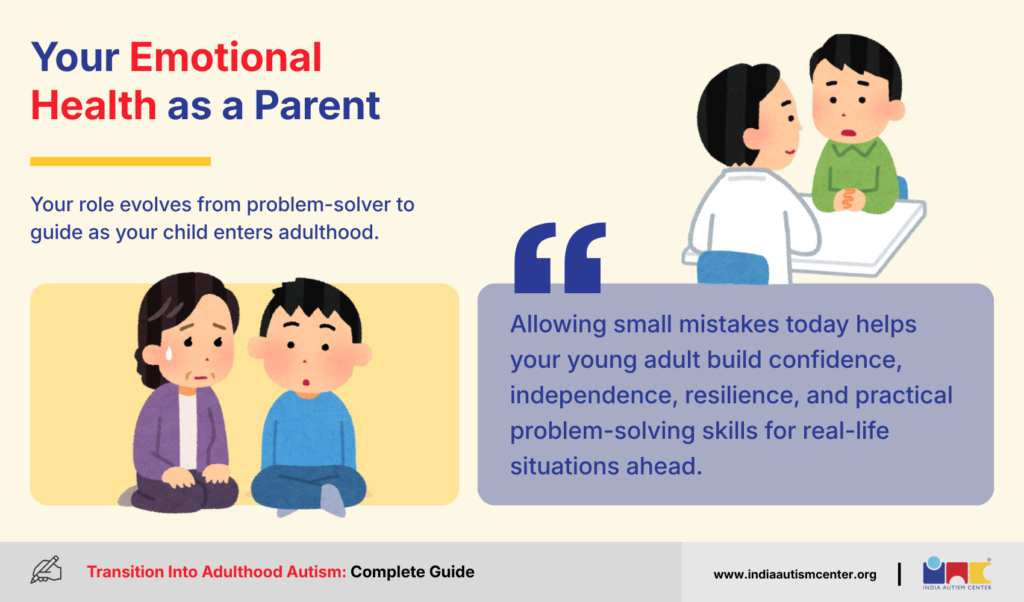
I see you. You have spent 20 years advocating, crying, celebrating, and exhausting yourself. And now the autism adulthood transition asks you to do even more.
But here is the secret. Your best role now is not “fixer.” It is “consultant.”
Step back. Let them fail in small ways. Let them forget to do laundry and wear a dirty shirt to work. Let them call you from the bus stop because they missed the bus. Do not rescue immediately.
Why? Because you will not be here forever. They need practice fixing their own small problems while you are still around to help them debrief.
Find your own support. A therapist. A parents’ group for adult autistic children. A weekly coffee with a friend who gets it. You cannot pour from an empty cup.
The First Year After High School: A Survival Guide
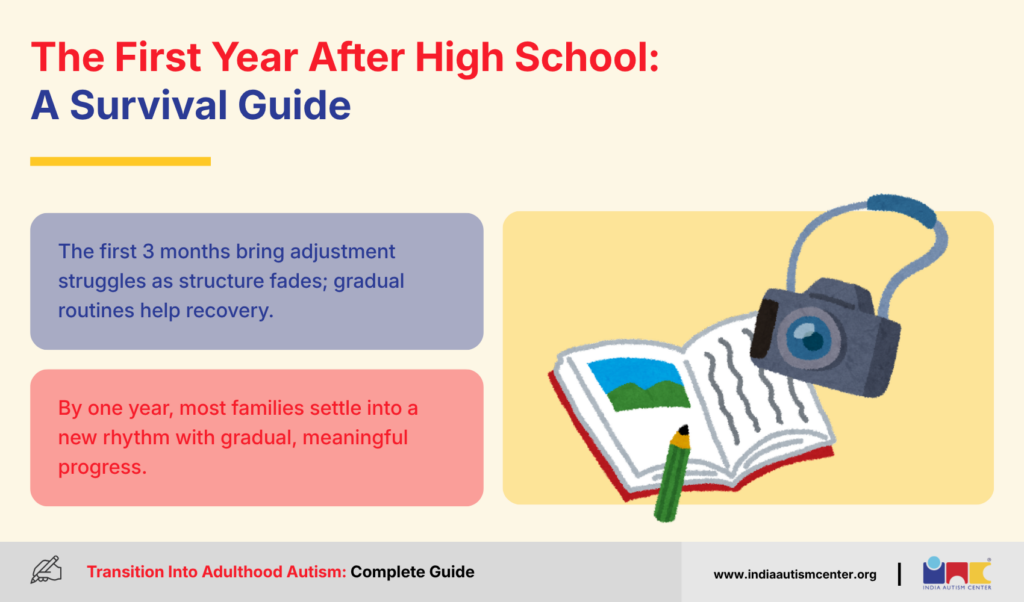
That first year of the autism adulthood transition will feel like chaos. Prepare for it.
The 3-Month Slump
Months 1-3: They sleep late, eat junk food, and seem lost. This is normal. The structure of school is gone. Give them a few weeks of decompression, then start slowly introducing new routines.
The One-Year Mark
After 12 months, most families have found a new rhythm. Maybe they work 15 hours a week at a pet store. Maybe they take two community college classes. Maybe they volunteer at a library. Progress is progress.
Celebrate small wins. A successful bus ride. A polite email to a professor. A meal they cooked without your help. Write these down. On hard days, read the list.
📥 Free download: Printable daily routine chart for autistic children
Conclusion
Close your eyes for a moment. Picture your child at 30. Not at 18. At 30.
What do you see? Maybe they live in a small apartment with a cat. Maybe they work at a grocery store and come home tired but satisfied. Maybe they text you a funny meme every morning.
That is success. That is not a tragedy. That is a real, meaningful adult life.
The autism adulthood transition is not about turning your child into a neurotypical corporate executive. It is about giving them the tools to build a life that feels good to them.
You have done amazing work to get them this far. Now take a breath. Make a plan. Start today with one small step.
Key Takeaways (for that parent notebook you keep)
- Start transition planning by age 14 – demand it in the IEP.
- Teach independent living skills at home – laundry, cooking, money.
- Vocational training for autism works – seek internships and job coaching.
- Consider guardianship alternatives – supported decision-making preserves dignity.
- Healthcare transition needs a script – practice self-advocacy phrases.
- Post-secondary education is optional – trade school is just as valid.
- Housing waitlists are long – start touring group homes and supported living at 16.
- Functional needs trust and ABLE account – protect benefits and savings.
- Write a letter of intent – your future self will thank you.
- Take care of yourself – you are the long-term support system.
Disclaimer: This article is for educational purposes. Laws, benefits, and programs change. Always consult an attorney, benefits counsellor, or medical professional for your specific situation.
Frequently Asked Questions
What if my adult child refuses to leave the house at all?
Start tiny. A walk to the mailbox. A drive-through coffee run. 5 minutes in the backyard. Then build. If refusal persists more than 2 weeks, consider depression screening.
Can my child still get SSI if they work?
Yes. SSI has work incentives. In 2025, they can earn about $2,000 per month and keep partial benefits. Talk to a benefits counsellor.
How do I handle meltdowns in public now that they are an adult?
Police may not understand autism. Create a safety card that explains “This is a meltdown, not aggression. Please give us 10 minutes alone.” Keep it in their wallet.
What if nothing I try works and they just play video games all day?
First, stop all unlimited screen time. Use video games as a reward for completing one small task (taking a shower, sending one job application). Then slowly increase expectations. Therapy may be needed for pathological demand avoidance.
Disclaimer: This article is intended for educational and informational purposes only. It is not a substitute for professional medical advice, diagnosis, or treatment. If you are pregnant or have concerns about medication use during pregnancy, please consult a qualified healthcare provider. If your child has received an autism diagnosis and you have questions about causes or support, please reach out to a trained specialist or an autism-focused organisation for guidance.
For expert insights, support services, and inclusive learning initiatives, visit the India Autism Center.