 Donate now
 Get a Call Back
 MENU
MENU 11 MIN READ
 SHARE
SHARE


Yes — the X chromosome does appear to offer girls a degree of biological protection against autism. A landmark study published in Nature Genetics in March 2026 identified specific genes on the X chromosome that may reduce the impact of autism-linked genetic mutations in females. This doesn’t mean girls can’t have autism. It means they may need a higher genetic threshold before it manifests.
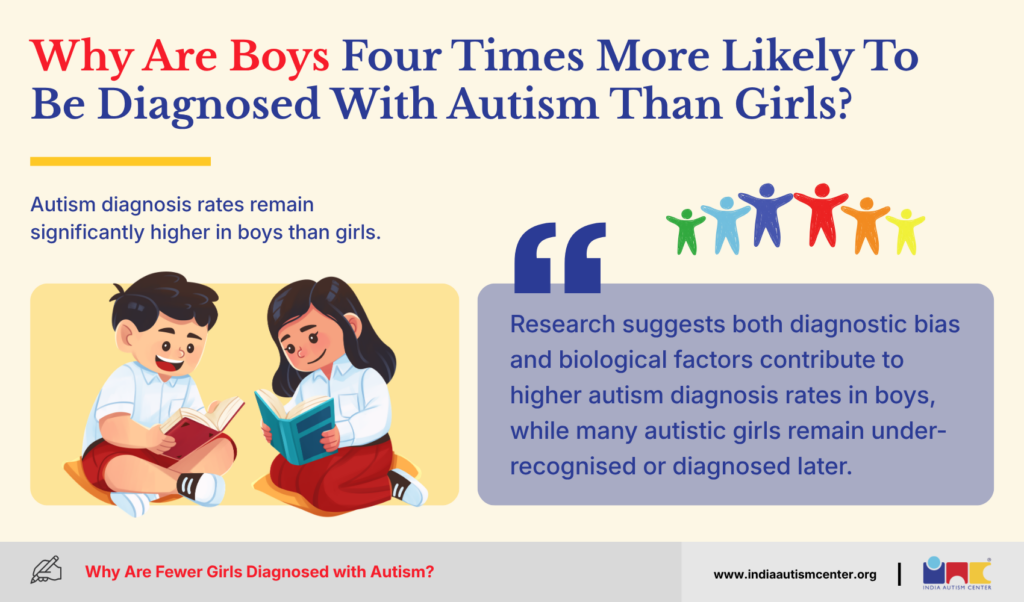
Why Are Boys Four Times More Likely To Be Diagnosed With Autism Than Girls?
This is one of the most persistent questions in autism research.
For decades, data across countries — including India — has shown that boys are diagnosed with autism at roughly four times the rate of girls. The ratio holds up across cultures, income groups, and healthcare systems.
For a long time, the dominant explanation was bias. The thinking was that girls were simply being missed — that they present differently, mask better, and fall through the diagnostic cracks. And that’s true, to a significant extent.
But a major 2026 genetic study has added a second, equally important layer to this story: biology itself may be at play.
What Did The 2026 Nature Genetics Study Actually Find?
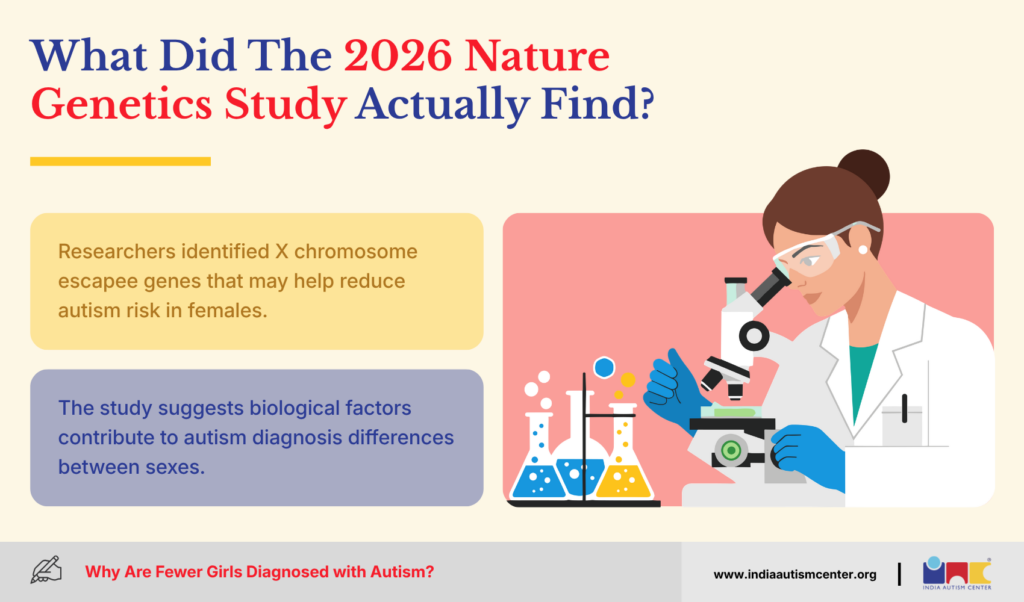
Researchers at the Whitehead Institute and the Massachusetts Institute of Technology (MIT) published a study on March 30, 2026, in Nature Genetics that zeroed in on the X chromosome as a possible source of protection against autism in females.
Here’s what they found, in plain language:
- Females carry two X chromosomes (XX); males carry one X and one Y (XY).
- Scientists previously believed one of a female’s two X chromosomes was almost entirely “switched off” — a process called X-inactivation.
- Newer research shows this is not the full picture. Some genes on the “inactive” X chromosome remain active. Scientists call these “escapee genes”.
- These escapee genes appear to regulate the activity of many other genes, including some directly linked to autism risk.
- Having a second copy of these regulatory genes may help counterbalance the effect of autism-associated genetic mutations.

The fact that we observe sex-related disparities in conditions affecting the entire body reinforces the idea that the male predominance in autism can't be explained solely by diagnostic inequalities.
- David Page, Lead author
What Is The "Female Protective Effect" In Autism?
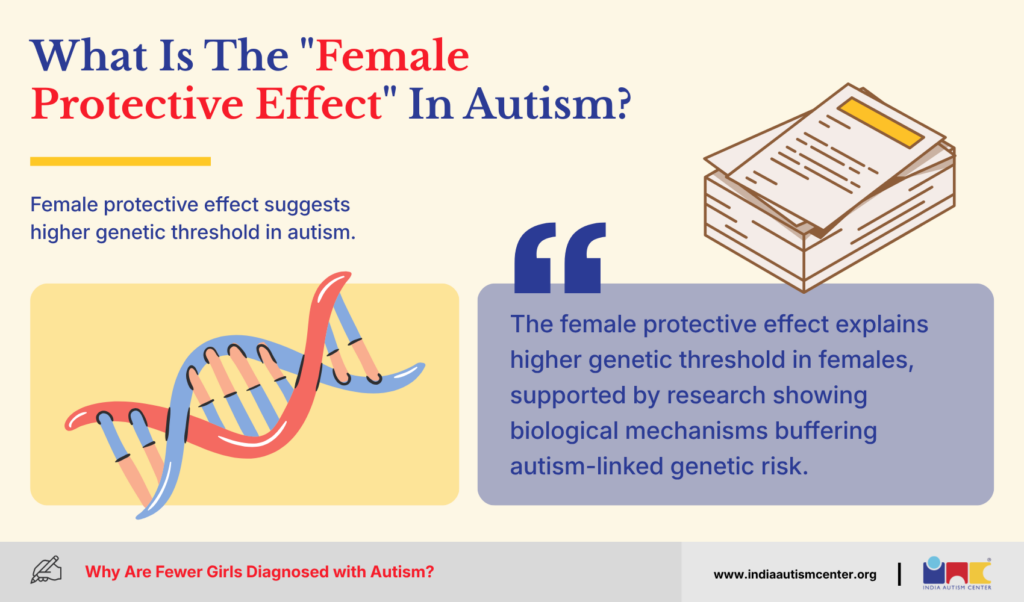
The Female Protective Effect (FPE) is a well-established theory in autism research. It proposes that females require a higher genetic or biological "load" before autism manifests compared to males.
Think of it like a dam with a higher wall. The same amount of water (genetic risk) that floods a lower dam in a boy may stay safely contained in a girl.
This doesn't mean the risk isn't there. It means the threshold is higher.
Key evidence supporting the FPE:
| Study | Year | Finding |
| American Journal of Human Genetics | 2014 | Autistic females carry more autism-linked genetic mutations on average than autistic males |
| Nature Genetics (Whitehead Institute/MIT) | 2026 | Escapee genes on the X chromosome may buffer the impact of those mutations |
| Multiple population studies | Ongoing | The 4:1 male-to-female ratio holds consistently across diverse populations |
The 2026 study doesn't invent the FPE. It gives us, for the first time, a credible biological explanation for how it works.
Want to know more? Get in touch with us.
What Exactly Are "Escapee Genes" On The X Chromosome?
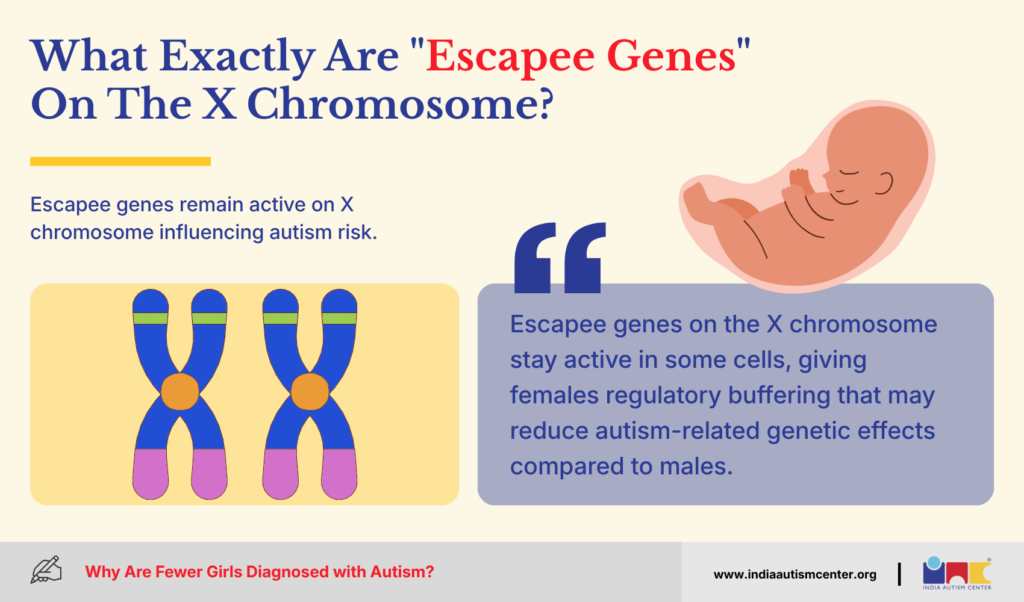
Here's a quick biology refresher, kept simple.
Every cell in the human body contains chromosomes — structures that carry genetic instructions. Females have two X chromosomes. To prevent a "double dose" of X-linked genes, one of the two X chromosomes in each female cell is largely silenced. This is called X-chromosome inactivation.
However, not all genes on the silenced X stay silent. Some "escape" the inactivation process and remain active. These are escapee genes.
Why does this matter for autism?
- Escapee genes on the second X chromosome give females an extra functional copy of certain regulatory genes.
- These regulatory genes can influence how autism-related mutations express themselves.
- In males, there is only one X chromosome — so there is no backup copy, no regulatory buffer.
It's the genetic equivalent of having a co-pilot in the cockpit. Males are flying single-handed.
Our biology is not uniform. Differences between the sexes clearly play an important role in health, and it's essential for us to understand them.
-Maya Talukdar, First author
Does This Mean Girls Are Immune To Autism?
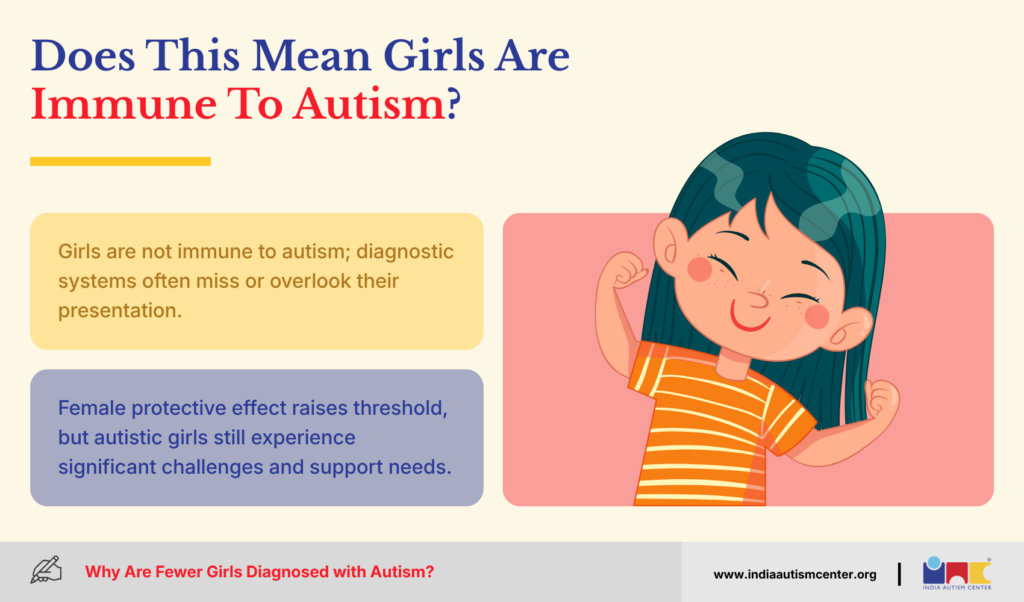
No — and this point is critical.
The female protective effect does not prevent autism. It raises the threshold at which autism manifests. When girls do cross that threshold, research consistently shows they often carry more significant genetic mutations than their male counterparts with similar diagnoses.
This means:
- Autistic girls are real. Their autism is not milder, imagined, or a misdiagnosis.
- They are being missed. The diagnostic system was largely built around the male presentation of autism.
- When they are diagnosed, their profile may be more complex than typical male presentations.
Girls who are autistic are not protected from the challenges of autism. They may simply have needed a larger biological "push" to reach diagnosis — and that gap in diagnosis has real-world consequences.
Why Are So Many Autistic Girls Still Being Missed?
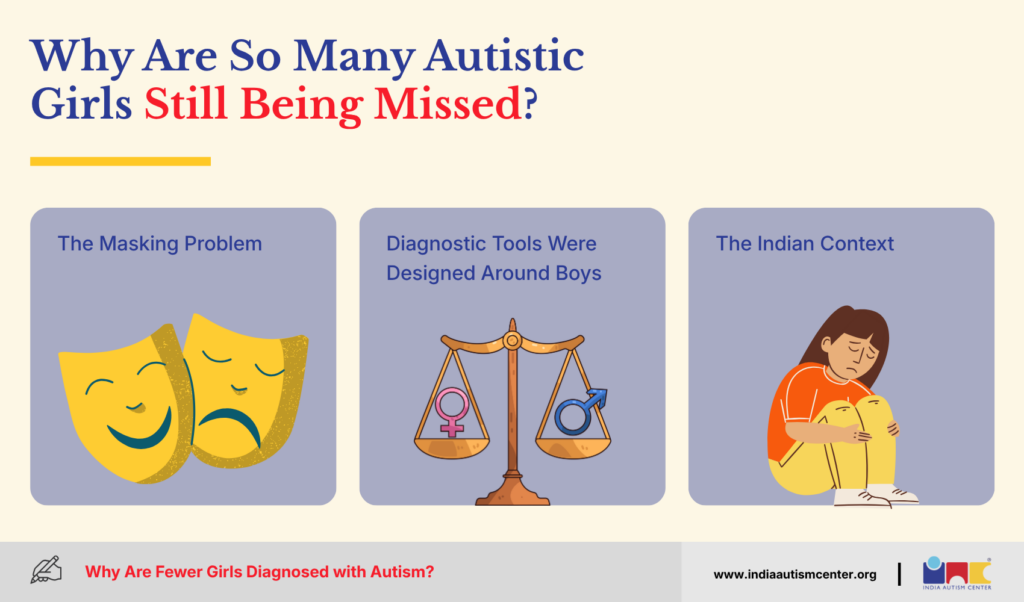
This is where biology and social context intersect — and where the problem deepens.
Even accounting for the female protective effect, there is strong evidence that a significant number of autistic girls are going undiagnosed. The reasons are both scientific and cultural.
The Masking Problem
Masking (also called camouflaging) refers to the conscious or unconscious process by which autistic people suppress their natural behaviours to appear neurotypical. Research shows autistic girls mask more extensively than autistic boys.
Common masking behaviours in girls include:
- Mimicking the social behaviour of peers
- Suppressing stimming in public
- Forcing eye contact even when it feels uncomfortable
- Using scripted social responses learned through observation
- Developing intense but socially acceptable special interests (e.g., books, animals, celebrities — rather than the train schedules or video games stereotypically associated with autistic boys)
Masking is exhausting. It works well enough to fool clinicians, teachers, and even parents — but it comes at a significant cost. Many autistic girls develop anxiety, depression, and burnout as a direct consequence of sustained masking, often hitting a breaking point in adolescence.
Diagnostic Tools Were Designed Around Boys
The original diagnostic criteria for autism were developed largely from studies of male subjects. Tools like the Autism Diagnostic Observation Schedule (ADOS) were not initially calibrated to detect the subtler, more socially-oriented presentations common in girls.
This has begun to change, but slowly. The bias persists in clinical practice, especially in lower-resource settings.
The Indian Context
In India, additional cultural layers complicate diagnosis in girls:
- Girls are socialised to be quiet, compliant, and accommodating — traits that can mask autistic behaviour effectively.
- Family concerns about marriageability and social stigma may discourage parents from seeking an autism evaluation for daughters.
- Diagnostic services in India remain heavily concentrated in urban centres, where gender biases in clinical practice mirror global patterns.
The result: India almost certainly has a significant population of autistic girls and women who have never been identified, never received support, and are navigating life without understanding why it feels so difficult.
📥 Free download: Printable daily routine chart for autistic children
What Are The Signs Of Autism in Girls That Parents Often Miss?
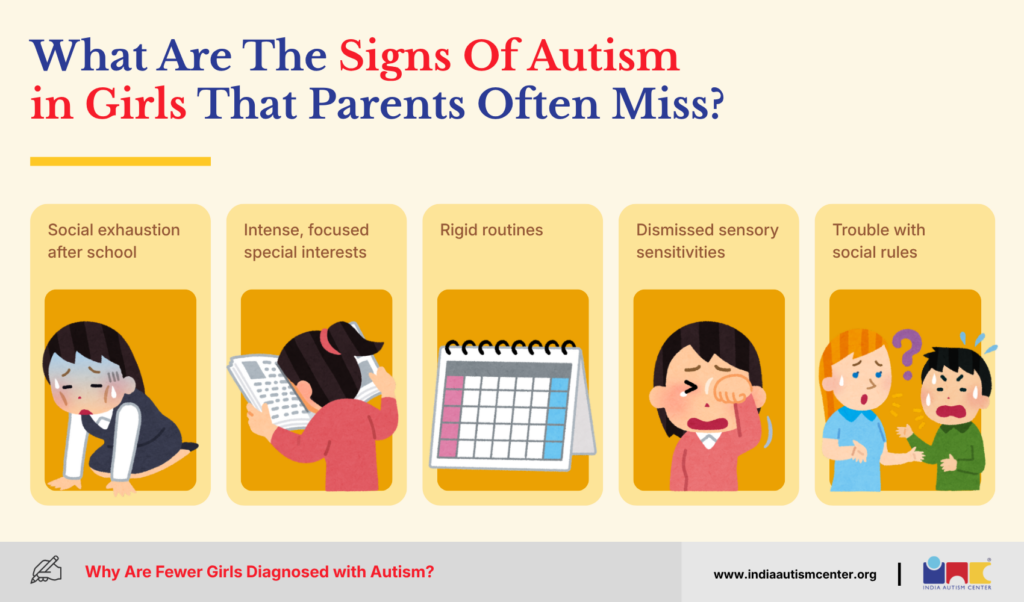
Because masking is so effective, the signs of autism in girls often look very different from what most parents picture when they think of autism.
Watch for these patterns in girls:
- Social exhaustion after school — appears fine in class, but melts down at home. School consumes all her regulatory energy.
- Intense, focused special interests — not unusual in type, but unusual in depth and exclusivity.
- Rigid routines — distress when plans change, even small ones.
- Sensory sensitivities dismissed as "being dramatic" — clothing textures, food consistency, loud environments.
- Difficulty with unstructured social time — playdates and group settings are harder than one-on-one interactions.
- Trouble with abstract social rules — understands explicit instructions but struggles with unspoken social norms.
- History of anxiety or depression — often the presenting issue in adolescent girls whose underlying autism was never detected.
None of these signs alone confirms autism. But a consistent pattern across multiple settings and developmental stages warrants a proper evaluation.
Read our blog on Does Tylenol Cause Autism? What the Largest Autism Study Found
What Does This Research Mean For The Future Of Autism Diagnosis?
The implications of the 2026 Nature Genetics study extend well beyond a single discovery.
For diagnostics: If we understand why girls have a higher threshold for autism, we can develop sex-sensitive screening tools that catch girls earlier — before years of masking take their toll.
For intervention: Earlier identification means earlier support. The earlier a child receives appropriate intervention, the better the outcomes across communication, daily living skills, and emotional regulation.
For genetic counselling: Families with autistic children may one day benefit from understanding their child's specific chromosomal profile — and what it means for siblings.
For other conditions: The female protective effect may apply to ADHD, dyslexia, and other neurodevelopmental conditions where boys are similarly over-represented. This research could open doors across multiple fields.
For research inclusivity: Science has historically under-included women and girls in autism research. This study is a reminder of what we miss when we do. More diverse, sex-stratified research is essential going forward.
What Should Parents Of Girls Do With This Information?
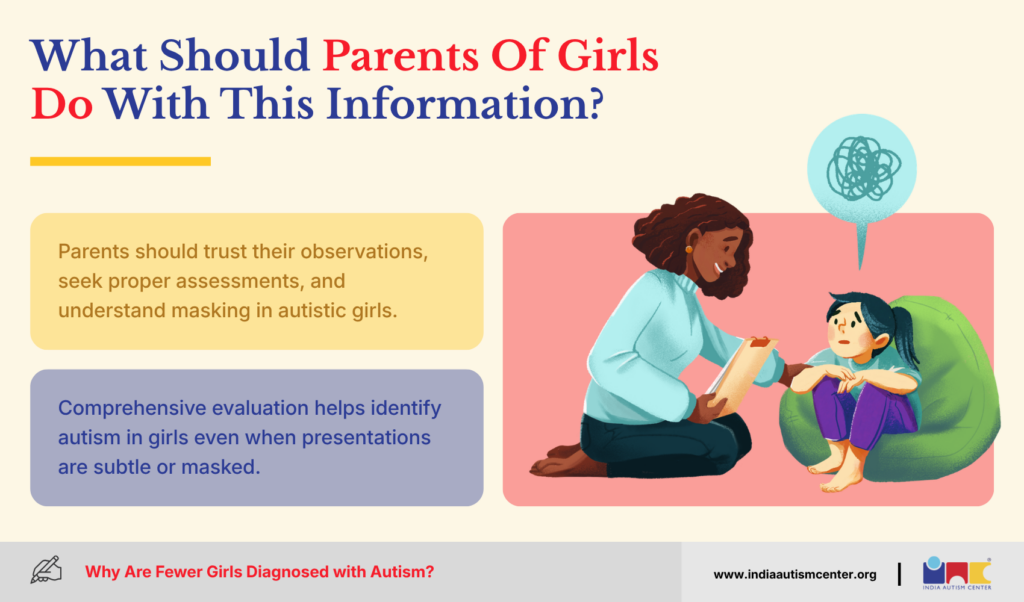
If you've been wondering whether your daughter might be autistic — or if you've been told she's "probably fine" — this research gives you scientific grounding to push further.
Here's what I'd recommend:
- Trust your observations. You see your child across contexts. A clinician sees her for an hour at her most regulated.
- Ask specifically about female presentation when seeking an assessment. Not all clinicians are trained in this.
- Don't let masking fool you. The fact that she "seems fine at school" doesn't rule out autism — it may, in fact, be evidence of it.
- Seek a multidisciplinary evaluation. Autism in girls often co-occurs with anxiety, ADHD, or sensory processing differences. A thorough assessment looks at the full picture.
- A diagnosis is not a ceiling. It's a starting point for understanding, support, and self-knowledge.
At India Autism Center, we work with families navigating exactly these questions. Our team provides comprehensive assessments that account for the full spectrum of autism presentations — including the subtler profiles more common in girls.
You may want to read Signs of Autism in Women: Early Clues, Diagnosis & Support
Conclusion
- Boys are diagnosed with autism roughly four times more than girls — a ratio that holds globally, including in India.
- A 2026 Nature Genetics study from the Whitehead Institute and MIT identified "escapee genes" on the X chromosome that may buffer the impact of autism-linked mutations in females.
- This supports the female protective effect — the theory that girls need a higher biological threshold before autism manifests.
- The FPE does not mean girls can't have autism. Many autistic girls are missed due to masking and diagnostic tools built around male presentations.
- Earlier, better, and more inclusive diagnosis for girls is both possible and urgent — and this research may accelerate it.
Want to know more? Get in touch with us.
Frequently Asked Questions (FAQs)
Can girls have autism even if the X chromosome offers protection?
Yes. The protection raises the threshold — it doesn't eliminate the possibility. Many girls are autistic, and many more are going undiagnosed.
Is the female protective effect proven?
The FPE is a well-supported theory with growing evidence. The 2026 study provides the first credible molecular mechanism. Further research is ongoing.
Why do autistic girls often get diagnosed later than boys?
Primarily due to masking behaviours and diagnostic tools not calibrated to female presentations. Cultural factors, including social pressure on girls to be compliant, can further obscure symptoms.
What should I do if I think my daughter might be autistic?
Seek a comprehensive evaluation from a multidisciplinary team experienced in autism. Ask specifically about female presentation. Don't rely on surface-level behaviour as a disqualifier.
Does this research change how autism is treated in girls?
Not yet directly, but it points toward the need for sex-stratified diagnostic tools and personalised intervention approaches — an important shift the field is beginning to make.
For expert insights, support services, and inclusive learning initiatives, visit the India Autism Center.
Disclaimer: This article is intended for educational and informational purposes only. It does not constitute medical advice, a clinical diagnosis, or a substitute for professional consultation. If you have concerns about your child's development, please consult a qualified healthcare professional or developmental specialist. India Autism Center encourages all families to seek personalised guidance from trained clinicians. The research cited reflects findings available at the time of publication and is subject to ongoing scientific review.
Sources: Nature Genetics (March 2026), Whitehead Institute for Biomedical Research, Massachusetts Institute of Technology, American Journal of Human Genetics (2014), Futura Sciences.