 Donate now
 Get a Call Back
 MENU
MENU 13 MIN READ
 SHARE
SHARE


Let me be honest with you.
When people first decide to work for an NGO, they are excited, motivated, and completely clueless. They have a degree, a burning desire to “do something meaningful,” and zero experience in the development sector. Every job posting they opened asked for “2+ years of field experience” or a “background in humanitarian work.” Many don’t have either.
And if you’re reading this, I’m guessing you’re in a similar spot.
Here’s the good news: you don’t need years of experience to start your NGO journey. What you need is the right strategy, a little patience, and the willingness to show up. In this guide, I’m going to walk you through exactly how to break into the NGO sector — step by step — even if you’re starting from zero.
What is an NGO, and why is it Different from a Regular Job?
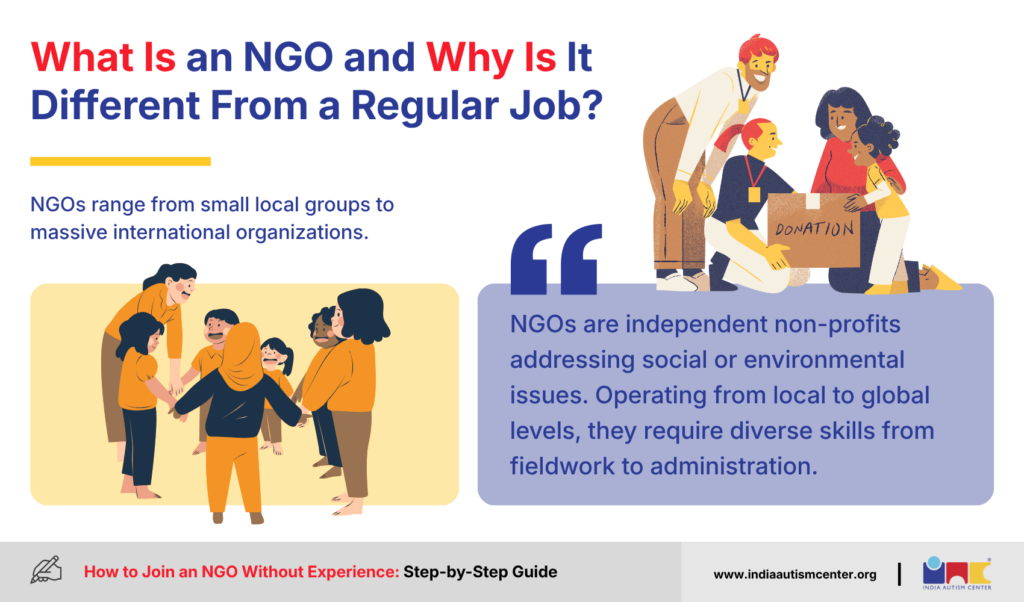
Before we talk about how to join one, let’s quickly understand what an NGO actually is — because “NGO” is a broad term that means different things in different contexts.
A Non-Governmental Organisation (NGO) is a non-profit organisation that operates independently of the government. Its goal is to address social, environmental, humanitarian, or developmental issues. NGOs are funded through donations, grants, and sometimes government partnerships — but they aren’t government bodies themselves.
There are different types of NGOs you might want to work with:
- Local/grassroots NGOs — small organisations working within a specific community or city (like an NGO in Kolkata working on child education)
- National NGOs — organisations working across a country (like Pratham or Goonj in India)
- International NGOs (INGOs) — global organisations like Oxfam, Save the Children, or Médecins Sans Frontières
- UN Agencies — like UNICEF, UNDP, or WHO (technically intergovernmental, but many entry-level roles exist here too)
NGO roles span a wide range: program delivery, field work, communications, fundraising, research, monitoring & evaluation (M&E), grant writing, finance, and administration. There’s genuinely a place for almost every skill set.
Why NGOs Don’t Always Need “Experienced” Candidates
Here’s something most job seekers get wrong: NGOs say they want experience, but what they really want is commitment.
In corporate jobs, experience signals competence. In the NGO sector, experience signals something deeper — that you understand the reality of working in challenging conditions, that you’re not going to quit after three months, and that you genuinely care about the cause.
But here’s the thing: you can demonstrate all of those things without prior NGO experience.
Many entry-level NGO roles — especially volunteering positions, internships, and fellowship programs — are specifically designed for people without formal experience. Organisations like UN Volunteers, AmeriCorps, and hundreds of local Indian NGOs actively recruit fresh graduates and career changers.
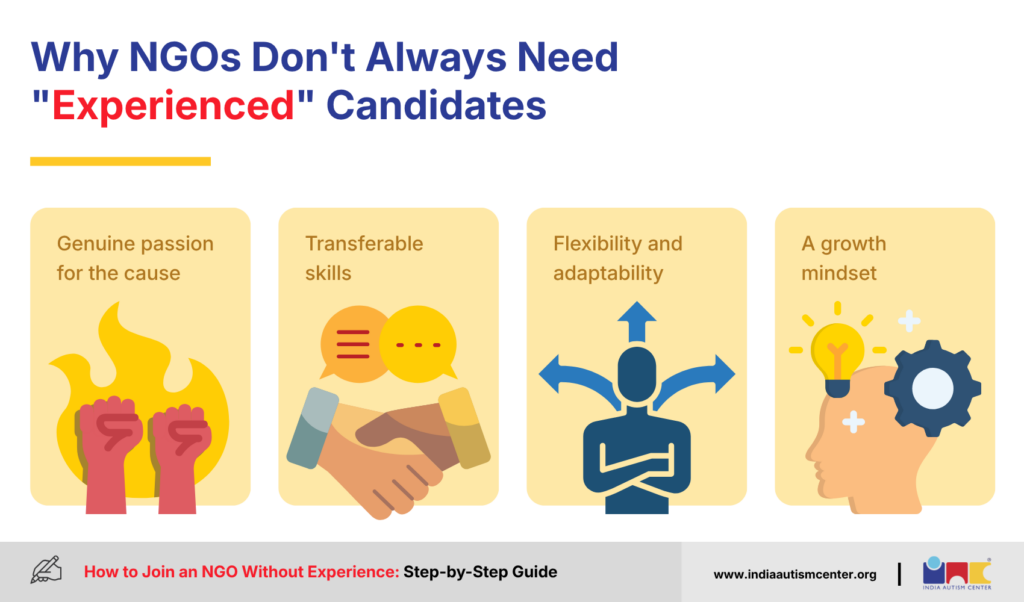
What they’re looking for isn’t a resume full of NGO stamps. They’re looking for:
- Genuine passion for the cause
- Transferable skills (communication, data, project management, writing)
- Flexibility and adaptability
- A growth mindset and willingness to learn
So if you’re sitting there thinking “I have nothing to offer” — stop. You likely have more than you think.
7 Proven Ways to Join an NGO Without Experience
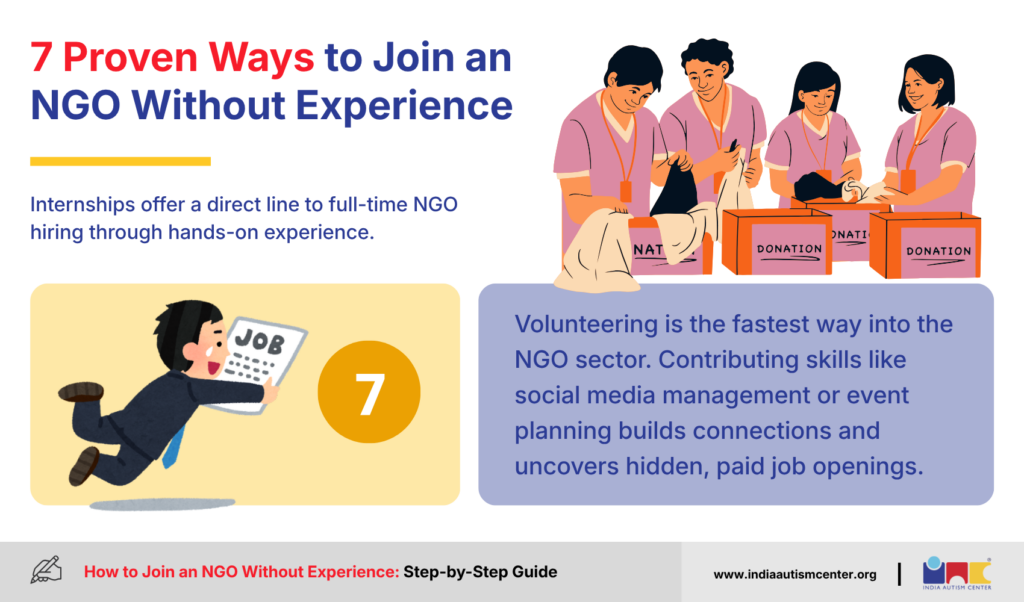
This is the core of what I want to share with you. These are real, actionable pathways — not vague advice like “follow your passion.”
1. Start as a Volunteer
Volunteering is the single fastest way to get your foot in the door. Almost every NGO has volunteer programs, and most of them require nothing more than willingness and reliability.
When I say volunteering, I don’t mean just weekend clean-up drives. I mean structured, skill-based volunteering where you contribute meaningfully:
- Help an NGO manage their social media
- Assist with data collection or field surveys
- Support their event planning or fundraising drives
- Teach a skill (English, computers, art) in their programs
Not only does this give you experience to put on your resume, but it also gets you inside the organisation. You build relationships, understand how the sector works, and often get first notice when paid positions open up.
Where to find volunteering opportunities:
- Volunteering India (volunteeringindia.com)
- iVolunteer (ivolunteer.in)
- United Way India
- Your city’s local NGO directories
- Google: “volunteer with NGO in [your city].”
2. Apply for Internships
NGO internships are one of the best-kept secrets for career switchers and fresh graduates. Many of them are paid (especially at larger national and international organisations), and they are explicitly designed for people with little to no prior experience.
Internships give you:
- Real work experience with a legitimate organisation
- A professional reference (huge for future applications)
- Clarity on whether NGO work is actually right for you
- A direct line to full-time internships
Where to find NGO internships:
- India Autism Center: The best NGOs in the neurodivergent sector
- Idealist.org: One of the best global platforms
- DevNetJobs.org: Focused on development sector roles
- LinkedIn: Search “NGO intern” or “non-profit intern”
- Organisation websites directly (check their “Careers” or “Get Involved” pages)
Pro tip: Don’t wait for internship listings to appear. Send a direct email to organisations you admire, expressing your interest and attaching a short proposal on how you can help. NGOs often create opportunities for motivated people who reach out.
3. Leverage Your Transferable Skills
This one changed the way I looked at my own resume.
You don’t need NGO experience to be valuable to an NGO. You need skills — and skills transfer across industries. Here’s how to map what you already know:
| Your Background | Transferable NGO Skill |
| Marketing / Social Media | Communications, digital outreach, fundraising |
| Teaching / Training | Capacity building, field education programs |
| Data Analysis / Excel | M&E (Monitoring & Evaluation), impact reporting |
| Finance / Accounting | Grant management, budgeting |
| Writing / Journalism | Grant writing, reports, donor communications |
| IT / Tech | Database management, digital tools for development |
| Healthcare | Community health programs, public health initiatives |
| Law | Human rights, legal aid programs |
Look at your existing skills and ask: “How would an NGO use this?” Then write your resume and cover letter through that lens.
4. Build a Cause-Specific Portfolio
If you don’t have NGO experience, create it yourself. A portfolio of cause-related work is surprisingly powerful — especially for roles in communications, research, or program design.
Here are practical ways to build one:
- Start a blog or newsletter about issues you care about (child rights, climate change, women’s empowerment)
- Create social media content advocating for a cause and build a small, engaged following
- Write research summaries or policy briefs on development issues
- Organise a community initiative — even something small like a local food drive or awareness campaign
- Contribute to open-source development projects that support social causes
When you apply to an NGO, you’ll be able to show — not just tell — that you care. That makes a massive difference.
5. Take Relevant Online Courses and Certifications
This one is simple, affordable, and often underused. There are excellent courses available — many of them free or low-cost — that give you foundational knowledge in the development sector.
Courses worth exploring:
- Coursera / edX: Search for courses on “International Development,” “Public Health,” “Human Rights,” “Sustainable Development Goals (SDGs).”
- NPTEL (for Indian learners): Development economics, social policy
- UN SDG Academy: Free online learning on global development
- UNHCR’s Learning Hub: Refugee and humanitarian response training
- Google.org Skills: Digital skills for the social sector
Even completing one or two relevant courses shows initiative. List them on your LinkedIn and resume under “Certifications” — they signal that you’re investing in this career switch seriously.
6. Network Inside the Sector
I’ll be direct: the NGO world is relationship-driven. A lot of hiring happens through word of mouth, referrals, and internal networks. If you’re only applying cold through job portals, you’re fighting the hardest battle.
Here’s how to network effectively:
- LinkedIn: Follow NGOs you admire, engage with their posts, connect with program officers and HR managers
- Attend events: Webinars, panel discussions, development conferences, TEDx talks — show up and introduce yourself
- Info interviews: Reach out to people working in NGOs and ask for a 20-minute call to learn about their journey. Most people are happy to help — and these conversations often lead somewhere unexpected.
- Join sector communities: Facebook groups, WhatsApp communities, Reddit threads focused on non-profit work.
- Alumni networks: Your college alumni working in NGOs are your warmest possible introduction
Don’t network just to “get a job.” Network to genuinely learn, build relationships, and contribute. The opportunities follow naturally.
7. Apply for Fellowship Programs
Fellowship programs are structured, time-bound experiences designed specifically to bring talented people into the social sector — often without prior NGO experience required.
Fellowships worth researching (India & Global):
- Teach For India Fellowship — education-focused, 2-year teaching fellowship
- Gandhi Fellowship — rural education and community leadership
- Acumen India Fellowship — social entrepreneurship and leadership
- Atlas Corps — international NGO placement fellowship
- Echidna Global Scholars — girls’ education focus
- LAMP Fellowship (India) — legislative research and public policy
- UN Young Professionals Programme (YPP) — entry into the UN system
Most fellowships come with a stipend, training, and mentorship. They’re an excellent launchpad — and they look exceptional on your resume.
How to Write an NGO Resume When You Have No Experience
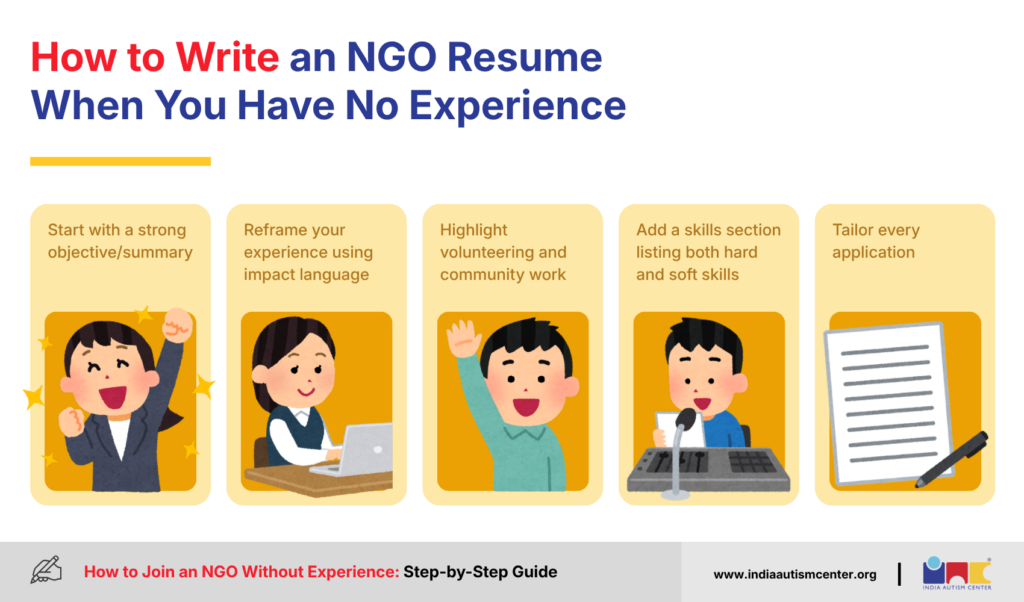
Your resume is your first impression. In the NGO sector, a resume isn’t just a career document — it’s a statement of values. Here’s how to write one that works:
1. Start with a strong objective/summary: Lead with 2–3 lines that communicate your motivation and what you bring. Example:
“A communications professional with 3 years of digital marketing experience, transitioning into the development sector with a focus on women’s empowerment and community engagement. Passionate about using storytelling for social impact.”
2. Reframe your experience using impact language: Even if your jobs weren’t NGO-related, describe them in terms of outcomes and people impacted.
3. Highlight volunteering and community work: Don’t bury it at the bottom. If your NGO-relevant experience is volunteering, make it prominent.
4. Add a skills section: List both hard skills (Excel, research, social media, content writing) and soft skills (communication, adaptability, cross-cultural sensitivity).
5. Tailor every application: Read the organisation’s mission carefully. Mirror their language. Show that you understand their specific work — not just “NGOs in general.”
Crafting a Cover Letter That Actually Gets Read
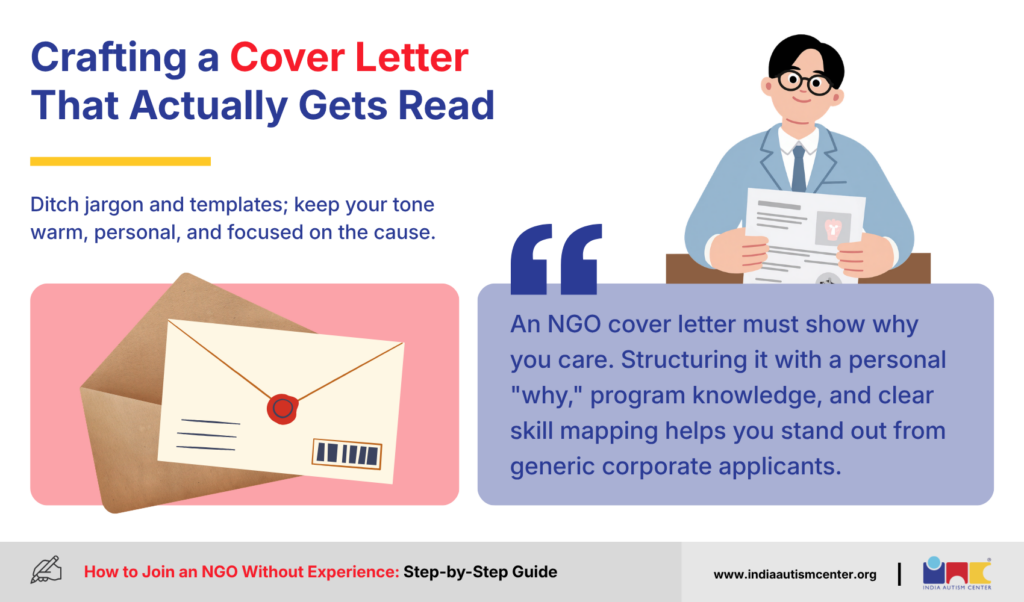
In corporate hiring, cover letters are often skimmed or ignored. In the NGO sector, they matter a lot.
NGO hiring managers want to know why you care — and a well-written cover letter is your chance to show them.
Structure your cover letter like this:
Paragraph 1 — Hook with your ‘why ‘: Tell them why this specific organisation and cause matters to you. Make it personal. Be specific.
Paragraph 2 — Show you understand their work: Mention a specific program, initiative, or impact report you’ve read. Demonstrate that you’ve done your homework.
Paragraph 3 — Connect your skills and experience: Explain clearly what you bring to the table and how your background maps to their needs.
Paragraph 4 — Close with intent: Express your enthusiasm, mention you’d love to discuss further, and include a clear call to action.
Mistakes to avoid:
- Starting with “I am writing to apply for…” (boring, skip it)
- Copy-pasting the same letter to multiple organisations
- Focusing only on what you want to gain, rather than what you’ll contribute
- Using corporate jargon (“synergize,” “leverage bandwidth”) — keep it warm and human
Where to Find NGO Job Opportunities
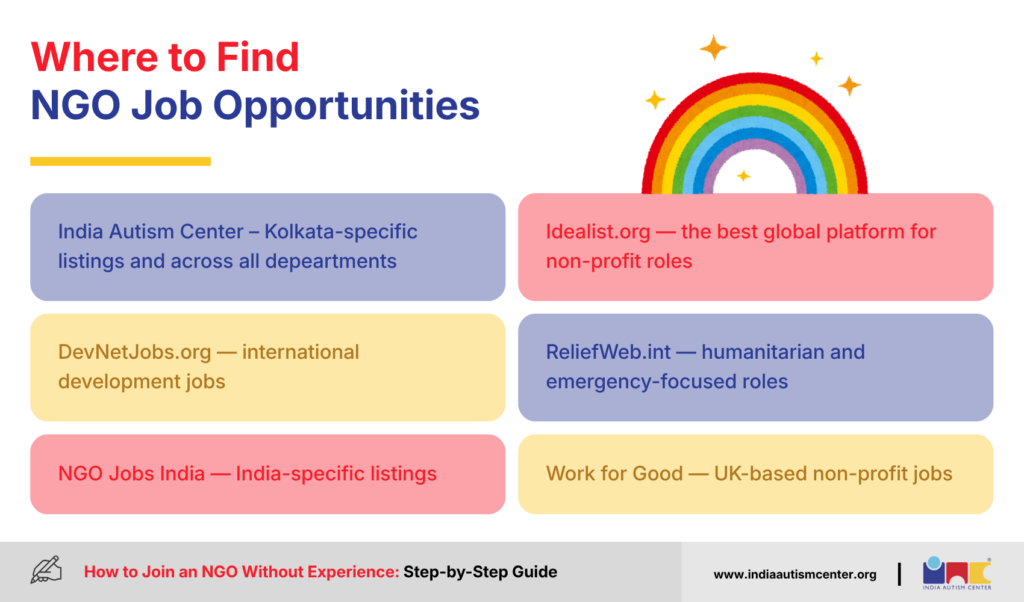
Here’s a consolidated list of the best places to look:
Job Boards:
- India Autism Center – Kolkata-specific listings and across all departments
- Idealist.org — the best global platform for non-profit roles
- DevNetJobs.org — international development jobs
- ReliefWeb.int — humanitarian and emergency-focused roles
- Work for Good — UK-based non-profit jobs
- Opportunity Desk — fellowships, grants, and opportunities globally
Other Channels:
- LinkedIn — follow NGOs, set job alerts, use keywords like “program associate,” “social sector,” “development sector fresher”
- Organisation websites — bookmark and check “Careers” pages of your target organisations regularly
- Facebook groups — search “NGO jobs India,” “development sector jobs,” “social sector careers”
- WhatsApp groups — many sector-specific networks share openings informally
How to Ace the NGO Interview
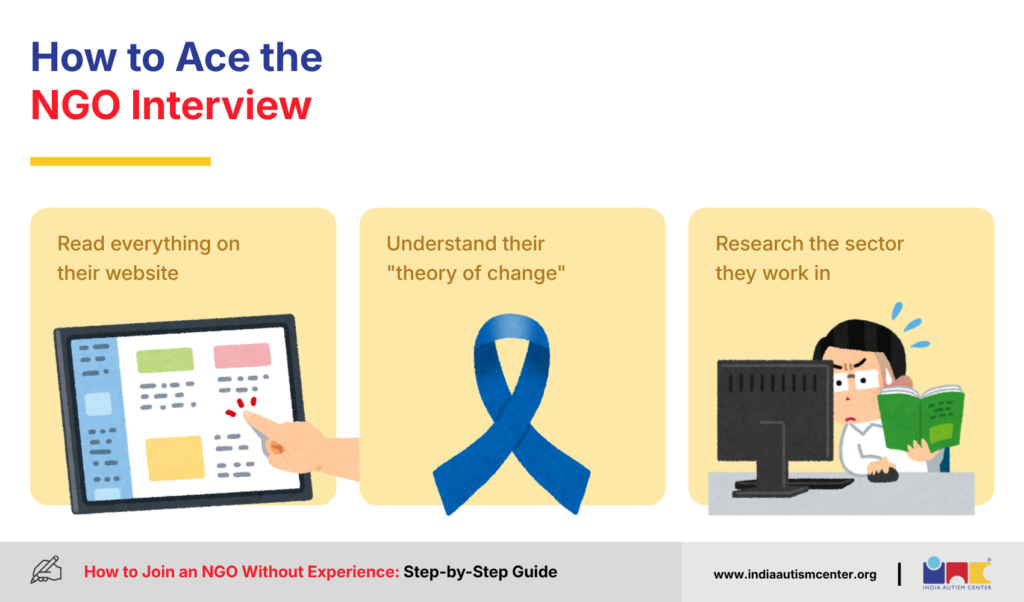
Getting the interview is half the battle. Here’s how to make it count.
Before the interview:
- Read everything on their website — mission, programs, annual reports, recent news
- Understand their “theory of change” (how they believe their work creates impact)
- Research the sector they work in so you can speak knowledgeably
Common NGO interview questions — and how to think about them:
- “Why do you want to work in the development sector?” — Be honest and specific. Avoid generic answers like “I want to make a difference.” Talk about a real moment or experience that shaped your interest.
- “What do you know about our organisation?” — This is a test of preparation. Have 2–3 specific things ready about their programs, geography, or recent impact.
- “How would you handle working in a resource-constrained environment?” — They want to know you can be creative, flexible, and resilient. Give a real example if you can.
- “Do you have experience with [specific skill — e.g., M&E, grant writing]?” — If not, don’t bluff. Be honest, express your eagerness to learn, and mention any adjacent experience or courses.
Questions you should ask them:
- “What does success look like in this role in the first 6 months?”
- “What are the biggest challenges your team is currently navigating?”
- “How does the organisation support the professional development of new team members?”
Asking good questions signals genuine interest and maturity.
Frequently Asked Questions
Can I join an NGO without a degree?
Yes. Many NGOs — especially at the grassroots level — hire based on skills, experience, and commitment rather than formal qualifications. Volunteering, certifications, and demonstrated passion can outweigh a degree in many cases.
Do NGOs pay their workers?
Yes, NGOs do pay salaries — they are not entirely run by volunteers. However, compensation is generally lower than the corporate sector, especially at entry level. International NGOs and UN agencies tend to offer more competitive packages.
How do I find NGOs near me?
Search “[your city] NGO list” or check your state’s NGO directory. In India, you can also explore the NITI Aayog NGO Darpan portal (ngodarpan.gov.in), which lists thousands of registered NGOs across the country
What skills do NGOs look for?
Communication, research, project management, data analysis, community engagement, grant writing, and digital skills are highly valued. Beyond technical skills, NGOs look for empathy, cultural sensitivity, adaptability, and a genuine commitment to the cause.
Is volunteering the only way to enter an NGO?
No. Volunteering is one of the easiest entry points, but internships, fellowships, direct applications for junior roles, and networking are all valid paths. Many people enter through lateral moves from related fields like public health, education, or government.
Can I join an international NGO without experience?
It’s harder, but not impossible. UN Volunteers, the UN Young Professionals Programme, and international fellowship programs like Atlas Corps are specifically designed to bring in candidates with limited formal experience. Start with these, build your experience, and move up from there.
Conclusion
I want to leave you with this: the NGO sector needs people like you.
It needs people who bring fresh perspectives, cross-sector skills, and genuine motivation. The world’s most pressing problems — poverty, inequality, climate change, displacement — aren’t going to be solved by people who already have all the answers. They’ll be solved by people who are willing to show up, learn, and contribute.
You don’t need a perfect resume. You need a clear starting point.
So here’s your action step for this week: pick one thing from this list and do it. Apply for a volunteering role. Sign up for an online course. Send one networking message on LinkedIn. Reach out to a local NGO.
Every career in the development sector started with one small step. Yours starts now.
Found this guide helpful? Share it with someone who’s looking to make the switch into the social sector. And if you have questions, drop them in the comments — I read every one.