 Donate now
 Get a Call Back
 MENU
MENU 10 MIN READ
 SHARE
SHARE


AI for neurodivergent workers is moving from software into physical spaces. Cobots, vision-guided robots, and sensor-driven systems are starting to redesign jobs around how autistic adults actually work best. This shift isn’t about replacing workers. It’s about removing the ambiguity, sensory overload, and unpredictable pacing that keep skilled autistic adults out of jobs they’re fully capable of doing.
Most of that work focuses on schools, therapy, and early intervention. But employment is where the conversation often goes quiet. So let’s talk about what physical AI in the workplace actually looks like, and why it matters right now.
What Is Physical AI, and Why Does It Matter for Autism Employment?
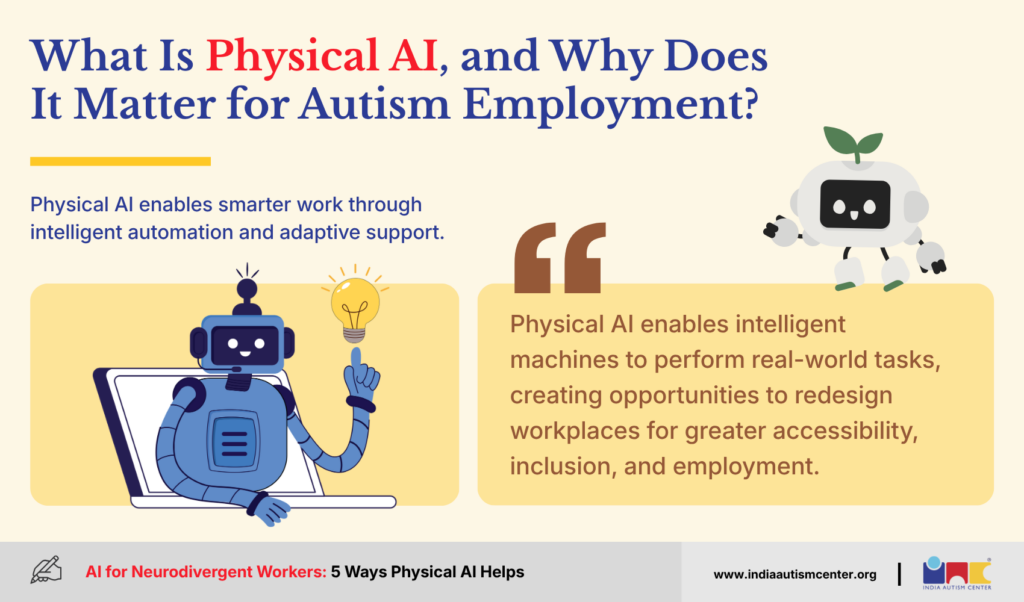
Physical AI refers to AI systems that act in the real world, not just on a screen. Think collaborative robots (cobots), mobile robots, and vision-guided inspection systems. Unlike software-only AI, physical AI touches parts, adjusts pacing, and responds to physical errors in real time.
This distinction matters for autism employment specifically. Many workplace barriers autistic adults face aren’t about screens or paperwork. They’re physical: cluttered workstations, unpredictable noise, sudden pace changes, and feedback that arrives too late to be useful.
Adoption of this technology is already underway. Deloitte’s 2026 State of AI in the Enterprise report found that most companies already report at least some use of physical AI, with that number expected to grow sharply over the next two years. The same report found that a large majority of companies haven’t redesigned jobs around what this technology can now do.
That gap is the whole story. Employers are installing new machines into old job designs. The robot changes. The job stays the same. This is exactly where the opportunity for accessible work sits — in the redesign, not just the installation.
What Employment Barriers Do Autistic Adults Actually Face at Work?
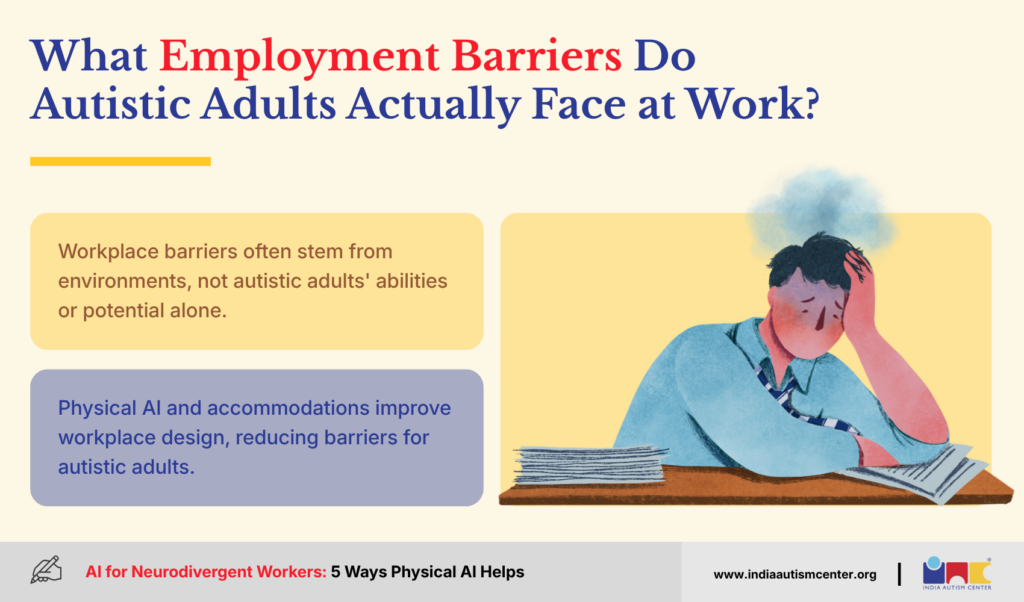
Autistic adults are not a single group with identical needs. But research and lived experience point to a recurring set of environmental barriers. These aren’t about ability. They’re about workplace design.
| Barrier | What It Looks Like | Why It Matters |
| Ambiguity | Unclear instructions, shifting priorities | Increases cognitive load, slows task completion |
| Sensory overload | Noise, bright lights, crowded floors | Builds fatigue across a shift, can trigger shutdown |
| Unpredictable pacing | Sudden speed-ups on a production line | Disrupts focus, increases error risk |
| Delayed or vague feedback | “That didn’t look right,” said hours later | Hard to decode, hard to act on |
None of these barriers are about skill. They’re about how the job is structured around the person doing it. This is the core argument physical AI advocates are making: fix the environment, and the skills gap often turns out to be smaller than assumed.
How Does India’s Legal Framework Address This?
India already has a legal foundation for workplace accommodation. The Rights of Persons with Disabilities (RPWD) Act, 2016 requires reasonable accommodation for employees with disabilities, including autism. A valid UDID (Unique Disability ID) certificate is often the documentation employers request to formalise this support.
The gap isn’t the law. It’s implementation. Most Indian employers don’t yet know what “reasonable accommodation” looks like in a factory or assembly line setting. Physical AI gives that abstract legal requirement a concrete, physical form.
Watch our video on
How Will Physical AI Make Work More Accessible for Autistic Adults?
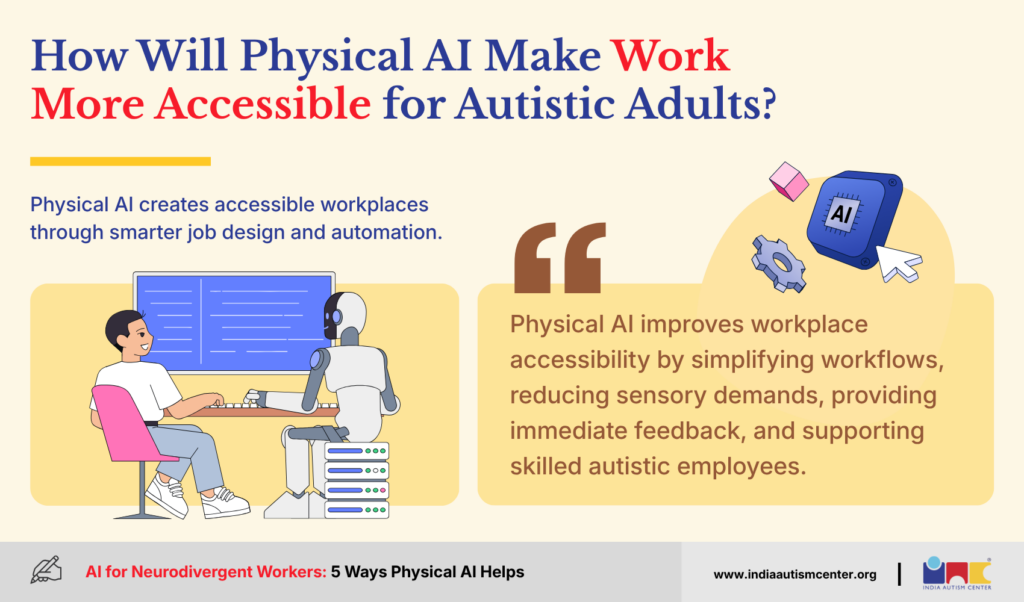
Here are five specific, physical ways this technology can reshape jobs. Each one addresses a real barrier, not a hypothetical one.
1. Can Cobots Bring the Right Part to the Worker?
A large share of a job’s difficulty isn’t the skilled task itself. It’s the logistics around it: searching bins, remembering part numbers, tracking a layout that changed last week. For many autistic workers, this load on working memory is the real barrier.
A cobot can stage and hand over the correct part at the correct moment. The job isn’t just explained better. It’s physically arranged better. This removes an entire category of friction before the skilled work even begins.
For an Indian assembly line or electronics manufacturing unit, this could mean a worker with strong precision skills spends their energy on the task, not on hunting for components. That’s a direct productivity gain, not just an accessibility one.
2. Can Robots Set a Steadier, Self-Paced Work Rhythm?
Sudden, unsignaled changes in pace can be disorienting for many autistic workers. Predictability is often what makes a job workable at all. A cobot can meter the flow of parts to match the worker’s rhythm.
When the worker is ready, the system advances. When the worker needs a short pause, it holds. This adjustment happens silently. Nobody has to disclose a need or ask for slower handling in front of colleagues.
This matters more in workplace cultures where disclosure carries stigma. In many Indian workplaces, asking for accommodation openly can still feel risky. A system that adjusts automatically removes that social cost entirely.
3. Can AI Catch Errors in the Work, Not After the Shift?
Workplace feedback is often indirect, delayed, and wrapped in tone. That combination is genuinely hard for many autistic workers to decode. A vision-guided system changes this by inspecting the actual part.
If a component is missing or misaligned, the system flags it immediately. It can hold the fixture or route the piece for rework the instant the error happens. There’s no tone to interpret and no reprimand with an audience.
This is a fundamentally different kind of feedback loop. It responds to the physical part, not to a supervisor’s mood or phrasing. That distinction is what separates useful correction from stressful, ambiguous criticism.
📥 Free download: Printable daily routine chart for autistic children
4. Can Mobile Robots Remove Chaotic Peripheral Work?
A job is rarely hard because of its core task. The real difficulty is everything happening around it: noise, foot traffic, interruptions, and constant switching between unrelated demands. For workers with heightened sensory sensitivity, this churn builds up across a shift.
Mobile robots can absorb this layer. They move materials and restock supplies, so the work comes to the worker instead of the other way around. The space gets quieter. The person stays focused on the task worth hiring them for.
This shift also benefits neurotypical workers, though the effect is often strongest for autistic employees managing sensory load. Reducing environmental noise tends to improve accuracy and reduce fatigue across an entire floor.
5. Can This Make Skilled Roles Reachable, Not Just Entry-Level Ones?
This is the outcome that matters most, and it’s also the one most likely to be done wrong. A lazy version of inclusion takes one narrow stereotype about autism and turns it into a single job assignment. That isn’t opportunity. It’s a stereotype with a job code.
Done correctly, this approach opens up precision assembly, machine-vision quality review, robotics maintenance, and equipment monitoring. These roles use focus, consistency, pattern recognition, and an eye for anomalies — strengths many autistic adults bring to technical work.
These jobs stayed closed for a reason that had nothing to do with capability. People weren’t excluded because they couldn’t do the skilled part. They were excluded because they couldn’t survive the chaos around it. Physical AI removes that chaos, not the skill requirement.
Read the Latest Tech in Autism You Should Know in 2026.
What Does This Mean for Autism Employment in India?
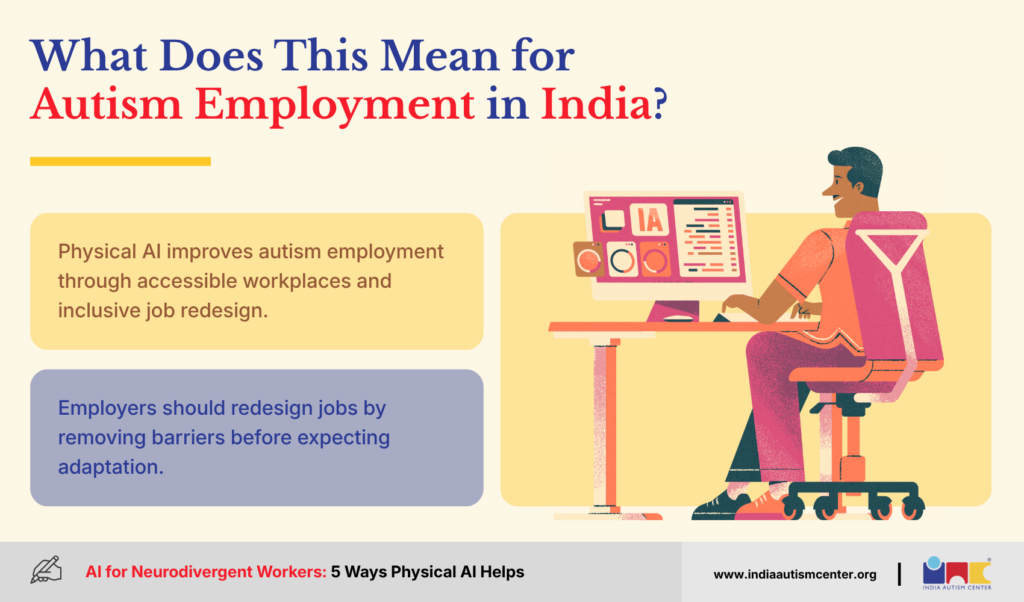
India’s autism employment landscape looks different from the US manufacturing context this conversation often starts in. Labour force participation among autistic and disabled adults remains significantly lower than the general population here. That gap has multiple causes, but workplace design is a major one.
The RPWD Act’s quota provisions already require certain employers to reserve positions for people with disabilities. What’s missing is the physical infrastructure to make those roles genuinely workable, not just technically compliant. Physical AI could be that infrastructure.
Government schemes like ADIP (Assistance to Disabled Persons for Purchase and Fitting of Aids and Appliances) already fund assistive devices. Extending that logic toward workplace robotics and adaptive systems is a natural next step, though not yet a widely discussed one.
Is This Already Happening Anywhere?
Yes, though still at an early stage. A Virginia Tech-led team, backed by the National Science Foundation, is building AI-guided cobots specifically designed to give neurodivergent workers responsive feedback and help manage pacing. This research is happening in the US, but the underlying design principles translate globally.
India’s manufacturing and electronics sectors are strong candidates for early adoption. Auto ancillary units, electronics assembly, and quality control functions all involve the kind of structured, repeatable physical work where cobots already perform well.
What Should Employers and Families Do Now?
For employers, the starting point isn’t buying robots. It’s auditing existing roles for redesign potential. Look at where ambiguity, pacing, and feedback delays create friction, not just where automation could cut headcount.
A few practical starting points:
- Separate the skill from the chaos. Identify which parts of a role are genuinely difficult versus which parts are just disorganized.
- Reference the RPWD Act directly when proposing pilot programs. Reasonable accommodation language already supports this kind of redesign.
- Start small. A single workstation redesign is easier to evaluate than a full-floor rollout.
- Involve autistic employees or candidates in the design process. Environmental barriers are best identified by the people who experience them.
For families, this is a useful framework when evaluating job opportunities or advocating for workplace accommodations. Ask not just “can they do the task,” but “what’s making the task harder than it needs to be.”
Watch our video on Why India’s Autism Employment Is Broken
Want to know more? Get in touch with us.
Conlcusion
Physical AI shouldn’t be measured only by how many workers it replaces. It should be measured by how many capable people it finally makes room for. For autistic adults, that means jobs redesigned around real strengths, not around an imaginary average worker.
The technology exists. The legal framework in India already supports accommodation. What’s missing is the deliberate work of connecting the two. That’s the conversation worth having next.
Frequently Asked Questions
What is physical AI in the context of autism employment?
Physical AI refers to robots and sensor-driven systems that act in the physical world, such as cobots and vision-guided inspection tools. In autism employment, these systems reduce ambiguity, manage pacing, and absorb sensory-heavy peripheral tasks.
How is physical AI different from other workplace AI tools?
Most workplace AI operates through software: scheduling tools, chatbots, or analytics dashboards. Physical AI acts directly on physical objects and environments, which is what allows it to change pacing, staging, and error detection in real time.
Can physical AI help with sensory sensitivity at work?
Yes. Mobile robots can absorb noisy, high-traffic peripheral tasks like restocking and material movement. This reduces the overall sensory load on the factory or workshop floor.
What Indian laws support workplace accommodation for autistic adults?
The RPWD Act, 2016 mandates reasonable accommodation for employees with disabilities. A UDID certificate is typically used to formalize eligibility for these accommodations with employers.
Is physical AI being used in Indian workplaces yet?
Adoption is still early. Global manufacturing sectors are leading, and Indian manufacturing and electronics units are strong candidates for future adoption given their reliance on structured, repeatable physical tasks.
Disclaimer: This article is intended for educational and informational purposes only. It does not constitute legal, employment, medical, or clinical advice. For guidance specific to workplace accommodations, disability certification, or individual employment situations, please consult a qualified professional or relevant government authority.
For expert insights, support services, and inclusive learning initiatives, visit the India Autism Center.