 Donate now
 Get a Call Back
 MENU
MENU 13 MIN READ
 SHARE
SHARE


If your child finds reading, spelling or writing much harder than their classmates despite regular practice, it is natural to wonder whether something more than a learning delay is involved. Dyslexia in children is one of the most common specific learning difficulties, affecting how the brain processes written language.
As per reports, around 10% of the population has dyslexia, with approximately 4% experiencing severe dyslexia. Dyslexia is not linked to intelligence, vision or motivation, and with the right support, children can thrive both academically and socially. Recognising dyslexia symptoms in children early allows families to access timely interventions that improve literacy, confidence and overall learning outcomes.
This guide explains the early warning signs, age-specific symptoms and practical ways to support children with dyslexia.
What Does Dyslexia Look Like in Children?
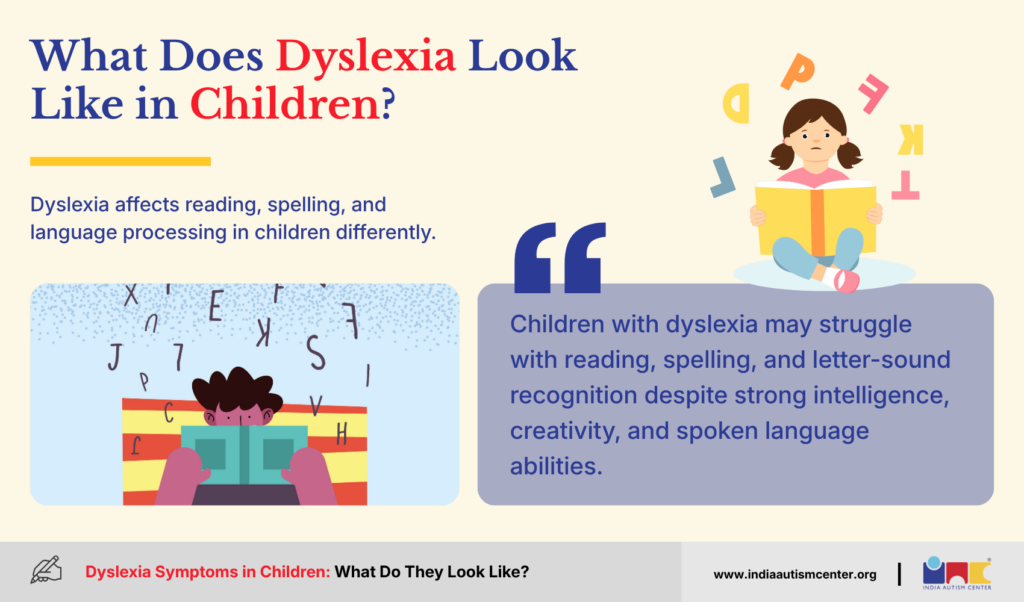
Many parents assume that dyslexia means reading letters backwards, but the reality is far more complex. Dyslexia in children affects how the brain processes language, making it harder to recognise sounds in words, connect letters to those sounds and read fluently. These challenges often become noticeable when children begin school, although subtle signs may appear much earlier.
A child with dyslexia may be bright, curious and highly creative, yet continue to struggle with reading tasks that seem easy for their peers. They may understand stories when someone reads aloud, but find it difficult to read the same text independently. Similarly, they may have an excellent spoken vocabulary but struggle to express those ideas in writing.
Dyslexia is one of several learning-related conditions that come under recognised disability categories. You can explore all types of disability to understand how conditions like dyslexia are classified.
Some common signs that parents and teachers notice include:
- Reading more slowly than classmates.
- Difficulty remembering letter sounds.
- Frequent spelling mistakes, even with familiar words.
- Trouble sounding out unfamiliar words.
- Forgetting verbal instructions.
- Avoiding reading or writing activities.
- Mixing up words that sound similar.
- Becoming frustrated with homework involving literacy.
These signs alone do not confirm dyslexia. However, when several difficulties persist over time despite regular classroom support, it is worth discussing them with your child’s teacher or a qualified professional.
📥 Free download: Printable daily routine chart for autistic children
What Is the Meaning of Dyslexia?
Understanding what dyslexia means can help clear up many common misconceptions.
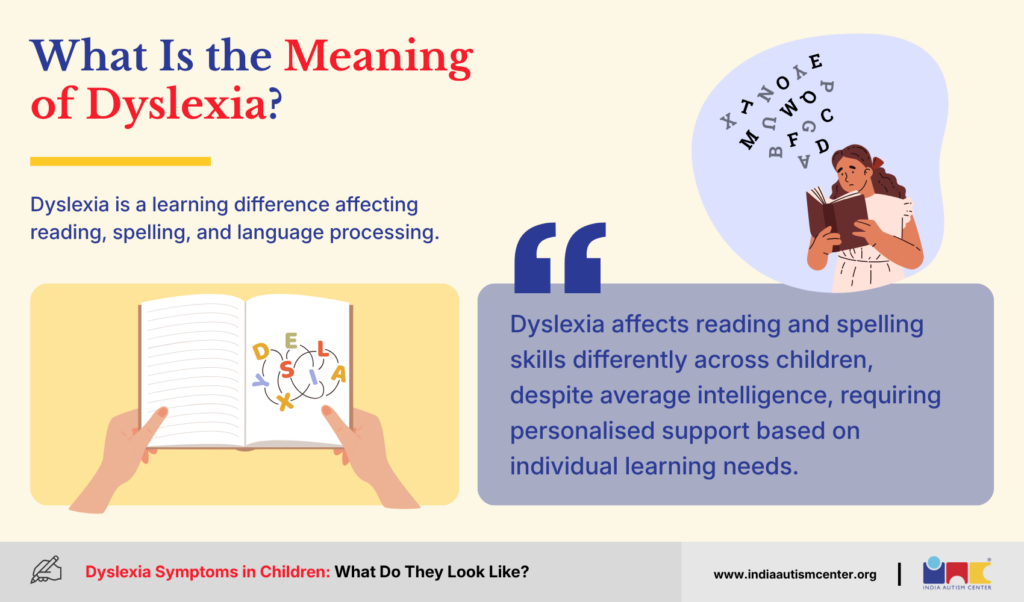
The British Dyslexia Association defines dyslexia as a specific learning difficulty that impacts the skills required for accurate and fluent word reading as well as spelling. It often involves difficulties with phonological awareness, verbal memory and processing speed. These challenges exist on a continuum, ranging from mild to more significant.
Importantly, dyslexia is not caused by poor intelligence, laziness or lack of effort. Many children with dyslexia often have average or above-average intelligence and often demonstrate strengths in creativity, problem-solving, visual thinking and reasoning.
Dyslexia also affects every child differently. While one child may struggle mainly with reading accuracy, another may find spelling, writing or remembering sequences more challenging. Some children develop coping strategies that hide their difficulties, making identification more difficult until academic demands increase.
Recognising these individual differences is essential because support should always be tailored to the child’s unique learning profile rather than based solely on a label.
Early Signs and Symptoms of Dyslexia
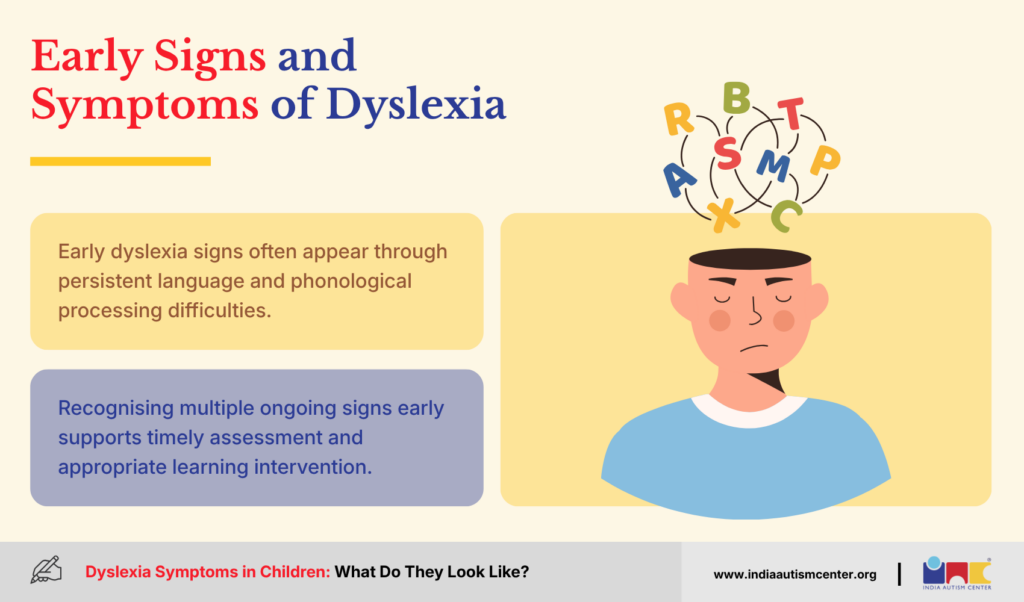
The early signs and symptoms of dyslexia often appear long before formal reading lessons begin. While not every child showing these behaviours has dyslexia, a combination of persistent difficulties may indicate that further assessment is needed.
Many early signs involve spoken language rather than reading itself because reading relies on strong language-processing skills.
Parents may notice that their child:
- Starts talking later than expected.
- Has difficulty learning nursery rhymes.
- Finds it hard to recognise rhyming words.
- Mixes up similar-sounding words.
- Has trouble remembering the names of familiar objects.
- Struggles to learn the alphabet.
- Finds it difficult to remember sequences, such as days of the week.
- Needs repeated instructions to complete simple tasks.
Research has consistently shown that phonological awareness, the ability to recognise and manipulate speech sounds, plays an important role in learning to read. Children with dyslexia often experience difficulties in this area from an early age, even before they enter school.
It is important to remember that one or two of these signs do not necessarily indicate dyslexia. Many young children develop these skills at different rates. However, when several signs persist for months and begin to affect learning, seeking professional advice can make a meaningful difference.
Want to know more? Get in touch with us.
Dyslexia Symptoms in 5-Year-Olds
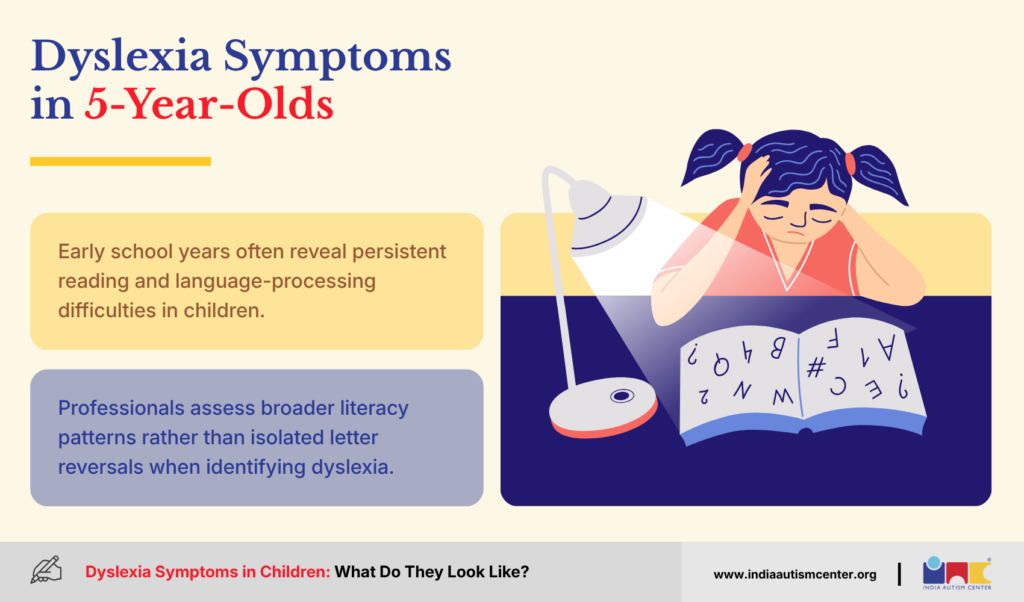
The first year of formal schooling is when dyslexia symptoms in 5-year-olds often become easier to recognise. At this stage, children are expected to learn letter sounds, begin reading simple books and develop early writing skills. While every child progresses differently, persistent literacy challenges may warrant closer attention.
Some of the most common dyslexia symptoms in 5-year-olds include difficulty remembering the sounds associated with letters, confusing letters with similar shapes, struggling to blend sounds into simple words and finding it hard to recognise familiar sight words. Many children also experience difficulty remembering sequences such as the alphabet or counting patterns.
Parents and teachers may also notice behaviours such as:
- Getting confused with letters like b, d, p and q.
- Reversing letters beyond what is typically expected for their age.
- Difficulty identifying the first or last sound in a word.
- Trouble clapping syllables in simple words.
- Avoiding activities involving books.
- Becoming upset or frustrated during reading practice.
- Difficulty following instructions with two or three steps.
Letter reversals alone should not be viewed as evidence of dyslexia because they are common during early writing development. Instead, professionals look for a broader pattern of language-processing difficulties alongside reading and spelling challenges.
Types of Dyslexia Symptoms in Children at Primary School
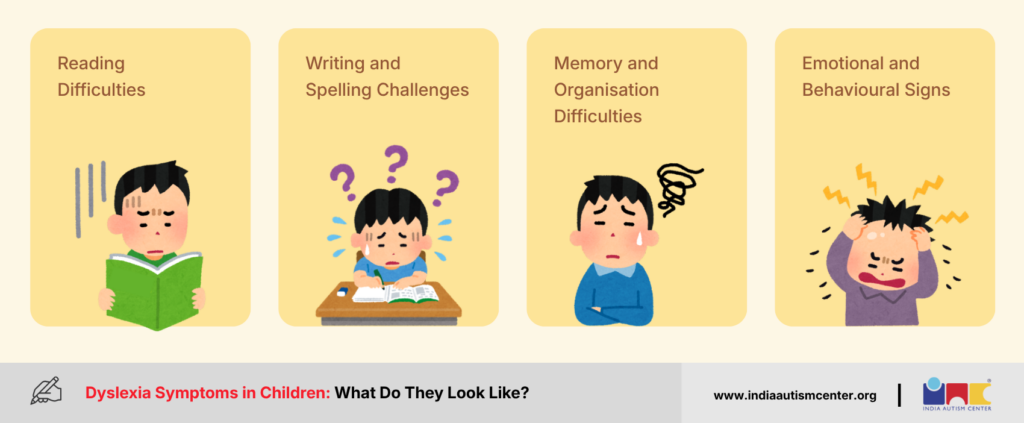
As children move through primary school, reading and writing become central to almost every subject. Lessons shift from “learning to read” to “reading to learn”. This is often when dyslexia symptoms in children become more noticeable, as classroom tasks demand greater reading fluency, accurate spelling and independent writing.
It is important to remember that dyslexia affects every child differently. Some children may struggle mainly with reading accuracy, while others find writing, organisation or remembering information more challenging. Looking at patterns across different learning activities provides a much clearer picture than focusing on a single difficulty.
Reading Difficulties
Reading is one of the areas most commonly affected by dyslexia. Children may know the individual sounds of letters but find it difficult to blend them into words quickly or accurately. As a result, reading can become slow, effortful and tiring.
Common reading-related dyslexia symptoms in kids include:
- Reading more slowly than classmates.
- Guessing unfamiliar words instead of sounding them out.
- Losing their place while reading.
- Skipping or adding words when reading aloud.
- Difficulty recognising common sight words automatically.
- Reading accurately one day but struggling with the same words the next.
- Finding it difficult to understand a passage because so much effort is required to decode the words.
A child may also enjoy listening to stories but avoid reading independently. This difference between listening comprehension and reading ability is often an important clue that should not be overlooked.
Writing and Spelling Challenges
Writing requires several skills to work together, including planning ideas, remembering spelling patterns, organising sentences and controlling handwriting. For children with dyslexia, managing all these processes simultaneously can be difficult.
You may notice that your child:
- Frequently misspells familiar words.
- Spells the same word differently within one piece of writing.
- Leaves out letters or syllables.
- Uses very simple vocabulary despite having a strong spoken vocabulary.
- Takes much longer than classmates to complete written work.
- Has untidy or inconsistent handwriting.
- Finds copying from the board particularly challenging.
These difficulties are often mistaken for carelessness. In reality, many children with dyslexia work much harder than their peers to produce a short piece of writing.
Memory and Organisation Difficulties
Although dyslexia is primarily associated with literacy, many children also experience challenges with working memory and processing speed. These skills help children remember information while completing a task, follow instructions and organise their work.
Some symptoms of dyslexia in children include:
- Forgetting multi-step instructions.
- Difficulty remembering spellings learned the previous day.
- Losing track of classroom routines.
- Struggling to remember sequences such as days of the week or multiplication tables.
- Misplacing books, homework or stationery.
- Taking longer to complete classroom tasks.
Emotional and Behavioural Signs
Not all dyslexia symptoms in children involve reading or writing. Some children begin to show emotional or behavioural changes as they become aware that learning feels more difficult for them.
Parents and teachers may observe that a child:
- Avoids reading aloud in class.
- Says they “hate reading” or “can’t do it”.
- Appears anxious before literacy lessons.
- Becomes frustrated with homework.
- Gives up quickly when faced with reading tasks.
- Seems unusually tired after school.
- Shows declining confidence despite trying hard.
These behaviours are not signs of laziness. They often reflect repeated experiences of finding classroom activities more demanding than expected. Providing encouragement and recognising effort can make a significant difference to a child’s confidence.
Why Early Recognition Matters?
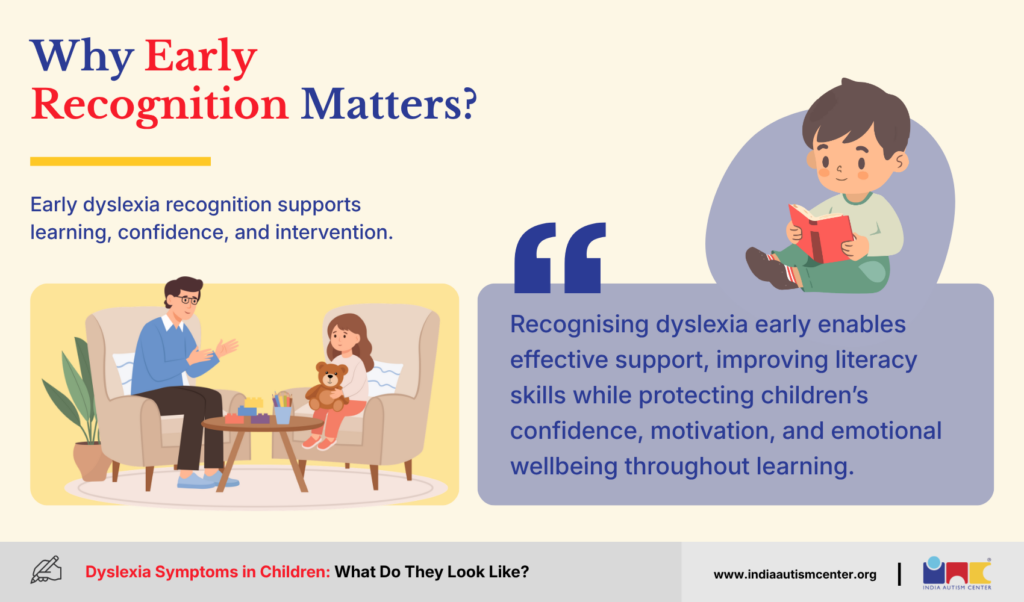
Recognising the symptoms of dyslexia in children early allows families to access interventions before reading difficulties begin to affect confidence and emotional wellbeing.
Children who repeatedly experience failure in literacy tasks may come to believe they are less capable than their peers. Over time, this can reduce motivation, increase anxiety around school and make learning even more challenging.
The encouraging news is that dyslexia can be effectively supported through evidence-based teaching approaches. Early intervention helps children build essential literacy skills while reinforcing their confidence and willingness to learn.
When Should Parents Seek an Assessment?
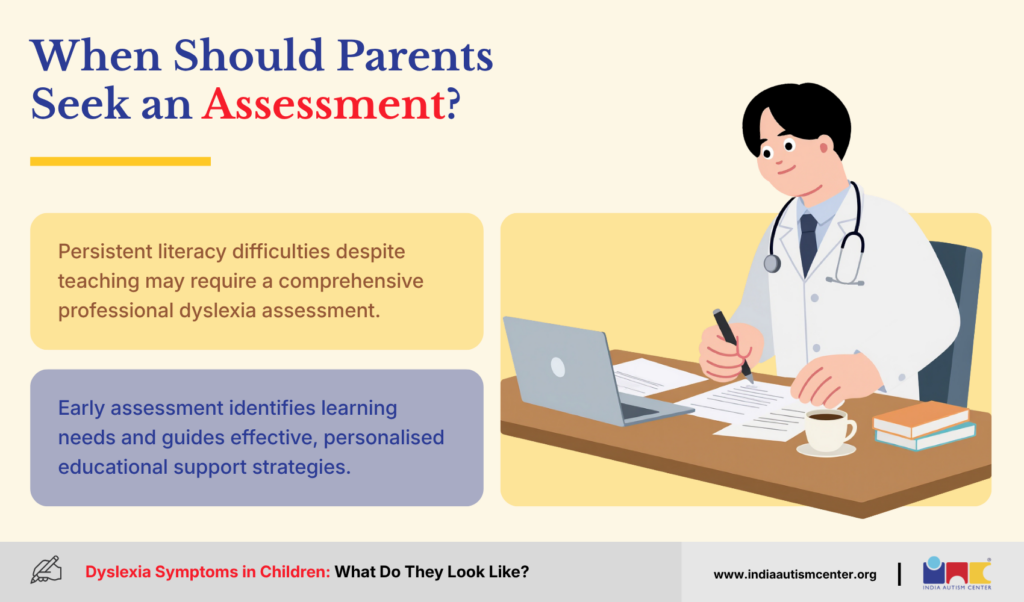
Many young children occasionally reverse letters, forget spellings or need extra help with reading. These behaviours are a normal part of learning. However, if difficulties continue over several months despite consistent teaching, it is worth seeking professional advice.
Consider discussing your concerns with your child’s teacher if your child:
- Continues struggling with reading despite regular practice.
- Finds spelling significantly harder than classmates.
- Avoids reading or writing whenever possible.
- Shows several of the early signs and symptoms of dyslexia.
- Appears increasingly frustrated or anxious about schoolwork.
A comprehensive assessment may involve an educational psychologist or another qualified specialist who evaluates reading accuracy, spelling, language processing, memory and other cognitive skills. The goal is not simply to provide a label but to understand how your child learns best and identify the support they need.
Early identification is associated with better educational outcomes because interventions can begin before literacy gaps widen.
How to Teach a Child with Dyslexia?
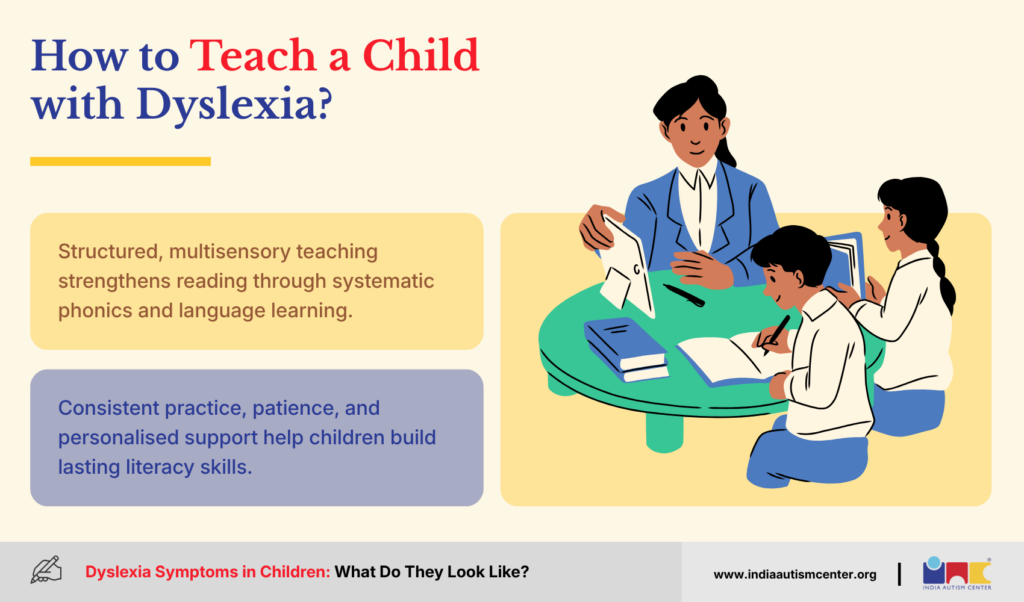
Parents often ask how to teach a child with dyslexia at home. While every child has unique learning needs, research consistently supports structured, explicit and multisensory teaching approaches.
The aim is not simply to help children memorise words but to build a strong understanding of how spoken sounds connect to written language.
Some practical strategies include:
- Break reading tasks into short, manageable sessions.
- Teach letter sounds systematically rather than relying on memorisation.
- Use multisensory activities such as tracing letters in sand, using magnetic letters or writing with finger paints.
- Read aloud together every day, even if your child cannot yet read independently.
- Encourage audiobooks alongside printed books to build vocabulary and comprehension.
- Give one instruction at a time and check understanding.
- Celebrate effort and progress rather than focusing only on correct answers.
- Allow additional time for homework and reading activities.
Many parents also search online for dyslexia reading answers, hoping to find a single solution. In reality, there is no universal programme that works for every child. Effective support combines evidence-based teaching, patience, regular practice and encouragement tailored to the child’s individual strengths and challenges.
Several research studies emphasise that structured literacy approaches, particularly those focusing on phonics, phonological awareness and decoding skills, provide the strongest evidence for improving reading outcomes in children with dyslexia.
Want to know more? Get in touch with us.
Supporting Children with Learning Differences at India Autism Center
Every child deserves the opportunity to learn in a way that builds on their strengths. While dyslexia in children is a specific learning difficulty and not a form of autism, some children may experience co-occurring developmental or learning differences that require a multidisciplinary approach.
Early identification and personalised support can help children develop literacy skills, improve confidence and participate more fully at school and at home.
At India Autism Center, families have access to evidence-based services that support children’s overall development. Depending on a child’s individual needs, this may include developmental assessments, early intervention programmes, speech and language therapy, occupational therapy, special education and parent guidance.
By working closely with families, educators and therapists, the centre aims to create personalised learning pathways that help every child reach their full potential.
Conclusion
Recognising dyslexia in children early can make a lasting difference to their learning journey and overall wellbeing. While every child develops at their own pace, persistent reading, spelling and language difficulties deserve timely attention.
With the right support, structured teaching and encouragement, children with dyslexia can build strong literacy skills and thrive both academically and personally. Seeking professional guidance early empowers families to address challenges effectively, helping children gain the confidence, resilience and skills they need to reach their full potential.
Frequently Asked Questions
At what age can dyslexia in children be identified?
Some early signs of dyslexia in children may appear as young as 4 or 5 years old, particularly when a child struggles with rhyming, letter recognition or learning sounds. However, a comprehensive assessment is usually more reliable once formal reading instruction has begun.
Are letter reversals a definite sign of dyslexia?
No. Reversing letters such as b and d is common during early writing development. It becomes a concern only when it persists alongside other dyslexia symptoms in children, such as poor phonological awareness and ongoing reading difficulties.
Can bilingual children develop dyslexia?
Yes. Dyslexia can occur in children who speak one language or multiple languages. Difficulties with reading and spelling may appear in each language, although the way they present can vary depending on the language’s writing system.
Is dyslexia hereditary?
Research suggests that genetics plays an important role in dyslexia. Children with a parent or sibling who has dyslexia are more likely to develop similar reading and language-processing difficulties than children without a family history.
Can children with dyslexia become fluent readers?
Yes. With evidence-based teaching approaches, regular practice and personalised support, many children with dyslexia develop significantly stronger reading skills and become confident learners. However, they may continue using different learning strategies.
Disclaimer: This article is intended for educational and informational purposes only. It is not a substitute for professional medical advice, diagnosis, or treatment. If you are pregnant or have concerns about medication use during pregnancy, please consult a qualified healthcare provider. If your child has received an autism diagnosis and you have questions about causes or support, please reach out to a trained specialist or an autism-focused organisation for guidance.
For expert insights, support services, and inclusive learning initiatives, visit the India Autism Center.