 Donate now
 Get a Call Back
 MENU
MENU 11 MIN READ
 SHARE
SHARE


Your autistic child may be ready for school if they can follow simple two-step instructions, tolerate a structured routine for at least 30–45 minutes, manage basic personal needs like toileting with minimal help, and communicate wants and needs — even non-verbally. But readiness isn’t a single milestone. It’s a profile.
That’s the honest answer. And I know it’s not the clean yes or no most parents come here hoping for.
We hear from families who are terrified of getting this decision wrong. Should I send my child this year? Will the classroom overwhelm them? What if they can’t sit still, or they have a meltdown in front of everyone? These aren’t small fears. They’re legitimate questions that deserve serious, practical answers.
So let me walk you through this properly.
What Does “School Ready” Actually Mean For An Autistic Child?
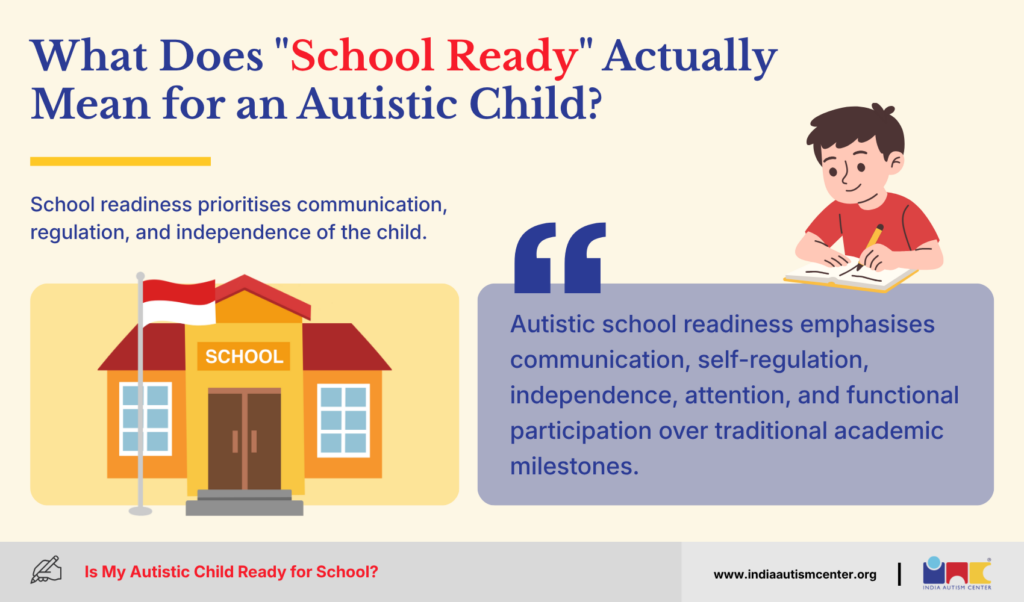
School readiness for an autistic child looks different from the standard checklist.
For neurotypical children, readiness typically means knowing colours, counting to ten, and being able to sit quietly. For autistic children, the more important markers are around self-regulation, communication, and sensory tolerance — not academic knowledge.
Here’s what matters most:
| Readiness Domain | What to Look For |
| Communication | Can express basic needs (verbally or via AAC/gestures) |
| Self-regulation | Can tolerate transitions without prolonged distress |
| Self-care | Manages toileting, eating, and dressing with some independence |
| Attention | Can engage with an activity for 10–15 minutes |
| Social tolerance | Can be in a shared space with other children without significant dysregulation |
Notice I said “with some independence” and “without significant dysregulation.” I’m not asking for perfection. I’m asking for a functional baseline that a school can build on.
Want to know more? Get in touch with us.
What Are the Signs My Autistic Child Is Ready for School?
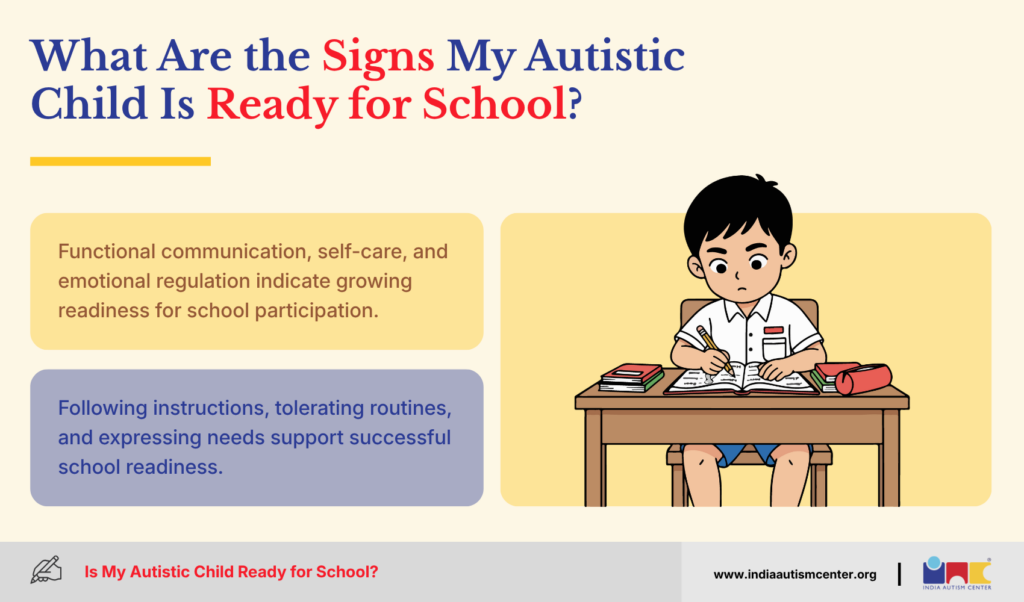
Look for functional communication, basic self-care, and the ability to tolerate — not necessarily enjoy — structured group settings.
These are the most reliable green-light indicators:
- Follows two-step verbal or visual instructions (e.g., “pick up your bag and sit down”)
- Can wait briefly — even 2–3 minutes — without full meltdown
- Uses consistent communication to express “yes,” “no,” “want,” or “help”
- Is toilet-trained or actively progressing toward it
- Shows some curiosity or interest in other children, even from a distance
- Can tolerate wearing school uniform or sensory-similar clothing for extended periods
If your child checks most of these, school is likely a viable option — with the right support in place. If they check only a few, that doesn’t mean “not ready forever.” It means you need a more structured autism early intervention plan before or alongside enrolment.
What If My Autistic Child Cannot Sit In Class?
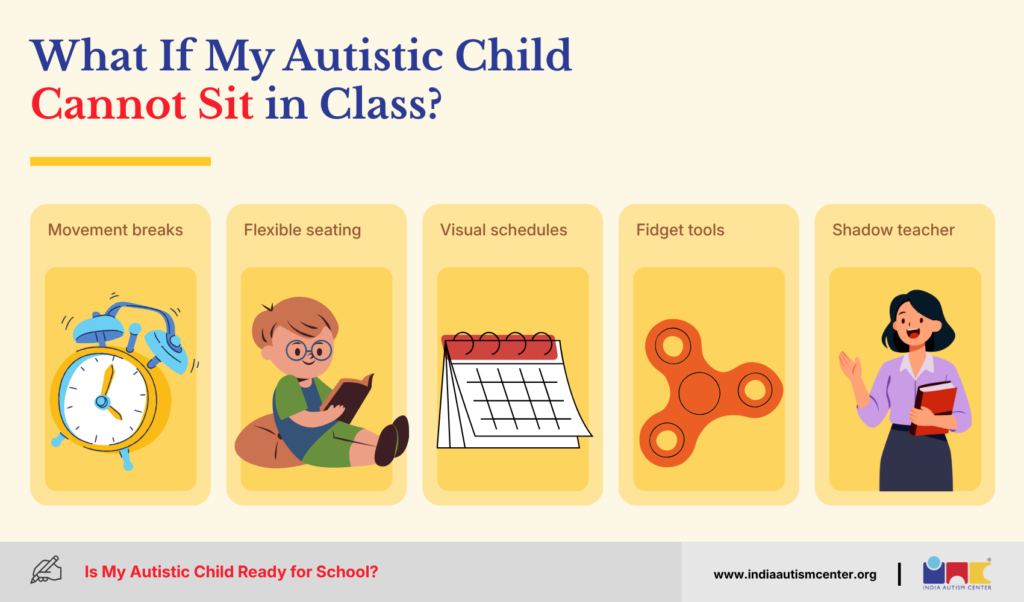
An autistic child who cannot sit in class is not failing — the classroom environment may simply be unaccommodating of their neurological needs.
This is one of the most common concerns I encounter. And it’s also one of the most misunderstood.
Sitting still in a row of desks for 40-minute periods is not a natural human activity. It’s especially not natural for autistic children, many of whom have significant sensory processing differences, proprioceptive needs, or attention profiles that require movement to regulate.
What actually helps:
- Movement breaks every 20–25 minutes
- Flexible seating — wobble cushions, floor seating, or corner desks
- Visual schedules so the child knows what’s coming
- Fidget tools that don’t distract others
- Shadow teacher or resource room access when dysregulation builds
The question isn’t “can my child sit in class?” The question is: “does this school know how to make sitting manageable for my child?”
What Are the Most Common Autism Classroom Behaviour Problems?
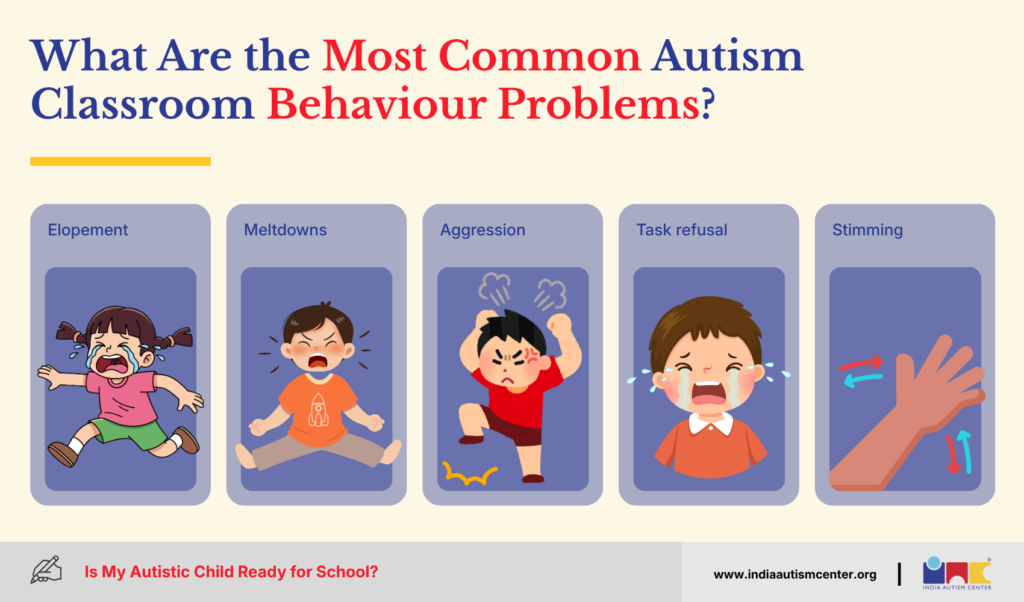
The most common classroom behaviour challenges in autistic children include elopement, meltdowns, aggression, refusal to transition, and self-stimulatory behaviour that disrupts group activities.
Let me be clear: these behaviours are not “bad behaviour.” They are communication and regulation strategies for a child whose nervous system is overwhelmed.
Most frequent challenges schools report:
- Elopement — leaving the classroom or school premises suddenly
- Meltdowns — full dysregulation in response to sensory or schedule overload
- Aggression — hitting, biting, or throwing, often as a last resort when overwhelmed
- Task refusal — shutting down when a demand exceeds current capacity
- Stimming — rocking, hand-flapping, or vocalising, which can disrupt group activities
Each of these has evidence-based responses. The problem is most schools haven’t been trained in them.
Want to know more? Get in touch with us.
How Do Schools Handle Autism Meltdowns?
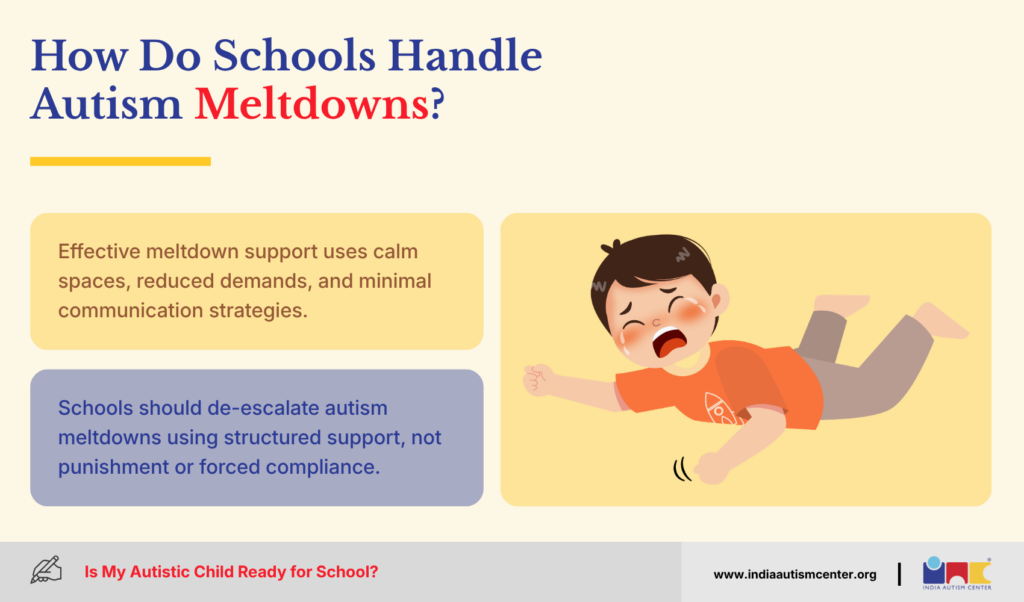
A prepared school handles autism meltdowns by reducing demands immediately, moving the child to a calm space, minimising language, and waiting — not redirecting, not reasoning, not disciplining.
This is what’s called a de-escalation protocol, and it should be written into your child’s autism IEP (Individualized Education Program) or equivalent support plan.
Here’s what proper meltdown management looks like:
What schools SHOULD do:
- Reduce all demands the moment escalation starts
- Move the child to a pre-designated calm or sensory space
- Use minimal language — one calm phrase, repeated if needed
- Maintain safety without physical restraint unless absolutely necessary
- Allow recovery time before returning to tasks
What schools SHOULD NOT do:
- Demand compliance mid-meltdown
- Send the child to the principal or isolate them punitively
- Call parents to take the child home every single time
- Treat meltdown as wilful disobedience
If a school’s default response is to call you every time your child melts down, that school needs training — not your child.
What Is an Autism IEP in India — and Does My Child Need One?
An Individualized Education Program (IEP) in India is a written document developed between parents, special educators, and therapists that outlines a child’s current levels, goals, accommodations, and review timelines.
India does not have federal IEP legislation equivalent to the US IDEA, but the Rights of Persons with Disabilities Act (RPWD Act, 2016) mandates that children with disabilities, including autism, receive reasonable accommodations and inclusive education support.
Under the RPWD Act, your child has the right to:
- Enrolment in a neighbourhood school without discrimination
- A support teacher or resource person if needed
- Modified assessments and evaluation criteria
- A barrier-free physical environment
In practice, most Indian schools — especially government and lower-budget private schools — are not equipped. This is where specialist centres, bridge schools, or hybrid models become relevant.
At India Autism Center, we work with families to build functional IEP-equivalent plans even when the school isn’t formally issuing one. It’s not ideal, but it’s the reality of the current ecosystem.
What Are Effective Autism Classroom Support Strategies?
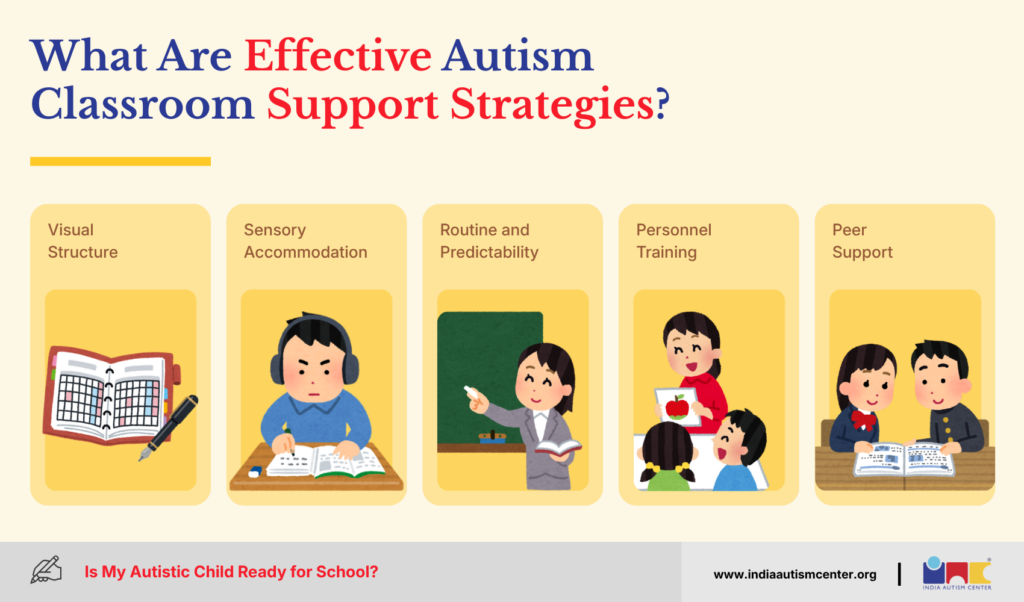
The most effective autism classroom support strategies combine visual structure, sensory accommodation, predictable routines, and trained personnel.
These are the non-negotiables:
Visual Structure
- Daily visual schedule posted at eye level
- Visual timers during transitions
- Picture-based task instructions where possible
Sensory Accommodation
- Seating away from windows, AC vents, or high-traffic areas
- Access to ear defenders or noise-reducing headphones during loud activities
- Lighting adjustments where fluorescent lights cause distress
Routine and Predictability
- Consistent classroom layout — no surprise rearrangements
- Advanced warning of changes (“Tomorrow, assembly will be at 10am, not 9am”)
- Consistent pairings with familiar adults
Personnel Training
- Class teacher trained in autism basics (not optional — essential)
- Shadow teacher or aide where possible
- Regular communication channel between school and family
Peer Support
- Buddy systems with trained classmates
- Social skills circle time built into the day
- Structured play opportunities, not just free play
Without at least half of these in place, many autistic children will not access learning — not because they can’t learn, but because they can’t regulate in a dysregulating environment.
What Are the Autism Learning Difficulties I Should Prepare the School For?
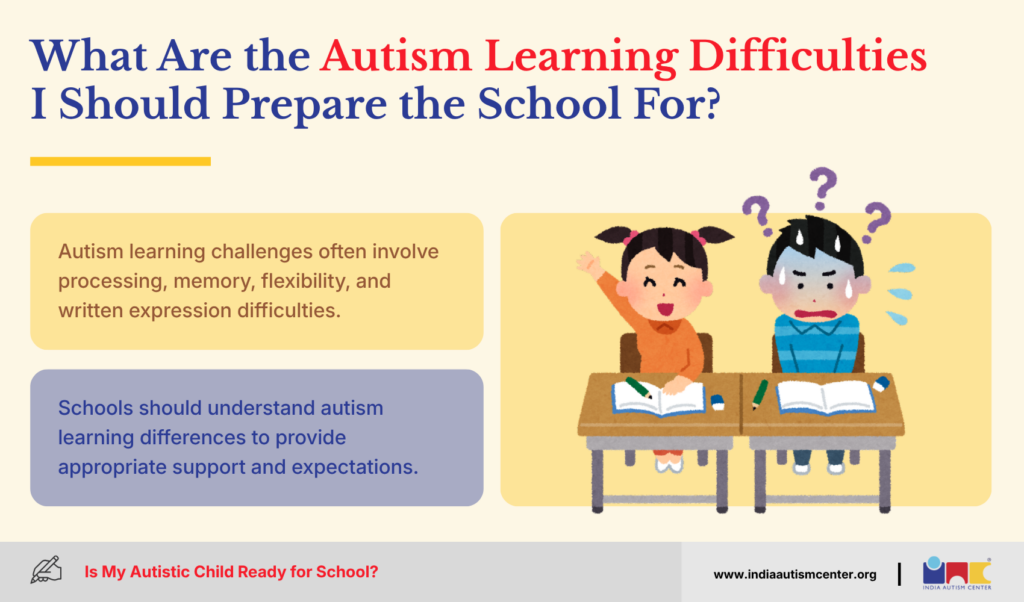
Autism-related learning difficulties most commonly involve processing speed, working memory, executive function, written expression, and generalising skills from one context to another.
These are not intellectual deficits. Many autistic children have strong abilities in specific domains — pattern recognition, memory for facts, spatial reasoning. But they may struggle with:
- Following multi-step verbal instructions without visual support
- Generalisation — learning a skill in therapy but not using it in school
- Working memory — keeping information in mind while completing a task
- Flexible thinking — adapting when a familiar method doesn’t work
- Written expression — translating thoughts onto paper, even when verbal communication is fluent
Tell the school these specifics upfront. Don’t wait for a teacher to notice and misread them as laziness or defiance.
How Do I Prepare My Autistic Child for School?
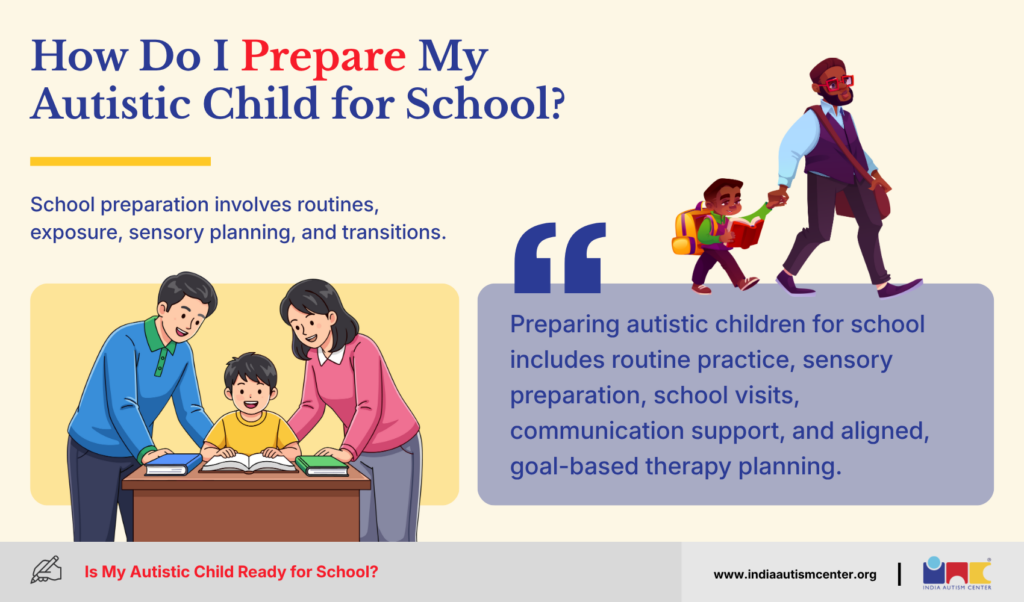
Start preparing at least 3–6 months before school begins, focusing on school-specific routines, social exposure, and desensitisation to the school environment itself.
Here’s a practical pre-school checklist:
- Visit the school multiple times before the first day — during off-hours first, then during active school time
- Practice the uniform at home, daily, for several weeks beforehand
- Establish a morning routine that mirrors the school-day schedule
- Work on transition tolerance — use timers, visual cues, and predictable endings
- Identify the child’s sensory triggers and communicate them to the school in writing
- Build communication about school — play “going to school” games at home
- Coordinate with a therapist to target specific school-readiness skills
If your child is currently in autism early intervention — speech therapy, occupational therapy, ABA, or a combination — brief the therapists on school readiness goals. Align therapy targets to classroom demands specifically.
What Support Is Available for Autistic Children in Indian Schools?
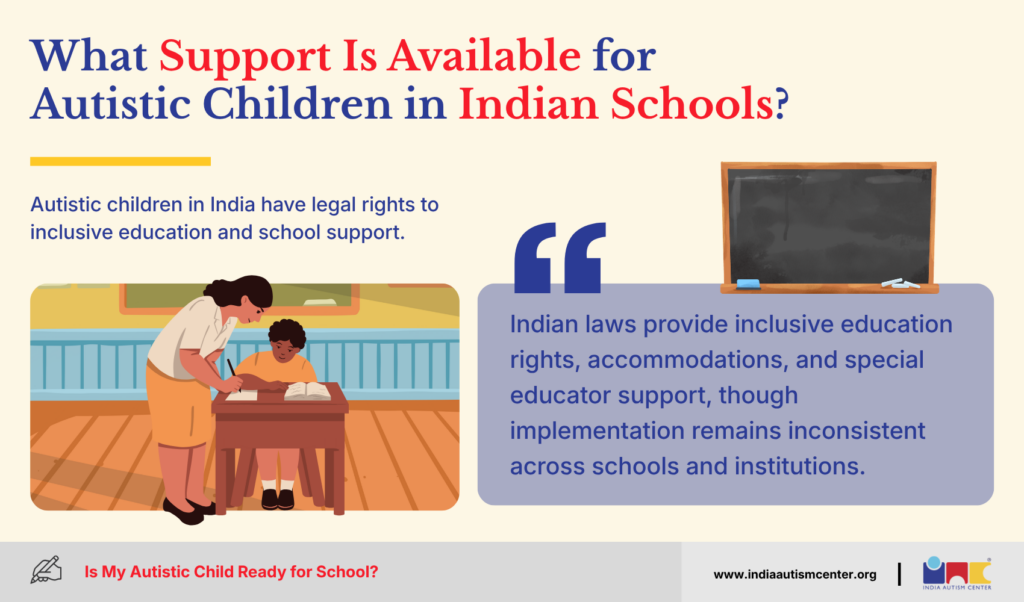
Autistic children in India are entitled to inclusive education support under the RPWD Act 2016, the National Education Policy 2020, and the RCI (Rehabilitation Council of India) framework for special educators.
Here’s what exists — even if it’s inconsistently implemented:
| Support Type | What It Covers |
| Inclusive Education Mandate | Right to enrol in regular school without refusal |
| RCI-Certified Special Educators | Trained professionals for IEP and in-class support |
| Scribe/Reader Accommodation | Available for board exams under disability category |
| Modified Assessment | Schools can adapt evaluation for autistic children |
| NIEPID and NIMH Resources | National institutes offering assessment and training |
The gap between what’s legally available and what’s practically accessible is significant. But knowing your rights is the starting point.
📥 Free download: Printable daily routine chart for autistic children
When Should I Consider a Special School Instead of Inclusive Education?
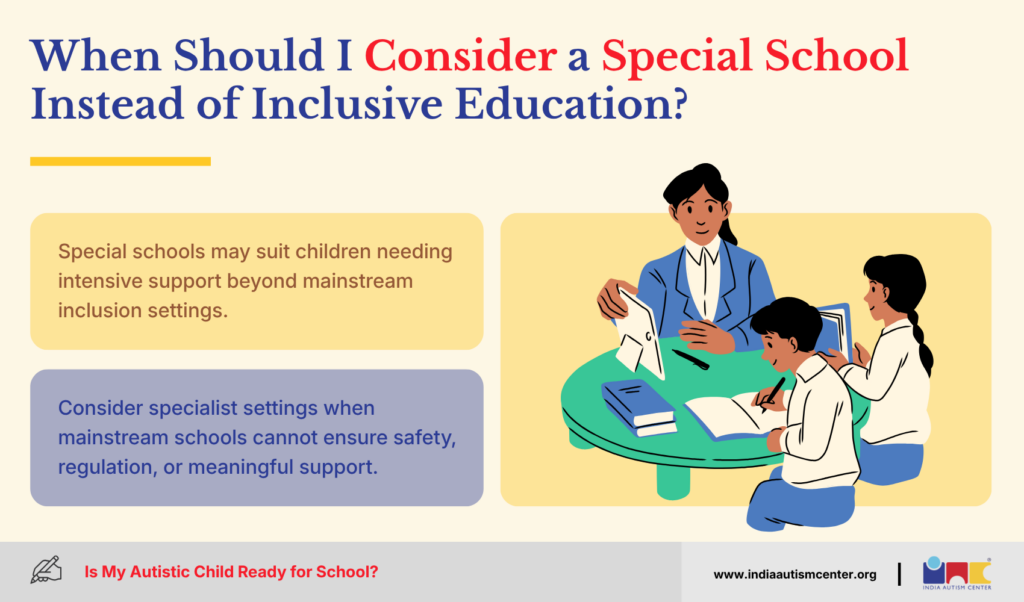
A special school or bridge programme may be more appropriate when a child’s sensory, communication, or behavioural profile makes a mainstream classroom genuinely unsafe or inaccessible — not just inconvenient.
Inclusive education is the goal. But inclusion must be meaningful, not just physical proximity to neurotypical peers.
Consider a specialist setting if:
- Your child is experiencing daily meltdowns in the current environment with no sign of regulation improvement
- The school is unwilling or unable to implement basic accommodations
- Your child is losing skills (regression) since starting school
- Safety concerns — elopement or aggression — are not being managed adequately
- Your child has co-occurring conditions (intellectual disability, epilepsy, severe anxiety) that require specialist support
A good bridge programme — like what we offer at India Autism Center through Manan — prepares children for eventual mainstream inclusion. It’s not a permanent alternative. It’s a structured stepping stone.
How To Survive School as an Undiagnosed Autistic Child in India (2025) | India Autism Center
What Is The Right Age to Start School for an Autistic Child?
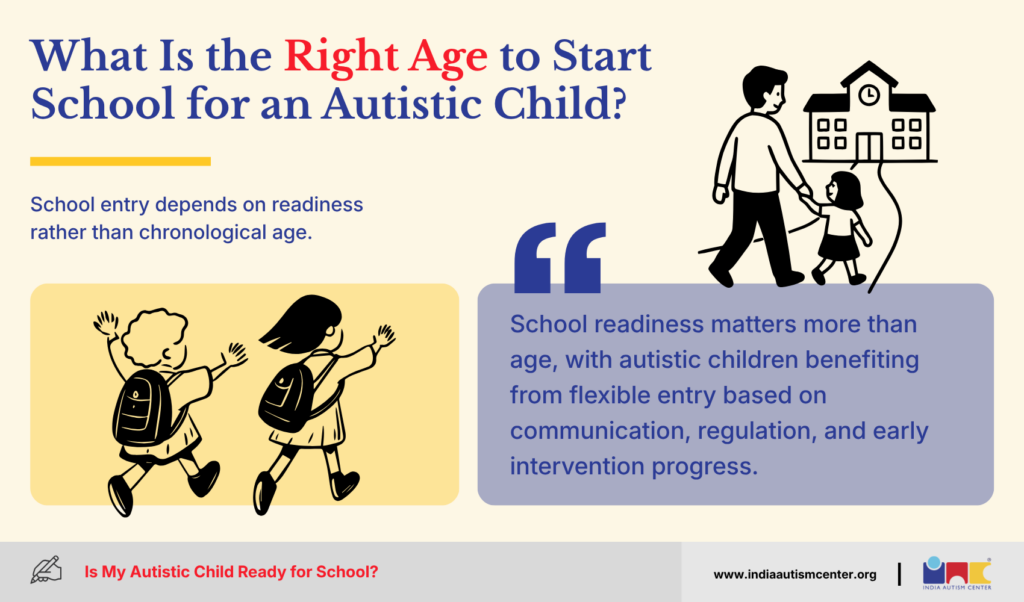
There is no single right age. The decision should be based on the child’s readiness profile, not their chronological age alone.
In India, the standard school entry age is 5–6 years. But many autistic children benefit from delaying formal school entry by 1–2 years to build foundational skills through early intervention first.
On the other hand, some autistic children with strong communication and self-regulation skills are ready at 4.5 years in the right environment.
The age question is less important than the readiness question. And readiness is built — not waited for.
Conclusion
I’ll leave you with this: no child is “not ready for life.” Some children are not yet ready for a specific environment. And sometimes, that environment needs to do the adapting.
If you’re sitting with this question — is my autistic child ready for school — you’re already doing the most important thing. You’re thinking carefully, advocating early, and refusing to accept generic answers for a child who is anything but generic.
If you want a proper readiness assessment, support plan, or guidance on the right school pathway for your child, our team at India Autism Center is here to help.
Disclaimer: This article is written for educational and informational purposes only. It is not a substitute for professional clinical assessment, medical advice, or individualised educational planning. Every autistic child has a unique profile — please consult a qualified developmental paediatrician, psychologist, or special educator before making decisions about your child’s schooling. For a formal evaluation or IEP development support, please reach out to a registered professional or contact India Autism Center directly.