 Donate now
 Get a Call Back
 MENU
MENU 11 MIN READ
 SHARE
SHARE


Autistic burnout recovery means reducing demands, restoring sensory safety, and rebuilding capacity gradually — not just resting more. Recovery is non-linear and often takes months, sometimes years. It requires structural changes to environment, workload, and masking, not willpower or a weekend off. This guide covers the full recovery process, realistic timelines, and practical tools you can use today.
What Is Autistic Burnout, Exactly?
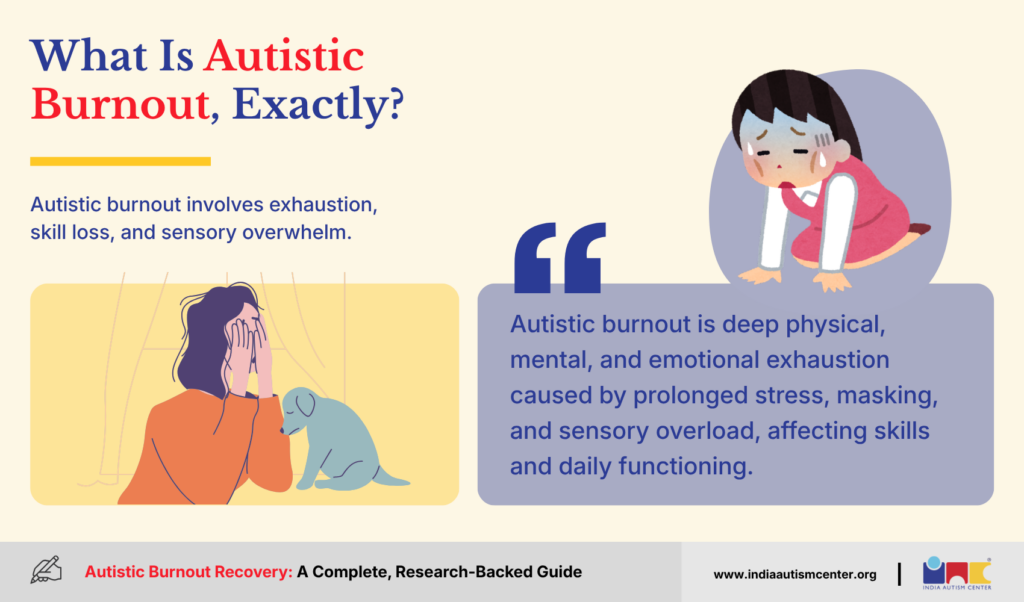
Autistic burnout is a state of deep physical, mental, and emotional exhaustion. It develops after prolonged periods of stress, masking, and sensory overload. Unlike everyday tiredness, it does not resolve with a good night’s sleep.
Three features define it consistently across research:
- Chronic exhaustion that ordinary rest doesn’t fix
- Loss of skills across communication, self-care, or work
- Reduced tolerance to stimulation, including sound, light, and social contact
I’ve seen this pattern repeatedly in the autism community I work with. People describe it as “running on empty with no refill in sight.”
📥 Free download: Printable daily routine chart for autistic children
How Is Autistic Burnout Different From Regular Burnout?
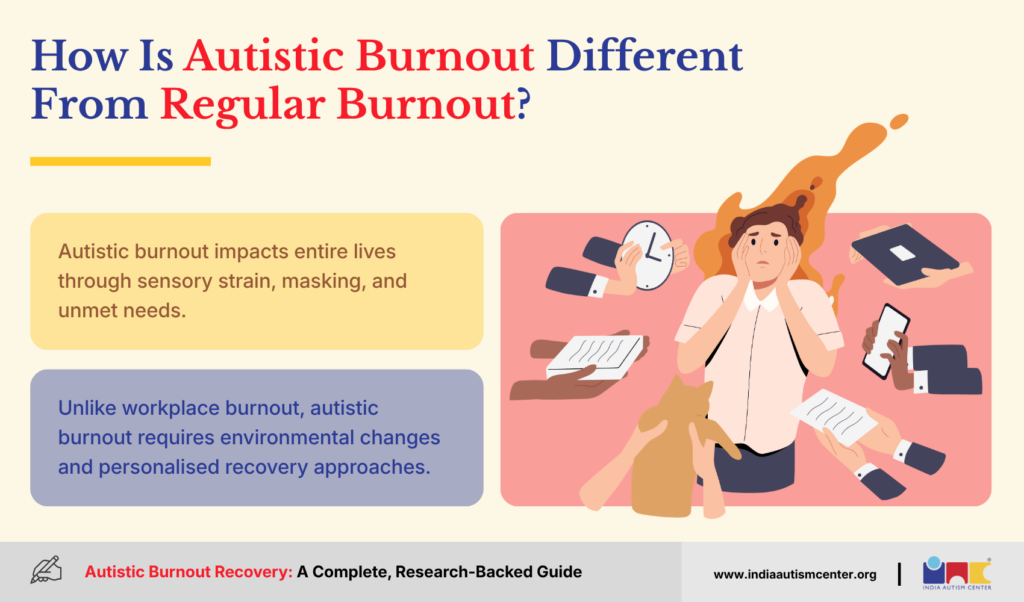
Occupational burnout usually stays contained to work. Autistic burnout spreads across every part of life. It affects communication, sensory processing, executive function, and relationships simultaneously.
Regular burnout responds well to vacations and workload changes. Autistic burnout often persists even after time off. The underlying cause — chronic mismatch between autistic needs and environmental demands — has to change first.
| Factor | Occupational Burnout | Autistic Burnout |
| Primary trigger | Workplace stress | Masking, sensory overload, unmet needs |
| Scope of impact | Mostly work | Work, home, relationships, self-care |
| Responds to rest alone | Often yes | Rarely |
| Typical duration | Weeks | Months to years |
| Recovery approach | Reduce workload | Reduce demands + redesign environment |
Is Autistic Burnout the Same as Depression?
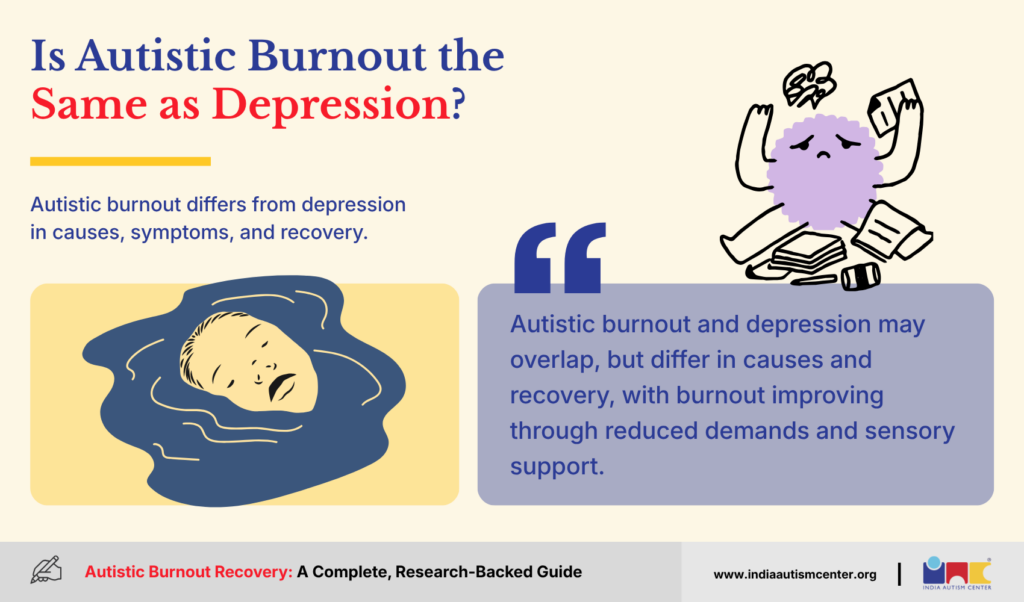
No. Autistic burnout and depression can look similar but have different roots. Depression involves persistent low mood and loss of interest, even in low-demand situations. Autistic burnout improves when demands and sensory load decrease, even if only partially.
Many autistic adults experience both together. If you’re unsure which you’re facing, a mental health professional familiar with autism can help you tell them apart. This distinction matters because the recovery strategies differ.
Want to know more? Get in touch with us.
Why Doesn’t Rest Alone Fix Autistic Burnout?
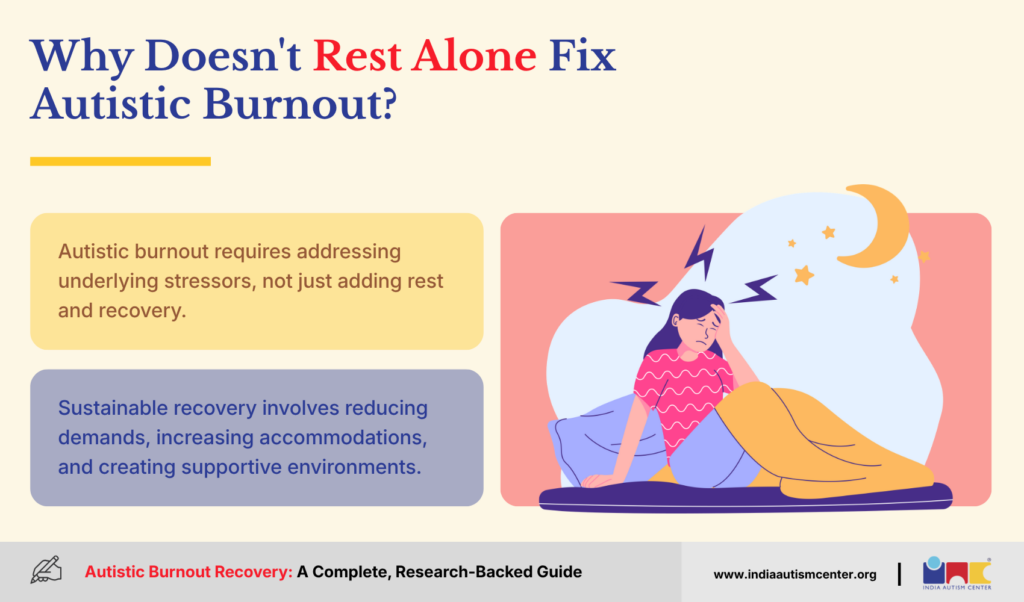
Rest alone doesn’t fix autistic burnout because the causes are structural, not just physical fatigue. Masking, sensory overload, and unsustainable demands drain capacity continuously. Sleep restores energy temporarily, but the underlying mismatch keeps draining it back out.
Think of it like a bucket with a hole. You can keep pouring water in — sleep, weekends, holidays — but if the hole isn’t patched, the bucket never fills. Patching the hole means changing your environment and expectations, not just adding more rest.
Recovery typically requires:
- Reducing demands at the source
- Increasing accommodations at work and at home
- Improving self-understanding of your own limits
- Redesigning environments to be more sustainable
This entire section has been covered in great detail in Autistic Burnout Recovery: A Complete, Research-Backed Guide
What Are the Early Signs You’re Heading Into Burnout?
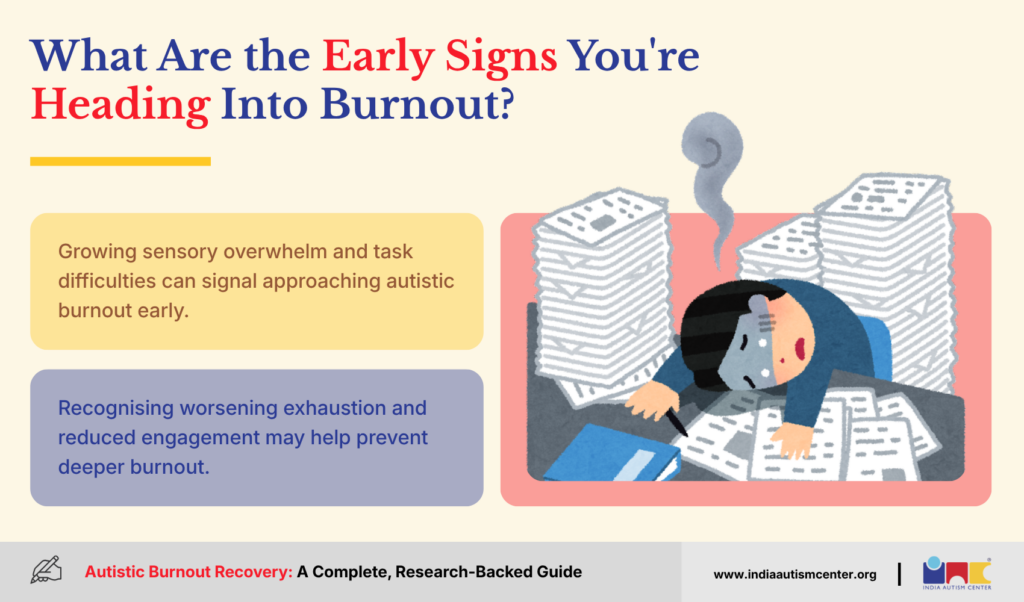
Recognising early signs can prevent burnout from deepening. Watch for these changes against your own baseline, not someone else’s:
- Masking becomes exhausting rather than automatic
- Everyday sounds or lights feel unbearable, not just annoying
- Simple tasks like cooking or replying to messages feel overwhelming
- You start avoiding places you used to manage fine, like the grocery store
- Your energy for special interests drops, which is often a red flag
If several of these apply and they’re getting worse, it’s worth slowing down before you hit full burnout.
How Long Does Autistic Burnout Recovery Take?
Autistic burnout recovery timelines vary widely, from a few months to several years. Mild burnout may ease within weeks once demands drop. Severe or repeated burnout, especially when the causes stay unaddressed, can last years.
Here’s a general framework, though your experience may not match it exactly:
| Stage | Typical Duration | What It Looks Like |
| Acute burnout | 2–8 weeks | Sharp drop in functioning, high sensory sensitivity |
| Stabilization | 1–3 months | Demands reduced, symptoms plateau |
| Early rebuilding | 3–6 months | Small tasks return, energy fluctuates |
| Sustainable rebuilding | 6 months–2 years | Gradual capacity gains, setbacks still occur |
| Ongoing management | Long-term | Ongoing prevention, occasional flare-ups |
Recovery is rarely a straight line. Most people describe a pattern of improvement, setback, then improvement again. A setback doesn’t mean you’re back to square one — it usually means a demand briefly exceeded your current capacity.
Want to know more? Get in touch with us.
What Does the Recovery Process Actually Involve?
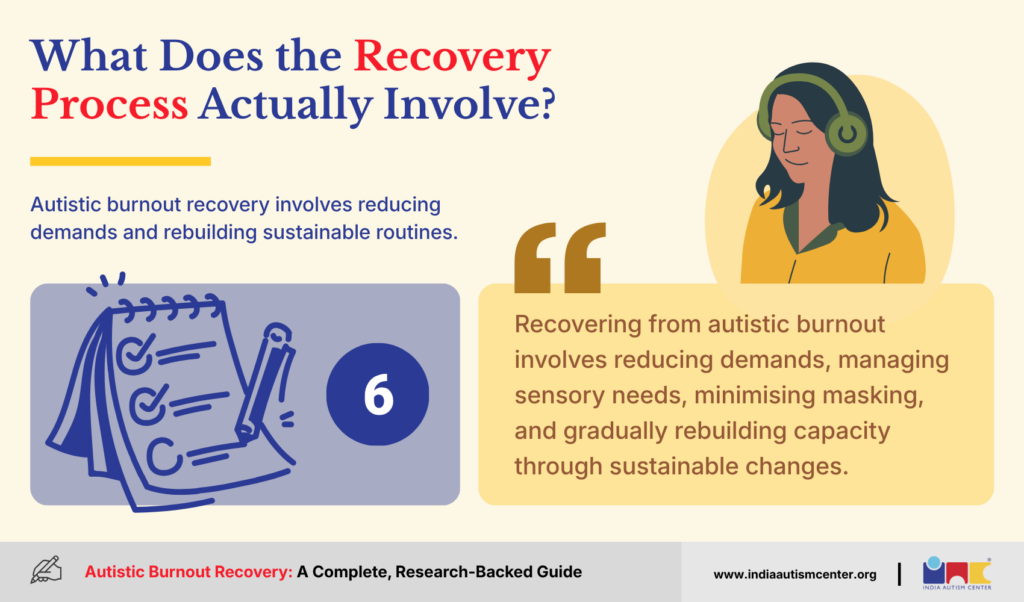
Recovery isn’t one action — it’s a set of coordinated changes. Based on current research and lived experience, here’s the framework I recommend.
Step 1: Stop Further Depletion First
Before you can rebuild, you have to stop losing ground. This means identifying and pausing whatever is draining you fastest, even temporarily. Push-through approaches usually make burnout worse, not better.
Ask yourself: what’s the single biggest drain right now? Can it be reduced, postponed, or removed for the next few weeks? Start there.
Step 2: Build an Energy Inventory
An energy inventory lists which activities drain you and which restore you. Rate each activity on a simple scale, such as 1 (very draining) to 4 (restorative). This turns a vague feeling of “I’m exhausted” into something you can actually act on.
Common draining activities:
- Masking in social or professional settings
- Unpredictable schedule changes
- Multitasking under time pressure
- Sensory-heavy environments like open offices
Common restorative activities:
- Time with special interests
- Solitude without social demands
- Predictable, low-stimulation routines
- Stimming without needing to suppress it
Step 3: Redesign Your Sensory Environment
Sensory recovery means reducing sensory load while your capacity returns. Small changes often make a measurable difference:
- Reduce lighting intensity or switch to warmer tones
- Use noise-cancelling headphones during high-stimulation hours
- Build in device-free, low-input windows daily
- Limit multitasking to one demand at a time
Step 4: Reduce Masking Where It’s Safe To Do So
Masking is one of the biggest hidden costs in autistic burnout. Unmasking gradually, in spaces where it’s safe, can meaningfully lower your daily energy spend.
This doesn’t mean disclosing your autism everywhere at once. It means finding pockets — home, trusted friends, specific communities — where you don’t have to perform neurotypical behavior.
Step 5: Rebuild Gradually, Not All at Once
Rebuilding capacity works best in small, sustainable increments. Trying to return to full functioning too quickly usually triggers a setback. A useful rule: add back one demand at a time, and wait before adding the next.
Step 6: Address the Root Causes to Prevent Relapse
Recovery without addressing the original causes often leads to repeated burnout cycles. Many autistic adults describe this pattern: push, compensate, crash, recover, then crash again. Preventing recurrence means changing the conditions that caused burnout in the first place, not just recovering from this one.
What Causes Autistic Burnout in the First Place?
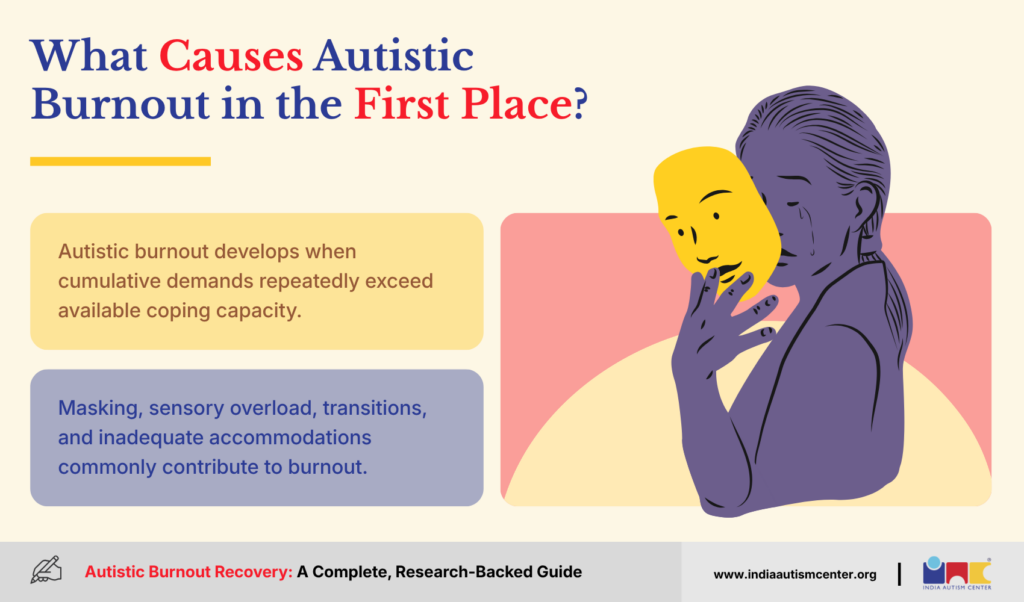
Autistic burnout rarely comes from one single stressor. It builds up from a combination of demands that exceed your available capacity over time. Understanding your specific causes matters more than following a generic recovery checklist.
Common contributing factors include:
- Chronic masking at work, school, or in family settings
- Sensory overload from noise, lighting, crowds, or unpredictable environments
- Executive function strain from juggling deadlines, admin, and daily tasks
- Social exhaustion from sustained interaction without recovery time
- Life transitions, such as a new job, move, or relationship change
- Lack of accommodations, which forces constant over-adaptation
In India specifically, cultural pressure to mask autistic traits can be intense. Joint family expectations, limited workplace disclosure protections, and low awareness of adult autism often mean autistic adults push through far longer before recognizing burnout. This delay tends to make the eventual burnout deeper and the recovery longer.
How Do You Know You’re Actually Recovering?
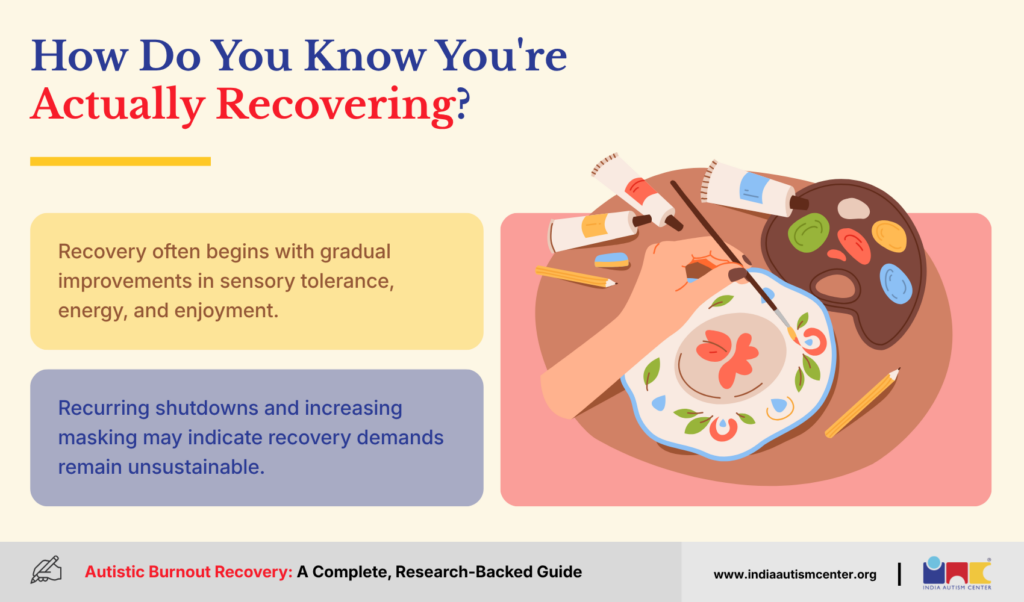
Recovery signs are often subtle at first, so it helps to know what to look for. Compare against your burnout baseline, not your pre-burnout self — early wins are usually small.
Signs recovery is progressing:
- Sensory tolerance is slowly increasing, even slightly
- You can complete a task without days of recovery afterward
- Special interests start feeling enjoyable again, not draining
- Setbacks are shorter and less severe than before
- You’re identifying your limits before hitting a wall, not after
Signs you may be pushing too fast:
- A single demanding day leads to several days of shutdown
- Sensory sensitivity spikes again after a period of improvement
- You’re masking more just to “prove” you’re better
- Sleep and appetite changes return after stabilizing
If you notice the second list more than the first, it’s worth pulling back demands again rather than pushing through.
How Does Masking Fuel the Burnout Cycle?
Masking means suppressing autistic traits to appear neurotypical. It’s one of the most consistently cited causes of autistic burnout in research. Sustained masking requires constant self-monitoring, which is mentally exhausting even when it looks effortless from the outside.
The cycle often looks like this: mask to meet expectations, deplete energy reserves, crash into burnout, recover just enough to function, then resume masking again. Without breaking this cycle, burnout tends to repeat.
Reducing masking doesn’t mean abandoning it everywhere at once. Start by identifying one low-risk setting — a close friend, a support group, or time alone — where you can drop the performance completely. Expand from there as it feels safe.
You may like to read more on Autism Masking: Reason, Signs, Effects, Types & Solutions
What Role Do Relationships Play in Autistic Burnout Recovery?
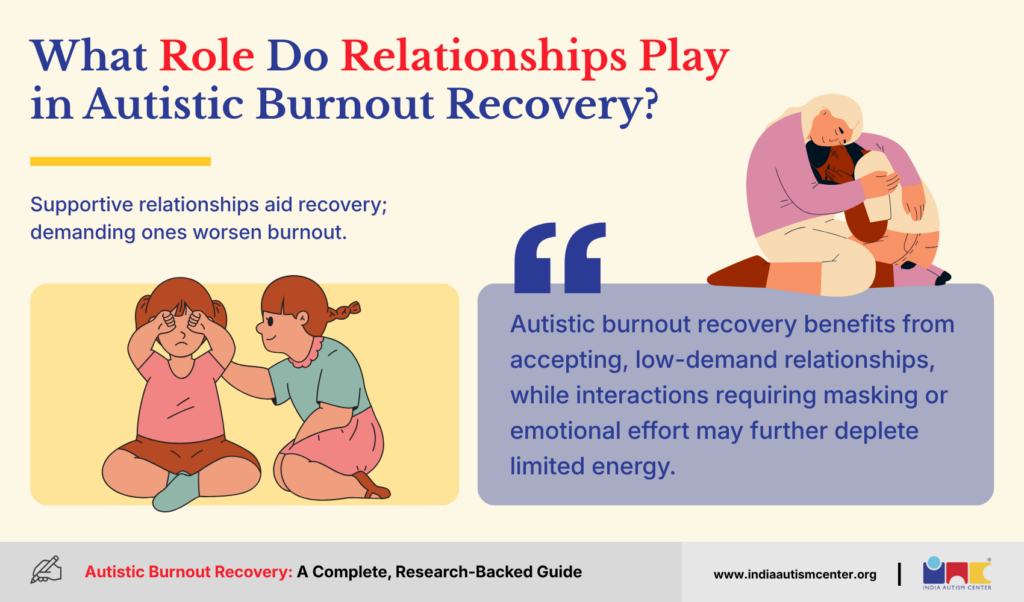
Relationships can either support or drain recovery, depending on how much social effort they require. Sustained social contact, even with people you love, uses the same limited capacity that burnout has already depleted.
This doesn’t mean isolating completely. It means being selective about which relationships get your limited energy during recovery. Relationships that require constant masking or emotional labor may need to be paused, while low-demand, accepting relationships can be genuinely restorative.
Being upfront with close people about reduced capacity — even briefly — tends to prevent misunderstandings. Most people would rather know you need space than assume you’re withdrawing from them personally.
What Are the Biggest Mistakes People Make During Autistic Burnout Recovery?
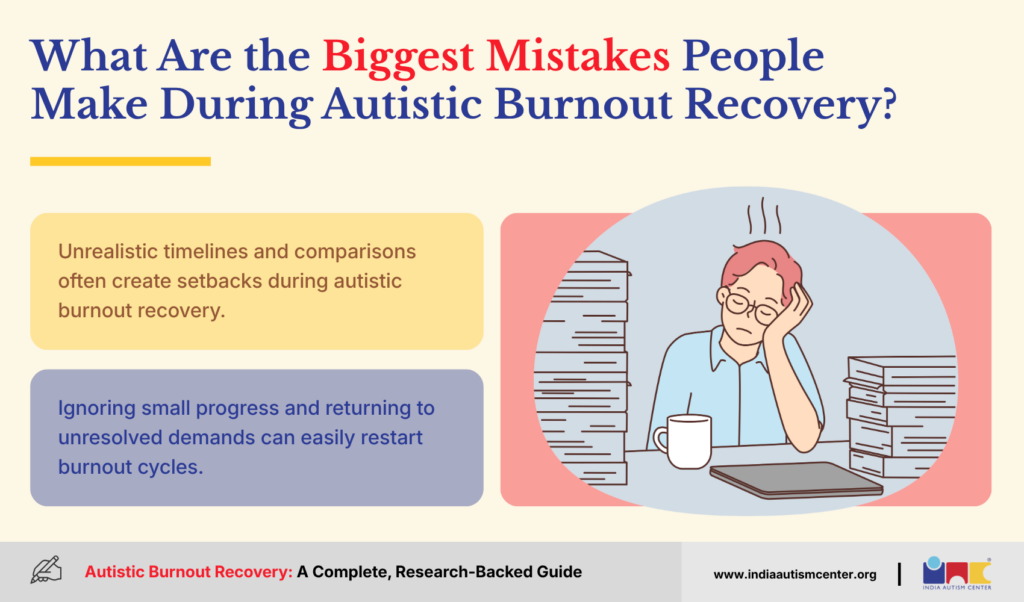
Certain patterns consistently slow down recovery, even with good intentions. Recognizing them early can save months of unnecessary setbacks.
- Treating recovery like a deadline. Setting a fixed date to “be back to normal” often triggers premature pushing and relapse.
- Comparing your recovery to someone else’s. Burnout severity and recovery speed vary widely between individuals.
- Returning to the exact same demands. Recovering fully, then walking back into the same unaddressed triggers, usually restarts the cycle.
- Ignoring small wins. Dismissing gradual progress as “not enough” removes motivation to keep going.
- Waiting for permission to rest. Many autistic adults delay reducing demands until they’re in crisis, rather than acting on early warning signs.
What Can Families and Employers Do to Support Recovery?
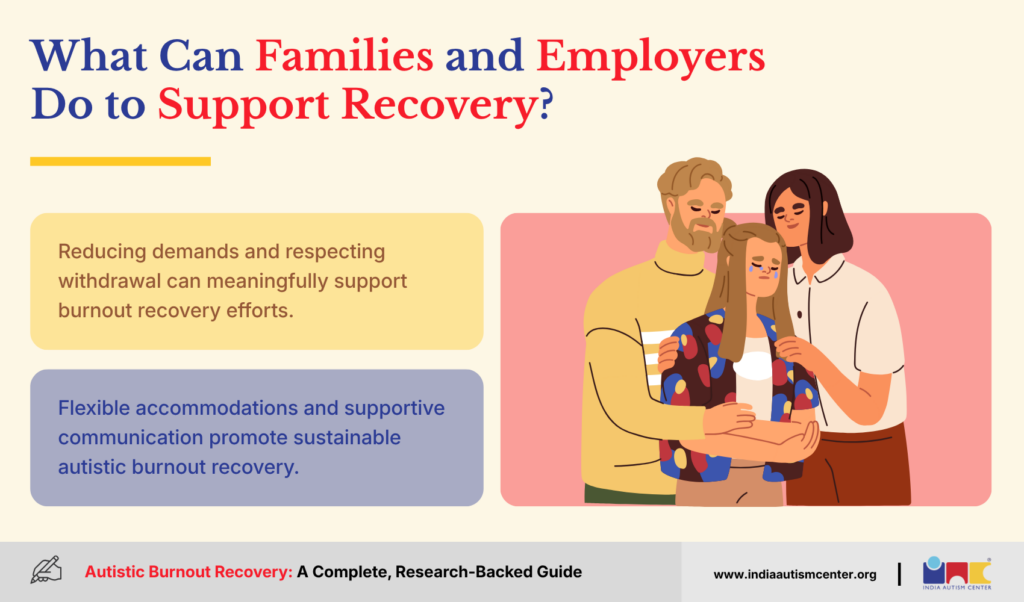
Recovery isn’t only an individual effort — the people and systems around an autistic person matter too. This is a gap most recovery guides skip entirely.
For families and caregivers:
- Reduce social and scheduling demands without requiring explanation
- Avoid pushing “just push through it” advice
- Allow withdrawal and solitude without treating it as a problem
- Learn the difference between burnout and defiance or laziness
For employers and workplaces:
- Allow flexible or reduced hours during acute burnout
- Offer sensory accommodations: lighting, noise control, quiet spaces
- Reduce unnecessary meetings and last-minute schedule changes
- Normalize written communication over spontaneous verbal demands
A workplace that treats these as reasonable accommodations, not special favors, significantly shortens recovery time.
Does Autistic Burnout Happen in Children and Teens?
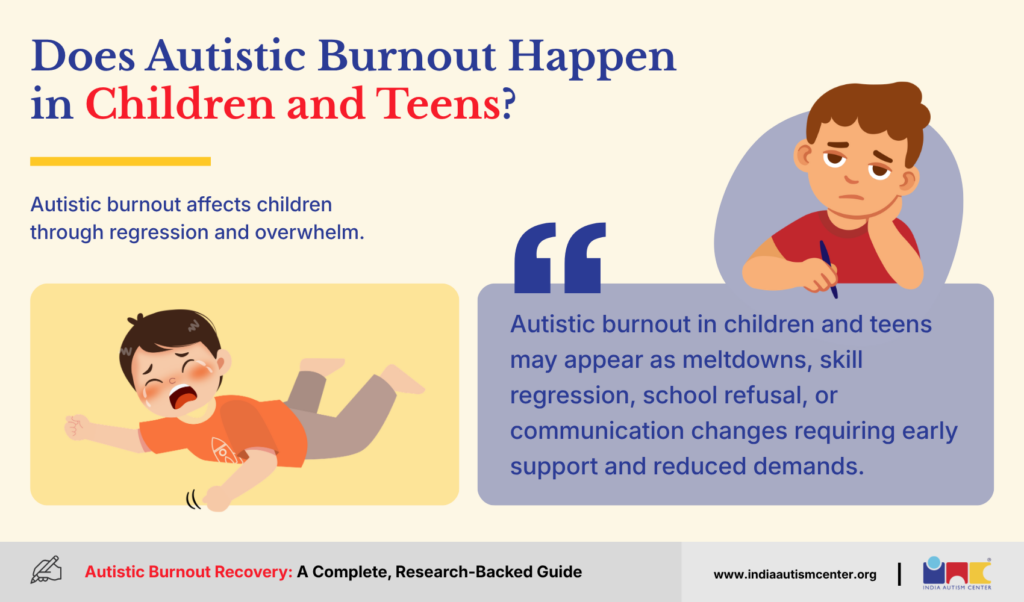
Yes, autistic burnout can affect children and teens, though it’s under-researched in this age group. In children, it often looks like increased meltdowns, school refusal, regression in skills, or sudden loss of speech in situations where they previously spoke.
Parents and educators should watch for sudden changes against the child’s usual baseline. Reducing academic and social demands early often prevents burnout from deepening in younger autistic people.
Frequently Asked Questions
Can you fully recover from autistic burnout?
Many autistic adults report substantial recovery, though full baseline function isn’t guaranteed for everyone. Recovery is more reliable when the root causes are addressed, not just the symptoms.
What’s the fastest way to recover from autistic burnout?
There’s no fast fix. The most effective approach is reducing demands immediately, then rebuilding gradually over months. Trying to speed up recovery through pushing usually backfires.
Can autistic burnout come back after recovery?
Yes, especially if the original causes — excessive masking, unsustainable workload, sensory overload — remain unaddressed. Ongoing prevention is part of long-term management, not a one-time fix.
Is autistic burnout recognised as a medical diagnosis?
Not currently. It’s a well-documented lived experience and an active area of research, but it isn’t yet a formal clinical diagnosis in the DSM-5 or ICD-11.
How is autistic burnout different from a meltdown or shutdown?
A meltdown or shutdown is usually a short, acute response to overwhelming input. Autistic burnout is a prolonged state that can last weeks or years and affects overall functioning, not just a single moment.
This article is for educational purposes only and does not constitute medical or psychological advice. Autistic burnout can overlap with other health conditions, including depression and anxiety. If you’re struggling with your mental health, please consult a qualified healthcare professional or therapist familiar with autism.
For expert insights, support services, and inclusive learning initiatives, visit the India Autism Center.