 Donate now
 Get a Call Back
 MENU
MENU 9 MIN READ
 SHARE
SHARE


Rest restores energy, but it doesn’t rebuild capacity. Autistic burnout happens when demands exceed resources for too long. Sleeping more or taking a vacation won’t fix that mismatch. Real recovery means reducing sensory and social demands, redesigning your environment, and rebuilding capacity gradually. Rest is one part of a larger process, not the whole solution. And in this blog we are going to answer why rest doesn’t help autistic burnout in great details, and what needs to be done.
What Is Autistic Burnout?
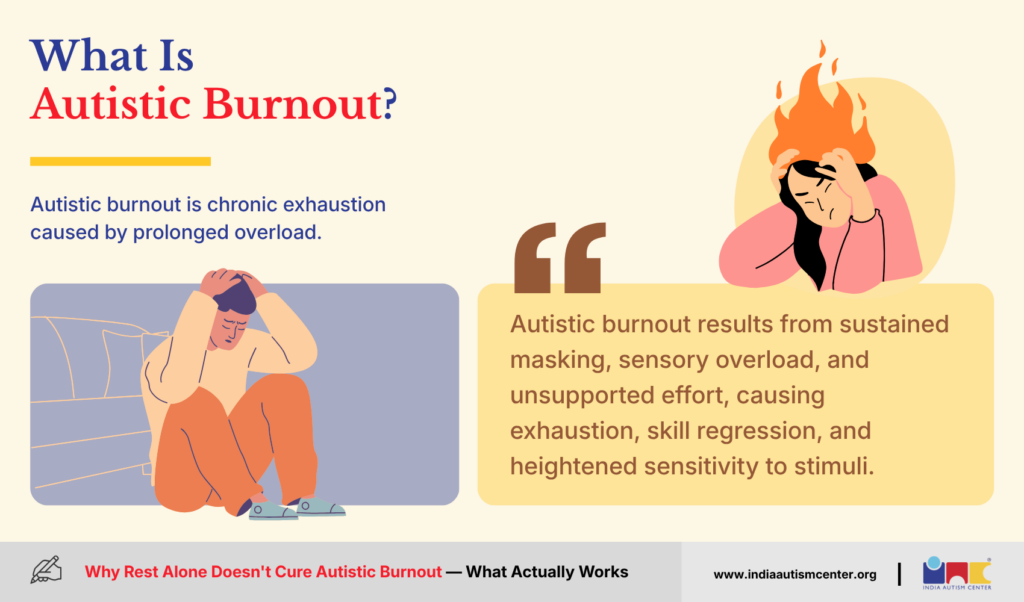
Autistic burnout is a state of chronic exhaustion caused by prolonged overextension of coping resources. It’s not the same as feeling tired after a busy week. It builds over months or years of masking, sensory overload, and unsupported effort.
Researchers describe three core features of autistic burnout:
- Chronic exhaustion that doesn’t improve with sleep
- Skill regression, where abilities you normally have become harder to access
- Reduced tolerance to stimuli, meaning sensory and social input feels more overwhelming than before
Autistic burnout can last weeks, months, or years. It often gets misread as laziness, depression, or a personality change. It’s none of those things. It’s a physiological response to sustained overload.
How Is Autistic Burnout Different From Depression or Chronic Fatigue?
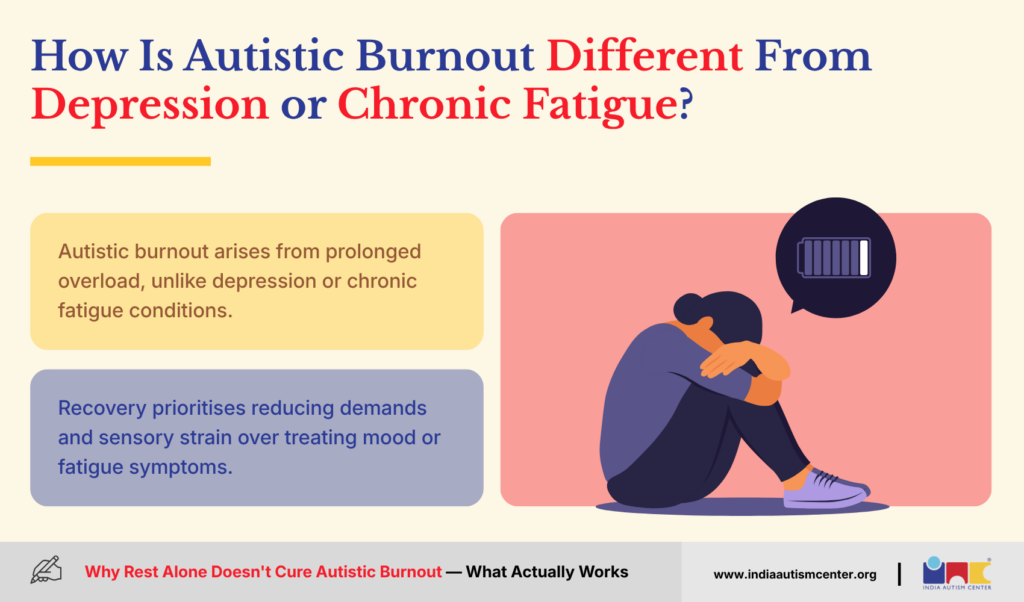
Autistic burnout overlaps with depression and chronic fatigue syndrome, but the causes and recovery paths differ. Depression often responds to therapy and medication targeting mood regulation. Autistic burnout responds to demand reduction and environmental change. Here’s how they compare:
| Feature | Autistic Burnout | Clinical Depression | Chronic Fatigue Syndrome |
| Primary cause | Prolonged demand-resource mismatch | Neurochemical/psychosocial factors | Unclear; often post-viral or immune-related |
| Core symptom | Skill regression + sensory sensitivity | Persistent low mood, anhedonia | Post-exertional malaise |
| Trigger pattern | Worsens with masking, sensory load | Can occur without external trigger | Worsens with physical/cognitive exertion |
| Response to rest | Partial relief only | Variable | Partial relief only |
| Primary recovery lever | Reducing environmental demands | Therapy, medication | Pacing, medical management |
| Mood | Flat or irritable, situational | Persistently low, pervasive | Can accompany fatigue |
These conditions can co-occur. A person can experience autistic burnout and depression at the same time. If symptoms persist beyond a few months, a clinical evaluation can rule out overlapping conditions and guide the right treatment combination.
📥 Free download: Printable daily routine chart for autistic children
Why Rest Alone Doesn’t Help Autistic Burnout
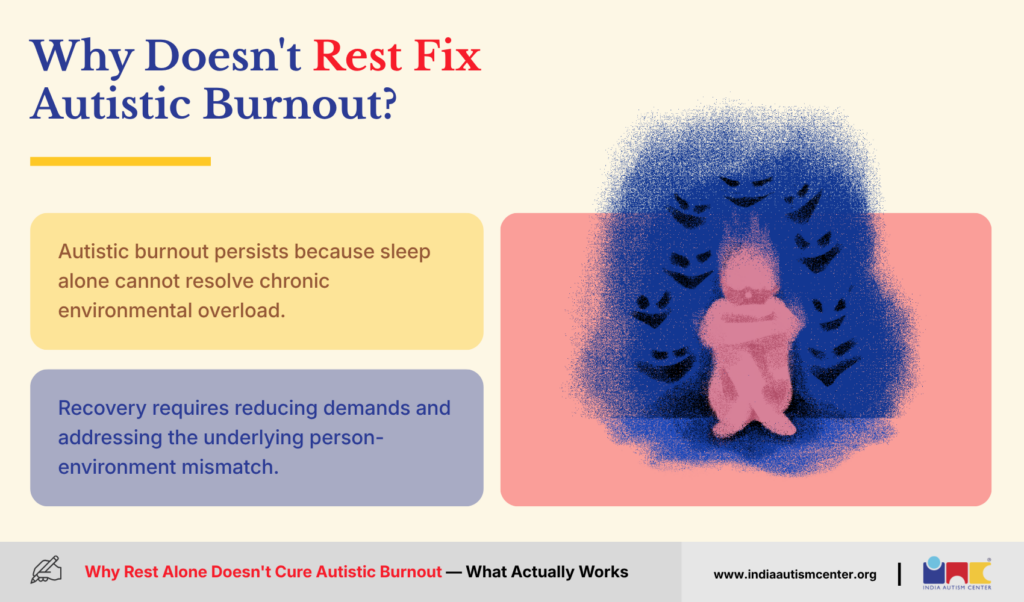
Rest doesn’t fix autistic burnout because burnout isn’t caused by a lack of sleep. It’s caused by a mismatch between environmental demands and available coping resources. Sleeping more won’t change the environment that caused the overload in the first place.
What Happens to the Body During Chronic Overload?
Sustained stress activates the hypothalamic-pituitary-adrenal (HPA) axis repeatedly. Over time, this system stops resetting properly between stressors. Researchers call this cumulative strain allostatic load.
High allostatic load means the body’s stress-response system stays partially activated even during rest. This explains why a person can sleep eight hours and still wake up exhausted. The nervous system hasn’t actually powered down.
What Is the Cognitive Resource Model?
Executive function operates like a limited daily resource. Every act of masking, sensory filtering, or social decoding draws from that resource pool. For autistic people, daily environments often demand far more of this resource than they provide back.
Rest can partially refill this pool. But if the same high-demand environment returns the next day, the pool drains again just as fast. This is the core reason vacations feel good but burnout returns.
Why Does Burnout Come Back After a Vacation?
Burnout comes back after a vacation because the underlying environment hasn’t changed. A vacation removes demands temporarily. Once you return to the same job, sensory environment, or social obligations, the same mismatch resumes. Recovery requires changing the environment, not just pausing it.
This is called person-environment mismatch. It means burnout isn’t a personal flaw. It’s a signal that your environment is asking for more than it’s built to support.
What Actually Causes Autistic Burnout?
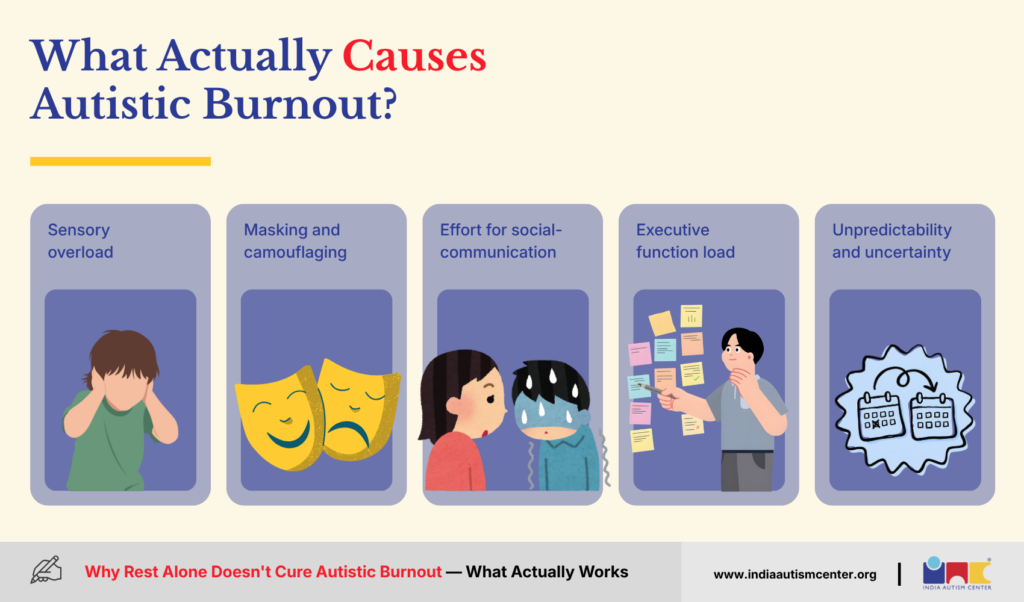
Autistic burnout is caused by cumulative, unsupported demand across several domains. The most common contributors include:
- Sensory overload — fluorescent lighting, open-plan offices, crowded transport, constant noise
- Masking and camouflaging — suppressing stims, forcing eye contact, scripting conversations
- Social-communication effort — the extra work of decoding neurotypical communication norms, sometimes called the double empathy problem
- Executive function load — planning, switching tasks, and managing unpredictability
- Unpredictability and uncertainty — last-minute changes, unclear expectations, unstructured time
Each of these draws down the same limited resource pool. Most autistic people face several of them simultaneously, every day, without accommodation.
Read our blog on Autism Masking: Reason, Signs, Effects, Types & Solutions
How Long Does Autistic Burnout Recovery Take?
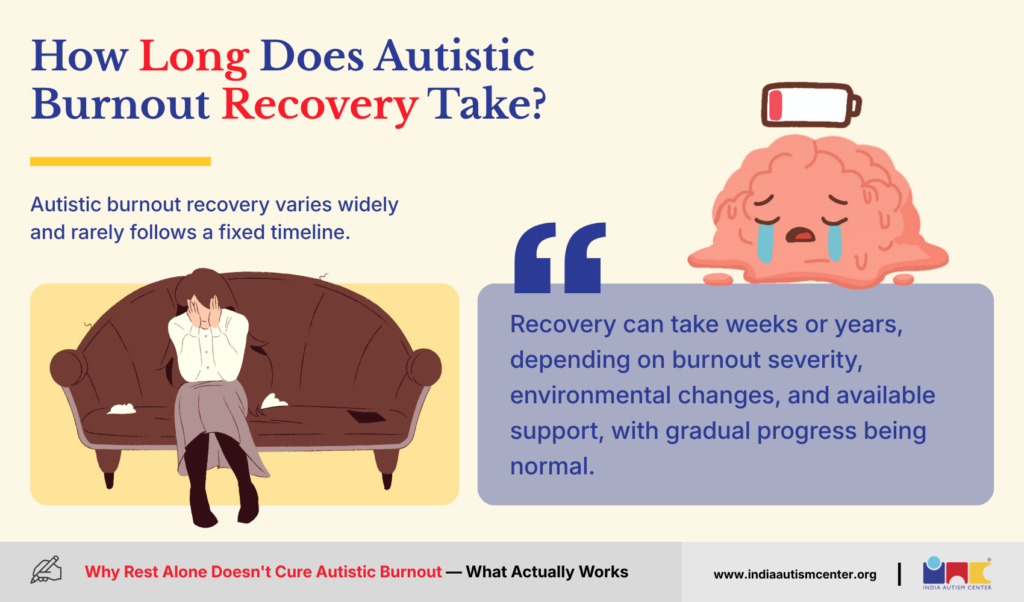
Autistic burnout recovery timelines vary widely, from a few weeks to several years. Recovery speed depends on burnout severity, how much the environment changes, and how much support is available. Mild burnout caught early can resolve in weeks with demand reduction. Severe, prolonged burnout can take years of sustained environmental change.
There’s no fixed recovery calendar. Expecting a fast timeline often causes people to push themselves back into the same overload cycle. Gradual, non-linear recovery is normal and expected.
Want to know more? Get in touch with us.
What Is the Actual Recovery Framework for Autistic Burnout?
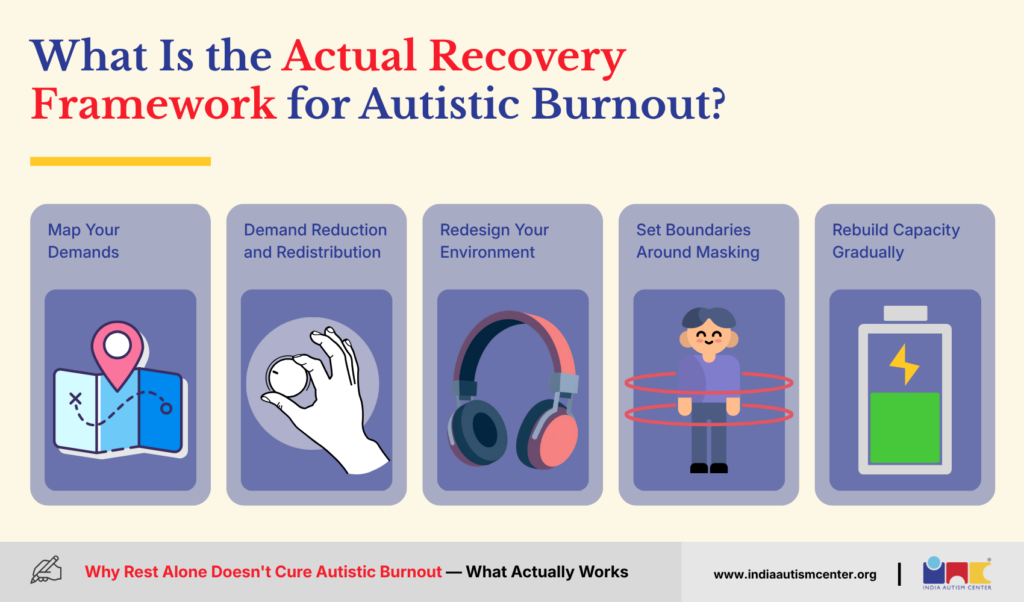
Recovering from autistic burnout requires five steps: mapping your demands, reducing them, redesigning your environment, setting boundaries around masking, and rebuilding capacity slowly. Rest supports this process but doesn’t replace it.
Step 1: Map Your Demands
List every recurring demand in your week. Rate each one by intensity, from mildly draining to severely draining. Include sensory, social, cognitive, and emotional demands separately. This map shows exactly where your resources are going.
Step 2: Reduce and Redistribute Demands
Once mapped, identify which demands can be reduced, delegated, or removed. Some examples:
- Swap open-plan seating for a quieter workspace, if possible
- Replace verbal check-ins with written updates
- Batch social obligations instead of spreading them daily
- Delegate high-effort tasks that don’t require your specific skills
Small reductions compound. You don’t need to remove every demand — just enough to stop the daily deficit.
Step 3: Redesign the Environment, Not Just Yourself
Environmental change works better than willpower. Noise-cancelling headphones, flexible hours, and written communication options reduce demand at the source. This is more sustainable than trying to build tolerance to an overwhelming environment.
Step 4: Set Boundaries Around Masking
Masking is one of the biggest hidden drains in autistic burnout. Identify low-risk spaces where you can unmask selectively, such as with trusted friends or at home. Reducing masking even part-time lowers cumulative load significantly.
Step 5: Rebuild Capacity Gradually
Add activities back slowly, one at a time. Watch for early warning signs of overload before adding more. Rebuilding too fast is the most common cause of relapse.
What Does Support Look Like for Employers and Families?
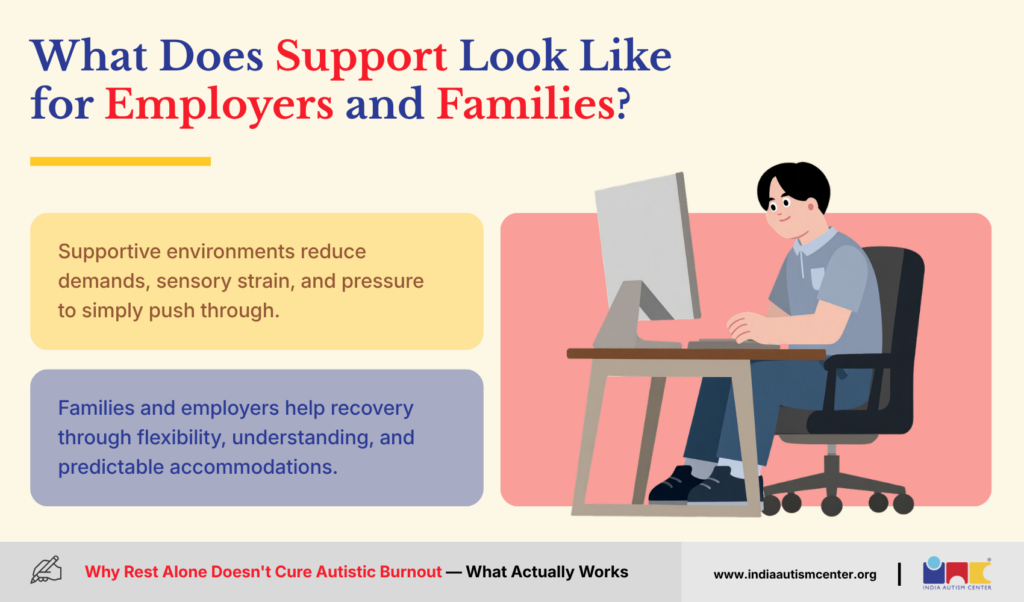
Employers and families can support autistic burnout recovery by reducing demands, not by encouraging more rest alone. Practical support includes flexible schedules, sensory-friendly spaces, written instructions, and predictable routines. Understanding replaces pressure to “push through.”
What Should Employers Do?
- Offer flexible or remote work options where feasible
- Reduce unnecessary meetings and last-minute changes
- Allow written communication as an alternative to verbal check-ins
- Provide a quiet space or allow noise-cancelling headphones
What Should Families Do?
- Avoid framing burnout as laziness or a phase
- Reduce social obligation pressure during recovery periods
- Allow stimming and unmasking at home without comment
- Ask what kind of support is helpful, rather than assuming
Avoid saying: “You just need to relax more” or “Everyone gets tired.” These responses minimize a physiological state and can delay recovery.
📥 Free download: Printable daily routine chart for autistic children
How Does Autistic Burnout Show Up Differently in Indian Workplaces and Families?
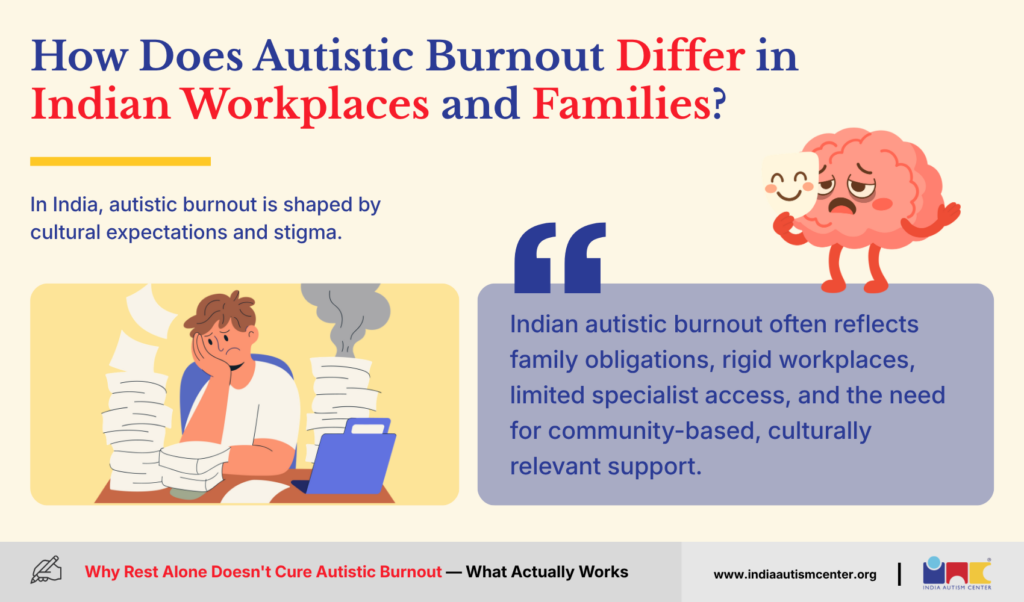
Autistic burnout in India often intersects with cultural expectations around family duty, workplace hierarchy, and limited flexibility. Joint-family living can increase social demand rather than reduce it. Open-plan offices and rigid attendance norms are common, and disclosure of autism still carries significant stigma in many workplaces.
Access to autism-informed therapists and occupational therapists remains limited outside major cities. This makes environmental self-management, rather than clinical intervention alone, a practical necessity for many autistic adults in India. Community-based and family-inclusive strategies often work better than approaches designed around Western workplace norms, such as fully remote work or living independently.
What Are the Signs You Need Professional Support?
Professional support becomes necessary when burnout symptoms persist beyond a few months, when skill regression is severe, or when self-harm thoughts appear. A psychiatrist or occupational therapist experienced with autism can assess co-occurring conditions and guide a structured recovery plan.
Warning signs that need clinical attention include:
- Burnout lasting more than three to six months without improvement
- Significant loss of previously stable daily living skills
- Withdrawal from all social contact, not just high-demand situations
- Thoughts of self-harm or hopelessness
If any of these apply, reach out to a qualified mental health professional promptly.
Frequently Asked Questions
Can autistic burnout be misdiagnosed as depression?
Yes. Autistic burnout shares symptoms with depression, including low energy and reduced motivation. Misdiagnosis is common when clinicians aren’t familiar with autism presentation in adults. An accurate diagnosis considers both possibilities together.
How is autistic burnout different from regular burnout?
Regular workplace burnout responds to reduced workload and rest. Autistic burnout requires reducing sensory and social demands specifically, alongside workload. It also includes skill regression, which isn’t typically part of standard burnout definitions.
Can you fully recover from autistic burnout?
Many autistic people recover significantly with sustained environmental change and demand reduction. Full recovery timelines vary, and some residual sensitivity may remain. Recovery is possible, but it’s rarely instant.
Does masking cause autistic burnout?
Masking is one of the largest contributors to autistic burnout. Suppressing natural behaviors and mimicking neurotypical norms requires continuous cognitive effort. Reducing masking, especially in safe environments, lowers overall burnout risk.
How do I explain autistic burnout to my employer or family?
Describe it as a physiological state caused by prolonged overload, not a mood or motivation issue. Share specific, practical accommodations that would help, rather than only naming the diagnosis. Concrete requests are usually easier for others to act on.
This article is for educational purposes only and isn’t a substitute for professional medical or psychological advice. If you’re experiencing prolonged burnout, skill regression, or thoughts of self-harm, please consult a qualified healthcare professional.
For expert insights, support services, and inclusive learning initiatives, visit the India Autism Center.