 Donate now
 Get a Call Back
 MENU
MENU 20 MIN READ
 SHARE
SHARE


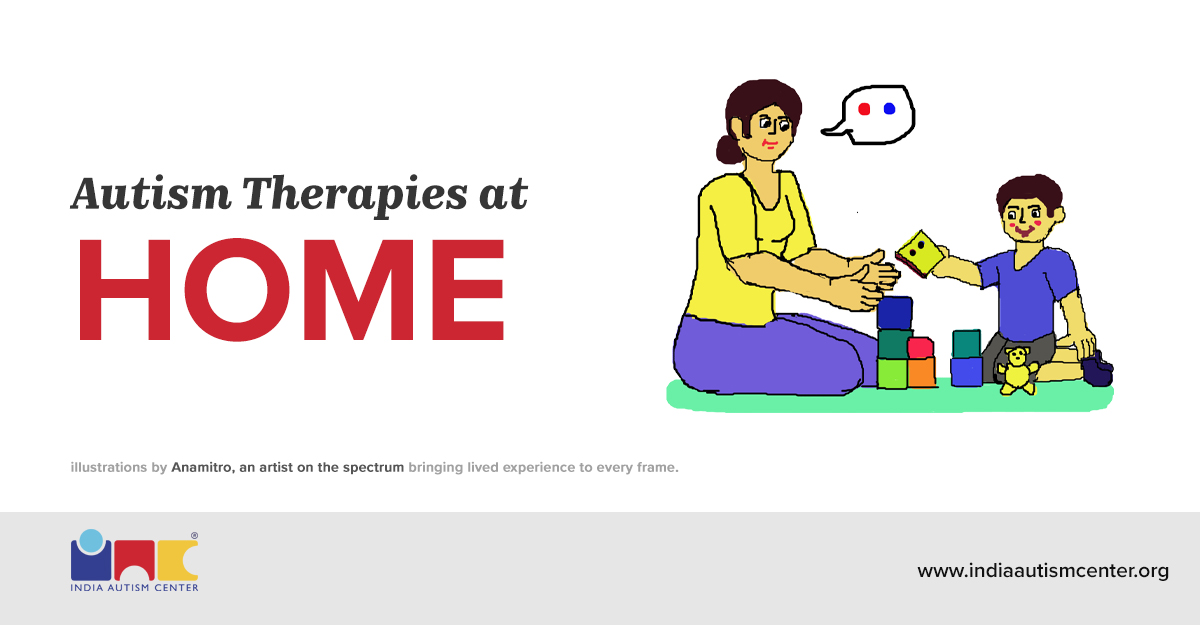
If you’ve ever sat across from your child after a therapy session and thought, “I wish I could do more between now and next week” – you’re not alone. Most parents feel that quiet ache. The good news is that the home is one of the most powerful therapy spaces your child will ever have. You are already the most important person in their world. This guide shows you how to use that.
Autism therapies at home are structured activities and interaction strategies you weave into daily life – mealtimes, bath time, play, bedtime. They don’t replace your therapist. They multiply the work your therapist has already started. Research consistently shows that children who receive therapy reinforcement at home make faster, more durable progress than those who receive clinic sessions alone.
Below, we cover 7 evidence-based approaches, how to adapt each for home use, what the Indian context means for your family, and how to know when to ask for more support.
Why Choose In-Home Autism Therapy?
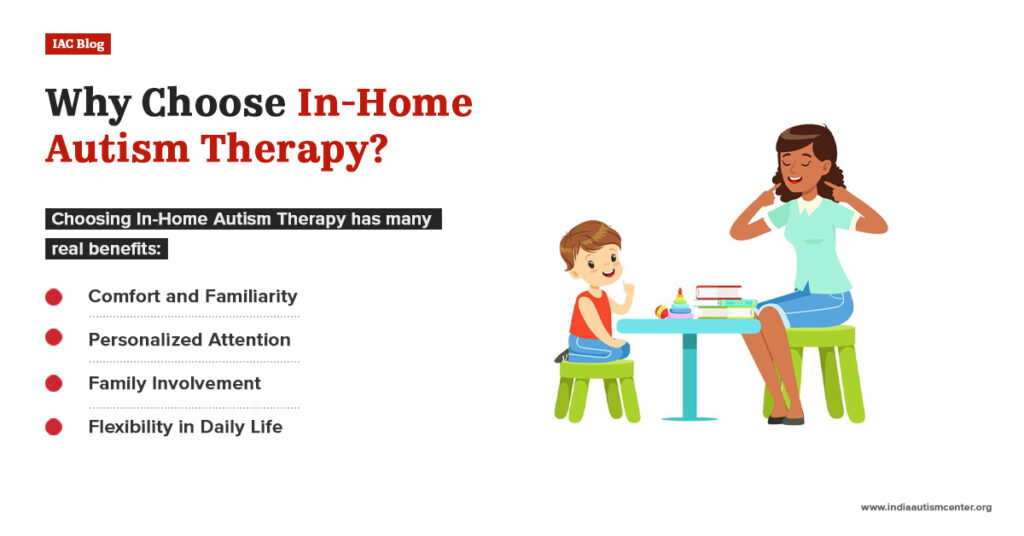
The clinic is where skills are introduced. Home is where they become real. That distinction matters enormously for autistic children, who often struggle to generalise learning from one setting to another. When a child practises a skill at the same kitchen table where they eat breakfast, in the same living room where they watch their favourite show, that skill sticks.
Comfort and Familiarity
The home environment removes a layer of sensory and social unpredictability that can make learning harder. Your child already knows the smells, sounds, and layout of home – and that familiarity lowers their baseline anxiety. A calmer nervous system is a more receptive one. When stress is low, the window for communication and connection opens wider, and that is precisely when learning happens most naturally.
Personalised Attention
No clinic session, however skilled the therapist, can replicate the one-to-one attention a parent provides across an entire day. At home, you can read your child’s mood in real time, pivot an activity when they’re overwhelmed, and seize unexpected moments of engagement – the spontaneous giggle over a spilled cup of water that becomes a five-minute language lesson. That kind of responsiveness is uniquely yours to give.
Family Involvement
When parents, siblings, and grandparents all understand the basics of what supports the child, the whole household becomes a therapeutic environment. Skills reinforced by multiple people across multiple contexts generalise faster. Family involvement also reduces caregiver burnout – when everyone shares the load, no single person carries it all.
Flexibility in Daily Life
Home-based therapies for autism don’t require a separate appointment slot. They live inside routines that already exist: narrating what you’re doing while cooking, practising turn-taking during a board game, using a visual schedule to ease the transition from screen time to dinner. This flexibility means therapy happens far more frequently than once or twice a week – and frequency is one of the strongest predictors of progress.
Effective Autism Therapies You Can Try at Home
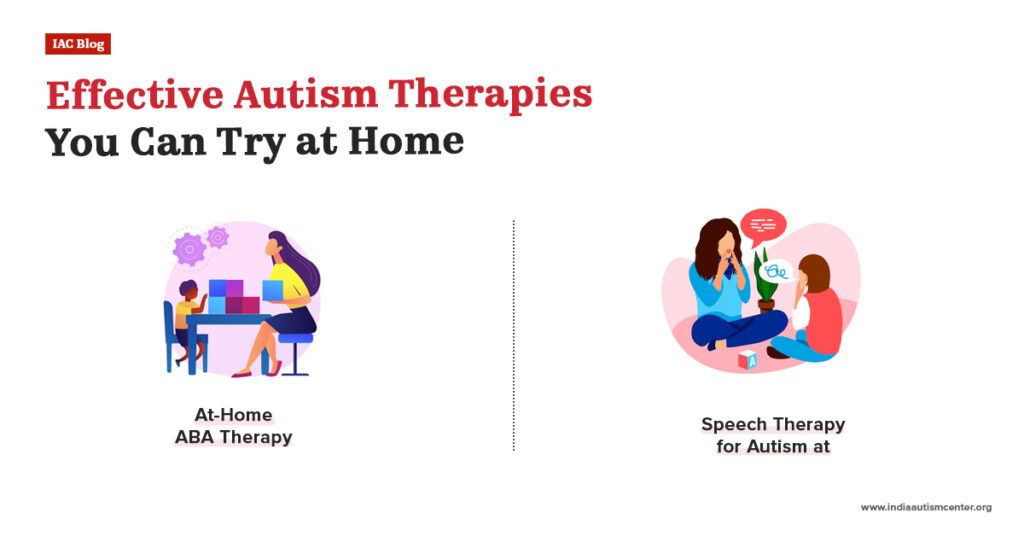
Applied Behaviour Analysis (ABA)
ABA is one of the most extensively researched interventions for autism. At its core, it breaks complex skills into small, teachable steps and uses consistent reinforcement to build them. At home, you don’t need to run formal ABA sessions – but understanding its principles transforms everyday interactions.
How it works: Identify a target skill (e.g., asking for a drink), break it into steps (make eye contact → point or vocalise → wait for response), prompt as needed, and reward the attempt immediately and specifically.
Practical parent tips:
- Use “errorless teaching” for new skills. Provide the prompt before the child has a chance to get it wrong – this builds confidence and reduces frustration.
- Keep sessions short. Five focused minutes of ABA-style practice during snack time beats a distracted 30-minute sit-down. Repetition across many small moments is more effective than one long session.
- Be consistent with your reinforcers. If stickers work on Monday, use stickers on Tuesday too. Consistency is what makes reinforcement powerful.
Always work with a qualified ABA therapist to set goals and review progress. Home practice should follow the programme your therapist has designed – not replace their clinical judgement.
Speech and Language Therapy
Communication challenges are central to autism, but “communication” is far broader than spoken words. It includes gestures, facial expressions, pointing, picture exchange, and augmentative and alternative communication (AAC) devices. Speech therapy at home means creating dozens of small communication opportunities throughout the day.
How it works: Follow your child’s lead in conversation. Expand on what they say rather than correcting it. If they say “ball,” you say “red ball” or “throw ball.” If they gesture, name the gesture and respond to it as a meaningful communication.
One of the most effective parent-training frameworks for this is the Hanen Centre’s “More Than Words” programme – a structured course for parents of autistic children under six, delivered by a Hanen-certified speech-language pathologist. It teaches parents to use everyday routines as communication opportunities and has strong research support from randomised controlled trials. Ask your speech therapist whether they are Hanen-certified or can recommend someone who is.
Practical parent tips:
- OWL: Observe, Wait, Listen. Before jumping in to help, pause and give your child space to initiate. Even a glance or a reach counts.
- Narrate your day simply. “Mummy is washing the cup. Washing. Cup.” Simple, repeated language builds vocabulary without pressure.
- Reduce questions, increase comments. Questions put children on the spot. Comments (“Oh, the dog is running!”) invite response without demanding it.
Floortime (DIR/Floortime)
Developed by child psychiatrist Dr Stanley Greenspan and Dr Serena Wieder, DIR/Floortime is a relationship-based approach that uses play as the vehicle for developmental growth. DIR stands for Developmental, Individual-difference, Relationship-based. The “Floortime” part is literal – you get on the floor with your child and follow their lead.
The key concept: circles of communication. Every back-and-forth exchange between child and caregiver – a look, a gesture, a sound, a shared laugh – is one “circle.” Opening a circle means initiating an interaction. Closing it means responding. The goal is to build longer and longer chains of these exchanges, which gradually develop emotional regulation, social thinking, and language.
Practical steps for parents:
- Follow your child into their world. If they’re spinning a wheel, spin one too. Join the activity on their terms before gently expanding it.
- Create a “problem” that invites interaction. Put a favourite toy just out of reach, or “accidentally” block their path. These gentle obstacles prompt communication without demanding it.
- Aim for 20 minutes of pure Floortime daily. No phones, no agenda. Just you, your child, and their chosen activity. Even three or four short sessions of five minutes each count.
Floortime is something parents can genuinely do well at home, especially after guidance from a trained DIR therapist. It is not about teaching – it is about connecting.
Relationship Development Intervention (RDI)
RDI was developed by Dr Steven Gutstein and focuses on building what he calls dynamic intelligence – the ability to adapt flexibly to changing situations, read social context, and share experiences with others. Where ABA tends to focus on discrete skills, RDI targets the underlying social-cognitive processes that make relationships possible.
The core mechanism: guided participation. Parents act as “guides,” structuring activities so the child must engage, problem-solve, and share the experience – but without explicit instruction or prompting. The parent varies their actions slightly to create just enough uncertainty to keep the child engaged and thinking.
Practical steps for parents:
- Do activities side by side, not face to face. Washing dishes together, folding laundry, gardening – these “co-regulation” activities build shared attention naturally.
- Use “declarative language.” Instead of “What colour is this?” (a test), say “Hmm, I wonder which one fits…” (an invitation to think together). This shifts the dynamic from compliance to collaboration.
- Slow down and pause. RDI relies on the child noticing and responding to small variations in what you do. If you rush, those moments disappear.
RDI is ideally guided by a certified RDI consultant, but the principles can be woven into daily life with relatively little training.
Creative Arts Therapy
Not every child communicates best through words or structured tasks. For many autistic children, drawing, music, movement, and storytelling are the most natural pathways to self-expression and emotional regulation. Creative arts therapy is not about producing good art – it is about using creative processes as a non-pressured, strength-based route to connection and communication.
Why it works: Creative activities engage the right hemisphere, reduce performance anxiety, and allow children to express experiences they may not yet have words for. A child who cannot describe feeling overwhelmed may draw it in vivid, telling detail.
Practical tips for parents:
- Music before transitions. Play a consistent “clean-up song” or “bath time song” to signal what’s coming next. Music reduces transition anxiety and builds routine memory.
- Offer drawing as emotional check-in. “Show me how you’re feeling today” with a blank page and crayons can open conversations that direct questions cannot.
- Movement breaks as regulation tools. Five minutes of jumping, spinning, or dancing before a demanding task helps regulate the nervous system and improve focus. This is not indulgence – it is preparation.
Parent-Child Interaction Therapy (PCIT)
PCIT is a structured, evidence-based therapy originally developed for young children with behavioural difficulties. It has been adapted for autism and is particularly effective for managing challenging behaviours while simultaneously building secure, warm attachment between parent and child.
How it works: A trained therapist coaches the parent in real time – typically through a one-way mirror or an earpiece – while the parent interacts with their child. The therapist guides the parent to use specific skills: following the child’s lead, describing their play, praising specifically, and setting calm, consistent limits.
Important note: PCIT requires a trained therapist to guide the initial sessions. It is not something to attempt from a book alone. However, once parents have learned the skills – usually over 14–17 sessions – they can apply them independently at home, and the effects are lasting. If challenging behaviours are significantly affecting your family’s daily life, ask your paediatrician or psychologist for a PCIT referral.
Occupational Therapy Activities at Home
Occupational therapy (OT) for autism addresses three broad areas: sensory integration (how the brain processes sensory input), fine motor skills (the small, precise movements needed for writing, dressing, eating), and daily living skills (independence in self-care and household tasks). OT activities at home are among the most practical and immediately impactful things parents can do.
Three practical home activities:
- Sensory bin play. Fill a large container with dried rice, lentils, or kinetic sand. Hide small objects inside for your child to find. This provides controlled tactile input, builds tolerance for different textures, and develops fine motor skills simultaneously. Start with textures your child already tolerates and expand gradually.
- Threading and sorting. Stringing large beads, sorting buttons by colour, or using tweezers to move small objects between containers all build the hand strength and precision needed for writing and self-care. Make it a game – sort the “red team” versus the “blue team.”
- Dressing practice with backward chaining. Teach your child to dress themselves by starting with the last step. If they’re learning to put on a shirt, you do everything except the final pull-over-the-head, and they do that one step. Gradually hand back more steps as confidence grows. This approach builds success from the very first attempt.
Here are 5 Effective Speech Therapies you might want to read.
Want to know more? Get in touch with us.
Daily Activities for Autism That Build Skills
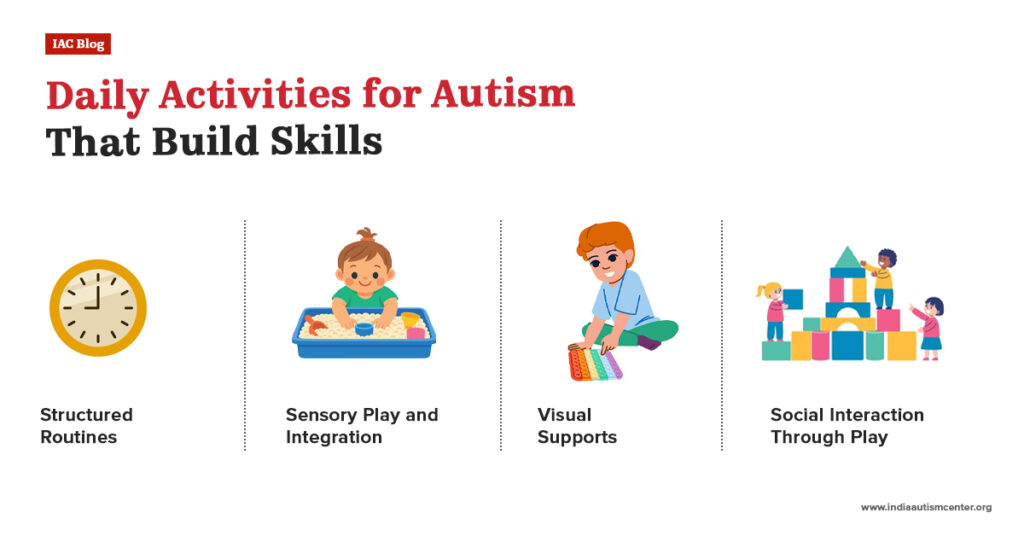
Therapy doesn’t need a special room or a special time. The most powerful learning happens inside the rhythms of ordinary life.
Structured Routines
Children with autism thrive on predictability – not because they are rigid, but because predictability frees up cognitive resources that would otherwise go to managing uncertainty. A consistent daily routine (wake-up, breakfast, play, therapy activities, lunch, rest, outing, dinner, bath, bed) reduces anxiety and creates natural, repeated opportunities to practise skills. Write it out as a simple visual schedule and review it together each morning. When changes are unavoidable, give advance warning: “After lunch, we’re going somewhere different today.”
Sensory Play and Integration
Sensory play is not just fun – it is neurological work. Activities like playing with water, sand, playdough, or textured fabrics help the brain learn to process and organise sensory information more efficiently. Start with sensory experiences your child already enjoys and use them as bridges to new ones. A child who loves water play might tolerate finger painting if you introduce it gradually. The goal is gradual expansion of the sensory comfort zone, never forced exposure.
Visual Supports
Visual supports – picture schedules, choice boards, emotion charts, first-then boards – make the invisible visible. Abstract concepts like “in five minutes” or “after you finish this, you can have that” become concrete and manageable. Print simple images from the internet, laminate them, and attach them to the fridge with velcro. You don’t need expensive materials. The key is consistency: use the same visual for the same concept every time, so your child can rely on it.
Social Interaction Through Play
Play is the original social curriculum. Simple games – rolling a ball back and forth, building a block tower together and knocking it down, simple card games like Snap – teach turn-taking, shared attention, and the joy of doing something with another person. Start with one-to-one play with a parent before introducing siblings or peers. Keep sessions short, positive, and child-led. The moment it stops being fun, it stops being therapeutic.
Benefits of Home-Based Autism Therapies
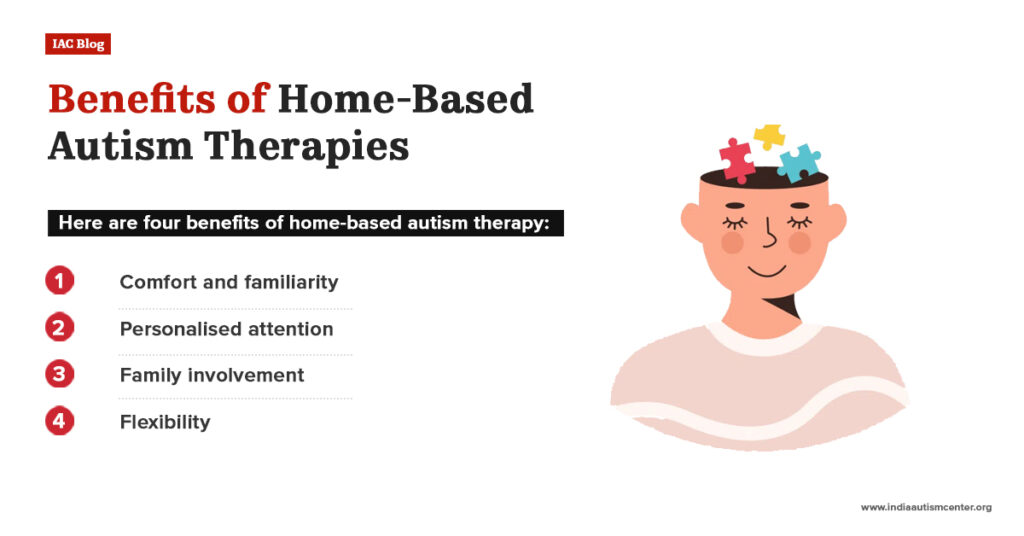
Comfort and Familiarity: The home environment offers comfort and familiarity, which can reduce anxiety and stress often experienced by individuals with autism. This setting promotes a more receptive state for learning and development.
Personalised Attention: At-home therapies allow for one-on-one interaction and personalised attention, which is crucial for addressing individual needs and preferences. Caregivers can tailor activities to match the individual’s interests and strengths.
Family Involvement: Involving family members in therapy fosters a strong support system. When everyone is on board, consistent therapy implementation becomes more achievable, leading to better outcomes.
Flexibility: Home-based therapies can be integrated into daily routines, making them flexible and adaptable. This flexibility can be particularly beneficial for individuals who may struggle with transitions.
Home Remedies for Autism: Practical Approaches
Create a Structured Routine
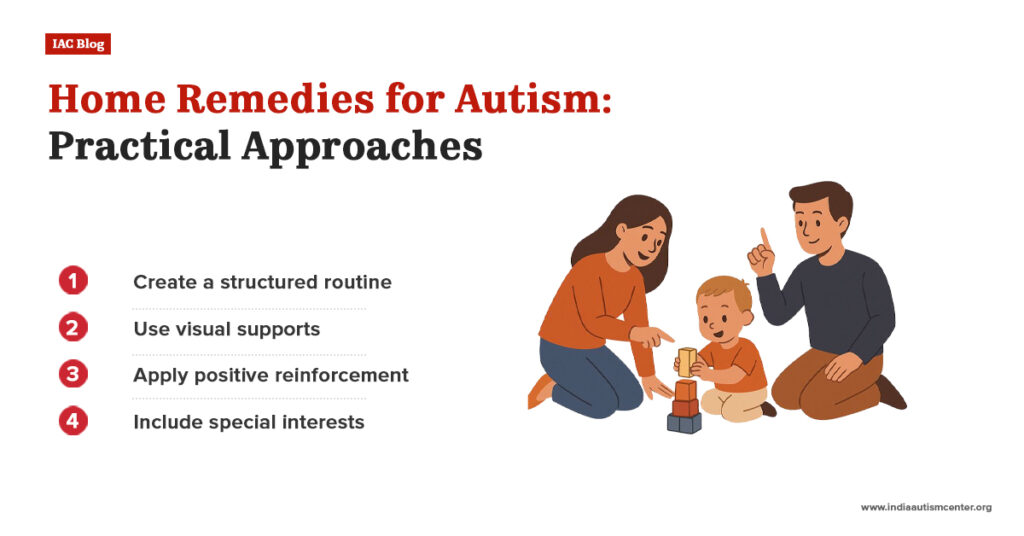
Individuals with autism thrive in structured environments. Establish a consistent daily routine that includes therapy sessions, leisure activities, meals, and rest.
Utilise Visual Supports
Visual aids such as schedules, charts, and pictures can help individuals with autism understand expectations and transitions. These aids provide a concrete representation of abstract concepts.
Implement Positive Reinforcement
Rewarding desired behaviours encourages repetition. Use verbal praise, stickers, tokens, or preferred activities as rewards to reinforce positive behaviours and achievements.
Incorporate Special Interests
Special interests can be powerful motivators. Integrate these interests into therapy activities to keep engagement high and foster a positive learning experience.
Want to know more? Get in touch with us.
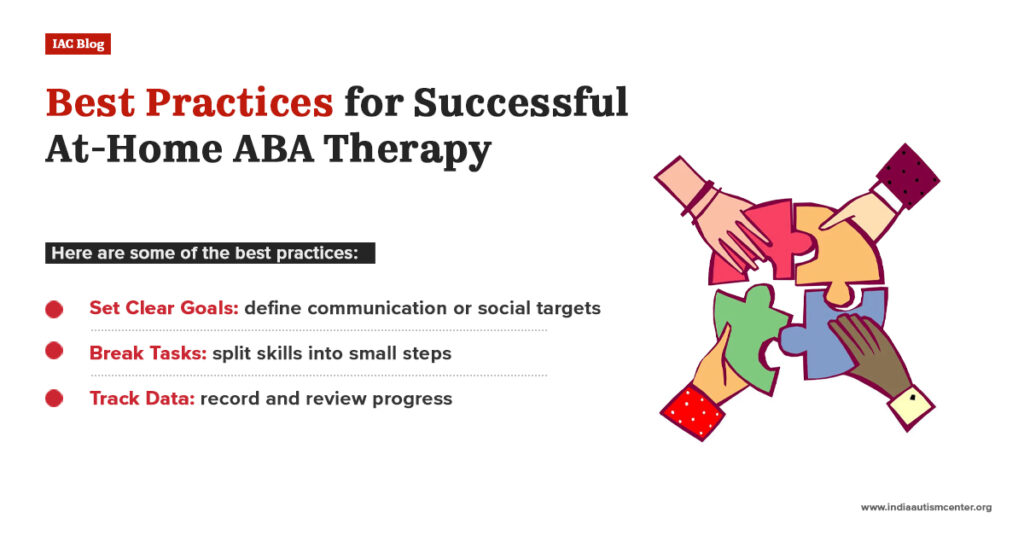
Best Practices for Successful At-Home ABA Therapy
Create a Structured Routine
Decide which therapy activities will happen at which times of day, and stick to it. Consistency is not rigidity – it is the scaffolding that makes everything else possible. A simple weekly plan (Monday: sensory bin + ABA practice; Tuesday: Floortime + speech activities) prevents decision fatigue and ensures nothing gets skipped when life gets busy.
Utilise Visual Supports
Use visual schedules, first-then boards, and choice cards not just as therapy tools but as communication infrastructure throughout the day. The more consistently you use them, the more your child will rely on them – and reliance on visual supports is a strength, not a crutch. Many autistic adults describe visual organisation tools as essential to their independence.
Implement Positive Reinforcement
Reinforcement works best when it is immediate, specific, and meaningful to the child. “Great job!” is less effective than “You asked for the cup – brilliant asking!” Identify your child’s top five motivators (a specific toy, a song, a food, a physical activity, a phrase they love) and use these deliberately. Rotate reinforcers to prevent satiation.
Incorporate Special Interests
A child obsessed with trains will learn prepositions faster if the lesson involves trains. A child who loves a particular cartoon character will engage more readily with a social story featuring that character. Special interests are not distractions from therapy – they are the most powerful engagement tools you have. Use them shamelessly.
Track Progress Simply
You don’t need sophisticated software. A small notebook kept in the therapy space is enough. Note the date, what you worked on, what went well, and what was hard. Take a short video clip once a week of a skill you’re targeting – these clips are invaluable for your therapist and for your own morale when progress feels slow. Review your notes with your therapist at every session. Over months, the pattern of progress becomes visible in a way that daily observation cannot reveal.
Know When to Seek Professional Help
Home therapy is powerful, but it has limits. Seek additional professional support if:
- Challenging behaviours are escalating – aggression, self-injury, or severe meltdowns that are increasing in frequency or intensity.
- Your child has plateaued for more than 6–8 weeks despite consistent home practice.
- You are feeling overwhelmed or burnt out. Caregiver wellbeing is not separate from child outcomes – it is central to them.
- New concerns emerge – regression in previously acquired skills, significant sleep disruption, or signs of anxiety or depression.
Recognising these signs and asking for help is not failure. It is exactly what a skilled, attentive parent does. The goal of home therapy is always to complement professional support, never to replace it.
Home-Based Autism Therapy in India: What Parents Need to Know
India’s autism landscape is changing rapidly, but navigating it still requires knowing where to look and what questions to ask.
The cost reality. Professional therapy sessions in India typically cost between ₹800 and ₹2,500 per session, depending on the city, the therapist’s qualifications, and the type of therapy. For a family attending three sessions a week across speech therapy, OT, and behaviour therapy, that adds up quickly. Home-based practice between sessions doesn’t just support progress – it multiplies the value of every session you pay for. The more your child practises at home, the faster they progress in clinic, and the fewer sessions you ultimately need.
Verify your therapist’s RCI registration. The Rehabilitation Council of India (RCI) is the statutory body that regulates rehabilitation professionals in India, including special educators, speech therapists, and clinical psychologists working with autism. Only professionals with RCI-recognised qualifications are legally entitled to practise as rehabilitation professionals. Before engaging any therapist, ask for their RCI registration number and verify it on the Central Rehabilitation Register at rehabcouncil.nic.in. This single step protects your child from unqualified practitioners.
Puja Dutta, the RCI-registered Clinical Psychologist who leads emotional skills programmes at India Autism Center, notes that parents are often unaware they can simply ask a therapist for their RCI number – and that any qualified professional will provide it without hesitation.
Know your rights under the RPWD Act 2016. The Rights of Persons with Disabilities Act, 2016 recognises autism spectrum disorder as a specified disability. Under the Act, children with benchmark disability are entitled to free education, and the government is required to provide healthcare support in the vicinity. While free therapy is not explicitly guaranteed for all families, parents can approach their District Disability Rehabilitation Centre (DDRC) – present in every district – for assessment, referrals, and access to subsidised or free rehabilitation services. Ask at your nearest government hospital for your local DDRC’s address.
Government resources worth knowing:
- NIMHANS, Bengaluru – offers low-cost child psychiatry and autism assessment services; one of India’s premier neuroscience institutes.
- AIIMS Child Psychiatry departments (Delhi, Bhopal, Bhubaneswar, Jodhpur, and others) – offer structured assessment and intervention programmes.
- State-run early intervention centres – most state governments operate centres under the National Trust and the Ministry of Social Justice; eligibility and services vary by state.
How to find a qualified home therapist in India:
1. Search the RCI Central Rehabilitation Register at rehabcouncil.nic.in for registered professionals in your city.
2. Ask your DDRC for a referral list of empanelled therapists.
3. Request a referral from your child’s paediatrician or hospital OPD – most major hospitals maintain lists of qualified therapists who do home visits.
Check with local autism parent support groups – word-of-mouth recommendations from other parents, combined with RCI verification, is often the most reliable route.
Conclusion
Autism therapies at home are powerful because they happen every day, in real life, with people your loved one trusts most — you. By integrating simple activities, routines, and encouragement, you build a supportive space where growth can happen naturally.
Remember: every small step forward matters. With patience, consistency, and warmth, you can make a positive difference in your child’s development and daily life.
P.S.- While autism therapies at home can be very helpful in everyday learning, support and guidance from specialised centres often make the journey more effective and meaningful for long-term development.
To get a deeper understanding, read our blog on Home-Based Treatment vs Autism Center.
Frequently Asked Questions (FAQs)
What are daily activities for autism that can be done at home?
Daily activities for autism include following visual schedules, practicing communication during meals, sensory play, reading together, and simple social games. These activities promote routine, independence, and skill development.
What are daily activities for autism that can be done at home?
Daily activities for autism include following visual schedules, practicing communication during meals, sensory play, reading together, and simple social games. These activities promote routine, independence, and skill development.
How effective is In-Home Autism Therapy?
In-Home Autism Therapy is highly effective when done consistently. It allows personalized support, reduces anxiety, and helps children apply skills in real-life situations, making learning more meaningful.
Can home-based therapies for autism replace professional therapy?
No. Home-based therapies for autism support progress but do not replace professional intervention. They work best when combined with guidance from therapists or specialists.
How much time should I spend on autism therapies at home daily?
You don’t need long sessions. Even 20–30 minutes a day of focused autism therapies at home, spread across routines like playtime or meals, can make a strong impact.
When should I seek professional help along with home therapy?
You should seek professional support if you notice developmental delays, behavioral challenges, or limited progress. Professionals can guide you on improving your In-Home Autism Therapy approach.
Useful Sources
Hanen Centre – More Than Words programme
ICDL – DIR/Floortime model and circles of communication
Rehabilitation Council of India – Central Rehabilitation Register
NIMHANS Child & Adolescent Psychiatry
Seattle Children’s – DIR/Floortime and Autism
Disclaimer: This article is intended for educational and informational purposes only. It is not a substitute for professional medical advice, diagnosis, or treatment. If you are pregnant or have concerns about medication use during pregnancy, please consult a qualified healthcare provider. If your child has received an autism diagnosis and you have questions about causes or support, please reach out to a trained specialist or an autism-focused organisation for guidance.
For expert insights, support services, and inclusive learning initiatives, visit the India Autism Center.