 Donate now
 Get a Call Back
 MENU
MENU 25 MIN READ
 SHARE
SHARE


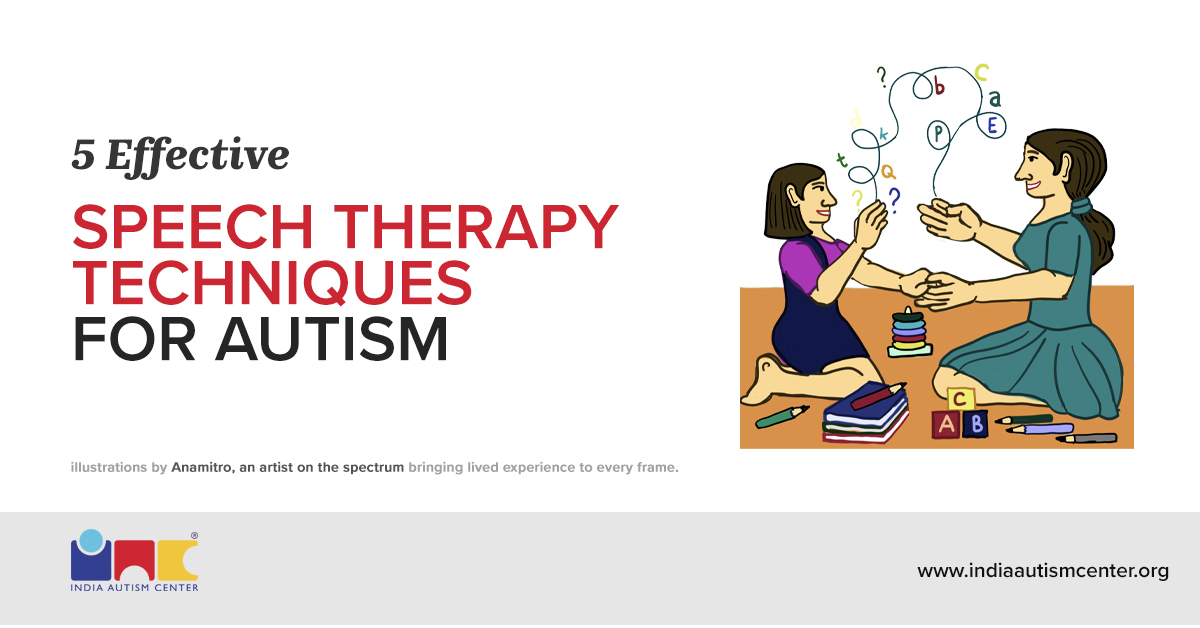
You’ve noticed it. Maybe it’s the silence where words should be, or the frustration on your child’s face when they can’t tell you what they need. Maybe they say a few words but can’t string them together. Maybe they repeat the same phrase over and over, and you’re not sure if they’re communicating or just echoing.
If you’re an Indian parent raising a child with autism, you already know that the communication piece is one of the hardest parts. And you’re probably wondering: Is there something I can do? Where do I even start?
The answer is yes – and you’ve already started by being here.
This guide walks you through the most effective speech therapy techniques for autism, what the research actually says about each one, and – crucially – a full section of speech therapy exercises for autism you can do at home today, no clinical setup needed. Whether your child is non-verbal, uses a few words, or speaks but struggles socially, there’s something here for your family.
Speech therapy for autistic children isn’t one-size-fits-all. But the right approach, started early and supported consistently at home, makes a real difference. That’s what autism speech language therapy is built on.
What Is Speech Therapy for Autism?
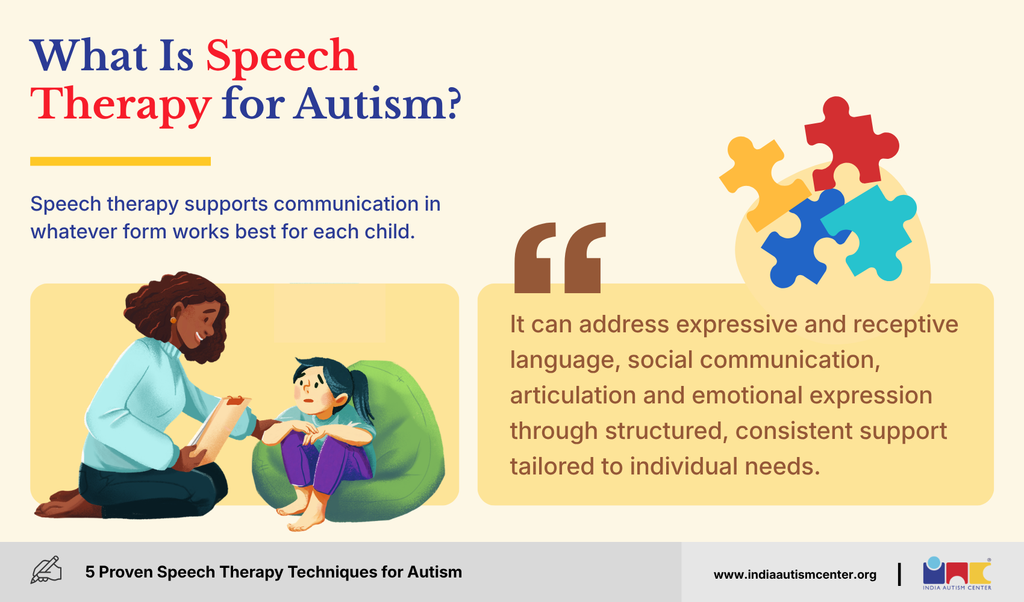
Speech therapy for autism is not just about getting a child to talk. That’s the most common misconception I hear from parents.
It’s about communication – in whatever form works best for your child. That might be spoken words, yes. But it could equally be picture cards, gestures, a tablet app, sign language, or a combination of all of these.
A speech-language pathologist (SLP) working with a child on the autism spectrum will typically address:
- Expressive language – helping your child say or signal what they want, feel, or need
- Receptive language – helping them understand what others are saying to them
- Pragmatic language – the social rules of communication (turn-taking, eye contact, greetings)
- Articulation – clearer pronunciation for children who do speak
- Emotional expression – labelling feelings so frustration doesn’t become a meltdown
Every child’s plan looks different. A 3-year-old who is non-verbal needs a very different approach from a 7-year-old who speaks fluently but struggles to hold a conversation. What they share is the need for structured, consistent, evidence-based support.
Understanding Communication Challenges in Autism
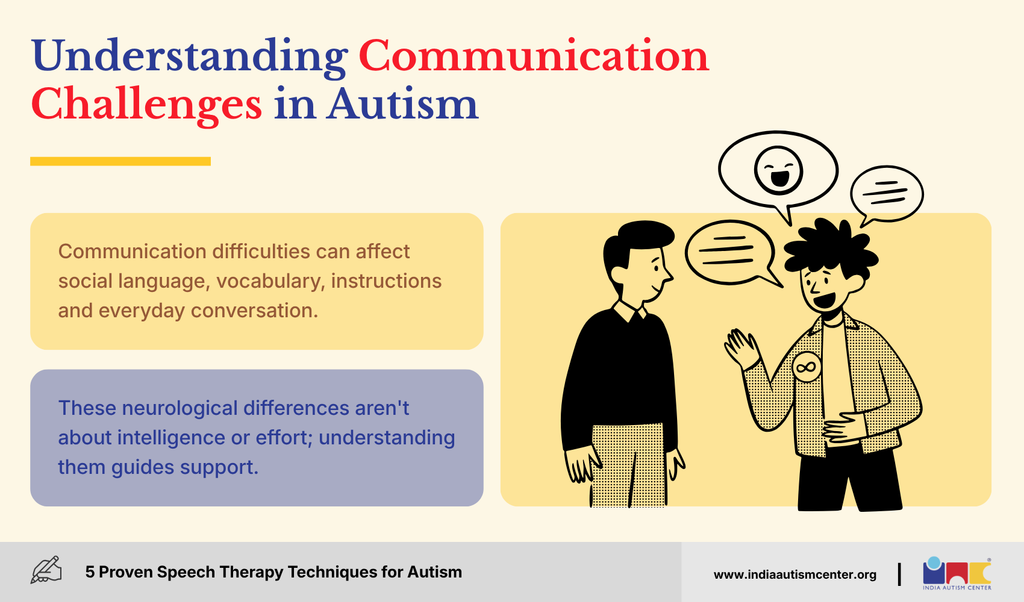
Before we talk techniques, it helps to understand why communication is hard for many children with autism. This isn’t about intelligence or effort – it’s about how the autistic brain processes and produces language.
According to the CDC’s ADDM Network, approximately 1 in 31 children aged 8 years in the US has Autism Spectrum Disorder (ASD). In India, estimates vary, but the challenge is significant and growing – and most families still don’t have easy access to specialist support.
Children with autism commonly experience:
- Difficulty with the social use of language (knowing when and how to speak, not just what to say)
- Limited or inconsistent vocabulary
- Echolalia – repeating words or phrases heard earlier, sometimes out of context
- Trouble following multi-step instructions
- Challenges initiating or sustaining back-and-forth conversation
- Sensory sensitivities that make certain environments overwhelming and communication harder
These aren’t character traits. They’re neurological differences. And understanding them is the first step to choosing the right support.
What speech therapy aims to achieve:
Good autism speech-language therapy doesn’t chase a single goal. It works across several areas simultaneously:
| Goal | What it looks like in practice |
|---|---|
| Functional communication | Child can request food, signal discomfort, say “help” |
| Social communication | Child learns greetings, turn-taking, reading facial cues |
| Comprehension | Child follows simple directions, understands stories |
| Articulation | Speech becomes clearer and easier for others to understand |
| Emotional expression | Child can label feelings instead of acting them out |
| Independence | Child communicates in school, at home, in public – without always needing a prompt |
Also read Does Speech Therapy Work? Here’s What the Evidence Actually Says
The Objectives of Speech Therapy for Autism
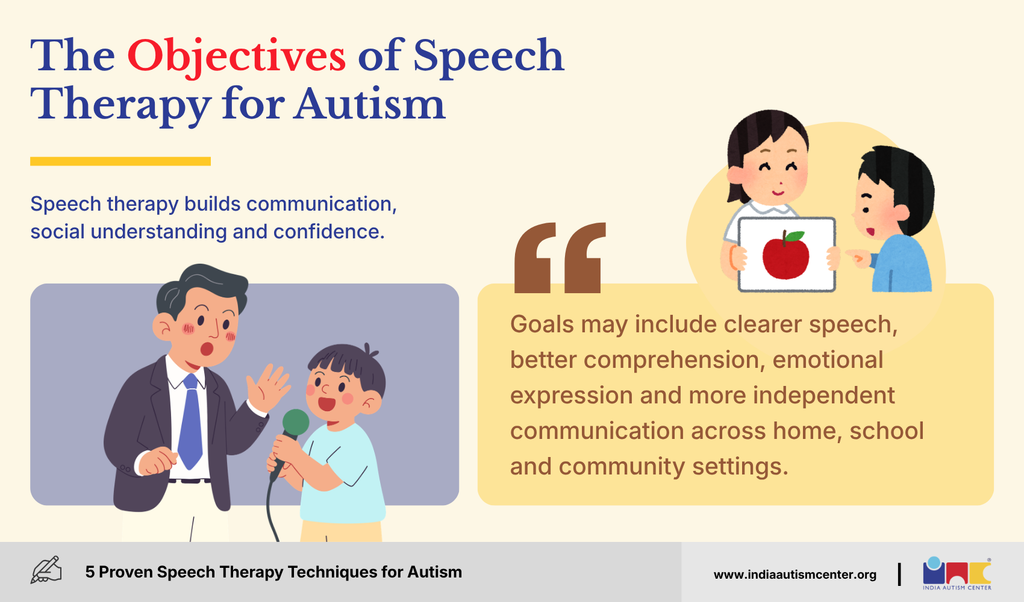
When we talk about speech therapy for autism, we aim for meaningful outcomes — not just talking more, but communicating better. Here are the core goals:
Encouraging Functional Communication
Most importantly, speech therapy helps your child communicate their needs, feelings, and ideas. Not just words, but meaningful interaction.
Developing Social Communication Skills
This includes taking turns in conversation, using greetings, maintaining eye contact, and responding appropriately during interactions. Here is an article on Social Skill Development, which you will find useful if you are looking to develop your child’s social skills.
Improving Understanding and Comprehension
Your child will learn to follow directions, recognise emotions, and understand stories and real-life situations.
Enhancing Articulation and Clarity
For those who speak, speech therapy helps with clearer pronunciation and better fluency.
Supporting Emotional Expression
Your child will learn to label feelings like “happy,” “sad,” “scared,” or “excited.” This reduces frustration and supports emotional regulation.
Promoting Confidence and Independence
As communication skills improve, so does confidence. This helps your child actively participate at home, school, and in social settings.
Want to know more? Get in touch with us.
Goals of Speech Therapy for Autism
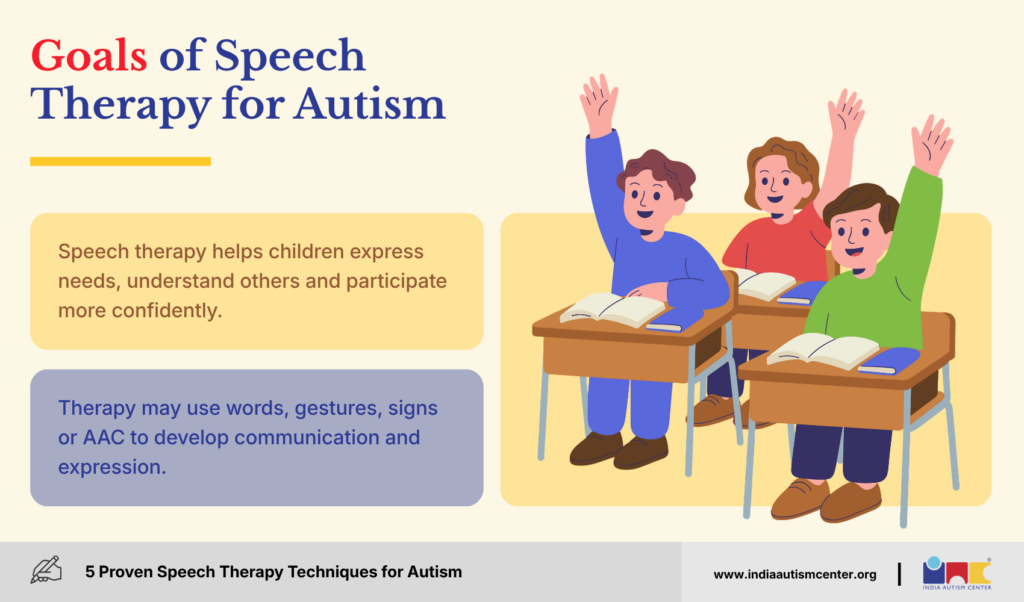
Speech therapy for autism is not solely targeted at improving verbal communication; it is primarily designed to help individuals express themselves, connect with others, and navigate daily interactions with greater confidence.
The ultimate goal of autism speech therapy activities may differ from one child to another. However, they generally revolve around enhancing both communication skills and social understanding.
1. Encouraging Functional Communication
The primary goal of speech therapy for kids with autism is to help them communicate their needs, thoughts, and feelings effectively. It can be through words, gestures, signs, or augmentative and alternative communication devices.
2. Developing Social Communication Skills
Kids with autism often struggle with pragmatic language, which is the social use of language. Autism activities for speech therapy focus on teaching individuals how to take turns in conversation, understand expressions and tone, maintain eye contact, and use appropriate greetings and introductions.
3. Enhancing Understanding and Comprehension
Speech therapy techniques for autism target not only how a child speaks but also how they understand language. Speech therapists work towards improving receptive language with the help of autism speech therapy activities. It helps children follow directions, recognise emotions in others, and understand stories or everyday situations.
4. Improving Articulation and Clarity
Some children with ASD speak but have difficulty pronouncing words clearly. Several speech therapy techniques for autism utilise articulation exercises, oral-motor activities, and repetition techniques to enhance clarity and fluency, thereby enabling others to understand them more effectively.
5. Supporting Emotional Expression and Regulation
Speech therapy is quite effective when it comes to emotional development. Therapists help children label their feelings (“I’m angry”, “I’m scared”) and use words instead of behaviours to express frustration. It helps reduce meltdowns and improve self-control.
6. Promoting Independence and Confidence
To communicate independently in real-life situations, speech therapy can prove to be quite helpful for children diagnosed with ASD. As they learn to express themselves clearly and understand others, their confidence grows, leading to better relationships and greater participation in school and community activities.
Want to know more? Get in touch with us.
5 Effective Speech Therapy Techniques for Autism
These are the approaches you’ll encounter most often in quality autism speech-language therapy. Each one is backed by research. Each one has a practical tip you can use at home to reinforce what’s happening in the clinic.
1. Picture Exchange Communication System (PECS)
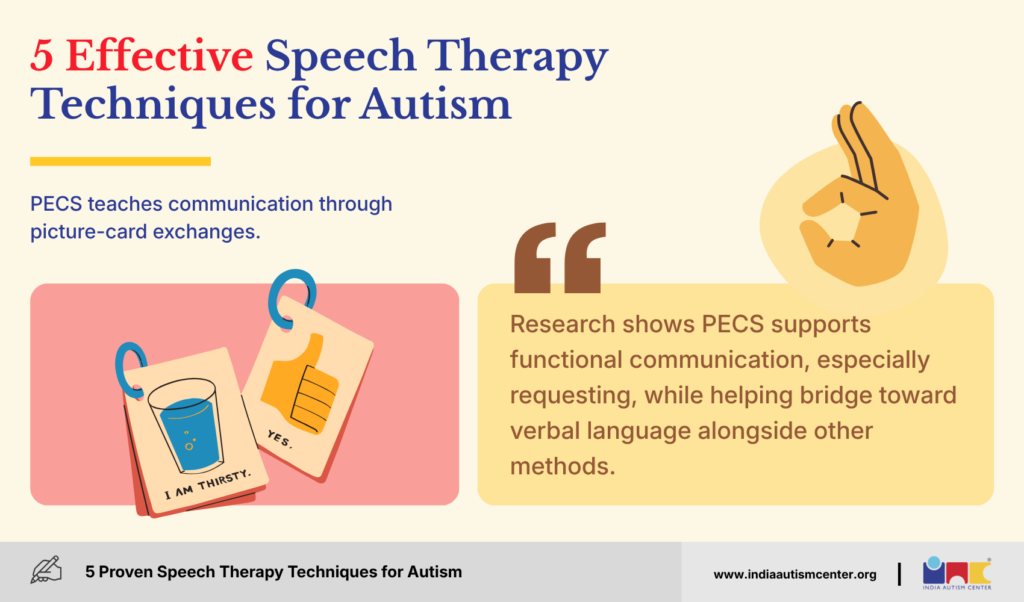
PECS is one of the most widely used speech therapy techniques for autism, especially for children who are non-verbal or have very limited speech. Developed in the late 1980s, it teaches children to communicate by exchanging picture cards – building from simple requests to full sentence structures.
How it works – the six phases:
1. Physical exchange – the child hands a picture to an adult to request an item
2. Increasing spontaneity – the child seeks out a communication partner independently
3. Discrimination training – choosing between multiple pictures for different items
4. Sentence structure – using strips like “I want + [picture].”
5. Answering questions – responding to “What do you want?”
6. Commenting – describing the environment: “I see a dog”
Research published in the journal Language, Speech, and Hearing Services in Schools found PECS produces small to moderate gains in functional communication, particularly for requesting. It’s most powerful as a bridge – building communication confidence while verbal language develops alongside it.
Parent tip: Make a small PECS board for snack time. Put pictures of 3–4 foods your child likes on a strip of cardboard. Before handing over the snack, wait for them to point to or hand you the picture. Even 5 minutes a day at the kitchen table builds the habit.
2. Applied Behaviour Analysis (ABA) with Verbal Behaviour (VB)
ABA is the most extensively researched intervention for autism – over 89% of studies report positive outcomes. When combined with Verbal Behaviour (VB) theory, it becomes a precise tool for building communication from the ground up.
VB breaks language into four functional categories:
- Mands (requests): “I want water” – the child asks for what they need. This is always the starting point because motivation drives communication.
- Tacts (labels): “That’s a bus” – naming and describing the world around them
- Echoics (imitation): Repeating sounds and words – the foundation of learning new vocabulary
- Intraverbals (conversation): Responding to what others say – “What do you do at school?” “I play.”
Therapists use positive reinforcement to encourage each attempt, however small. The goal is to make communication work for the child, so they want to do it again.
Parent tip: During play, narrate everything your child does. “You’re rolling the ball. Ball. Roll.” Then pause and wait. Don’t rush to fill the silence. That pause – therapists call it “expectant waiting” – is one of the most powerful prompts you have.
3. Social Stories and Role-Play
Developed by Carol Gray in the 1990s, Social Stories are short, personalised narratives that describe social situations from the child’s point of view. They’re a core part of autism speech-language therapy because they teach the why behind social communication, not just the what.
How they work:
- A story is written (or illustrated) about a specific situation: going to a birthday party, waiting in a queue at school, greeting a relative
- The language is simple, positive, and predictable
- The child reads or hears the story repeatedly before the situation occurs
- Role-play then lets them practise the conversation in a safe space
For Indian families, Social Stories can be written in Hindi, Bengali, Tamil, or any regional language – and they work best when they reflect your child’s actual life, not generic scenarios.
Parent tip: Before a family gathering or festival, write a 5-sentence story together: “At Diwali, there will be many people. Some people will say ‘Happy Diwali’ to me. I can say ‘Happy Diwali’ back. It’s okay if it’s noisy. I can go to a quiet room if I need a break.” Read it together every day for a week before the event.
4. Augmentative and Alternative Communication (AAC)
AAC covers any tool or strategy that supplements or replaces spoken speech. It’s not a last resort – it’s a legitimate, powerful communication system that many autistic individuals use alongside or instead of verbal speech.
Two main types:
Unaided AAC (no equipment needed):
- Pointing and gesturing
- Facial expressions
- Sign language (Indian Sign Language is increasingly used in therapy here)
- Eye gaze
Aided AAC (uses tools):
- Low-tech: picture boards, communication books, PECS cards
- High-tech: speech-generating devices, tablet apps like Proloquo2Go or Snap Core First
A common worry among parents is that using AAC will stop their child from developing speech. The research consistently says the opposite – AAC supports language development rather than replacing it. It reduces frustration, gives the child a working communication system, and often accelerates verbal speech.
Parent tip: If your child uses an AAC device or app in therapy, ask the therapist to show you exactly how to model it at home. “Aided language stimulation” – where you point to symbols on the device as you speak – is one of the most effective things a parent can do to reinforce AAC use.
5. Play-Based Speech Therapy
Children learn through play. That’s not a soft, feel-good statement – it’s developmental science. Play-based speech therapy uses the child’s natural environment and interests to create communication opportunities that feel like fun, not work.
What it looks like:
- Pretend play: Playing “doctor” or “kitchen” to practise vocabulary and turn-taking
- Music and movement: Songs like “Wheels on the Bus” build rhythm, repetition, and anticipation – all foundations for speech
- Sensory play: Water, sand, playdough – narrating the experience (“Wet! Cold! Squeeze!”) builds descriptive language
- Cause-and-effect toys: Bubbles, pop-up toys, wind-up animals – the child learns that their action (or word) produces a result
Play-based therapy is particularly effective for young children and those who resist structured drills. It meets the child where they are, in activities they already enjoy.
Parent tip: Follow your child’s lead during play. If they’re lining up toy cars, sit beside them and do the same. Say the colour of each car as you place it. Don’t redirect – join. This “parallel play with narration” is a technique therapists use every session, and you can do it for free, right now, on your living room floor.
Autism Speech Therapy Activities to Try at Home
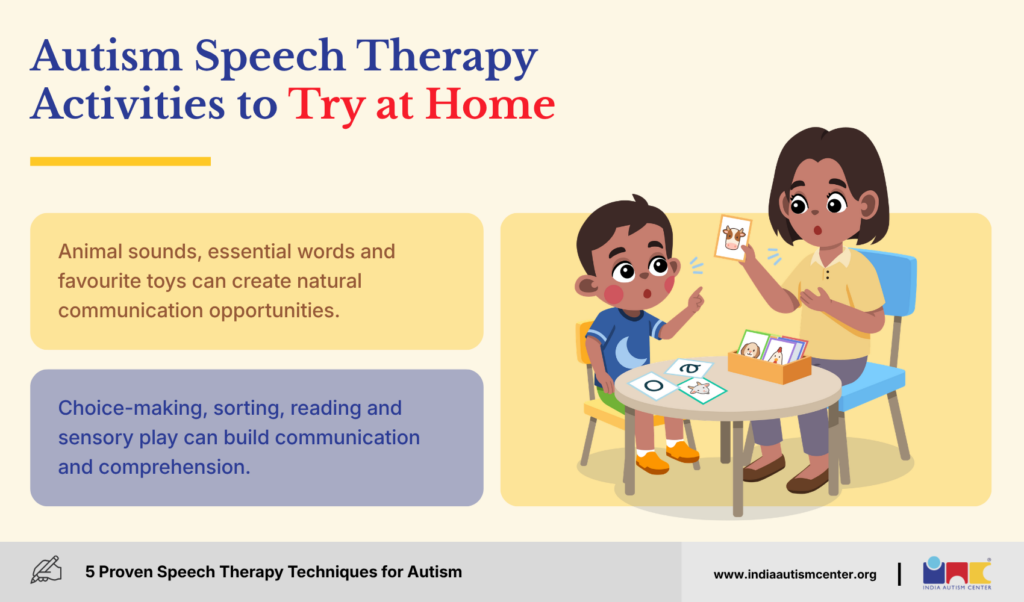
Even everyday activities at home can be powerful learning tools. Simple autism activities for speech therapy, such as reading, singing, or playtime, can help your child develop communication, comprehension, and social skills in a fun and natural way.
Exercise 1: Animal Noises and Sound Imitation
How to do it: Set up a small collection of toy animals – a cow, a dog, a cat, a duck. Pick up each animal, make the sound, and wait. Don’t rush. If your child picks up the cow, you moo. If they hand it to you, you moo again and wait to see if they copy. Over days and weeks, try pausing before you make the sound – let the silence invite them to fill it.
Why it works: Research consistently shows that many children with ASD respond to animal sounds more readily than human speech. Animal noises are predictable, repetitive, and emotionally neutral – there’s no social pressure attached to a moo. For non-verbal children especially, this is often one of the first exercises an SLP introduces because it targets sound imitation, the building block of all spoken language. Once a child is imitating sounds, you have something to build on.
Exercise 2: Teaching Essential Words – “More,” “Help,” “Stop”
How to do it: Pick one word to focus on for a week. Let’s start with “more.” At snack time, give your child a small portion of something they love – a few grapes, a couple of biscuit pieces. When they finish, gesture towards the plate and say “more?” clearly. Pair it with the sign (both hands, fingertips touching). Wait. If they reach, gesture, or vocalise anything, immediately give more and celebrate. Gradually, hold out a little longer before giving the reward.
Why it works: Children with autism often know words but struggle to use them functionally – in the right moment, for the right purpose. Teaching “more,” “help,” and “stop” in real, everyday contexts (not just in drills) gives your child three words that immediately improve their quality of life and reduce frustration. These are the words that say I have needs, and I can communicate them. That’s enormous. Pair each word with a consistent sign so children who aren’t yet verbal have a physical way to express it.
Exercise 3: Using Favourite Toys and Snacks as Communication Prompts
How to do it: Choose something your child loves – a specific toy, a favourite snack, a tablet. Place it somewhere visible but just out of reach. Don’t hand it over immediately. Wait and watch. If they reach, point, or look at you, respond immediately by naming the item (“Biscuit! You want biscuit!”) and giving it to them. After a few days, try waiting a moment longer – see if they’ll vocalise or gesture more clearly.
Why it works: This technique, called “sabotage” in therapy circles, uses motivation as the engine of communication. When a child really wants something, they have a genuine reason to communicate. You’re not drilling vocabulary in the abstract – you’re creating real communicative need. For children with mild to moderate autism, this often leads to them learning the name of the item and using it spontaneously within weeks.
Exercise 4: Positive Reinforcement – Making Communication Pay Off
How to do it: Identify 3–4 things your child finds genuinely rewarding: a specific snack, 10 minutes with a favourite toy, a song they love, a short video. Every time they attempt communication – a word, a gesture, a picture card, a look – respond immediately and enthusiastically, and pair it with the reward. The key word is immediately. Delayed rewards don’t teach the same lesson.
Why it works: Positive reinforcement is the backbone of ABA therapy, and it works because it makes communication worth doing. Children with autism often don’t find social praise (“Good job!”) as motivating as neurotypical children do. That’s not a flaw – it’s just how their reward system works. Find what your child finds rewarding and use it consistently. Over time, the communication itself becomes rewarding because it reliably gets them what they want. That’s the goal.
Exercise 5: Choice-Making Activities
How to do it: Offer two options – always two, not five. Hold up a red cup and a blue cup: “Red or blue?” Hold up two snacks: “Apple or banana?” Hold up two books: “This one or this one?” Name each option clearly as you hold it up. Wait for a response – a point, a reach, a word, a look. Accept any response as valid and honour it immediately.
Why it works: Choice-making is one of the most powerful speech therapy exercises for autism because it teaches children that their communication has consequences – good ones. It builds agency. It also naturally creates opportunities for pointing, naming, and eventually short sentences (“I want blue”). Start with objects the child can see and touch. As they get more confident, move to pictures, then to verbal-only choices. Research on preschool-aged children with ASD shows that regular choice-making activities significantly increase spontaneous communication attempts over time.
Exercise 6: Sorting and Categorising Games
How to do it: Gather a mix of objects or picture cards – fruits, vehicles, animals, clothes. Sit with your child and sort them together into groups. Name each item as you place it: “Mango – fruit. Car – vehicle. Dog – animal.” Let your child lead the sorting. If they put a tomato with the vehicles, don’t correct immediately – ask: “Tomato. Where does the tomato go?” Use picture cards from magazines, printed sheets, or old calendars if you don’t have toy sets.
Why it works: Many children with autism are naturally drawn to sorting and arranging – it’s a strength, not just a quirk. This exercise leverages that interest to build vocabulary, categorisation, and descriptive language. Sorting games also encourage independent thinking and problem-solving. When you narrate the sorting process out loud, you’re modelling the kind of language you want your child to eventually use. It’s low-pressure, structured, and endlessly adaptable to your child’s level.
Exercise 7: Reading Picture Books Together
How to do it: Choose books with large, clear illustrations and simple, repetitive text – Brown Bear, Brown Bear is a classic for a reason. Read slowly. Point at each picture before you name it. Pause on pages and ask: “What’s this?” or “What colour is the dog?” If your child is non-verbal, ask them to point to the dog, the bird, the fish. Ask yes/no questions: “Is the bear brown?” Accept any attempt at an answer – a nod, a point, a sound – as a success.
Why it works: Shared book reading is one of the most researched home-based strategies for supporting language development in children with autism. A 2010 study in the Journal of Autism and Developmental Disorders found that interactive reading significantly increased vocabulary and joint attention in young children with ASD. The key is interactive – not just reading aloud, but pausing, pointing, questioning, and responding to whatever your child offers. Even 10 minutes of this before bed, done consistently, adds up.
Exercise 8: Sensory Play with Narration
How to do it: Set up a simple sensory activity: a tray of dry rice or lentils, a bowl of water with cups and spoons, playdough, or a tub of sand. Sit beside your child and play alongside them. As they explore, narrate what you both experience: “Cold water. Wet hands. Pour. Splash! Soft dough. Squeeze.” Keep your language short – one or two words at a time. Don’t demand responses. Just model.
Why it works: Many children with autism have sensory processing differences, and sensory play meets them in a space where they’re already engaged and regulated. When you narrate the experience in simple, concrete language, you’re doing something therapists call “self-talk” – modelling language without requiring a response. Over time, children begin to associate the words with the sensations and start using them spontaneously. Sensory play also reduces anxiety, which makes communication more likely to happen. It’s one of the most underused tools available to parents at home.
Here are the activities, their objective, how to conduct them, and what skills they develop:
| Activity | Objective | Example / How to Do It | Skills Developed |
| Morning Routine Conversations | Build sequencing and functional vocabulary | Narrate actions during dressing and brushing: “Shirt on! Pants on!” | Receptive language, daily communication |
| Storytime Reading | Improve comprehension and emotional recognition | Read picture books aloud, pause to ask questions (“Who is this?” “How does he feel?”) | Vocabulary, joint attention, emotional understanding |
| Music and Singing Games | Encourage imitation and sound production | Sing action songs like “If You’re Happy and You Know It” | Auditory processing, expressive speech, rhythm |
| Imitation & Play Games | Strengthen turn-taking and imitation | Copy gestures or sounds, play rolling ball or “Peek-a-Boo” | Imitation, turn-taking, joint attention |
| Snack Time Choices | Teach requesting and decision-making | Offer snack options: “Do you want an apple or a banana?” | Expressive communication, AAC use |
| Emotion Labeling | Develop emotional language and empathy | Label emotions: “You’re happy.” “You’re angry.” | Self-expression, social awareness |
| PECS & Visual Schedules | Support communication for nonverbal children | Use picture cards to request or make choices | Visual association, functional communication |
| Role-Play Conversations | Practice real-life social interaction | Pretend to order food or greet someone: “Hello! I want pizza.” | Pragmatic language, conversation flow |
| Outdoor Exploration | Link sensory experiences with language | Name things during walks — “Tree”, “Bird”, “Car” | Observation, descriptive vocabulary |
| Speech Therapy Apps / AAC Tools | Reinforce speech and vocabulary with technology | Use apps like Proloquo2Go or Speech Blubs | AAC development, word recall, and pronunciation |
Want to know more? Get in touch with us.
The Power of Early Intervention
If there’s one thing the research agrees on, it’s this: earlier is better.
Children who begin autism speech-language therapy before the age of 3 – ideally as soon as a diagnosis or developmental concern is identified – consistently show better long-term communication outcomes than those who start later. A review of 14 studies found that 12 of them reported better developmental outcomes when intervention began at a younger age.
Why does it matter so much? Because the brain is most plastic – most open to learning new patterns – in the first few years of life. The neural pathways for language are being laid down right now. Early therapy doesn’t just teach words; it shapes how the brain organises and processes communication.
What early intervention focuses on:
- Joint attention – getting the child to share focus on an object or event with another person. This is the foundation of all social communication.
- Imitation – copying sounds, gestures, and actions. Children learn language by imitating; building this skill early accelerates everything else.
- Vocabulary development – building a core set of functional words before formal schooling begins
- Emotional regulation alongside communication – because a child who is overwhelmed cannot communicate, and a child who can communicate is less likely to become overwhelmed
In India, access to early diagnosis and specialist therapy remains uneven – many families in smaller cities and towns face long waiting lists or no services at all. This is exactly why home-based exercises matter so much. You don’t have to wait for a clinic appointment to start supporting your child’s communication.
If you suspect your child has a speech or language delay, don’t wait for a formal diagnosis before seeking support. Talk to your paediatrician, request a referral to a speech-language pathologist, and start the home exercises in this article today.
Bonus article: The Role of Early Intervention in Autism Spectrum Disorder
Choosing the Right Speech Therapist
The key to your child’s progress is choosing the right speech therapist for autism. A good therapist will personalise sessions, involve parents in the process, and set realistic, measurable goals tailored to your child’s needs.
Here is what parents can do:
- Verify certification and experience in ASD.
- Ask if they use evidence-based techniques (PECS, AAC, ABA-VB).
- Look for therapists who involve parents in goal-setting.
If you’re looking for structured assessments, personalised therapy plans, and expert support under one roof, reaching out to the India Autism Center (IAC) can give you the clarity and confidence you need to move forward.
Measuring Progress: Small Wins, Big Impact
Progress in speech therapy for autistic children rarely looks like a straight line. There will be plateaus. There will be weeks where nothing seems to change, followed by a sudden leap. This is normal – and it’s why measuring progress carefully matters.
Signs of meaningful progress to watch for:
- More frequent communication attempts – even if the attempts aren’t perfect words yet. A child who is reaching, pointing, and vocalising more is making progress.
- Improved comprehension – following simple instructions, responding to their name more consistently, understanding “no” and “wait”
- Reduced frustration – fewer meltdowns at moments of communication breakdown
- New spontaneous words or phrases – words that appear without prompting, in context
- Increased social engagement – making eye contact, initiating play, showing interest in others
What parents can do:
- Keep a simple communication diary. Note new words, new gestures, new attempts – even small ones. Over months, the pattern becomes visible and motivating.
- Celebrate every milestone, however small. Your child said “more” for the first time? That’s enormous. Treat it like it is.
- Share your observations with the therapist. You see your child in dozens of situations the therapist never will. Your notes are clinical data.
- Seek peer support. Connecting with other Indian parents of autistic children – through local groups or online communities – provides both practical tips and emotional sustenance.
Progress is not always visible day to day. But it is happening.
Conclusion
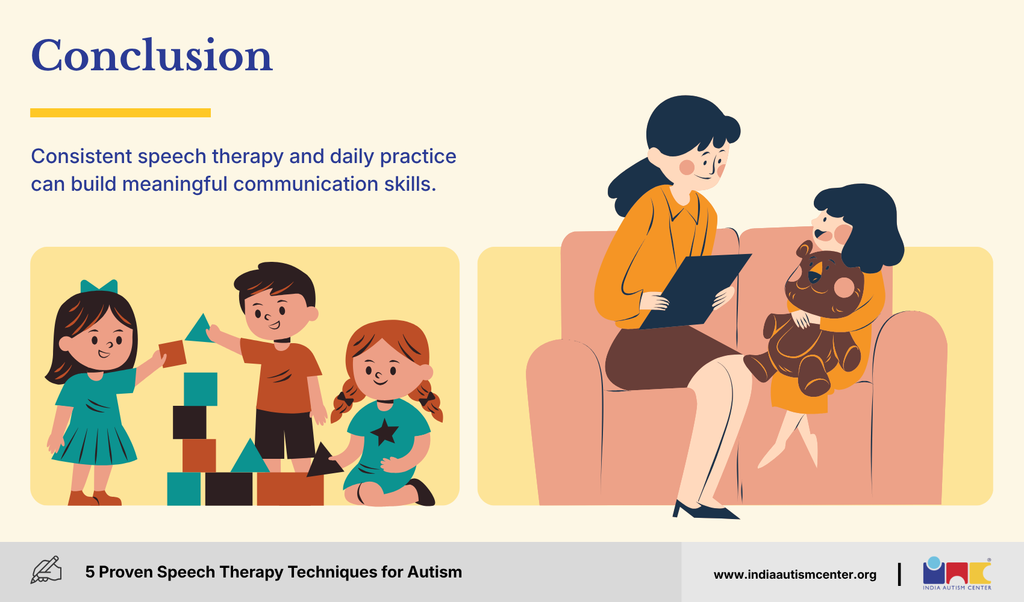
Effective speech therapy techniques for autism are crucial, as they help children connect and express themselves effectively. From play-based sessions to AAC tools and daily home activities, every effort counts toward building meaningful communication. For better results, it is essential to receive the proper guidance, maintain consistency, and have support. Speech therapy is known to empower children with autism to find their voice.
Frequently Asked Questions
How does speech therapy help kids with autism?
Speech therapy for autism focuses on improving verbal and nonverbal communication skills. It helps children understand language, express their needs, and interact meaningfully with others in daily life.
At what age should speech therapy start for a child with autism?
Experts recommend starting speech therapy for autism as early as possible, ideally between ages 2 and 5, when language development is most active. Early intervention improves long-term communication outcomes.
How long does speech therapy for autism take to show results?
Progress varies by child, but consistent sessions combined with autism speech therapy activities at home can show noticeable improvement within a few months.
How do parents support speech therapy at home?
Parents can reinforce therapy goals by using short, repetitive phrases, encouraging turn-taking, and incorporating speech therapy activities for autism into daily routines, such as meals or playtime.
What are some visual supports used in autism speech therapy?
Visual supports, such as PECS cards, picture schedules, and flashcards, help children associate words with images, making communication more straightforward to understand and comprehend.
For expert insights, support services, and inclusive learning initiatives, visit the India Autism Center.
Useful Sources
CDC Autism Data & Statistics – prevalence figures and surveillance data
ASHA Evidence Map: PECS – research on Picture Exchange Communication System outcomes
PMC: Early Intervention Age-of-Entry Studies – evidence on why earlier intervention produces better outcomes
PMC: Shared Book Reading and Autism – research on interactive reading and language development in ASD
ABA Therapy Outcomes – summary of ABA research findings
Disclaimer: This article is intended for educational and informational purposes only. It is not a substitute for professional medical advice, diagnosis, or treatment. If you are pregnant or have concerns about medication use during pregnancy, please consult a qualified healthcare provider. If your child has received an autism diagnosis and you have questions about causes or support, please reach out to a trained specialist or an autism-focused organisation for guidance.