 Donate now
 Get a Call Back
 MENU
MENU 23 MIN READ
 SHARE
SHARE


You’ve sat through three different appointments. One specialist says it could be autism. Another says it looks more like a learning disorder. A third shrugs and says, “We’ll watch and wait.” You come home more confused than when you left – and your child is still struggling.
That confusion is not a failure of parenting. It’s a failure of the system to communicate clearly about two conditions that genuinely overlap in ways that challenge even experienced clinicians. Non-verbal learning disorder vs autism is one of the most misunderstood comparisons in developmental paediatrics, and Indian families face the additional burden of navigating it with fewer specialist resources, inconsistent terminology, and a diagnostic landscape that is still catching up.
This article will not give you vague reassurances. It will give you the specific differences, the clinical criteria, the Indian legal rights, and the concrete next steps – so you can walk into your next appointment knowing exactly what to ask.
What Is Non-Verbal Learning Disorder (NVLD)?
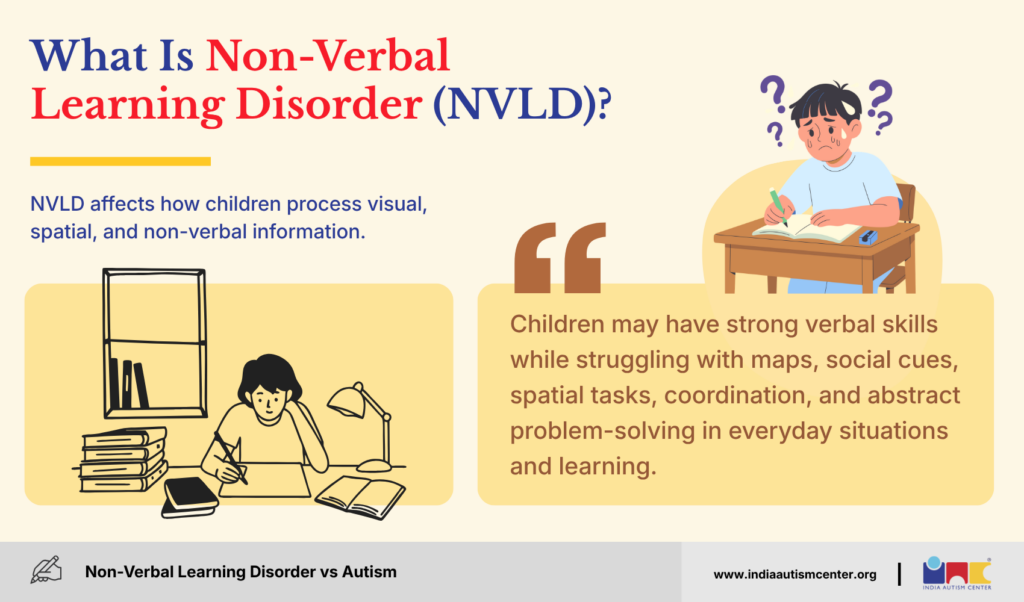
Non-verbal learning disorder (NVLD) – also called nonverbal learning disability or developmental visuospatial disorder – is a neurodevelopmental condition in which a child’s brain struggles to interpret and respond to visual and spatial information. The core deficit is not in speaking or reading words. It is in making sense of the non-verbal world: maps, diagrams, facial expressions, body language, spatial distance, and abstract concepts.
Children with NVLD often:
- Excel in spoken language, vocabulary, rote memory, and factual recall
- Struggle with visual-spatial tasks – reading maps, doing puzzles, copying shapes, understanding geometry
- Miss nonverbal social cues such as tone of voice, facial expressions, gestures, and sarcasm
- Appear clumsy or uncoordinated because they cannot accurately judge distance and space
- Have difficulty with abstract thinking, novel problem-solving, and adapting to unexpected changes
The name “non-verbal learning disorder” trips up many parents. It does not mean the child cannot speak. It means the child has difficulty processing non-verbal information.
The Paradox of NVLD: Fluent Speaker, Missed Signals
Here is the central paradox: a child with NVLD may speak like a little professor – articulate, advanced, even charming in conversation – and yet be completely lost when asked to draw a simple diagram, navigate a new building, or understand why a classmate is upset.
They can follow detailed verbal instructions but get disoriented in a new environment. Can memorise facts from a textbook but cannot interpret a bar graph. They can describe a social situation in perfect sentences but misread the emotional tone entirely.
This gap between verbal brilliance and non-verbal confusion is precisely what makes NVLD so easy to miss – and so easy to mistake for autism, ADHD, or anxiety. As Puja Dutta, an RCI-registered psychologist with India Autism Center, explains:
“Parents often misread social or spatial difficulties when comparing NVLD vs autism. Without a proper assessment, this can lead to misdiagnosis and missed intervention windows. A comprehensive evaluation by trained professionals is essential to ensure timely and appropriate support.”
Is NVLD a Formal Diagnosis? (DSM-5 Status Explained)
No – and this is a critical point that shapes everything else.
NVLD is not currently listed in the DSM-5 (Diagnostic and Statistical Manual of Mental Disorders, Fifth Edition), the reference manual used by clinicians worldwide, including in India, to make formal diagnoses. There is no standardised diagnostic code, no agreed-upon checklist, and no single validated test for NVLD the way there is for autism.
Some researchers advocate renaming it “developmental visuospatial disorder” to better reflect its core deficit and to build the case for eventual DSM inclusion. That process is ongoing.
What this means practically: a child with a clear NVLD profile may receive a diagnosis of “specific learning disorder,” “ADHD,” or even “autism” – not because those labels are accurate, but because they are the closest available boxes. This is exactly why a thorough neuropsychological evaluation matters so much.
NVLD is also not the same as social (pragmatic) communication disorder, another condition that can look similar. Social pragmatic communication disorder involves difficulty using language in social contexts but does not include the visual-spatial deficits that define NVLD, and it also lacks the repetitive behaviours required for an autism diagnosis.
How Common Is NVLD?
A 2020 study published in JAMA Network Open estimated that NVLD affects approximately 3% to 4% of children and adolescents in the United States. There are no equivalent large-scale Indian prevalence studies, but given that NVLD is believed to arise from neurological differences in right-hemisphere brain function, there is no reason to assume the Indian prevalence is dramatically different.
Because NVLD lacks a formal DSM-5 diagnosis, it is almost certainly under-identified in India, where specialist neuropsychological services are concentrated in metros and awareness among general paediatricians remains low.
Understanding NVLD is only half the picture. Let’s now look at what autism actually is – because the two conditions are frequently conflated, and the distinction matters enormously for treatment.
📥 Free download: Printable daily routine chart for autistic children
What Is Autism Spectrum Disorder (ASD)?
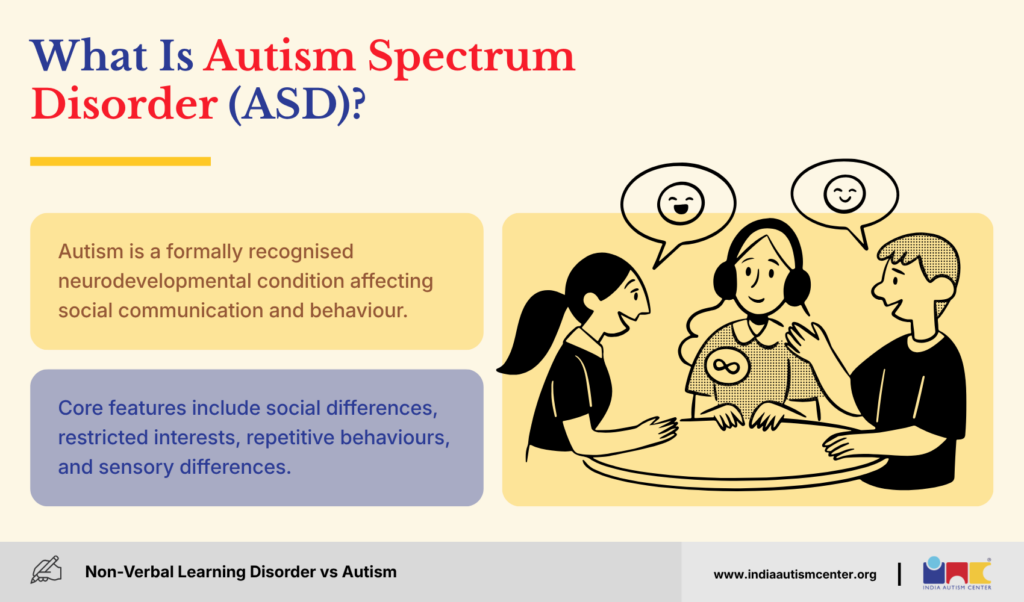
Autism spectrum disorder (ASD) is a formally recognised neurodevelopmental condition listed in the DSM-5 under Neurodevelopmental Disorders. It is characterised by persistent differences in social communication and interaction, combined with restricted, repetitive patterns of behaviour, interests, or activities. Both features must be present for a diagnosis.
According to the Centers for Disease Control and Prevention (CDC), autism affects approximately 1 in 31 children in the United States as of 2023. Indian prevalence data is harder to pin down, but estimates from studies published in journals such as the Indian Journal of Psychiatry suggest figures in a broadly comparable range, with significant regional variation.
Core features of ASD include:
- Social communication differences – difficulty with back-and-forth conversation, interpreting facial expressions, understanding social intentions, and using language for social purposes
- Repetitive behaviours and restricted interests – stimming (hand-flapping, rocking), insistence on sameness, intensely focused interests, rigid routines
- Sensory processing differences – hypersensitivity or hyposensitivity to sounds, lights, textures, temperatures, tastes, and other sensory input
Autism Is a Spectrum – Not a Single Profile
Autism is a spectrum condition. This is not just a polite way of saying “everyone is a little autistic.” It means that two children with the same diagnosis can look entirely different. One child may be minimally verbal, require round-the-clock support, and experience significant sensory overwhelm. Another may be highly verbal, academically strong, and largely independent – but struggle profoundly with social reciprocity and unexpected change.
This variability is part of why autism is so often confused with NVLD. A verbally fluent, academically capable autistic child and a child with NVLD can look remarkably similar in a classroom or a social setting. The differences emerge when you look more carefully at the underlying mechanisms.
How Common Is Autism in India?
India does not yet have a national autism registry, which makes precise figures difficult. Studies from NIMHANS (National Institute of Mental Health and Neurosciences, Bengaluru) and other institutions suggest prevalence figures ranging from roughly 1 in 89 to 1 in 125 children, though methodological differences make direct comparisons tricky. What is clear is that autism is significantly under-diagnosed in India, particularly in rural areas and among girls, and that awareness has grown substantially since the RPWD Act 2016 formally recognised ASD as a disability.
Non-Verbal Learning Disorder vs Autism Spectrum Disorder
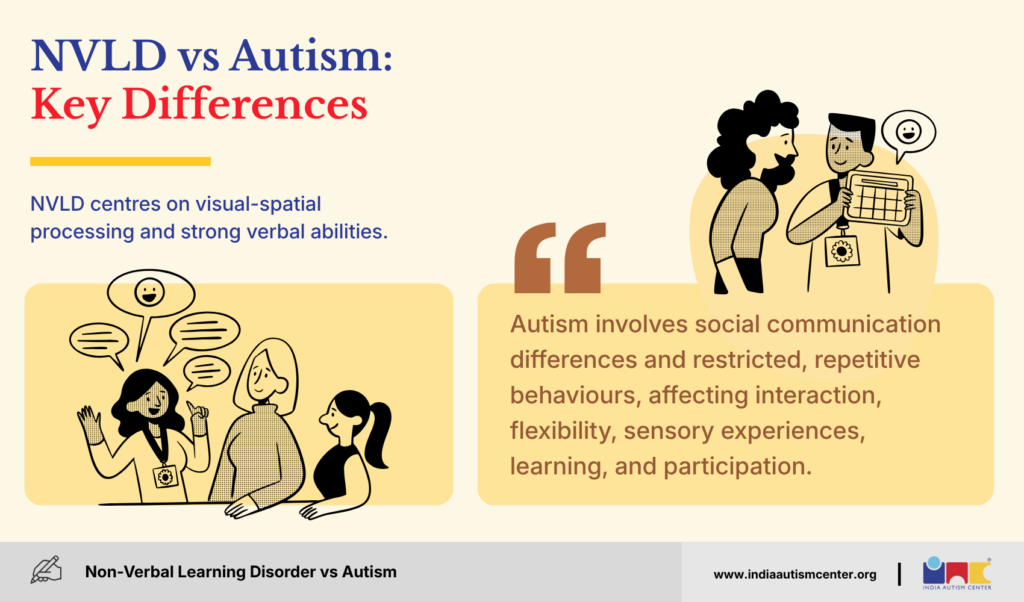
| Key Trait | Non Verbal Learning Disorder (NVLD) | Autism Spectrum Disorder (ASD) |
| Verbal Ability | Strong verbal skills; articulate speech and vocabulary | Ranges from nonverbal to highly verbal; challenges in social communication |
| Visual-Spatial Reasoning | Major difficulties (maps, puzzles, spatial tasks) | May vary; not a core diagnostic feature |
| Nonverbal Social Cues | Struggles with facial expressions, tone, and body language | Common; part of core diagnostic criteria |
| Repetitive Behaviors / Routines | Not typical, but may rely on routine for comfort | Hallmark symptom: stimming, insistence on sameness |
| Sensory Processing | May have proprioceptive challenges | Broad range: hypo- or hyper-sensitivity to sensory input |
| Motor Coordination | Clumsy movements, poor handwriting | May be present, but varies |
| DSM-5 Recognition | Not formally recognized | Yes, under Neurodevelopmental Disorders |
| Diagnostic Tools | No standardized tool; diagnosis via neuropsychological evaluation | Multiple validated tools: ADOS, ADI-R, M-CHAT, etc. |
| Co-occurrence | May co-occur with ASD or ADHD | May co-occur with intellectual disability, anxiety, ADHD, etc. |
| Root Challenge | Difficulty interpreting and responding to nonverbal information | Difficulty with social communication, behavior regulation, and sensory input |
Social Communication Differences
Both NVLD and autism involve social difficulties, but the root cause differs fundamentally.
A child with NVLD wants to connect socially and often tries hard to do so. Their difficulty is in reading the room – they miss the tone of voice, the raised eyebrow, the subtle shift in body language that signals “I’m bored” or “that was a joke.” They are socially motivated but socially misreading.
In autism, the social communication difference is more pervasive. It may include difficulty initiating conversation, understanding social intentions, interpreting figurative language, and adjusting communication style to different contexts. Some autistic children actively prefer solitude; others desperately want friends but find the unwritten rules of social interaction genuinely opaque.
Social pragmatic communication disorder sits somewhere between the two: primarily a pragmatic language difficulty, without the repetitive behaviours of autism and without the spatial processing deficit of NVLD.
Motor Skills and Spatial Reasoning
Motor difficulties appear in both conditions, but for different reasons – a distinction that has direct implications for therapy.
In NVLD, clumsiness stems from visuospatial processing difficulties. The child cannot accurately judge where their body is in space, how far away an object is, or how to plan a physical movement through a spatial environment. Handwriting is often particularly affected.
In autism, motor difficulties – when present – are more often linked to sensory processing differences or motor planning (dyspraxia). The child may have difficulty with the sequencing of movements or be overwhelmed by the sensory experience of certain physical activities.
As Dr Gordon Day has noted: “Both disorders are associated with problems with motor skills, but it is explained in NVLD by visual-spatial organisation, while in autism, it is associated with sensory processing difficulties.” Same surface behaviour, different mechanism – and therefore different therapeutic targets.
Language and Verbal Ability
This is perhaps the clearest differentiator. Children with NVLD typically have strong verbal skills – they are often early talkers, good readers of words (though not of graphs or diagrams), and comfortable with verbal explanation. Their verbal IQ is usually significantly higher than their performance IQ, and this discrepancy is a key diagnostic signal.
In autism, verbal ability varies enormously across the spectrum. Some autistic children are minimally verbal or use augmentative and alternative communication (AAC). Others are highly verbal but use language in ways that feel one-sided, overly literal, or socially mistuned. The key is that social use of language – pragmatics – is affected regardless of vocabulary level.
Sensory Processing
Sensory processing differences are a core diagnostic feature of autism and are included in DSM-5 criteria. Autistic children may be hypersensitive to sounds (covering ears in noisy environments), textures (refusing certain foods or clothing), lights, or smells – or hyposensitive, seeking intense sensory input.
In NVLD, sensory differences are not a defining feature, though proprioceptive challenges (difficulty sensing where the body is in space) are common and contribute to the motor clumsiness described above.
Repetitive Behaviours and Restricted Interests
This is a diagnostic dividing line. Repetitive behaviours and restricted interests are required for an autism diagnosis. They are not a defining feature of NVLD.
An autistic child may stim (rock, flap, spin), insist on the same route to school every day, become intensely absorbed in a narrow topic (train schedules, dinosaur taxonomy, a specific video game), or become distressed when routines change.
A child with NVLD may also prefer routine – but this preference is driven by the anxiety of navigating an unpredictable world, not by the neurological pull towards sameness that characterises autism. The distinction is subtle but clinically meaningful.
Emotional Regulation and Meltdowns
Both conditions can involve emotional dysregulation and what looks like a meltdown – intense emotional outbursts that seem disproportionate to the trigger.
In NVLD, meltdowns are typically triggered by cognitive overload: too many simultaneous demands, confusing instructions, a sudden change in plan that the child cannot mentally reorganise. The child’s executive function is overwhelmed.
In autism, meltdowns are often triggered by sensory overload, routine disruption, or communication breakdown – the neurological threshold for overwhelm is reached, and the result is a full-system crash that is not defiance but a genuine loss of regulatory capacity.
In both cases, discipline is the wrong response. What helps is preparation, sensory scaffolding, and emotional co-regulation.
The surface similarities between these two conditions are real – but so are the differences. The next section explains why even experienced clinicians get confused.
Understanding the Overlap Between NVLD and Autism
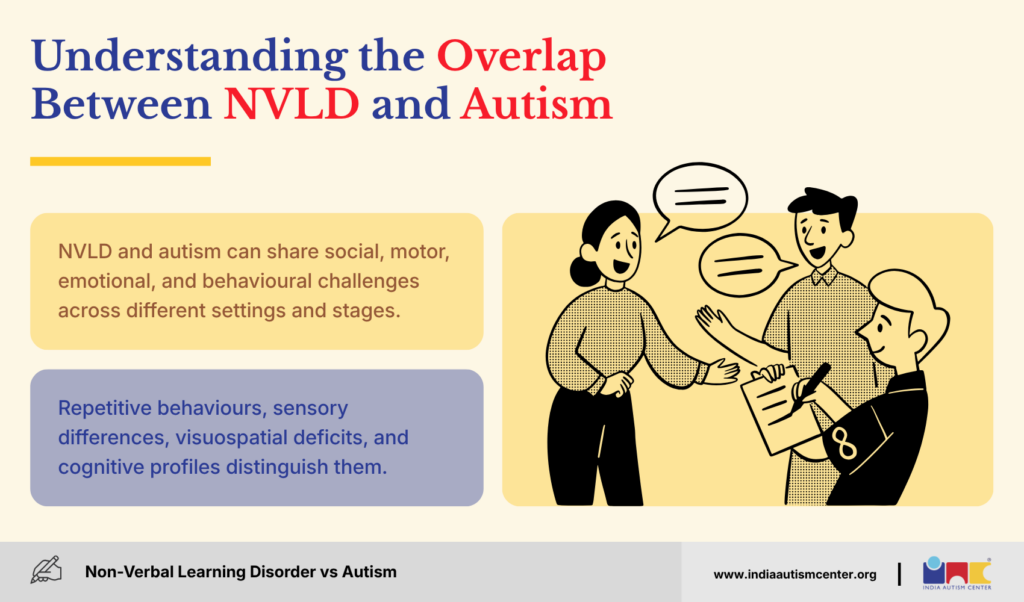
Here is a realistic scenario that plays out in clinics across India every week. A parent brings in a 7-year-old who speaks fluently, has an impressive vocabulary, struggles to make friends, gets overwhelmed by unexpected changes, has messy handwriting, and melts down when the school schedule changes. The child is clearly struggling. But is it NVLD or autism?
The overlapping traits that create this confusion include:
- Social difficulties – both conditions affect the ability to read and respond to social cues
- Motor clumsiness – present in both, for different reasons
- Resistance to change – present in both, driven by different mechanisms
- Strong verbal ability – common in NVLD; also common in verbally fluent autistic children
- Academic inconsistency – both conditions can produce uneven academic profiles
- Emotional dysregulation – meltdowns appear in both, though triggered differently
- Anxiety – extremely common as a co-occurring condition in both NVLD and autism
The critical differentiators that a skilled evaluator will look for:
- Repetitive behaviours and restricted interests – present in autism, not in NVLD
- Sensory hypersensitivity/hyposensitivity – a core autism feature, not a defining NVLD feature
- Visuospatial processing deficit – the hallmark of NVLD, not a required autism feature
- Verbal-performance IQ discrepancy – a key NVLD signal on cognitive testing
When Both Conditions Co-Occur
NVLD and autism can co-occur. This is not a theoretical edge case – it is clinically documented. A child can have the visuospatial processing deficit of NVLD and the social communication differences and repetitive behaviours of autism simultaneously.
Co-occurring conditions make diagnosis harder and treatment planning more complex. A child with both NVLD and autism will need interventions that address the spatial processing deficit and the sensory processing differences and the social communication challenges – not a one-size-fits-all programme.
Other common co-occurring conditions to be aware of:
- ADHD – frequently co-occurs with both NVLD and autism
- Anxiety disorders – extremely common in both populations
- Specific learning disorders (dyslexia, dyscalculia)
- Depression – particularly in older children and adolescents with NVLD who are aware of their differences
Accurate diagnosis is not just an academic exercise. It determines which interventions are offered, which school accommodations are granted, and which legal protections apply. That brings us to the diagnostic process itself.
Children with NVLD and ASD may both appear clumsy. Struggling with handwriting, tripping often, or fumbling through physical activities.
But the underlying reasons diverge.
- In NVLD, motor challenges arise from difficulties in processing space and distance
- In autism, these issues often stem from sensory overload

Both disorders are associated with problems with motor skills, but it is explained in NVLD by visual-spatial organization, while in autism, it is associated with sensory processing difficulties.
Same behaviors, different mechanisms. And that distinction can inform very different therapeutic approaches.
How Is NVLD Diagnosed? (And How Is It Different From Autism Diagnosis?)
The NVLD Diagnostic Process
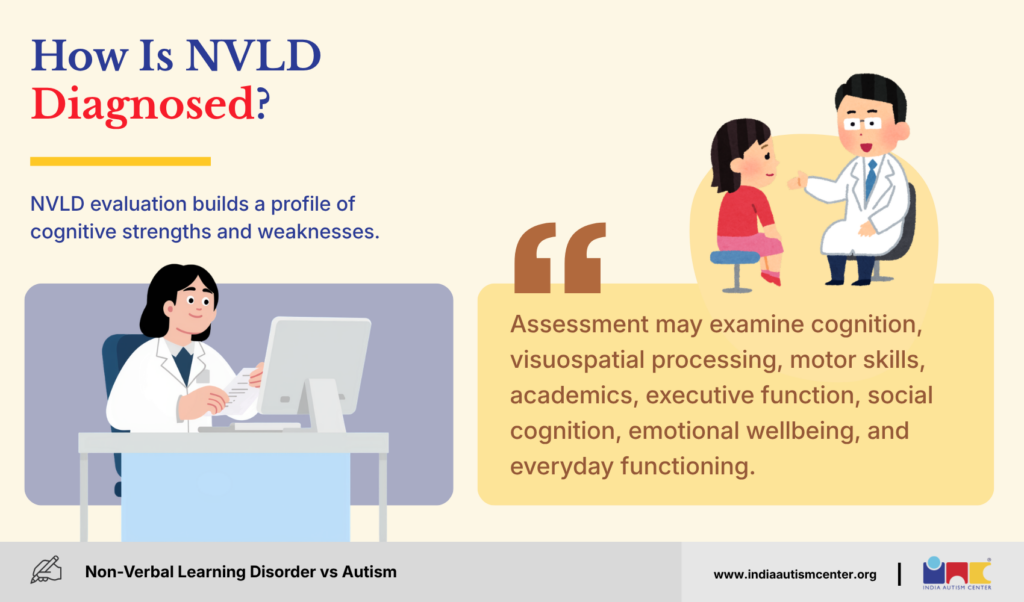
Because NVLD lacks a DSM-5 entry, there is no single standardised diagnostic pathway. What clinicians do instead is build a profile – a comprehensive picture of the child’s strengths and weaknesses across multiple domains – and determine whether that profile fits the NVLD pattern.
A thorough NVLD evaluation typically includes:
- Clinical interview with parents and, where possible, the child
- Teacher reports and school records (looking for patterns of academic inconsistency)
- Cognitive assessment (IQ testing) – specifically looking for a significant discrepancy between verbal and performance/visuospatial scores
- Visual-spatial processing tests – assessing the ability to interpret diagrams, navigate space, and process visual information
- Motor assessment – fine and gross motor coordination
- Academic achievement testing – reading, writing, maths
- Executive function assessment – planning, organisation, working memory
- Social cognition assessment – theory of mind, emotion recognition
- Emotional and behavioural screening – anxiety, depression, ADHD symptoms
The evaluator will also explicitly assess for autism, ADHD, and specific learning disorders to rule in or rule out co-occurring conditions.
The Autism Diagnostic Process in India
Autism diagnosis in India follows international clinical guidelines, adapted to the Indian context. A formal ASD diagnosis requires:
- Developmental history – detailed parent interview covering early milestones, communication, social development, and behaviour
- Behavioural observation – structured and unstructured observation of the child
- Standardised assessment tools (see below)
- Multi-disciplinary input – ideally involving a clinical psychologist, developmental paediatrician, and speech-language pathologist
Key Assessments Used in India (RCI-Registered Professionals, CARS, ADOS, Vineland)
In India, assessments should be conducted by RCI-registered psychologists or clinical psychologists (registered with the Rehabilitation Council of India). Key tools used include:
- CARS (Childhood Autism Rating Scale) – a widely used observational rating scale for autism severity; practical and validated for Indian clinical settings
- ADOS-2 (Autism Diagnostic Observation Schedule, 2nd Edition) – the gold-standard structured observational assessment for autism; requires specialist training
- ADI-R (Autism Diagnostic Interview – Revised) – a detailed parent interview covering the three core autism domains
- M-CHAT-R/F – a screening tool for toddlers (16–30 months), widely used in Indian paediatric settings
- Vineland Adaptive Behavior Scales – measures real-world adaptive functioning (communication, daily living skills, socialisation, motor skills); essential for understanding how a child functions day-to-day, not just how they perform on tests
- Neuropsychological evaluation – for NVLD specifically, this is the most important assessment; it maps cognitive strengths and weaknesses across verbal, visuospatial, memory, attention, and executive function domains
For NVLD, there is no equivalent of the ADOS-2. The diagnosis rests on the neuropsychological profile, clinical judgement, and the exclusion of other explanations.
Why Early and Accurate Diagnosis Matters
An inaccurate diagnosis does not just delay the right support – it can actively cause harm. A child with NVLD who is treated primarily for autism may receive interventions (such as certain behavioural programmes) that do not address the core visuospatial deficit and may even increase anxiety. A child with autism who is treated primarily for a learning disorder may miss out on the sensory integration support and communication strategies that could make a transformative difference.
Early diagnosis – before age 5 for autism, and as early as possible for NVLD – is associated with significantly better long-term outcomes. The brain is most plastic in the early years, and targeted intervention during this window yields the greatest gains.
Diagnosis is not a label. It is a map. And the right map leads to the right destination.
Living With NVLD or Autism in India: What Families Can Expect
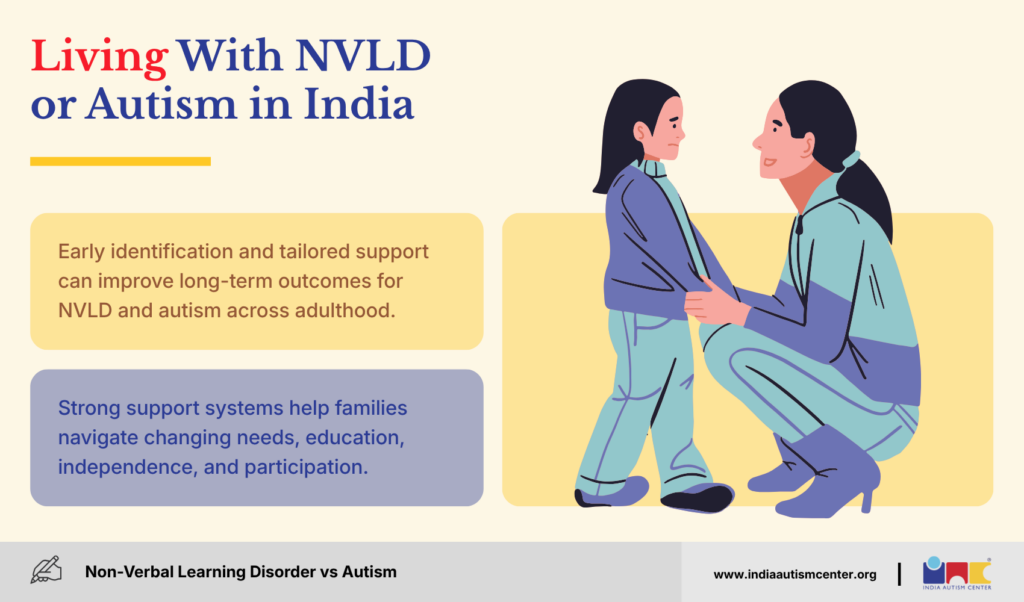
Long-Term Outlook for NVLD
The long-term outlook for children with NVLD is genuinely positive – particularly when the condition is identified early and the right supports are in place. Many adults with NVLD lead independent, fulfilling lives. They often gravitate towards careers that leverage their verbal strengths: writing, law, teaching, counselling, research.
The challenges that tend to persist into adulthood include:
- Difficulty with organisation and time management
- Continued struggles with spatial tasks (driving, navigating new environments)
- Social anxiety and difficulty reading social situations
- Challenges in workplaces that require strong visual-spatial skills or rapid adaptation to change
With coping strategies, career support, and continued social learning, most adults with NVLD manage these challenges effectively. The key is that they need to understand their own profile – and that starts with an accurate diagnosis in childhood.
Long-Term Outlook for Autism
The long-term outlook for autism varies considerably across the spectrum. Some autistic adults live fully independently, hold demanding careers, and have rich social lives. Others require ongoing support with daily living, communication, and community participation.
What research consistently shows is that early, intensive, targeted intervention significantly improves long-term outcomes across the spectrum. The specific skills that improve most with early intervention include communication, adaptive behaviour, and social participation.
In India, the expanding network of autism-specific schools, therapy centres, and vocational training programmes – supported by the RPWD Act’s provisions – means that the support landscape is improving, even if it remains uneven across regions.
Building a Support System in India
Whether your child has NVLD, autism, or both, building a strong support system is not optional – it is essential. Practically, this means:
- A core clinical team: ideally including an RCI-registered clinical psychologist, a speech-language pathologist, and an occupational therapist
- A school ally: a teacher or special educator who understands your child’s profile and can implement accommodations
- A parent community: connecting with other families navigating similar challenges – through local support groups, online communities, or organisations like the Autism Society of India
- Regular review: your child’s needs will change as they develop; assessments and intervention plans should be reviewed at least annually
India’s major cities – Mumbai, Delhi, Bengaluru, Chennai, Kolkata, Hyderabad – have growing ecosystems of specialist services. Families in smaller cities and rural areas face greater challenges, but telehealth options have expanded significantly since 2020 and can provide access to specialist consultation that was previously unavailable outside metros.
The support system you build today is the foundation your child will stand on for years to come.
Conclusion
If the traits described here align with what you’re noticing in your child, it’s worth slowing down and taking a closer look.
Because what if these patterns don’t correct themselves with time, discipline, or simply trying harder?
What makes a real difference is targeted support, grounded in an accurate understanding of your child’s brain.
That starts with a strategic, well-informed approach, which includes the following steps:
- Consult a qualified specialist who can look beyond surface behavior
- Ask for a comprehensive evaluation that assesses not just for autism, but also learning, motor, and processing differences
- Build a multidisciplinary team, including speech-language therapists, occupational therapists, and clinical psychologists, to map out your child’s needs with precision
- Follow through on individualized interventions to understand whether the diagnosis falls under autism, NVLD, or elements of both.
Also, engage proactively with your child’s school. Sharing diagnostic insights can open doors to critical accommodations such as structured routines, additional processing time, or visual supports that reduce daily friction.
At India Autism Center, we specialize in creating clarity where there’s diagnostic fog. So, if you’re struggling to distinguish between nonverbal learning disorder vs autism, feel free to contact us.
Frequently Asked Questions
Is NVLD a form of autism?
No, non-verbal learning disorder is not a form of autism. While both involve challenges with social cues and learning, NVLD is primarily about visual-spatial processing and is not on the autism spectrum.
Is NVLD autism?
No. NVLD and autism are separate conditions. NVLD affects how people understand nonverbal information, while autism involves broader differences in social communication, sensory response, and repetitive behaviors.
Is nonverbal learning disorder on the autism spectrum?
No. NVLD is not classified as being on the autism spectrum. However, the two can look similar in social and academic settings, which often leads to misdiagnosis.
Is non-verbal learning disorder on the autism spectrum?
No. Non-verbal Learning Disorder is not officially recognized as part of the autism spectrum, although it shares some overlapping traits.
Is NVLD related to autism?
They’re related in presentation but not the same condition. Both can affect social behavior and learning, but autism typically impacts a wider range of developmental areas, including sensory processing.
What causes NVLD?
While research is ongoing, NVLD is believed to stem from right-hemisphere brain dysfunction, affecting visual-spatial, organizational, and abstract reasoning skills.
What causes autism?
A mix of genetic and environmental factors causes autism. It affects brain development, leading to differences in communication, behavior, and sensory experience.
What’s the difference between non-verbal learning disorder and autism?
Autism affects social skills, communication, and sensory processing. NVLD mainly impacts visual-spatial reasoning, understanding body language, and abstract thinking, while verbal skills are often strong.
Can autism be mistaken for a learning disability?
Yes. Autism is a neurodevelopmental condition, not a learning disability, but it can be mistaken for one due to overlapping academic challenges. A full evaluation helps clarify the difference.
Can people with NVLD speak?
Yes. Speaking is usually a strength for people with NVLD. They often have strong vocabularies and communicate well with words, but struggle with social cues and spatial reasoning.
Do kids with NVLD speak?
Yes. Kids with NVLD typically speak fluently and often sound advanced for their age. Their challenges show up more in nonverbal and abstract reasoning tasks.
Is non-verbal related to autism?
It can be, but not always. Nonverbal communication challenges are common in autism, but other conditions like apraxia, trauma, or hearing loss can also cause someone to be nonverbal.
Can a child be nonverbal but not autistic?
Yes. Non-verbal behavior can stem from various causes, like speech delays, apraxia, selective mutism, or neurological conditions, without involving autism.
What’s the difference between being nonverbal and being autistic?
Being nonverbal means not using spoken language. Being autistic means having a different neurotype that affects social, sensory, and communication patterns. Not all autistic people are nonverbal.
Do nonverbal autistic children have intelligence?
Yes. Many nonverbal autistic children have average or above-average intelligence. They may think and learn differently, and communicate better through nonverbal tools like AAC.
Can you go nonverbal without autism?
Yes. People can temporarily or permanently lose speech due to stress, trauma, selective mutism, or other neurological factors unrelated to autism.
Do nonverbal kids eventually talk?
Some do, some don’t. With early intervention and the right supports, many children develop speech over time. Others may rely on alternative forms of communication long-term.
How to teach a child with NVLD?
Use structured, step-by-step instructions. Support verbal strengths, but provide visual aids, social skills coaching, and help with organizing space, time, and tasks.
How does NVLD affect adults?
Adults with NVLD may struggle with organization, abstract reasoning, or reading social cues. Many manage well with coping strategies, career support, and continued social learning.
Disclaimer: This article is intended for educational and informational purposes only. It is not a substitute for professional medical advice, diagnosis, or treatment. If you are pregnant or have concerns about medication use during pregnancy, please consult a qualified healthcare provider. If your child has received an autism diagnosis and you have questions about causes or support, please reach out to a trained specialist or an autism-focused organisation for guidance.
For expert insights, support services, and inclusive learning initiatives, visit the India Autism Center.