 Donate now
 Get a Call Back
 MENU
MENU 21 MIN READ
 SHARE
SHARE


Autism looks different at every age. Routines that worked in childhood may no longer hold up against the demands of school, work, or relationships. Suddenly, what once felt manageable can feel overwhelming.
This leaves many wondering: ‘Is autism getting worse with age?’
Here’s the truth. Research shows autism itself doesn’t worsen over time. However, new environments and increasing pressures can make the challenges associated with autism appear more intense.
In this article, you’ll learn what actually happens as autistic individuals grow older, what makes autism seem worse, and what you can do to adapt.
So, let’s get right into it.
Is Your Autism Getting Worse with Age?
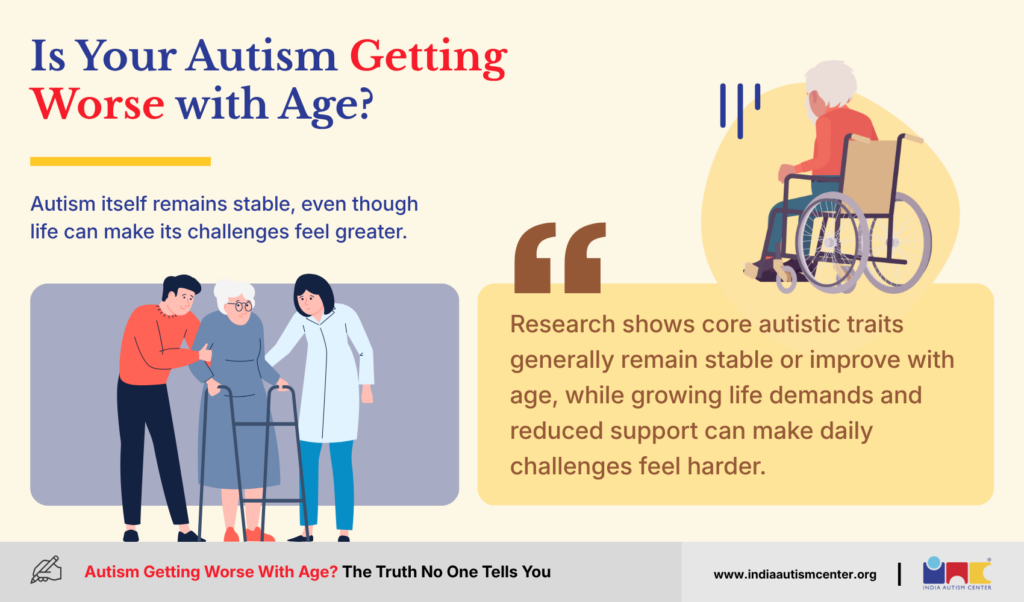
The short answer is no. Current scientific evidence suggests that the symptoms of autism spectrum disorder (ASD) typically do not worsen with age.
A large-scale systematic review published in PMC found that the core symptoms of ASD either remain stable or improve as individuals grow older. The neurodevelopmental profile – the way an autistic brain is wired – does not deteriorate over time the way a progressive condition like Parkinson’s does.
But here’s what that review can’t fully capture: the felt experience of being autistic often gets harder as life gets more complex.
Childhood has built-in scaffolding. There are routines, structured classrooms, patient adults, and a social world where parallel play is perfectly acceptable. Then adolescence arrives. Then employment, followed up by relationships, finances, ageing parents, and a healthcare system that barely recognises adult autism at all.
The autism didn’t change. The world did.
A landmark 2023 longitudinal study – Hong et al. (PMC10623813), tracking 406 autistic individuals across nine waves from adolescence through midlife – found exactly this pattern. Most autism-related behavioural symptoms followed an inverted U-shape: they improved from adolescence into midlife, then levelled off or worsened slightly in later midlife. But physical health measures – number of medications, health ratings, chronic conditions – worsened steadily with age, independent of autism severity.
That’s the real story. The autism doesn’t get worse. But the body accumulates stress, the supports disappear, and the world keeps raising the bar.
Let’s break it down.
Early Childhood (Ages 0–5): When Differences First Appear
This is typically when autism is first noticed – and, ideally, first diagnosed.
In the early years, the environment is still relatively forgiving. Toddlers aren’t expected to navigate complex social hierarchies or manage their own schedules. A child who lines up toys, avoids eye contact, or has a very narrow range of foods is often described as “particular” or “shy” rather than flagged for assessment.
What parents often notice first:
- Delayed or absent speech, or speech that develops and then regresses
- Intense focus on specific objects or topics
- Sensitivity to sounds, textures, lights, or crowds
- Difficulty with transitions or changes in routine
- Limited eye contact or response to their name
This is also the window where early intervention has the greatest impact. The brain is at its most plastic between ages 0 and 5. Applied Behaviour Analysis (ABA), speech therapy, occupational therapy, and play-based interventions started in this window consistently show the strongest long-term outcomes.
The gap between noticing and diagnosing is a critical problem in India. Many families notice something is different by age 2 or 3 but don’t receive a formal diagnosis until age 5 or later – sometimes much later. Every month of delay in this window is a missed opportunity.
School Age (Ages 6–12): When the Gap Starts to Widen
Primary school is where the social and academic demands of neurotypical life begin to pull ahead of what many autistic children can manage without support.
The classroom environment – fluorescent lights, unpredictable noise, group work, unspoken social rules – is often a sensory and social minefield. A child who seemed to be “keeping up” in kindergarten may begin to visibly struggle by Class 3 or 4.
What typically emerges in this stage:
- Difficulty making and keeping friends as peer social dynamics grow more complex
- Meltdowns or shutdowns that teachers misread as behavioural problems
- Academic struggles in subjects requiring working memory or executive function
- Anxiety around school attendance, particularly after breaks or disruptions
- Bullying – autistic children are disproportionately targeted
This is also when co-occurring conditions like ADHD, dyslexia, and anxiety are often identified – or missed. In India, many children in this age group are still waiting for a first diagnosis, let alone a second one.
Structured support at this stage – an Individualised Education Plan (IEP), classroom accommodations, social skills groups, and continued therapy – makes a measurable difference in long-term outcomes.
Adolescence (Ages 13–19): The Hardest Transition
Ask most autistic adults when things got hardest, and they’ll say: secondary school.
The social world of adolescence is built on unspoken codes, shifting alliances, sarcasm, and emotional reciprocity – exactly the domains where autism creates the most friction. Peers are no longer content with parallel play. They want connection, banter, and social fluency that many autistic teenagers simply haven’t developed.
At the same time, puberty brings hormonal changes that can genuinely amplify sensory sensitivities, emotional dysregulation, and anxiety. This is not autism “getting worse” – it’s biology interacting with an already-demanding social environment.
Research shows that approximately 40% of autistic youth meet criteria for at least one anxiety disorder. Depression rates climb sharply in this period too. And masking – the exhausting practice of suppressing autistic traits to pass as neurotypical – typically intensifies in the teenage years, with serious consequences for mental health and identity.
Common struggles in adolescence:
- Using slang without understanding context, leading to social exclusion
- Copying risky peer behaviour to gain acceptance
- Crossing social or physical boundaries without realising it
- Increasing school refusal or dropout
- First episodes of autistic burnout
In India, this is also the age when family pressure around board exams, career choices, and marriage expectations begins to mount – adding layers of stress that have nothing to do with autism but everything to do with the autistic person’s wellbeing.
Additionally, several issues tend to surface more prominently during these years:
- Anxiety ramps up: Meta-analyses estimate that about 40% of autistic youth meet the criteria for at least one anxiety disorder.
- Masking takes its toll: Research shows that masking autistic traits, especially during teenage years, can lead to elevated stress, exhaustion, loss of identity, and depression.
Adulthood (Ages 20–40): Invisible Struggles, Real Pressures
For many autistic adults, the twenties and thirties are the most isolating period of their lives.
The formal support structures of childhood and adolescence – school-based therapy, structured routines, IEP accommodations – vanish almost overnight. What replaces them? An open-plan office. A job interview. A romantic relationship. A landlord. A tax return.
The world expects full neurotypical competence. And it offers almost no scaffolding.
What this looks like in practice:
- Workplaces with fluorescent lighting, constant noise, vague instructions, and unwritten social rules
- Relationships that depend on emotional reciprocity, reading between the lines, and managing conflict
- The end of formal therapy hours and built-in accommodations
- Years of masking leading to deep exhaustion, reduced functioning, and sometimes regression in coping strategies
- Social isolation that compounds over time
The Hong et al. (2023) study found that autistic adults without intellectual disability showed some signs of accelerating aging-related challenges in later midlife – including worsening repetitive behaviours and more medications for physical health problems. This isn’t the autism itself worsening. It’s the cumulative cost of decades of unmet need.
Clinicians at India Autism Center consistently observe that autistic adults who reach their late twenties without a clear support structure – employment support, mental health care, community connection – are at significantly elevated risk of burnout, depression, and social withdrawal.
Midlife and Beyond (Ages 40+): What Research Says About Older Autistic Adults
This is the least-studied and least-supported phase of the autistic lifespan. Most autism research focuses on children. Most autism services are designed for children. Autistic adults over 40 are largely invisible to the system.
What we do know, from the Hong et al. (2023) study and other emerging research:
- Physical health declines more steeply in autistic adults than in the general population
- Rates of chronic conditions, medication use, and healthcare complexity are higher
- Social isolation tends to deepen as peer networks shrink
- Cognitive flexibility – already a challenge for many autistic people – may decline further with age
- Grief and loss (of parents, of caregivers, of routines) can trigger significant regression
A 2024 study published in The Gerontologist found that autistic adults over 50 reported significantly lower quality of life and higher rates of depression than both neurotypical peers and younger autistic adults.
The message is clear: autism care cannot stop at 18, or 25, or even 40. It needs to be a lifespan commitment.
📥 Free download: Printable daily routine chart for autistic children
Why Autism Can Feel Worse With Age – 5 Real Reasons
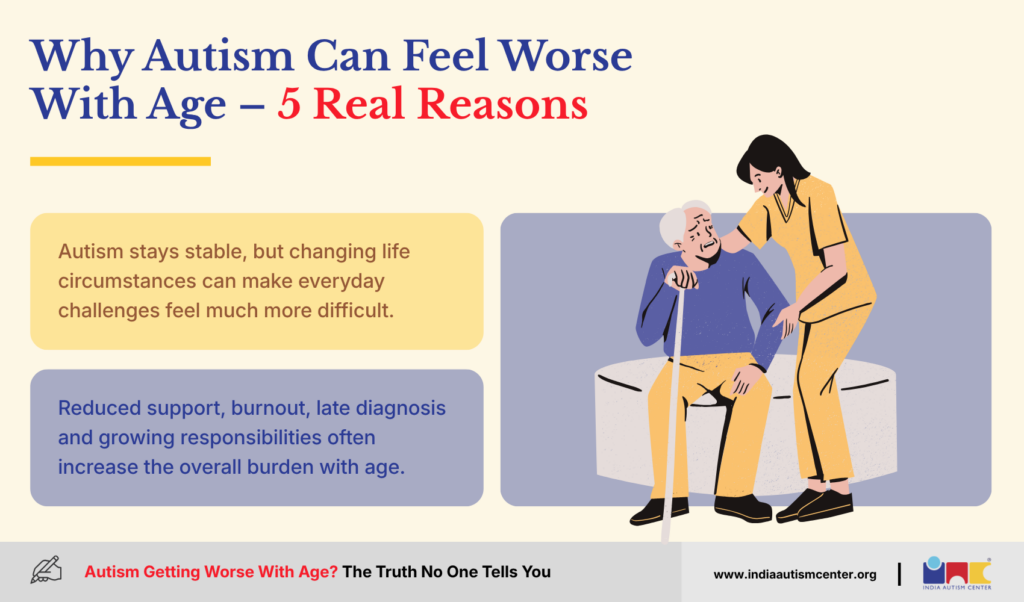
The neurology is stable. But the experience can genuinely deteriorate. Here’s why.
1. Supports Fade as Expectations Rise
In childhood, the system provides scaffolding: structured classrooms, therapy hours, understanding teachers, parental advocacy. In adulthood, all of that disappears – but the expectations multiply.
An autistic adult is expected to manage their own schedule, finances, social life, career, and health – often without any of the accommodations that made childhood manageable. The gap between what’s expected and what’s supported is where the crisis lives.
2. Autistic Burnout Accumulates Over Time
Autistic burnout is not a metaphor. It’s a clinically recognised state of chronic exhaustion resulting from sustained masking, sensory overload, and the effort of navigating a neurotypical world.
Research on autistic burnout describes it as a loss of skills and functioning that can last months or years. Skills that seemed solid – communication, self-care, emotional regulation – can regress significantly during burnout.
Burnout accumulates. Each episode leaves a residue. By midlife, many autistic adults are managing the effects of two or three major burnout episodes, often without ever having had them named or treated.
3. Struggles Become Invisible in Adulthood
When an autistic child struggles, the system notices. When an autistic adult struggles, they’re often told to try harder.
Adults who are articulate, employed, or in relationships are frequently told they “don’t seem autistic.” Their internal experience – the constant sensory management, the social scripting, the executive function workarounds – is invisible to everyone around them. This invisibility means they don’t get support. And without support, the struggles compound.
4. Uneven Skill Profiles Become More Obvious
Autism creates uneven development. Someone might be a brilliant engineer but unable to manage a grocery run. They might give polished presentations at work but fall apart when their routine changes by 20 minutes.
In childhood, these inconsistencies are easier to accommodate. In adulthood, they create real-world consequences: job loss, relationship breakdown, financial crisis. The autism hasn’t changed – but the stakes have.
5. Late or Missed Diagnosis Delays the Right Support
A significant proportion of autistic people – particularly women, girls, and those without intellectual disability – are not diagnosed until adulthood. Some receive their first diagnosis at 40, 50, or later.
Decades without a framework for understanding your own neurology is genuinely damaging. It leads to misdiagnosis (depression, personality disorders, anxiety), inappropriate treatment, and a profound sense of being fundamentally broken.
Late diagnosis is not a minor inconvenience. It’s a decades-long deprivation of the right support.
Comorbidities That Worsen With Age in Autistic Individuals
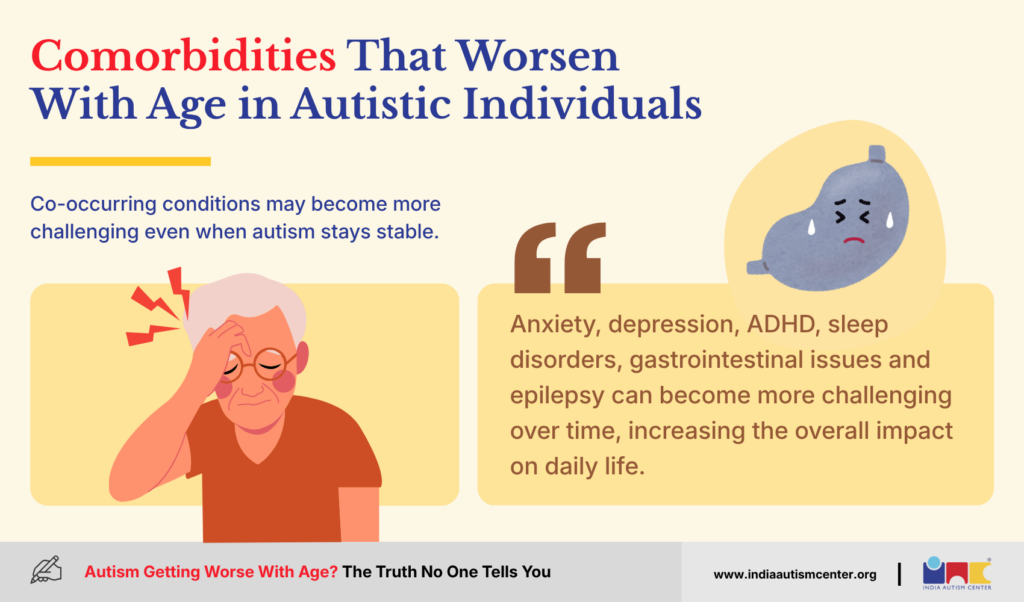
Autism itself is stable. But the conditions that frequently co-occur with autism are not. These comorbidities can and do worsen over time – and they’re a major driver of the sense that autism is “getting worse.”
Anxiety and Depression
Anxiety is the most common comorbidity in autism. Meta-analyses estimate that approximately 40% of autistic youth meet criteria for at least one anxiety disorder. In adults, rates of depression climb sharply – Medicaid data from the US show depression in approximately 20% of autistic adults, compared to 7.5% of autistic children.
The mechanisms are clear: years of social rejection, masking, sensory overload, and unmet needs create the conditions for chronic anxiety and depression. These aren’t inevitable – but they are predictable without adequate support.
ADHD and Executive Function Decline
ADHD co-occurs in an estimated 30–50% of autistic individuals. Executive function – planning, initiating tasks, managing time, switching attention – is already a challenge for many autistic people. As life demands increase and the scaffolding of structured environments disappears, executive function difficulties become more consequential.
In midlife, some autistic adults also experience what researchers describe as accelerated cognitive aging – not dementia, but a steeper-than-average decline in processing speed and cognitive flexibility.
Sleep Disorders
Sleep problems affect an estimated 50–80% of autistic individuals across the lifespan. Difficulty falling asleep, staying asleep, and achieving restorative sleep are common – and they’re bidirectionally linked with anxiety, depression, and sensory sensitivities.
Poor sleep makes everything harder: emotional regulation, sensory tolerance, executive function, and social capacity all deteriorate with insufficient sleep. In adulthood, when there’s no caregiver managing bedtime routines, sleep disorders often go unaddressed and worsen.
Gastrointestinal Issues
GI problems – constipation, diarrhoea, bloating, food intolerances – are significantly more common in autistic individuals than in the general population. Research suggests that up to 70% of autistic people experience chronic GI symptoms.
These aren’t just physical discomforts. GI distress directly affects behaviour, mood, and sensory tolerance. An autistic person in chronic GI pain is an autistic person in a constant state of sensory overload – which looks, from the outside, like autism “getting worse.”
Epilepsy and Seizure Risk
Epilepsy is more common in autism than in the general population. Estimates suggest that 20–30% of autistic individuals develop epilepsy by adulthood – with risk increasing significantly during puberty and again in midlife.
This is one of the clearest examples of a comorbidity that genuinely worsens with age. New-onset seizures in an autistic adult who had no history of epilepsy in childhood are not uncommon. Regular neurological monitoring is essential.
Does High Functioning Autism Get Worse with Age
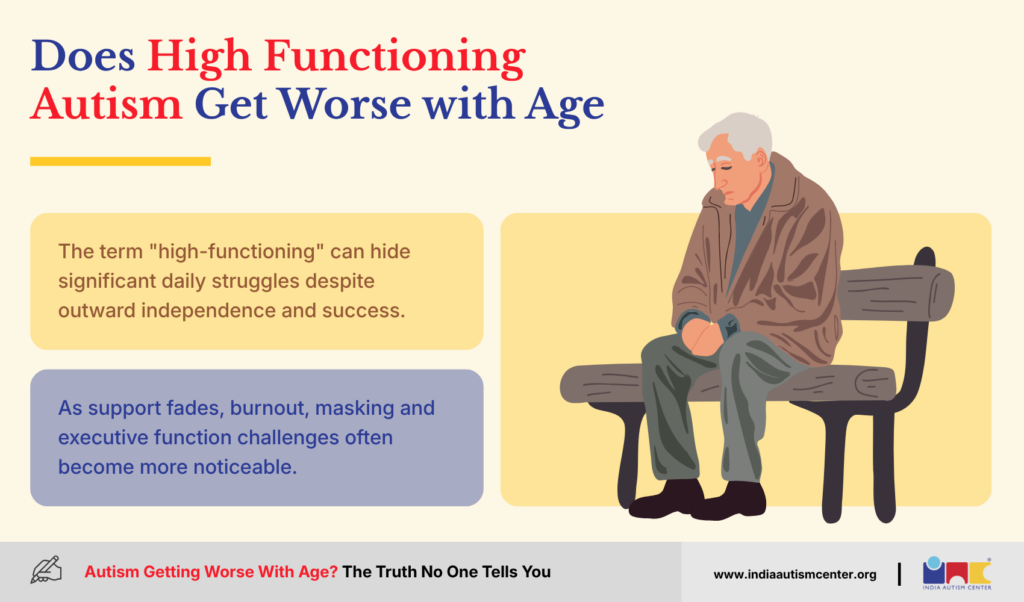
The answer to this question is not straightforward.
Primarily, because the term ‘high-functioning’ can be misleading. It implies that an individual with autism is coping well simply because they can speak fluently or maintain a job.
In reality, many of these individuals are working twice as hard behind the scenes to manage challenges such as sensory overload, social exhaustion, and difficulties with executive functioning, which do not diminish over time.
Here’s what typically happens as these high-functioning autistic individuals grow older:
Supports Fade Away
In childhood, structured routines, visual schedules, therapy, and understanding teachers often provide support.
However, as adults, these resources quietly disappear.
Suddenly, there is an expectation to manage workplaces, relationships, and emotional regulation without accommodations, simply because they appear capable.
Burnout Becomes More Common
Masking strategies, such as rehearsing social scripts and hiding natural responses, can be useful in the short term, but they come at a high cost.
Over time, these strategies can lead to burnout. It manifests as chronic fatigue, increased anxiety, low mood, skill loss, and even physical health issues.
Struggles Remain Invisible
When an autistic individual is articulate or academically successful, their challenges often go unnoticed.
Employers, family, and peers may assume they are thriving when in reality, they are drained from continuously having to self-regulate.
Uneven Skill Profiles Become More Obvious
Strengths and challenges do not always occur together.
For instance, someone may excel in professional presentations but neglect basic self-care, such as eating. They might manage small talk at a party, yet struggle to cope with sudden changes in their routine.
This inconsistency is common among individuals with autism spectrum disorder. However, the label ‘high-functioning’ oversimplifies their experiences, ultimately leaving them without the support they need.
Interventions That Help at Every Life Stage
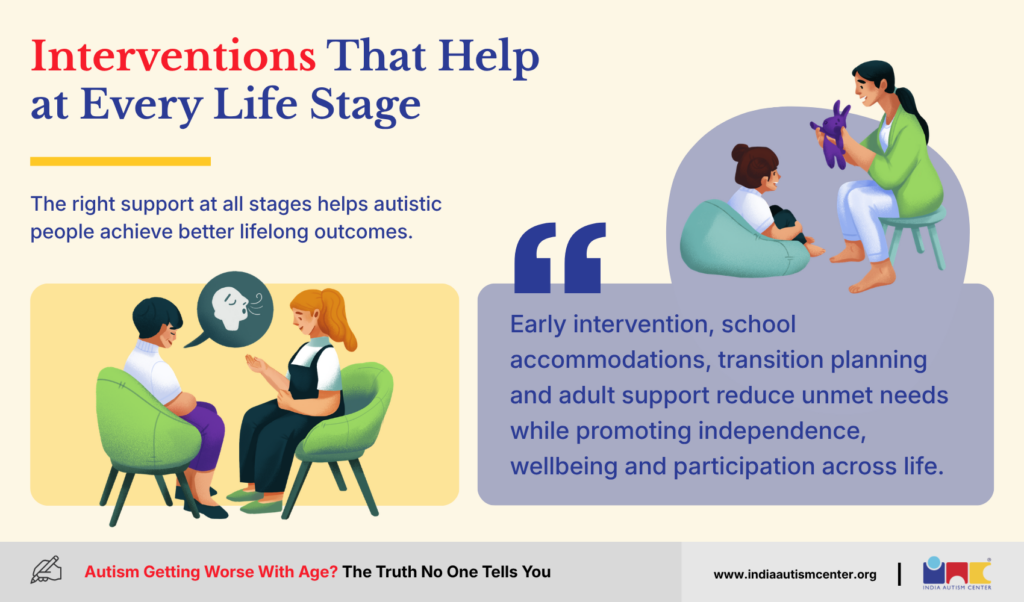
The most important thing we know about autism across the lifespan is this: the right support at the right time changes outcomes. It doesn’t cure autism – it doesn’t need to. It reduces the cumulative burden of unmet need.
Early Intervention (Ages 0–6): The Most Critical Window
The brain is at its most plastic in the first six years of life. Early intervention in this window consistently produces the strongest long-term outcomes across communication, daily living skills, and adaptive behaviour.
Evidence-based approaches include:
- ABA therapy (Applied Behaviour Analysis) – focused on building functional skills
- Speech and language therapy – for communication, both verbal and non-verbal
- Occupational therapy – for sensory processing and fine motor skills
- DIR/Floortime – relationship-based, child-led approach
- Parent-mediated interventions – training parents to embed therapeutic strategies into daily routines
In India, access to these services is heavily concentrated in urban centres. Families in smaller cities and rural areas often face waits of 6–18 months for a first assessment, let alone ongoing therapy.
School-Age Support (Ages 6–12): Structure, Therapy, and IEP
At school age, the focus shifts to academic inclusion and social participation. Key interventions include:
- Individualised Education Plans (IEPs) – legally mandated accommodations under the RPwD Act 2016 in India
- Social skills groups – structured peer interaction with therapeutic support
- Sensory accommodations – quiet spaces, reduced fluorescent lighting, movement breaks
- Continued speech and OT – to maintain and build on early gains
- Anxiety management – CBT adapted for autism, delivered by trained therapists
Adolescent Support (Ages 13–19): Transition Planning and Social Skills
Adolescence requires a specific focus on transition – from school to further education or work, and from childhood to adult identity.
Key interventions:
- Transition planning – starting at age 14, not 17
- Vocational assessment and skills training
- Social skills and relationship education – including puberty, consent, and online safety
- Mental health support – specifically targeting anxiety, depression, and burnout
- Identity-affirming support – helping autistic teens understand and accept their neurology
Adult Support (Ages 20+): Independence, Employment, and Mental Health
Adult autism support in India is almost non-existent in the public system. Most autistic adults are left to navigate employment, relationships, and mental health without any specialist support.
What makes a real difference:
- Supported employment programmes – job coaching, workplace accommodations, employer education
- Mental health care from autism-informed therapists – not generic CBT, but approaches adapted for autistic cognition
- Community and peer support – reducing the isolation that drives depression
- Residential care options – for those who need structured support to live safely and well
Support for Older Adults (Ages 40+): Preventing Regression
Older autistic adults are the most underserved group in the system. Key priorities:
- Continuity of care – not having to re-explain your needs to every new provider
- Physical health monitoring – proactive management of epilepsy, GI issues, cardiovascular risk
- Grief and loss support – particularly around the loss of parents and primary caregivers
- Housing security – planned, sensory-appropriate living arrangements before a crisis forces the issue
Interventions by Life Stage: Summary Table
| Life Stage | Key Interventions | Primary Goal |
|---|---|---|
| Early Childhood (0–6) | ABA, speech therapy, OT, Floortime, parent training | Build foundational communication and daily living skills |
| School Age (6–12) | IEP, social skills groups, sensory accommodations, CBT | Academic inclusion and social participation |
| Adolescence (13–19) | Transition planning, vocational skills, mental health support | Prepare for adult life; protect mental health |
| Adulthood (20–40) | Supported employment, autism-informed therapy, peer support, residential care | Independence, employment, wellbeing |
| Midlife and Beyond (40+) | Continuity of care, physical health monitoring, housing planning | Prevent regression; maintain quality of life |
Challenges Unique to India: Late Diagnosis, Stigma, and Rural Access
India’s autism landscape has three structural problems that compound each other.
Late diagnosis. Many Indian children are not diagnosed until after age 5 – and many autistic adults have never received a formal diagnosis at all. The reasons are multiple: shortage of trained developmental paediatricians and psychologists, concentration of specialist services in metros, lack of awareness among general practitioners, and culturally specific presentations that don’t match Western diagnostic criteria.
Stigma. In many Indian families – particularly in smaller cities, towns, and rural areas – an autism diagnosis carries significant social stigma. Families may delay seeking diagnosis to avoid the label. Parents, particularly mothers, are often blamed. Marriage prospects for siblings are considered. These pressures are real, and they delay access to support by years.
Rural access. The gap between urban and rural autism services in India is vast. A family in Mumbai or Bengaluru can access multiple specialist centres, therapy providers, and support groups. A family in rural Bihar or Odisha may have no access to a trained autism specialist within 200 kilometres. Telehealth is beginning to bridge this gap, but the infrastructure is still inadequate.
Clinicians at India Autism Center see this pattern repeatedly: families who travelled from smaller towns and rural districts, having spent years navigating misdiagnosis, traditional remedies, and well-meaning but uninformed advice from local doctors. The delay is not the family’s failure. It’s a system failure.
Ageing Well on the Autism Spectrum: Redefining What It Means
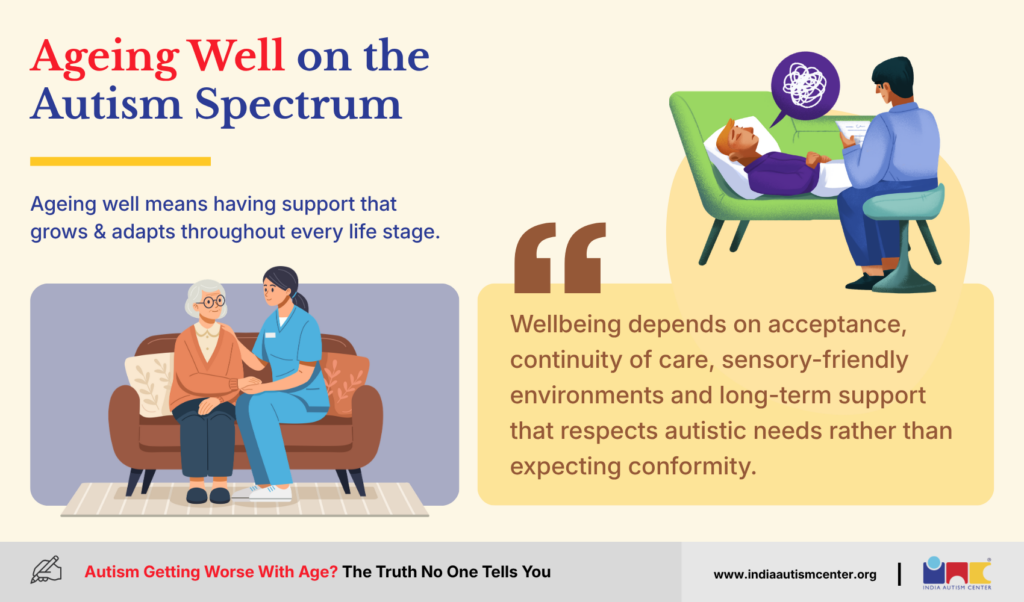
The conventional definition of “aging well” – staying physically active, cognitively sharp, and socially productive – was built for neurotypical people. For autistic individuals, it’s not just inadequate. It’s actively harmful.
A recent study found that only 3.3% of autistic adults met the criteria for “successful aging” under the traditional model. That’s not a reflection of autistic people’s capacity. It’s a reflection of how broken the model is.
A 2017 Australian study asked autistic adults and their carers what aging well actually looked like to them. The answers were clear:
- Being accepted as they are, without pressure to mask
- Having responsive, consistent support that doesn’t require constant re-explanation
- Living in sensory-considerate environments
- Staying socially connected – but on their own terms
- Retaining control over routines, space, and daily choices
The problem with the “successful aging” playbook is that it treats difference as deficit. Autistic routines, communication styles, and sensory needs are not failures to be corrected. They’re realities to be accommodated.
From independence to interdependence. For autistic adults, aging well doesn’t mean doing everything alone. It means having the right kind of support – without having to justify why it’s necessary. Continuity of care is not a luxury. It’s a clinical necessity. Caregivers and autistic adults alike describe the exhaustion of navigating fragmented systems, of re-explaining needs to every new provider, of starting from scratch every time a service ends.
What sustains wellbeing isn’t just access to services. It’s consistency, trust, and the absence of the need to perform neurotypicality just to be taken seriously.
Redefining aging well on the spectrum means:
- Listening to autistic voices about what wellbeing actually means to them
- Building long-term supports that grow and adapt with the individual
- Training healthcare professionals to recognise and respond to autism across the lifespan
- Designing housing, healthcare settings, and communities with sensory needs in mind
- Valuing emotional safety, identity, and quality of life alongside productivity
Aging well should not be a privilege reserved for those who conform to a narrow neurotypical standard. Every autistic person deserves a life that fits them – not one they’ve been forced to fit into.
Parting Words: Support and Care for Autistic Individuals
So, no, autism spectrum disorder itself doesn’t worsen with age.
But unmet needs do. And the cost of managing alone can quietly build until it surfaces as burnout, isolation, or health decline.
That’s why the real question isn’t “Does autism get worse with age?” but rather: “Are we providing the right kind of support as life changes?”
The goal isn’t crisis response. It’s steady, evolving care. That might mean a therapist who understands masking and burnout, or daily routines that support executive function.
Planning is key. Most importantly, support must be consistent. It must also be anchored in continuity and trust, not repeated cycles of re-explaining. Autistic adults don’t outgrow their needs. Their care simply needs to grow with them.
And if you’re exploring long-term care, feel free to contact us.
Frequently Asked Questions
Can autism worsen with age if untreated?
Autism does not progress or deteriorate, even if untreated. Without support, though, individuals may face burnout, isolation, or declining mental health, which can make daily challenges more intense and harder to manage.
Do autism symptoms get worse with age?
Autism symptoms remain stable, but life stages such as adolescence, employment, or aging can intensify how those symptoms appear. Support systems, social expectations, and co-occurring conditions play a large role in how symptoms are experienced.
Does autism get better with age?
While autism is lifelong, communication, self-regulation, and social skills often improve as autistic individuals learn strategies and gain lived experience, particularly when consistent support is available.
At what age is autism the hardest?
Many find the teenage years most challenging due to heightened academic and social pressures. Puberty, identity formation, and shifting expectations can all intensify autistic traits and make this stage feel overwhelming.
At what age does autism peak?
Autism does not peak because it is lifelong. However, certain phases, like adolescence or midlife, may feel more difficult when transitions and responsibilities outpace the support systems in place.
Disclaimer: This article is intended for educational and informational purposes only. It is not a substitute for professional medical advice, diagnosis, or treatment. If you are pregnant or have concerns about medication use during pregnancy, please consult a qualified healthcare provider. If your child has received an autism diagnosis and you have questions about causes or support, please reach out to a trained specialist or an autism-focused organisation for guidance.
For expert insights, support services, and inclusive learning initiatives, visit the India Autism Center.