 Donate now
 Get a Call Back
 MENU
MENU 12 MIN READ
 SHARE
SHARE


Getting a disability certificate is an important administrative step for people with disabilities and their families in Uttar Pradesh. The certificate provides official recognition of a specified disability and can be required when applying for eligible government schemes, educational provisions, employment-related benefits and other entitlements.
According to Census 2011, Uttar Pradesh had 4,157,514 persons with disabilities, representing 2.08% of the state’s population. Hence, to access the right support, it is important to understand how to get a disability certificate in UP.
What Is a Disability Certificate in UP?
A disability certificate is an official document issued after assessment by a notified medical authority. It records the type of specified disability and the percentage of disability assessed according to the applicable government guidelines.
The legal framework comes primarily from the Rights of Persons with Disabilities Act, 2016. Section 58 allows a person with a specified disability to apply to a certifying authority having jurisdiction. The authority assesses the disability according to notified assessment guidelines and either issues the certificate or informs the applicant that no specified disability has been established. A certificate issued under the Act is valid throughout India.
For applicants in Uttar Pradesh, the process is now closely integrated with the national Unique Disability ID, or UDID, system. The Department of Empowerment of Persons with Disabilities states that the UDID system supports online applications for disability certificates and UDID cards, assessment by hospitals or Medical Boards, renewal and tracking of applications.
Who Can Apply for a Disability Certificate in UP?
A person who has a disability covered under the RPwD Act can apply for certification. The assessment is not based simply on whether someone has received a diagnosis from a private professional.
The notified medical authority must assess the disability using the government-prescribed guidelines.
The current framework covers specified disabilities including:
- Visual impairment
- Hearing impairment
- Speech and language disability
- Locomotor disability
- Intellectual disability
- Specific learning disabilities
- Autism Spectrum Disorder
- Mental illness
- Cerebral palsy
- Muscular dystrophy
- Chronic neurological conditions
- Multiple sclerosis
- Parkinson’s disease
- Blood disorders such as haemophilia, thalassaemia and sickle cell disease
- Multiple disabilities
- Other specified categories recognised under the Act and subsequent notifications
The government certificate forms specifically include Autism Spectrum Disorder among the specified disability categories.
This is particularly relevant to families seeking a disability certificate in Uttar Pradesh for an autistic child or adult. A clinical diagnosis of autism is important evidence, but the final percentage and nature of disability for certification are determined by the authorised medical authority under the applicable assessment guidelines.
Does a Person Need 40% Disability to Get a Certificate?
This is one of the most important points to understand.
The term “benchmark disability” generally refers to a person with not less than 40% of a specified disability, as defined under the RPwD Act. Many benefits and reservations are specifically linked to benchmark disability.
However, 40% should not be confused with eligibility to be assessed or certified at all. DEPwD issued a specific advisory in July 2024 concerning the issuance of disability certificates and UDID cards to persons assessed below 40%. The department continues to list this advisory among its official UDID documents.
Therefore, families should not assume that a person must first prove 40% disability before applying for a certificate. Whether a particular scheme, reservation or concession is available will depend on its own eligibility requirements.
This distinction matters especially for autism, because an autism diagnosis and the percentage assigned for disability certification are not interchangeable concepts.
How to Get a Disability Certificate in UP Through the UDID Portal?
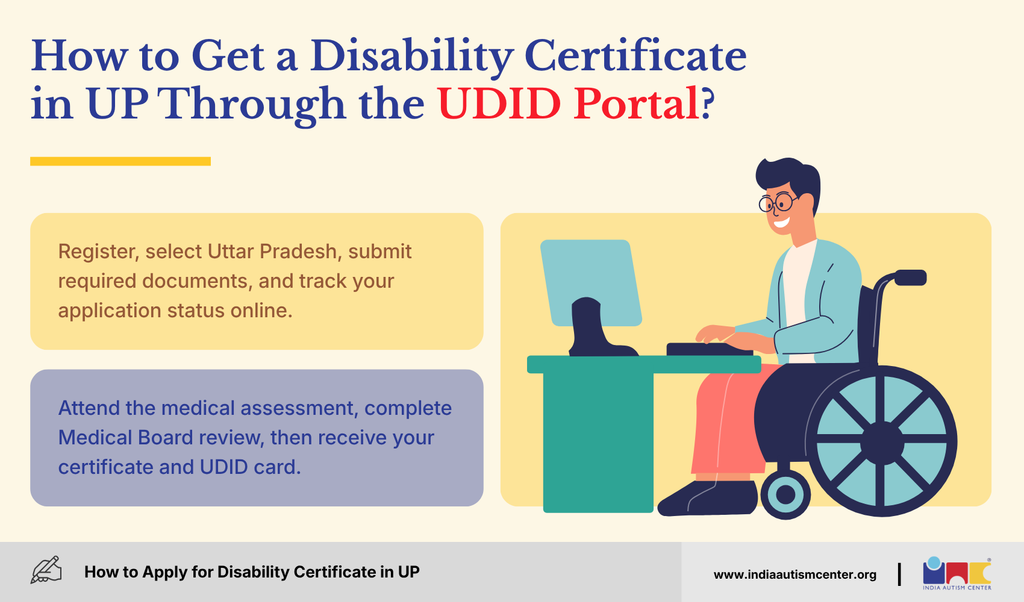
The UDID portal simplifies the process of applying for a disability certificate and UDID card. Here is how the process works:
Step 1: Register on the UDID portal
Create an account on the portal by entering your details, such as contact, address and identity details accurately.
Step 2: Select Uttar Pradesh and your district
Choose Uttar Pradesh and the relevant district to identify the designated medical authority or hospital.
Step 3: Submit the application
Complete the application form, upload the required documents and save your acknowledgement or application number.
Step 4: Complete verification
Track your application and follow any instructions issued by the designated medical authority.
Step 5: Attend the disability assessment
Visit the assigned hospital for assessment by authorised specialists. Carry relevant diagnostic and medical records, particularly for autism-related applications.
Step 6: Medical Board review
The Medical Board reviews the assessment and determines the recognised disability and percentage according to applicable government guidelines.
Step 7: Receive your certificate and UDID card
Once approved, the disability certificate and UDID card are generated through the system. Monitor the portal for updates and retain your application details.
What Documents Are Required for a Disability Certificate in UP?
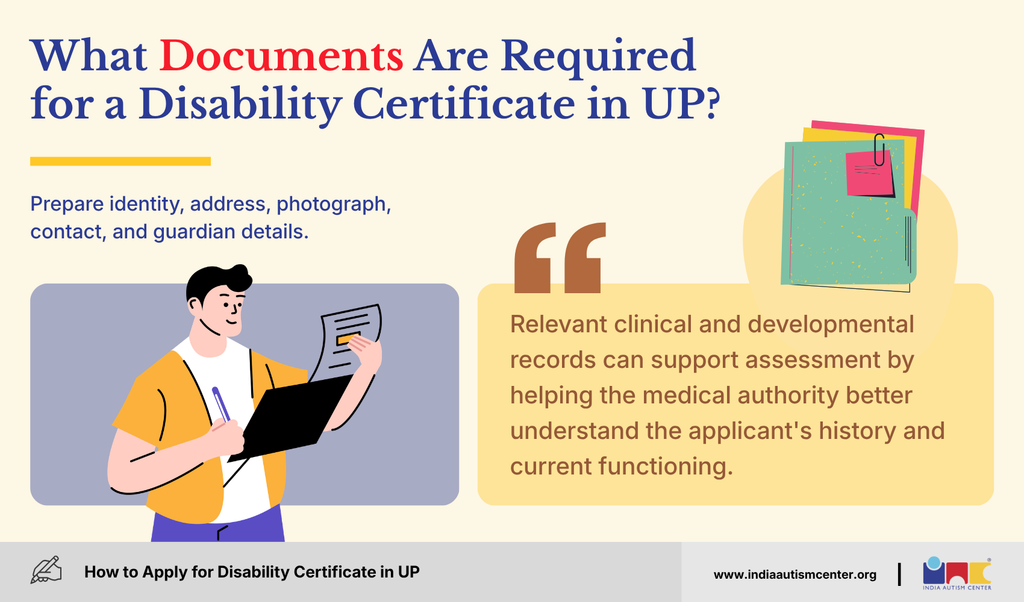
The exact documents requested can depend on the applicant and the requirements of the concerned medical authority. Applicants should therefore check the current instructions on the UDID portal before submitting their application.
The current statutory application form includes:
- Aadhaar details as proof of identity, subject to the applicable provisions
- Residential address details
- Recent passport-size photograph
- Applicant and parent or guardian details, where applicable
- Mobile number and other contact information
The 2024 amended application form specifically provides fields for Aadhaar information, address and a recent photograph.
For a smoother medical assessment, it is also sensible to keep relevant clinical records available, particularly where the applicant has a developmental or neurological condition. For example, an autism-related application may benefit from carrying previous diagnostic reports, developmental assessments, psychological assessments, therapy records and educational reports where these are available and relevant.
These supporting records do not replace the government’s assessment. They help the medical authority understand the applicant’s history.
What Documents Should Parents of an Autistic Child Keep Ready?
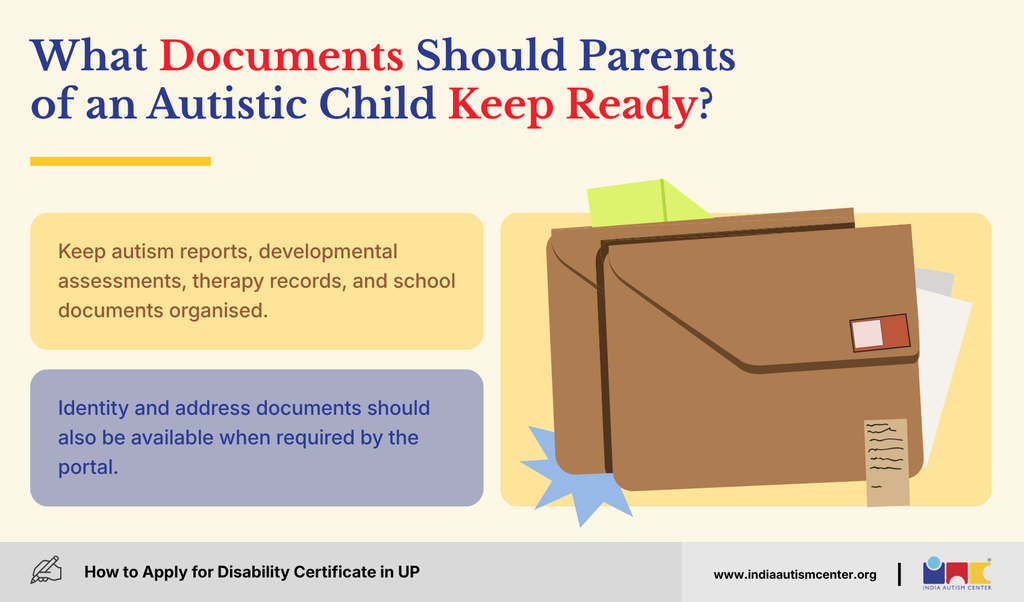
For families applying for an autism-related disability certificate in Uttar Pradesh, paperwork can become especially important because autism is a developmental condition and its functional impact may vary significantly between individuals.
Parents should consider keeping a consolidated file containing:
- Autism diagnostic or clinical assessment reports
- Developmental history and previous assessments
- Relevant psychological or functional assessments
- Speech and language assessment reports, where applicable
- Occupational therapy or other therapy records, where relevant
- School reports or Individualised Education Plan documentation, where available
- Previous disability certificate or UDID information, if applying for renewal or reassessment
- Identity and address documents required by the portal
A parent should not assume that having more documents automatically results in a higher disability percentage. The purpose of supporting records is to provide accurate evidence of the person’s history and functioning.
How Long Does It Take to Receive a Disability Certificate in UP?
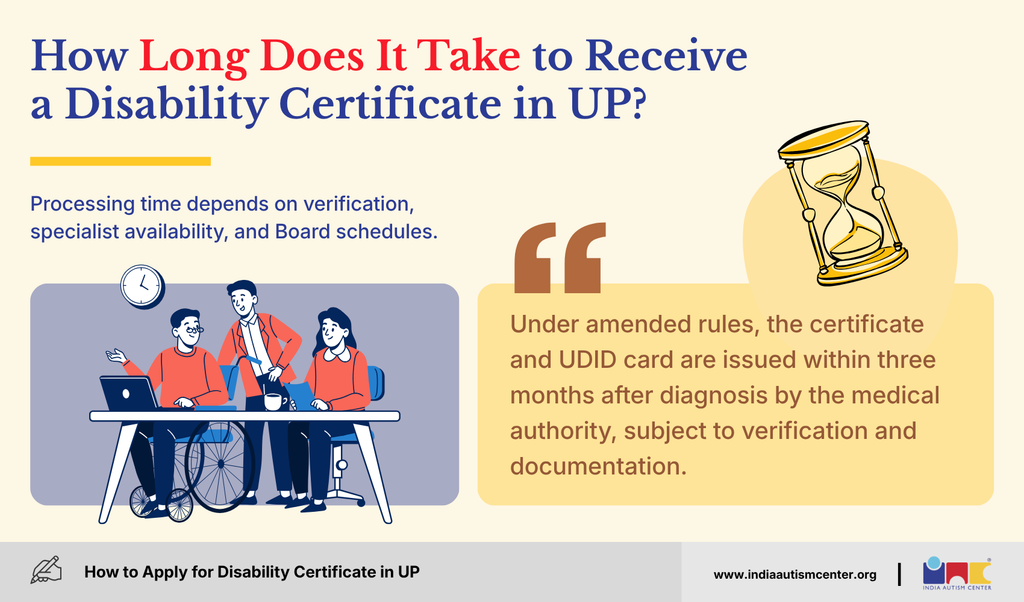
The time required to receive a disability certificate in Uttar Pradesh can vary depending on document verification, specialist availability, Medical Board schedules and whether additional assessments are needed.
Under the amended Rights of Persons with Disabilities Rules, the Medical Authority issues the disability certificate and UDID card within three months of a disability being diagnosed. If an application is rejected after assessment, the reasons for rejection must be communicated through the online platform within one month.
Submitting an online application does not mean the certificate will be issued immediately, as medical assessment and verification are essential parts of the process. Applicants should regularly check their UDID application status and contact the designated hospital or medical authority if their application remains pending.
What Should You Do If the Application Is Rejected?
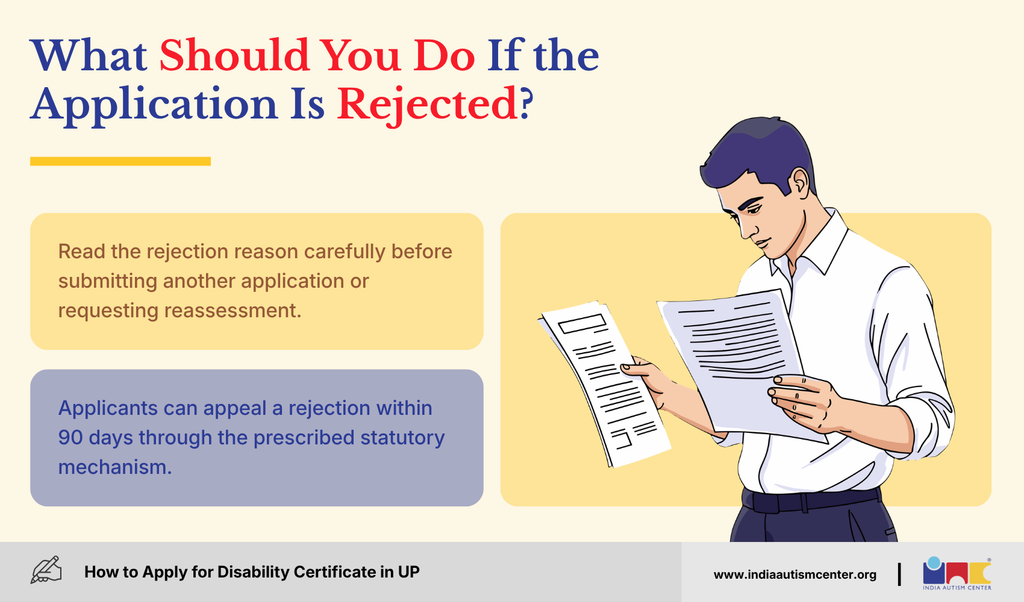
A rejection does not necessarily mean that an applicant has no route to review further.
The amended rules require the medical authority to communicate the reason for rejection through the online platform. The current rules provide for an appeal within 90 days of rejection, using the mechanism prescribed under Section 59 of the RPwD Act.
Section 59 of the RPwD Act provides a statutory right to appeal against the decision of a certifying authority to the designated appellate authority.
Applicants should read the stated reason for rejection carefully rather than immediately submitting a duplicate application. If the issue is an incomplete document, incorrect information or an assessment-related concern, the appropriate next step can be different.
What Benefits Can a Disability Certificate Help You Access?
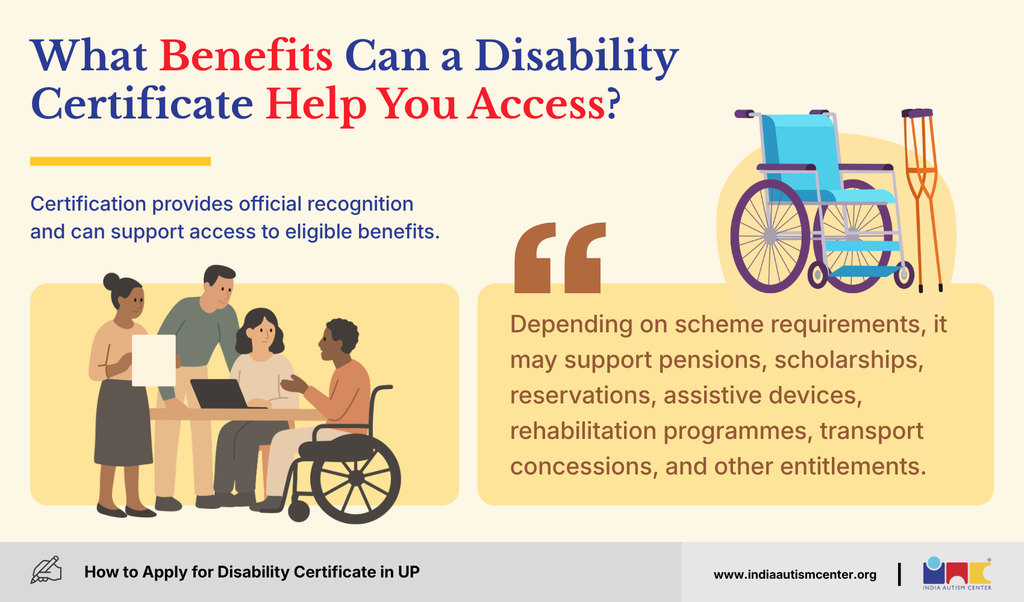
A disability certificate provides official recognition of a person’s certified disability and can support access to various government schemes and entitlements. However, having a certificate does not automatically make someone eligible for every benefit.
Eligibility may depend on disability type and percentage, age, income, education and other scheme-specific requirements.
Depending on the applicable criteria, a disability certificate or UDID card may be required for:
- Government welfare schemes and disability pensions
- Scholarships and educational concessions
- Employment-related provisions and reservations
- Assistive devices and rehabilitation programmes
- Applicable transport concessions
- Other central and state government benefits
For example, the ADIP Scheme requires eligible applicants to meet specific conditions, including benchmark disability requirements. Therefore, families should always check the eligibility criteria of the particular scheme they wish to access rather than assuming that certification guarantees a benefit.
Disability Certificate in UP for Autism: What Parents Should Know?
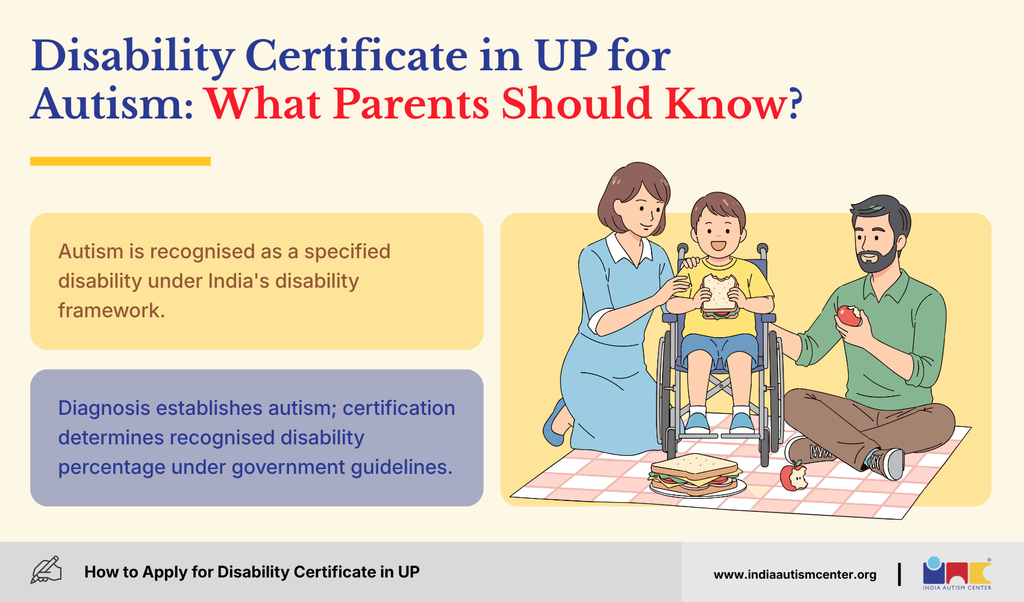
Autism Spectrum Disorder is recognised as a specified disability under India’s disability framework, with government-prescribed assessment guidelines. For parents, it is important to distinguish diagnosis from certification.
An autism diagnosis establishes whether a person meets the clinical criteria for autism, while disability certification determines the recognised disability and percentage under government guidelines.
The certificate is an administrative document that may support access to eligible schemes and services. It does not define a child’s abilities or potential. Families can pursue certification alongside appropriate developmental, educational and therapeutic support.
Common Mistakes to Avoid When Applying
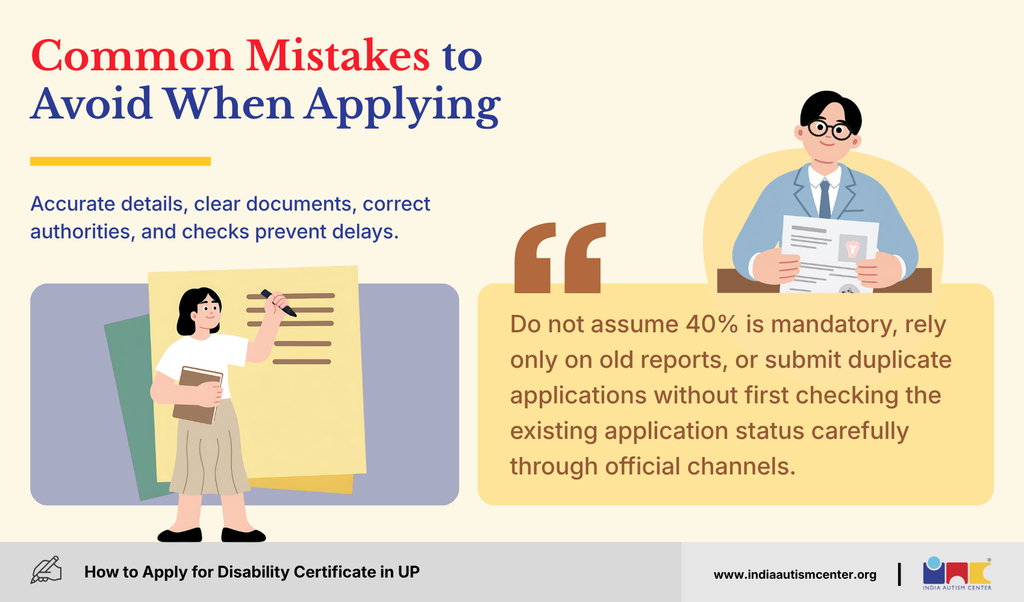
Although applying for a disability certificate in UP through the UDID portal is structured, simple errors can cause unnecessary delays. Keep these points in mind:
- Entering incorrect details: Ensure your name, date of birth, Aadhaar information and address match your supporting documents.
- Selecting the wrong authority: Use the UDID portal to identify the designated medical authority rather than approaching an unauthorised hospital.
- Uploading unclear documents: Submit clear, legible documents in the formats accepted by the portal.
- Not checking application status: Regularly track your application and respond to requests for verification or assessment.
- Assuming 40% is mandatory: Benchmark disability may be required for specific benefits, but it should not automatically be treated as a prerequisite for applying for certification.
- Relying only on old reports: Previous reports can provide useful evidence, but the authorised medical authority determines the final certification.
- Submitting duplicate applications: If an application is pending or rejected, check its status and reason before submitting another.
What If You Cannot Complete the Application Online?
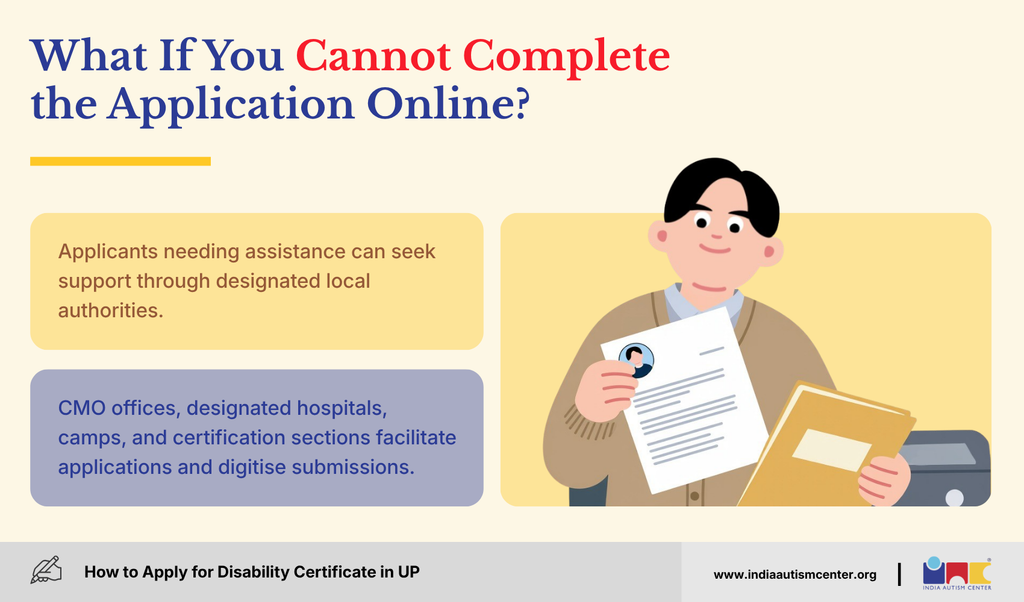
The UDID programme is designed to support applicants who may need assistance.
The official UDID system states that applications can be made online and that procedures can also be facilitated through camps and CMO offices. The national programme also allows offline applications to be digitised by the relevant authorities.
Applicants who have difficulty using the portal can therefore approach the concerned CMO Office, designated hospital, disability certification section or relevant district-level authority for assistance.
This is particularly useful for people who have limited digital access, require a caregiver to assist them or face accessibility barriers while completing the application.
A Practical Checklist Before You Apply
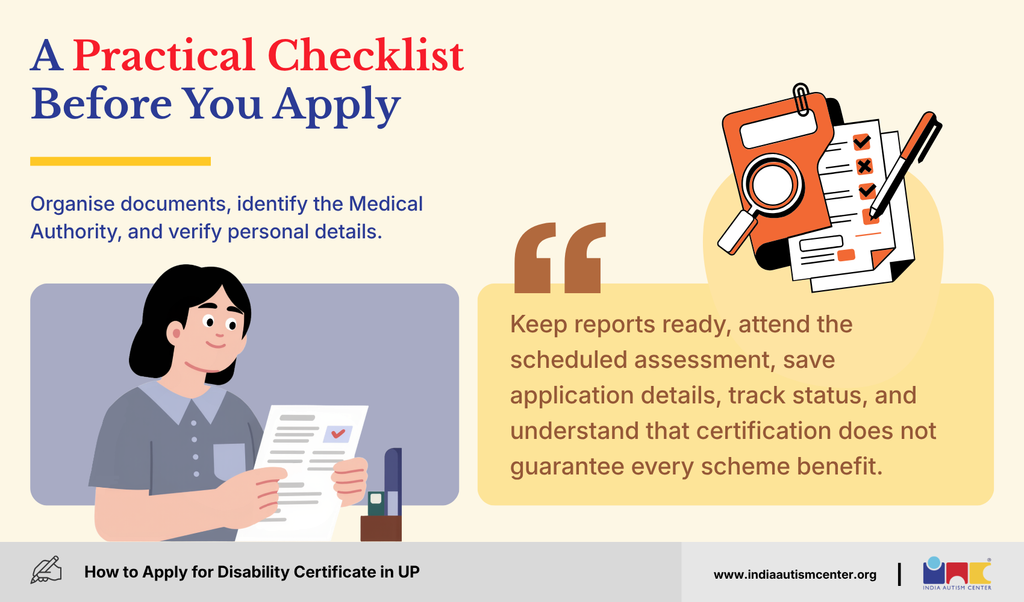
Before starting an application for a disability certificate in UP, check that:
- Your personal information is accurate.
- Your Aadhaar and address details are available as required.
- You have a recent photograph.
- Relevant medical, diagnostic and assessment reports are organised.
- Parent or guardian details are available for a child or person requiring assistance.
- You have identified the appropriate district and Medical Authority.
- You can attend the medical assessment when scheduled.
- You save your application details and regularly track the status.
- You understand that certification and eligibility for individual schemes are separate matters.
Keeping these details ready can make the process considerably easier and reduce avoidable delays.
How India Autism Center Supports Families Beyond Certification
India Autism Center supports families beyond disability certification by providing accessible information on autism assessment, early intervention, communication, sensory needs and inclusive education. Understanding that every autistic person has individual strengths and support needs, the Centre helps families navigate autism-related information alongside essential administrative processes. This broader approach can help families make informed decisions about ongoing support and care.
Conclusion
Applying for a disability certificate in UP involves registration through the UDID portal, document verification, medical assessment and Medical Board review. Understanding each stage can help applicants avoid delays and prepare the required records. For autistic individuals and their families, accurate documentation and awareness of eligibility requirements can make it easier to navigate certification and access applicable government schemes and services.
Frequently Asked Questions
How should I apply for a disability certificate in UP online?
You can apply through the official UDID portal by registering, entering your details, selecting the relevant medical authority and completing the required verification and disability assessment.
Can autistic people get a disability certificate in UP?
Yes. Autism spectrum disorder is a specified disability recognised under India’s disability framework and is included in the government disability certificate forms.
How long does it take to get a disability certificate in UP?
Under the amended RPwD Rules, the Medical Authority is required to issue the certificate and UDID card within three months of a disability being diagnosed, subject to the prescribed process.
Where can I track my disability certificate application?
Application status can be tracked through the official UDID portal after registration and submission.