 Donate now
 Get a Call Back
 MENU
MENU 11 MIN READ
 SHARE
SHARE


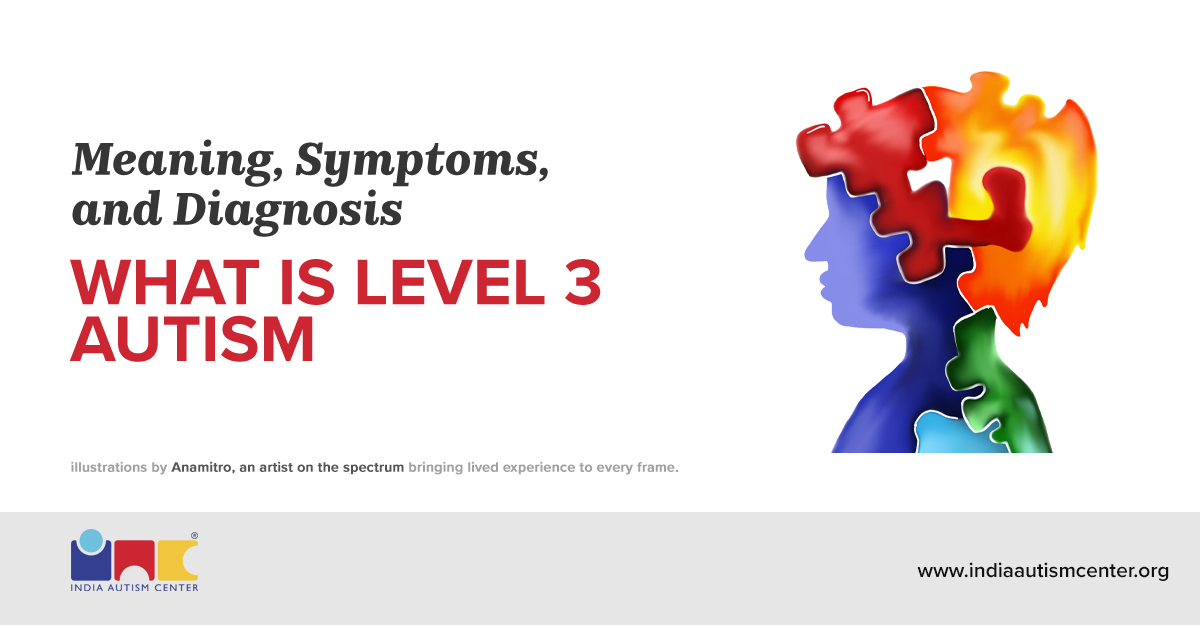
Autism is not a one-size-fits-all condition. It exists on a spectrum, meaning every individual experiences it differently. Among the three levels defined under Autism Spectrum Disorder (ASD), level 3 autism is considered the most intensive in terms of support needs.
For parents, caregivers, and educators, understanding what level 3 autism is is necessary. It helps to provide the right care, therapy, and long-term planning for individuals on this part of the spectrum.
According to the CDC, about 1 in 31 children is diagnosed with autism spectrum disorder. Among these, a smaller percentage falls into level 3 of asd, which requires very substantial support. Research also suggests that early diagnosis and intervention can improve outcomes significantly, even in cases of stage 3 autism.
Today, we will explain in detail what level 3 autism is, its symptoms, diagnosis, and long-term outlook.
What is Level 3 Autism?
Level 3 autism spectrum disorder refers to the most severe classification within ASD. Individuals diagnosed at this level need very substantial support in their daily lives. To understand what level 3 autism is, it helps to know how autism levels are defined:
Level 1 Autism: Requires support
Level 2 Autism: Requires substantial support
Level 3 Autism: Requires complete support
People with autism level 3 often have significant challenges in communication, social interaction, and behavior. These challenges can affect nearly every part of daily functioning.
Individuals who have level 3 autism have very limited use of functional speech, experience extreme distress when routines change, and may have significant sensory sensitivities. For parents, this often means your child lives in a world that feels much louder, brighter, and more chaotic than it does for others.
You might occasionally hear people use the term stage 3 autism. It is important to clarify that autism is not a progressive disease with “stages.” Instead, it is a developmental condition with “levels” of support. Using the correct terminology helps in accessing the right therapeutic resources and insurance coverage.
Recognising Autism Level 3 Symptoms
In the world of asd level 3, the sensory input of daily life, the hum of a refrigerator, the texture of a shirt, or the flickering of a fluorescent light, can be as overwhelming as a thunderclap.
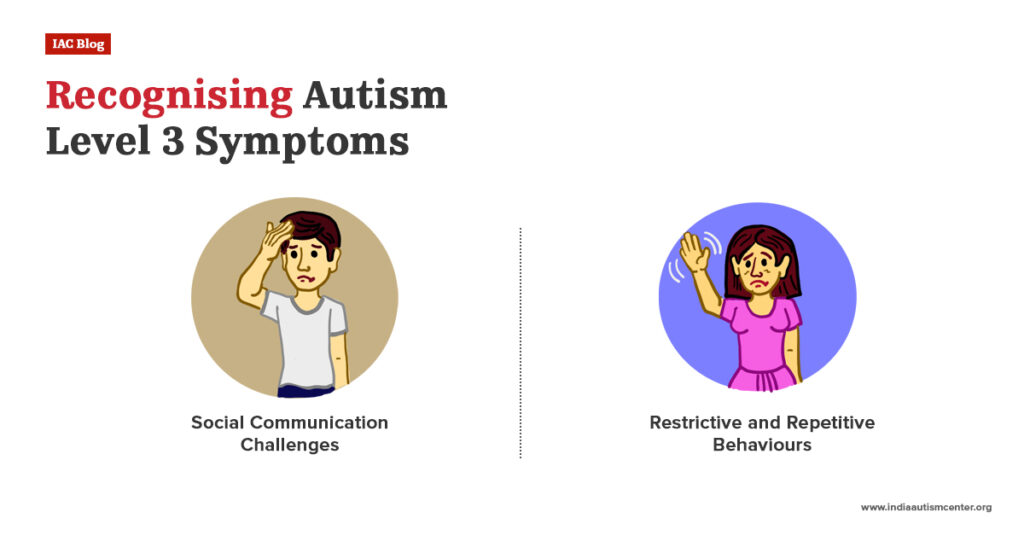
When we discuss autism level 3 symptoms, we are referring to a set of behaviors that indicate a person needs substantial support to navigate daily life. These symptoms are categorised into two main categories: social communication and restrictive, repetitive behaviors.
1. Social Communication Challenges
In level 3 , communication is often the most significant hurdle. While a child with Level 1 might struggle with sarcasm or social cues, a child with Level 3 autism may struggle to convey basic physical needs like hunger or pain.
Limited or Absent Verbal Speech
- Many individuals use “functional language” only, meaning they might use single words to get what they need, but cannot engage in a back-and-forth conversation.
- Some may use echolalia, which is the repetition of phrases they have heard in movies or from parents, but they may not use these phrases to communicate a specific thought.
Difficulty with Social Initiation and Response
- They may not respond when their name is called, even if their hearing is perfect.
- They might not use gestures, such as pointing at an aeroplane in the sky or waving goodbye.
- Social reciprocity (the natural give-and-take of human interaction) is often absent. They may seem to be in their own world, not out of a desire to be alone, but because the “social coding” others use is not processed by their brain the same way.
2. Restrictive and Repetitive Behaviours
The second pillar of what is level 3 autism involves behaviors that provide the individual with a sense of order and safety in a chaotic world.
Inflexible Adherence to Routines
- A change as minor as the brand of milk in the fridge or the sequence of putting on shoes can cause extreme distress.
- This distress often manifests as a “meltdown,” a total neurological overload distinct from a typical toddler tantrum.
Intense Repetitive Movements (Stimming)
- Motor Stims: This includes vigorous hand-flapping, rocking back and forth, or spinning in circles for long periods.
- Visual Stims: A child might stare at the spinning blades of a fan or line up toys in a perfectly straight line for hours, becoming highly distressed if one toy is moved.
Sensory Processing Issues
- Hypersensitivity: They may be hyper-aware of sounds, smells, or lights that others don’t notice. The sound of a hair dryer might feel physically painful.
- Hyposensitivity: Conversely, they may have a high pain threshold or a “sensory seeking” behavior, such as crashing into walls or furniture to feel the physical pressure against their body.
Identifying Level 3 Autism in a Toddler
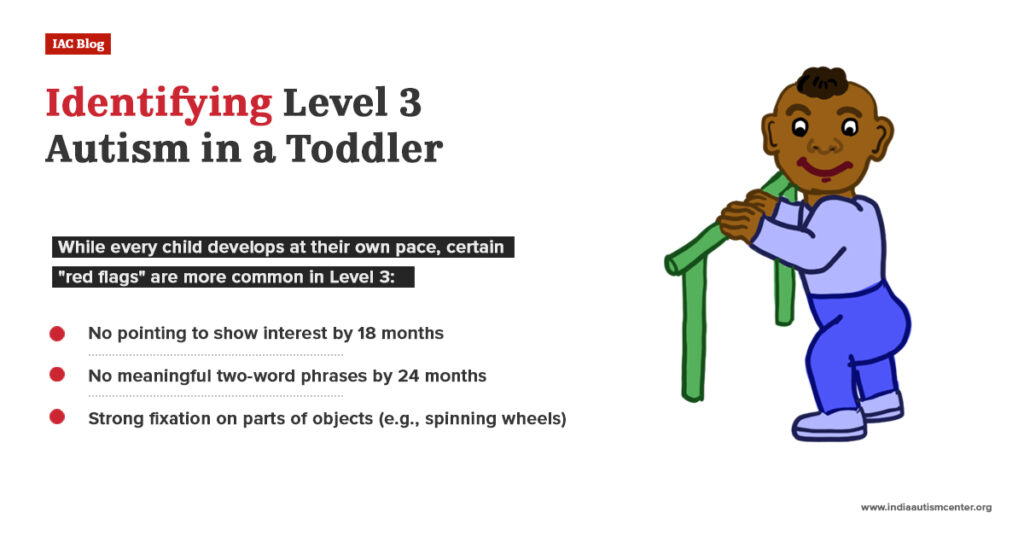
Early identification is crucial. When looking for level 3 autism in toddler years, parents often notice that their child is “in their own world.” While every child develops at their own pace, certain “red flags” are more common in Level 3:
- By 18 months, the child does not point to things to show interest.
- By 24 months, there is a total absence of two-word meaningful phrases.
- The child shows an extreme fixation on parts of objects, such as the spinning wheels of a toy car, rather than on the whole toy.
If you notice these autism level 3 symptoms, it does not mean your child cannot learn or grow. It means their brain is wired to process information in a very specific way that requires specialised teaching methods.
Steps in the Diagnostic Process
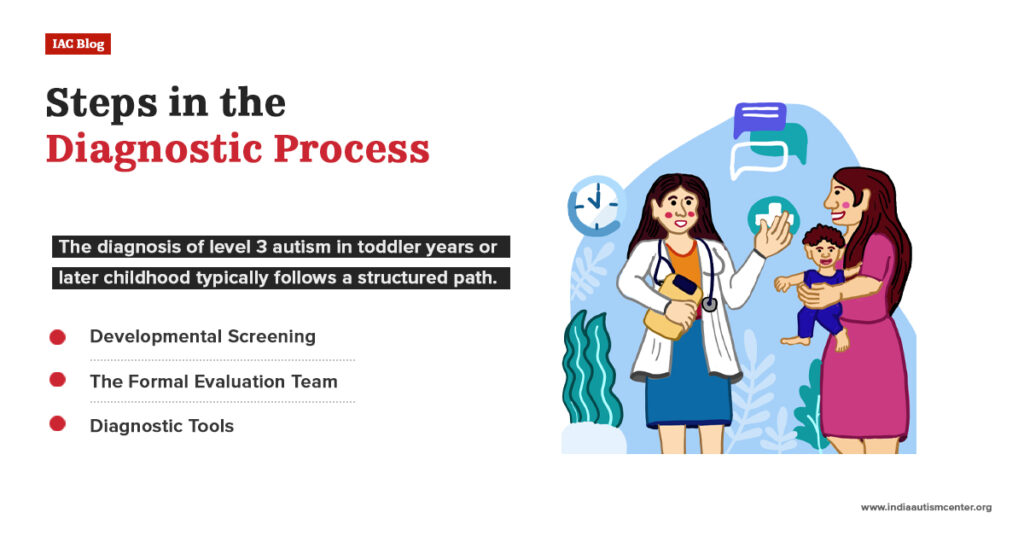
The diagnosis of level 3 autism in toddler years or later childhood typically follows a structured path.
Developmental Screening
This is often the first step, usually performed by a pediatrician. They use tools like the M-CHAT (Modified Checklist for Autism in Toddlers). If a child scores in the high-risk range, they are referred for a “gold standard” formal evaluation.
The Formal Evaluation Team
One person rarely makes a level 3 autism diagnosis. The team usually includes:
- Developmental Pediatricians: To rule out any physical or neurological causes.
- Child Psychologists: To evaluate cognitive and emotional functioning.
- Speech-Language Pathologists (SLPs): To know the severity of communication delays.
- Occupational Therapists (OT): To assess sensory processing and fine motor skills.
Diagnostic Tools
The team uses standardised tests to measure Level 3 symptoms of autism objectively. The most common tool is the ADOS-2 (Autism Diagnostic Observation Schedule).
During this test, the clinician engages the child in specific activities to see how they communicate and play. For Level 3, the child may show a total lack of interest in the examiner or the social nature of the tasks.
Differentiating Level 3 from Other Levels
A key part of the diagnosis is distinguishing Level 3 autism from Levels 1 or 2. Let us look at how level 3 autism differs from levels 1 and 2:
| Feature | Level 1 (Requiring Support) | Level 2 (Substantial Support) | Level 3 (Very Substantial Support) |
| Social Communication | Can speak in full sentences and engage in talk, but struggles with the “back-and-forth” flow of conversation. | Speaks in simple sentences. Their interaction is limited to narrow special interests, and they have marked oddities in nonverbal communication. | Very limited or no functional speech. They rarely initiate interaction and may only respond to very direct social approaches. |
| Response to Change | Becomes anxious when plans change, but can eventually adapt with some verbal coaching. | Clear distress or difficulty changing focus. It is obvious to a casual observer that the person is struggling to switch tasks. | Extreme distress or meltdowns when routines are altered. They have great difficulty redirecting their focus from a repetitive task. |
| Social Skills | May appear “awkward” or have trouble making friends, but desires social connection. | Has marked gaps in social and nonverbal communication skills; may not seek out others unless they need something. | Appears to be in their own world. They may not respond to their name or acknowledge the presence of others in the room. |
| Daily Living Skills | Can often manage self-care and independent living with occasional guidance or organizational tools. | Needs significant help with daily transitions and may require a structured environment or a part-time caregiver. | Requires 24/7 supervision. They usually need full assistance with basic needs like dressing, hygiene, and safety. |
Can Level 3 Autism Improve?
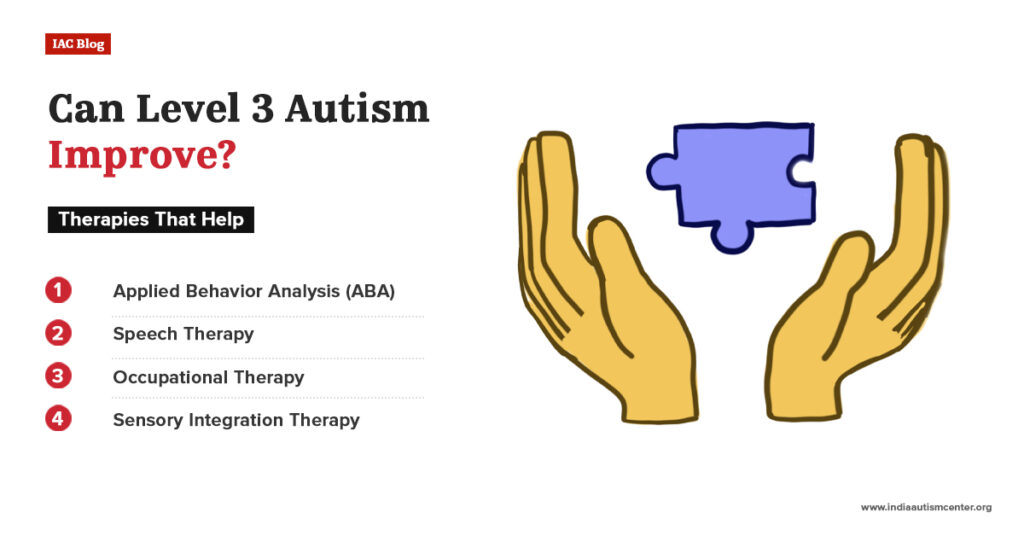
It is vital to note that these levels are not permanent “labels” that never change. When we ask whether level 3 autism can improve, we are looking at the spectrum’s fluidity.
With intensive early intervention, especially when identifying level 3 autism in toddler years, a child can gain communication skills that move them into a lower support category over time.
What Improvement Means
- Better communication skills
- Reduced behavioral challenges
- Increased ability to perform daily tasks
However, level 3 autism is a lifelong condition. The goal is not to “cure” it but to help the individual reach their full potential.
Therapies That Help
- Applied Behavior Analysis (ABA): This highly structured therapy focuses on reinforcing positive behaviours and teaching essential life skills. For level 3 autism, intensive one-on-one sessions help reduce severe challenges—like self-injury—while building foundational communication.
- Speech Therapy: Speech therapy addresses profound communication barriers, helping individuals safely express their needs and emotions. When spoken language isn’t possible, therapists introduce Alternative and Augmentative Communication (AAC) tools like speech-generating tablets.
- Occupational Therapy: Occupational therapy builds functional independence by teaching daily living skills like dressing, eating, and personal hygiene. Strategies are customised to the individual’s physical abilities to improve motor skills and overall quality of life.
- Sensory Integration Therapy: Because level 3 autism often involves severe sensory sensitivities that trigger distress, this therapy uses structured activities to regulate the nervous system. Techniques like deep pressure help individuals process sensory input safely and reduce anxiety.
Can Level 3 Autism Live Independently?
A major concern for families is: Can a person with level 3 autism live independently? In most cases, individuals with level 3 autism spectrum disorder require ongoing support throughout their lives.
Some individuals may earn basic self-care skills, while some may require full-time caregiving. The level of independence eventually depends on early intervention, cognitive abilities, and access to different types of therapy and support.
While complete independence may not always be possible, many individuals with asd level 3 can lead meaningful and fulfilling lives when they get the right support system.
Level 3 Autism Life Expectancy
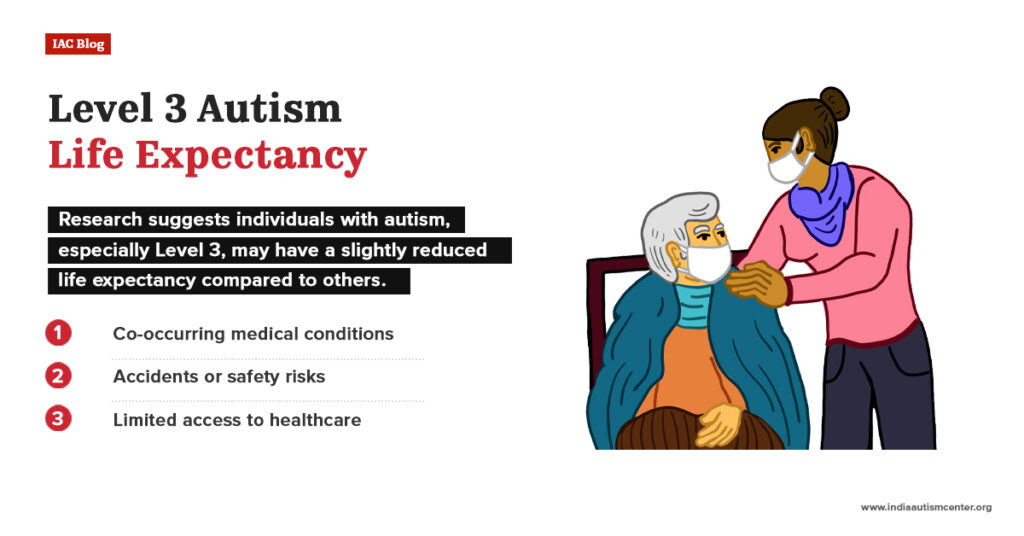
Another important concern is the life expectancy of level 3 autism. Research suggests that individuals with autism may have a slightly reduced life expectancy when compared to others who do not have autism level 3. However, this is often due to:
- Co-occurring medical conditions
- Accidents or safety risks
- Limited access to healthcare
Myths About Level 3 Autism
There are several myths that people believe when it comes to level 3 autism, which can create confusion and unnecessary fear for families.
Myth 1: People with level 3 autism cannot learn
Reality: Individuals with asd level 3 can learn with structured support, therapies, and consistent routines.
Myth 2: They cannot communicate
Reality: Communication may not necessarily be verbal, however tools like gestures, pictures, or devices can be quite helpful to express needs.
Myth 3: They do not feel emotions
Reality: People with autism level 3 are known to experience emotions on a deeper level, but may express them differently.
Myth 4: Level 3 autism cannot improve
Reality: While lifelong, skills can improve with therapy. Progress may be slow but meaningful.
Myth 5: They cannot live a meaningful life
Reality: With the right kind of support, individuals with level 3 autism spectrum disorder can enjoy routines, relationships, and fulfilling experiences.
Understanding the true meaning of level 3 autism helps replace fear with informed support and acceptance.
Conclusion
Understanding what level 3 autism is goes beyond labels. It is about recognising the level of support an individual needs and responding with patience, structure, and informed care.
While level 3 autism spectrum disorder presents significant challenges in communication, behavior, and daily functioning, it does not define a person’s potential or worth.
With early diagnosis, consistent therapies, and a robust support system, people with autism level 3 can make steady progress and lead fulfilling lives in their own way. The journey needs long-term commitment from families as well as caregivers, but the impact of the right interventions can be life-changing.
The key is awareness and acceptance. When we truly understand the meaning of level 3 autism, we move closer to creating an environment where individuals are supported, respected, and given every opportunity to thrive.
Frequently Asked Questions
What is level 3 autism?
Level 3 autism is a severe form of autism spectrum disorder, where individuals need very substantial support in communication, behavior, and daily living activities. It affects how a person interacts and functions every day.
How is level 3 autism different from other levels?
Unlike levels 1 and 2, level 3 autism spectrum disorder involves more severe challenges, including minimal communication and a greater need for supervision and structured support.
Can a person with level 3 autism live independently?
The answer to whether a person with level 3 autism can live independently varies. Most individuals need lifelong support, but some may gain partial independence with proper training and structured environments.
How is level 3 autism diagnosed?
Diagnosis of level 3 autism spectrum disorder is done through developmental screenings, behavioral assessments, and guidelines from DSM-5. It helps to understand the severity and support needs.
Can children with level 3 autism go to school?
Yes, children with level 3 autism can attend school through special education programs that mainly focus on communication, behavior, and life skills development.
For expert insights, support services, and inclusive learning initiatives, visit the India Autism Center.