 Donate now
 Get a Call Back
 MENU
MENU 17 MIN READ
 SHARE
SHARE


For many families, autism support begins in childhood. But what happens when a child grows into an adult? As adults on the autism spectrum face new social, emotional, and practical challenges, the importance of specialised support for adults becomes stronger than ever. This is why support for autistic adults is essential.
It focuses on life skills, emotional wellbeing, dignity, and meaningful participation in society.
In this blog, I will explain:
- Why specialised support for adults with autism is necessary
- What types of support matter most
- How families and professionals can work together
Signs of Autism in Adults: What to Look For
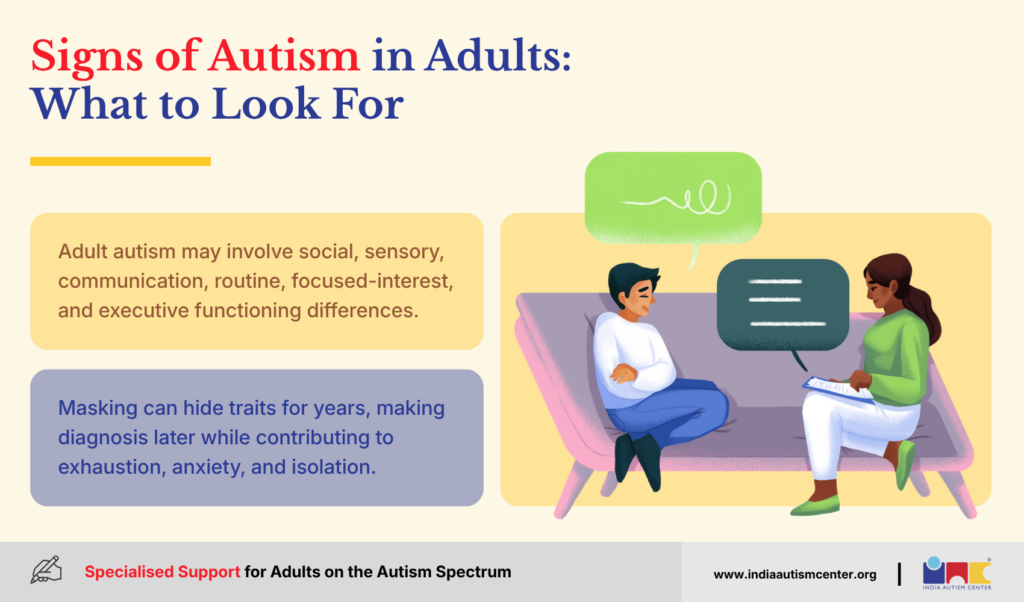
Autism does not look the same at 30 as it does at 3. In childhood, the signs are often obvious – delayed speech, limited eye contact, meltdowns in unfamiliar places. By adulthood, many autistic people have developed ways to cope, compensate, and blend in. That does not mean the autism has gone away. It means it has gone underground.
Here are some of the most common signs of autism in adults:
- Difficulty reading social cues – missing sarcasm, not knowing when a conversation is over, misreading facial expressions or tone
- Sensory sensitivities – being overwhelmed by loud sounds, bright lights, strong smells, certain textures of clothing or food
- A strong need for routine – feeling genuinely distressed when plans change unexpectedly, not just mildly annoyed
- Intense, focused interests – deep expertise in one or two specific areas, sometimes to the exclusion of other topics
- Communication differences – preferring direct, literal language; finding small talk exhausting; struggling in group conversations but doing well one-on-one.
- Post-social exhaustion – appearing fine during a social event but feeling completely drained, or even physically unwell, afterwards.
- Difficulty with executive functioning – struggling to start tasks, manage time, switch between activities, or make decisions under pressure
Why So Many Adults Are Diagnosed Late
Many autistic adults spent their entire childhoods being told they were “quirky”, “too sensitive” or “just anxious”. Autism was not on anyone’s radar – or the available assessments were designed around how autism presents in young boys, missing many other presentations entirely.
Women and girls are particularly underdiagnosed. Research consistently shows that autistic females are more likely to “mask” – consciously or unconsciously copying social behaviour, suppressing stimming, rehearsing conversations in advance and working extremely hard to appear neurotypical. This masking can fool even experienced clinicians. It also comes at a cost: chronic exhaustion, anxiety and a persistent sense of not quite fitting in, without knowing why.
A late diagnosis – whether at 25, 45, or 65 – is not a failure. For many people, it is the first time their life finally makes sense.
📥 Free download: Printable daily routine chart for autistic children
Understanding the Need for Support for Autistic Adults
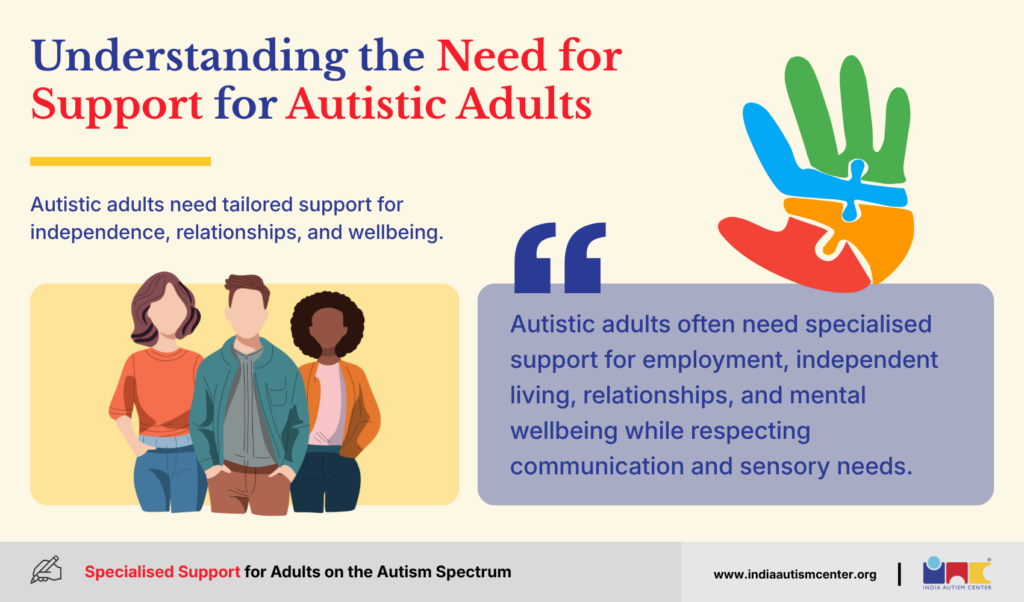
Autistic adults face challenges that differ from those of children. While children may need help with basic communication and learning, adults often struggle with:
- Employment and vocational skills
- Independent living
- Social relationships
- Mental health and emotional regulation
- Long-term safety and care
You may notice that your adult child can speak well but struggles to manage daily routines. Or they may understand tasks but find social rules confusing. These are not signs of failure. There are signs that specialised support for adults with autism must be tailored to adult life.
Unlike general disability services, autism-specific support recognises sensory needs, communication styles and behaviour patterns. It does not try to “fix” the person. Instead, it adapts the environment and builds skills that promote independence.
Want to know more? Get in touch with us.
Specialised Support for Autistic Adults: What Does It Mean?
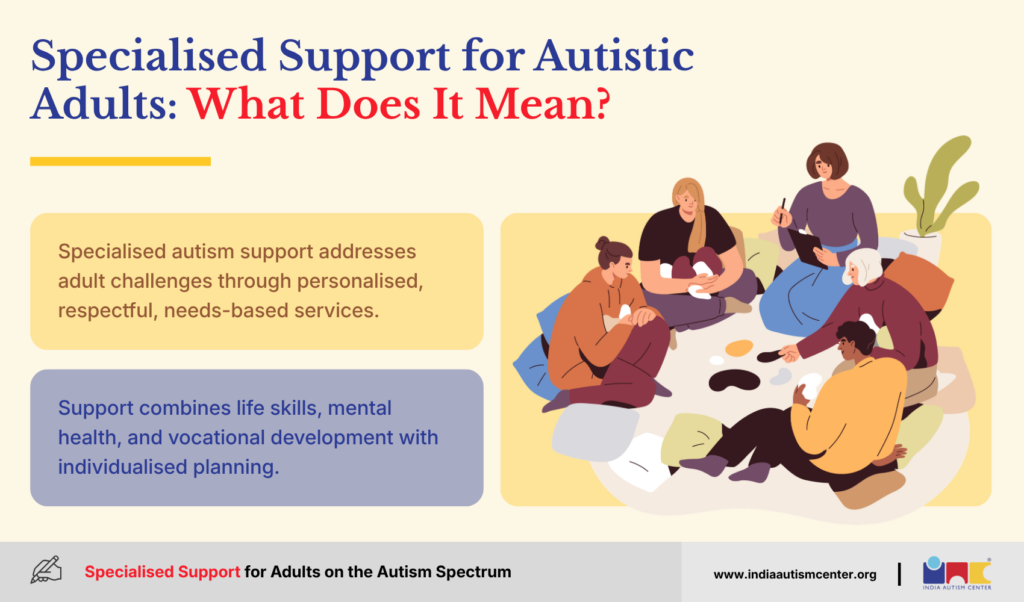
Specialised support for autistic adults means services designed specifically for the autistic brain and adult life demands. It combines therapy, education, and daily living support respectfully.
This support usually includes:
- Life-skills training
- Vocational and work readiness programmes
- Social and communication development
- Mental health care
- Safe residential or day-care options
Each adult is different. Some may need high support. Others may live independently with guidance. The goal is not to force everyone into one model. The goal is to understand what you or your loved one needs and provide that support consistently.
At India Autism Center (IAC), assessments guide personalised planning. We do not assume ability or disability. We observe, listen, and adapt.
If you want to know more about Autism in Adults – Signs, Symptoms, & Support Options, this article is for you.
Types of Specialised Support for Autistic Adults
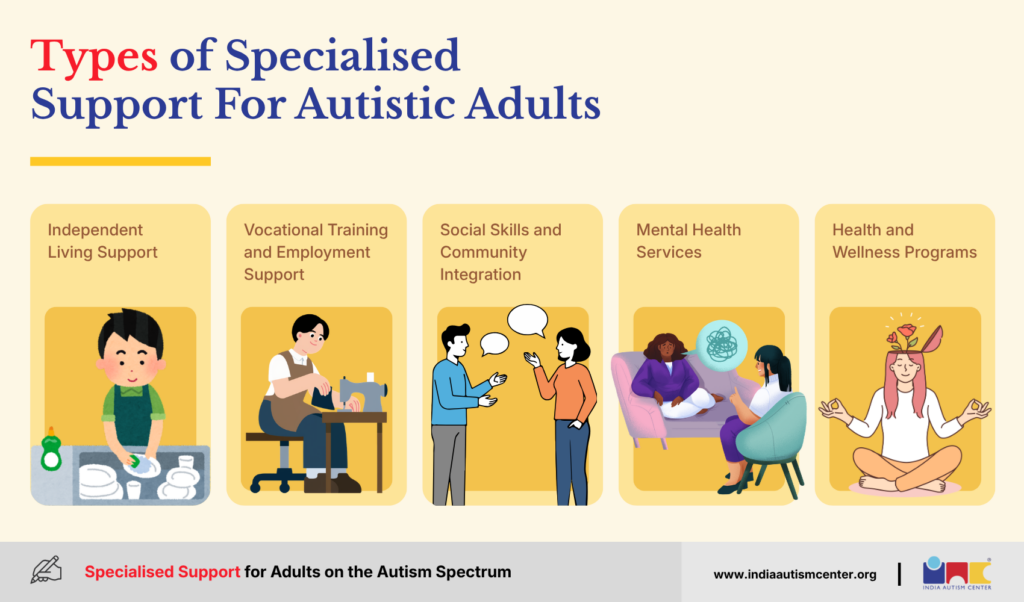
Specialised support for autistic adults aims to help them. They address challenges and promote independence. These services can include:
Vocational Training and Employment Support
Vocational training for adults with autism can boost their job skills. It often taps into their unique strengths, like attention to detail and focus. Moreover, support for autistic adults aids in finding jobs and offers ongoing help to keep the jobs.
Social Skills Training and Community Integration
Social skills training for adults with autism aims to improve their communication and relationships. It also seeks to boost their social interactions. Often, these programs are held in groups, allowing participants to practise in a safe, supportive setting.
Social clubs and peer support groups help people on the spectrum connect with others. They are community integration initiatives. They reduce isolation and promote social engagement.
Independent Living Support
Many adults with autism want to live independently. They may need support to do so. Independent living services can help with daily tasks. This includes cooking, cleaning, and managing money. Also, housing programs that offer supported living can help. They provide a safe, structured place for adults with autism.
Mental Health Services
Due to the high rate of mental health issues in adults with autism, access to specialised mental health services is vital. These services should meet the unique needs of individuals with autism. They can include counselling for autistic adults, cognitive-behavioural therapy (CBT), and support groups. Moreover, experienced mental health professionals can help manage anxiety, depression, and other challenges.
Health and Wellness Programs
Health and wellness programs for adults with autism can boost their well-being. These programs may include fitness activities, nutrition education, and stress management techniques. These programs can improve the quality of life for people with autism. They can also prevent new health problems by focusing on overall health.
Understanding Co-occurring Conditions: Anxiety, Depression and Autism
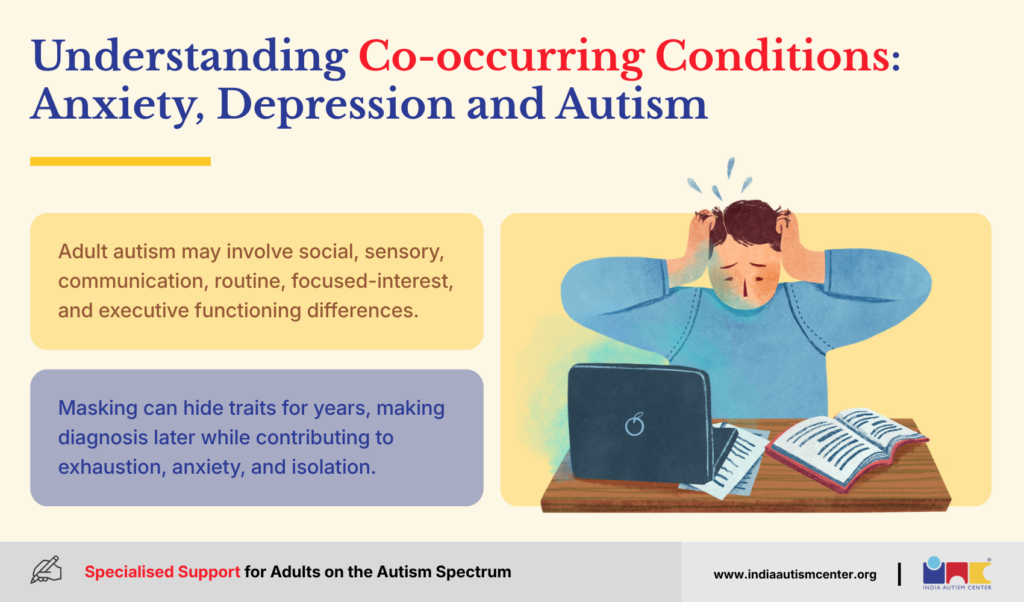
Here is something that does not get said often enough: anxiety and depression are not separate problems that happen to affect some autistic people. They are extremely common – and often a direct result of living in a world that was not designed for the autistic brain.
Studies suggest that up to 50% of autistic adults experience clinically significant anxiety, and roughly 40% experience depression at some point in their lives. These are not small numbers.
Why Do They Occur?
The reasons are not mysterious. Consider what daily life can involve for an autistic adult:
- Masking – spending enormous energy pretending to be someone you are not, day after day
- Social pressure – navigating workplaces, families and relationships that expect neurotypical behaviour
- Isolation – feeling like you do not belong anywhere, even when surrounded by people
- Repeated failure – trying hard at things that seem effortless for everyone else, and still getting it wrong
How These Conditions Present Differently in Autistic Adults
Over time, this wears people down. The result is often anxiety that feels constant and low-level, or depression that looks like withdrawal, loss of interest in special interests, or a flat, exhausted affect.
Standard anxiety in a non-autistic person might look like worry and restlessness. In an autistic adult, it can show up as increased rigidity, more intense need for routine, physical symptoms (headaches, stomach problems), or a complete shutdown. Depression may not look like sadness – it may look like a sudden inability to do things that were previously manageable, or an intensification of autistic traits.
This is why it matters enormously that mental health professionals understand autism before they try to treat co-occurring conditions. A misread presentation leads to the wrong treatment.
What Actually Helps
Both CBT (Cognitive Behavioural Therapy) and mindfulness-based approaches have good evidence behind them for autistic adults – but only when they are properly adapted. That means:
- Using concrete, unambiguous language instead of metaphor-heavy explanations
- Slowing the pace and adding more sessions if needed
- Incorporating visual supports and structured worksheets
- Building in the person’s special interests as anchors for the work
- Removing overly abstract mindfulness instructions in favour of clear, step-by-step practices
A therapist who simply applies standard CBT to an autistic adult without adaptation is likely to get limited results. The right fit matters.
Autism and Relationships: Navigating Social Life as an Adult
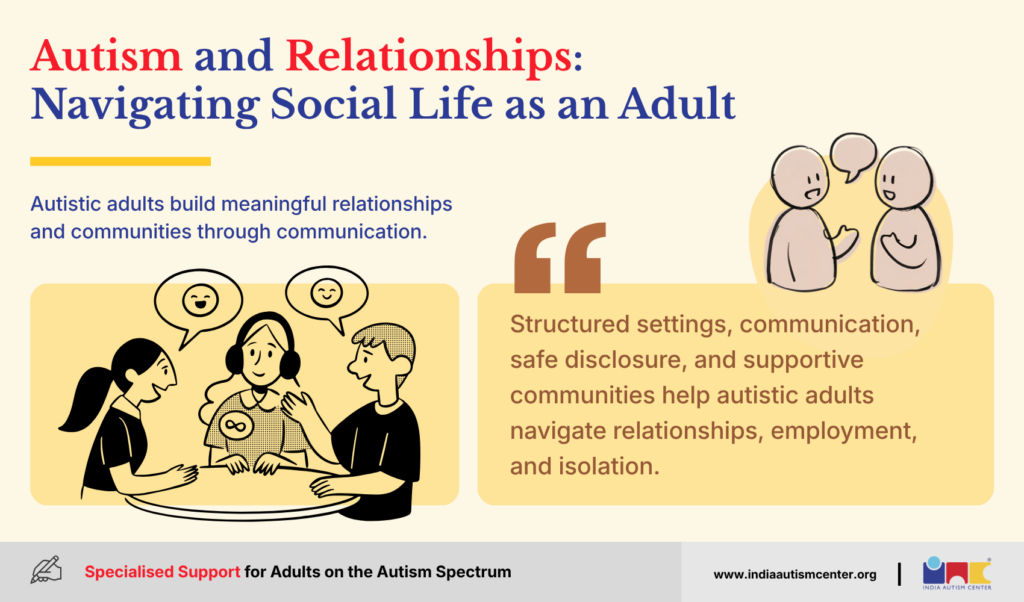
Autistic adults want connection. That is not in question. What is harder is finding it – and keeping it – in a social world built around unwritten rules, subtle cues, and the expectation that everyone communicates the same way.
Friendships
Many autistic adults find one-on-one friendships easier than group settings. Shared interests are often the best foundation – a book club, a gaming group, a running club. Structured environments where the topic is clear and conversation has a natural focus tend to work better than open-ended socialising.
The challenge is that adult friendships in India often form through workplaces, extended family networks or neighbourhood communities – all of which can be socially demanding. Finding autism-affirming spaces, whether in person or online, can make a real difference.
Romantic Relationships
Autistic adults can and do have loving, lasting romantic relationships. The key is usually direct communication. Hinting, implying, and expecting a partner to “just know” what you need tends not to work well. Agreeing early in a relationship on how to communicate needs, how to handle sensory overload, how much alone time is needed, and how to repair conflict – these conversations, though they feel awkward, prevent a great deal of misunderstanding later.
Disclosing Autism to a Partner or Employer
There is no rule that says you must disclose. The decision depends entirely on whether disclosure will bring understanding and support, or risk and discrimination.
For partners: many autistic adults find that disclosure – when the relationship feels safe – leads to greater understanding and less conflict. It gives both people a framework for why certain things are hard.
For employers: under the Rights of Persons with Disabilities (RPwD) Act, 2016, employers are required to provide reasonable accommodation to employees with disabilities. You only need to disclose what is necessary to request a specific accommodation. You do not owe anyone your full history.
Finding Community and Reducing Isolation
Isolation is one of the biggest risks for autistic adults in India. The good news is that online communities have made it possible to find your people without leaving home. Communities like r/AutisticIndians on Reddit, Facebook groups for autistic adults in India, and peer support networks run by organisations like Action for Autism offer spaces where autistic adults can talk to others who genuinely understand.
Connection – even digital connection – matters for mental health and wellbeing.
📥 Free download: Printable daily routine chart for autistic children
Specialised Support for Adults with Autism and Family Involvement
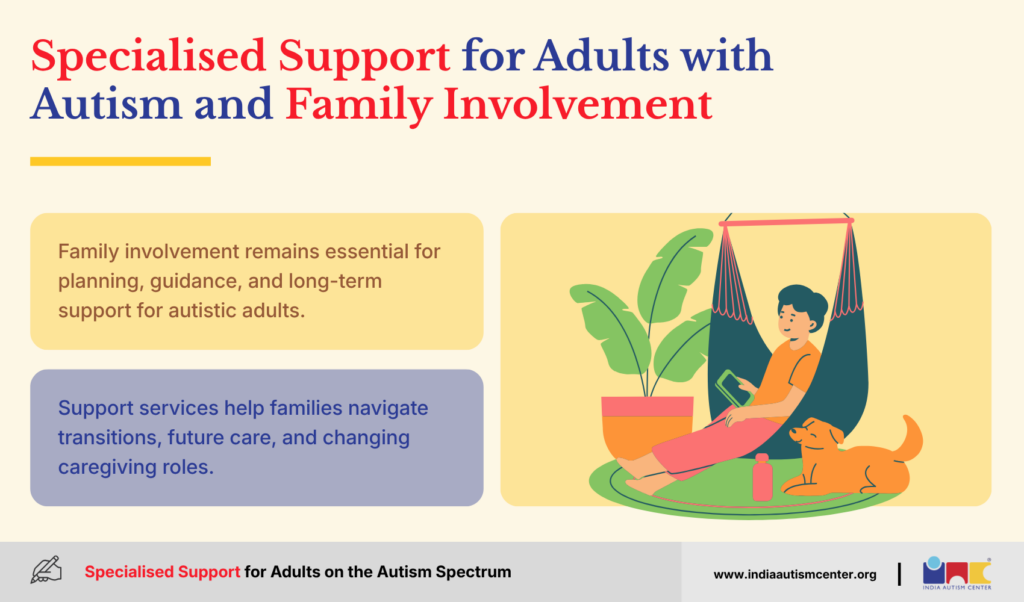
Families remain central even in adulthood. Parents often worry about the future. “What will happen when I am no longer there?” This is a difficult but necessary question.
Specialised support for adults with autism includes:
- Family counselling
- Transition planning
- Long-term care strategies
- Legal and financial guidance
At IAC, families are partners, not observers. We involve them in planning and goal-setting. We also help parents shift roles—from constant caregivers to supportive guides.
This balance protects both the adult and the family’s emotional health.
Want to know more? Get in touch with us.
Why Specialised Support for Adults Matters for the Future
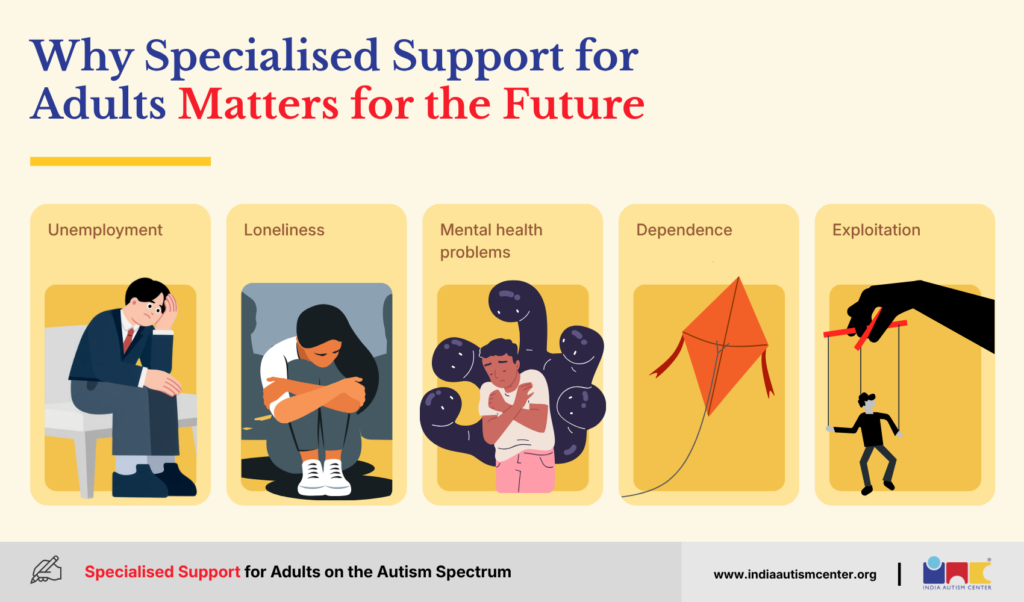
Without proper support, autistic adults risk:
- Unemployment
- Loneliness
- Mental health problems
- Dependence
- Exploitation
With specialised support for autistic adults, the future looks different:
- Skills grow
- Confidence improves
- Families feel secure
- Society benefits from diversity
You are not just supporting one person. You are shaping a system that respects neurodiversity.
Practical Organisation Strategies for Autistic Adults
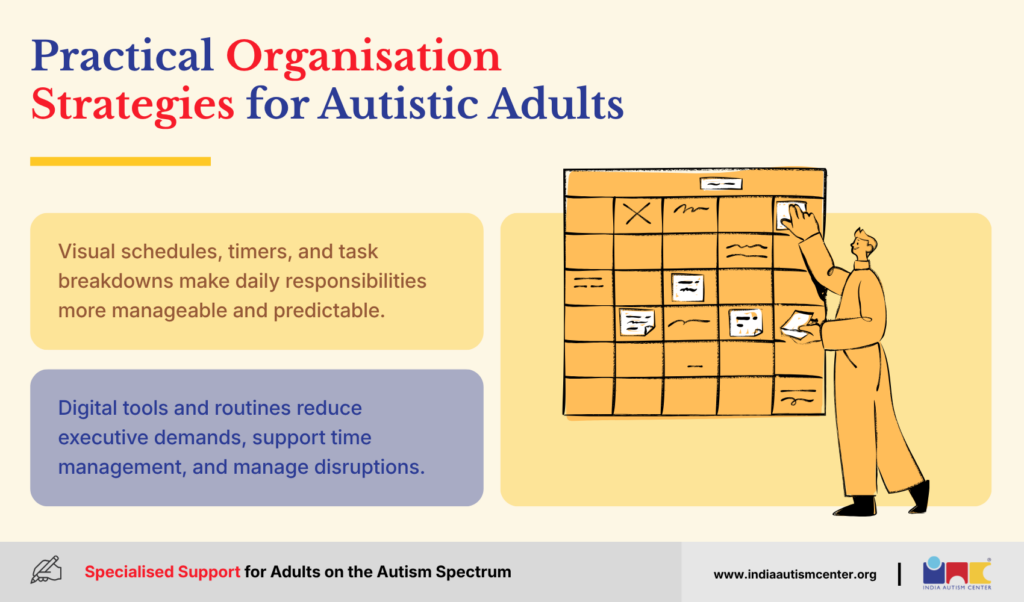
Executive functioning – the brain’s ability to plan, organise, start tasks, manage time, and make decisions – is an area where many autistic adults struggle. This is not laziness or lack of intelligence. It is a neurological difference that responds well to the right external supports.
Visual Schedules and Planners
A visual schedule turns an abstract day into something concrete and predictable. It does not have to be elaborate – a simple whiteboard with the day’s tasks in order, or a printed weekly planner on the fridge, can significantly reduce the anxiety of not knowing what comes next.
What works well:
- Breaking each task into its smallest steps (not “clean bathroom” but “get cleaning spray → wipe sink → wipe toilet → mop floor”)
- Using colour coding for different types of tasks (work, personal, health)
- Reviewing the schedule at the same time each morning to set expectations for the day
Timers
Many autistic adults struggle with time blindness – the inability to feel how much time is passing. A visual timer (like the Time Timer app or a physical Time Timer clock) makes time visible. Set it for a task, and the shrinking red disc shows exactly how much time remains. This is far more effective than a phone alarm for most people.
Apps That Support Executive Functioning
Several apps are specifically useful for autistic adults managing daily life:
- Todoist or TickTick – for task management with recurring reminders
- Time Timer – visual countdown for tasks and transitions
- Notion – for building structured personal systems (routines, project tracking, notes)
- Google Calendar with colour-coded categories – for scheduling and time-blocking
- Finch – a self-care app that uses a gentle, low-pressure approach to daily goals
The best app is the one you will actually use. Start with one tool, not five.
Building Predictable Routines
Routines are not a crutch – they are a legitimate cognitive strategy. A consistent morning routine, for example, removes dozens of small decisions from the start of the day, preserving mental energy for things that actually require it.
When routines are disrupted (and they will be), having a short “reset plan” – a few steps to return to baseline – can prevent a difficult moment from derailing the entire day.
The Role of Technology in Supporting Adults on the Spectrum
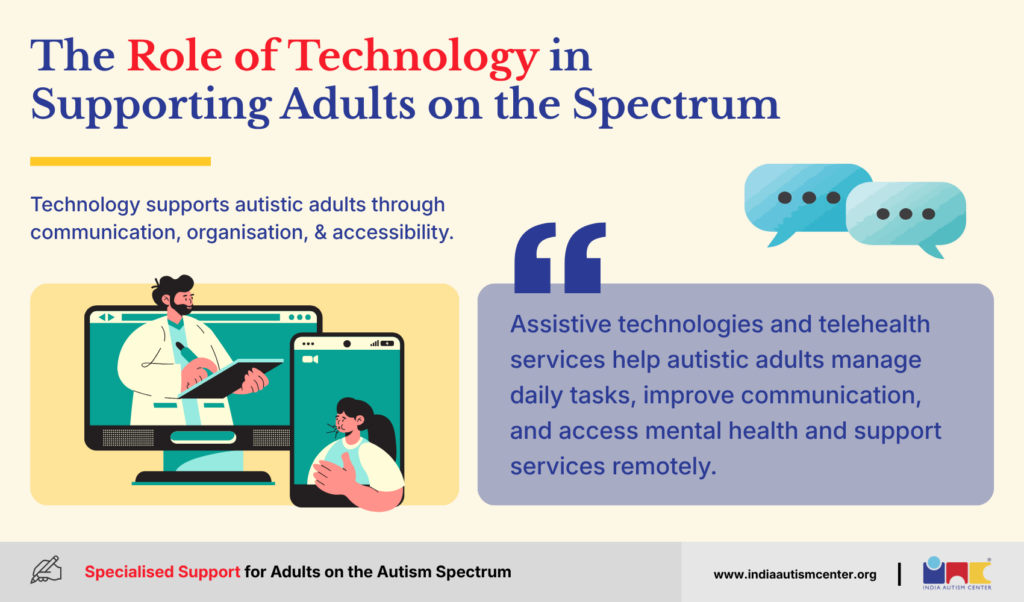
Technology is vital in autism support for adults. Assistive tools, like communication apps and organisers, help them manage daily life. For example, apps that boost executive functioning improve time management, task organisation, and decision-making.
Telehealth services have become more common.
They offer remote mental health counselling for autistic adults, social skills training, and support. This is especially helpful for adults with autism. It eases challenges with in-person interactions and aids those in areas with few specialised services.
The Importance of Advocacy and Policy
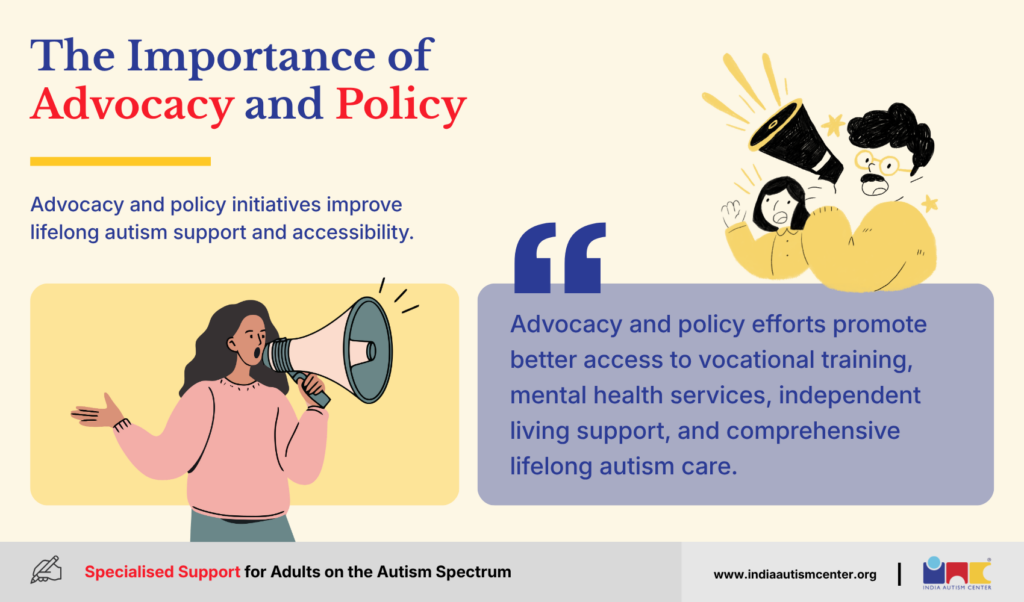
Specialised support for autistic adults is a must. However, advocacy and policy initiatives are crucial for making them accessible to everyone in need. Countries like the United States and the United Kingdom recognise the need for autism support for adults. Yet, gaps still exist. Advocates want better access to vocational training and mental health services. They also want more support for independent living.
For example, the U.S. Autism CARES Act calls for lifelong research and services for autism, not just in childhood.
In India, Action for Autism focuses on employment opportunities, vocational training, and inclusive living spaces for adults on the spectrum. They advocate for policy changes that improve the availability of specialised services and inclusion efforts.
Getting an Autism Diagnosis as an Adult in India
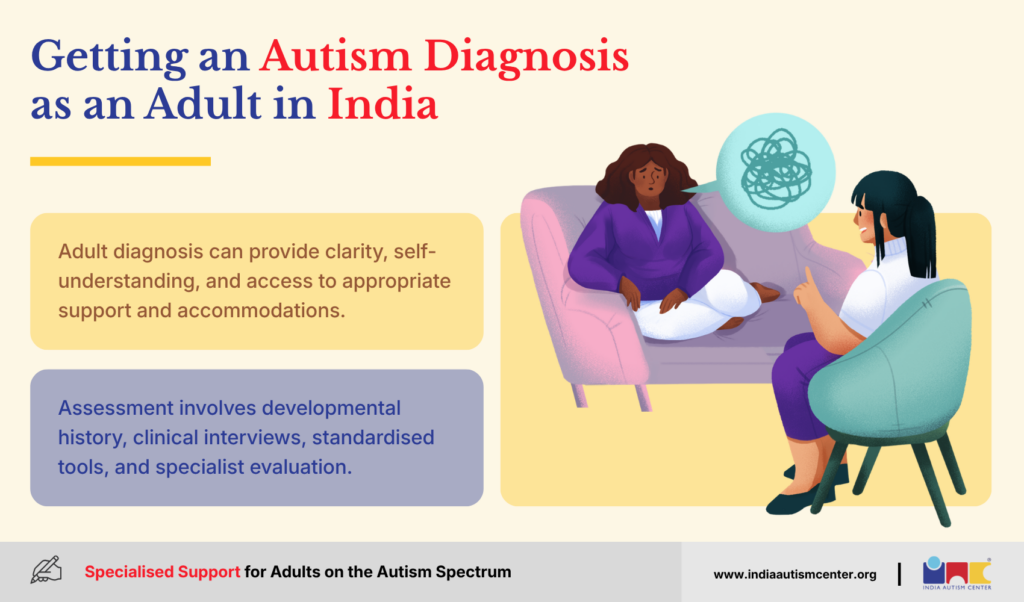
A diagnosis in adulthood is more common than people think – and more useful than many people expect.
Why Adults Seek Diagnosis
Some adults seek a diagnosis because they have always felt different and want to understand why. Others are prompted by a child’s diagnosis that makes them recognise themselves. Some reach a point of crisis – burnout, job loss, relationship breakdown – and finally look for answers. All of these are valid reasons.
A diagnosis does not change who you are. It changes how you understand yourself, and it opens doors to support that was previously inaccessible.
The Assessment Process in India
There is no single test for autism. The assessment is a clinical process that typically involves:
1. Initial screening – Some clinicians use self-report tools like the AQ-10 or RAADS-R as a starting point. These are not diagnostic, but they help determine whether a full assessment is warranted.
2. Developmental history – The clinician will ask about childhood: early speech and language development, social behaviour at school, sensory sensitivities, and any previous diagnoses or concerns. If a parent or sibling can provide input, that is helpful, but it is not always possible.
3. Clinical interview – A structured conversation covering current difficulties in social communication, routines, sensory experiences, work and daily functioning, and mental health history.
4. Standardised assessment tools – Tools such as the ADOS-2 (Autism Diagnostic Observation Schedule) and ADI-R (Autism Diagnostic Interview-Revised) are used in more comprehensive assessments.
5. Cognitive or neuropsychological testing – Sometimes added to assess IQ, attention, or co-occurring conditions like ADHD or learning disabilities.
6. Written report and feedback – A formal diagnostic report with findings, recommendations, and next steps.
In India, assessments are conducted by RCI-registered clinical psychologists and psychiatrists with experience in neurodevelopmental conditions. They are available in psychiatry departments at major hospitals, private clinics, and specialist centres like IAC.
What to bring to your assessment:
- Any childhood records (school reports, previous assessments)
- A written list of your current difficulties – be specific
- Information from a parent or sibling if available
- Details of any previous mental health diagnoses or treatments
How a Diagnosis Brings Clarity
Many adults describe their diagnosis as a profound relief. Suddenly, a lifetime of struggling in ways that seemed invisible to others has an explanation. It is not weakness or laziness. It is a different neurology.
A diagnosis also provides access to formal support: disability certificates, workplace accommodations, government schemes, and specialist services. It is both a personal milestone and a practical tool.
IAC offers comprehensive adult autism assessments in Kolkata, conducted by experienced RCI-registered clinical psychologists. If you or a family member is seeking an assessment, our team can guide you through the process.
Conclusion
Autism does not end in childhood. Adulthood brings new needs, dreams and challenges. Specialised support for adults with autism ensures that these years are not filled with fear or limitation but with structure, opportunity and dignity.
At India Autism Center, we see adults not as problems to manage but as people with potential to nurture. Through tailored programmes, emotional care and community integration, IAC makes specialised support for adults possible.
If you are wondering what the future holds, remember this: with the right support, adulthood on the spectrum can be meaningful, productive and respected.
Frequently Asked Questions (FAQs)
Why is specialised support for adults important in autism?
Specialised support for adults is important because autistic adults face challenges related to employment, independence, social life and mental health. Autism-specific support addresses these needs in an age-appropriate and respectful way.
What does specialised support for autistic adults include?
It includes life-skills training, vocational support, emotional wellbeing services, social development and, when needed, residential or day-care support.
How does special support for autism differ from child therapy?
Child therapy focuses on early development. Special support for autism in adulthood focuses on independence, work readiness, social participation and long-term wellbeing.
How does India Autism Center support autistic adults?
India Autism Center provides structured adult programmes, vocational training, residential and day services, family guidance and advocacy to ensure long-term support and dignity.
For expert insights, support services, and inclusive learning initiatives, visit the India Autism Center.