 Donate now
 Get a Call Back
 MENU
MENU 18 MIN READ
 SHARE
SHARE


Autism is often discussed in terms of challenges — communication differences, social expectations, sensory needs, and behavioural features. But there’s another side that often goes uncelebrated. Yes, I’m talking about autism’s special talents and unique abilities — strengths that are powerful, inspiring, and deeply human.
In this blog, you’ll discover what these talents are, how they show up, why they matter, and how India Autism Center (IAC) supports individuals with autism to embrace their strengths and grow their abilities.
What Are Autism’s Special Talents and Unique Abilities?
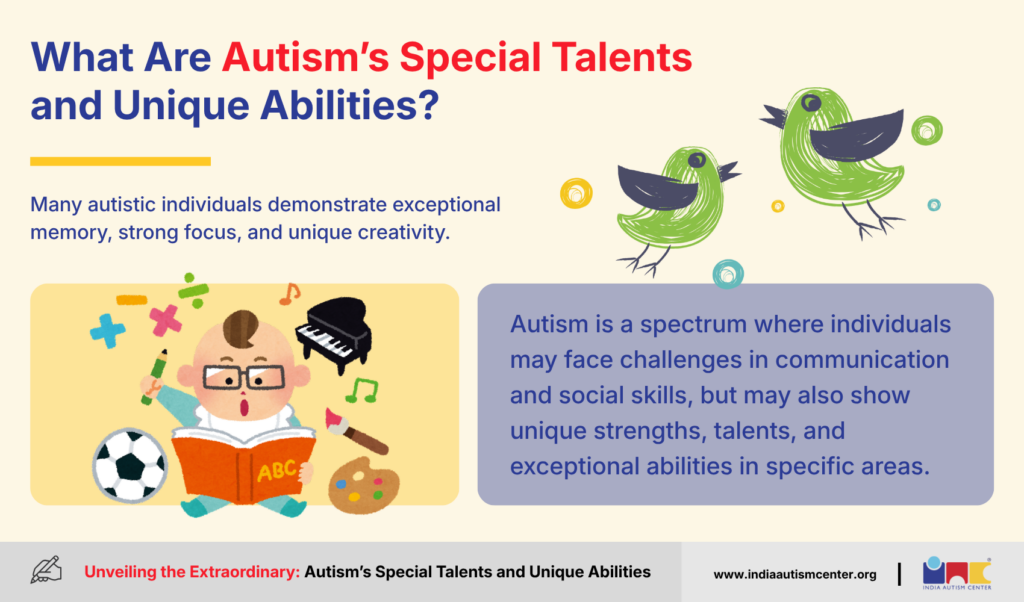
Autism Spectrum Disorder (ASD) is not a single condition. It’s a spectrum — meaning every individual is different. Some autistic people may struggle with communication and social skills. Others may have extraordinary strengths in certain areas. These strengths might be subtle, like paying attention to tiny details or more dramatic, like musical or artistic genius.
Autism’s special talents and unique abilities refer to the natural strengths many autistic individuals develop. These strengths can take many forms, from remarkable memory skills to intense focus and creativity.
We often use the term autism special abilities to describe these natural strengths. Similarly, when an individual displays exceptionally high ability in a narrow area, like rapid math calculation or perfect pitch in music, we might describe these as savant skills in autism.
Want to know more? Get in touch with us.
The Strengths and Abilities Seen in Autism
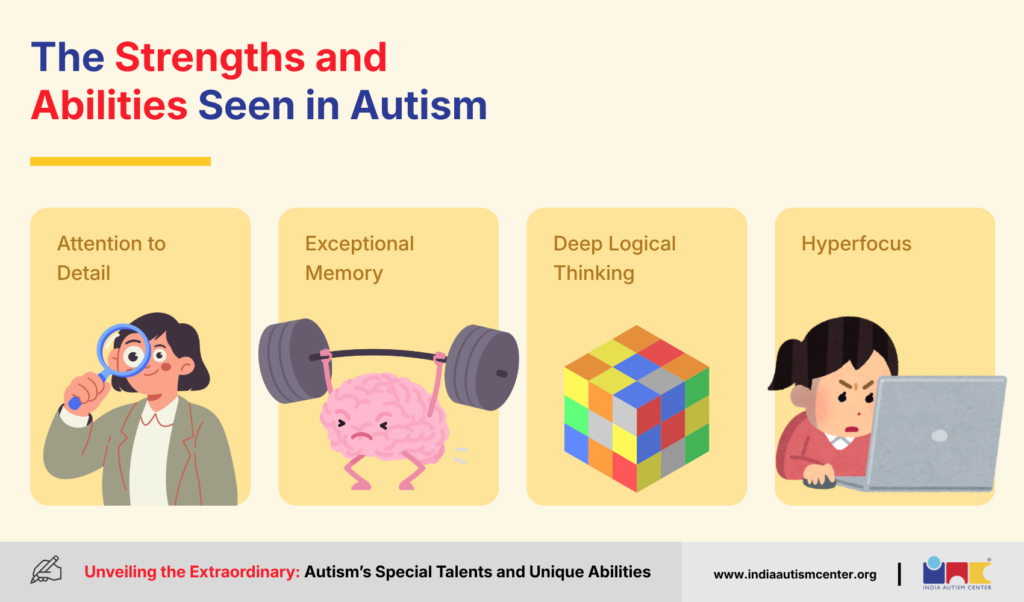
Autism brings a range of strengths that deserve recognition and appreciation. These strengths are a key part of autism’s special abilities. It doesn’t mean that every autistic person will exhibit all these traits, but they are common pathways where many individuals shine.
1. Enhanced Attention to Detail
Have you ever noticed how some people with autism seem to see patterns others miss? They might spot tiny errors, remember small facts, or notice things before anyone else does. This attention to detail is one of the most common strengths.
For example:
- Identifying repeated patterns in a dataset
- Recognising minute differences in visual art
- Spotting inconsistencies during quality checks
This strength may feel effortless for an autistic child, but it’s incredibly valuable in areas like research, design, data work, and science.
2. Exceptional Memory
A powerful memory is another hallmark strength for many autistic individuals. Some remember long strings of information. Others recall details from scenes, dates, or concepts hours or even years later.
This type of memory can help in:
- Academic success
- Language learning
- Professional creative work
- Technical problem-solving
For many, memory is not just a skill — it’s a lifelong talent they can build upon.
3. Deep Logical Thinking
Many autistic individuals approach problems differently. Rather than jumping to a conclusion, they examine all angles and pieces. This logical thinking helps in complex thinking tasks, math, engineering, puzzles, and even strategic games.
This kind of analytical ability can translate into real-world success when nurtured properly.
4. Hyperfocus: One of the Most Recognised Autism Special Abilities
One of the most fascinating strengths is hyperfocus — an intense ability to concentrate on something of interest for long periods.
Hyperfocus isn’t “stubbornness” or “fixation.” It’s a genuine cognitive pattern. When an autistic individual is truly interested in something — like coding, art, history, or mechanics — they can dive deep and remain engaged far beyond a typical attention span.
This strength can turn hobbies into careers and passions into expertise.
Savant Syndrome vs. General Autism Strengths: What’s the Difference?
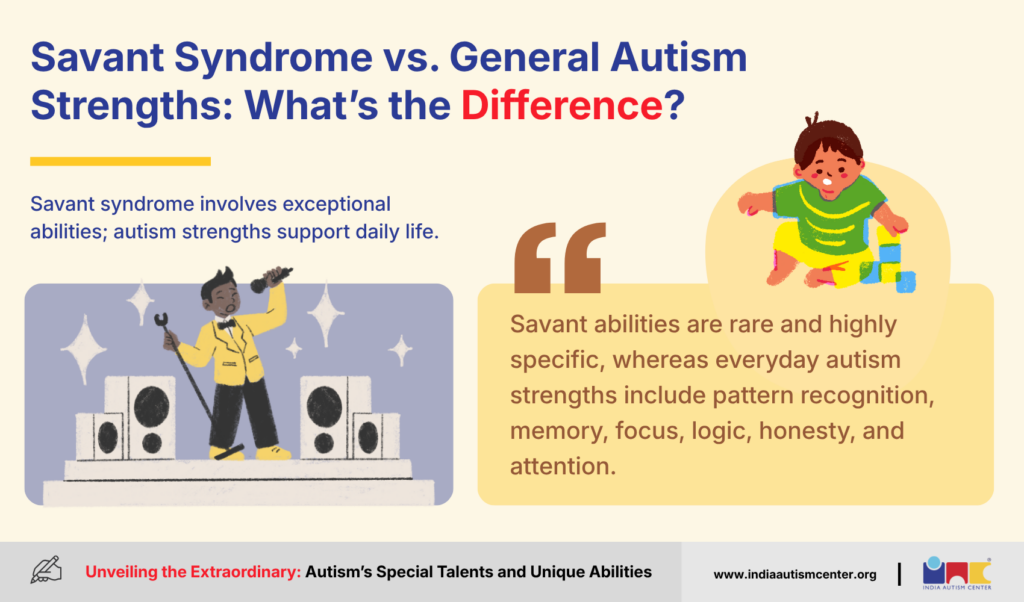
This is one of the most important distinctions to understand – and one that’s often blurred by popular media.
Savant syndrome is a specific, clinically recognised pattern in which a person shows one extraordinary, narrow ability that far exceeds what most humans can do: think of someone who can calculate the day of the week for any date in history within seconds, or reproduce a detailed cityscape from a single helicopter flight. Research suggests that around 10% of autistic people show some form of savant ability – remarkable, but clearly not the majority. The skill is typically narrow, specific, and often emerges without formal instruction.
General autism strengths, on the other hand, are far more widespread. These are the cognitive and personality traits that many autistic people share – not extraordinary in the “world-record” sense, but genuinely powerful in everyday life:
- Attention to detail – noticing what others overlook
- Reliable long-term memory – especially for facts, systems, and sequences
- Hyperfocus – the ability to go very deep on a subject of interest
- Logical, systematic thinking – breaking problems into clear steps
- Honesty and directness – a consistent, reliable communication style
- Pattern recognition – spotting regularities in data, language, or design
The Rain Man myth – that all autistic people are mathematical geniuses or possess some hidden spectacular gift – is simply not accurate. And it’s actually harmful, because it sets an unrealistic standard that most autistic individuals feel they can never meet. When a child doesn’t show a dramatic savant skill, families sometimes worry that they’re “missing” something. They’re not.
Understanding the difference between savant syndrome vs autism strengths matters because it shifts the focus where it belongs: on the real, everyday abilities that every autistic person carries. A child who memorises every train route in their city, or who can spot a pattern in a spreadsheet that a trained analyst misses – that is a genuine, valuable strength. It doesn’t need to be world-class to be worth celebrating.
Both savant skills and general strengths are part of the same broad picture of autism strengths and challenges. The goal isn’t to rank them. It’s to see them clearly, name them, and build on them.
Understanding Savant Skills in Autism
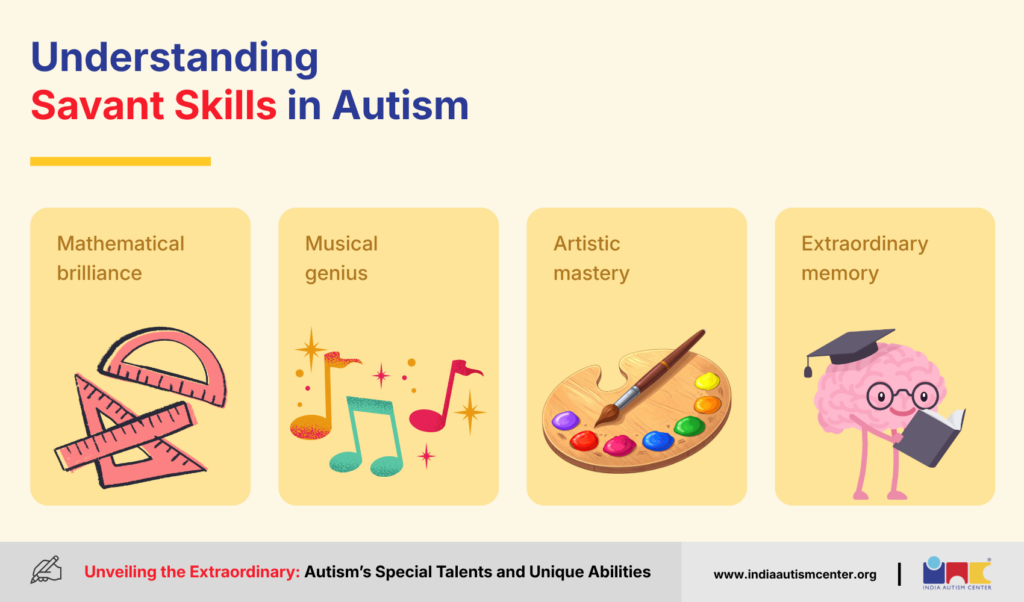
You might have heard about savant skills in autism on TV — especially in movies like Rain Man. But it’s important to explain what this really means.
A savant skill is an extraordinary ability or talent that goes well beyond typical human capacities in specific areas. It’s found in only a small subset of autistic individuals — not everyone on the spectrum.
These skills may include:
- Mathematical brilliance — calculating complex numbers quickly
- Musical genius — identifying pitches perfectly or playing instruments by ear
- Artistic mastery — producing detailed and intricate works
- Extraordinary memory — remembering facts or sequences with precision
While savant skills are rare, they show us how different forms of intelligence can emerge in unique and powerful ways. It reminds us that intelligence isn’t one-size-fits-all.
Note: Not every autistic person has savant skills — and that’s okay. Autism’s special talents and unique abilities are broader than just these rare presentations.
Want to know more? Get in touch with us.
The Many Forms of Unique Talents
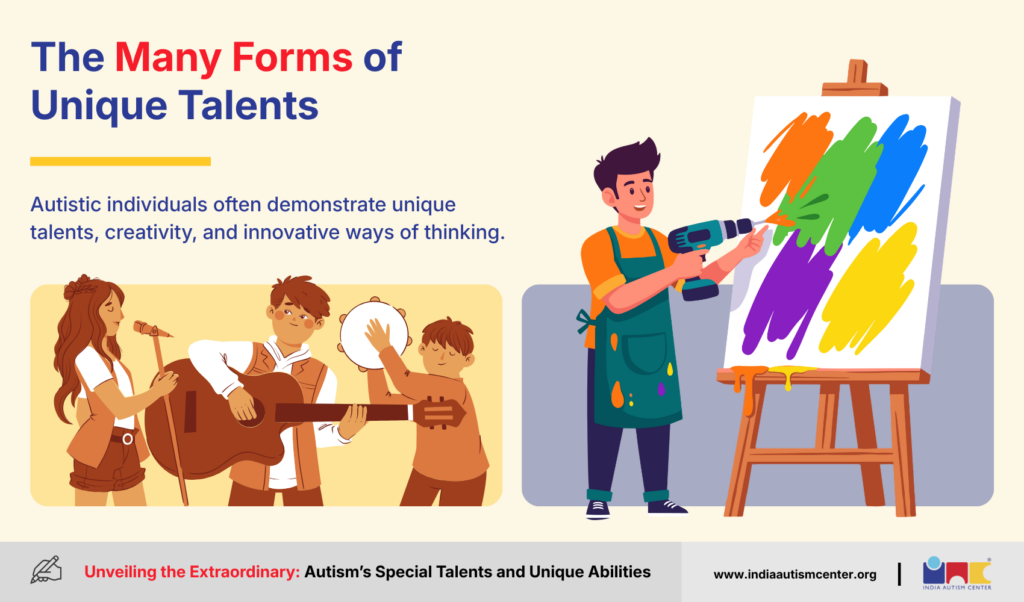
Beyond savant skills, many autistic individuals display unique talents that are equally worthy of celebration. These skills might not be “world-renowned,” but they are personally meaningful and socially valuable.
Some examples include:
- Creative storytelling
- Pattern recognition
- Visual thinking
- Deep curiosity about specific subjects
- Innovative problem-solving
- Detail-driven crafts and hobbies
These are all part of the broad spectrum of autism’s special abilities. They may not fit a traditional “gifted” label, but they reflect intelligent, creative, and thoughtful ways of experiencing the world.
How the Autistic Brain Thinks Differently: Real Examples
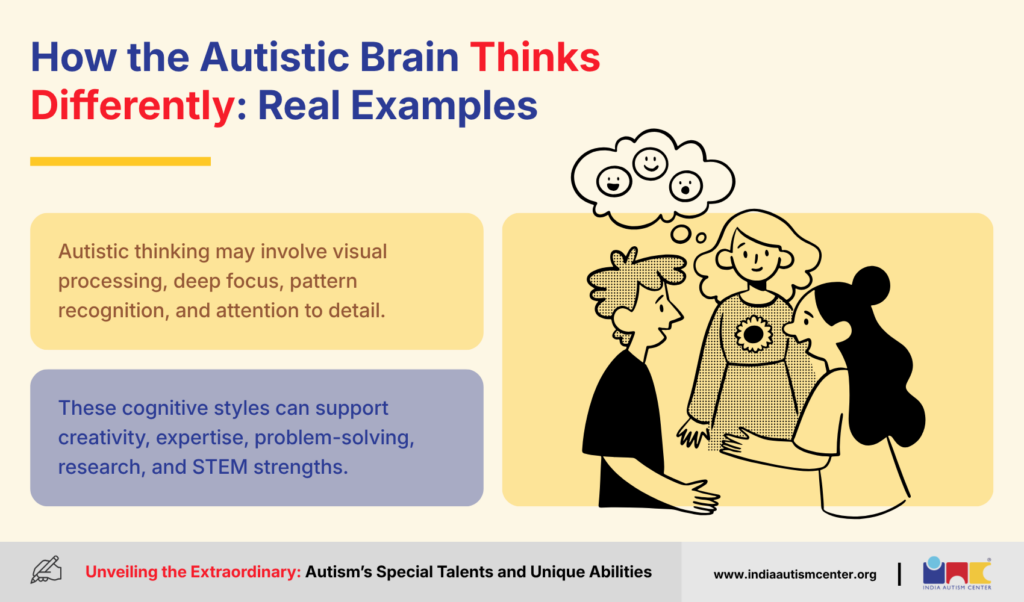
Understanding how autistic people think – not just what they’re good at – is one of the most empowering things a family or educator can do. The autistic brain isn’t a broken version of a neurotypical brain. It’s a different operating system. And these autistic thinking examples show exactly what that means in practice.
Visual Thinking: “Thinking in Pictures”
Temple Grandin, the world-renowned animal scientist and autism advocate, describes her mind as working like a video camera. Words convert into full-colour mental movies. When she designed livestock facilities, she didn’t sketch on paper first – she ran the entire facility through her mind, testing different cattle sizes, weather conditions, and movement patterns, all in vivid visual detail. Her book Thinking in Pictures (1995) remains the clearest first-person account of this cognitive style.
Visual thinking is common among autistic individuals. A child who struggles to explain a concept verbally may be able to draw it with remarkable accuracy. A teenager who finds abstract maths confusing may excel at geometry, architecture, or 3D design – because those subjects map directly onto how their mind already works.
Bottom-Up Thinking: Details Before the Big Picture
Most neurotypical thinkers process information top-down: they start with the overall concept and fill in the details. Many autistic people do the opposite. They notice the specific details first – a particular word choice, a small inconsistency, a precise measurement – and build upward toward the larger idea.
In practice, this looks like: a student who can recite every ingredient in a recipe but struggles to summarise “what the dish is for”; or a software developer who catches a single misplaced character in 500 lines of code before anyone else has even read the function. Bottom-up thinking is extraordinarily useful in quality control, research, editing, and engineering.
Monotropism: Single-Channel Deep Focus
The concept of monotropism – developed by autistic researchers Dinah Murray, Mike Lesser, and Wenn Lawson – describes the tendency to direct attention intensely into one channel at a time, rather than spreading it across many. This is why hyperfocus feels so natural for many autistic people: the brain is literally wired to go deep rather than wide.
A practical example: an autistic child who becomes completely absorbed in learning everything about volcanoes – geography, chemistry, history, mythology – isn’t being obsessive. They’re exercising a natural cognitive style that, in the right environment, produces genuine expertise.
Pattern Recognition and Systemising
Many autistic individuals have a strong systemising tendency – the drive to analyse and construct systems, find rules, and identify patterns. This shows up in:
- Noticing grammatical patterns in a new language faster than peers
- Identifying stock market trends or data anomalies
- Mastering musical scales and chord progressions by ear
- Recognising recurring narrative structures in literature
These thinking styles aren’t just interesting – they’re directly valuable in STEM fields (where pattern recognition and logical rigour are prized), in the arts (where visual and structural thinking produce original work), and in research (where bottom-up attention to detail catches what others miss). The autistic brain doesn’t think less. It thinks differently – and in many contexts, it thinks better.
Why These Savant Skills Matter
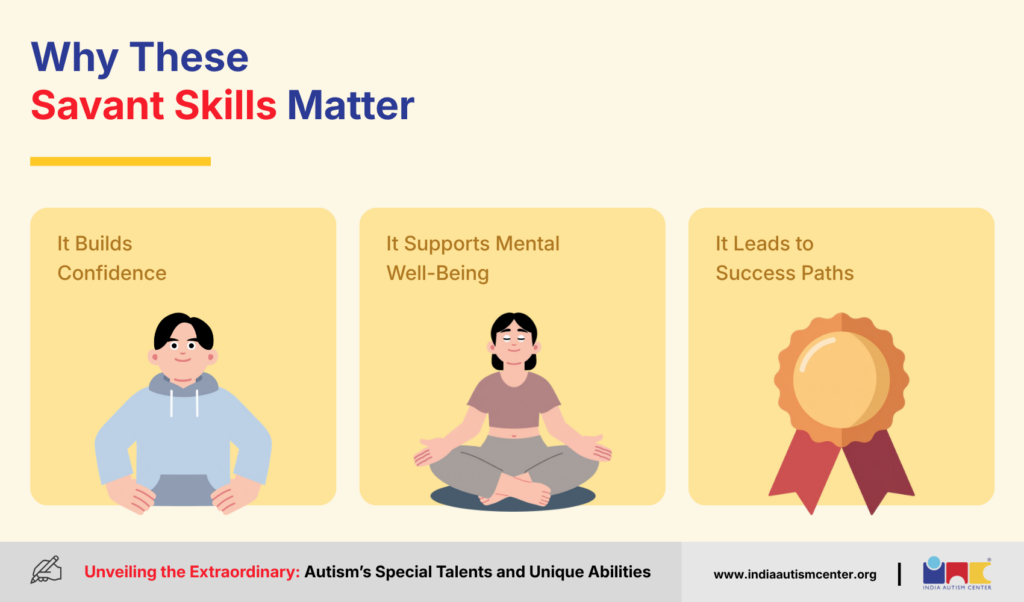
Sometimes, society focuses too much on what autistic individuals struggle with. But when we emphasise their strengths and abilities, we shift the conversation to potential.
Here’s why this matters:
1. It Builds Confidence
Recognising strengths helps a person with autism feel valued for who they are — not “fixed” or “changed.”
2. It Supports Mental Well-Being
Strength-based approaches reduce anxiety and frustration. They help people build self-worth.
3. It Leads to Success Paths
When your strengths guide your education, career, or hobbies, you’re far more likely to thrive.
The Role of IAC in Nurturing Autism’s Special Talents and Unique Abilities
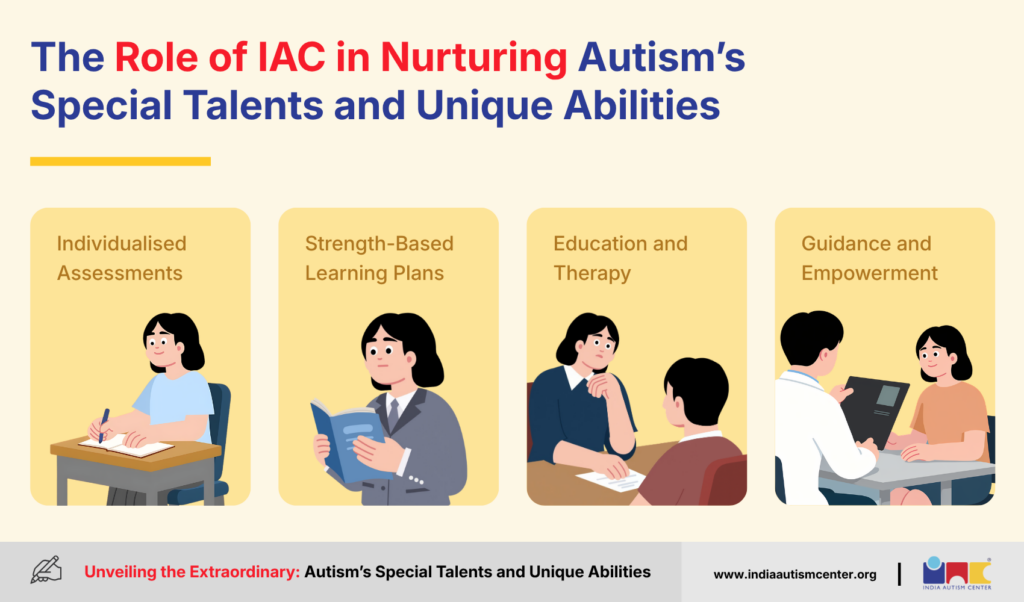
At IAC, I’ve seen firsthand how the right support can transform potential into reality.
IAC focuses on strength-based autism support. We don’t just help with challenges — we help uncover hidden abilities and special talents in every individual.
Here’s how IAC makes that possible:
Individualised Assessments
At IAC, every child and adult receives personalised evaluations. These assessments help identify strengths — whether it’s memory, focus, logic, creativity, or social learning.
Strength-Based Learning Plans
Based on individual abilities, IAC creates custom learning plans. These plans use strengths to support development. For example:
- A child with strong visual thinking may excel in digital art or design.
- A student with hyperfocus may thrive in coding or scientific research programs.
Supportive Education and Therapy
IAC uses therapies that boost abilities and promote independence. This includes structured learning, communication support, social skills training, and creative expression. These programs don’t just teach skills — they honour each person’s unique learning style and pace.
Family Guidance and Empowerment
Families play a central role. IAC equips caregivers with tools to nurture talents at home. When families understand strengths, they can provide consistent encouragement and meaningful opportunities.
Want to know more? Get in touch with us.
How You Can Support and Celebrate These Autism Special Abilities
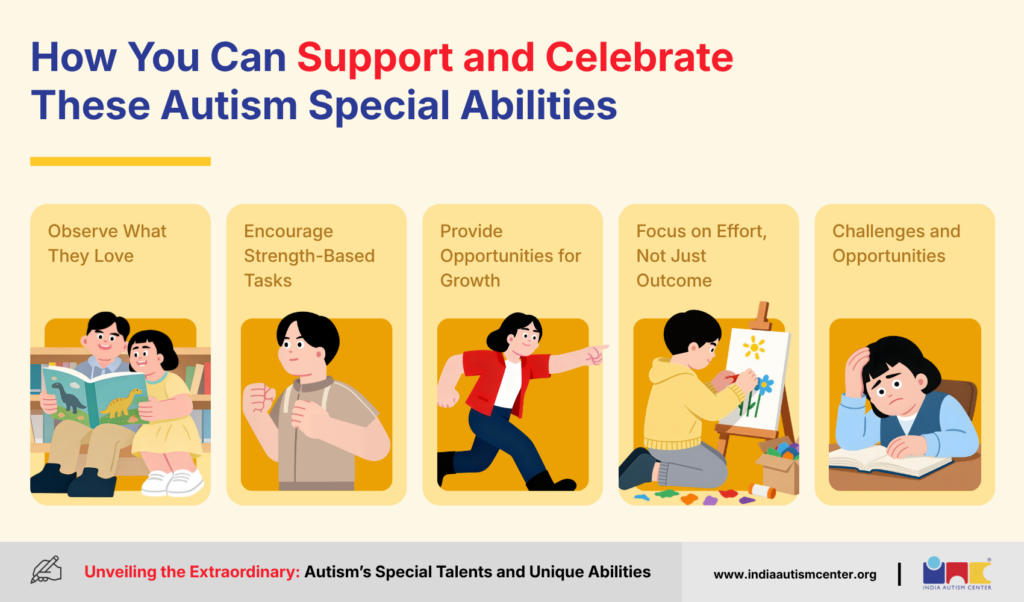
If you’re reading this and thinking about someone you care for, here are some actionable steps:
Observe What They Love
Pay attention to activities they return to again and again.
Encourage Strength-Based Tasks
Let them explore areas where they naturally succeed. This builds confidence.
Provide Opportunities for Growth
Enrol them in classes, clubs, or mentorships that nourish their interests.
Focus on Effort, Not Just Outcome
Praise dedication, resilience, and creative problem-solving — not just trophies or results.
Challenges and Opportunities
While celebrating autism strengths and abilities, it’s crucial to recognise the ongoing challenges that autistic individuals may face. Social and communication difficulties, sensory sensitivities, and the need for routine can present hurdles in various aspects of life. Addressing these challenges requires a multifaceted approach that combines support, understanding, and accommodation.
📥 Free download: Printable daily routine chart for autistic children
Famous Autistic Individuals and Their Extraordinary Talents
History is full of people whose autistic traits weren’t a barrier to success – they were part of the engine of it. Here are six well-documented individuals whose stories offer something real for families and individuals navigating the autism journey today.
Temple Grandin – Animal Science and Advocacy
Temple Grandin (born 1947) is a Professor of Animal Science at Colorado State University and one of the most influential designers of humane livestock handling facilities in the world. Diagnosed with autism in early childhood at a time when many clinicians recommended institutionalisation, she went on to design systems now used in roughly half of all cattle processing facilities in North America.
Her visual thinking – the ability to mentally simulate machinery and animal movement in three dimensions – is directly tied to her autism. She has said repeatedly that she would not have achieved what she did without thinking the way she does. For families: Grandin’s story is a reminder that an unconventional learning style is not a deficit. It’s a different path to the same destination.
Alan Turing – Computing and Codebreaking
Alan Turing (1912–1954) is widely regarded as the father of modern computing. His work at Bletchley Park during World War II – cracking the Enigma code – is credited with shortening the war by an estimated two years. Turing was never formally diagnosed with autism during his lifetime, and any such attribution is retrospective. But historians and clinicians have widely noted traits consistent with autism: intense, narrow focus; difficulty with social convention; a preference for logical systems over social hierarchies; and a relentless drive to follow an idea to its logical conclusion regardless of what others thought.
His story matters because it shows what happens when a mind that doesn’t fit the social mould is given the right problem to solve.
Albert Einstein – Physics and Theoretical Science
Albert Einstein (1879–1955) is another figure frequently cited in discussions of the autistic genius – though, again, any diagnosis is retrospective and speculative. Einstein reportedly didn’t speak until age three, showed intense focus on narrow interests, and struggled with conventional schooling. Whether or not he was autistic, his cognitive style – thinking in thought experiments, visualising physical phenomena before calculating them – shares features with what we now understand as autistic thinking.
The takeaway for families isn’t “my child might be the next Einstein.” It’s simpler: a child who thinks differently from their classmates is not behind. They may simply be on a different track.
Satoshi Tajiri – Creator of Pokémon
Satoshi Tajiri (born 1965) created Pokémon – one of the highest-grossing media franchises in history – out of a childhood obsession with collecting insects. Tajiri has been open about his autism diagnosis. His hyperfocus on a single interest, his ability to build an entire logical system (the Pokémon world has its own ecology, type chart, and evolutionary rules), and his persistence through years of near-bankruptcy to complete the original game are all consistent with autistic cognitive strengths.
For children who are told their “special interests” are a problem: Tajiri’s story is proof that a deep, sustained passion for one thing can become something the whole world wants to be part of.
Anthony Hopkins – Acting
Sir Anthony Hopkins (born 1937) – two-time Academy Award winner and one of the most celebrated actors of his generation – was diagnosed with Asperger’s syndrome as an adult. He has spoken openly about how his autism shapes his preparation: he reads scripts hundreds of times, building an extraordinarily detailed internal map of his character before he ever steps on set. What might look like rigid repetition is actually a sophisticated cognitive strategy.
Hopkins’ story is particularly meaningful for autistic individuals who are told they “lack empathy.” His ability to inhabit complex characters – including Hannibal Lecter and King Lear – suggests something quite different.
Greta Thunberg – Climate Advocacy
Greta Thunberg (born 2003) has been open and proud about her autism diagnosis. She has described her ability to see the climate crisis with unflinching clarity – without the social filters that lead many adults to soften or qualify what the data actually says – as directly connected to how she thinks. Her monotropic focus on a single issue, her refusal to accept vague reassurances, and her willingness to say exactly what she means have made her one of the most influential climate voices of the 21st century.
For autistic young people who feel their directness is a problem: Thunberg’s example shows that saying exactly what you mean, without social performance, can move the world.
These individuals didn’t succeed despite autism. Their cognitive styles – the visual thinking, the hyperfocus, the pattern recognition, the monotropic depth, the refusal to accept social convention over logical truth – were central to what made them extraordinary. Every autistic child carries some version of these traits. The question is never whether the ability is there. It’s whether the environment is ready to recognise it.
Conclusion
Autism is more than a diagnosis. It’s a unique way of interacting with the world — a way that brings distinct talents, powerful minds, and incredible creativity.
Whether it’s the intense focus of hyperfocus, the brilliance seen in some savant skills, or the quiet strength of attention to detail — all these talents deserve appreciation and support.
At IAC, we are committed to nurturing these abilities, promoting understanding, and helping every individual flourish on their own terms.
If you’re ready to learn more about how we work with strengths — from educational planning to talent development — reach out to IAC today. Together, we can help autistic individuals not just overcome challenges, but celebrate their remarkable gifts.
Frequently Asked Questions (FAQs)
What are Autism’s Special Talents and Unique Abilities?
Autism’s special talents and unique abilities refer to the natural strengths many autistic individuals show, such as strong memory, attention to detail, creative thinking, logical reasoning, and deep focus. These autism special abilities vary from person to person and can appear in academic, artistic, or technical areas.
What are savant skills in autism?
Savant skills in autism are rare but exceptional abilities seen in some individuals, such as extraordinary talent in mathematics, music, art, or memory. While not every autistic person has savant skills, these abilities highlight the unique cognitive strengths that can exist within the autism spectrum.
How can parents support the strengths and abilities in children with autism?
Parents can support the strengths and abilities in children with autism by observing their interests, encouraging skill-based activities, providing structured learning opportunities, and focusing on their abilities rather than only on challenges. Strength-based learning helps build confidence and long-term independence.
How does India Autism Center (IAC) help nurture autism’s special abilities?
India Autism Center (IAC) supports autism special abilities through personalised assessments, strength-based learning plans, therapeutic programs, and family guidance. IAC focuses on identifying each child’s unique talents and helping them develop those abilities alongside essential life and communication skills.
Disclaimer: This article is intended for educational and informational purposes only. It is not a substitute for professional medical advice, diagnosis, or treatment. If you are pregnant or have concerns about medication use during pregnancy, please consult a qualified healthcare provider. If your child has received an autism diagnosis and you have questions about causes or support, please reach out to a trained specialist or an autism-focused organisation for guidance.
For expert insights, support services, and inclusive learning initiatives, visit the India Autism Center.