Category: Disability

  • 5 PwD Scholarships for Students with Disabilities (2026)

    5 PwD Scholarships for Students with Disabilities (2026)

    Access to quality education should not depend on a student’s physical, intellectual or developmental abilities or financial circumstances. However, the additional costs associated with assistive devices, accessible learning resources, transport and specialised support can make education challenging for many families.

    Under Section 32 of the Rights of Persons with Disabilities (RPwD) Act, 2016, government and government-aided higher education institutions must reserve a minimum of 5% of seats for persons with benchmark disabilities.

    Alongside these provisions, several scholarships for students with disabilities help make education more affordable and accessible.

    This guide explores the available scholarships, eligibility requirements, financial benefits and application process for students with disabilities in India.

    What Are Scholarships for Students with Disabilities?
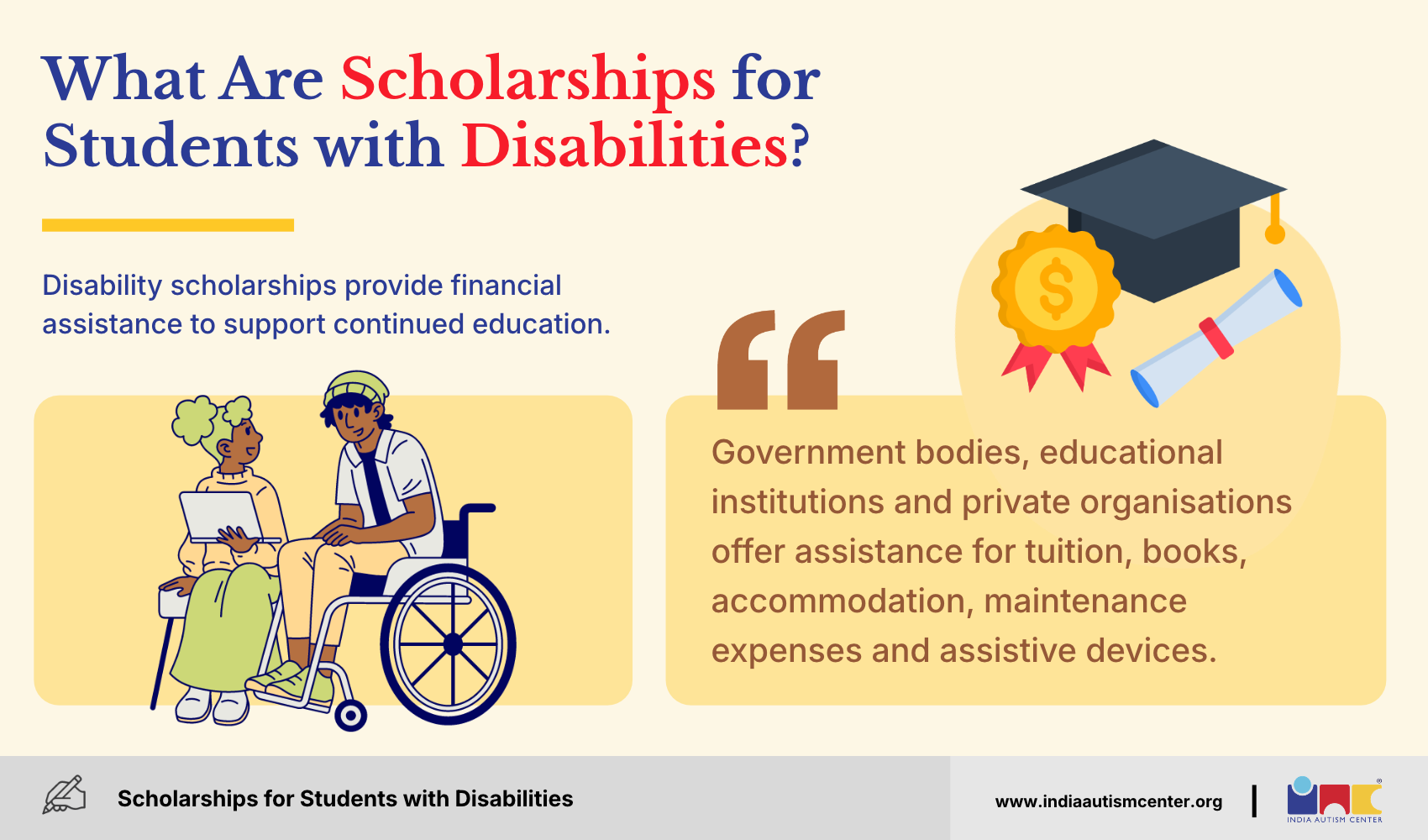
    Students with a graduation cap and medal illustrating what scholarships for students with disabilities are

    Scholarships for students with disabilities are essentially financial assistance programmes designed to help learners with recognised disabilities continue their education without facing excessive financial pressure. These programmes are offered by the Central Government, State Governments, educational institutions and private organisations.

    The assistance may cover tuition fees, admission charges, books, stationery, accommodation, maintenance expenses and assistive devices. Some scholarships support students in secondary education, while others are specifically designed for undergraduate, postgraduate and research programmes.

    In India, the Department of Empowerment of Persons with Disabilities (DEPwD), working under the Ministry of Social Justice and Empowerment, administers several government scholarship schemes. These programmes aim to improve access to education and encourage students to pursue their academic and professional goals.

    Major Government Scholarships for Students with Disabilities
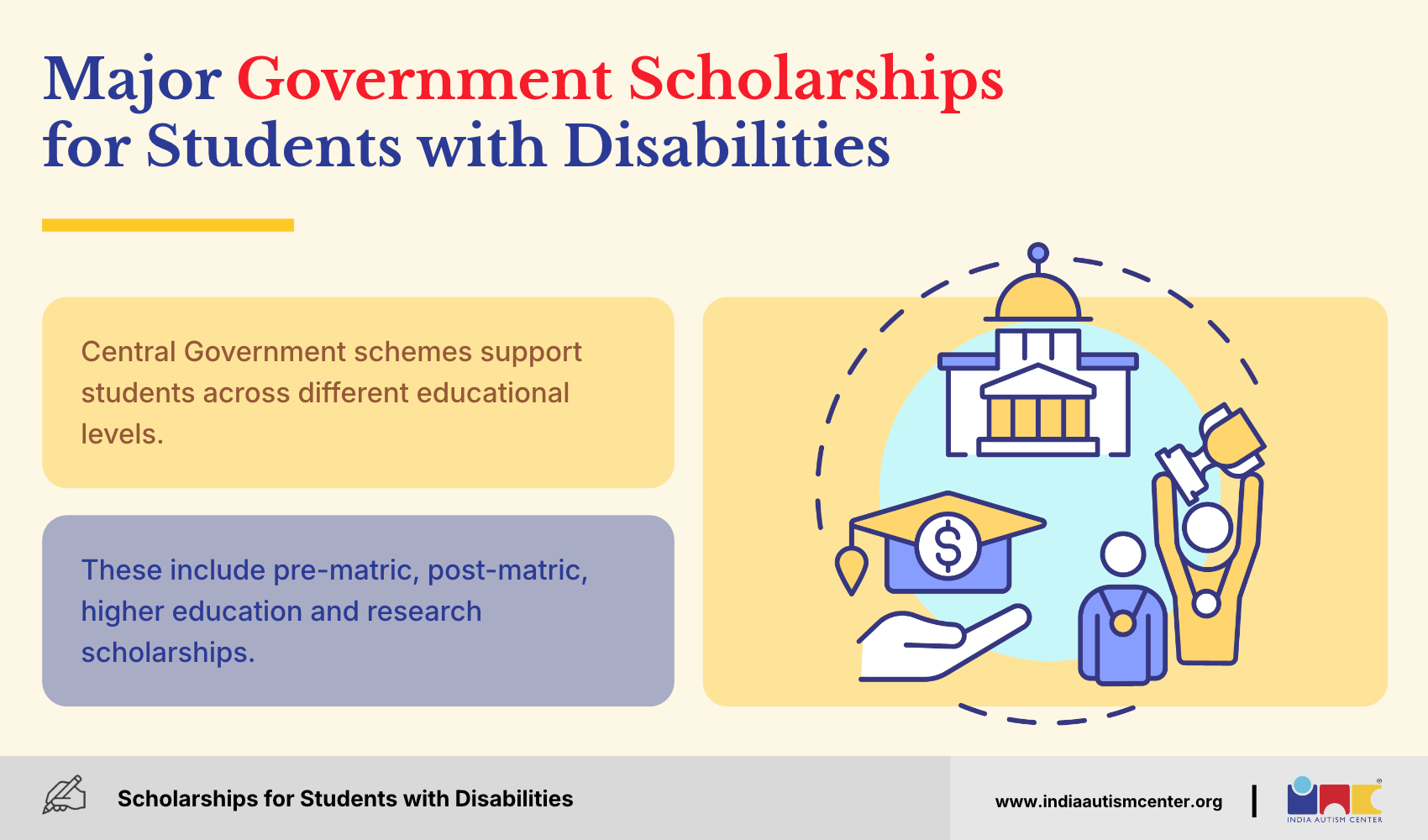
    Government building and students illustrating major government scholarships for students with disabilities

    The Central Government’s umbrella scholarship scheme includes different components based on the student’s educational level and requirements. Here are the main programmes worth exploring.

    1. Pre-Matric Scholarship for Students with Disabilities
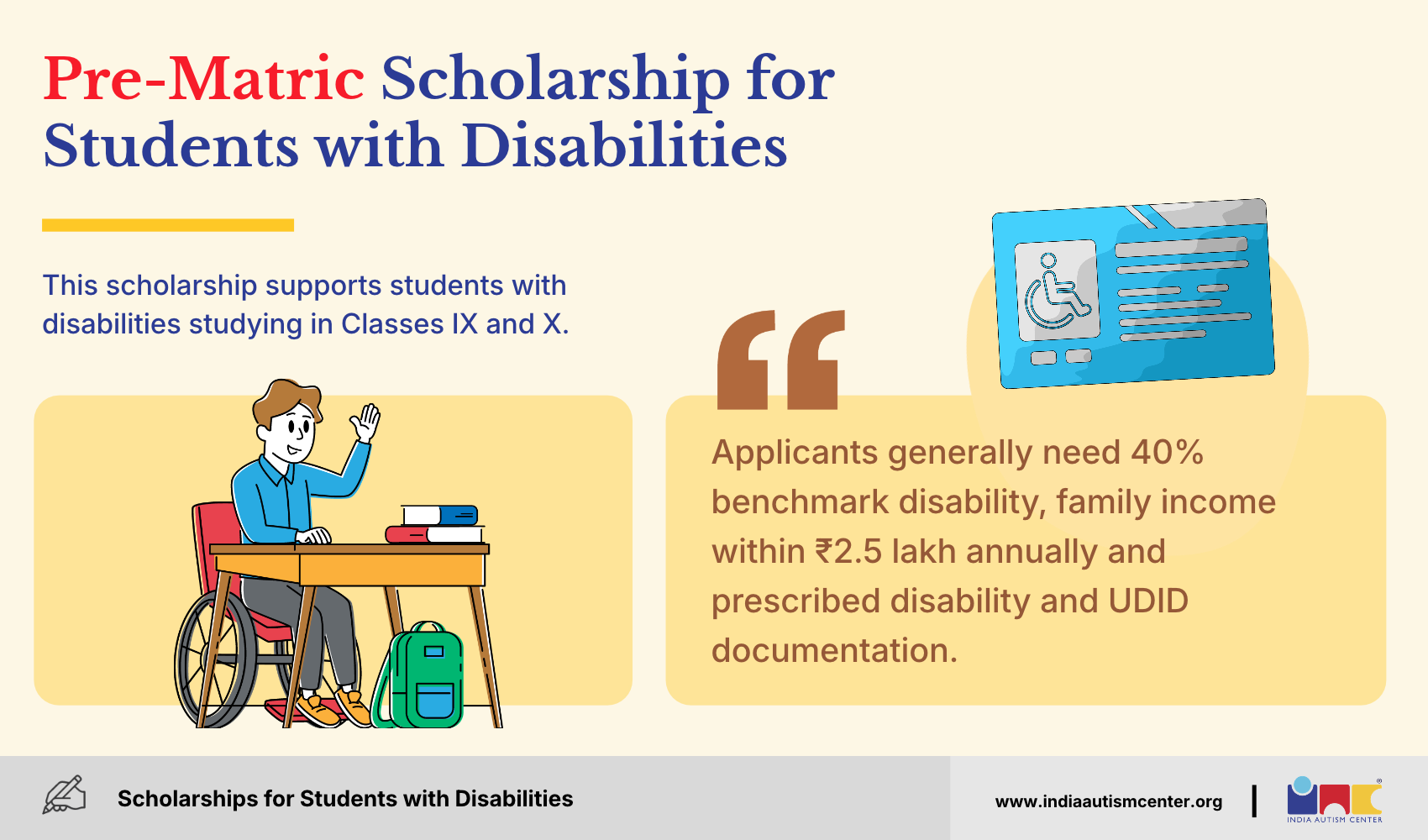
    Student in a wheelchair at a desk illustrating the pre-matric scholarship for students with disabilities

    This scholarship supports students studying in Classes IX and X. Its primary objective is to reduce the financial burden of secondary education and prevent students from discontinuing their studies.

    Eligibility:

    • The applicant must be an Indian citizen with at least a 40% benchmark disability.
    • The student must be enrolled in Class IX or X in a recognised school.
    • Annual family income must not exceed ₹2.5 lakh.
    • A valid disability certificate and prescribed Unique Disability ID (UDID) documentation are required.
    • The applicant must satisfy the scheme’s conditions regarding other scholarships or stipends.

    Financial assistance:

    BenefitDay ScholarHosteller
    Monthly maintenance allowance₹500₹800
    Annual book grant₹1,000₹1,000
    Disability allowance₹2,000–₹4,000 annually₹2,000–₹4,000 annually

    The disability allowance depends on the prescribed disability category. Students with visual impairment or intellectual disabilities receive ₹4,000 annually, while those in other eligible disability categories receive ₹2,000.

    2. Post-Matric Scholarship for Students with Disabilities
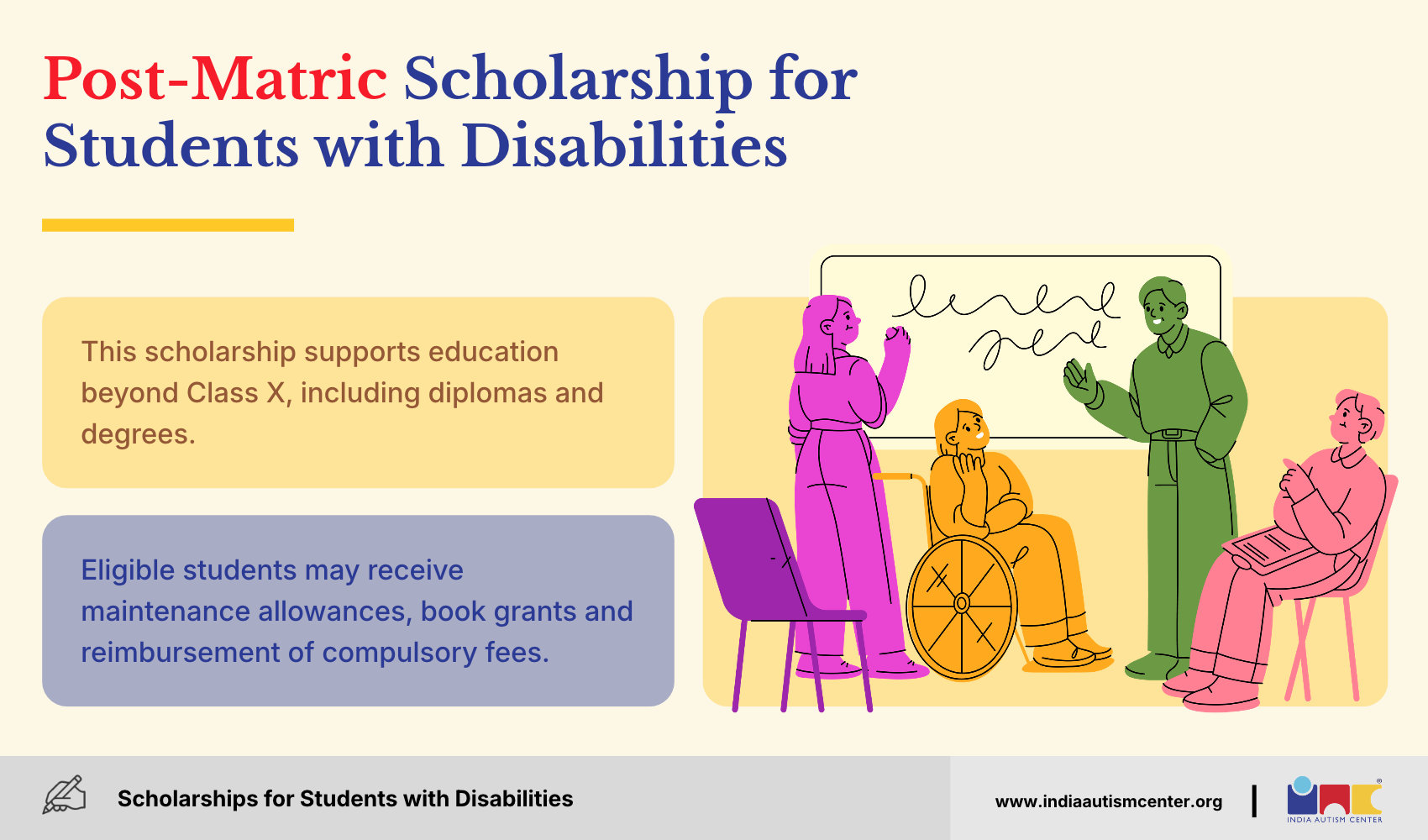
    Students and a teacher at a board illustrating the post-matric scholarship for students with disabilities

    The Post-Matric Scholarship supports students pursuing education after Class X. It covers Classes XI and XII, recognised diploma programmes, undergraduate degrees and postgraduate courses.

    Eligibility:

    • The applicant must be an Indian citizen with a disability of at least 40%.
    • The student must be enrolled in an eligible recognised course.
    • Annual family income must not exceed ₹2.5 lakh.
    • The applicant must have the prescribed disability and UDID documentation.
    • Other scholarship and stipend restrictions apply.

    Financial assistance:

    • Monthly maintenance allowance of ₹750 for day scholars and ₹1,600 for hostellers.
    • Annual book allowance of ₹1,500.
    • Disability allowance of ₹2,000–₹4,000 annually, depending on the disability category.
    • Reimbursement of eligible compulsory non-refundable fees, subject to a prescribed annual ceiling of ₹1.5 lakh.

    This scheme is particularly useful for students planning to pursue higher secondary education, professional diplomas or university degrees.

    3. Top Class Education Scholarship for Students with Disabilities
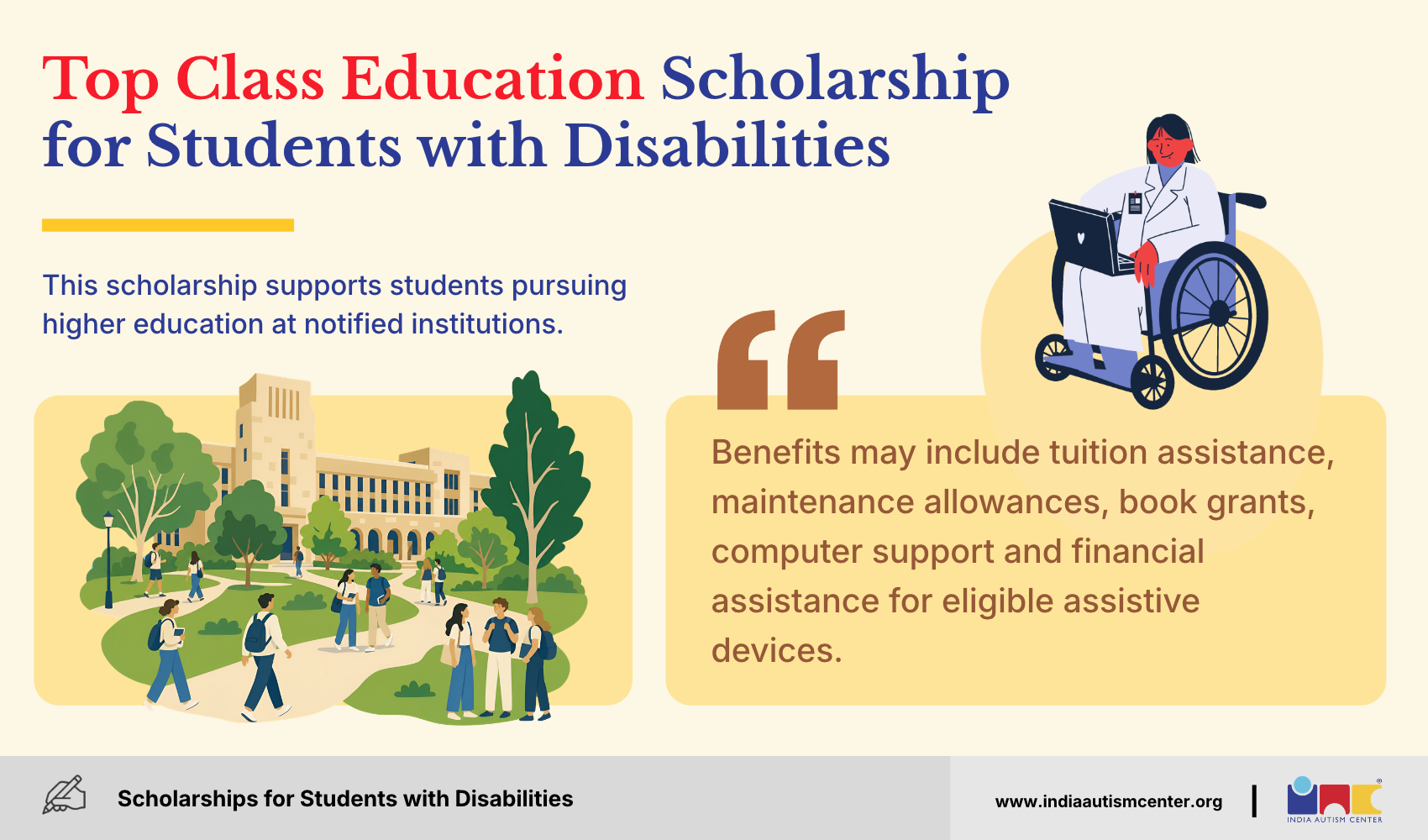
    University campus and student in a wheelchair illustrating the Top Class Education Scholarship

    Students seeking admission to higher education can explore the Top Class Education Scholarship. It supports eligible students enrolled in graduate, postgraduate and diploma programmes at institutions notified under the scheme.

    Eligibility:

    • The applicant must be an Indian citizen with at least a 40% benchmark disability.
    • The annual income of the family must not exceed ₹8 lakh.
    • The applicant must secure admission at an institution notified under the scheme.
    • Prescribed UDID and disability documentation must be available.
    • The applicant must meet conditions related to other scholarships and stipends.

    Financial assistance includes:

    • Tuition and admission fee support of up to ₹2 lakh annually.
    • Monthly maintenance allowance of ₹1,500 for day scholars and ₹3,000 for hostellers.
    • Special disability allowance of ₹2,000 per month.
    • Books and stationery allowance of ₹5,000 annually.
    • One-time assistance of up to ₹45,000 for a computer.
    • Assistance of up to ₹30,000 for eligible aids and assistive devices.

    This is one of the important disability scholarships for college students, particularly those pursuing higher education at selected institutions.

    4. National Fellowship for Persons with Disabilities
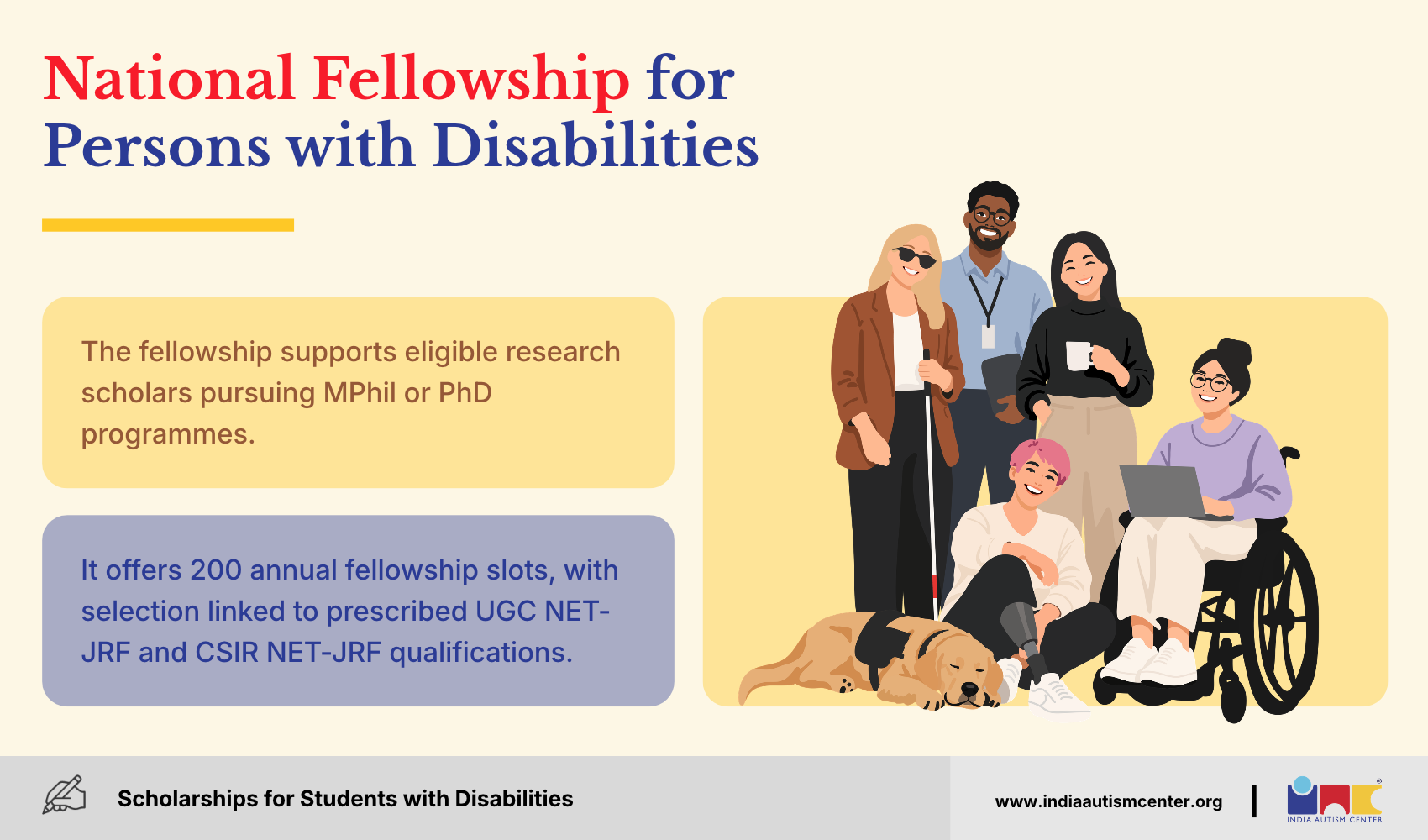
    Group of diverse people with disabilities illustrating the National Fellowship for Persons with Disabilities

    Students interested in academic research can explore the National Fellowship for Persons with Disabilities (NFPwD). The programme supports eligible candidates pursuing research leading to an MPhil or PhD at Indian universities, subject to the applicable University Grants Commission (UGC) regulations and scheme guidelines.

    The scheme provides fellowship assistance to selected research scholars. It has 200 fellowship slots annually, with selection linked to the prescribed UGC National Eligibility Test (NET) Junior Research Fellowship and Council of Scientific and Industrial Research (CSIR) NET-JRF qualifications.

    Unlike the pre-matric and post-matric scholarships, the National Fellowship does not have a family income ceiling under the published scheme framework. Applicants must check the latest selection, admission and disability certification requirements before applying.

    5. National Overseas Scholarship for Students with Disabilities
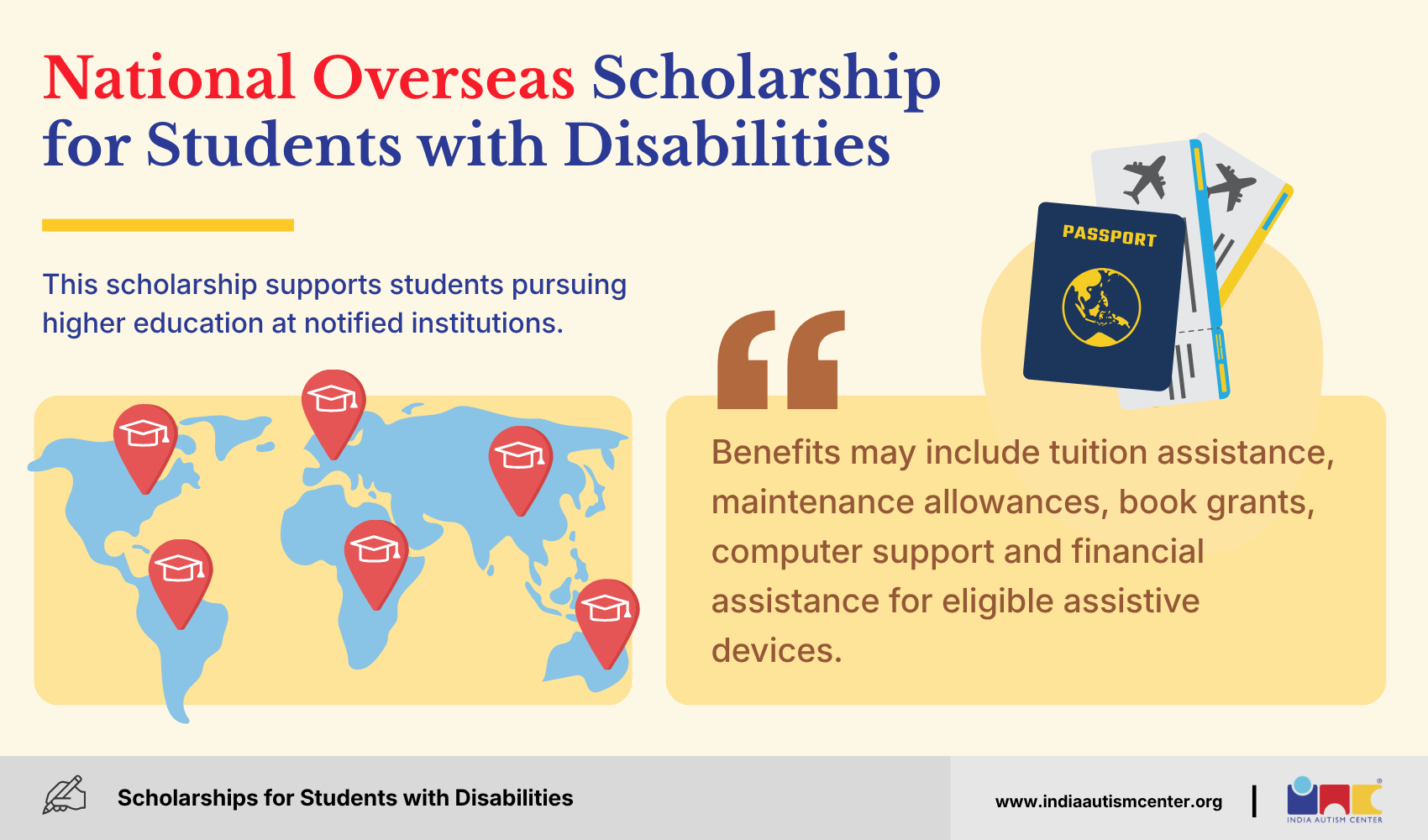
    World map with location pins and a passport illustrating the National Overseas Scholarship for students with disabilities

    Students planning to pursue higher education abroad can explore the National Overseas Scholarship. It supports eligible students undertaking Master’s degree or PhD programmes at recognised foreign universities in approved fields.

    Depending on the applicable guidelines, financial assistance may cover tuition fees, maintenance expenses, contingency allowances and other approved costs.

    Applicants must meet the prescribed disability, academic, family income and admission requirements. Since overseas scholarship conditions and selection procedures can change, students should refer to the latest DEPwD notification before applying.

    Other Financial Assistance for Disabled Students in India
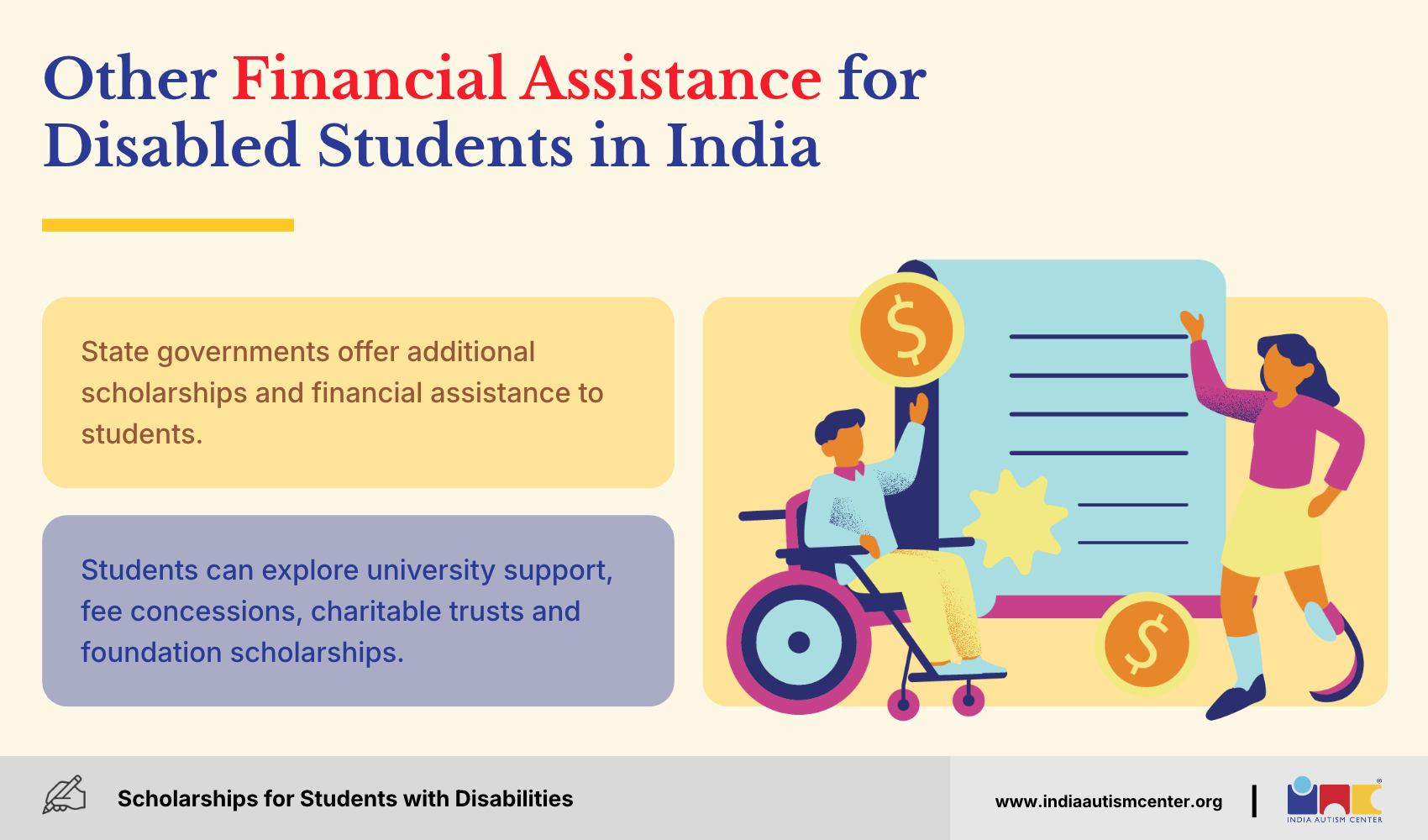
    People with coins and documents illustrating other financial assistance for disabled students in India

    Apart from Central Government schemes, students should explore state-level scholarships and assistance programmes. These are particularly useful because eligibility requirements and benefits can differ across states.

    For instance, Maharashtra offers a State Pre-Matric Scholarship for Disabled Persons. Eligible students studying in Classes I to X can explore this scheme through the state’s disability welfare department.

    Students can also enquire about:

    • State government post-matric scholarships.
    • Financial assistance offered by universities and colleges.
    • Fee concessions and education support from charitable trusts.
    • Private foundation scholarships for students with disabilities.
    • Institutional support for assistive technology and accessible learning resources.

    These options can provide additional financial assistance for disabled students in India, depending on the student’s location, educational level and eligibility.

    Who Is Eligible for a PwD Scholarship in India?
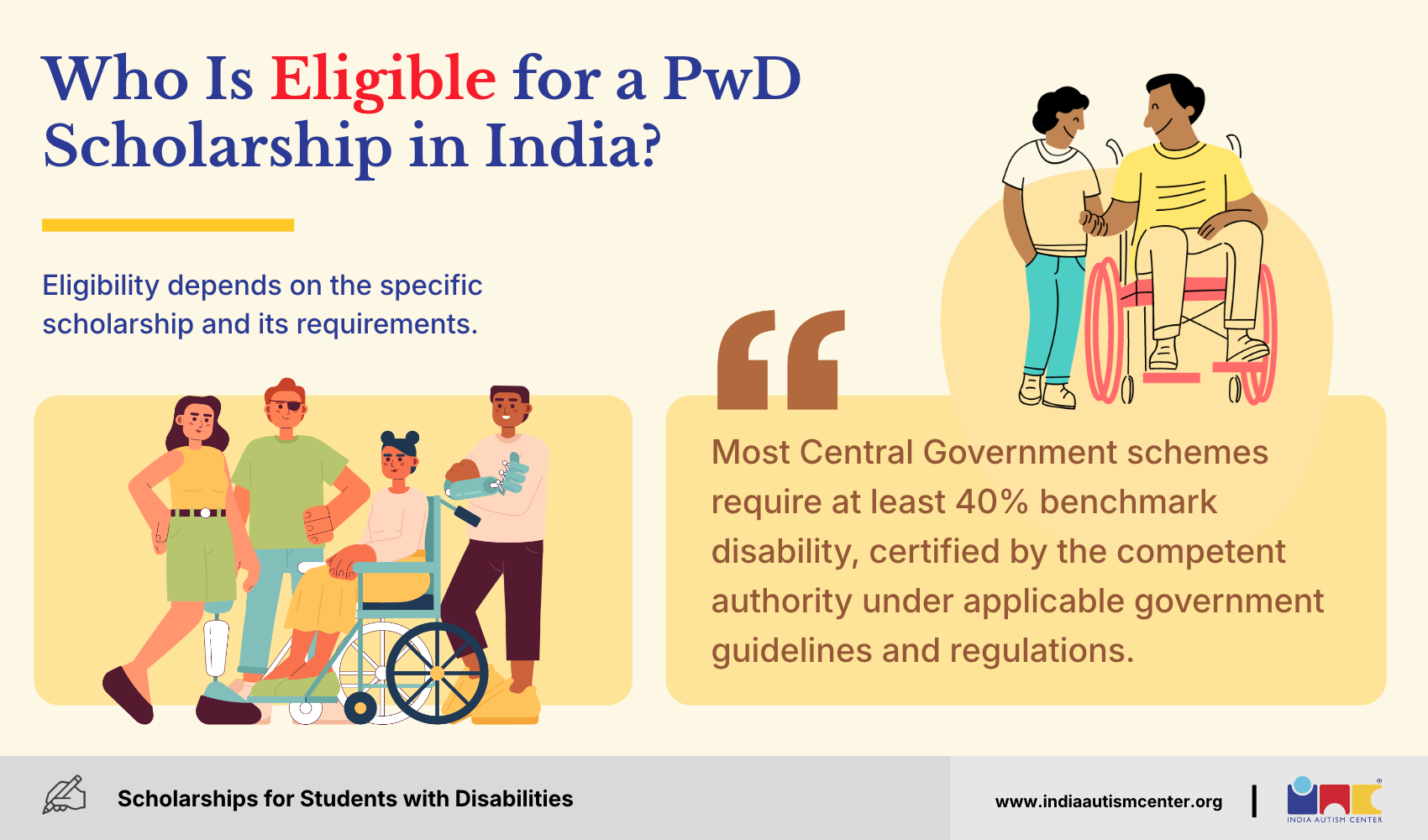
    Group of people with disabilities illustrating who is eligible for a PwD scholarship in India

    The eligibility for PwD scholarship programmes depends on the individual scheme. However, most Central Government scholarships for students with disabilities require applicants to have at least a 40% benchmark disability.

    Under the RPwD Act, 2016, benchmark disability refers to a specified disability assessed at 40% or more, as certified by the competent authority.

    The Act recognises 21 specified disabilities, including:

    • Autism Spectrum Disorder (ASD)
    • Intellectual disability
    • Specific learning disabilities, including dyslexia
    • Cerebral palsy
    • Blindness and low vision
    • Hearing impairment
    • Locomotor disability
    • Speech and language disability
    • Multiple disabilities
    • Mental illness

    A diagnosis alone does not automatically establish scholarship eligibility. For example, a student with autism or Attention Deficit Hyperactivity Disorder (ADHD) must meet the applicable disability assessment and certification requirements.

    ADHD is not separately listed among the 21 specified disabilities, so a diagnosis should not be assumed to qualify a student for a benchmark-disability scholarship.

    How to Apply for Scholarships for Students with Disabilities?
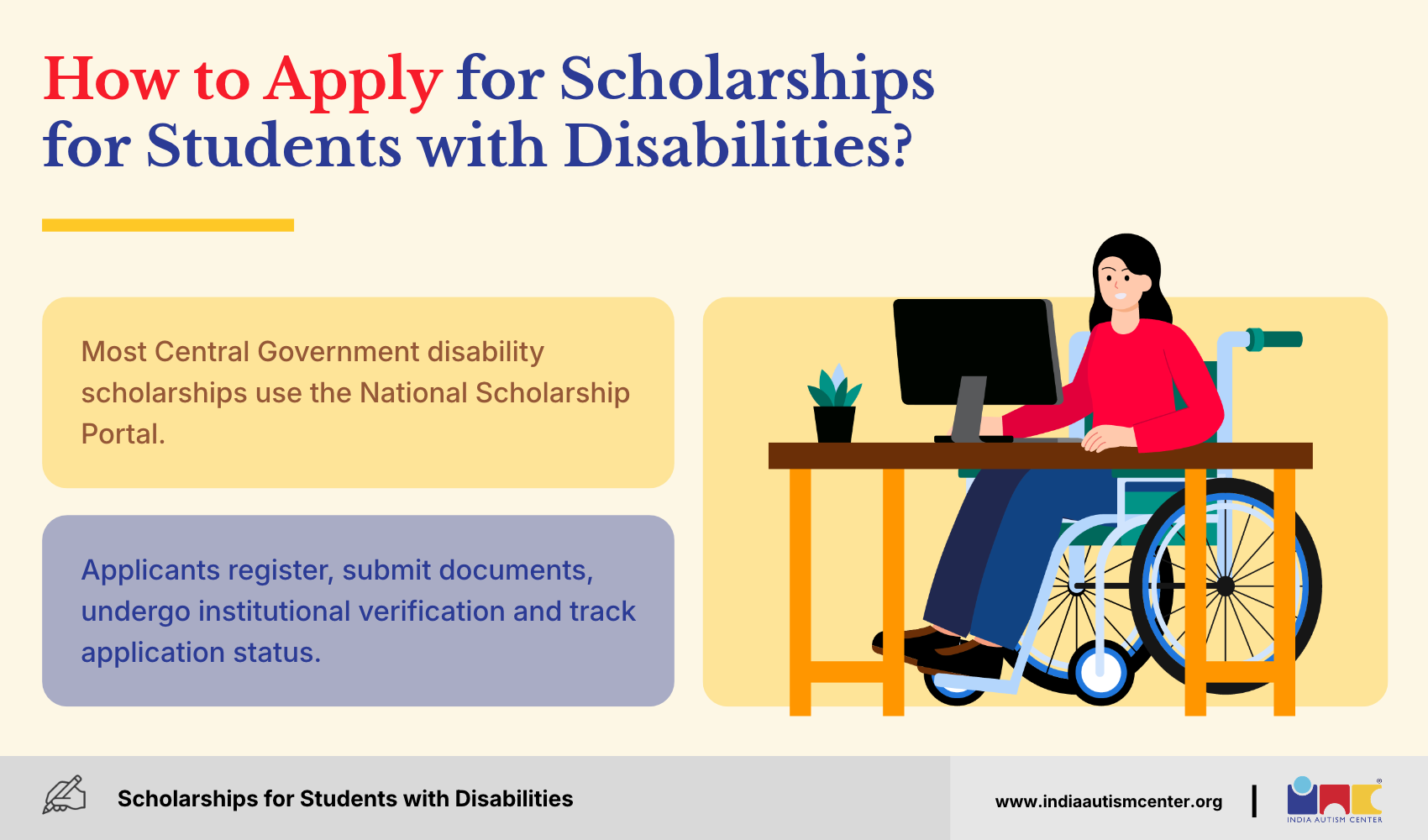
    Student in a wheelchair at a computer illustrating how to apply for scholarships for students with disabilities

    Most Central Government scholarships for students with disabilities are available through the National Scholarship Portal (NSP). The application process usually includes the following steps:

    1. Identify the right scholarship: Visit the NSP and check the schemes listed under the Department of Empowerment of Persons with Disabilities. Choose the programme that matches the student’s current educational level.

    2. Complete One-Time Registration (OTR): Register on the portal using the prescribed identity verification process. An OTR number is generated for scholarship applications.

    3. Fill in the application form: Provide accurate personal, academic, disability and bank account details. Make sure that the information matches the supporting documents.

    4. Upload the required documents: Submit the disability certificate, UDID details, income certificate, academic records and other documents requested under the scheme.

    5. Complete institutional verification: The application is checked by the educational institution and designated government authorities. Students should follow up if any information or document needs correction.

    6. Track the application: Regularly check the application status on the portal. Once approved, scholarship payments are generally transferred through Direct Benefit Transfer (DBT), using the Public Financial Management System (PFMS).

    Application deadlines differ by scheme and academic year. Students should check the NSP for the latest opening dates, closing dates and verification deadlines.

    How Can Students Improve The Chances of Receiving a Scholarship?
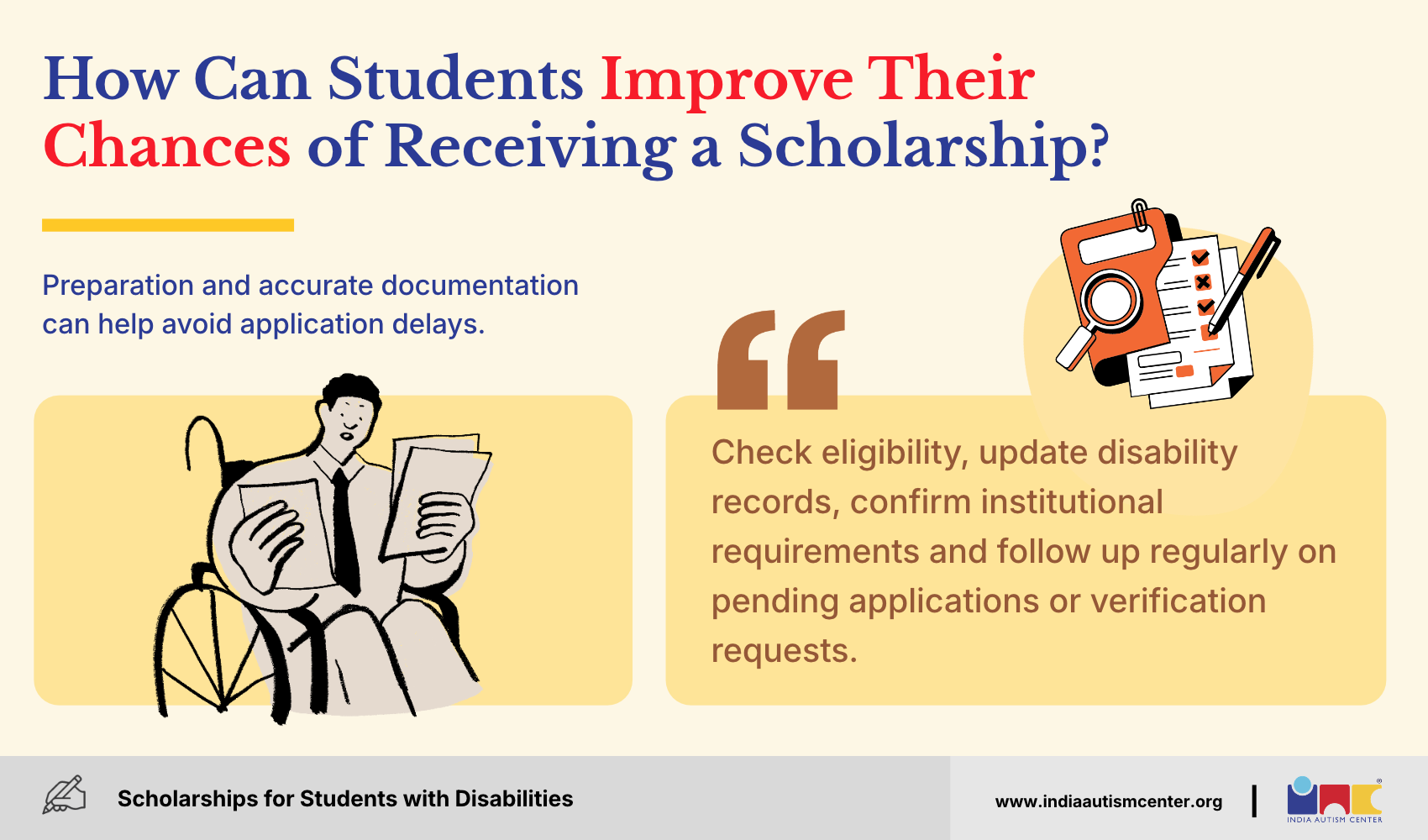
    Person reading documents illustrating how students can improve their chances of receiving a scholarship

    Meeting the primary eligibility requirements is the first step. Students and parents should also pay attention to the application process in order to avoid unnecessary delays or rejection.

    A few practical steps can help:

    • Apply early: Starting the application process before the deadline gives families enough time to arrange documents and complete verification.
    • Keep disability records updated: Ensure that the disability certificate and UDID information are accurate and meet the scheme requirements.
    • Check institutional eligibility: Some scholarships are restricted to students admitted to notified institutions. Confirm this before accepting admission.
    • Understand the financial conditions: Check family income limits, fee reimbursement ceilings and restrictions on receiving multiple scholarships.
    • Follow up regularly: Contact the school, college or relevant department if the application remains pending or requires clarification.

    Parents can also help students identify suitable courses, accessible institutions and available educational support. This is particularly important for learners who may require additional assistance with communication, academic participation or daily activities.

    Why Is Inclusive Education Important Alongside Financial Assistance?
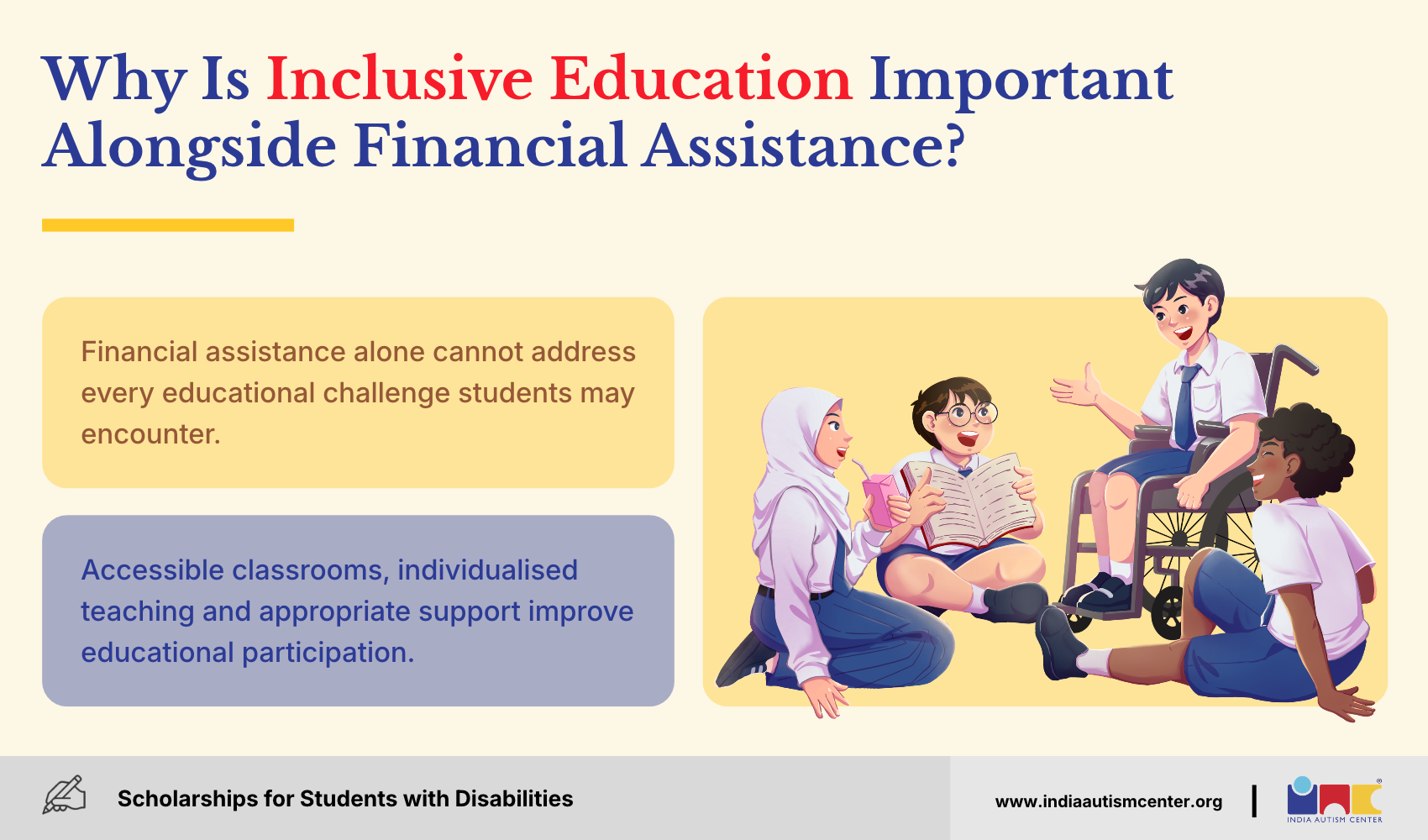
    Students learning together illustrating why inclusive education matters alongside financial assistance

    Scholarships can reduce educational expenses, but financial support alone cannot address every challenge a student with a disability may face.

    For example, students with ASD may benefit from structured learning environments, predictable routines and appropriate communication support. Those with dyslexia may require accessible reading materials and specialised teaching strategies. Students with ADHD may benefit from classroom adjustments that support attention, organisation and task management.

    Understanding individual learning requirements is therefore essential. Parents and educators can explore areas such as inclusive education, sensory processing and speech and language therapy to understand the different forms of support that may improve educational participation.

    The Rights of Persons with Disabilities Act (RPwD), 2016, also requires educational institutions to provide inclusive education and reasonable accommodation. Section 32 specifically provides for at least 5% reservation in government and government-aided higher education institutions for persons with benchmark disabilities.

    Access to appropriate autism therapies, early intervention and individualised educational support can further help learners develop their abilities and participate more confidently in academic environments.

    How India Autism Center Supports Individuals with Autism and Their Families
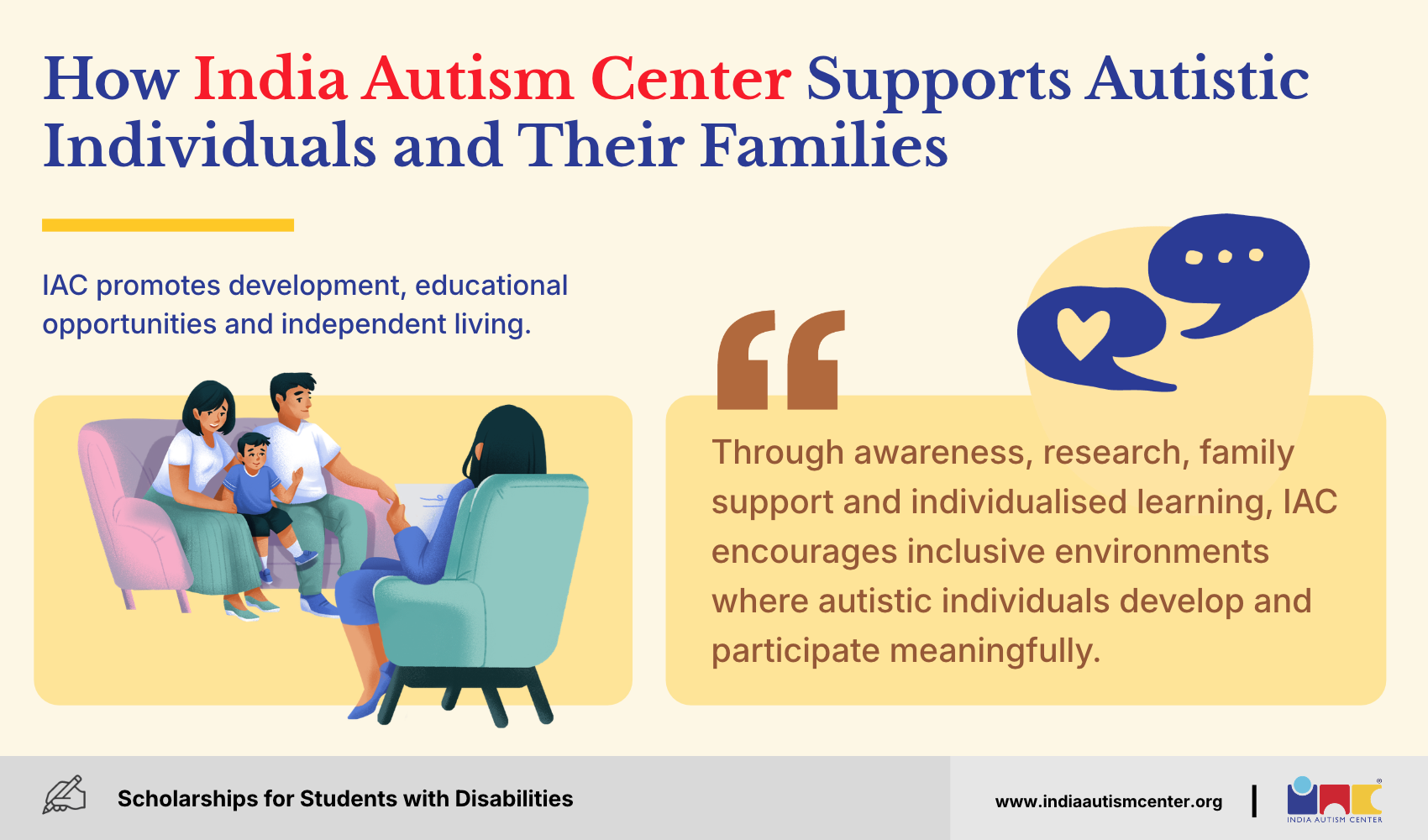
    Family on a sofa illustrating how India Autism Center supports individuals with autism and their families

    At India Autism Center (IAC), we recognise that access to education, appropriate developmental support and opportunities for independent living are essential for individuals with autism.

    Financial assistance can help families manage educational expenses, while awareness of autism, early intervention and individualised learning approaches can address different developmental and educational needs. We believe every individual deserves opportunities to learn, develop necessary life skills and participate meaningfully in society.

    Through awareness, research, family support and a commitment to inclusive environments, India Autism Center aims to contribute towards a society where individuals on the autism spectrum can access the opportunities and support they need to thrive.

    Conclusion
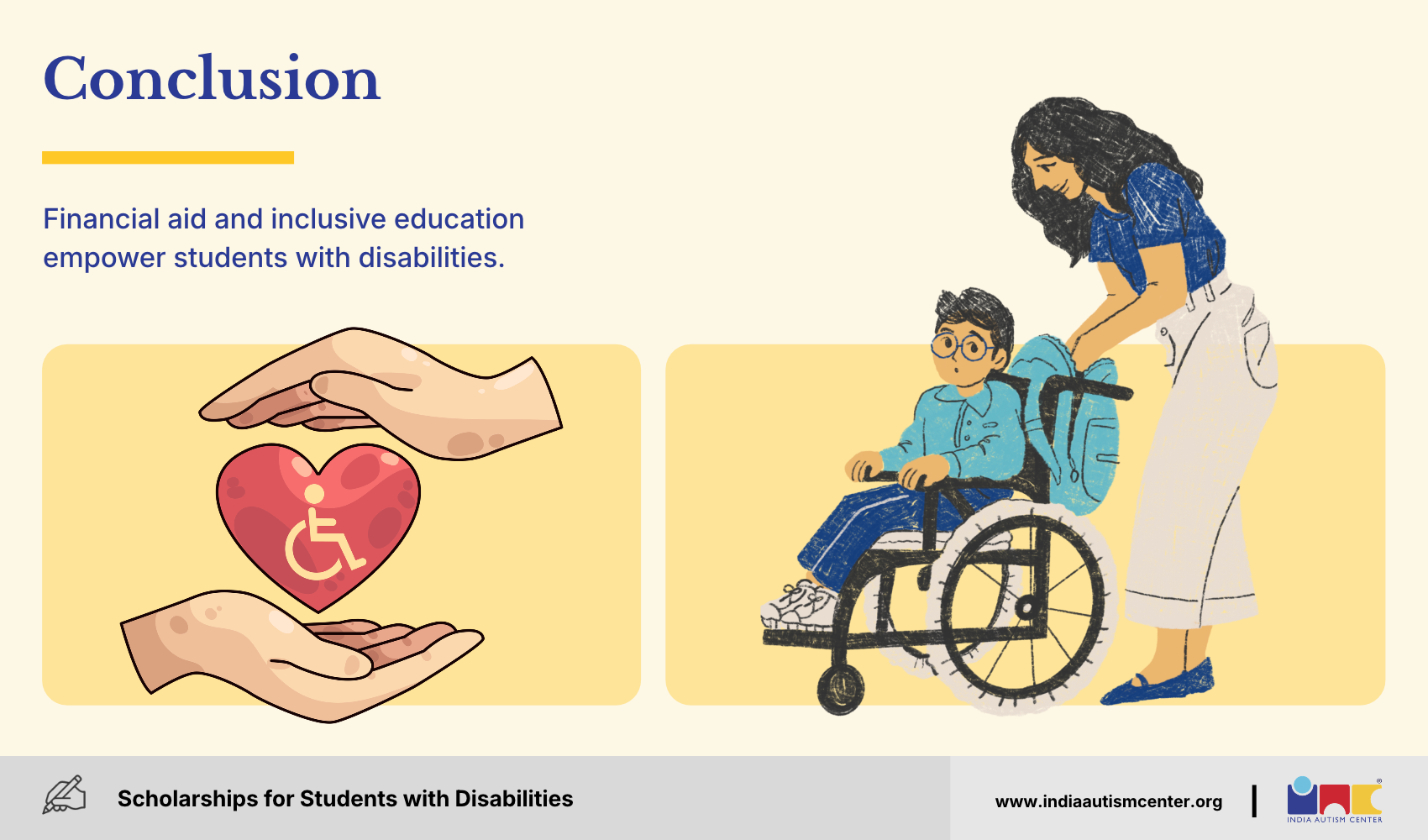
    Hands holding a heart and a parent with a child in a wheelchair illustrating the conclusion on disability scholarships

    Scholarships for students with disabilities can make education more accessible by reducing financial barriers and creating opportunities for academic and professional growth. From secondary education scholarships to postgraduate assistance and research fellowships, several government programmes meet different educational needs.

    Students and parents should understand eligibility requirements, keep disability documentation current and regularly check official portals for application updates. Combining financial assistance with accessible learning environments and appropriate educational support can help students with disabilities pursue their aspirations with greater confidence.

    Frequently Asked Questions

    1. What are the best scholarships for students with disabilities in India?

    Major options include the Pre-Matric Scholarship, Post-Matric Scholarship and Top Class Education Scholarship, administered by the Department of Empowerment of Persons with Disabilities. Research students can also explore the National Fellowship for Persons with Disabilities.

    2. Who is eligible for a PwD scholarship in India?

    Most Central Government disability scholarships require applicants to be Indian citizens with at least 40% benchmark disability. Other conditions may include family income limits, academic qualifications, admission to a recognised institution and valid disability documentation.

    3. Can students with autism apply for disability scholarships?

    Yes. Autism Spectrum Disorder is one of the 21 specified disabilities recognised under the RPwD Act, 2016. However, students generally need an officially assessed benchmark disability of at least 40% to qualify for the Central Government schemes discussed above. Other scheme-specific conditions also apply.

    4. Can students with ADHD apply for scholarships for disabled students?

    Students with ADHD may explore relevant educational assistance programmes. However, ADHD diagnosis alone does not automatically establish eligibility for government PwD scholarships. Applicants must meet the applicable disability assessment and certification requirements.
  • Difference Between Temporary and Permanent Disability

    Difference Between Temporary and Permanent Disability

    TL;DR

    • The main difference between temporary and permanent disability is how long the impairment is expected to last, not how severe it is.
    • A temporary disability can become permanent if recovery is incomplete or complications cause lasting limitations.
    • In India, support for permanent disability includes the disability certificate and UDID card, government schemes, and education and rehabilitation services.
    • Families should plan for changing support needs, since assessments and eligibility can change over time.

    An injury can leave someone unable to walk for weeks, while a lifelong condition may require support with communication, learning or everyday activities. But does the duration of a disability determine how much support a person needs? 

    Understanding temporary vs. permanent disability helps individuals and families make informed decisions about treatment, rehabilitation, financial assistance and long-term care. 

    The World Health Organization (WHO) states that 1.3 billion people, or in other words, 16% of the global population, experience significant disability. Although some impairments improve with treatment, others require lifelong support. 

    Knowing the distinction is especially important for families supporting autistic individuals and people with intellectual disabilities.

    What Is Temporary Disability?

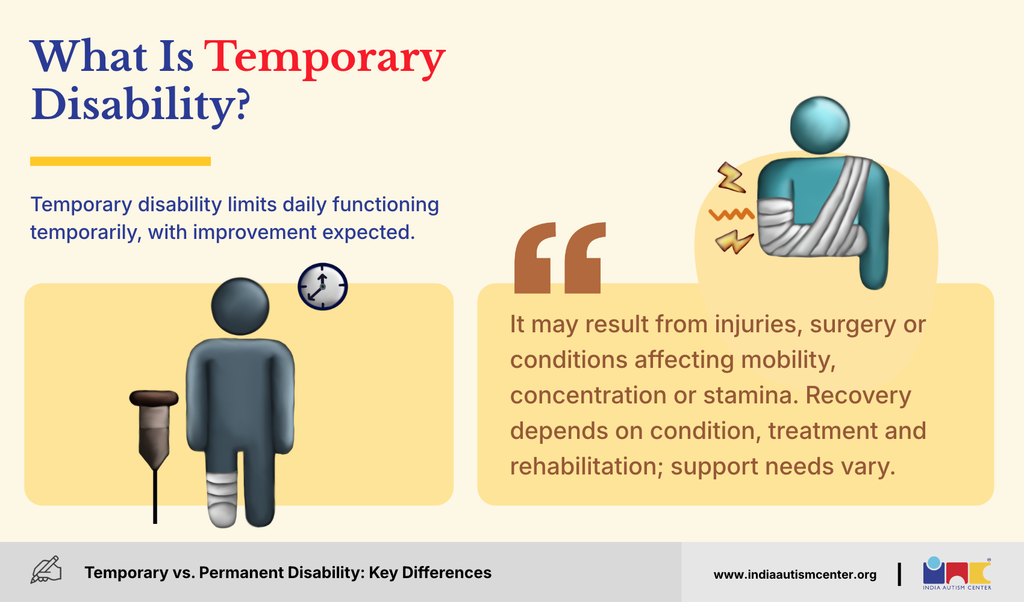
    Infographic explaining temporary disability, recovery, and short-term mobility limitations.

    The meaning of temporary disability is an injury, illness or impairment that limits a person’s ability to work, study or perform everyday activities for a limited period, with recovery or improvement expected.

    Imagine someone who fractures their leg in an accident. They may need crutches, physiotherapy and help with daily tasks for several weeks. As the fracture heals, they may gradually regain mobility and return to their usual routine. This is a typical example of temporary disability.

    However, temporary disability is not limited to physical injuries. It can also involve cognitive functioning, stamina, or other abilities affected by a health condition.

    Examples include:

    • A fractured limb that temporarily restricts movement.
    • Recovery following surgery that limits everyday activities.
    • An injury that prevents someone from performing their usual job for a period.
    • A health condition that temporarily affects concentration or physical endurance.

    The duration depends on the underlying condition, its severity, treatment and the person’s response to rehabilitation. Some people recover fully, while others experience complications or lasting impairments.

    Temporary disability does not necessarily mean that someone is completely dependent on others. A person may manage most activities independently but need assistance with specific tasks during recovery.

    What Is Permanent Disability?

    Infographic explaining permanent disability and long-term support, with a wheelchair illustration.

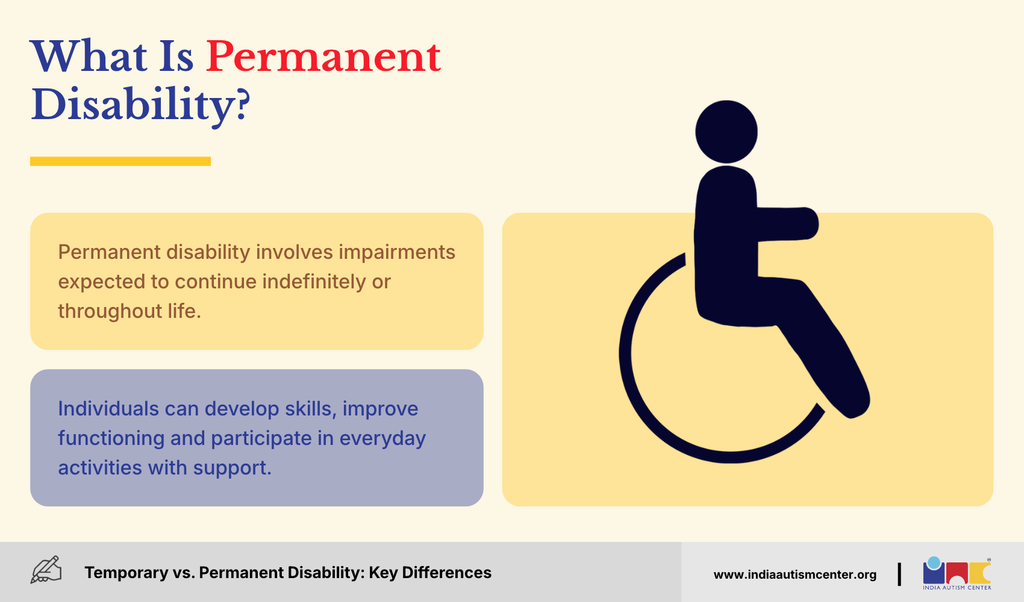
    The meaning of Permanent disability is an impairment or functional limitation expected to continue indefinitely or throughout a person’s lifetime.

    It may result from a congenital condition, an injury, an illness or a progressive health condition. Unlike temporary disability, the underlying impairment is not generally expected to resolve completely, although a person’s abilities and support needs may change.

    Examples include:

    • Permanent vision or hearing impairment.
    • A spinal cord injury resulting in lasting mobility limitations.
    • Certain lifelong neurological conditions that affect daily functioning.
    • A lifelong neurodevelopmental condition that may involve ongoing support needs like Autism Spectrum Disorder (ASD) or Attention Deficit Hyperactivity Disorder (ADHD).

    It is important to understand that permanent disability does not mean permanent dependence. Someone with a mobility impairment may learn to use a wheelchair independently, while an autistic person may develop communication, self-care and daily living skills through appropriate support.

    The aim is not necessarily to eliminate the underlying condition. It is to help the individual participate in education, employment, relationships and community life as meaningfully as possible.

    Temporary vs. Permanent Disability: What Are the Key Differences?

    Infographic comparing temporary and permanent disability by duration, recovery, and support needs.

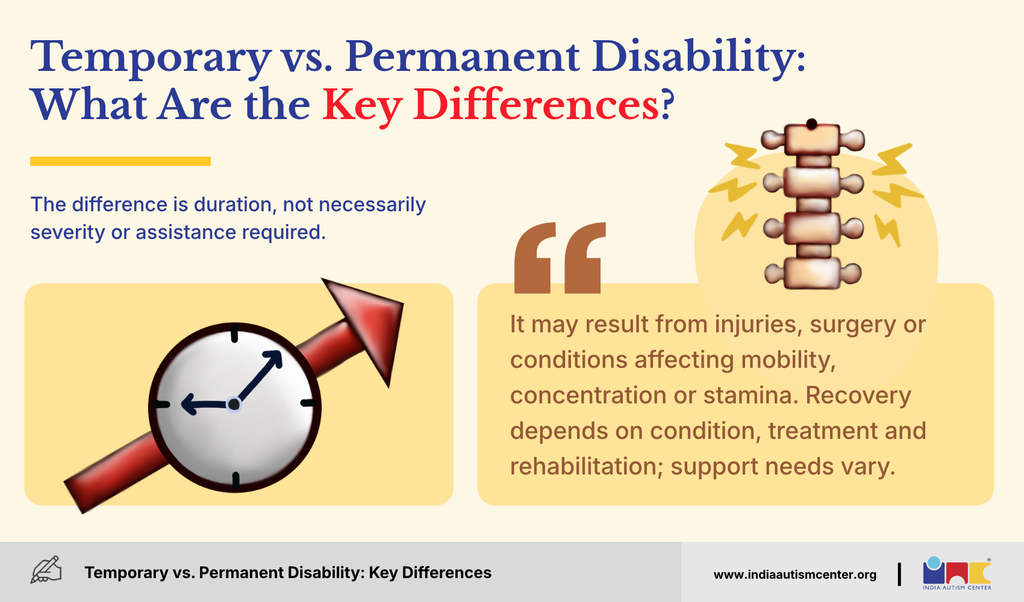
    The primary difference between temporary and permanent disability is the expected duration of the impairment. However, duration alone does not determine its severity, the assistance required, or eligibility for financial benefits.

    FactorTemporary disabilityPermanent disability
    DurationExpected to improve or resolve over timeExpected to persist indefinitely
    RecoveryFull or substantial recovery may be possibleThe underlying impairment may remain, although functioning can improve
    TreatmentOften focuses on healing and restoring functionMay focus on rehabilitation, adaptation and ongoing support
    Daily assistanceUsually depends on recovery needsMay range from occasional help to lifelong assistance
    Financial impactMay involve temporary income loss and medical expensesMay involve continuing expenses or changes in earning capacity
    PlanningOften focuses on recovery and returning to usual activitiesMay require long-term care, accessibility and financial planning
    BenefitsDepend on insurance, employment arrangements and applicable schemesDepend on certification, scheme-specific eligibility and individual circumstances

    Consider two people who experience significant difficulty walking. One may regain mobility after surgery and rehabilitation, while the other may have a permanent mobility impairment and use a wheelchair. Both may need assistance, but their treatment, financial planning and longer-term support arrangements can differ considerably.

    This is why understanding temporary vs. permanent disability requires more than looking at a diagnosis. Medical prognosis, functional limitations and the relevant legal or insurance criteria all matter.

    Can Temporary Disability Become Permanent?

    Infographic explaining how temporary disability may become permanent if recovery remains incomplete.

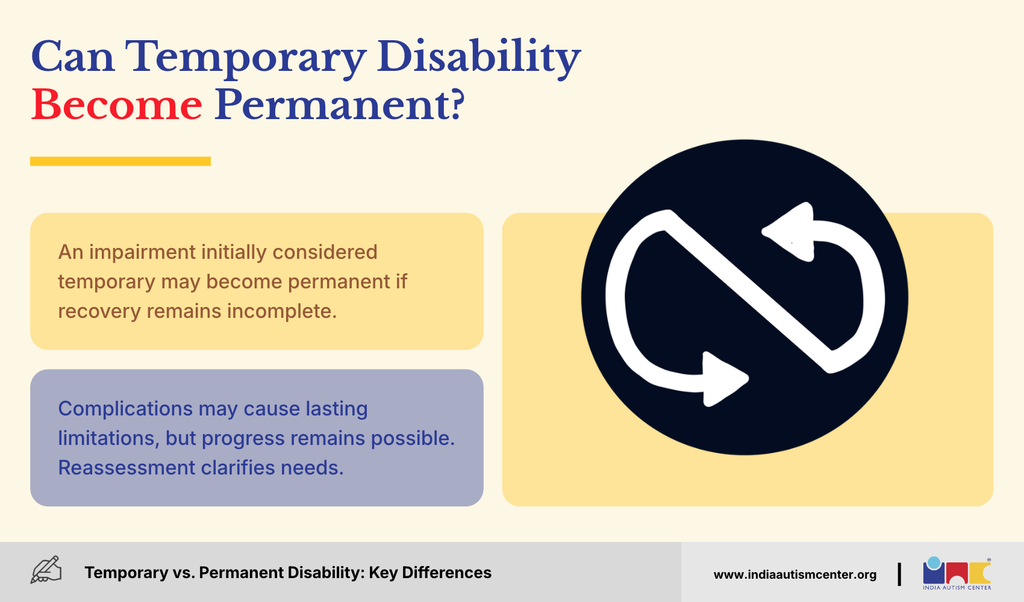
    Yes. An impairment initially expected to resolve may become permanent if recovery is incomplete or complications result in lasting damage.

    For example, a person who sustains a serious injury may initially need assistance only during rehabilitation. If the injury causes permanent nerve damage, however, the resulting limitations may continue indefinitely.

    The reverse distinction is equally important: a permanent disability does not prevent a person from making progress. With appropriate interventions, someone may develop new skills, improve mobility, or become more independent.

    A healthcare professional can assess the likely course of recovery. However, medical prognosis and formal disability classification are not always identical. An insurer or government authority may use specific assessment criteria to determine eligibility for benefits or certification.

    If a condition’s impact changes, the person or their family should seek an appropriate reassessment rather than assume that the original classification will answer every future question.

    What Are Temporary Disability Benefits?

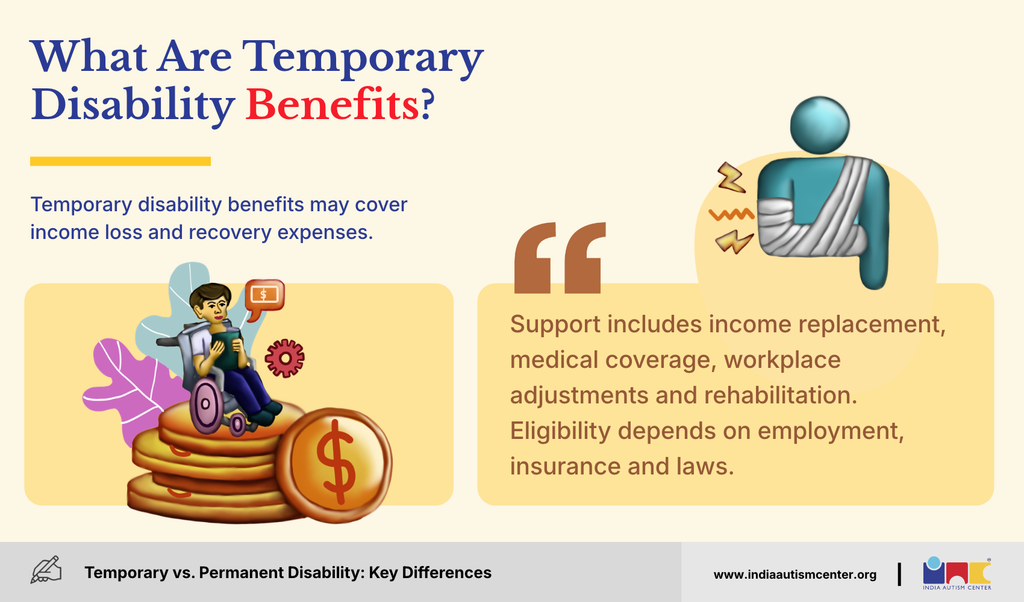
    Infographic about temporary disability benefits, including income replacement and rehabilitation support.

    Temporary disability benefits are forms of financial or practical assistance that may help eligible people manage income loss and additional expenses while their functioning is restricted.

    These benefits are not automatically available to everyone with a temporary impairment. Their availability depends on the country, employment arrangements, insurance coverage and applicable statutory provisions.

    Depending on the circumstances, assistance may include:

    • Income replacement: Payments through an eligible insurance policy, employment arrangement or statutory scheme.
    • Medical expenses: Cover for eligible treatment, hospitalisation or rehabilitation under the relevant policy or programme.
    • Workplace adjustments: Temporary changes to duties, responsibilities or working hours where appropriate.
    • Rehabilitation: Physiotherapy, occupational therapy or other clinically appropriate interventions.
    • Practical assistance: Help with transport, personal care or daily activities, depending on available services.

    In India, no single universal temporary disability payment automatically covers everyone who becomes temporarily unable to work. Employees should check their employment policies, insurance arrangements and applicable legal entitlements. Depending on the circumstances, the relevant legal framework may provide compensation for employment-related injuries.

    Before making a claim, check the policy’s definition of disability, waiting periods, exclusions, medical documentation requirements and payment limits. Some policies distinguish between temporary total disability and temporary partial disability, which can affect the amount or duration of payments.

    Understanding these conditions matters because benefits during recovery may differ from those for a lasting impairment.

    What Support Is Available for Permanent Disability in India?

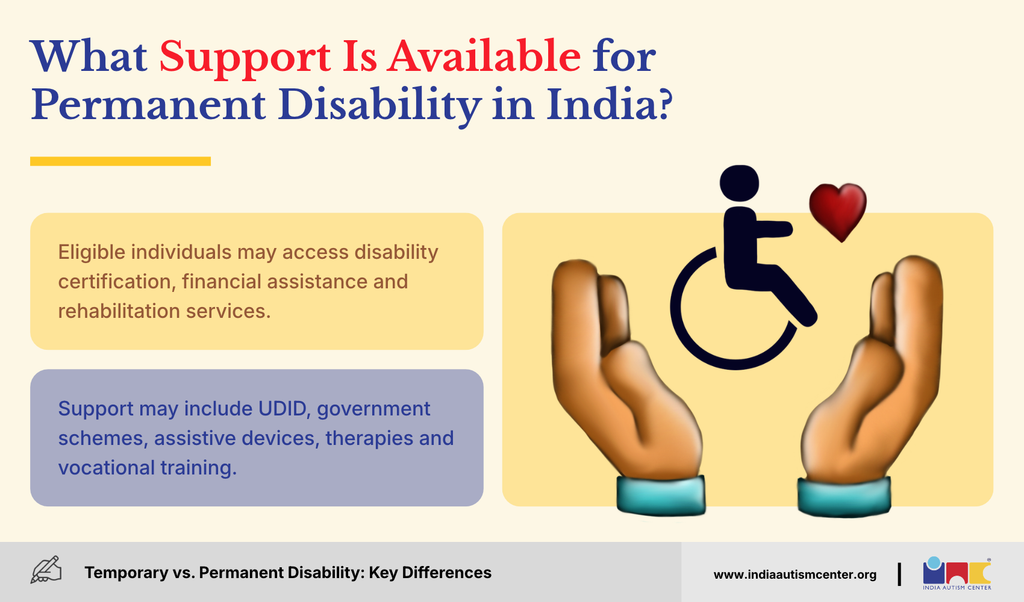
    Infographic showing permanent disability support in India, including certification, schemes, and assistive devices.

    Permanent disability support can extend beyond financial assistance. Depending on the person’s needs and eligibility, it may include disability certification, government schemes, assistive devices, educational accommodations and rehabilitation services.

    1. Disability certificate and UDID card

    The Unique Disability ID (UDID) initiative provides a standardised system for disability identification in India. Eligible individuals can apply through the official UDID portal and undergo assessment by the authorised medical authority. 

    Under the Rights of Persons with Disabilities Act (RPwD), 2016, benchmark disability generally refers to a specified disability assessed at not less than 40%, as defined by the Act. This threshold applies to specific entitlements, but it should not be treated as a universal requirement for every disability-related service.

    Families should also distinguish between a clinical diagnosis and a government disability certificate. A diagnosis identifies a condition, whereas certification follows the applicable assessment and administrative requirements.

    2. Government schemes and financial assistance

    Eligible individuals may access disability pensions, scholarships, assistive devices, healthcare support and other welfare benefits. Requirements differ between central and state government programmes.

    The Assistance to Persons with Disabilities for Purchase/Fitting of Aids and Appliances (ADIP) Scheme supports eligible beneficiaries with assistive devices under its applicable rules. Families can learn more through our guide to the ADIP Scheme.

    It is also worth exploring the government schemes available for persons with disabilities in India. Always verify current eligibility conditions, application procedures, and benefit amounts with the relevant authority.

    3. Education, rehabilitation and daily living support

    A disability may affect how someone communicates, learns, moves around or manages everyday responsibilities. Appropriate support can help address these barriers.

    Depending on individual needs, services may include special education, speech and language therapy, occupational therapy, accessible transport, communication aids and vocational training.

    Assistive technology can also improve access to education and everyday activities. For autistic individuals and someone with intellectual disabilities, personalised early interventions may support communication, self-care, social participation and practical life skills.

    Families can also explore the different types of intellectual disability to better understand why support requirements vary between individuals. A diagnosis alone does not determine someone’s abilities or future potential.

    Read our article on How to Apply for Disability Certificate in West Bengal? (Complete Guide) and How to Get a Disability Certificate in UP: Step-by-Step Complete Guide.

    How Is Disability Assessed?

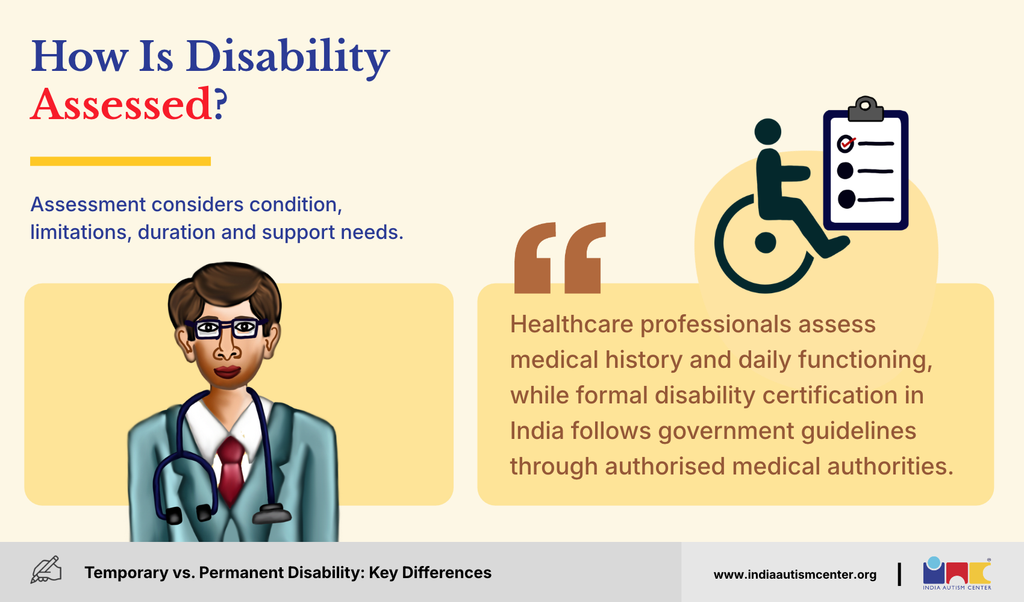
    Infographic explaining disability assessment in India based on medical history, daily functioning, and support needs.

    Disability assessment considers the underlying condition, its effect on functioning, expected duration and, where relevant, the person’s support requirements. The process varies according to whether the assessment is for medical treatment, an insurance claim or official certification.

    Healthcare professionals may review medical history, examination findings, investigations and response to treatment. Depending on the condition, assessment may also consider mobility, communication, cognitive functioning and everyday activities.

    In India, formal disability certification is undertaken by an authorised medical authority under the applicable government guidelines. The assessment and documentation requirements depend on the specified disability.

    For example, assessing autism or intellectual disability involves considering developmental history and functioning rather than simply whether someone can perform a single task independently. A clinical diagnosis does not automatically establish a particular disability percentage.

    Families should keep relevant medical reports, assessment records and treatment summaries. If an application is refused or a decision appears incorrect, they should ask the responsible authority about available review or appeal procedures.

    How Can Families Plan for Changing Support Needs?

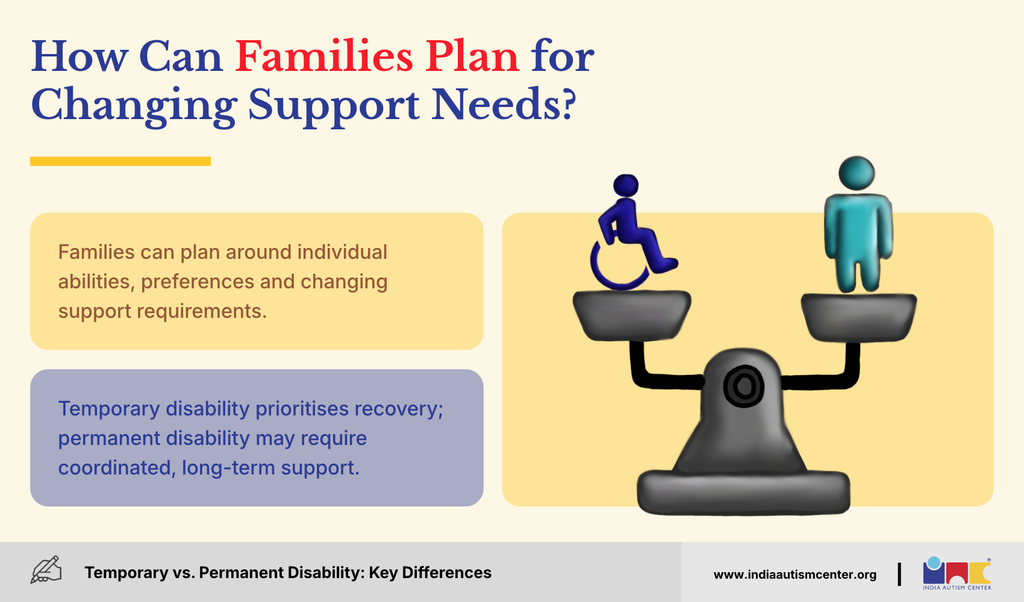
    Infographic showing how families can plan for changing temporary and permanent disability support needs.

    The practical implications of temporary vs. permanent disability extend beyond medical appointments and paperwork. Families benefit from planning around the individual’s current abilities, preferences and foreseeable needs.

    For temporary disability, priorities may include safe recovery, rehabilitation, accessible transport and a gradual return to school, work or usual activities.

    For permanent disability, planning may involve:

    • Reviewing accessibility and safety at home, school or work.
    • Identifying appropriate communication aids and assistive technology.
    • Coordinating healthcare, education and rehabilitation services.
    • Exploring eligible financial assistance and disability-related schemes.
    • Considering future care arrangements, financial planning and the individual’s preferences.

    Families supporting autistic individuals may also benefit from learning about communication support and alternative communication methods. These approaches can help people express their needs, preferences and decisions in ways suited to their abilities.

    Review support plans as circumstances change. The objective is to address actual needs without assuming that a permanent condition prevents progress or that a temporary impairment will always resolve completely.

    How India Autism Center Supports Individuals and Families

    Infographic outlining India Autism Center services, including therapies, life skills, vocational training, and living programmes.

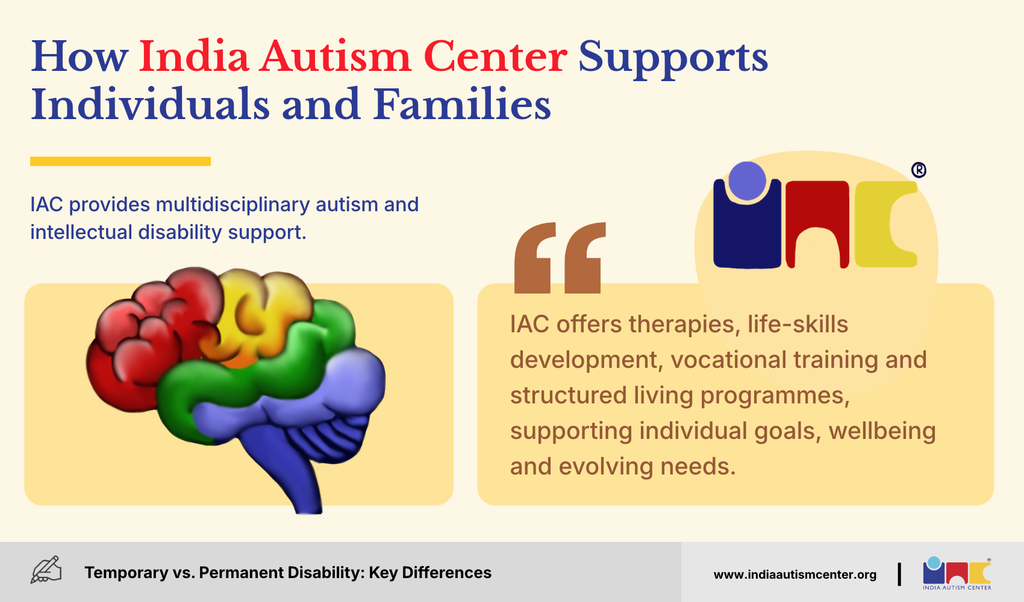
    India Autism Center (IAC) focuses on supporting autistic individuals and people with intellectual disabilities through personalised, multidisciplinary care. Recognising that every individual has different abilities, communication preferences and support needs, its approach may incorporate therapies, life-skills development, vocational training and structured living programmes according to individual requirements. 

    For families navigating long-term disability, coordinated support can connect everyday care with opportunities for participation, wellbeing and greater independence. 

    The emphasis is on understanding the person, setting meaningful goals and adapting support as needs evolve, rather than defining someone’s future solely by a diagnosis or disability classification.

    Conclusion

    Conclusion infographic showing a family and how disability duration informs assessment and individualised support planning.

    Understanding temporary vs. permanent disability helps individuals and families distinguish recovery-focused care from long-term support. Temporary disability may improve with treatment and rehabilitation, while permanent disability can require ongoing adaptations and assistance. Neither classification alone determines a person’s abilities or quality of life.

    In India, disability certification, insurance benefits and government assistance follow different eligibility rules. Seeking professional assessment, checking official requirements and developing an individualised support plan can help people access relevant services and participate more fully in everyday life.

    Frequently Asked Questions

    1. What is the main difference between temporary and permanent disability?

    Temporary disability is expected to improve or resolve over time, whereas permanent disability is expected to continue indefinitely. Both can affect daily functioning, and their severity varies between individuals.

    2. Can temporary disability become permanent?

    Yes. An injury or illness initially expected to resolve may cause lasting impairment. Medical reassessment can help clarify the prognosis and identify appropriate rehabilitation or ongoing support.

    3. Are temporary disability benefits available in India?

    They may be available depending on employment arrangements, insurance coverage, the circumstances of the injury or illness and applicable legal provisions. India does not provide one universal temporary disability payment to everyone.

    4. Does permanent disability mean a person cannot work?

    No. Many people with permanent disabilities work, study and participate in community life. Accessibility, reasonable accommodation, assistive technology and appropriate support can help reduce barriers.

    5. Is autism considered a permanent disability?

    Autism spectrum disorder is known to be a lifelong neurodevelopmental condition. However, support needs and functional abilities vary considerably, and individuals can develop skills and greater independence over time.

  • Types of Intellectual Disability Explained: Levels, Warning Signs & Support Every Parent Should Know!

    Types of Intellectual Disability Explained: Levels, Warning Signs & Support Every Parent Should Know!

    A child may learn to speak later than their peers, struggle to understand new concepts, or need extra help with everyday activities. While these differences do not automatically indicate intellectual disability, persistent difficulties across learning and daily functioning may warrant a professional assessment. 

    The American Psychiatric Association estimates that intellectual disability affects approximately 1% of the population, with around 85% of affected individuals having mild intellectual disability. 

    Understanding the types of intellectual disability, their signs and available support helps families recognise concerns early and make informed decisions about education, therapy and long-term independence.

    What Is Intellectual Disability?

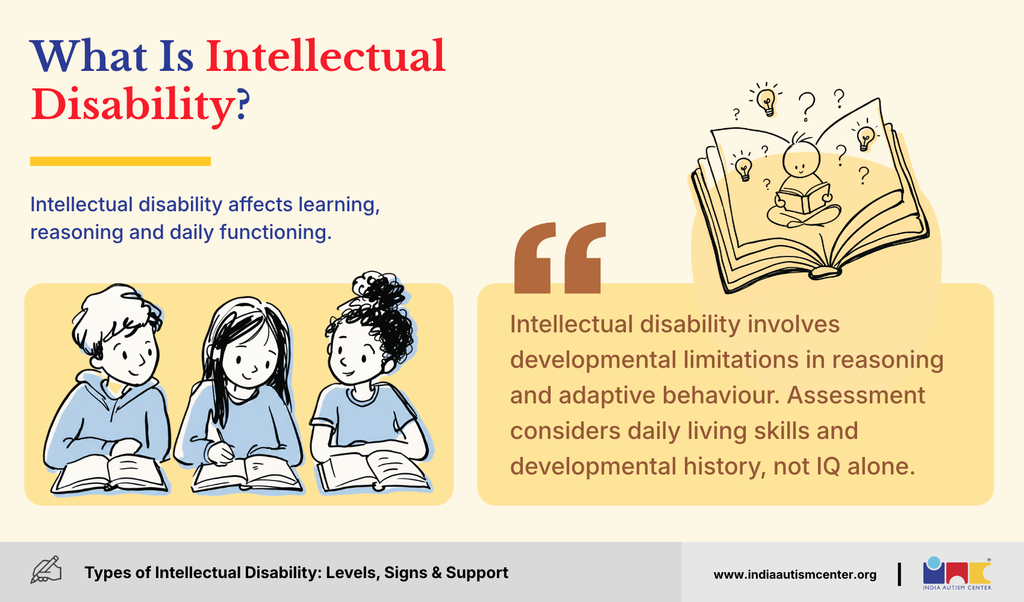
    Explanation of intellectual disability affecting learning, reasoning and adaptive behaviour

    Intellectual disability is a neurodevelopmental condition characterised by significant limitations in intellectual functioning and adaptive behaviour that begin during development. It can affect how a person learns, communicates, solves problems and manages everyday responsibilities.

    Intellectual functioning includes reasoning, memory, learning and decision-making. Adaptive behaviour refers to the conceptual, social and practical skills needed to navigate daily life.

    As per the American Association on Intellectual and Developmental Disabilities (AAIDD), a diagnosis involves three key considerations:

    • Significant limitations in intellectual functioning, like reasoning and problem-solving.
    • Significant limitations when it comes to adaptive behaviour, including communication, social understanding, and practical daily living skills.
    • Onset during the developmental period.

    An IQ score around 70 to 75 may indicate a significant limitation in intellectual functioning, but an IQ score alone cannot confirm intellectual disability. Assessment must also consider adaptive behaviour, developmental history and individual circumstances.

    The term cognitive disability is broader than intellectual disability and can describe difficulties affecting thinking, learning, memory or other cognitive functions. The two terms are related but are not interchangeable in every context.

    What Are the Four Types of Intellectual Disability?

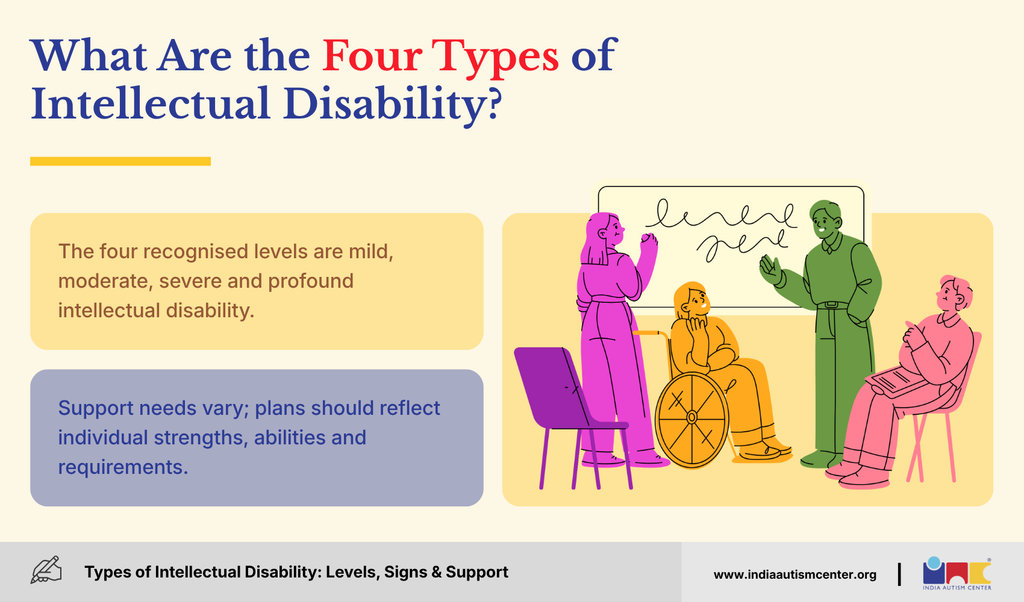
    Four levels of intellectual disability: mild, moderate, severe and profound

    The four commonly recognised levels are mild, moderate, severe and profound intellectual disability. These categories describe the general extent of limitations in intellectual and adaptive functioning.

    However, they are not rigid descriptions of a person’s abilities. Someone may need considerable help with communication but manage certain daily activities independently. Support should therefore be based on individual needs rather than a label alone.

    1. Mild Intellectual Disability

    People with mild intellectual disability may take longer to learn academic concepts, understand abstract ideas, or solve unfamiliar problems. These difficulties can become more noticeable as schoolwork and everyday responsibilities grow more complex.

    Common characteristics include:

    • Difficulty understanding complicated instructions and abstract concepts.
    • Slower development of reading, writing, and mathematical skills.
    • Challenges with budgeting, planning and managing time.
    • Needing guidance when making unfamiliar decisions.

    For example, a student may understand basic addition but struggle with multi-step word problems. Breaking the task into smaller parts, using visual examples, and providing repeated practice can improve understanding.

    With appropriate education and opportunities to develop practical skills, many people with mild intellectual disability can work, maintain relationships, and live independently or with limited support.

    2. Moderate Intellectual Disability

    Moderate intellectual disability generally involves more noticeable difficulties with learning, communication, and everyday functioning. Individuals may develop functional academic and self-care skills but often need structured teaching and regular assistance.

    Possible characteristics include:

    • Difficulty understanding complex language and unfamiliar instructions.
    • Needing repeated demonstrations to learn new tasks.
    • Requiring support with money management, travel or personal care.
    • Finding it difficult to recognise risks or navigate unfamiliar social situations.

    For instance, a teenager may learn to prepare a simple meal by following picture-based instructions but still need reminders about kitchen safety. Individualised education, speech and language therapy, occupational therapy, and supported practice can help build communication, self-care, and social skills.

    3. Severe Intellectual Disability

    Severe intellectual disability involves substantial limitations in intellectual functioning and adaptive behaviour. Individuals may communicate through a small number of spoken words, gestures, pictures or assistive communication systems, although communication abilities vary considerably.

    Common characteristics may include:

    • Significant difficulty understanding spoken instructions.
    • Needing extensive assistance with dressing, bathing or eating.
    • Limited ability to complete unfamiliar activities independently.
    • Requiring close supervision to maintain safety.

    Support may include personalised education, communication interventions, personal care and coordinated healthcare. Consistent routines and visual cues can help individuals understand what is happening and participate in familiar activities.

    4. Profound Intellectual Disability

    Profound intellectual disability is associated with extensive support needs across most areas of daily life. Some individuals also have physical, sensory or medical conditions that affect movement, feeding or communication.

    Possible characteristics include:

    • Very limited conventional speech, with communication through facial expressions, gestures, sounds or assistive systems.
    • Extensive assistance with personal care and everyday activities.
    • Significant challenges with mobility or understanding the surrounding environment.
    • The need for ongoing supervision and coordinated support.

    The focus is on health, comfort, communication, meaningful engagement and quality of life. Even when a person needs extensive assistance, their preferences and responses should be recognised and respected.

    What Are Some of the Signs and Symptoms of Intellectual Disability?

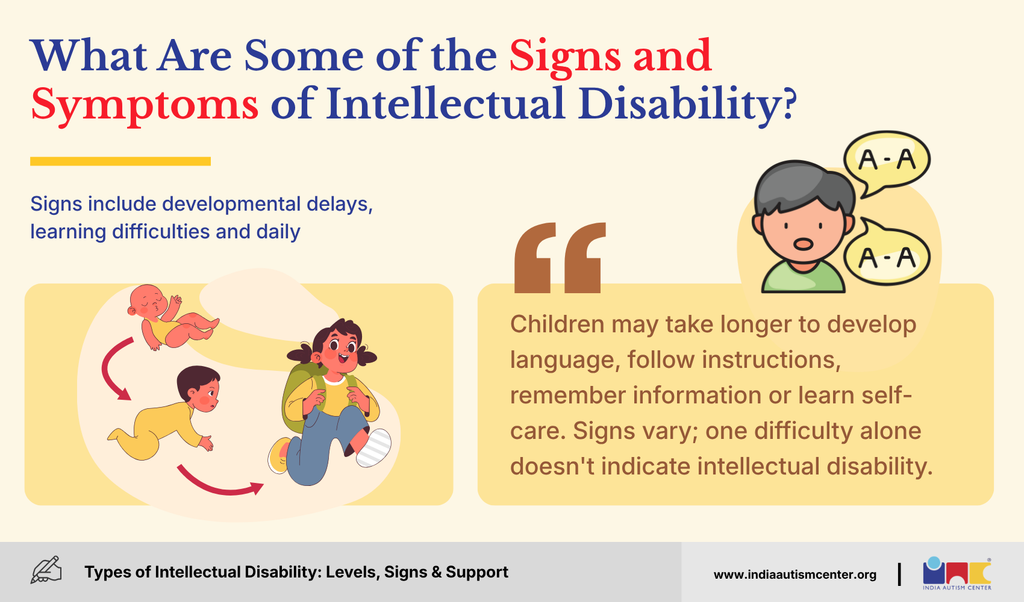
    Signs of intellectual disability including developmental delays and learning difficulties

    Intellectual disability symptoms differ by age, developmental profile, and support needs. Some signs appear in infancy or early childhood, while others emerge as learning and daily responsibilities become more demanding.

    Developmental Signs in Children

    Parents may notice that a child takes longer to acquire certain skills. However, developmental milestones vary, and a delay in one area does not automatically indicate intellectual disability.

    Potential signs include:

    • Delays in developing speech, understanding language or following simple instructions.
    • Taking longer to learn concepts such as numbers, shapes or colours.
    • Difficulty remembering information or applying previously learned skills.
    • Needing more help than expected with dressing, feeding and other self-care activities.
    • Challenges with age-appropriate problem-solving and social understanding.

    The pattern, persistence and extent of these difficulties matter more than any single behaviour.

    Learning, Communication and Social Difficulties

    A child may struggle to understand new information, remember instructions or apply a familiar skill in a different setting. They may need more repetition and hands-on demonstrations to learn effectively.

    Communication difficulties can affect the ability to express needs, understand conversations, or follow instructions. Some individuals develop spoken language, while others benefit from gestures, picture symbols or augmentative and alternative communication (AAC).

    Social and practical challenges may include difficulty recognising risks, understanding social boundaries, managing changes in routine or making everyday decisions.

    The older phrase mental retardation symptoms is outdated and can be stigmatising. Intellectual disability is the appropriate contemporary term.

    Importantly, these signs can also occur in children with hearing difficulties, language disorders, autism or other developmental conditions. A qualified professional can help to understand the underlying cause.

    What Causes Intellectual Disability?

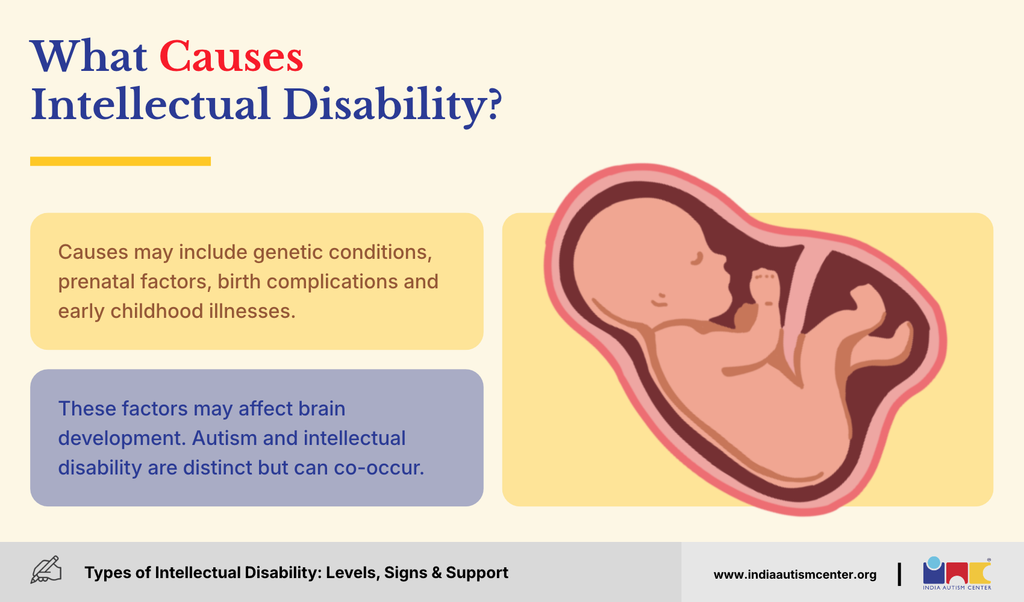
    Possible causes of intellectual disability including genetic and prenatal factors

    Intellectual disability can result from genetic, biological and environmental factors that affect brain development. Sometimes the cause is identifiable; in other cases, it remains unknown.

    Common causes and associated factors include:

    • Genetic conditions: Down syndrome, fragile X syndrome or certain other genetic or chromosomal conditions.
    • Prenatal factors: Certain infections during pregnancy, prenatal alcohol exposure and other factors affecting foetal development.
    • Birth-related complications: Significant brain injury or oxygen deprivation around birth.
    • Early childhood conditions: Serious infections affecting the brain, traumatic brain injury and certain other medical conditions.

    These factors do not inevitably cause intellectual disability. Risk depends on the specific condition and circumstances.

    Autism Spectrum Disorder (ASD) can co-occur with intellectual disability, but the two are distinct. An autistic person does not automatically have intellectual disability, and a person with intellectual disability is not necessarily autistic.

    How Is Intellectual Disability Diagnosed?

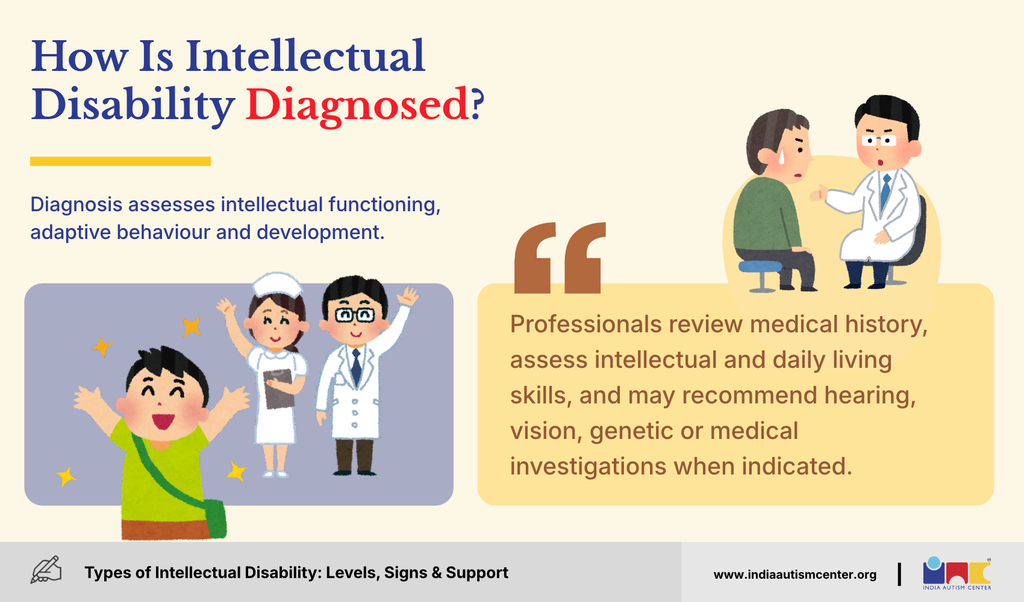
    Diagnosis of intellectual disability through assessment of intellectual functioning and adaptive skills

    Diagnosis requires a comprehensive assessment of intellectual functioning, adaptive behaviour and developmental history. It cannot be established through a checklist of symptoms or an IQ score alone.

    The process may involve:

    1. Developmental and medical history: Reviewing milestones, health conditions, family history and concerns raised by parents or teachers.
    2. Intellectual assessment: Using appropriate standardised tests to examine reasoning, memory, learning and problem-solving.
    3. Adaptive behaviour assessment: Evaluating conceptual, social and practical skills in everyday settings.
    4. Additional investigations: Considering hearing and vision assessments, genetic testing or other medical investigations when indicated.

    A developmental pediatrician, clinical psychologist or another appropriately qualified professional may coordinate the assessment.

    An important part of diagnosis is identifying strengths and support needs. For example, a child who struggles with spoken instructions may understand tasks more effectively through demonstrations or visual aids.

    Parents should seek advice if developmental concerns persist or if a child loses skills they previously had. Support for identified difficulties can begin while further assessments are being arranged.

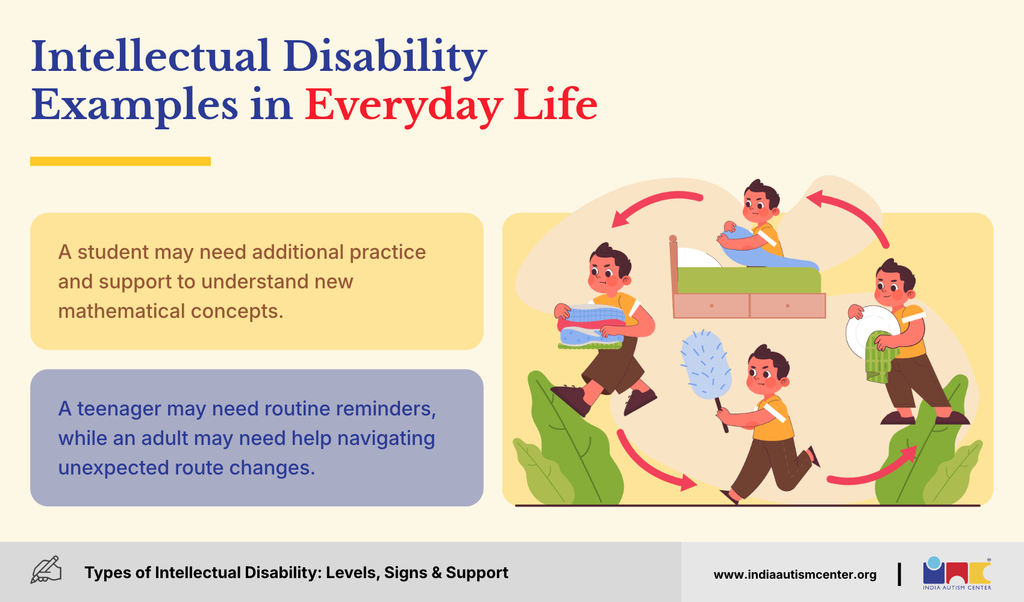
    Intellectual Disability Examples in Everyday Life

    Everyday examples of intellectual disability involving learning and changes in routine

    Practical examples of intellectual disability help explain how the condition can affect daily activities without suggesting that every individual has the same experience.

    • At school: A child may need additional time, visual instructions and repeated practice to learn a mathematics concept.
    • At home: A teenager may learn to dress independently but need reminders to follow a morning routine.
    • In the community: An adult may confidently follow a familiar travel route but need assistance when the route changes unexpectedly.

    These examples illustrate why abilities must be assessed individually. A person may manage one activity independently while needing support with another.

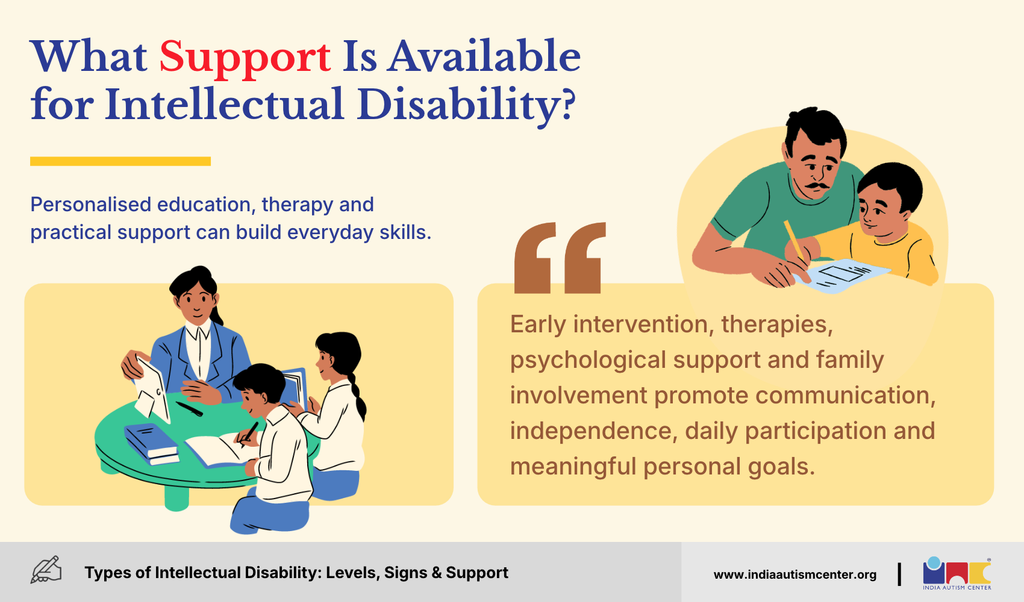
    What Support Is Available for Intellectual Disability?

    Educational, therapeutic and family support available for people with intellectual disability

    There is no single treatment that removes intellectual disability. However, personalised interventions, accessible education and practical support can help individuals develop skills, communicate more effectively and participate in everyday life.

    Early Intervention and Special Education

    Early intervention can support the development of communication, motor, social and daily living skills. Educational strategies may include breaking tasks into smaller steps, using visual materials and allowing additional practice.

    Progress should be measured against individual goals rather than relying only on comparisons with other children.

    Speech and Language Therapy

    Speech and language therapy supports understanding, expression and functional communication. Depending on individual needs, it may involve spoken language, gestures, picture-based communication or AAC.

    The end goal is to help individuals express their needs, communicate preferences and participate in decisions.

    Occupational Therapy

    Occupational therapy can help develop practical skills such as dressing, eating, handwriting, personal hygiene and completing daily routines. Therapists may recommend adaptations that make these activities more accessible.

    Psychological and Behavioural Support

    Individualised psychological and behavioural approaches can help develop useful skills, establish predictable routines and understand the reasons behind distress or behaviours that create difficulties.

    Interventions should respect the individual’s dignity, preferences and safety. They should focus on meaningful goals rather than simply making a person appear more typical.

    Family and Community Support

    Parents and caregivers help individuals practise skills outside formal sessions. Consistent routines, clear instructions and opportunities to make choices can encourage confidence and participation.

    Schools and community services can also support inclusion through appropriate accommodations, accessible activities and opportunities to build relationships.

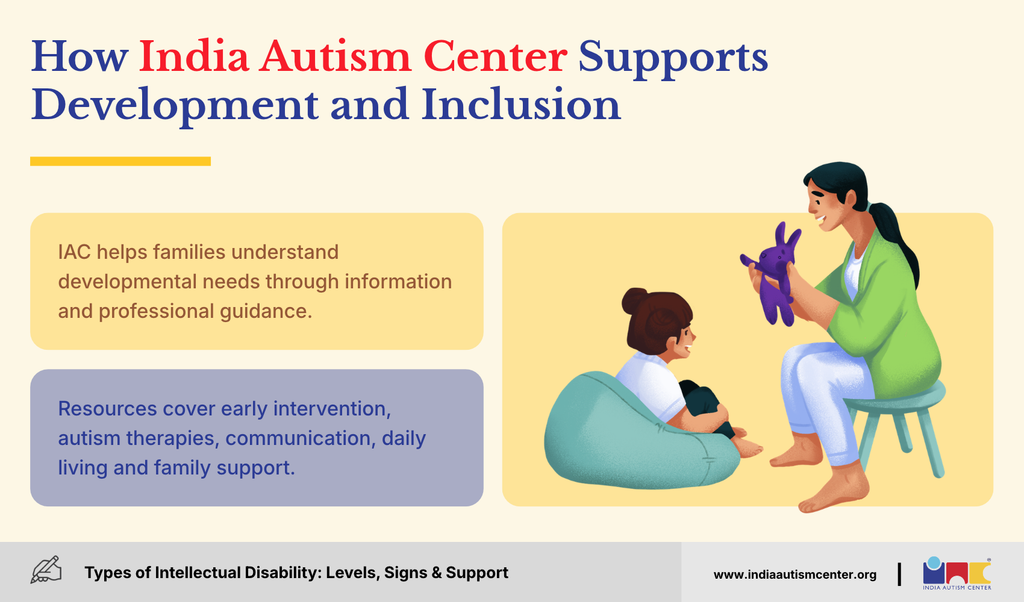
    How India Autism Center Supports Development and Inclusion

    India Autism Center resources supporting child development, communication and inclusion

    India Autism Center (IAC) recognises the importance of understanding each individual’s developmental profile, strengths and support requirements. For families navigating developmental concerns, reliable information and appropriate professional guidance can clarify the next steps.

    Depending on an individual’s assessment and care plan, support may focus on communication, daily living skills, structured learning and family involvement. Families can also explore IAC’s resources on early intervention for autism and autism therapies to learn more about developmental intervention approaches.

    Intellectual disability and autism are not interchangeable diagnoses. Select support based on the individual’s assessed needs rather than assuming the same intervention suits everyone.

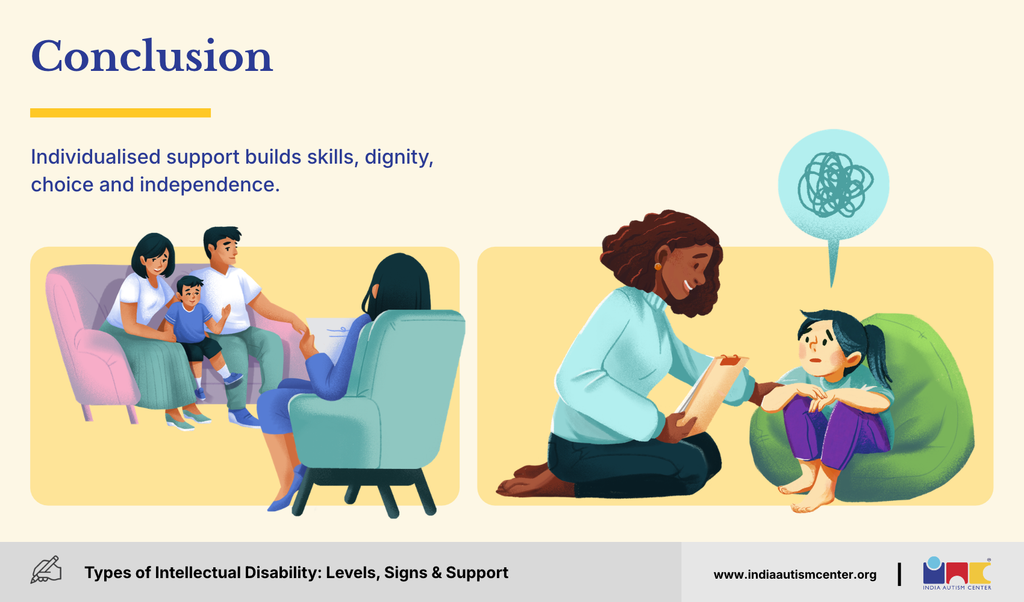
    Conclusion

    Importance of individualized support for independence and daily living skills in intellectual disability

    Understanding the types of intellectual disability helps families recognise support needs without placing unnecessary limits on an individual’s potential. Mild, moderate, severe and profound intellectual disability describe different levels of difficulty, but every person has a distinct combination of abilities and challenges. 

    Early assessment, individualised education, communication support and practical skill development can make everyday life more accessible. With appropriate support, individuals can build skills, participate in their communities and experience greater dignity, choice and independence.

    Frequently Asked Questions

    1. What are the four types of intellectual disability?

    The four commonly recognised levels are mild, moderate, severe and profound intellectual disability. They describe differences in intellectual and adaptive functioning, although individual support needs vary.

    2. What are the early symptoms of intellectual disability in children?

    Possible intellectual disability symptoms include delayed speech, slower development of age-appropriate skills, difficulty learning new concepts and challenges with everyday activities. Professional assessment is required to determine the cause.

    3. Can intellectual disability be cured?

    There is no single cure for intellectual disability. However, personalised interventions, education and ongoing support can help individuals develop skills and also improve their quality of life.

    4. Is intellectual disability the same as autism?

    No. Intellectual disability affects intellectual functioning and adaptive behaviour. Autism is a separate neurodevelopmental condition involving differences in social communication as well as restricted or repetitive behaviours. Both can occur in the same person.

    5. Can a person with intellectual disability live independently?

    Some individuals live independently, while others benefit from occasional assistance, supported living or extensive daily care. Independence depends on individual abilities, accessible environments and available support.