 Donate now
 Get a Call Back

 MENU
 11 MIN READ
 SHARE


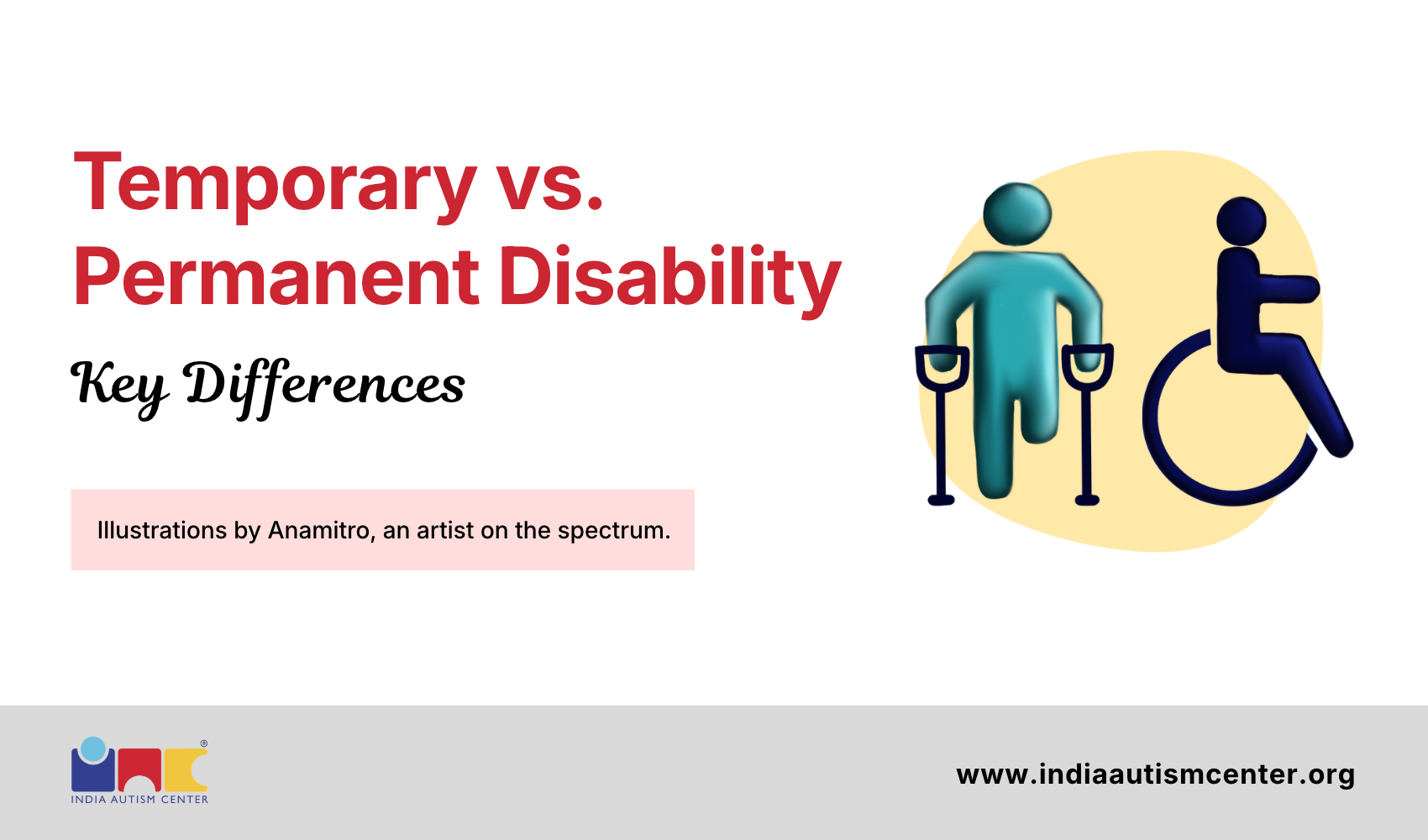
An injury can leave someone unable to walk for weeks, while a lifelong condition may require support with communication, learning or everyday activities. But does the duration of a disability determine how much support a person needs?
Understanding temporary vs. permanent disability helps individuals and families make informed decisions about treatment, rehabilitation, financial assistance and long-term care.
The World Health Organization (WHO) states that 1.3 billion people, or in other words, 16% of the global population, experience significant disability. Although some impairments improve with treatment, others require lifelong support.
Knowing the distinction is especially important for families supporting autistic individuals and people with intellectual disabilities.
What Is Temporary Disability?
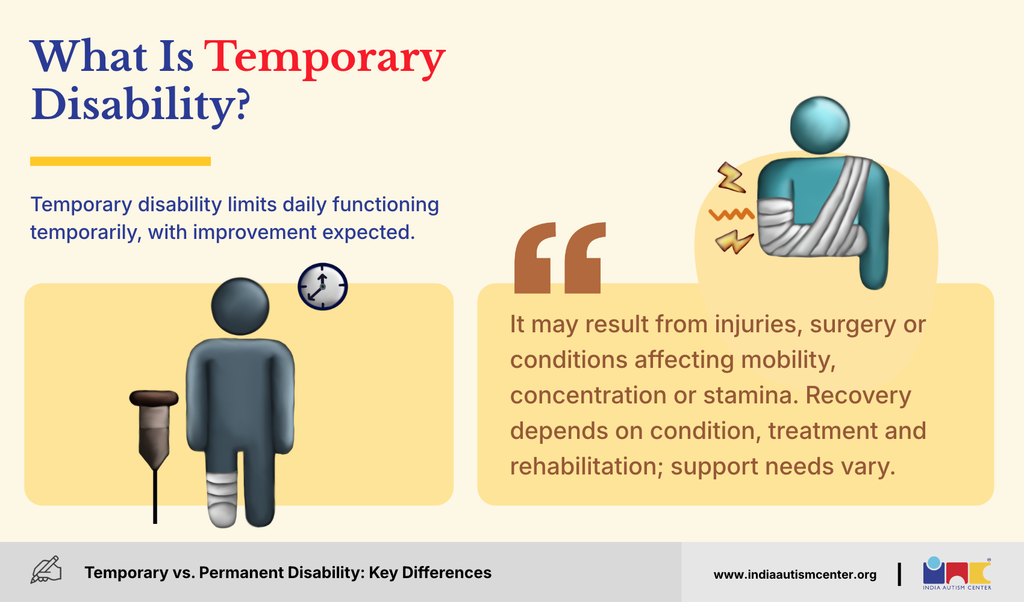
The meaning of temporary disability is an injury, illness or impairment that limits a person’s ability to work, study or perform everyday activities for a limited period, with recovery or improvement expected.
Imagine someone who fractures their leg in an accident. They may need crutches, physiotherapy and help with daily tasks for several weeks. As the fracture heals, they may gradually regain mobility and return to their usual routine. This is a typical example of temporary disability.
However, temporary disability is not limited to physical injuries. It can also involve cognitive functioning, stamina, or other abilities affected by a health condition.
Examples include:
- A fractured limb that temporarily restricts movement.
- Recovery following surgery that limits everyday activities.
- An injury that prevents someone from performing their usual job for a period.
- A health condition that temporarily affects concentration or physical endurance.
The duration depends on the underlying condition, its severity, treatment and the person’s response to rehabilitation. Some people recover fully, while others experience complications or lasting impairments.
Temporary disability does not necessarily mean that someone is completely dependent on others. A person may manage most activities independently but need assistance with specific tasks during recovery.
What Is Permanent Disability?
The meaning of Permanent disability is an impairment or functional limitation expected to continue indefinitely or throughout a person’s lifetime.
It may result from a congenital condition, an injury, an illness or a progressive health condition. Unlike temporary disability, the underlying impairment is not generally expected to resolve completely, although a person’s abilities and support needs may change.
Examples include:
- Permanent vision or hearing impairment.
- A spinal cord injury resulting in lasting mobility limitations.
- Certain lifelong neurological conditions that affect daily functioning.
- A lifelong neurodevelopmental condition that may involve ongoing support needs like Autism Spectrum Disorder (ASD) or Attention Deficit Hyperactivity Disorder (ADHD).
It is important to understand that permanent disability does not mean permanent dependence. Someone with a mobility impairment may learn to use a wheelchair independently, while an autistic person may develop communication, self-care and daily living skills through appropriate support.
The aim is not necessarily to eliminate the underlying condition. It is to help the individual participate in education, employment, relationships and community life as meaningfully as possible.
Temporary vs. Permanent Disability: What Are the Key Differences?
The primary difference between temporary and permanent disability is the expected duration of the impairment. However, duration alone does not determine its severity, the assistance required, or eligibility for financial benefits.
| Factor | Temporary disability | Permanent disability |
| Duration | Expected to improve or resolve over time | Expected to persist indefinitely |
| Recovery | Full or substantial recovery may be possible | The underlying impairment may remain, although functioning can improve |
| Treatment | Often focuses on healing and restoring function | May focus on rehabilitation, adaptation and ongoing support |
| Daily assistance | Usually depends on recovery needs | May range from occasional help to lifelong assistance |
| Financial impact | May involve temporary income loss and medical expenses | May involve continuing expenses or changes in earning capacity |
| Planning | Often focuses on recovery and returning to usual activities | May require long-term care, accessibility and financial planning |
| Benefits | Depend on insurance, employment arrangements and applicable schemes | Depend on certification, scheme-specific eligibility and individual circumstances |
Consider two people who experience significant difficulty walking. One may regain mobility after surgery and rehabilitation, while the other may have a permanent mobility impairment and use a wheelchair. Both may need assistance, but their treatment, financial planning and longer-term support arrangements can differ considerably.
This is why understanding temporary vs. permanent disability requires more than looking at a diagnosis. Medical prognosis, functional limitations and the relevant legal or insurance criteria all matter.
Can Temporary Disability Become Permanent?
Yes. An impairment initially expected to resolve may become permanent if recovery is incomplete or complications result in lasting damage.
For example, a person who sustains a serious injury may initially need assistance only during rehabilitation. If the injury causes permanent nerve damage, however, the resulting limitations may continue indefinitely.
The reverse distinction is equally important: a permanent disability does not prevent a person from making progress. With appropriate interventions, someone may develop new skills, improve mobility, or become more independent.
A healthcare professional can assess the likely course of recovery. However, medical prognosis and formal disability classification are not always identical. An insurer or government authority may use specific assessment criteria to determine eligibility for benefits or certification.
If a condition’s impact changes, the person or their family should seek an appropriate reassessment rather than assume that the original classification will answer every future question.
What Are Temporary Disability Benefits?
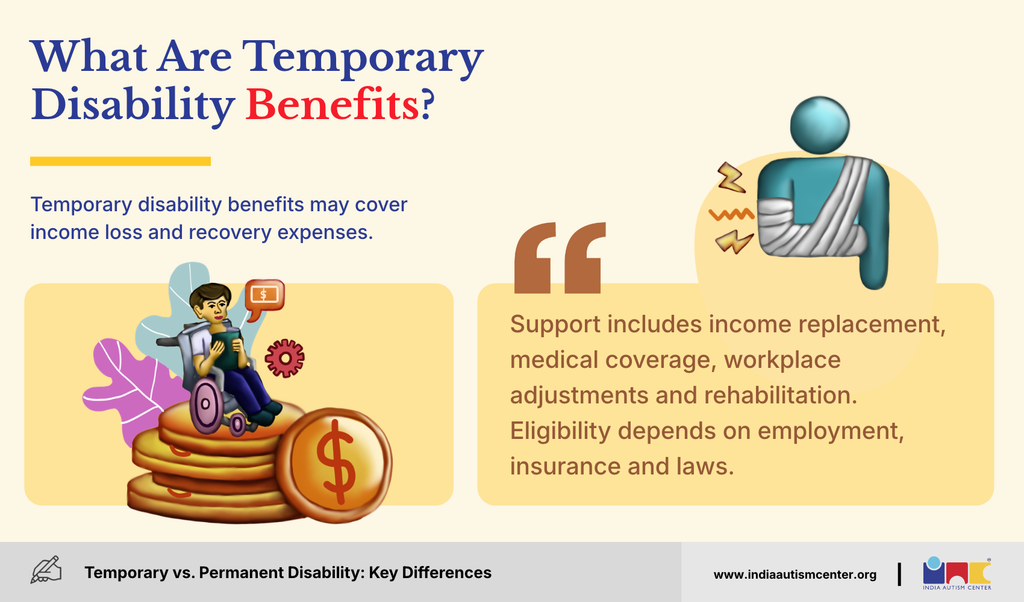
Temporary disability benefits are forms of financial or practical assistance that may help eligible people manage income loss and additional expenses while their functioning is restricted.
These benefits are not automatically available to everyone with a temporary impairment. Their availability depends on the country, employment arrangements, insurance coverage and applicable statutory provisions.
Depending on the circumstances, assistance may include:
- Income replacement: Payments through an eligible insurance policy, employment arrangement or statutory scheme.
- Medical expenses: Cover for eligible treatment, hospitalisation or rehabilitation under the relevant policy or programme.
- Workplace adjustments: Temporary changes to duties, responsibilities or working hours where appropriate.
- Rehabilitation: Physiotherapy, occupational therapy or other clinically appropriate interventions.
- Practical assistance: Help with transport, personal care or daily activities, depending on available services.
In India, no single universal temporary disability payment automatically covers everyone who becomes temporarily unable to work. Employees should check their employment policies, insurance arrangements and applicable legal entitlements. Depending on the circumstances, the relevant legal framework may provide compensation for employment-related injuries.
Before making a claim, check the policy’s definition of disability, waiting periods, exclusions, medical documentation requirements and payment limits. Some policies distinguish between temporary total disability and temporary partial disability, which can affect the amount or duration of payments.
Understanding these conditions matters because benefits during recovery may differ from those for a lasting impairment.
What Support Is Available for Permanent Disability in India?
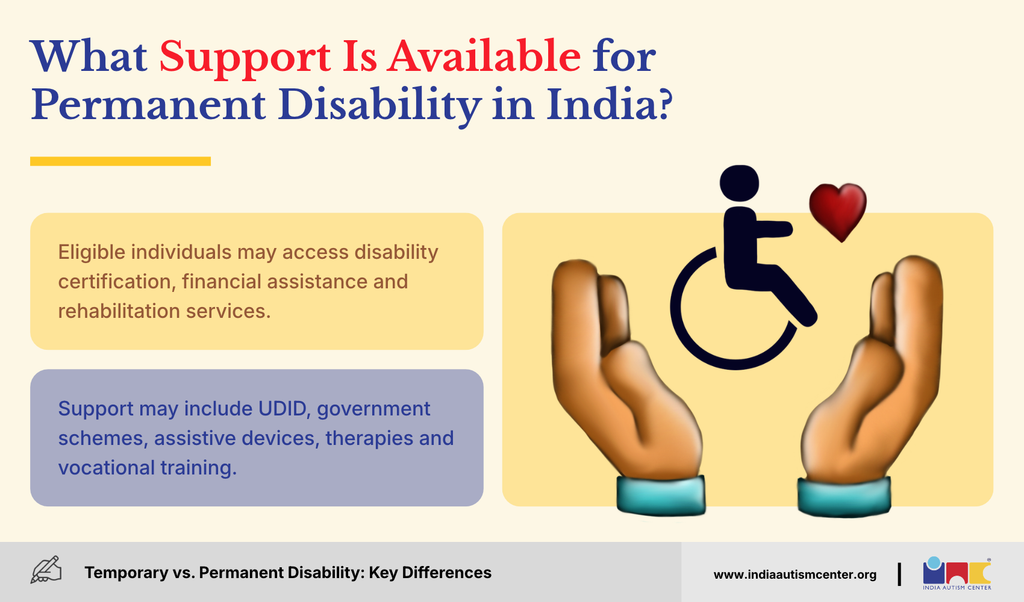
Permanent disability support can extend beyond financial assistance. Depending on the person’s needs and eligibility, it may include disability certification, government schemes, assistive devices, educational accommodations and rehabilitation services.
1. Disability certificate and UDID card
The Unique Disability ID (UDID) initiative provides a standardised system for disability identification in India. Eligible individuals can apply through the official UDID portal and undergo assessment by the authorised medical authority.
Under the Rights of Persons with Disabilities Act (RPwD), 2016, benchmark disability generally refers to a specified disability assessed at not less than 40%, as defined by the Act. This threshold applies to specific entitlements, but it should not be treated as a universal requirement for every disability-related service.
Families should also distinguish between a clinical diagnosis and a government disability certificate. A diagnosis identifies a condition, whereas certification follows the applicable assessment and administrative requirements.
2. Government schemes and financial assistance
Eligible individuals may access disability pensions, scholarships, assistive devices, healthcare support and other welfare benefits. Requirements differ between central and state government programmes.
The Assistance to Persons with Disabilities for Purchase/Fitting of Aids and Appliances (ADIP) Scheme supports eligible beneficiaries with assistive devices under its applicable rules. Families can learn more through our guide to the ADIP Scheme.
It is also worth exploring the government schemes available for persons with disabilities in India. Always verify current eligibility conditions, application procedures, and benefit amounts with the relevant authority.
3. Education, rehabilitation and daily living support
A disability may affect how someone communicates, learns, moves around or manages everyday responsibilities. Appropriate support can help address these barriers.
Depending on individual needs, services may include special education, speech and language therapy, occupational therapy, accessible transport, communication aids and vocational training.
Assistive technology can also improve access to education and everyday activities. For autistic individuals and someone with intellectual disabilities, personalised early interventions may support communication, self-care, social participation and practical life skills.
Families can also explore the different types of intellectual disability to better understand why support requirements vary between individuals. A diagnosis alone does not determine someone’s abilities or future potential.
How Is Disability Assessed?
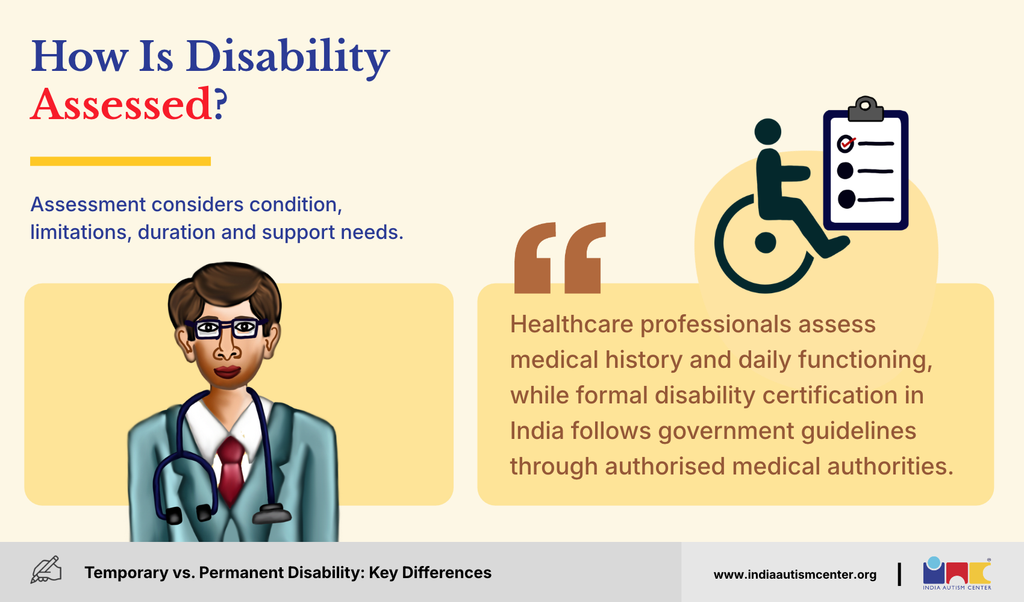
Disability assessment considers the underlying condition, its effect on functioning, expected duration and, where relevant, the person’s support requirements. The process varies according to whether the assessment is for medical treatment, an insurance claim or official certification.
Healthcare professionals may review medical history, examination findings, investigations and response to treatment. Depending on the condition, assessment may also consider mobility, communication, cognitive functioning and everyday activities.
In India, formal disability certification is undertaken by an authorised medical authority under the applicable government guidelines. The assessment and documentation requirements depend on the specified disability.
For example, assessing autism or intellectual disability involves considering developmental history and functioning rather than simply whether someone can perform a single task independently. A clinical diagnosis does not automatically establish a particular disability percentage.
Families should keep relevant medical reports, assessment records and treatment summaries. If an application is refused or a decision appears incorrect, they should ask the responsible authority about available review or appeal procedures.
How Can Families Plan for Changing Support Needs?
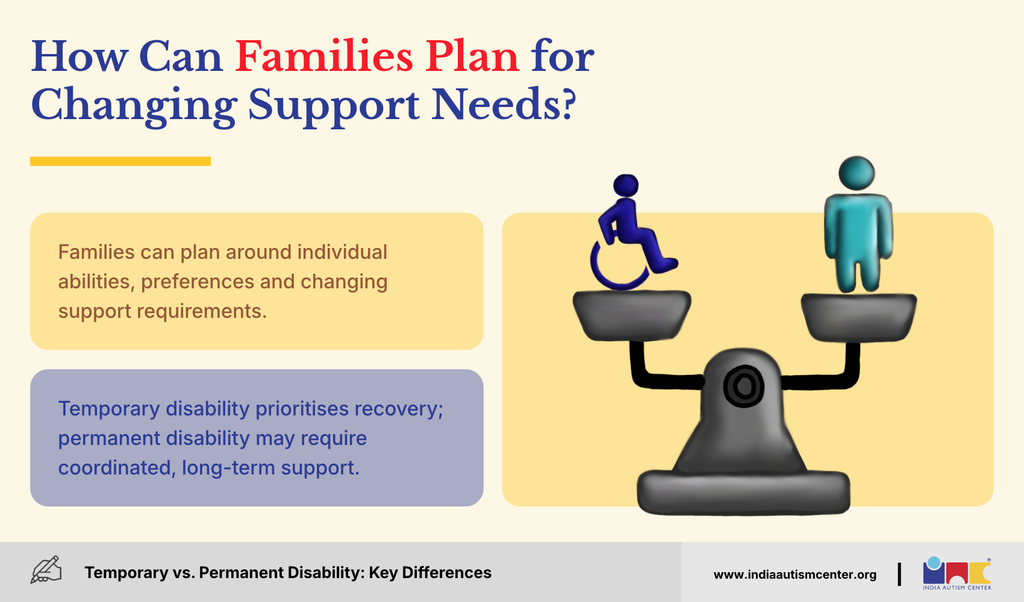
The practical implications of temporary vs. permanent disability extend beyond medical appointments and paperwork. Families benefit from planning around the individual’s current abilities, preferences and foreseeable needs.
For temporary disability, priorities may include safe recovery, rehabilitation, accessible transport and a gradual return to school, work or usual activities.
For permanent disability, planning may involve:
- Reviewing accessibility and safety at home, school or work.
- Identifying appropriate communication aids and assistive technology.
- Coordinating healthcare, education and rehabilitation services.
- Exploring eligible financial assistance and disability-related schemes.
- Considering future care arrangements, financial planning and the individual’s preferences.
Families supporting autistic individuals may also benefit from learning about communication support and alternative communication methods. These approaches can help people express their needs, preferences and decisions in ways suited to their abilities.
Review support plans as circumstances change. The objective is to address actual needs without assuming that a permanent condition prevents progress or that a temporary impairment will always resolve completely.
How India Autism Center Supports Individuals and Families
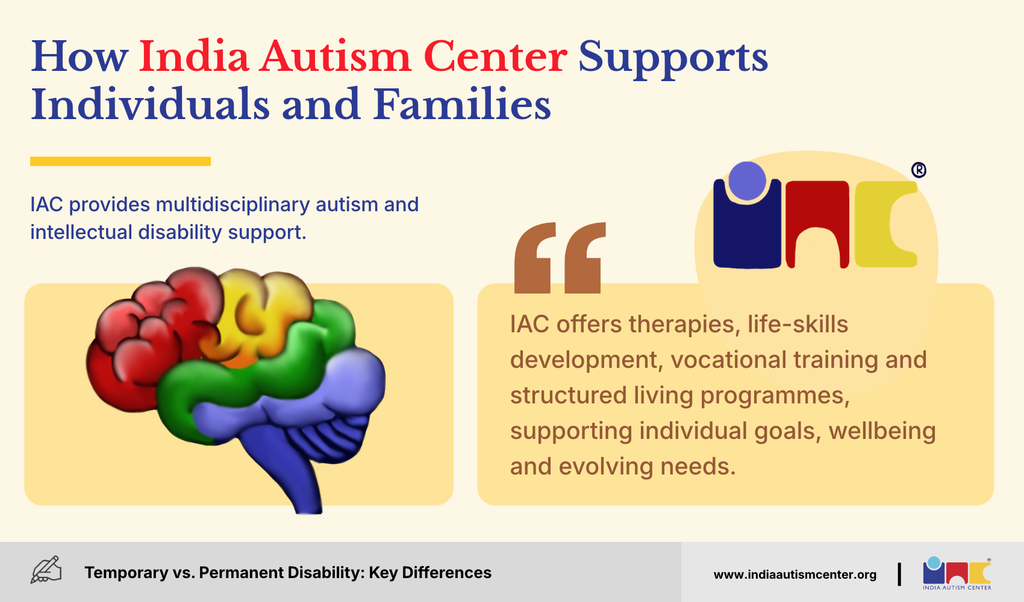
India Autism Center (IAC) focuses on supporting autistic individuals and people with intellectual disabilities through personalised, multidisciplinary care. Recognising that every individual has different abilities, communication preferences and support needs, its approach may incorporate therapies, life-skills development, vocational training and structured living programmes according to individual requirements.
For families navigating long-term disability, coordinated support can connect everyday care with opportunities for participation, wellbeing and greater independence.
The emphasis is on understanding the person, setting meaningful goals and adapting support as needs evolve, rather than defining someone’s future solely by a diagnosis or disability classification.
Conclusion
Understanding temporary vs. permanent disability helps individuals and families distinguish recovery-focused care from long-term support. Temporary disability may improve with treatment and rehabilitation, while permanent disability can require ongoing adaptations and assistance. Neither classification alone determines a person’s abilities or quality of life.
In India, disability certification, insurance benefits and government assistance follow different eligibility rules. Seeking professional assessment, checking official requirements and developing an individualised support plan can help people access relevant services and participate more fully in everyday life.
Frequently Asked Questions
1. What is the main difference between temporary and permanent disability?
Temporary disability is expected to improve or resolve over time, whereas permanent disability is expected to continue indefinitely. Both can affect daily functioning, and their severity varies between individuals.
2. Can temporary disability become permanent?
Yes. An injury or illness initially expected to resolve may cause lasting impairment. Medical reassessment can help clarify the prognosis and identify appropriate rehabilitation or ongoing support.
3. Are temporary disability benefits available in India?
They may be available depending on employment arrangements, insurance coverage, the circumstances of the injury or illness and applicable legal provisions. India does not provide one universal temporary disability payment to everyone.
4. Does permanent disability mean a person cannot work?
No. Many people with permanent disabilities work, study and participate in community life. Accessibility, reasonable accommodation, assistive technology and appropriate support can help reduce barriers.
5. Is autism considered a permanent disability?
Autism spectrum disorder is known to be a lifelong neurodevelopmental condition. However, support needs and functional abilities vary considerably, and individuals can develop skills and greater independence over time.