 Donate now
 Get a Call Back
 MENU
MENU 14 MIN READ
 SHARE
SHARE


If you’re a parent of twins and autism has entered your world — whether through a recent diagnosis, a nagging worry, or a question your paediatrician raised — I want you to know something first: you are not alone, and you are asking exactly the right questions.
Twin studies have shaped nearly everything we know about autism. For decades, researchers have looked at twins to understand why autism happens, how much of it is genetic, and what it means when one twin is diagnosed. The answers are nuanced, sometimes surprising, and — most importantly — genuinely useful for parents like us.
In this article, we are going to walk you through what the science actually says, in plain language. No jargon, no scary statistics without context. Just the honest, evidence-based information you need to understand your children and support them well.
What Is Autism, and Why Do Twin Studies Matter?
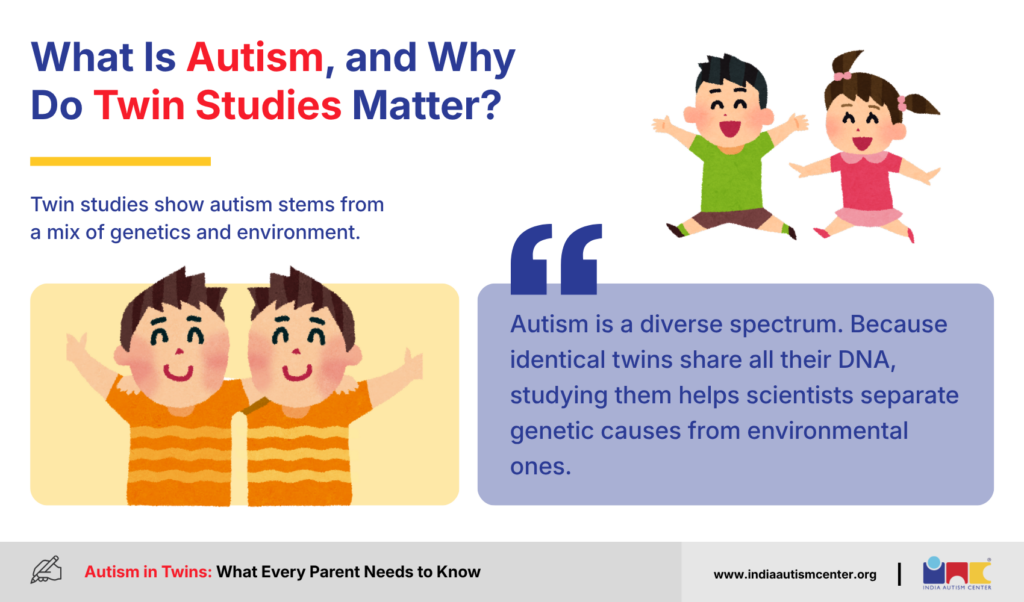
Autism Spectrum Disorder (ASD) is a neurodevelopmental condition that affects how a person communicates, socialises, and experiences the world. The word “spectrum” is key — autism looks very different from one person to the next. Some autistic individuals are highly verbal and academically gifted; others may have significant support needs. Many fall somewhere in between.
According to the CDC, about 1 in 36 children in the United States is diagnosed with ASD. Globally, the World Health Organisation estimates 1 in 100 children is on the spectrum, though rates vary by country and diagnostic criteria.
So why are twins so central to autism research?
Because twins give scientists a rare natural experiment. When researchers study twins — especially identical ones who share the same DNA — they can start to separate what’s caused by genes from what’s caused by environment. If autism were purely genetic, identical twins would always both be autistic. If it were purely environmental, the rates would look similar in identical and fraternal twins. The truth, as we’ll see, is somewhere more interesting than either extreme.
Identical Twins vs. Fraternal Twins: What’s the Difference?
Before we get into the research, it helps to understand the two types of twins and why scientists treat them differently.
Identical twins (monozygotic, or MZ) come from a single fertilised egg that splits into two. This means they share virtually 100% of their DNA. They are always the same sex, and they often look strikingly similar.
Fraternal twins (dizygotic, or DZ) come from two separate eggs fertilised by two separate sperm. They share roughly 50% of their DNA — the same as any two siblings. They can be the same sex or different sexes, and they may or may not look alike.
This genetic difference is exactly why researchers love studying both types together. By comparing how often autism appears in identical versus fraternal twin pairs, scientists can get a clearer picture of just how much genetics is driving the condition.
📥 Free download: Printable daily routine chart for autistic children
What Does the Research Actually Tell Us?
Here is where things get genuinely fascinating — and reassuring in some ways, and sobering in others.
The Concordance Rate: What It Means for Your Family
In research, the word “concordance” simply means both twins sharing the same trait or diagnosis. A concordance rate of 100% would mean that if one identical twin has autism, the other always does too. A rate of 0% would mean it never happens.
The numbers from decades of twin studies are striking:
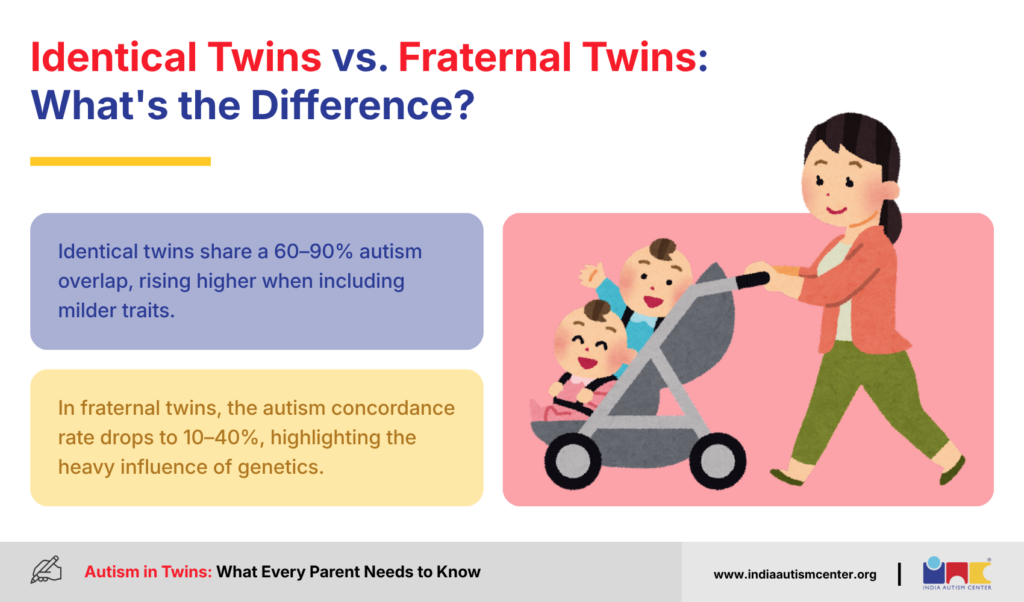
- In identical (MZ) twins, the concordance rate for autism is roughly 60–90%. Some studies put it even higher when they include the broader autism phenotype — meaning milder autistic traits that don’t meet the full diagnostic threshold.
- In fraternal (DZ) twins, the concordance rate is significantly lower, around 10–40%.
For comparison, the general population rate is about 2–3%. So even being a fraternal twin of an autistic child raises the chances meaningfully.
The gap between those two numbers — 60–90% versus 10–40% — is what tells us genetics is playing a major role. But notice that even in identical twins, concordance isn’t 100%. If autism were entirely down to genes, identical twins would always share the diagnosis. The fact that they don’t tells us something equally important: environment, and other biological factors, matter too.
Want to know more? Get in touch with us.
Is Autism Genetic? Understanding Heritability
One of the most common questions parents ask is: “Did I pass this on to my child?”
It’s an emotionally loaded question, and it deserves an honest answer.
Autism is one of the most heritable neurodevelopmental conditions we know of. Heritability estimates from twin studies typically range from 64% to 91%. That means somewhere between 64 and 91 cents of every metaphorical dollar of autism risk comes from genetic factors.
But here’s what heritability does not mean: it doesn’t mean autism is caused by a single “autism gene” that parents pass down. It doesn’t mean you did something wrong. And it doesn’t mean the outcome is fixed.
Autism is polygenic — meaning hundreds, possibly thousands, of genes are each contributing a tiny bit of risk. Some of these variants are inherited; others arise as new mutations (called de novo mutations) that weren’t present in either parent. This is why autism can appear in a family with no prior history of it, and why siblings of autistic children have elevated risk even when parents are neurotypical.
What about the environment?
Environmental factors also play a real role — and this is important for parents to understand, because it is not about anything you did or didn’t do during pregnancy.
Research has linked a higher likelihood of autism to factors including:
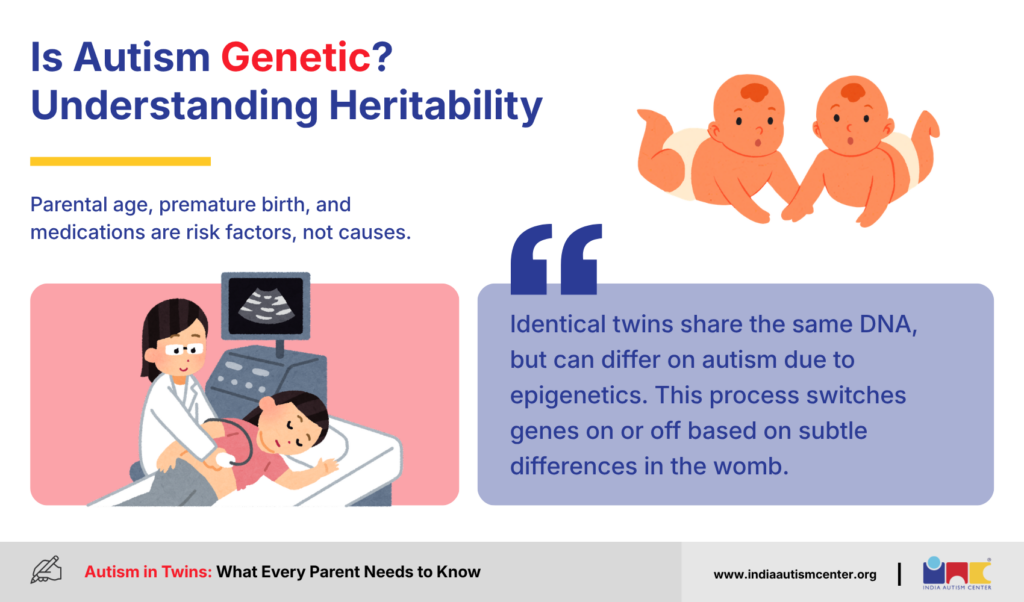
- Advanced parental age (particularly paternal age over 40)
- Premature birth and low birth weight
- Prenatal exposure to certain medications (notably valproate, used for epilepsy)
- Complications during labour and delivery
None of these is a guarantee, and none of them is anyone’s fault. They are risk factors in a statistical sense — they shift probabilities slightly, they don’t determine outcomes. Most children exposed to these factors are not autistic, and most autistic children were not exposed to them.
The Epigenetics Piece: Why Identical Twins Can Be Different
Here’s something that surprises many parents: identical twins can have the same DNA and still have very different experiences of autism, or one can be autistic while the other is not.
How is that possible?
The answer lies in epigenetics — the study of how genes are switched on or off by biological and environmental influences. Even though identical twins start with the same genetic code, over time, their gene expression can diverge. Different experiences in the womb (one twin may receive slightly more nutrients or be in a different position), different immune responses, different early-life exposures — all of these can change how genes are expressed without changing the underlying DNA sequence.
This is actually a hopeful finding, in a way. It tells us that genes are not destiny. The environment — including early intervention, therapy, and support — can genuinely make a difference.
If One of My Twins Has Autism, What Are the Chances for My Other Twin?
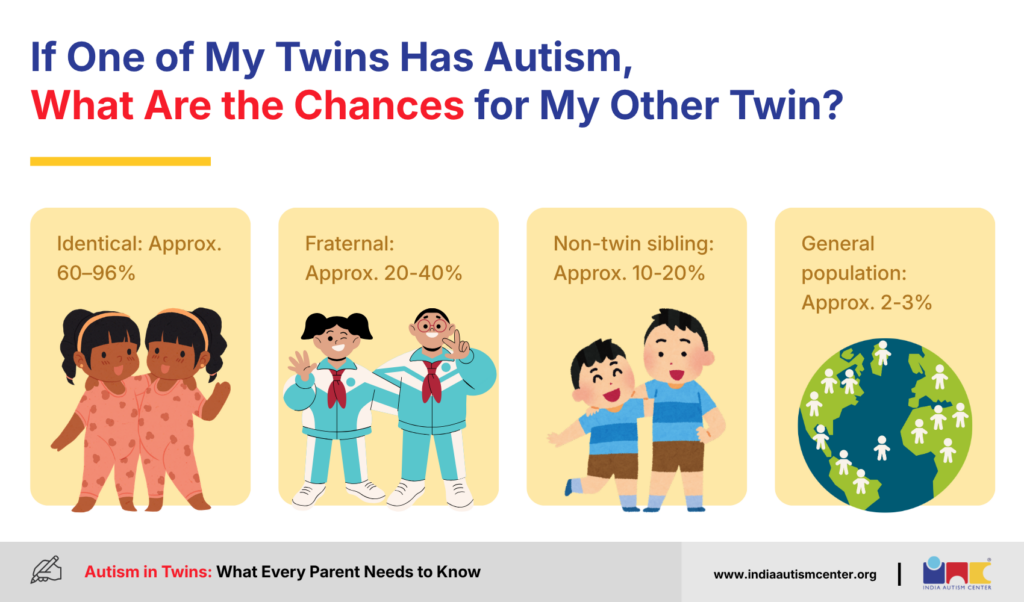
This is the question most parents come here to answer, and I want to give you the clearest possible picture.
| Twin Type | Risk if the Other Twin Has Autism |
| Identical (MZ) | Approximately 60–96% |
| Fraternal (DZ) | Approximately 20–40% |
| Non-twin sibling | Approximately 10–20% |
| General population | Approximately 2–3% |
A few things worth noting:
Severity can differ significantly. Even when both twins in an identical pair are autistic, they may present very differently. One might be minimally verbal with high support needs; the other might be highly verbal with milder challenges. Same genes, different expression.
The broader autism phenotype matters. In many cases where one twin is autistic and the other isn’t formally diagnosed, the undiagnosed twin still shows some subclinical autistic traits — slightly different social communication patterns, particular sensory preferences, narrow interests. Researchers call this the “broader autism phenotype” (BAP). It’s not autism, but it’s a sign the genes are present even if the full condition isn’t expressed.
What should you do with this information? If one of your twins has been diagnosed, I’d strongly recommend asking your paediatrician about developmental monitoring for the other twin, even if they seem to be developing typically. The earlier a diagnosis is made, the earlier support can begin — and early intervention has consistently been shown to make a meaningful difference.
Diagnosing Autism in Twins: The Unique Challenges
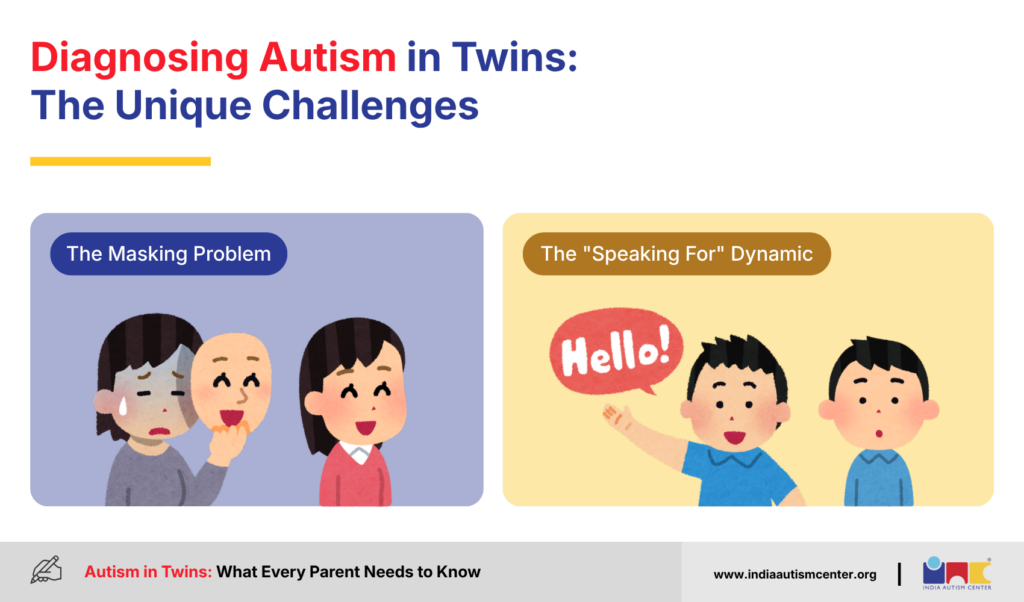
Diagnosing autism in twins comes with a set of challenges that many parents and even some clinicians don’t anticipate.
The Masking Problem
When one twin is clearly autistic, attention often focuses on that child. The other twin may actually be masking autistic traits — subconsciously learning to imitate their twin’s social behaviour or compensating with their own strategies. This is especially common in girls, who tend to mask more effectively than boys regardless of whether they have a twin.
The “Speaking For” Dynamic
Twin pairs often develop tight communication shortcuts. The more verbally fluent twin may answer questions for both, fill in silences, or guide their co-twin through social situations. In a diagnostic assessment, this can make the quieter twin appear more socially capable than they actually are without their twin present.
What Good Assessment Looks Like
A thorough evaluation should assess each twin independently — in separate rooms, with separate sessions. The gold standard tools are:
- ADOS-2 (Autism Diagnostic Observation Schedule) — a structured observation
- ADI-R (Autism Diagnostic Interview – Revised) — a detailed parent interview
- M-CHAT-R/F — a screening tool used in toddlers (18–30 months)
If you feel that your concerns about the second twin aren’t being taken seriously because “we already assessed the other one and they’re fine,” advocate clearly. Each child deserves their own thorough evaluation.
📥 Free download: Printable daily routine chart for autistic children
Supporting Your Twins: Practical Guidance for Parents
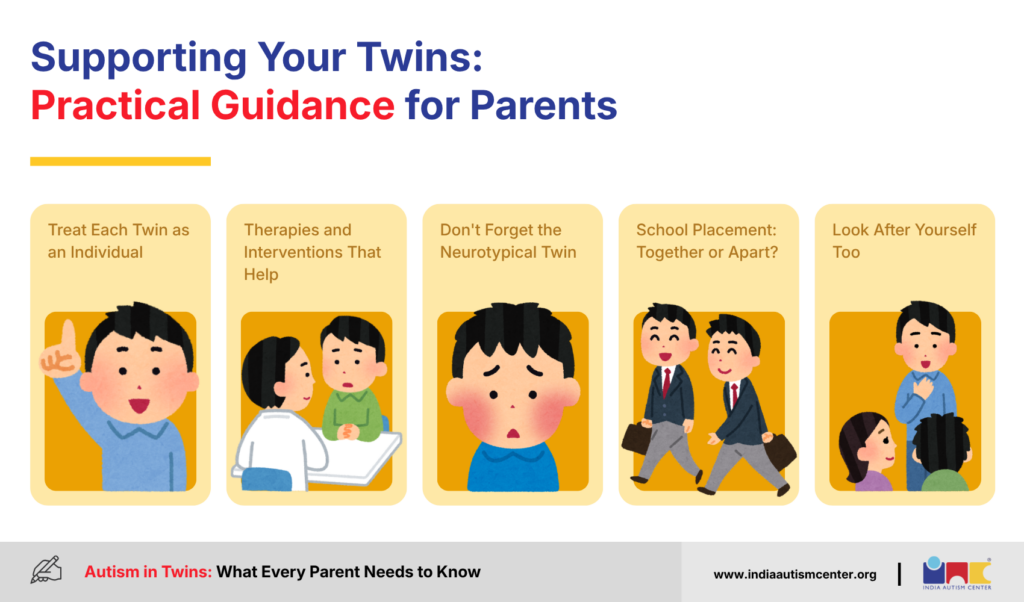
Learning that one or both of your twins is autistic doesn’t change who your children are. It changes what you now know about them, and it opens the door to support that is genuinely life-changing when started early and sustained consistently.
Treat Each Twin as an Individual
This might seem obvious, but it’s easy to fall into patterns where twins are treated as a unit — same school, same class, same therapy group. In families with autism in the mix, this needs careful thought. Each child’s needs are different. Each child’s pace of development is their own.
Create space for each twin to have their own relationships with you, their own achievements, and their own identity outside of being “the twins.”
Therapies and Interventions That Help
The most effective approaches are individualised — designed around each child’s specific profile of strengths and challenges. Depending on your child’s needs, these may include:
- Speech and language therapy — for communication development, whether verbal or AAC (augmentative and alternative communication)
- Occupational therapy (OT) — for sensory processing, fine motor skills, and daily living skills
- Applied Behaviour Analysis (ABA) — structured skill-building; look for providers who take a naturalistic, child-led approach
- Social skills groups — for children who want to build peer connections
- Parent-mediated approaches — programmes like JASPER, ESDM, and Hanen that train you to support your child in everyday interactions
None of these are one-size-fits-all. A good therapist will regularly review progress and adjust the approach.
Don’t Forget the Neurotypical Twin
If one of your twins is autistic and the other is not, the neurotypical child has their own emotional journey to navigate. They may feel overlooked when their sibling needs more attention. They may feel confused about why their twin is different and may internalise worry or feel pressure to compensate.
Acknowledge their feelings directly. Keep some time that is just for them. Consider sibling support groups, many of which are offered by autism organisations and are specifically designed for brothers and sisters of autistic children.
School Placement: Together or Apart?
This is one of the most common questions twin parents ask, and there’s no universal right answer.
Some twins thrive in the same classroom — the familiar presence of their sibling is regulating and comforting. Others do better in separate classes, where the autistic child can receive more targeted support without being compared to their twin, and where both children have the chance to build their own friendships independently.
Talk openly with your school’s SENCO (Special Educational Needs Coordinator) or equivalent, consider your children’s individual preferences, and revisit the decision each year — what’s right at age five may not be right at age nine.
Look After Yourself Too
Parenting twins is demanding under the best of circumstances. Add an autism diagnosis — or two — and the weight can feel immense. The research is detailed that parental well-being directly affects child outcomes. This isn’t a guilt trip; it’s a reason to prioritise your own support.
Seek out parent support groups (online and in-person), be honest with your GP about how you’re coping, and remember that asking for help is one of the best things you can do for your children.
Conclusion
If there’s one thing I hope you take from this article, it’s this: autism in twins is not a mystery beyond your understanding, and it is not outside your ability to respond to meaningfully.
The science tells us that genetics matters enormously — but it is not destiny. Epigenetics, environment, early intervention, and the quality of daily support all make a real difference to how autistic children develop and thrive.
If one of your twins has been diagnosed, get the other assessed. If both have been diagnosed, seek individualised support for each. And through all of it, take care of yourself — because your children need you at your best, not just your most exhausted.
You are already doing the most important thing: you are trying to understand.
Frequently Asked Questions
Are twins more likely to have autism than singletons?
Some research suggests a modest increase in autism rates among twins compared to singletons, though findings have been mixed. What is well-established is that twins are more likely than the general population to have a co-twin with autism if they are an identical twin of an autistic child.
Can twins have completely different levels of autism?
Yes, absolutely. Even identical twins with shared DNA can present very differently. One might need significant daily support while the other needs minimal accommodations. Autism is a spectrum, and gene expression varies even between genetically identical individuals.
Is autism caused by genetics or the environment?
Both play a role. Genetics accounts for roughly 64–91% of autism risk based on twin studies. Environmental factors — including prenatal exposures, birth complications, and parental age — contribute the remainder. Neither is “the cause” on its own; it’s an interaction.
At what age should I screen my twin for autism if the other has already been diagnosed?
As soon as possible. Screening tools like the M-CHAT-R/F are used from 18 months. If your other twin is already past that age and hasn’t been evaluated, speak to your paediatrician about a formal developmental assessment. Don’t wait for obvious signs — many children on the spectrum don’t show clear signs until 2–3 years of age, and some not until school age.
Do identical twins always share an autism diagnosis?
No. The concordance rate for identical twins is high (60–96%) but not 100%. Epigenetic differences, in-womb environmental variations, and other biological factors mean that one identical twin can be autistic while the other is not.
Disclaimer: This article is intended for educational and informational purposes only. It is not a substitute for professional medical advice, diagnosis, or treatment. If you are pregnant or have concerns about medication use during pregnancy, please consult a qualified healthcare provider. If your child has received an autism diagnosis and you have questions about causes or support, please reach out to a trained specialist or an autism-focused organisation for guidance.
This article is for informational purposes only and does not constitute medical advice. If you have concerns about your child’s development, please consult a qualified healthcare professional.