 Donate now
 Get a Call Back
 MENU
MENU 20 MIN READ
 SHARE
SHARE


If you’re reading this, chances are you’ve been hit, kicked, bitten, or screamed at by your own child — and you didn’t know what to do. Maybe you cried afterward or felt guilty for getting frustrated. Maybe you Googled “why does my autistic child get aggressive suddenly” at midnight, desperate for something — anything — that would help.
I want you to know: you are not a bad parent. And your child is not a bad kid.
Aggressive behavior in autism is one of the most exhausting, heartbreaking, and misunderstood challenges that autism families face. It affects an estimated 25–30% of autistic children at some point, and for many families, it’s the number one reason they seek help.
This guide is written for you — the parent who is in the thick of it. I’m going to walk you through what’s actually happening when your child lashes out, what’s causing it, and most importantly, what you can do about it in a way that actually works.
Have a look at What Is Autism? Signs, Causes & Truths Explained Simply
What Is Aggressive Behavior in Autism?
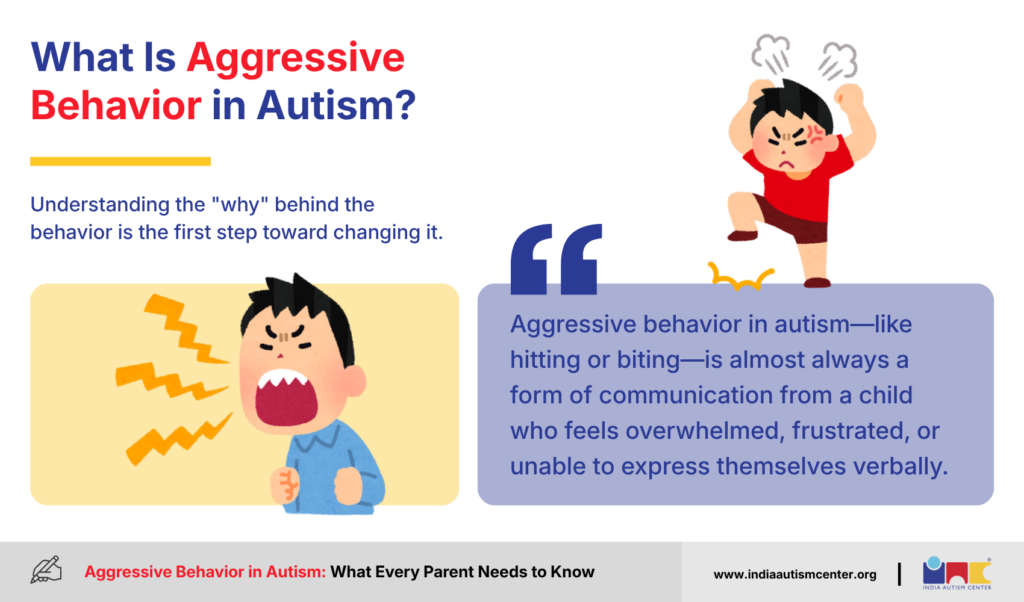
When we talk about aggressive behaviour in autism, we’re talking about a wide range of behaviors that can include:
- Hitting, slapping, or punching (often directed at parents or caregivers)
- Biting — themselves or others
- Kicking, scratching, or pulling hair
- Throwing objects
- Head-banging or other forms of self-injury
- Screaming or extreme emotional outbursts
Here’s the most important thing I want you to hold onto as you read this: aggression in autism is almost always a form of communication. Your child isn’t hitting you because they’re mean or manipulative. They are overwhelmed, in pain, frustrated, or terrified — and they don’t have the words or the tools to tell you that.
Think of it this way: if you were locked in a room where everything was too loud, too bright, and too overwhelming, and nobody understood what you were saying, you might start acting out, too.
This doesn’t mean the behavior is okay or that you just accept it. But understanding the why behind the behavior is the very first step toward actually changing it.
Who does autism aggression affect?
Autism aggression can happen at any age — it’s common in young children, but it can persist into the teen years and even adulthood if not properly addressed. It can affect autistic individuals at every level of the spectrum, but it tends to be more frequent and intense in children who have limited verbal communication.
Autism Meltdowns vs. Tantrums — What’s the Difference?
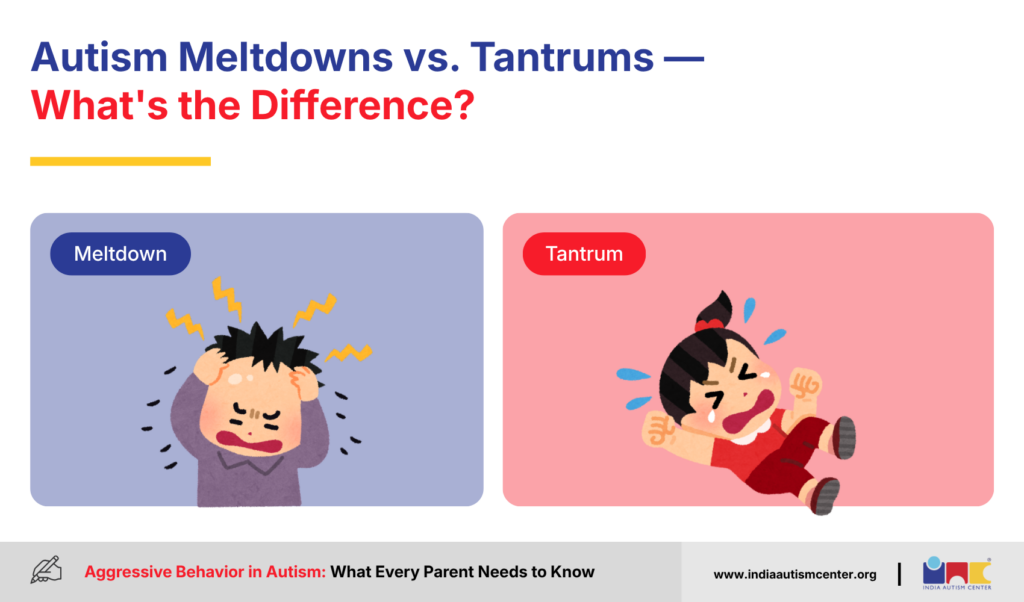
One of the most common mistakes parents and even professionals make is treating a meltdown like a tantrum. These are two completely different things, and responding to them the same way can actually make things worse.
| Meltdown | Tantrum | |
| What it is | A neurological response to overwhelming sensory or emotional input | Goal-directed behavior to get something or avoid something |
| Is the child in control? | No — they’ve lost control | Somewhat — they’re aware of what they’re doing |
| Does it stop when they get what they want? | No | Often yes |
| What triggers it? | Sensory overload, anxiety, communication breakdown | Being told “no,” not getting a preferred item, transitions |
| How long does it last? | Can last minutes to over an hour | Usually shorter once need is met |
| What helps? | Reduce stimulation, wait it out, stay calm | Set clear boundaries, do not give in to demands |
| What makes it worse? | Trying to reason, punishing, high-stimulation responses | Giving in every time, escalating conflict |
A meltdown is not manipulation. Your child is not “doing this for attention.” During a meltdown, their nervous system has completely overloaded — it’s closer to a panic attack than a deliberate choice. Punishing them for it doesn’t work because they aren’t in a state where learning can happen.
A tantrum, on the other hand, does involve some degree of awareness. A child having a tantrum might sneak glances at you to see your reaction. They may stop the moment they get what they want.
Knowing which one you’re dealing with changes everything about how you respond. Read Autism Meltdown in Different Age Groups.
What Causes Aggression in Autism?
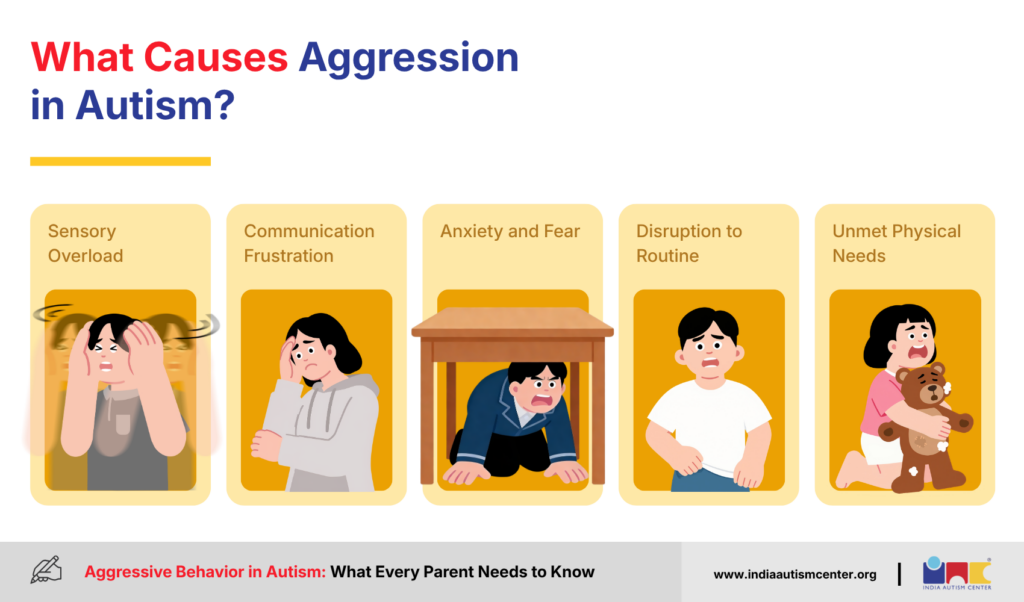
There is no single answer to the question of what causes aggression in autism — it’s usually a combination of factors. Here are the most common ones:
Sensory Overload
Many autistic individuals experience sensory input very differently from neurotypical people. Sounds that seem normal to you — a crowded mall, a TV in the background, fluorescent lights humming — can feel like physical pain to them. When the sensory world becomes too much, aggression can be the result of complete overwhelm.
Communication Frustration
This is huge, especially in younger children and those with limited verbal speech. Imagine desperately needing something — to be left alone, to have the TV turned off, to have a specific toy — and not being able to say so. You’ve tried to communicate in every way you know how, and nobody is understanding you. That kind of frustration can quickly boil over into physical behavior.
For nonverbal or minimally verbal autistic children, hitting and biting are often the most “effective” communication tools they have — because they get an immediate response.
📥 Free download: Printable daily routine chart for autistic children
Anxiety and Fear
Autism and anxiety often go hand-in-hand. In fact, up to 40–50% of autistic individuals also have an anxiety disorder. When an autistic child feels unsafe, unsure, or threatened — even by something that seems small to you, like a change in routine — the fight-or-flight response can kick in. Aggression is sometimes literally the body’s fear response.
Disruption to Routine
Many autistic children rely heavily on routine and predictability. When something unexpected happens — the usual route to school is different, a parent is late, a planned activity gets cancelled — it can trigger intense distress that comes out as aggression.
Unmet Physical Needs
This one is often overlooked. A child who is hungry, tired, or in physical pain is far more likely to be aggressive. Autistic children often have difficulty identifying and communicating internal body states (a condition called interoception differences). So instead of saying “my tummy hurts,” they might just explode.
Hidden medical causes like ear infections, gastrointestinal pain, headaches, or dental pain are a surprisingly common driver of sudden aggression in autistic children who can’t verbally explain what’s wrong.
Emotional Dysregulation
Many autistic individuals have difficulty regulating their emotions. They can go from calm to completely overwhelmed very quickly, with little awareness of how or why. They may not yet have the emotional toolkit to manage big feelings — and aggression is what happens when those feelings have nowhere else to go.
Common Autism Aggression Triggers — And How to Spot Them
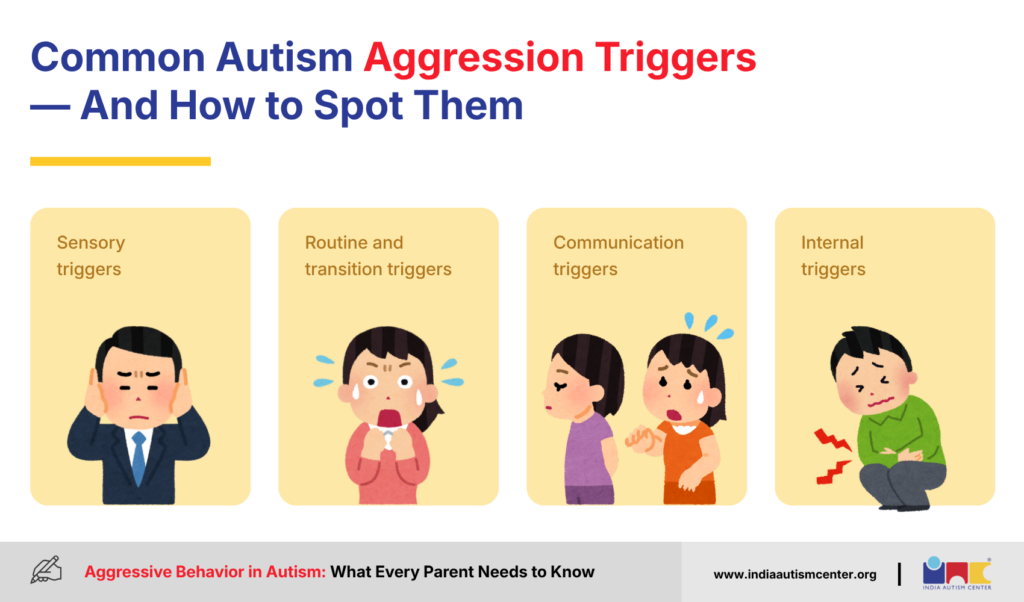
Understanding autism aggression triggers is one of the most powerful things you can do as a parent. Because if you can predict when a meltdown is coming, you can often prevent it — or at least reduce its intensity.
Every autistic child is different, but here are the most common triggers I hear parents describe:
Sensory triggers:
- Loud or sudden noises (fireworks, alarm bells, other children screaming)
- Crowded or busy environments
- Certain textures of clothing, food, or objects
- Bright or flickering lights
- Strong smells
Routine and transition triggers:
- Unexpected changes to the schedule
- Transitions between activities (especially stopping a preferred activity)
- New environments or unfamiliar situations
- Arrival of visitors or changes in who’s present at home
Communication triggers:
- Being unable to express a need or want
- Not being understood
- Being asked to do something they don’t understand
Internal triggers:
- Hunger or thirst
- Fatigue
- Illness or pain
- Anxiety about an upcoming event
How to track your child’s triggers
One of the best tools available to you is the ABC chart — short for Antecedent, Behavior, Consequence. For every aggressive episode, jot down:
- A (Antecedent): What happened right before the behavior? Where were they? Who was there? What time was it?
- B (Behavior): What exactly did they do?
- C (Consequence): What happened after? What did you do? Did the behavior stop? Did they get what they seemed to want?
After a week or two of tracking, patterns start to emerge. You might notice that most aggressive incidents happen right before dinner (hunger), during transitions from screen time, or in specific environments. That information is gold.
How to Handle an Aggressive Autistic Child: Step-by-Step
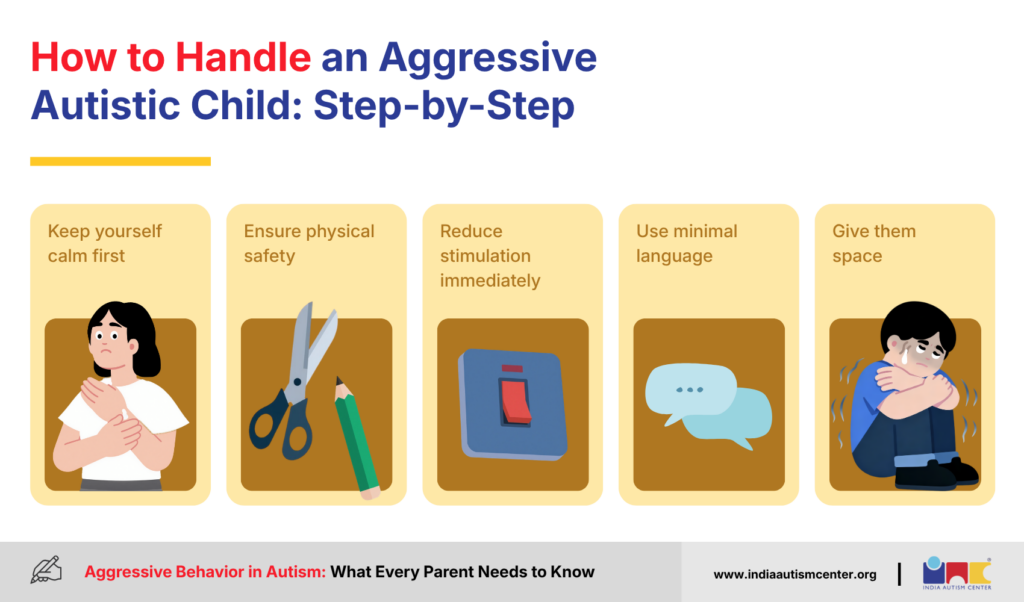
When aggression is happening in the moment, most of us react on instinct — and our instincts aren’t always helpful. Here’s a calmer, more effective approach:
Step 1: Keep yourself calm first
I know this is the last thing you want to hear when your child has just bitten your arm. But your nervous system directly influences your child’s nervous system. If you escalate, they escalate. Slow, deep breaths. Lower your voice. Soften your posture. You are the regulation they can’t find in themselves right now.
Step 2: Ensure physical safety
Move dangerous objects out of reach. If your child is hitting, create physical distance without escalating. If there are other children present, remove them from the area calmly.
Step 3: Reduce stimulation immediately
Turn off the TV. Dim the lights if you can. Reduce noise. Move to a quieter space if possible. You’re trying to reduce the input their nervous system is trying to process.
Step 4: Use minimal language
During a meltdown or aggressive episode, your child’s brain is not in a state to process complex language. Don’t lecture or explain consequences. Don’t ask “why did you do that?” Keep it to one or two words maximum: “Safe now.” “It’s okay.” Or nothing at all.
Step 5: Give them space
This doesn’t mean abandonment — it means not hovering over them or demanding eye contact or compliance. Sit nearby, stay present and calm, and let the storm pass.
What NOT to do:
- Don’t punish them during a meltdown. It doesn’t teach anything and increases distress.
- Don’t physically restrain unless absolutely necessary for safety. Physical restraint can be traumatic.
- Don’t match their emotional energy. Yelling back, crying, or threatening escalates the situation.
- Don’t take it personally in the moment. I know that’s hard. But this is not about you.
How to Calm an Autistic Meltdown in the Moment
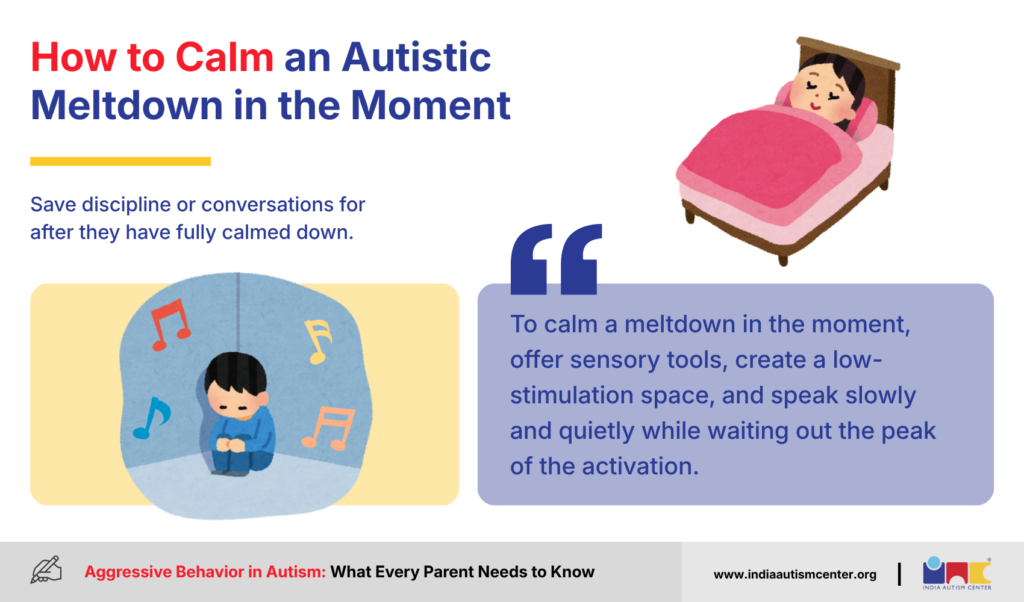
Once you’ve followed the steps above, here are specific things that can help your child come back to a regulated state:
Sensory tools that help many children:
- Weighted blanket or lap pad (the deep pressure is calming)
- Noise-cancelling headphones
- A favorite comfort object or fidget tool
- A cool cloth on the face or back of the neck
- Gentle, rhythmic movement (rocking, swinging)
Environmental adjustments:
- A designated “calm-down corner” in your home — a low-stimulation space with soft lighting, sensory tools, and a few comfort items. This is not a punishment space. It’s a safe haven they can learn to use proactively.
What to say (and how to say it):
- Speak slowly and quietly
- Use your child’s name calmly at the start
- Acknowledge their feelings without interrogating: “You’re really upset. I’m right here.”
- Avoid questions during the peak of the meltdown
Wait it out. The hardest part of calming an autistic meltdown is that you can’t rush it. The brain needs time to come back down from that level of activation. Trying to force the process — demanding they stop, removing privileges, applying consequences in the moment — extends it.
After the meltdown has passed and your child is calm — this is when reconnection and gentle conversation can happen, if they’re ready for it.
Here is a detailed blog on How to Handle Autism Meltdown: Complete Guide for Parents and Caregivers
How to Stop Hitting in Autism: Long-Term Strategies
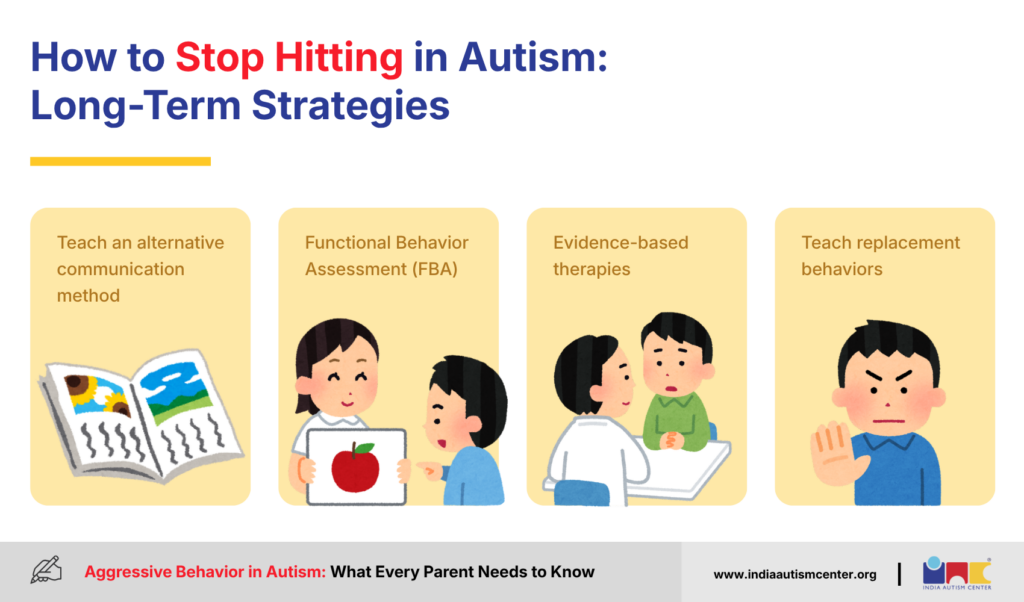
In-the-moment management is only half the picture. The longer-term goal is to reduce the frequency and intensity of aggressive behavior over time. Here’s what actually works:
Teach an alternative communication method
If hitting is being used to communicate “stop,” “I need help,” “I’m overwhelmed,” or “I want that” — you need to give your child another way to say those things.
This might look like:
- Picture Exchange Communication System (PECS): Using picture cards to communicate
- Augmentative and Alternative Communication (AAC) devices: Tablet-based apps like Proloquo2Go
- Sign language: Even a few basic signs (more, stop, help, no) can dramatically reduce frustration-based aggression
- Visual cues: Emotion cards or “first-then” boards
The research is clear: teaching communication reduces aggression. These aren’t workarounds — they’re powerful, evidence-based tools.
Functional Behavior Assessment (FBA)
An FBA is a formal process where a specialist (usually a Board Certified Behavior Analyst, or BCBA) figures out the function of the aggressive behavior — what need it is serving. Is it to escape a task? To get attention? To get a preferred item? To communicate sensory discomfort?
Once you know the function, you can address it directly rather than just trying to suppress the behavior.
Evidence-based therapies
Applied Behavior Analysis (ABA): When delivered ethically and with your child’s wellbeing at the center, ABA therapy can be highly effective at reducing aggressive behavior and teaching replacement behaviors. Look for providers who take a neurodiversity-affirming, naturalistic approach.
Positive Behavior Support (PBS): A framework that focuses on understanding behavior, reducing triggers, and teaching new skills — without punishment-based strategies.
Occupational Therapy (OT): Particularly effective when sensory processing is a major driver of aggression. An Occupational Therapy can develop a “sensory diet” — a personalized plan of sensory activities that help regulate your child’s nervous system throughout the day.
Speech-Language Therapy: Essential for children whose aggression is rooted in communication frustration. And this why we have A Comprehensive Guide to Speech and Language Therapy for Autism
Teach replacement behaviors
Instead of just trying to eliminate hitting, explicitly teach what to do instead. Practice saying “stop” or handing over a “break” card. Role-play scenarios when your child is calm. Reinforce the replacement behavior consistently and enthusiastically.
Autism Behavior Management at Home: Daily Strategies
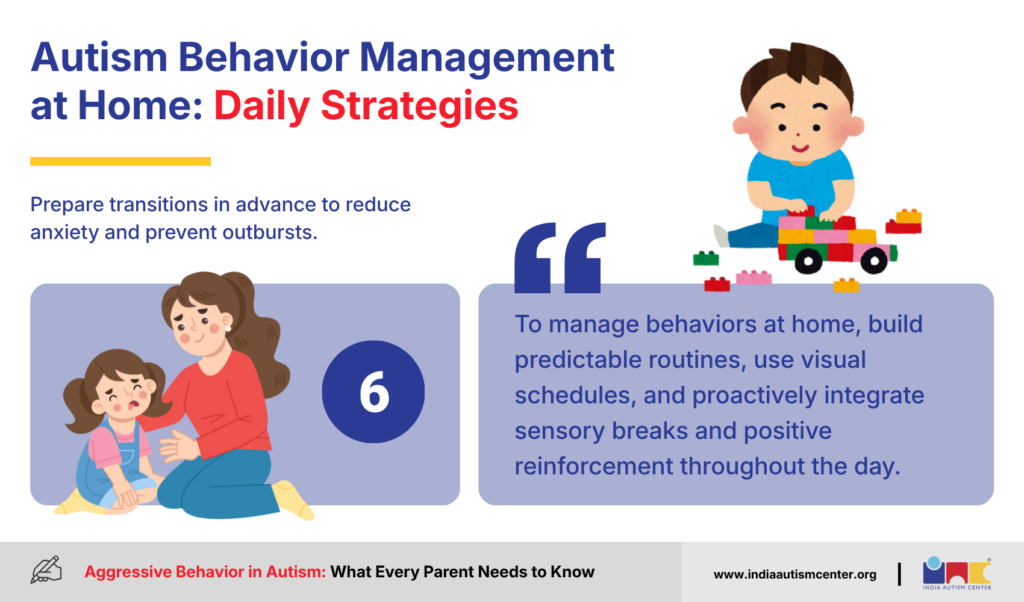
The home environment is where you have the most control — and that’s actually great news. Here are day-to-day strategies that make a real difference:
Build predictable routines
Predictability is genuinely calming for the autistic brain. A consistent daily schedule — wake up, breakfast, activities, meals, wind-down, bed — reduces anxiety and therefore reduces the likelihood of aggressive outbursts.
When you know a disruption is coming (a doctor’s appointment, a trip, a visitor), prepare your child in advance. Talk about it. Show them a picture schedule of what’s happening. Give them as much notice as possible.
Use visual schedules
Words are harder to process than visuals for many autistic children — especially when emotions are already elevated. A simple visual schedule (pictures or symbols showing the sequence of the day) gives your child a way to know what’s coming without relying on you to constantly explain.
Social stories
Social stories are short, simple narratives that walk your child through a situation they find challenging — from their perspective. You can create one for almost anything: “When I feel angry, I can go to my calm corner.” “When it’s time to turn off the TV, I can give my tablet to Mum.” These aren’t magic, but used consistently they build new neural pathways.
Create a calm-down corner
Set up a small space in your home — a corner of their room, under the stairs, anywhere quiet — with items that help your child self-regulate. Think: soft cushions, sensory toys, headphones, a lava lamp, weighted blanket. Make it a positive place they want to go, not a punishment room.
Positive reinforcement
Catch your child being calm, cooperative, or using their words (or AAC device) — and make a big deal of it. Specific, enthusiastic praise (“I love how you used your words to tell me you needed a break!”) reinforces the behaviors you want to see more of.
Token boards and reward systems can work well for some children — they provide visible, predictable reinforcement for positive behavior.
Proactive sensory strategies
Don’t wait for your child to become overwhelmed — build sensory breaks into their day before they need them. This might mean 10 minutes of jumping on a trampoline before homework, a fidget toy available during meals, or noise-canceling headphones for the school run.
Managing Aggression in Non-verbal Autistic Children
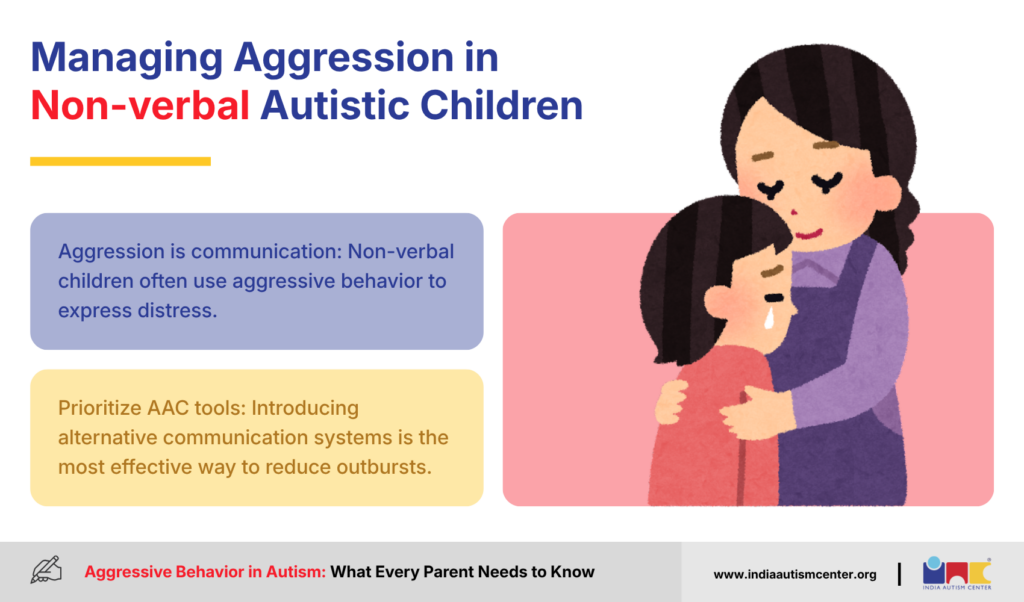
Nonverbal autism aggression deserves its own section, because the dynamics are somewhat different — and the stakes feel higher.
When a child has very limited verbal communication, aggression often becomes their most effective communication tool. If hitting makes you leave the room when they need alone time, or makes you give them the toy they want, or makes you turn off the overwhelming TV — then from their perspective, hitting works.
This is not manipulation in the way we typically think of it. It’s a child doing the best they can with the tools they have. Your job — with professional support — is to give them better tools.
What helps most for nonverbal children
Prioritize communication above everything else. This is the single most impactful thing you can do. Work with a speech-language pathologist to find the right AAC system for your child. Research consistently shows that robust communication support reduces aggressive behavior — often dramatically.
Become a body language expert. Before your child reaches the point of aggression, there are usually early warning signs — if you know what to look for. Learn your child’s individual signs of rising distress: increased stimming, avoiding eye contact, tensing up, pulling at clothes, becoming very still, a particular sound or expression. These are your windows for early intervention.
Use visual supports everywhere. “First-then” boards, choice boards, emotion charts, and picture schedules can give nonverbal children a way to navigate their world with more autonomy and less frustration.
Reduce demands when they’re already at the edge. If you can tell your child is getting close to their limit, it’s not the time to push through homework or practice transitions. Strategic retreating is not giving in — it’s smart parenting.
Strategies for Aggressive Behavior in Autistic Adults
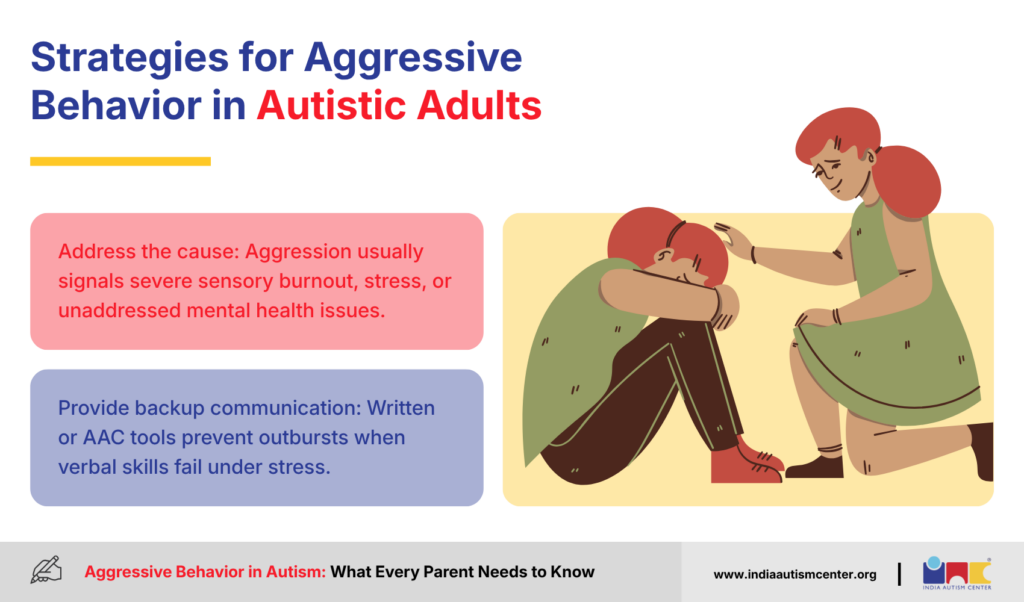
Aggression doesn’t automatically resolve when an autistic child becomes an adult — and for families still supporting adult autistic children at home, this can be an incredibly isolating experience.
Aggression in autistic adults often looks different from childhood aggression. It may be less frequent but more physically significant. It may be triggered by workplace stress, relationship difficulties, or the ongoing exhaustion of navigating a neurotypical world.
What helps for autistic adults:
Emotional regulation support: Adapted DBT (Dialectical Behavior Therapy) and CBT for autism can help autistic adults build emotional regulation skills. Look for therapists with experience in autism — not just anxiety or depression.
Sensory accommodations: Adults still have sensory needs. Noise-cancelling headphones at work, control over lighting at home, the ability to take sensory breaks — these aren’t accommodations to be ashamed of. They’re necessary for wellbeing.
Communication support: Some autistic adults who can speak find that their verbal communication breaks down under stress. Having a written or AAC-based backup can prevent communication-related frustration from boiling over.
Addressing the underlying cause: Very often, aggression in autistic adults is a sign that something is seriously wrong — they’re being pushed past their limits at work, dealing with an unaddressed mental health condition, or in an environment that isn’t meeting their needs. The aggression is the symptom. Find the cause.
Psychiatric evaluation: For some autistic adults, co-occurring conditions like ADHD, OCD, anxiety, or depression significantly contribute to aggression. Medication, when appropriate and carefully managed, can make a real difference — but it should always be part of a broader support plan, not the only intervention.
When to Seek Professional Help
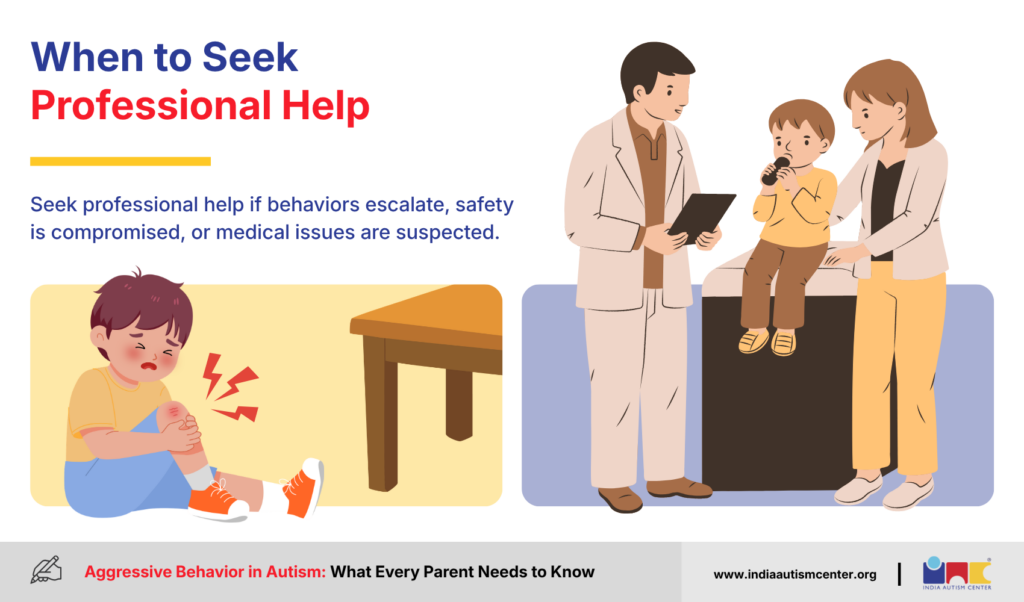
There’s no shame in needing a team. In fact, managing significant autism aggression at home without any professional support is extremely hard, and it’s not what you should be expected to do alone.
Seek professional help when:
- The aggression is frequent (multiple times per week or daily)
- Someone is getting hurt — your child, you, or siblings
- You’ve tried behavior strategies consistently and they’re not helping
- The aggression is getting more intense over time
- Your child seems to be in pain, or aggression is sudden and unexplained (rule out a medical cause first)
- Your mental health or the family’s wellbeing is significantly impacted
Who to contact:
- Pediatrician or GP: Start here. Rule out medical causes for a sudden increase in aggression (ear infections, constipation, GI issues, dental pain). Also discuss referrals.
- Board Certified Behavior Analyst (BCBA): For a Functional Behavior Assessment and behavior support plan.
- Occupational Therapist (OT): For sensory-based strategies and a sensory diet.
- Speech-Language Pathologist (SLP): For AAC and communication-based intervention.
- Child Psychiatrist or Psychologist: For co-occurring anxiety, ADHD, or other conditions that may be driving aggression.
Watch what experts say about Autism aggression:Why Aggression Happens in Autism and What Actually Helps | India Autism Center
📥 Free download: Printable daily routine chart for autistic children
Conclusion
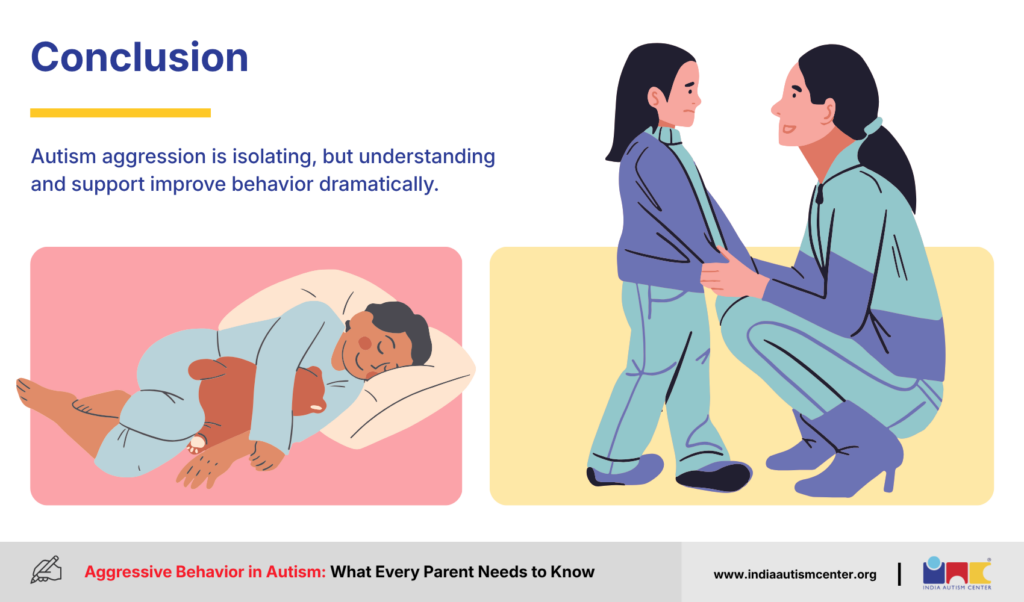
Living with autism aggression is hard in a way that’s difficult to put into words. On the days when you’ve been hurt, or you’ve watched your child suffer through a meltdown, or you’ve had to cancel another outing because you didn’t know what might trigger an episode — it can feel impossibly lonely.
But I want you to hear this: things can get better. With the right support, the right strategies, and the right team around your family, aggressive behaviour in autism can improve — often dramatically. Your child is not broken. They are communicating the only way they know how right now. Your job isn’t to fix them. It’s to understand them and to build a bridge.
You are already doing that — just by being here and reading this far.
If this article helped you, share it with another autism parent who might need it. And if you’d like support tailored to your child’s specific needs, please reach out to your local autism support organisation or speak to your pediatrician about a referral.
Frequently Asked Questions
Why does my autistic child hit me and not other people?
This is actually a sign of attachment and trust. Your child hits you because you are safe. They know you won’t abandon them, won’t hurt them back, and will still love them. It doesn’t make it okay, but it means something important about your relationship.
Is aggression more common in boys with autism?
Studies do show higher rates of externalised aggression in autistic boys, while autistic girls tend to internalise distress. However, aggression can occur in autistic children of any gender.
My autistic child was calm for months and suddenly became aggressive. Why?
Sudden-onset aggression in a child who was previously calm is a red flag for an unaddressed medical issue — particularly pain. Rule out ear infections, constipation, dental pain, and gastrointestinal issues first. A change in environment, school stress, or puberty can also be triggers.
Can aggression in autism be cured?
“Cured” isn’t quite the right word — but aggression can absolutely improve significantly with the right support, communication tools, and environmental adjustments. Many children who were significantly aggressive at age 4 are living calm, connected lives by their teens with proper intervention.
Should I call the police if my child is being aggressive?
This is a deeply difficult question. Most autism parents exhaust every other option first — and rightfully so, because police involvement can be traumatic and dangerous for autistic individuals. If you are genuinely in danger, call for help. But also speak to your child’s BCBA or psychiatrist about a safety plan for severe episodes before they happen, so you have a protocol ready.
At what age does autism aggression typically peak?
For many children, aggression peaks in the early to middle childhood years (ages 4–10) and often reduces with proper intervention and as communication skills grow. However, puberty can bring a new wave of challenging behavior for some families.
Is it okay to walk away during a meltdown?
If you need a moment to regulate yourself, stepping away briefly — while ensuring your child is physically safe — is okay. You cannot help your child if you’re completely dysregulated yourself.
This article is for informational purposes only and is not a substitute for professional medical, psychological, or behavioural advice. If your child is experiencing significant aggressive behavior, please consult a qualified professional.
For expert insights, support services, and inclusive learning initiatives, visit the India Autism Center.