 Donate now
 Get a Call Back
 MENU
MENU 12 MIN READ
 SHARE
SHARE


In autism, the brain processes social rewards — like smiles, praise, or eye contact — differently from nonsocial rewards like food or sensory experiences. This isn’t indifference. Specific brain circuits that connect emotional value to social signals show reduced functional connectivity in individuals with higher autistic traits. That distinction changes everything about how we support autistic people.
What Are Social and Nonsocial Rewards — and Why Does the Difference Matter?
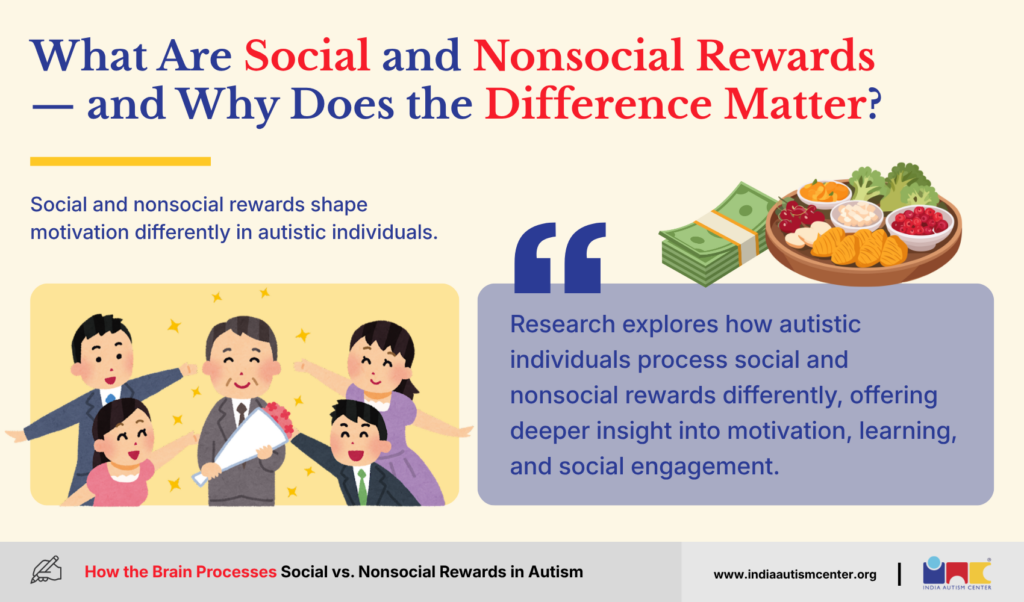
Before we get into the neuroscience, it helps to be clear on what we mean.
Social rewards are things that feel good because they involve human connection. A smile from a parent. A “well done” from a teacher. Eye contact that signals approval.
Nonsocial rewards are things that are intrinsically satisfying — independent of another person. Food, money, a favourite object, a particular texture or sound.
For most neurotypical people, social rewards feel powerful and motivating from birth. For many autistic individuals, this isn’t the case — and understanding why at a brain level is what the latest research is finally beginning to explain.
How Does the Neurotypical Brain Respond to Social Rewards?
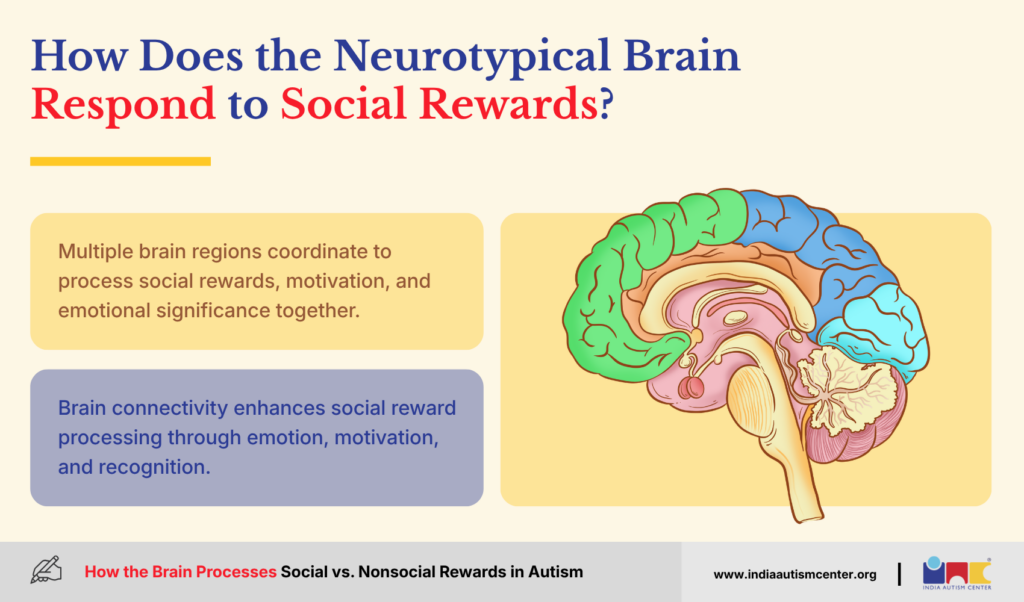
The brain doesn’t have one single “reward centre.” It has a whole network of regions that work together.
When a neurotypical person receives a social reward — say, a warm smile — several brain areas activate in coordination:
| Brain Region | Role in Reward Processing |
| Medial Orbitofrontal Cortex (mOFC) | Assigns value to an experience — tells you if it’s worth seeking again |
| Ventral Striatum | Drives motivation and anticipation of reward |
| Anterior Insula (AI) | Processes emotional and bodily feelings; makes social moments feel significant |
| Anterior Cingulate Cortex (ACC) | Integrates emotion and decision-making; tracks whether things are “going well” |
| Fusiform Gyrus (FG) | Specialises in face recognition and reading social cues |
| Amygdala | Tags experiences with emotional salience |
Social rewards activate all of these regions. More importantly, these regions talk to each other. It’s the connectivity between them — the neural conversation — that gives social rewards their motivating power.
Want to know more? Get in touch with us.
What Is the Social Motivation Hypothesis of Autism?
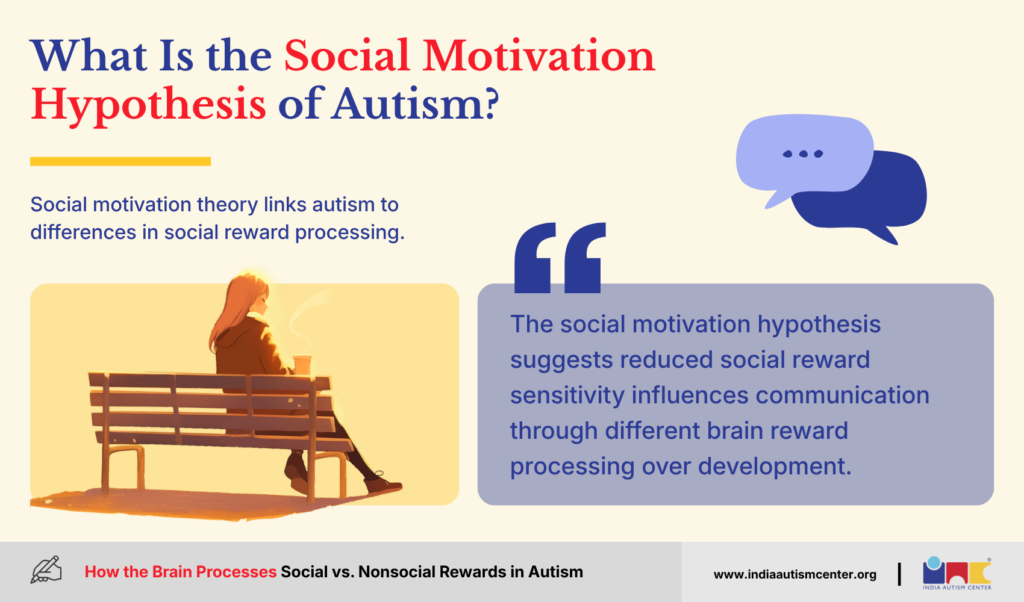
The social motivation hypothesis is one of the most influential frameworks in autism research.
The idea is this: autistic individuals may experience social stimuli as less rewarding from early in development. Because social rewards don’t activate the brain’s reward system as strongly, there’s less drive to seek out social interaction. Less interaction means fewer opportunities to develop social skills. This compounds over time.
It’s a cascade — not a single deficit.
The hypothesis suggests that what looks like a “social communication difficulty” on the outside is, at its root, a difference in how the brain assigns value to social experiences. The brain isn’t broken. It’s running a different calculation.
This theory has been supported by neuroimaging studies, but the picture is far more nuanced than the original hypothesis suggested. And that’s what makes recent research so important.
What Does the 2025 fMRI Study Actually Show?
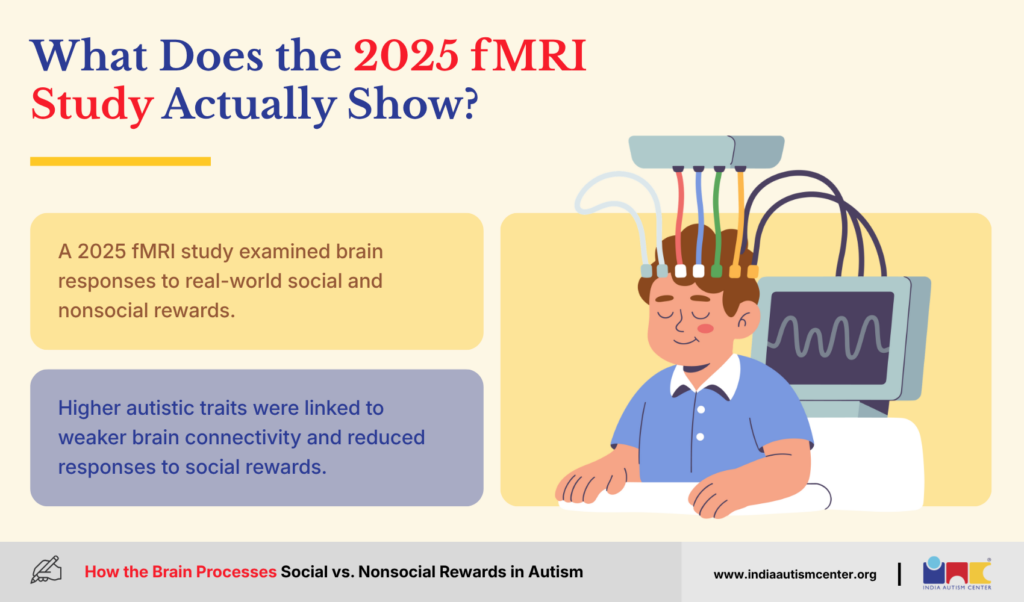
A 2025 study published in Personality Neuroscience — co-authored by researchers affiliated with the University of Reading and India Autism Center, Kolkata — looked directly at how autistic traits affect the brain’s response to social versus nonsocial rewards.
Here’s what makes this study stand out: most earlier research used artificial stimuli — strangers’ faces, abstract symbols. This study used real-world images, carefully matched for emotional intensity, brightness, and arousal levels. That makes the findings much closer to everyday life.
What they did:
- 37 adults underwent fMRI brain scanning
- Participants viewed social reward images (e.g., warm, genuine smiles) and nonsocial reward images matched for emotional valence
- Researchers measured both brain activity and subjective ratings of how positive each image felt
What they found:
Individual preference for social images was linked to stronger functional connectivity between two specific pairs of brain regions:
- The left anterior insula (LAI) and the medial orbitofrontal cortex (mOFC)
- The left fusiform gyrus (LFG) and the anterior cingulate cortex (ACC)
In individuals with higher autistic traits, both of these connections were weaker.
Those same individuals also rated social images as less positive — their subjective experience matched the reduced brain activity. This is significant. It means the difference isn’t just detectable on a brain scan. It shows up in how people actually feel about social moments.
Which Brain Regions Are Most Affected in Autism’s Reward System?
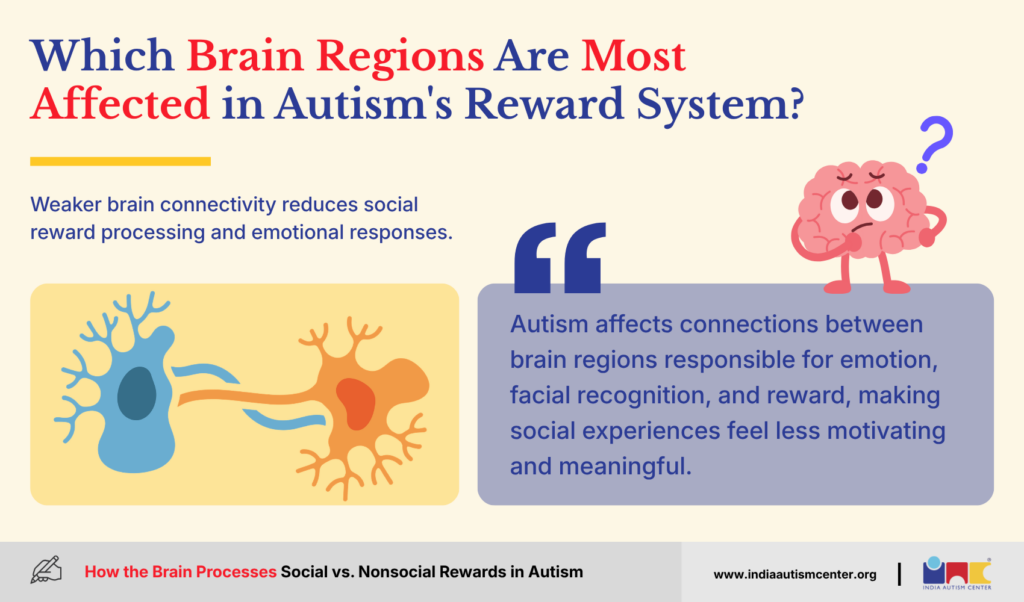
Let me break this down simply.
The anterior insula is what helps you feel why something matters emotionally. When it doesn’t communicate well with the mOFC (which assigns value to experiences), social moments don’t get flagged as worth repeating.
The fusiform gyrus is your brain’s face-processing hub. When it doesn’t connect strongly to the ACC (which tracks social outcomes), reading and responding to others’ expressions becomes harder to integrate with decision-making.
In short: the individual parts of the brain may be functioning. But the pathways between them are weaker. It’s like having all the instruments in an orchestra but the musicians aren’t hearing each other clearly.
Is It Social Rewards Specifically — or All Rewards?
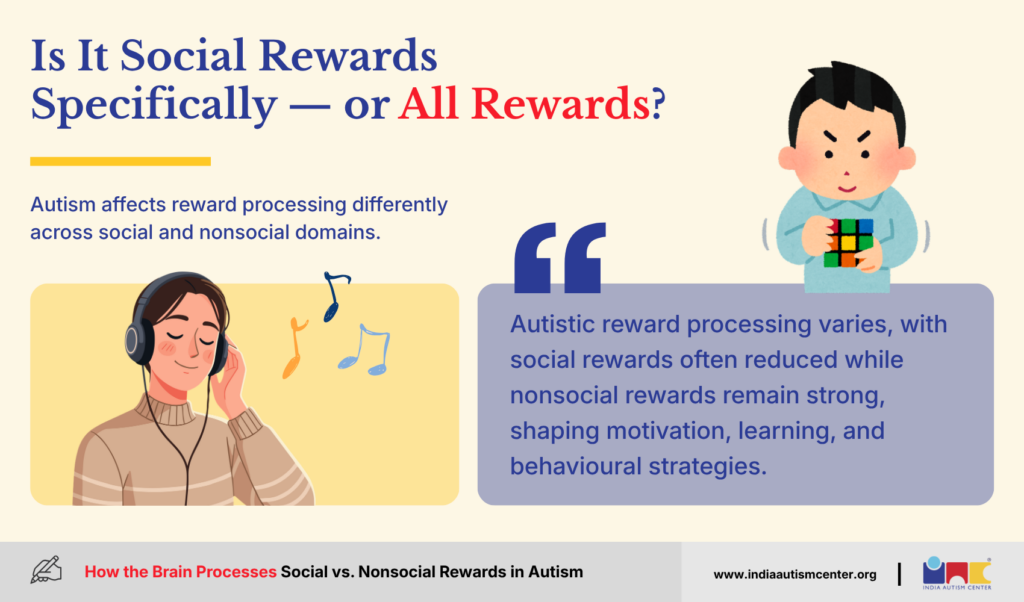
This is one of the most debated questions in the field. And the honest answer is: it depends.
Some studies show reduced reward responses only in the social domain. Others find that reward processing differences in autism span both social and nonsocial categories — including monetary rewards.
What recent evidence suggests is a more nuanced position:
- Reward processing in autism is not absent — it is differently calibrated
- The brain may still process nonsocial rewards quite typically in many autistic individuals
- The specific disruption appears to be in how social information gets translated into reward value
- This means autistic individuals can and do experience strong reward responses — just often through nonsocial channels (interests, sensory experiences, objects)
This has real implications for how we design therapy, learning environments, and motivational strategies.
What’s the Difference Between Reward Anticipation and Reward Reception in Autism?
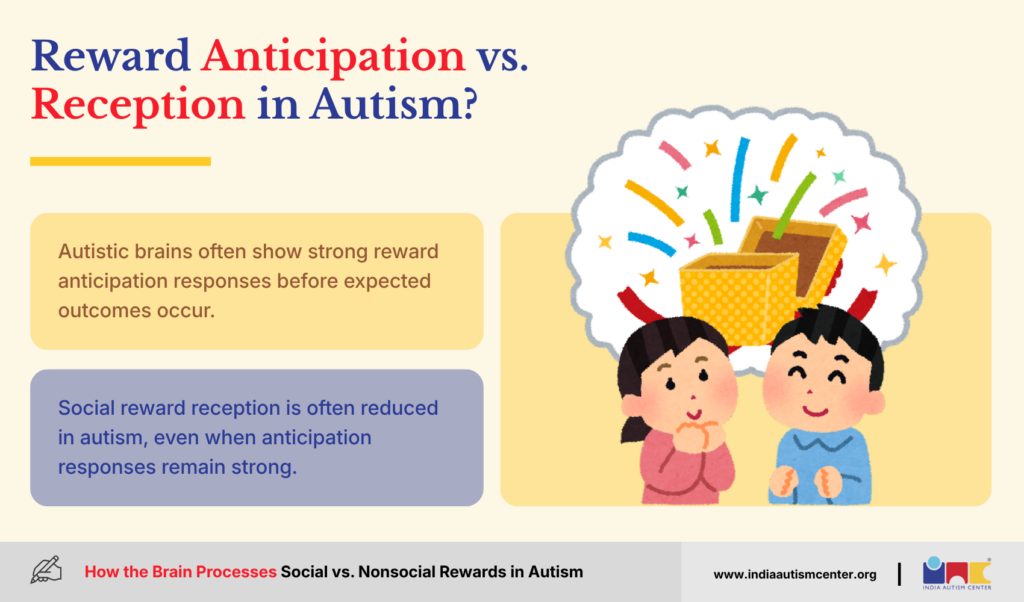
This distinction often gets overlooked — but it matters practically.
Research using EEG (measuring electrical brain activity) has found that autistic individuals and those with higher autistic traits actually show heightened brain responses during the anticipation phase of reward — the moment when you’re expecting something good to happen.
But during the reception of social rewards — when the smile or praise actually arrives — the neural response is attenuated, particularly for social rewards.
Think of it this way: the autistic brain may expect a reward with as much (or more) excitement as anyone else. But when the reward is a social one — a nod, a smile, a word of approval — it doesn’t land with the same neural weight.
This is a crucial distinction for parents and educators. It means the issue isn’t low motivation overall. It’s that social feedback specifically may not register as the powerful signal it does for neurotypical peers.
Does This Look the Same for Autistic Girls and Boys?
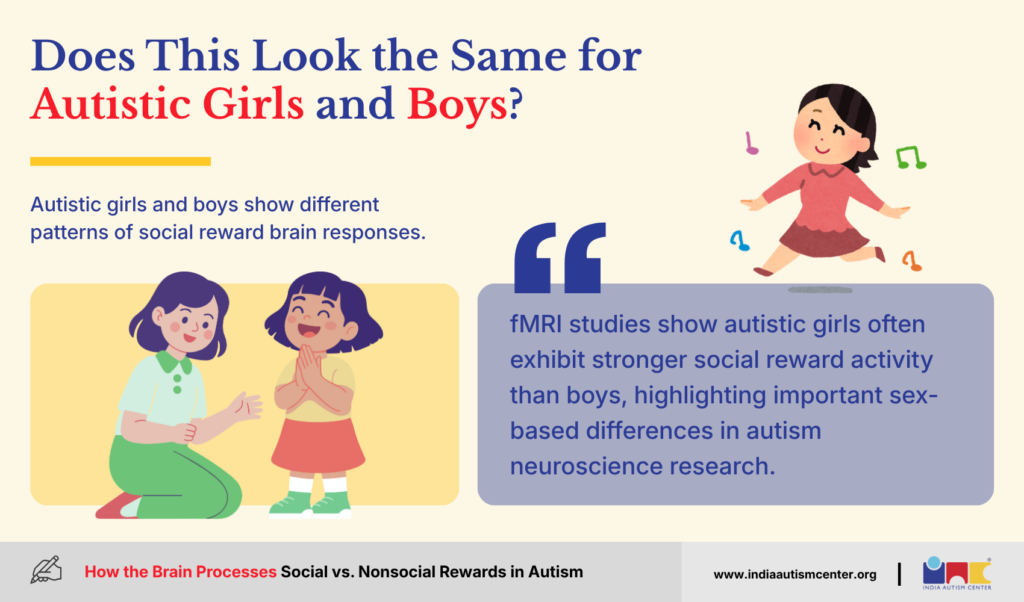
No — and this is an important gap in the original social motivation theory.
Research using fMRI in children and adolescents found that autistic girls showed increased neural activity to social rewards — not decreased. Specifically, autistic girls showed greater activity in the nucleus accumbens (a core reward region) and the anterior insula compared to typically developing girls.
This is the opposite of what’s been found in autistic boys.
What this tells us:
- Reduced social reward sensitivity is not universal across all autistic people
- The neural profile may differ significantly between autistic males and females
- This likely contributes to why autistic girls are frequently missed in diagnosis — their social reward processing may not match the pattern that diagnostic criteria were originally built to detect
The science is still developing here. But it’s a reminder that “autism” is not one brain type.
How Does This Research Change the Way We Should Support Autistic Individuals?
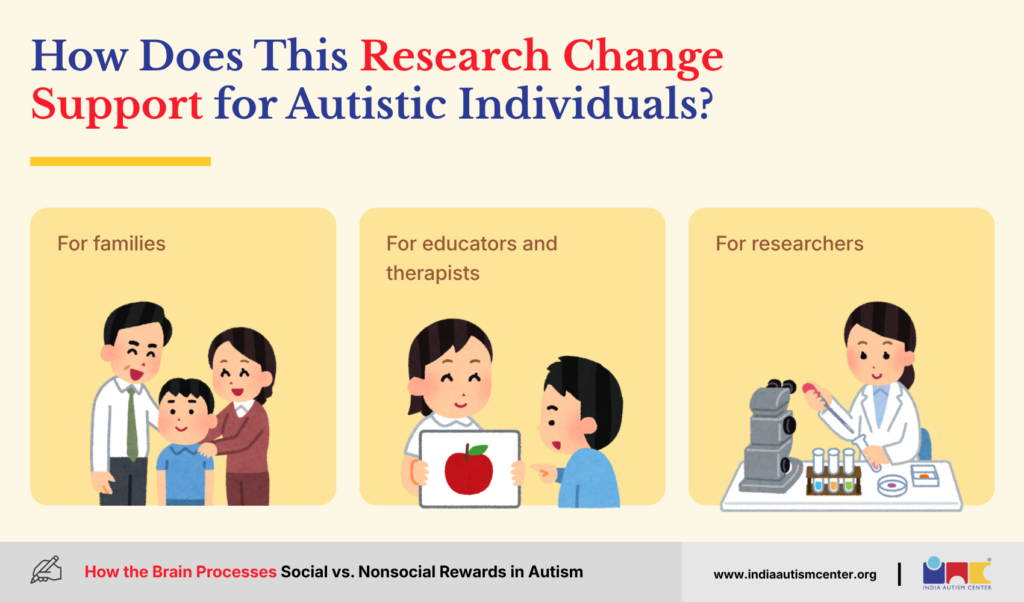
Understanding the neuroscience shifts the frame entirely.
When an autistic child doesn’t respond to praise or social approval the way a parent or teacher expects, it isn’t stubbornness, lack of effort, or emotional disconnection. The brain’s reward circuitry is genuinely processing that social signal differently.
Here’s what this means practically for:
Families:
- Combining social rewards with preferred nonsocial rewards (a favourite activity, a sensory item) can be more effective than relying on praise alone
- Noticing and responding to what does register as rewarding for your specific child is more useful than assuming praise should motivate them
- Recognising that reduced social reward responsivity is neurological — not a choice — can reduce blame and conflict at home
Educators and therapists:
- Motivational systems that assume social approval is inherently reinforcing may need to be redesigned for autistic learners
- Strength-based approaches that lean into genuine interests and nonsocial reward preferences are neurologically consistent with what the brain is actually doing
- The goal isn’t to force social reward sensitivity — it’s to build meaningful engagement in ways the autistic brain can sustain
Researchers:
- The 2025 study introduces a new experimental paradigm that could contribute to transdiagnostic biomarkers for social cognitive processes — markers that go beyond diagnosis categories and speak to underlying brain function
Want to know more? Get in touch with us.
What Does This Mean for Early Development?
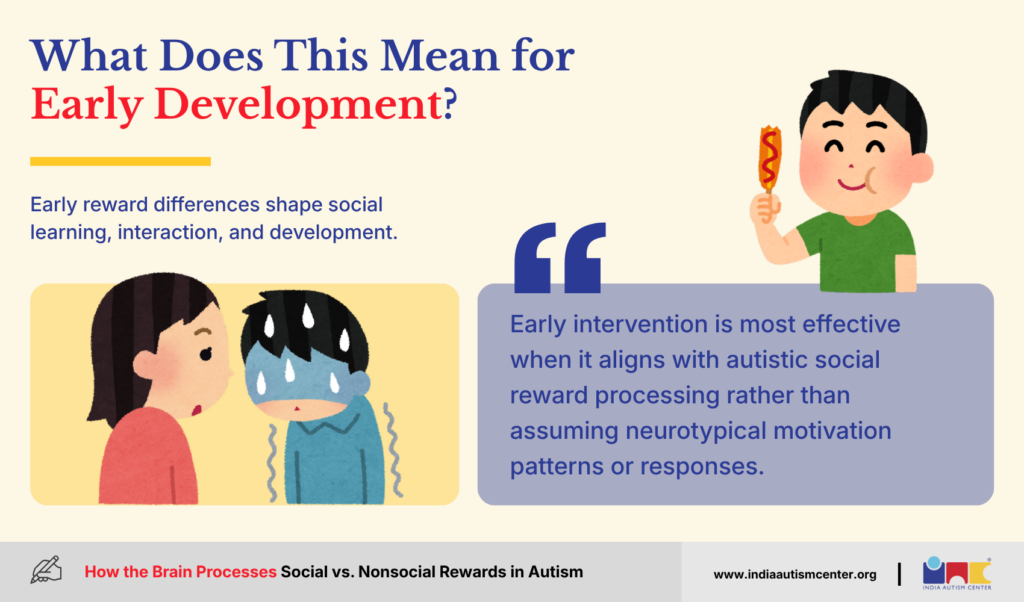
The social motivation cascade matters most early.
If social stimuli aren’t registering as rewarding in infancy and early childhood, fewer social interactions happen. Fewer interactions mean less practice with reading faces, interpreting tone, and building the social pattern recognition that most people develop automatically.
This isn’t irreversible. But it does mean that early intervention — designed with an understanding of how the autistic brain processes social information — will be more effective than approaches that assume a neurotypical reward system.
The aim should never be to make social rewards feel “normal” through pressure. The aim should be to meet the brain where it is and build genuine connection from there.
What Does the Research Still Not Know?
It’s worth being honest about the limits here.
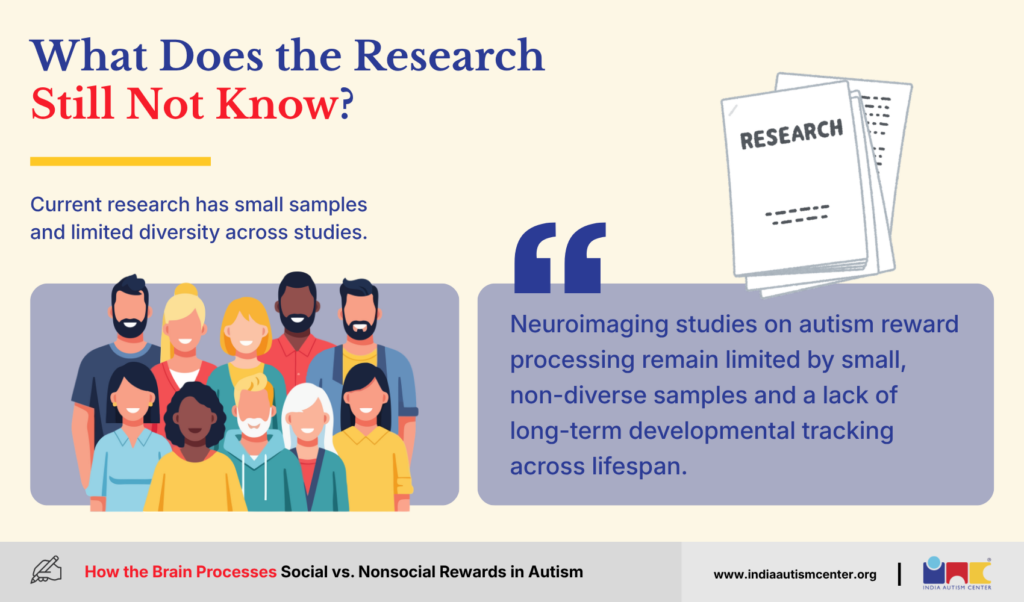
- The 2025 fMRI study had 37 participants — a relatively small sample
- Most neuroimaging studies in this area still have sample sizes under 50
- The majority of participants in this field historically have been male, white, and Western — limiting generalisability
- We don’t yet have strong longitudinal data on how these brain patterns change across the lifespan
- The relationship between neural reward differences and specific everyday behaviours is still being mapped
The field is moving fast. But we’re still at the point where the findings are highly important directionally, even if the full picture isn’t complete.
📥 Free download: Printable daily routine chart for autistic children
Conclusion
The science of social reward processing in autism is young — but it’s already telling us something important. The autistic brain is not unmotivated. It is not emotionally empty. It is processing the world through a different neural architecture, one where social signals carry less automatic reward weight.
That understanding should change how we talk about autism. It should change how we design support. And it should deepen our respect for the way autistic individuals navigate a world built largely around social reward systems they experience differently.
At India Autism Center, our research division Khoj is committed to building an evidence base that reflects the actual diversity of autistic experience — including how the brain’s reward system works differently across individuals. Because better science leads to better support.
Key Takeaways
- Social rewards (smiles, praise, approval) and nonsocial rewards (food, money, sensory experiences) are processed by overlapping but distinct brain networks
- In individuals with higher autistic traits, functional connectivity between the anterior insula and mOFC, and between the fusiform gyrus and ACC, is reduced
- This reduced connectivity correlates with lower subjective ratings of social images — meaning the brain difference shows up in lived experience
- The issue is not that autistic individuals can’t feel rewards. It’s that social signals don’t reliably trigger the same reward response as they do in neurotypical brains
- Autistic girls may show an opposite neural pattern to autistic boys — more activity, not less, to social rewards
- Practical support should work with the brain’s actual reward preferences, not against them
Frequently Asked Questions
Does the autistic brain feel no social rewards at all?
No. The autistic brain can and does respond to social stimuli. The difference is in the strength and consistency of the neural signal — reduced functional connectivity between reward-related regions means social rewards may not register as strongly or reliably.
Can therapy improve social reward processing in autism?
Some interventions — particularly those that pair social experiences with preferred nonsocial rewards — may help build positive associations over time. The goal is building genuine engagement, not forcing neurotypical reward responses.
Is reduced social reward sensitivity the same in all autistic people?
No. Research shows significant variability — particularly between autistic males and females. Autistic girls, for example, have been found to show increased neural activity to social rewards in some studies, not decreased.
What brain regions are most involved in social reward processing?
The anterior insula, medial orbitofrontal cortex, fusiform gyrus, anterior cingulate cortex, and ventral striatum are the most studied. The connections between these regions matter as much as the regions themselves.
What is the social motivation hypothesis of autism?
It’s a theory suggesting that autistic individuals experience social stimuli as less rewarding, leading to reduced motivation for social interaction, which then compounds into broader social communication differences over development.
Educational Disclaimer: This article is intended for informational and educational purposes only. It does not constitute medical advice, diagnosis, or treatment. The research discussed is ongoing and findings from animal or laboratory studies do not automatically translate to clinical recommendations for humans. Parents and caregivers should always consult a qualified medical professional — including a paediatrician, neurologist, or clinical nutritionist — before making any decisions about supplementation or dietary changes for a child with autism. India Autism Center does not endorse any specific supplement, treatment, or brand.
For expert insights, support services, and inclusive learning initiatives, visit the India Autism Center.