 Donate now
 Get a Call Back
 MENU
MENU 8 MIN READ
 SHARE
SHARE


Prenatal paracetamol use does not increase a child’s risk of autism, Attention Deficit Hyperactivity Disorder (ADHD), or intellectual disability. This is the conclusion of a large sibling-matched study of over 700,000 mother-child pairs, published in JAMA Internal Medicine in 2026. The finding holds regardless of dosage, trimester, or how often paracetamol was used during pregnancy.
If you are pregnant and worried about a headache tablet you took last week, I want to put your mind at ease. Let me walk you through exactly what the science says, why the panic started, and what it means for you.
What Sparked the Paracetamol-Autism Debate?
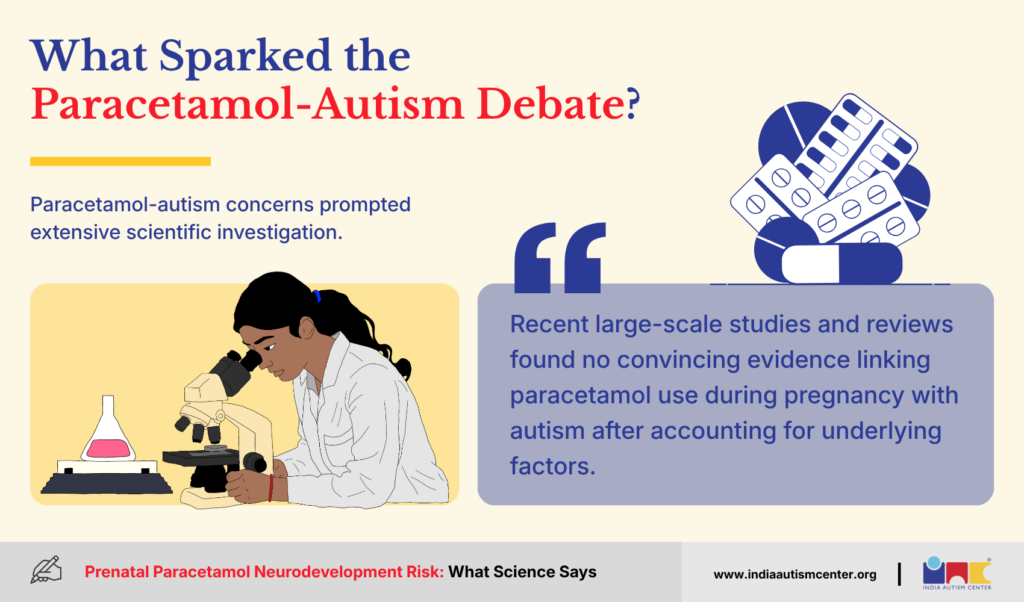
In September 2025, statements from the US administration suggested a possible link between paracetamol use in pregnancy and autism spectrum disorder (ASD). This claim spread quickly across news outlets and social media. Expecting mothers around the world, including here in India, grew anxious almost overnight.
Health bodies responded fast. The World Health Organization and other major medical authorities reaffirmed paracetamol’s safety profile. But public concern doesn’t disappear with a single statement. It needed strong, direct evidence. That evidence has now arrived.
Three separate lines of research converged in early-to-mid 2026: a massive sibling-matched cohort study from Hong Kong, a 43-study systematic review from The Lancet, and a dedicated meta-analysis in the Journal of the American Academy of Child & Adolescent Psychiatry. All three point in the same direction.
What Did the New HKUMed Study Actually Find?
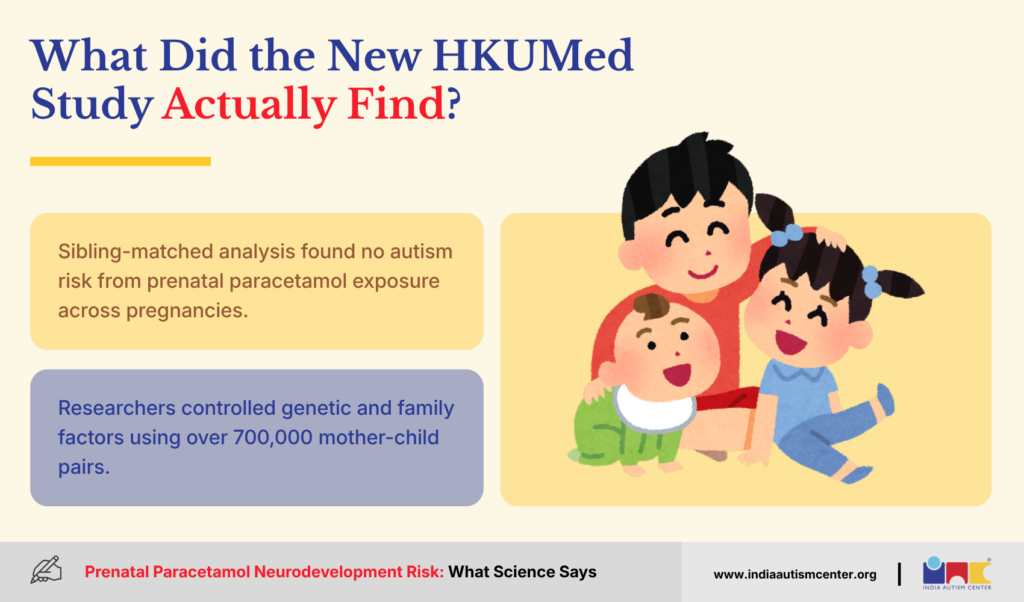
Researchers from the University of Hong Kong (HKUMed), working with Aston Pharmacy School’s Professor Ian Chi-Kei Wong, ran the most rigorous test possible on this question. They used electronic medical records for 708,020 mother-child pairs collected in Hong Kong between 2000 and 2023.
Here’s what made this study different. Instead of just comparing children of mothers who took paracetamol to children of mothers who didn’t, they compared siblings from the same mother. One sibling was exposed to paracetamol in the womb. The other wasn’t. This design cancels out genetic and family-environment differences that usually muddy this kind of research.
The result: no association between prenatal paracetamol exposure and the risk of ASD or ADHD. This held true across every variable the team tested.
What the Sibling-Matched Study Controlled For
| Variable Tested | Result |
| Dosage (low vs. high) | No increased risk |
| Trimester of exposure | No increased risk in 1st, 2nd, or 3rd trimester |
| Usage pattern | No increased risk with sporadic, intermittent, or persistent use |
| Outcome measured | No link to ASD or ADHD |
Why does sibling-matching matter so much? Because autism and ADHD are strongly influenced by genetics. If you compare unrelated children, you can’t easily separate genetic risk from medication exposure. Comparing siblings removes that noise. This is considered the gold standard design for this type of question.
Does Acetaminophen Cause ADHD?
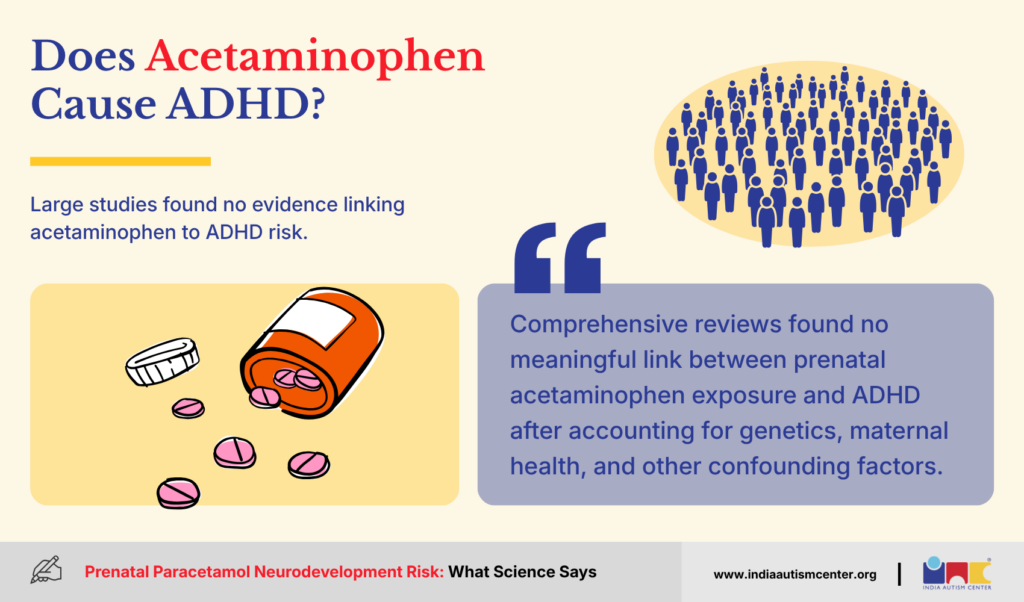
The HKUMed study isn’t standing alone. A systematic review published in The Lancet Obstetrics, Gynaecology, & Women’s Health in January 2026 looked at 43 studies from around the world. Data came from Europe, the United States, Japan, Brazil, and New Zealand.
The review was led by Professor Asma Khalil of City St George’s, University of London. Her team found no evidence that prenatal paracetamol exposure raises the risk of autism, ADHD, or intellectual disability. Some earlier individual studies had suggested small associations. Once researchers applied proper adjustment for confounding factors, those associations disappeared.
A separate meta-analysis published in the Journal of the American Academy of Child & Adolescent Psychiatry in October 2025 reached a similar conclusion. That analysis reported an odds ratio of 0.97 for ADHD following in-utero acetaminophen exposure. An odds ratio close to 1.0 means essentially no effect.
One detail from that review is worth knowing. Statistical significance only showed up when researchers used patient-chart data, not maternal recall. Maternal recall has actually been shown to be more accurate than chart data for over-the-counter medicines. This tells us that some earlier “risk signals” were likely a data quality problem, not a real biological effect.
Why Did Earlier Studies Suggest a Link?
You may have read older articles claiming a connection between paracetamol and neurodevelopmental problems. Here’s why those studies painted a different picture.
- Confounding factors — genetics, maternal illness, fever, and chronic pain all independently affect child development.
- Recall bias — some older studies relied on parents remembering medication use months or years later.
- Short follow-up periods — a few studies didn’t track children long enough to draw firm conclusions.
- Lack of sibling controls — most early research compared unrelated children, which cannot separate genetic risk from drug exposure.
A large Swedish cohort of 2.48 million births found no association once familial confounding was accounted for. A Japanese cohort had initially suggested a minor risk increase for ADHD and ASD, but further analysis traced this back to confounding and misclassification, not a real drug effect.
This is a good example of why one study should never be taken as final proof. Science builds confidence through repetition and stronger methodology, not through a single headline.
Is Paracetamol Safe During Pregnancy?
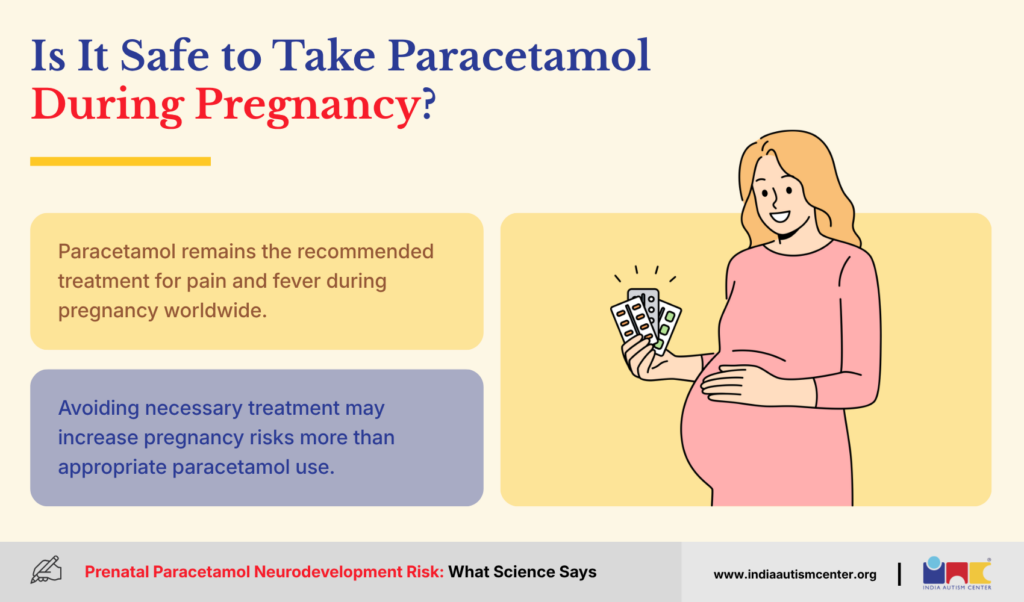
Yes. Paracetamol remains the first-line recommended treatment for pain and fever during pregnancy. This guidance comes from major medical bodies including the CDC, ACOG (American College of Obstetricians and Gynecologists), and the Society of Obstetricians and Gynaecologists of Canada.
More than two-thirds of pregnant women take paracetamol at some point during pregnancy. It’s used to manage:
- Headaches and migraines
- Fever from infections
- Body aches and joint pain
- Post-procedure pain relief
Avoiding paracetamol isn’t automatically the “safer” choice. Untreated fever and pain in pregnancy carry their own documented risks, including miscarriage, preterm birth, and other adverse outcomes. Choosing to avoid treatment out of fear can sometimes create more risk, not less.
What Should Expectant Mothers in India Know?
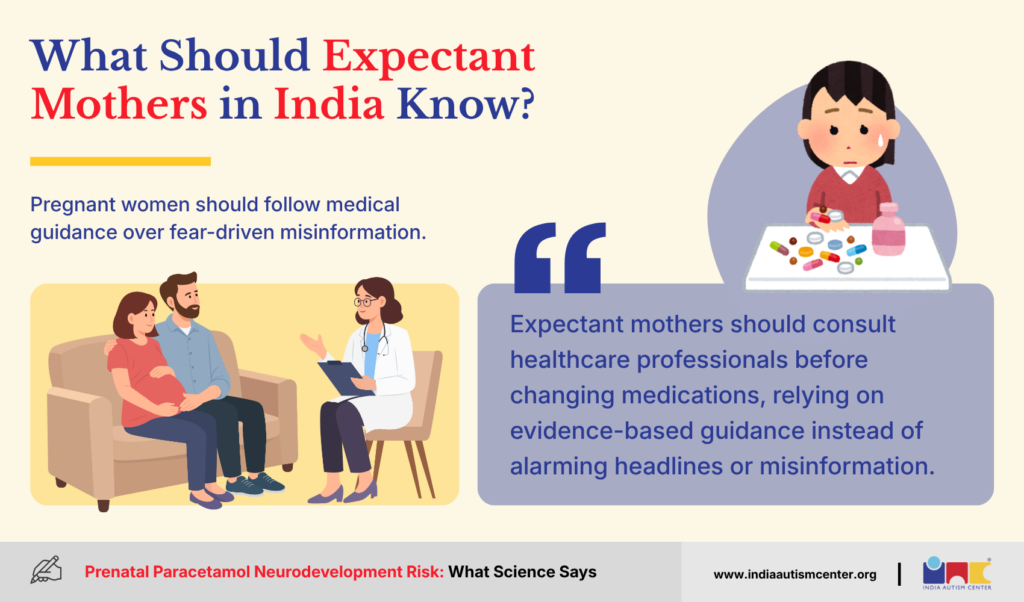
Indian obstetric guidance, broadly aligned with FOGSI (Federation of Obstetric and Gynaecological Societies of India) recommendations, supports paracetamol as a safe option when used as directed during pregnancy. It remains widely available and commonly prescribed across Indian hospitals and clinics.
I’ve noticed a pattern in India worth flagging directly: fear-driven avoidance of basic medication. When international headlines create panic, some expectant mothers stop taking necessary treatment altogether, sometimes without consulting a doctor first. This isn’t a safer path. It’s an uninformed one.
If you’re pregnant and dealing with fever or pain, the right move is simple:
- Don’t self-diagnose based on news headlines.
- Talk to your obstetrician about appropriate dosage and duration.
- Don’t avoid necessary treatment out of unverified fear.
At India Autism Center, our focus stays on what actually helps families: early identification and support, not retroactive guilt over a paracetamol tablet taken for a fever. If you have concerns about your child’s development, early screening tools matter far more than worrying about past medication use.
How Should Pregnant Women Use Paracetamol Responsibly?
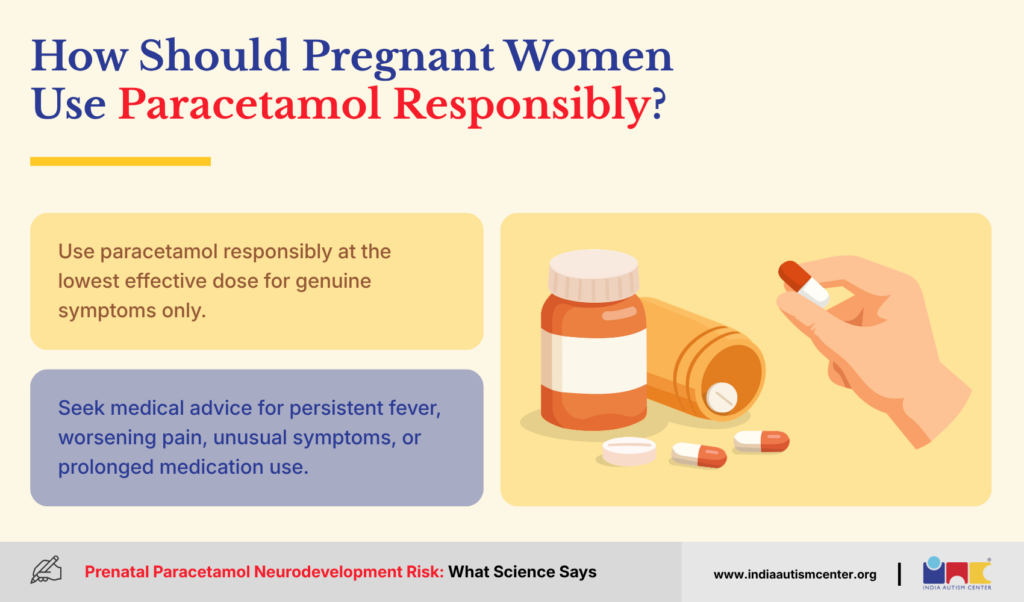
Responsible use matters more than avoidance. Here’s a general guide, though your doctor’s advice always takes precedence over anything you read online.
General Paracetamol Guidance in Pregnancy
| Factor | General Guidance |
| When to use | For genuine pain or fever, not as a precaution |
| Duration | Shortest effective duration |
| Dosage | Lowest effective dose, as advised by your doctor |
| Frequency | Follow product label or physician instructions |
| When to consult a doctor | Fever lasting more than a day, recurring pain, or before regular/prolonged use |
Red flags that need medical attention rather than self-medication include:
- Fever above 100.4°F (38°C) that persists
- Pain that worsens despite medication
- Any unusual symptoms alongside fever or pain
You might also want to read about Does Tylenol Cause Autism? What the Largest Autism Study Found
Key Takeaways
Let me summarise where the evidence actually stands right now:
- A 708,020-pair sibling-matched study found no link between prenatal paracetamol use and autism or ADHD.
- A 43-study systematic review in The Lancet reached the same conclusion.
- A separate meta-analysis reported an ADHD odds ratio of 0.97, essentially no effect.
- Earlier studies suggesting risk were affected by confounding, recall bias, and weaker study design.
- Untreated pain and fever during pregnancy carry their own real risks.
- Paracetamol remains the first-line recommended option per WHO, CDC, ACOG, and Indian obstetric guidance.
Frequently Asked Questions
Does paracetamol during pregnancy cause autism?
No. The largest and most rigorous studies, including a sibling-matched cohort of over 700,000 pairs, found no increased autism risk linked to prenatal paracetamol use.
Does acetaminophen cause ADHD in children?
No. A 2025 meta-analysis reported an odds ratio of 0.97 for ADHD following prenatal acetaminophen exposure, indicating no meaningful increase in risk.
Is paracetamol safe to take in all trimesters of pregnancy?
Yes. The HKUMed study found no increased risk regardless of whether exposure occurred in the first, second, or third trimester.
What if I already took paracetamol during my pregnancy?
Current evidence gives strong reassurance. There is no need for guilt or concern based on past use, especially when taken as directed for genuine pain or fever.
What are safer alternatives for pain or fever in pregnancy?
Paracetamol remains the recommended first-line option. Always consult your obstetrician before trying alternatives, since some other pain relievers carry higher documented risks in pregnancy.
Why did earlier studies suggest a link if it’s not real?
Older studies often lacked sibling controls, relied on inconsistent data sources, and didn’t fully account for genetic and family confounding factors, which distorted the findings.
Disclaimer: This article is for educational and informational purposes only. It is not a substitute for professional medical advice, diagnosis, or treatment. Always consult a qualified obstetrician or healthcare provider regarding medication use during pregnancy or any concerns about your child’s development.