 Donate now
 Get a Call Back
 MENU
MENU 10 MIN READ
 SHARE
SHARE


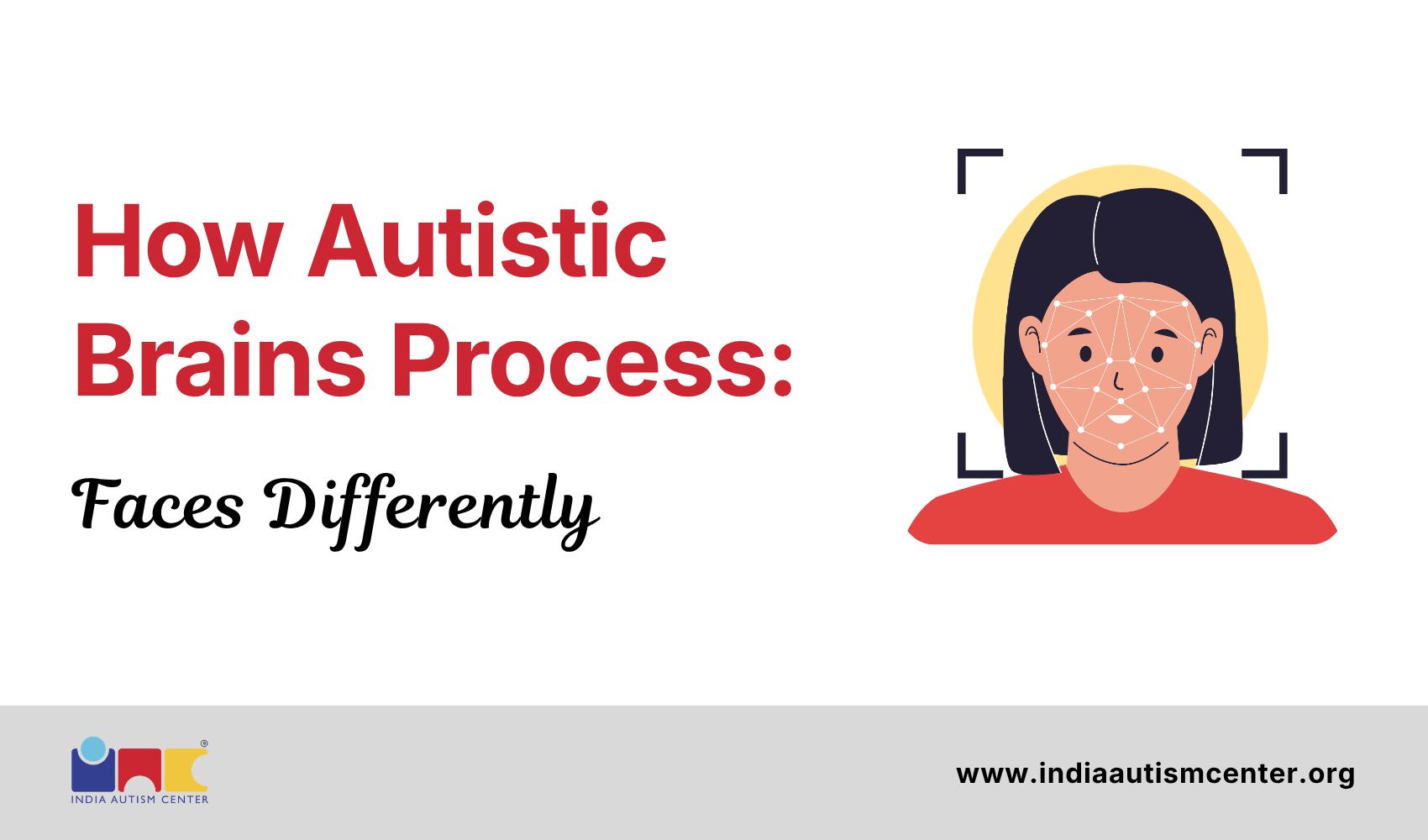
Autistic brains process faces differently because the neural signals linked to face recognition are less distinct, and unlike neurotypical brains, these signals don’t sharpen with age. A 2026 Yale study of nearly 400 children, published in Nature Mental Health, confirms this using full-scalp EEG data. I’ll walk you through what the research found and what it means for autistic children and adults.
What Is Face Processing, and Why Does It Matter in Autism?
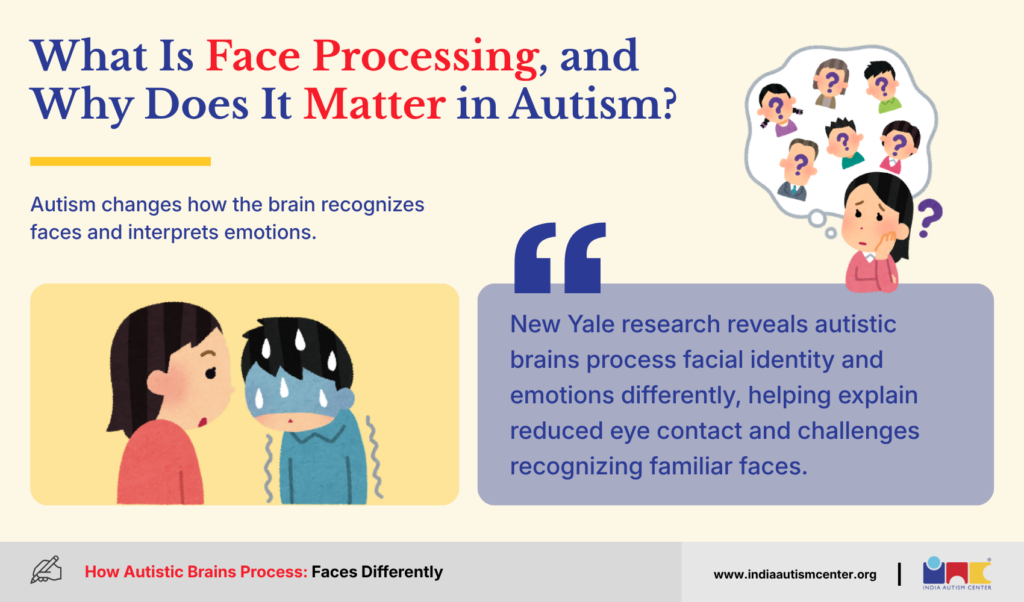
Face processing is how our brains turn visual information into recognition of identity and emotion. It starts the moment light hits the retina. It ends when we know whose face we’re looking at, and what they’re feeling.
This isn’t one single step. It’s a chain of rapid neural events. Researchers have studied this chain in autism for over two decades.
Two hallmark traits of autism relate directly to this chain:
- Reduced eye contact
- Difficulty recognising faces and facial emotions
Scientists have long suspected these traits connect to how the autistic brain handles facial information at a neural level. The new Yale research gives us the clearest picture yet.
How Do Autistic Brains Process Faces Differently?
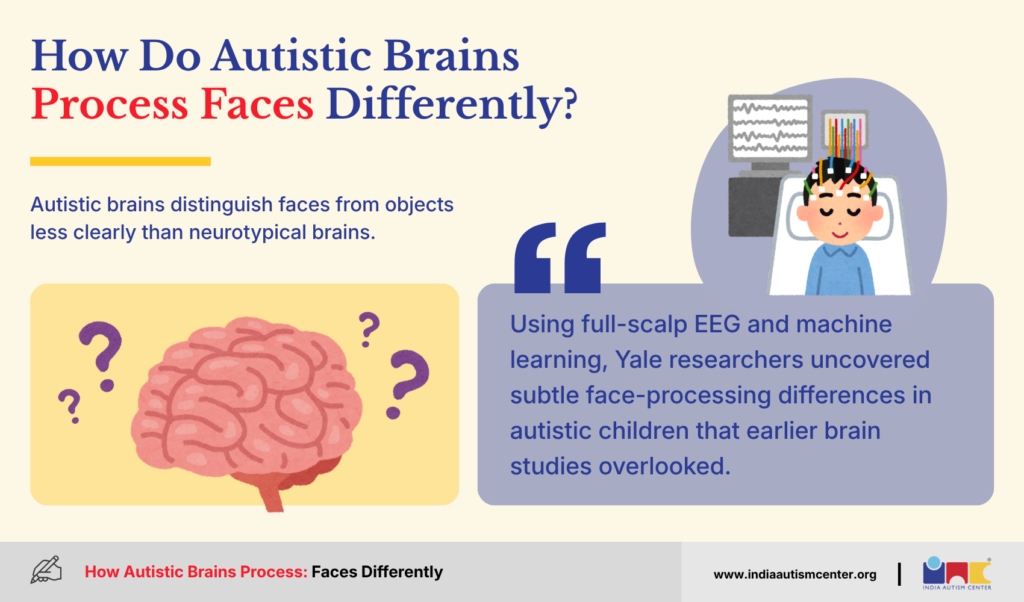
Autistic brains show less distinct neural activity when processing faces compared to neurotypical brains. This makes it harder for researchers, and possibly for the brain itself, to clearly separate “looking at a face” from “looking at an object.”
Led by James McPartland, PhD, at Yale’s Center for Brain and Mind Health, researchers used EEG to measure electrical activity across all 128 electrodes on the scalp. Most earlier studies looked at only one or two brain regions. This study captured the full picture.
The team then used machine learning to predict what each child was looking at, based purely on brain activity. Here’s what they found:
- In neurotypical children, the algorithm could reliably tell when a child was looking at a face versus an object.
- In autistic children, this prediction was significantly harder to make.
- The neural signature of “face” versus “non-face” was blurrier in autistic brains.
McPartland described this using a traffic analogy. Measuring one brain region is like watching one downtown camera to judge city traffic. Measuring all 128 electrodes is like using satellite imaging to track every car in the city at once. This full-scalp approach is why the study could detect differences that earlier research missed.
📥 Free download: Printable daily routine chart for autistic children
Why Doesn’t Face Processing Refine With Age in Autistic Children?
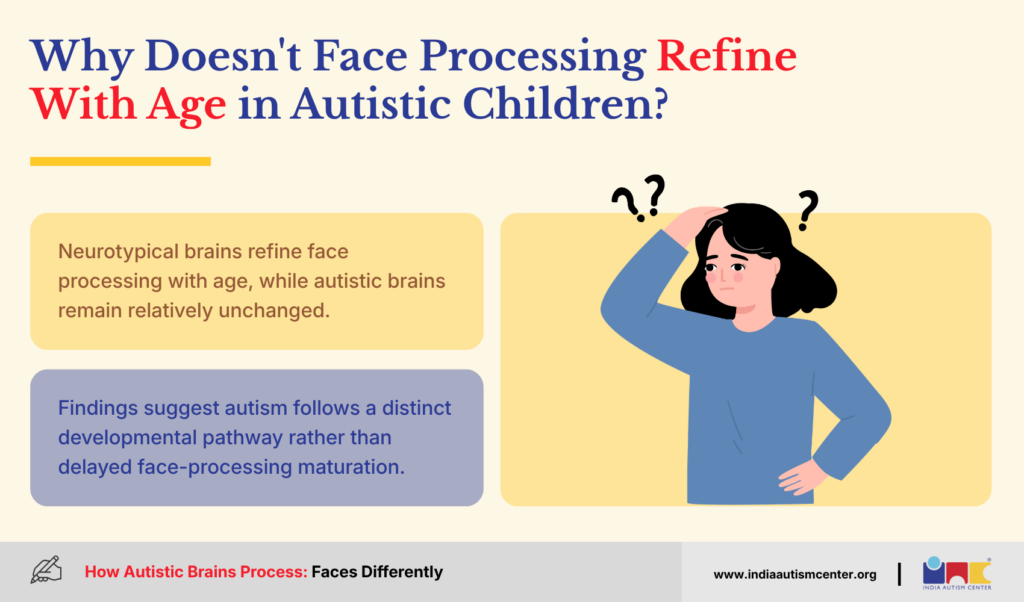
In neurotypical children, face processing becomes more specialized as they get older. Their brains get progressively better at distinguishing faces from other visual information. This is a normal, expected part of development.
Autistic children don’t show this same trend. The study found no significant change in face-processing accuracy across different ages in autistic participants. Their neural response to faces stays roughly the same from early childhood onward, according to first author Jason Griffin, PhD, now at the University of Houston.
This table summarizes the core contrast:
| Feature | Neurotypical Brain | Autistic Brain |
| Face vs. object signal distinction | Clear and consistent | Less distinct |
| Change in accuracy with age | Improves over time | Stays flat |
| Face-processing specialization | Increases with development | Reduced developmental change |
| N170 brain response timing | On typical schedule | Delayed |
| Onset of measurable differences | — | Earlier than previously known |
This lack of age-related refinement suggests something important. The difference isn’t just a delay that autistic children will “catch up” on later. It appears to be a distinct developmental trajectory.
What Is the N170, and Why Does This Study Go Beyond It?
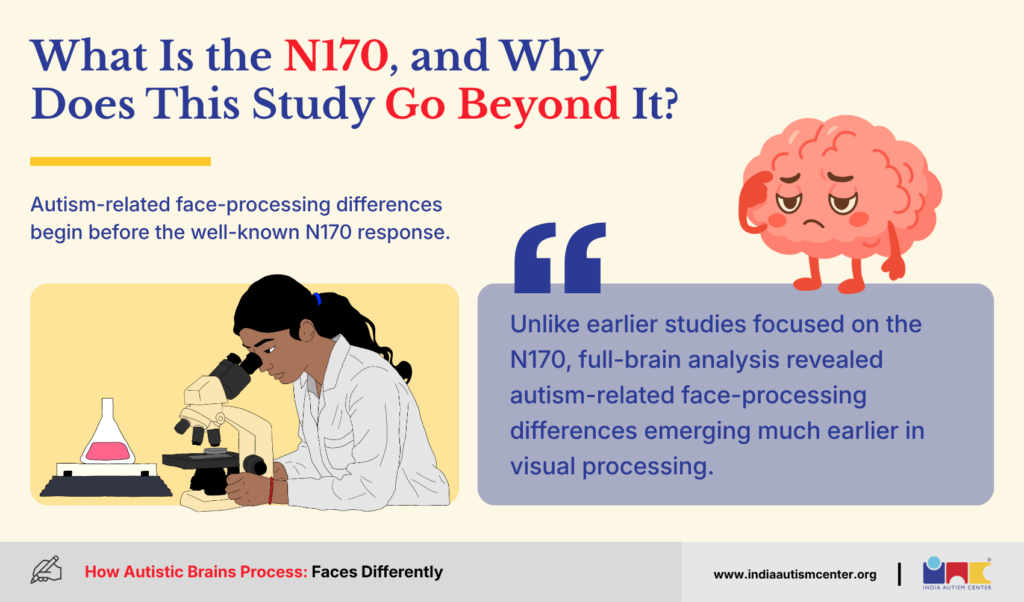
The N170 is a well-known biomarker in face-processing research. It refers to a shift in brain activity that happens about 170 milliseconds after someone sees a face. In autistic individuals, this response is typically delayed.
Most previous studies focused narrowly on the N170 signal. This new research looked at the full temporal range of brain activity, not just one snapshot at 170 milliseconds. That broader window revealed something new.
Differences between autistic and neurotypical face processing appear to begin even earlier than the N170 response. This pushes back scientists’ understanding of when, in the visual-processing chain, autism-related differences first emerge.
Is Difficulty Recognizing Faces a Core Feature of Autism, or a Result of Avoiding Eye Contact?
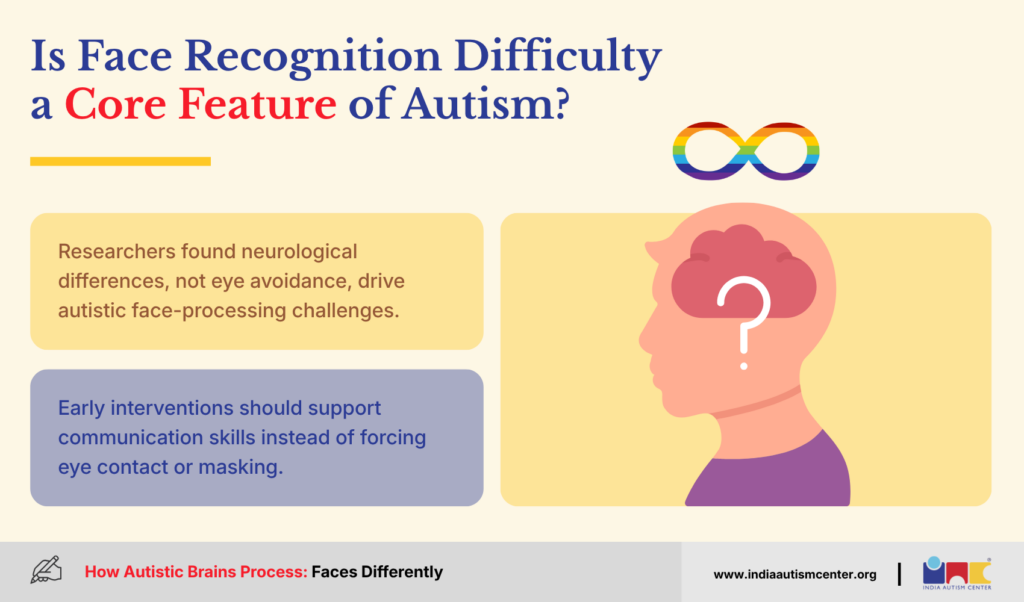
This is one of the most important questions the study addresses. For years, clinicians debated whether face-processing struggles were caused by autism itself, or simply by autistic people avoiding eye contact and getting less “practice” reading faces.
The Yale findings point toward autism itself as the driver. Researchers found that the reduced developmental refinement seen in autistic children reflects an underlying neurological difference. It is not simply a byproduct of looking at faces less often.
This distinction matters for how we support autistic individuals. If the root cause is neurological, then interventions need to target the underlying processing difference. Simply instructing someone to “make more eye contact” doesn’t address that.
Why Doesn’t Forcing Eye Contact Help?
For decades, some clinical approaches pushed autistic children to make eye contact as a way to improve social engagement. Researchers now understand this approach doesn’t fix the underlying processing difference.
Forcing eye contact addresses a behavior, not the neural mechanism behind it. It can also cause real discomfort for autistic individuals, since eye contact itself can be overwhelming for many.
A more effective approach focuses on:
- Building alternative strategies for reading social and emotional cues
- Supporting communication in ways that don’t rely solely on facial interpretation
- Structured, individualized social-skills therapy rather than one-size-fits-all eye-contact drills
This is where structured therapy programs, especially those designed specifically around autism, make a meaningful difference. Therapies that build on a child’s actual strengths tend to work better than approaches that push against core neurological traits.
For more deeper insights on this topic, read Autism and Eye Contact: Everything You Should Know [Updated]
What Does This Mean for Autism Diagnosis?
Right now, autism is diagnosed based entirely on behavioral observation. There is no blood test, brain scan, or single biological marker that confirms an autism diagnosis today.
This study is an early step toward changing that. McPartland describes it as introducing a new potential biomarker for future diagnostic tools. The goal isn’t to replace behavioral assessment immediately, but to eventually support and refine it.
Biological markers, like distinct EEG signatures, could eventually help with:
- Identifying autism earlier in development
- Distinguishing between different autism subgroups
- Predicting which children may respond best to specific interventions
- Reducing reliance on subjective behavioral checklists alone
For now, though, standard behavioral screening tools remain the primary diagnostic pathway. Tools like the M-CHAT-R/F are still the accessible, validated first step for identifying early signs of autism, including differences in social engagement and face-related behaviors, in young children.
What Does This Mean for Early Intervention?
Since face-processing differences appear to emerge early and don’t self-correct with age, the researchers suggest interventions may be most effective in early childhood. This is when these developmental patterns are just beginning to diverge.
Early intervention isn’t about “correcting” autism. It’s about giving children tools to navigate a world that relies heavily on facial communication, from classrooms to playgrounds. Many autistic individuals are not distressed by their traits and don’t want or need intervention.
But for those who do experience real difficulty, understanding facial expressions can affect daily life in concrete ways. Reading a teacher’s frustration, a peer’s friendliness, or an interviewer’s reaction all depend on this kind of processing. Supporting these skills early can meaningfully improve quality of life later.
Want to know more? Get in touch with us.
How Common Are Face-Processing Differences in Autism?
Face-processing differences are considered one of the most consistently observed traits across autism research, though they vary in intensity from person to person. Some autistic individuals report significant difficulty recognising familiar faces. Others notice only mild challenges with reading subtle emotional expressions.
This variability is important to keep in mind. Autism is a spectrum, and face processing differences reflect that same range. No single symptom checklist applies to every autistic person the same way.
What Should Parents and Caregivers Take Away From This Research?
If your child struggles with recognizing faces or reading emotions, this research offers a reassuring reframe. These difficulties are not a matter of effort or attention. They reflect real, measurable differences in brain activity.
Here’s what this means practically:
- Pushing a child to “just look people in the eye” is unlikely to help, and may cause distress.
- Early, structured support around emotional and social understanding can be valuable.
- Every autistic child’s experience with face processing is different, so individualized assessment matters more than generic advice.
- Standardized screening tools remain the best current starting point if you have concerns about your child’s development.
How Was This Study Different From Earlier Autism Face-Processing Research?
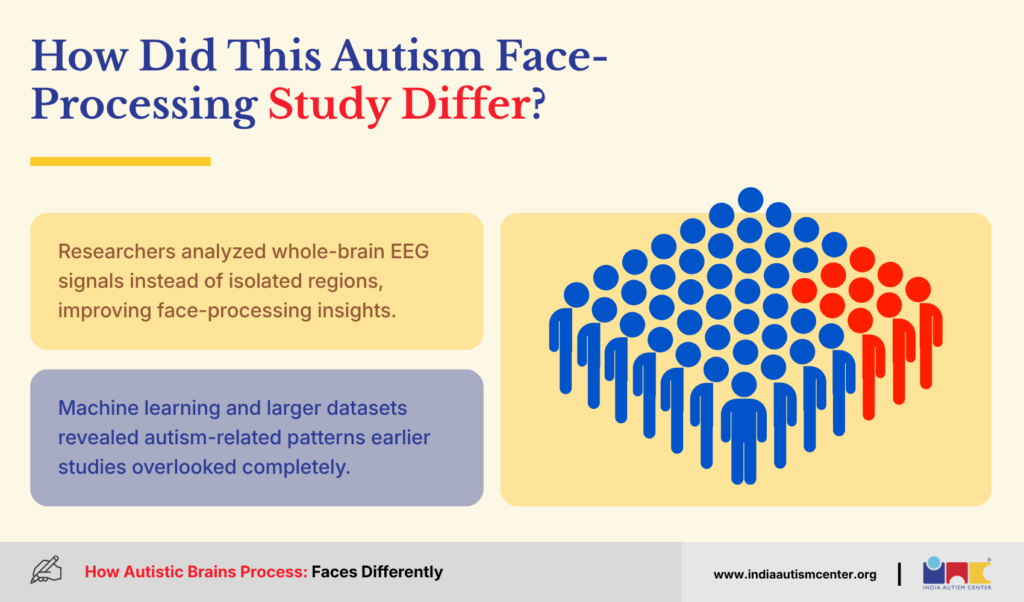
Most earlier EEG studies on autism and face processing relied on a handful of electrodes placed over specific brain regions. This narrow approach could only capture activity in one or two areas at a time.
The Yale team used data from the Autism Biomarkers Consortium for Clinical Trials (ABC-CT), a large research initiative tracking autistic and neurotypical children over time. Researchers recorded activity across all 128 scalp electrodes as children viewed images of faces and objects.
This full-scalp method offered three key advantages:
1. Wider coverage — capturing brain-wide activity instead of one isolated region
2. Machine learning analysis — using algorithms to detect subtle patterns humans might miss
3. Larger sample size — nearly 400 children, spanning a range of ages, strengthening the reliability of results
This combination is why the researchers could confidently identify a difference that smaller, narrower studies had not fully captured before. It also explains why McPartland calls this a genuinely new way of measuring face perception in autism.
Conclusion
This research builds on findings dating back to the early 2000s, when Yale-led studies first showed reduced activity in face-processing brain regions among autistic individuals. Two decades later, this new full-scalp EEG approach confirms and deepens that understanding.
The takeaway is straightforward: autistic brains process faces differently at a fundamental, measurable level. This isn’t a deficit to be “fixed” through forced eye contact. It’s a neurological difference that deserves informed, individualized support, starting as early as possible when a child or family wants it.
Frequently Asked Questions
What is face processing in autism?
Face processing in autism refers to how the autistic brain interprets facial identity and emotion. Research shows this process involves less distinct neural signals compared to neurotypical brains.
Why do autistic children have trouble recognizing facial emotions?
Studies suggest the brain regions and neural signals involved in face processing are less specialized in autistic children, and this specialization doesn’t increase with age the way it typically does.
Is difficulty with faces present in all autistic people?
No. Face-processing differences are common in autism but vary widely between individuals. Some experience significant difficulty, while others notice only subtle differences.
Can EEG diagnose autism?
Not yet. Current research, including this Yale study, is exploring EEG-based biomarkers, but autism diagnosis today still relies on behavioral assessment.
Does face-processing ability improve with therapy?
Structured, individualised social-skills interventions, especially when introduced early, can help autistic individuals build strategies for social and emotional understanding, even if the underlying neural pattern remains different.
Disclaimer: This article is intended for educational purposes only and does not constitute medical or diagnostic advice. If you have concerns about your child’s development or suspect signs of autism, please consult a qualified pediatrician, developmental specialist, or licensed healthcare provider for proper evaluation.
For expert insights, support services, and inclusive learning initiatives, visit the India Autism Center.