 Donate now
 Get a Call Back
 MENU
MENU 10 MIN READ
 SHARE
SHARE


Autism in girls is missed because diagnostic tools were built around how boys present, and because girls camouflage their traits more effectively. I want to walk you through exactly why this happens, what it looks like in real life, and what parents and clinicians can do about it — especially here in India.
Why Is Autism in Girls Missed So Often?
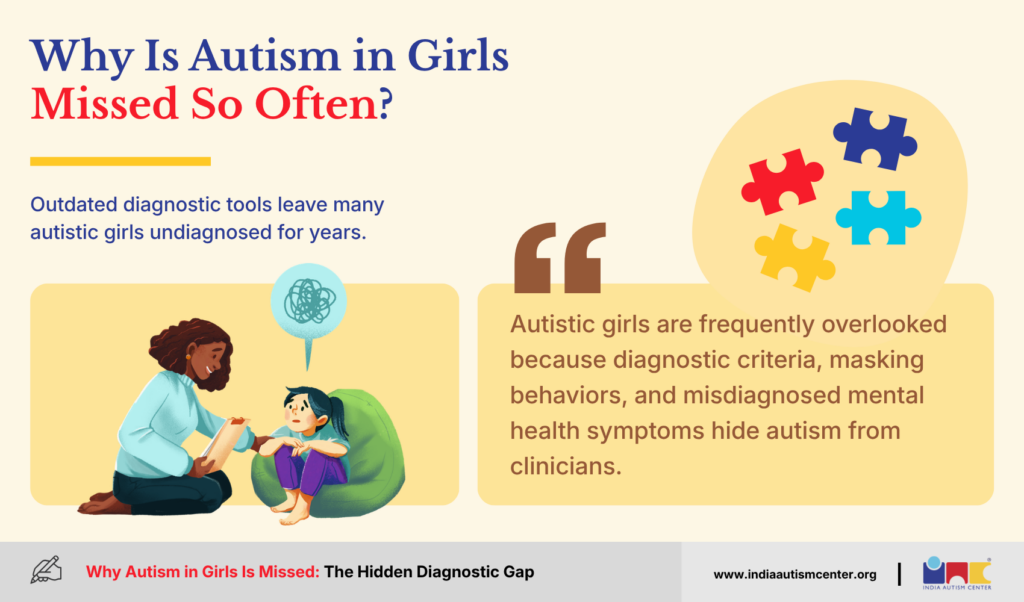
Autism in girls is missed mainly for three reasons. The tools we use were tested on boys. Girls mask their traits better. And girls’ symptoms often get labeled as anxiety or depression instead.
I’ve spent years writing about autism diagnosis, and this pattern comes up again and again. It isn’t that autism is rare in girls. It’s that our systems weren’t designed to catch it.
For decades, clinicians believed autism affected boys four times more often than girls. That 4:1 ratio shaped everything — the diagnostic criteria, the screening tools, even public perception of what autism “looks like.” Newer research puts the real ratio closer to 2:1 or 3:1 (Cook et al., 2024). That gap between old assumptions and new evidence is where thousands of girls fall through.
Is Autism Really Less Common in Girls, or Just Less Recognized?
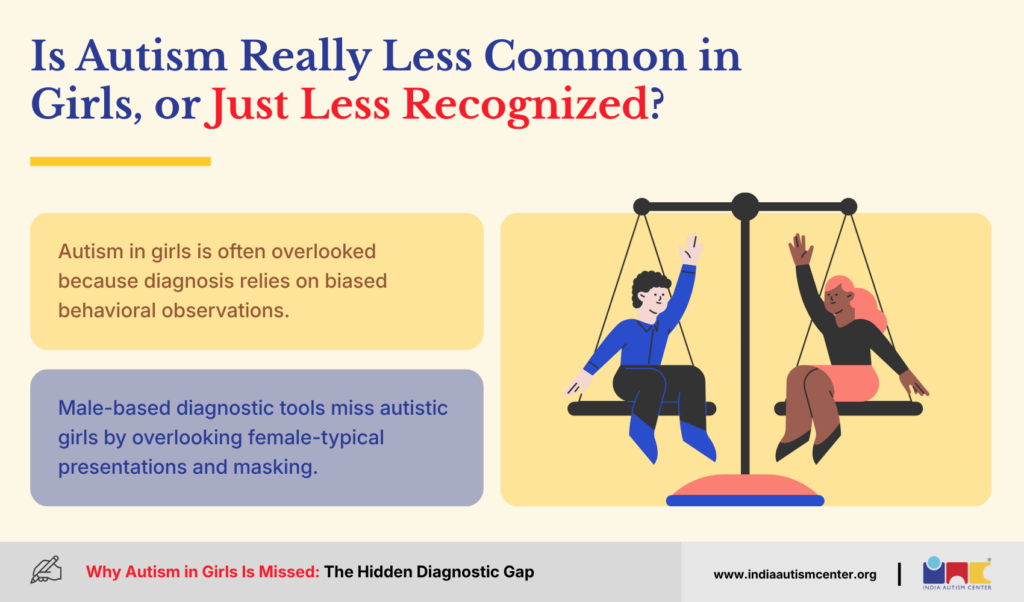
Autism is not necessarily less common in girls. It is less recognized in girls. This is a critical distinction.
Autism is highly genetic. Researchers estimate genetic factors account for 64 to 91 per cent of autism cases (Cook et al., 2024). There’s no single “autism gene,” and no blood test confirms it. Diagnosis depends entirely on observed behavior — and that’s where bias creeps in.
Here’s the comparison that matters:
| Ratio Estimate | Basis |
| 4:1 (male:female) | Older data, based on tools normed almost entirely on boys |
| 2:1 to 3:1 (male:female) | Revised estimate accounting for camouflaging and diagnostic bias (Cook et al., 2024) |
The narrowing gap tells us something important: a large share of “missing” autistic girls were never rare cases. They were missed cases.
Why Were Diagnostic Tools Built Around Boys in the First Place?
Diagnostic tools like the ADOS (Autism Diagnostic Observation Schedule) were developed and validated using largely male samples. This happened because autism was long considered a male-dominant condition, so researchers studied the population they had — boys.
As a result, these tools measure the behaviors boys commonly show. They don’t account for behaviors more typical of girls, such as camouflaging. If a symptom isn’t on the checklist, a clinician isn’t trained to look for it. That’s not a small oversight. It’s a structural gap in how autism gets diagnosed.
This is also why the discredited “extreme male brain” theory gained traction for so long.
We have an article on Why Are Fewer Girls Diagnosed with Autism? The X Chromosome May Hold the Answer
What Was the “Extreme Male Brain” Theory, and Why Was It Wrong?
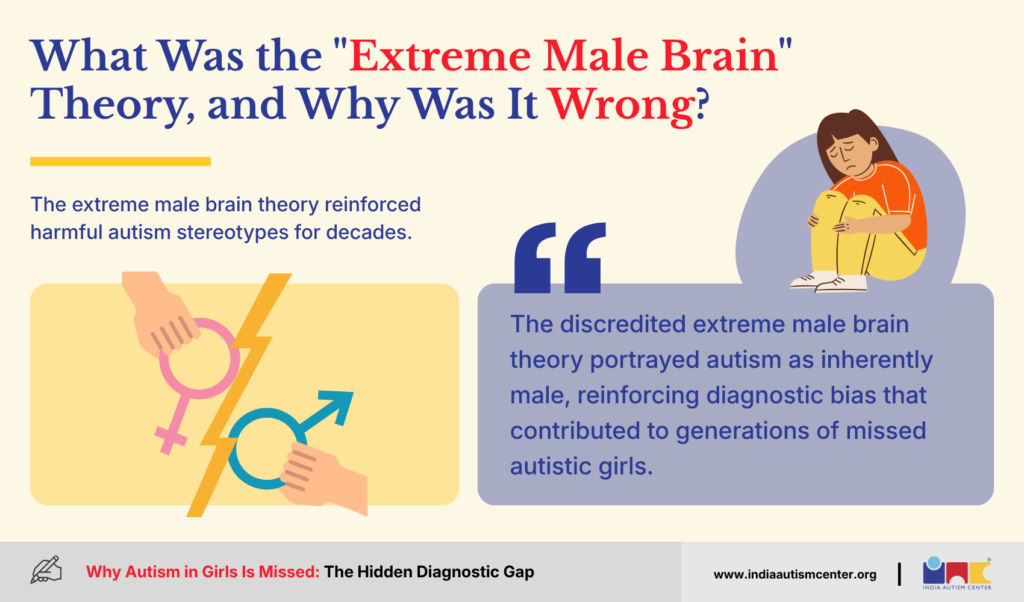
The extreme male brain theory, proposed by researcher Simon Baron-Cohen in 2002, suggested autism was an exaggerated version of typical “male” thinking — strong on systemising, weak on empathy. It framed autism as inherently more male.
This theory has been heavily criticized for relying on gender stereotypes rather than solid evidence. Baron-Cohen himself has since acknowledged the terminology was problematic. It likely reflected socialised behaviour differences, not real biological sex differences in the brain.
The damage, though, was already done. A generation of clinicians trained under this framework learned to expect autism in boys — not girls. That expectation still shapes diagnosis today.
📥 Free download: Printable daily routine chart for autistic children
How Do Autistic Girls Camouflage Their Symptoms?
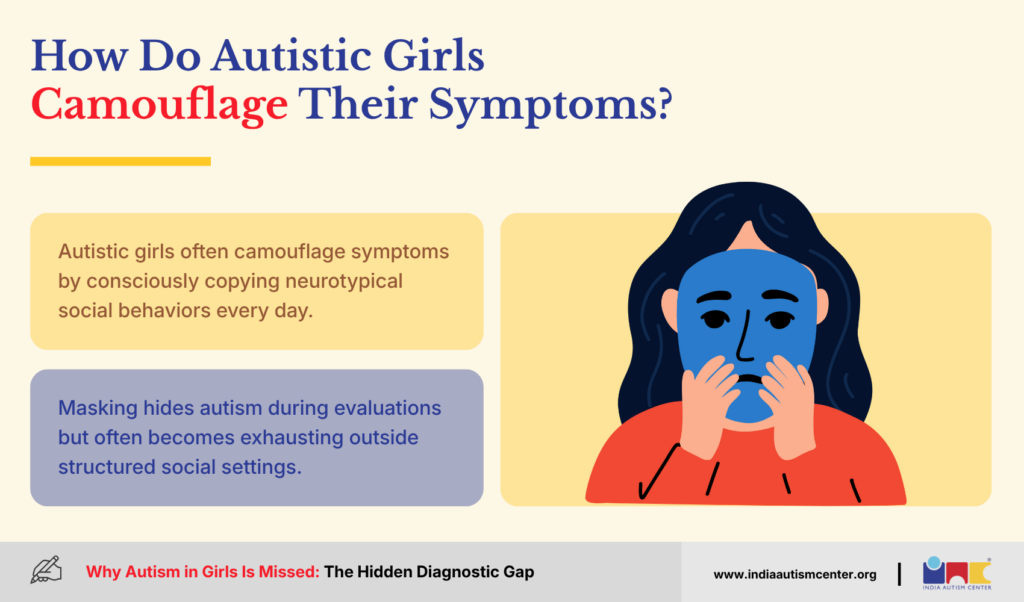
Autistic girls often camouflage, or “mask,” by copying the social behavior of their neurotypical peers. They study how other girls talk, move, and react, then consciously imitate it.
This happens because girls tend to be more socially motivated than boys, even when autistic (Young et al., 2018). That motivation drives them to blend in rather than stand out. Common camouflaging behaviors include:
- Scripting conversations in advance, rather than responding spontaneously
- Mimicking friends’ interests even without genuine engagement
- Suppressing stimming (repetitive movements) in public, then releasing it at home
- Forcing eye contact despite discomfort
- Rehearsing facial expressions to match social expectations
A clinician who observes a child for 30 to 45 minutes will likely miss all of this. Masking is designed to hold up under short-term scrutiny. It usually collapses only at home, after school, when the effort becomes too exhausting to sustain.
Do Autistic Girls Struggle With Friendships Like Autistic Boys Do?
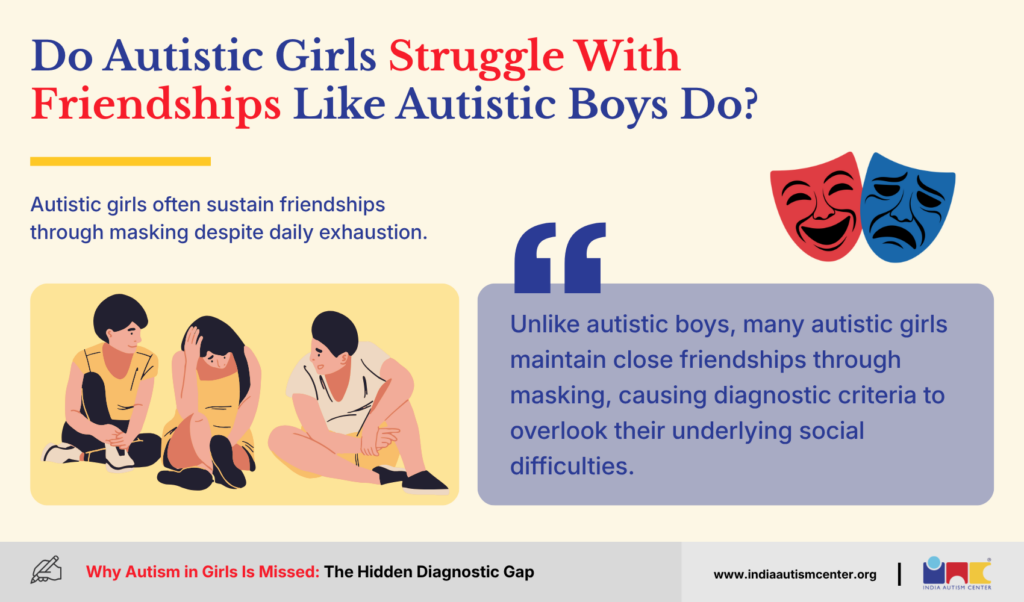
No, not in the same way. This is one of the clearest examples of diagnostic bias in autism girls face.
Difficulty forming friendships is a core diagnostic criterion for autism. But research shows this mainly holds true for autistic boys, who report fewer close friendships than neurotypical boys (Young et al., 2018). Autistic girls, by contrast, often report friendship closeness similar to their neurotypical peers.
That doesn’t mean the friendships come easily. It means girls work harder — through camouflaging — to sustain them. A clinician using friendship difficulty as a checklist item will often clear an autistic girl who is, in fact, exhausting herself daily to maintain normal-looking relationships.
Why Do Autistic Girls Get Misdiagnosed With Anxiety or Depression?
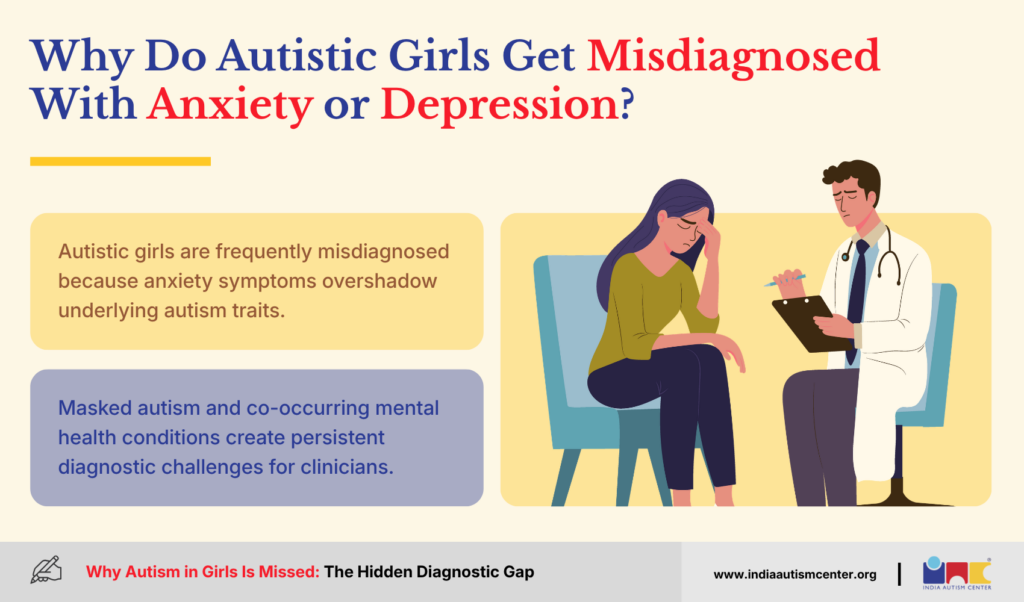
Autistic girls are frequently diagnosed with anxiety or depression instead of autism because these conditions are more familiar to clinicians and easier to spot in short appointments.
Up to 70 percent of autistic individuals have at least one co-occurring mental health condition, and this is especially true for girls (Cook et al., 2024). Anxiety and depression symptoms are visible and well-documented. Autism symptoms, especially masked ones, are not.
This creates a diagnostic trap. A girl comes in with anxiety. She gets treated for anxiety. The underlying autism goes unaddressed — sometimes for years, sometimes for a lifetime. Misdiagnosis in autism girls isn’t rare. It’s close to routine.
I’d also point out: autism itself is not a mental health disorder. It’s a form of neurodiversity — a different way of processing information, not a disordered one. But because it so often travels alongside anxiety and depression, it gets overshadowed by conditions clinicians are quicker to name.
Want to know more? Get in touch with us.
What Does Undiagnosed Autism in Girls Look Like in India?
In India, autism diagnosis in girls faces an added layer of difficulty: cultural expectations around compliance and social “adjustment.”
Girls are often raised to accommodate, to avoid conflict, and to fit in socially — traits that overlap heavily with camouflaging behavior. A girl who masks her discomfort to please her family or teachers may be praised for being “well-behaved,” not flagged for evaluation.
Add to this a broader awareness gap. Many Indian pediatricians and school counsellors are trained primarily on male-presenting autism traits. Referral rates for autism screening remain lower for girls than boys across Indian clinical settings. The result: Indian girls are frequently referred for anxiety, shyness, or academic pressure — not autism — well into adolescence or adulthood.
At India Autism Center, we see this pattern often: families who come in seeking help for a “quiet, anxious” daughter, only to discover, after a full evaluation, that autism was the root cause all along.
What Are the Early Signs of Autism in Girls Parents Often Miss?
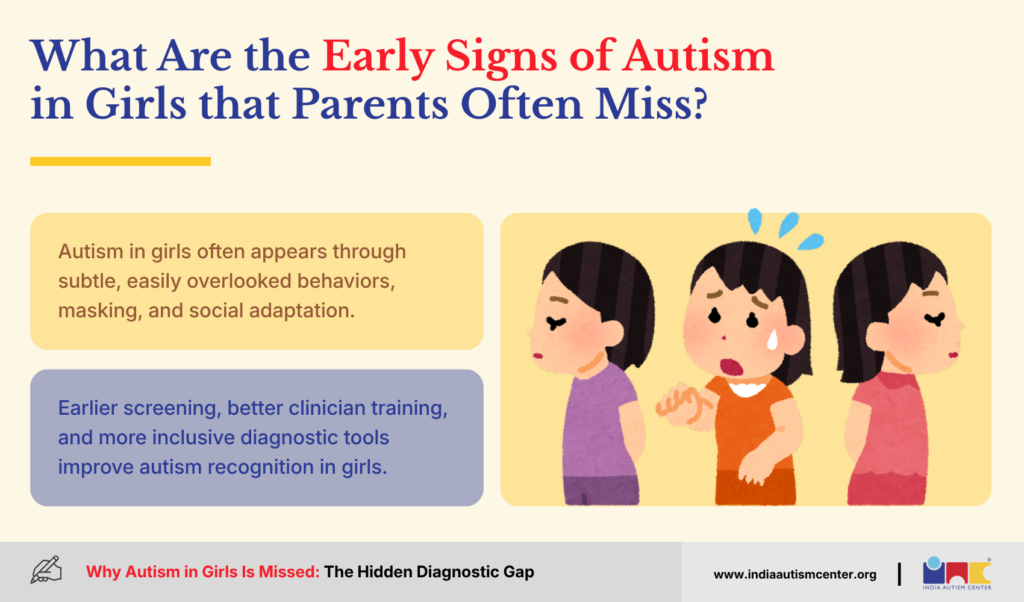
Autism in girls doesn’t always look like the “textbook” signs most parents have heard about. Here’s how the presentation often differs:
| Commonly Known Sign (Male-Normed) | Often Seen in Girls Instead |
| Avoids eye contact | Forces eye contact, appears exhausted after |
| Few or no friendships | Has friends, but relationships feel scripted or effortful |
| Obvious repetitive movements | Stims privately, suppresses it in public |
| Narrow, unusual interests (trains, numbers) | Intense interest in socially typical topics (animals, celebrities, books) taken to an extreme depth |
| Meltdowns in public | Holds it together outside, meltdowns only at home |
| Delayed or unusual speech | Verbally fluent, but conversation feels one-directional or rehearsed |
If several of these sound familiar, it’s worth pursuing a formal screening, not dismissing them as personality traits.
How Can Autism Diagnosis in Girls Actually Improve?
Improving autism diagnosis in girls requires changes at three levels: clinical training, diagnostic tools, and observation practices.
1. Clinician training needs to explicitly cover camouflaging and female-typical presentations, not just male-normed checklists.
2. Diagnostic tools need updated validation studies that include girls in equal numbers, so tools like the ADOS reflect a fuller range of presentations.
3. Multi-setting observation matters more than single clinic visits. Parents and teachers should be asked directly about behavior differences between home and school.
4. Screening should start earlier, especially when a girl shows anxiety, perfectionism, or social exhaustion alongside strong academic performance — a combination that often hides autism in plain sight.
5. Progress is happening. Clinicians are increasingly aware of these gaps, and newer research is actively working to close them. But we still have a long way to go before diagnostic tools are truly inclusive.
When Should You Seek an Autism Evaluation for Your Daughter?
You should consider an autism evaluation if your daughter shows a consistent gap between how she behaves at home versus outside, alongside social exhaustion, intense but narrow interests, or sensory sensitivities.
Some practical red flags by age:
- Early childhood (2–5 years): Delayed pretend play, intense reactions to sensory input (tags, sounds, textures), difficulty with transitions
- School age (6–12 years): Academic success paired with social exhaustion, very few but intensely close friendships, meltdowns confined to home
- Adolescence (13+ years): Chronic anxiety, perfectionism, identity confusion, burnout from years of masking, difficulty explaining “why socializing feels so hard”
If this sounds like your daughter, a structured screening is the right next step. Tools like the M-CHAT-R/F for younger children offer an accessible starting point before a full clinical evaluation.
Read our blog on 2026 Study | Young Women with ADHD Are at Higher Risk of Serious Health Problems
Conclusion
Autism in girls is missed not because it’s rare, but because our diagnostic systems weren’t built to see it. Masking, male-normed tools, and overlapping anxiety or depression diagnoses all play a part. Recognizing these patterns early — as a parent, teacher, or clinician — can make the difference between years of confusion and a diagnosis that finally makes sense of a girl’s lived experience.
Frequently Asked Questions
Why is autism underdiagnosed in girls?
Because diagnostic tools were validated mainly on boys, and girls camouflage their traits more effectively, making autism harder to detect in short clinical observations.
What is autism masking or camouflaging?
It’s the conscious or unconscious effort to hide autistic traits by mimicking neurotypical social behavior, often at high emotional cost.
Can autistic girls have close friendships?
Yes. Autistic girls often report friendship closeness similar to neurotypical peers, even though maintaining those friendships can be far more effortful than it appears.
Is the 4:1 male-to-female autism ratio still accurate?
No. Once camouflaging and diagnostic bias are accounted for, researchers estimate the real ratio is closer to 2:1 or 3:1 (Cook et al., 2024).
What should I do if I suspect my daughter is autistic?
Start with a structured screening tool, then seek a full evaluation from a qualified clinician experienced in recognizing female-presenting autism traits.
Disclaimer: This article is for educational purposes only and does not constitute medical or clinical advice. If you suspect your child may be autistic, please consult a qualified healthcare professional or developmental specialist for proper screening and diagnosis.
References
Baron-Cohen, S. (2002). The extreme male brain theory of autism. Trends in Cognitive Sciences, 6(6), 248-254.
Cook, J., Hull, L., & Mandy, W. (2024). Improving diagnostic procedures in autism for girls and women: A narrative review. Neuropsychiatric Disease and Treatment, 505-514.
Young, H., Oreve, M. J., & Speranza, M. (2018). Clinical characteristics and problems diagnosing autism spectrum disorder in girls. Archives de Pédiatrie, 25(6), 399-403.