 Donate now
 Get a Call Back
 MENU
MENU 13 MIN READ
 SHARE
SHARE


Every child learns differently, but when a child consistently struggles to read, write, understand numbers, or process information despite receiving appropriate instruction, it may indicate a learning disability.
Such neurological differences tend to affect how the brain processes information rather than a child’s intelligence or willingness to learn. According to the research, specific learning disorders affect approximately 5% to 15% of school-aged children across different languages and cultures, making early identification and intervention essential.
Understanding all the different types of learning disabilities can help parents, educators, and caregivers recognise challenges early, access the right support, and empower children to develop the skills and confidence they need to thrive both inside and outside the classroom.
What Are Learning Disabilities?
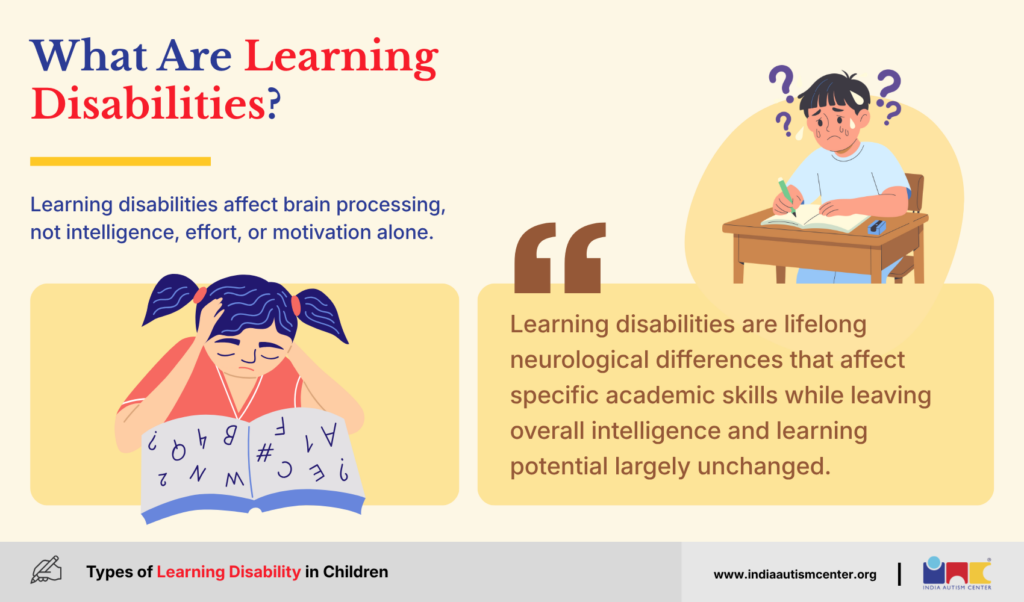
Learning disabilities are lifelong neurological differences that affect the way the brain receives, processes, stores, or communicates information. Poor teaching, low intelligence, hearing problems, or lack of effort do not cause them.
Children with learning disabilities often have average or even above-average intelligence but struggle in one or more academic areas despite receiving appropriate instruction.
The list of learning disabilities covers several conditions that affect reading, writing, mathematics, language, motor coordination, memory, and organisation.
It is important to distinguish learning disabilities from intellectual disability. While intellectual disability affects overall cognitive functioning, learning disabilities impact specific academic skills.
Learning disabilities can affect:
- Reading comprehension
- Writing and spelling
- Mathematical reasoning
- Language processing
- Organisation and planning
- Attention and memory
- Motor coordination
Many children experience more than one learning disability simultaneously, making comprehensive assessment essential.
What Are the 7 Types of Learning Disabilities?
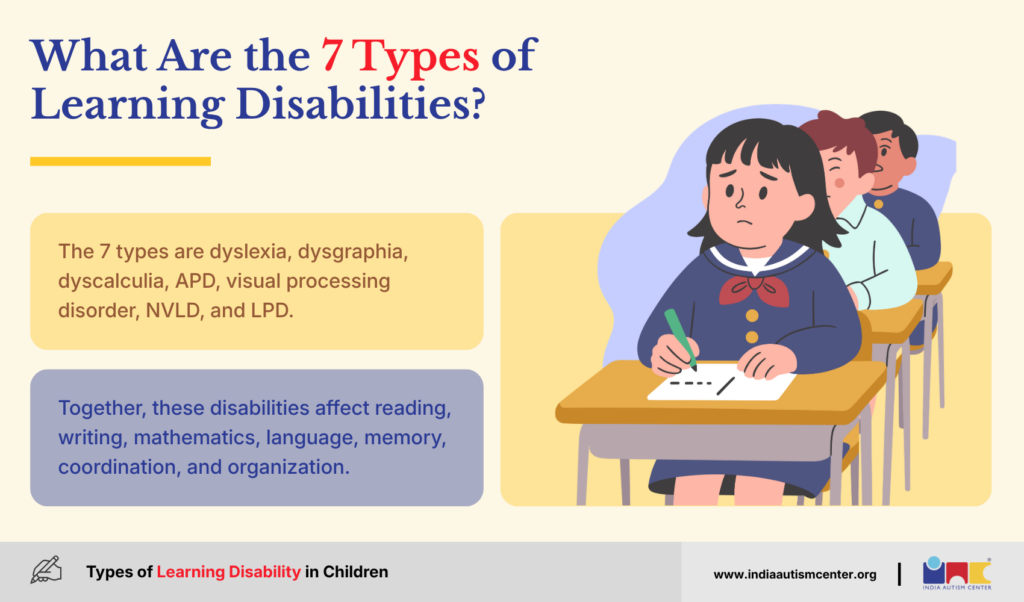
Parents and educators often ask: What are the 7 main types of learning disabilities, and how do they affect a child’s development? Learning disabilities are neurological conditions that interfere with the brain’s ability to receive, process, store, or communicate information.
Each condition affects a different set of skills, which means children with learning disabilities require tailored support rather than a one-size-fits-all approach.
It is also important to remember that many children experience more than one learning disability at the same time. For example, a child with dyslexia may also have dysgraphia, while another may have both dyscalculia and attention difficulties.
Early diagnosis and evidence-based interventions can dramatically improve academic performance, confidence, and overall wellbeing.
Below is a comprehensive list of learning disabilities, explaining the seven most recognised types and how they present in children.
1. Dyslexia
Dyslexia is the most common type of learning disability and primarily affects reading, spelling, and language processing. It occurs because the brain processes written language differently, making it difficult to recognise words accurately and fluently.
Children with dyslexia are often intelligent and curious but struggle with decoding words, connecting letters to sounds, and reading smoothly.
These challenges can affect reading comprehension and classroom participation if appropriate support is not provided.
Common signs include:
- Slow or hesitant reading
- Difficulty recognising familiar words
- Frequent spelling mistakes
- Confusing similar-looking letters or words
- Trouble remembering letter-sound relationships
- Avoiding reading aloud
One of the most common examples of a specific learning disability is a child who can retell a story perfectly after hearing it but struggles to read the same story independently.
Structured literacy programmes, multisensory phonics instruction, audiobooks, and additional classroom support have been shown to improve reading outcomes for children with dyslexia.
2. Dysgraphia
Dysgraphia is a learning disability that typically affects handwriting and written expression. Although children know what they want to say, they often find it difficult to organise their thoughts on paper or write them clearly.
The difficulty extends beyond poor handwriting. Children may struggle with spelling, sentence construction, grammar, punctuation, and organising ideas into coherent paragraphs.
Some common signs include:
- Illegible or inconsistent handwriting
- Slow writing speed
- Difficulty copying text
- Poor spacing between words and letters
- Hand fatigue while writing
- Frequent grammatical and spelling errors
Children with dysgraphia often perform much better during verbal discussions than in written assignments. Occupational therapy, handwriting interventions, keyboard use, and structured writing support can help improve both handwriting and written communication.
3. Dyscalculia
Dyscalculia affects a child’s ability to understand numbers, mathematical concepts, and calculations. It is sometimes referred to as “mathematics dyslexia” because of its impact on numerical reasoning.
Children with dyscalculia may struggle to understand number relationships, estimate quantities, remember mathematical facts, or solve arithmetic problems even after repeated practice.
Typical difficulties include:
- Counting accurately
- Recognising numerical patterns
- Understanding place value
- Learning multiplication tables
- Telling the time
- Managing money
- Solving multi-step mathematical problems
One of the most common examples of a specific learning disability is a child who understands classroom discussions but cannot remember basic addition or subtraction facts despite regular practice.
Visual teaching methods, number lines, manipulatives, interactive activities, and real-life mathematical examples can help children develop stronger numerical understanding.
4. Auditory Processing Disorder (APD)
Auditory Processing Disorder is known to affect how the brain processes sounds rather than how the ears hear them. Children with APD usually have normal hearing but struggle to interpret spoken information, particularly in noisy environments such as classrooms.
These difficulties can affect listening, communication, and classroom learning.
Common symptoms include:
- Frequently asking people to repeat instructions
- Difficulty following verbal directions
- Confusing similar-sounding words
- Trouble understanding speech in noisy settings
- Difficulty remembering spoken information
For example, a teacher may give several instructions in class, but the child remembers only the first or last.
Speech and language therapy, classroom accommodations, assistive listening devices, and reducing background noise can significantly improve learning outcomes.
5. Visual Processing Disorder
Visual Processing Disorder primarily affects how the brain interprets visual information. It differs from vision problems, as children can often see clearly during an eye examination yet still struggle to process what they see.
Children may experience challenges with reading, recognising patterns, understanding spatial relationships, and accurately interpreting visual information.
Signs may include:
- Getting confused between similar letters such as “b” and “d”
- Difficulty copying from the board
- Problems identifying shapes or patterns
- Losing their place while reading
- Difficulty understanding maps, charts, or diagrams
These challenges may interfere with reading fluency, mathematics, handwriting, and everyday classroom activities.
Support strategies include using larger print, colour coding, visual organisers, and breaking visual tasks into smaller, manageable steps.
6. Non-Verbal Learning Disability (NVLD)
Non-Verbal Learning Disability primarily affects visual-spatial reasoning, motor skills, organisation, and social understanding, while verbal abilities often remain strong.
Children with NVLD usually develop excellent vocabulary and language skills but find it difficult to interpret non-verbal communication, understand visual information, or organise tasks.
Common characteristics include:
- Difficulty understanding facial expressions and body language
- Poor coordination and motor planning
- Problems with organisation and time management
- Difficulty interpreting diagrams and visual instructions
- Challenges with social interactions
A child with NVLD may excel in reading and speaking but struggle to complete puzzles, understand graphs, or navigate unfamiliar environments.
Occupational therapy, social skills training, structured routines, and explicit teaching of organisational skills can help children manage these challenges successfully.
7. Language Processing Disorder (LPD)
Language Processing Disorder affects the brain’s ability to understand and express spoken language. It differs from hearing impairment because children can hear sounds normally but have difficulty processing the meaning of language.
Children with LPD may struggle to understand conversations, remember verbal information, or express themselves clearly.
Common signs include:
- Difficulty understanding complex instructions
- Limited vocabulary for their age
- Trouble finding the right words
- Frequently misunderstanding conversations
- Difficulty answering questions appropriately
- Challenges following classroom discussions
Among the different types of learning disabilities, Language Processing Disorder can significantly affect communication, reading comprehension, and academic achievement if left unaddressed.
Speech and language therapy, simplified instructions, visual supports, and repetition can help children improve both receptive and expressive language skills.
What Causes Learning Disabilities?
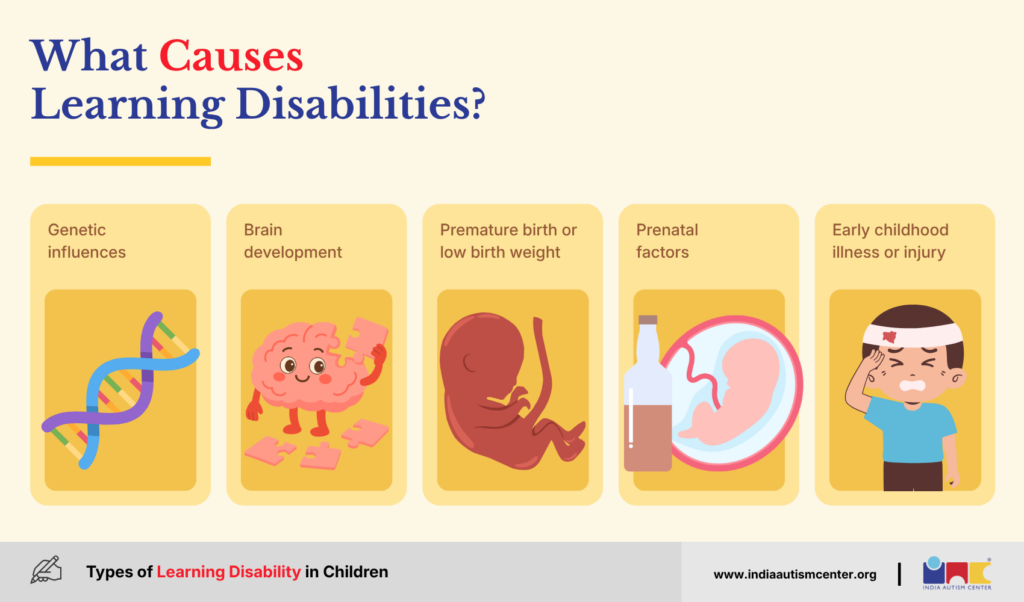
Researchers believe that learning disabilities result from differences in brain development and functioning rather than parenting style or educational opportunities.
Several factors may increase the likelihood of developing a learning disability.
1. Genetic influences
Learning disabilities often run in families. Studies have shown strong hereditary links, particularly for dyslexia and dyscalculia.
2. Brain development
Differences in how certain brain regions process language, numbers, or visual information can contribute to learning challenges.
3. Premature birth or low birth weight
Children born prematurely have a higher likelihood of experiencing developmental and learning difficulties.
4. Prenatal factors
Exposure to alcohol, drugs, infections, or severe nutritional deficiencies during pregnancy may affect brain development.
5. Early childhood illness or injury
Although less common, serious head injuries or neurological illnesses can influence learning abilities.
Importantly, learning disabilities are not caused by laziness, poor parenting, excessive screen time, or lack of intelligence.
Early Signs of Learning Disabilities
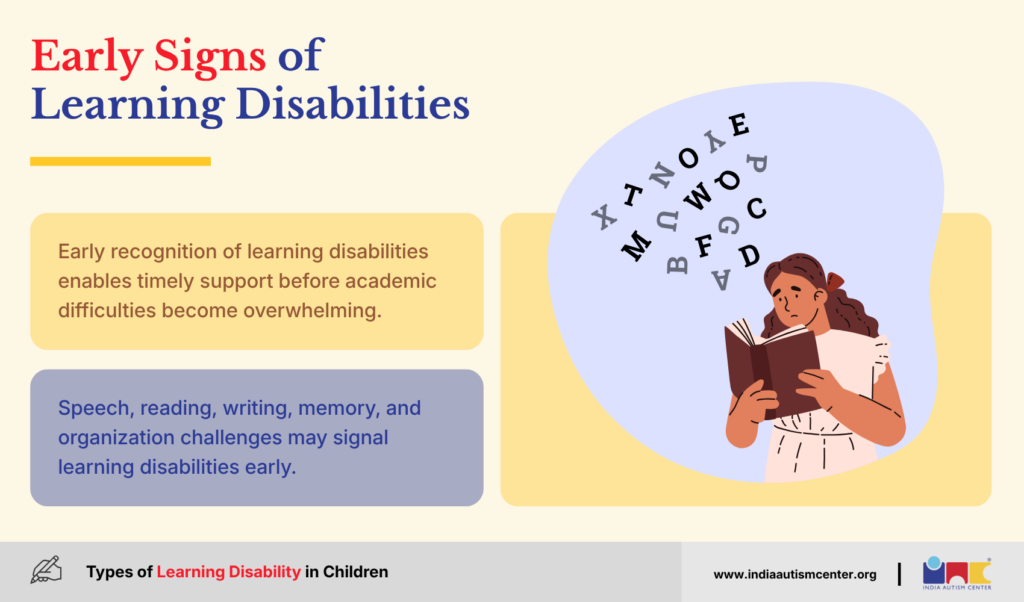
Recognising difficulties early allows children to receive interventions before academic struggles become overwhelming.
Some common early signs of learning difficulties in students include:
- Difficulty recognising letters or sounds
- Delayed speech and language development
- Persistent spelling mistakes
- Trouble remembering sequences
- Difficulty following multiple instructions
- Slow reading speed
- Frequent reversal of letters beyond the expected developmental age
- Difficulty understanding numbers
- Problems organising schoolwork
- Poor handwriting
- Avoidance of reading or writing tasks
Children with autism may also experience learning disabilities. However, autism and learning disabilities are separate conditions that can occur independently or together. A comprehensive developmental assessment helps identify each child’s unique strengths and support needs.
Can a Child Have More Than One Learning Disability?
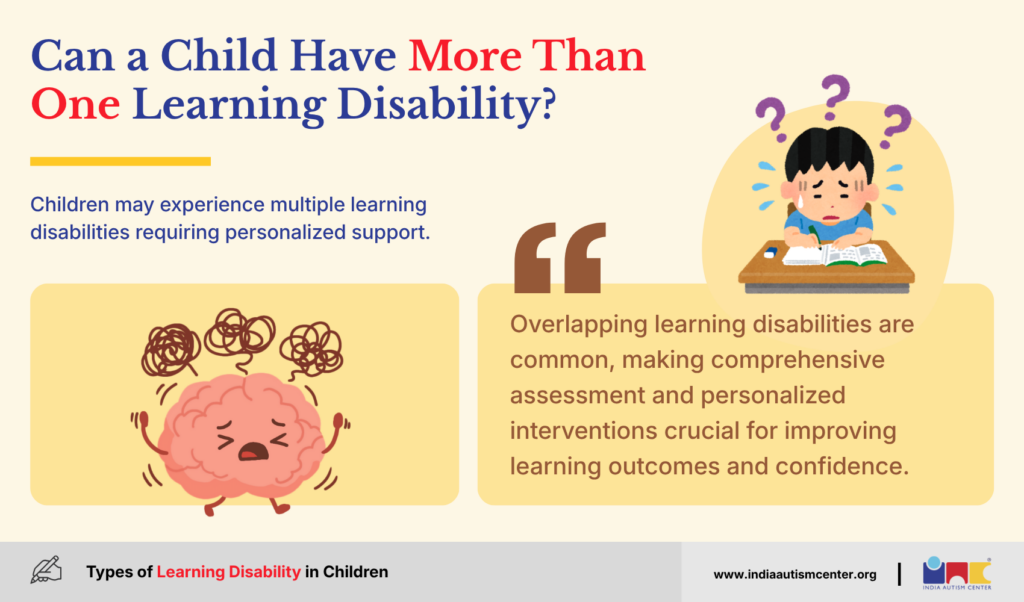
Yes. It is common for children to experience more than one condition from the learning disabilities list. For example, a child with dyslexia may also have dysgraphia, while another may experience dyscalculia alongside Language Processing Disorder.
Additionally, some children with autism, ADHD, developmental language disorder, or dyspraxia may also have one or more types of learning disabilities. Because these conditions can overlap, a comprehensive assessment by qualified professionals is essential to accurately identify each child’s strengths and challenges.
Understanding the 7 main types of learning disabilities allows parents and educators to recognise early warning signs and provide timely, evidence-based support. With the right interventions, classroom accommodations, and encouragement, children with learning disabilities can develop effective coping strategies, achieve academic success, and build the confidence needed to thrive throughout their lives.
How Are Learning Disabilities Diagnosed?
Recognising the types of learning disabilities is only the first step. An accurate diagnosis is equally important because different learning disabilities require different forms of support. Identifying a child’s specific strengths and challenges early allows families and educators to provide interventions before learning difficulties begin to affect confidence and emotional wellbeing.
There is no single test that can diagnose all learning disabilities. Instead, specialists carry out a comprehensive assessment that may include:
- A detailed developmental, medical, and family history
- Feedback from parents, teachers, and caregivers
- Standardised assessments of reading, writing, mathematics, and language skills
- Evaluations of memory, attention, reasoning, and cognitive abilities
- Vision and hearing tests to rule out sensory impairments
According to the research, symptoms of a Specific Learning Disorder should generally persist for at least six months despite targeted interventions before a formal diagnosis is made. Once identified, professionals can recommend personalised strategies that address the child’s unique learning needs.
Supporting Children with Learning Disabilities
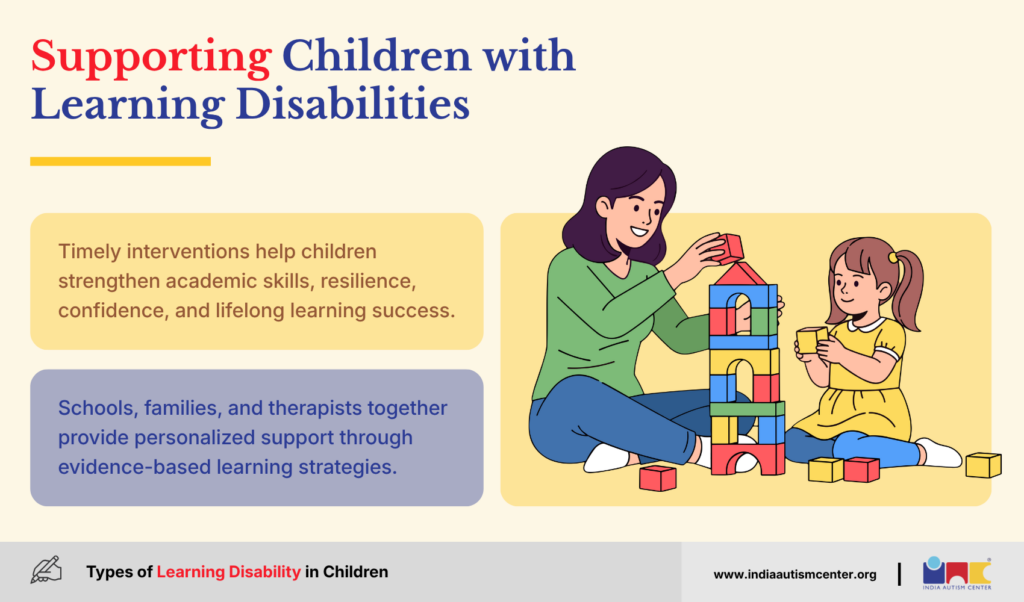
A diagnosis is not a limitation. Instead, it provides a roadmap for helping children learn more effectively. With timely intervention and consistent support, children with learning disabilities can strengthen their academic skills, build resilience, and become confident learners.
Effective support often combines educational strategies, therapeutic interventions, and family involvement. Depending on the child’s needs, support may include:
- Multisensory teaching methods that engage visual, auditory, and hands-on learning
- Structured literacy programmes for reading and spelling difficulties
- Speech and language therapy to improve communication skills
- Occupational therapy to develop handwriting, motor skills, and organisation
- Assistive technologies including text-to-speech software, audiobooks, and speech-to-text tools
- Breaking complex tasks into smaller, achievable steps
- Positive reinforcement that celebrates effort and progress
Schools also play a vital role by creating an inclusive learning environment. Helpful classroom accommodations may include:
- Extra time during examinations and assignments
- Visual schedules and graphic organisers
- Simplified, step-by-step instructions
- Reduced copying from the board
- Keyboard use instead of lengthy handwritten work
- Alternative methods of assessment where appropriate
Parents can reinforce these strategies at home by maintaining predictable routines, reading together regularly, encouraging strengths beyond academics, and maintaining open communication with teachers and therapists. When families and schools work together, children receive the consistent support they need to thrive.
Living with Learning Disabilities
Learning disabilities are lifelong neurological differences, but they do not prevent children from achieving their goals. With the right support, many children develop effective coping strategies and go on to excel in education, careers, and everyday life.
However, learning disabilities can influence more than academic performance. Without appropriate support, children may experience:
- Reduced self-confidence
- Anxiety about school or examinations
- Frustration with everyday learning tasks
- Difficulty building peer relationships
- Avoidance of reading, writing, or mathematics activities
Addressing these emotional challenges is just as necessary as improving academic skills. Encouragement, patience, and recognising a child’s strengths can significantly boost their confidence and motivation.
It is also important to understand that autism and learning disabilities are separate neurodevelopmental conditions, although they can occur together. Some autistic children may also have one or more types of learning disabilities, while others may not. A comprehensive developmental assessment helps professionals understand each child’s complete profile and recommend interventions that support both learning and overall development.
Supporting Every Child’s Potential with India Autism Centre
At India Autism Centre, we believe every child deserves the opportunity to learn in a way that reflects their individual strengths and needs. Through evidence-based interventions, multidisciplinary expertise, family guidance, and inclusive educational support, we help children with autism and learning disabilities develop academic, communication, social, and life skills. By working closely with families, educators, and therapists, we create an environment where children feel understood, supported, and can achieve their full potential.
Conclusion
Understanding the different types of learning disabilities empowers parents, educators, and caregivers to recognise challenges early and provide the right support at the right time.
Although these conditions affect how children process and acquire information, they do not define intelligence or future success.
With an accurate diagnosis, personalised interventions, collaborative support from families and schools, and a nurturing environment, children who have learning disabilities can build confidence, overcome obstacles, and live an enriched life.
Frequently Asked Questions
At what age can learning disabilities be identified?
Early signs may appear in preschool, but many learning disabilities become more noticeable once children begin reading, writing, and solving mathematical problems in primary school.
Is dyslexia the most common type of learning disability?
Yes. Dyslexia is widely recognised as the most common type of learning disability, affecting reading accuracy, fluency, spelling, and language processing.
Are learning disabilities hereditary?
Research suggests that several types of learning disabilities, particularly dyslexia and dyscalculia, have a strong genetic component and may run in families.
Which school accommodations benefit children with learning disabilities?
Helpful accommodations include additional exam time, assistive technology, simplified instructions, visual organisers, alternative assessments, and reduced copying from the board.
Can children with learning disabilities succeed academically?
Absolutely. With early diagnosis, personalised interventions, appropriate classroom support, and family involvement, many children perform well in school and higher education.