 Donate now
 Get a Call Back
 MENU
MENU 54 MIN READ
 SHARE
SHARE


Autism skills and activities refer to the structured exercises and daily practices that help autistic individuals build social, communication, life, cognitive, motor, and sensory abilities. These activities are used by parents, teachers, and therapists to support growth at every age, from early childhood through adulthood. I have put together this guide to walk you through each skill area in detail.
Skill-building in autism is rarely fast, and it is rarely a straight line. A skill that improves for two weeks may plateau, or even regress temporarily, before the next jump forward. This is normal. I mention it here so you do not mistake a normal plateau for a failed activity.
What Skill Areas Are Commonly Affected in Autism?
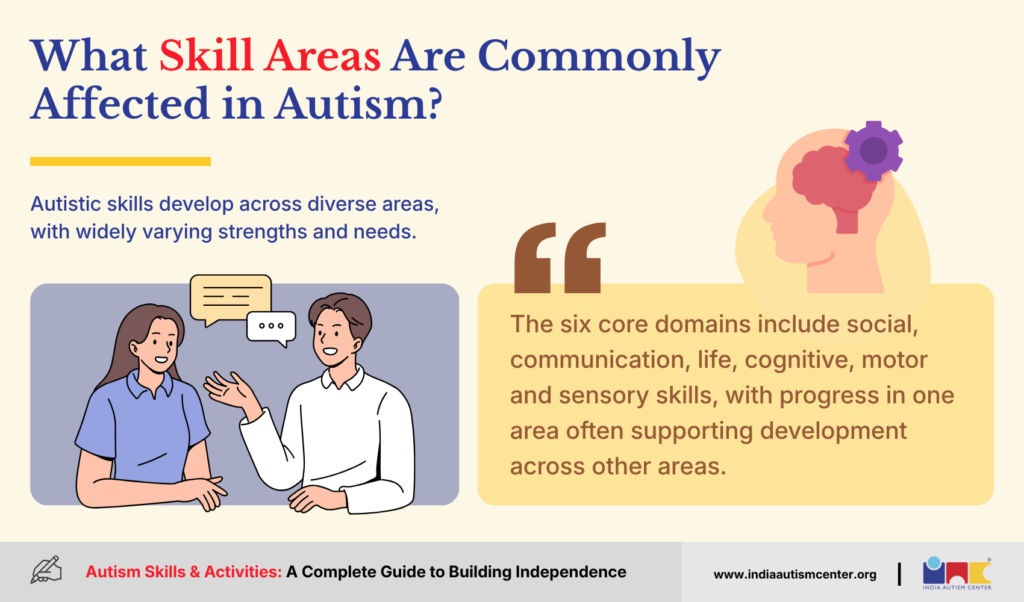
Autism affects six core skill domains: social skills, communication skills, life/daily living skills, cognitive skills, motor skills, and sensory processing. Not every autistic person struggles with every domain equally. Some people need heavy support in one area and very little in another.
Progress in one area often supports progress in another. For example, better sensory regulation frequently makes social interaction easier, because a child who is not overwhelmed by noise or light has more capacity to focus on a conversation.
Here is a quick reference table I use when I explain this to parents:
| Skill Domain | What It Covers | Why It Matters |
| Social skills | Turn-taking, eye contact, reading social cues, making friends | Builds relationships and reduces isolation |
| Communication skills | Verbal speech, non-verbal cues, AAC use, conversation | Enables the person to express needs and connect with others |
| Life/daily living skills | Hygiene, dressing, cooking, money handling | Supports independence at home and in the community |
| Cognitive skills | Attention, memory, problem-solving, flexible thinking | Underpins learning, planning, and decision-making |
| Motor skills | Fine motor (grip, writing) and gross motor (balance, coordination) | Affects handwriting, self-care, and physical activity |
| Sensory processing | Response to sound, touch, light, movement | Affects comfort, focus, and behavior regulation |
I will go through each of these domains one at a time. I have organized the sections so you can jump straight to the one you need, or read through the whole guide for a complete picture.
Do Autism Skills Develop in a Fixed Order?
No, autism skills do not develop in one fixed order. Development is uneven across domains, and this unevenness is a defining feature of autism, not an exception to it. A child might show advanced cognitive skills while still needing significant support with social communication.
I always caution parents against comparing a child’s skill profile to a typical developmental chart. A more useful comparison is the child’s own progress over time, across each individual domain. This is why I recommend tracking skills domain by domain, rather than using a single overall “developmental age.”
How Do You Know Which Skill to Focus On First?
You know which skill to focus on first by identifying which gap most affects daily functioning or safety. Communication skills are often prioritized first, since they support every other domain. A child who can communicate needs and discomfort has an easier path to learning social, life, and academic skills.
I generally recommend this order of priority when multiple domains need support at once:
- Safety-related communication — expressing needs, discomfort, or danger
- Functional communication — requesting, protesting, and answering basic questions
- Core life skills — hygiene, safety awareness, basic self-care
- Social skills — interaction with peers and adults
- Cognitive and academic skills — building on a stable communication and behaviour foundation
This order is a general guideline, not a rigid rule. A professional assessment will give you a more precise, individualised priority list.
📥 Free download: Printable daily routine chart for autistic children
What Are Social Skills Activities for Autism?
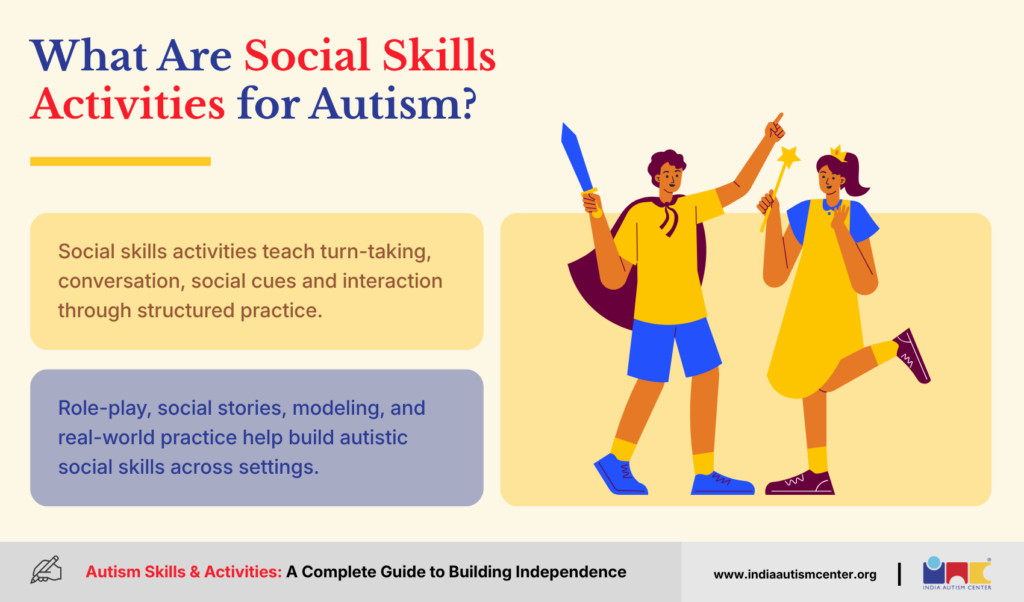
Social skills activities for autism are structured exercises that teach turn-taking, eye contact, conversation, and reading social cues. These activities are typically broken down into small, teachable steps rather than taught all at once. I always tell parents that social skills are learnable, not fixed traits.
Autism and social skills are closely linked because many autistic individuals process social information differently. This does not mean a lack of interest in connection. It usually means the person needs more explicit, structured teaching to learn skills that come more naturally to non-autistic peers.
Why Do Autistic Individuals Struggle With Social Skills?
Autism spectrum disorder social skills challenges usually stem from three sources: difficulty reading non-verbal cues, difficulty with reciprocal conversation, and difficulty predicting what others are thinking or feeling. This last challenge is sometimes called “theory of mind.”
I want to be clear about something important here. Struggling with social skills is not the same as not caring about relationships. Most autistic people I have worked with deeply want friendships and connection. The challenge is in the mechanics of social interaction, not the desire for it.
How Do You Improve Social Skills in Autism?
You improve social skills in autism through repeated practice, direct teaching, and real-world application. The most effective approaches combine four elements:
- Modeling — showing the skill through video or live demonstration
- Role-play — practicing the skill in a low-pressure setting
- Social stories — short narratives that explain social situations step by step
- Real-world practice — applying the skill in actual social settings, with support
I recommend starting small. Pick one skill, such as greeting a peer, and practice it repeatedly across different settings before moving to the next skill. Trying to teach too many skills at once usually backfires.
Social Skills Development in Autism | 5 Proven Approaches (2026)
What Are Some Core Social Skills Activities for Autism?
Social skills activities for autism fall into a few reliable categories. I have listed the ones I see used most often in classrooms, therapy sessions, and homes:
- Turn-taking games — board games, card games, or simple ball-passing games
- Role-play scenarios — practicing greetings, asking for help, or joining a group
- Video modeling — watching short clips of appropriate social behavior, then imitating it
- Social stories — written or illustrated narratives describing a specific social situation
- Perspective-taking exercises — activities that ask “how do you think they felt?”
- Structured play dates — short, adult-guided play sessions with one peer
Each of these activities can be adjusted for age and skill level. A turn-taking game for a preschooler might be as simple as rolling a ball back and forth. For a teenager, it might be a structured debate or group project.
How Long Should a Social Skills Activity Session Last?
A social skills activity session should last between ten and thirty minutes, depending on the person’s age and attention span. Shorter, more frequent sessions almost always outperform long, infrequent ones. I recommend starting with the shortest session length that still allows the activity to feel complete, then extending gradually as tolerance builds.
For younger children, five to ten minutes is often enough. For teenagers and adults, sessions of twenty to thirty minutes tend to work well, especially when the activity is tied to a genuine interest or social goal.
What Makes a Social Skills Activity Effective?
An effective social skills activity is specific, repeatable, and tied to a real-world outcome. Vague goals like “be more social” rarely produce results. Specific goals like “greet one classmate by name each morning” are far easier to teach, practice, and measure.
I look for four qualities in any social skills activity before recommending it:
- Clarity — the target skill is specific and observable
- Repeatability — the activity can be practiced multiple times per week
- Relevance — the skill applies to a real situation the person faces
- Feedback — there is a clear way to know whether the skill was used correctly
What Common Mistakes Do Parents and Teachers Make With Social Skills Training?
The most common mistake is targeting too many social skills at once instead of focusing on one clear, observable behavior. I regularly see well-meaning adults try to address eye contact, turn-taking, and conversation skills all in the same session. This usually overwhelms the child and slows overall progress.
Other frequent mistakes include:
- Correcting in the moment, in front of peers — this often increases anxiety rather than building skill. Feedback works better delivered privately, right after the activity ends.
- Assuming lack of eye contact means lack of attention — many autistic individuals listen and process information more effectively while looking away. Forcing eye contact can actually reduce comprehension.
- Skipping the “why” — teaching a rule without explaining its purpose makes the skill harder to generalize. Explaining why we say “please” helps the lesson stick better than rote repetition alone.
- Ending practice as soon as the skill appears once — one successful attempt does not mean a skill is mastered. I recommend continuing practice until the skill appears consistently across several different sessions.
How To Measure Progress in Social Skills Activities?
You measure progress in social skills activities by tracking specific, observable behaviors over time, rather than relying on a general impression of “doing better socially.” A simple frequency count, taken weekly, gives a much clearer picture than memory alone.
I recommend a basic tracking format like this:
| Week | Target Skill | Times Observed | Setting |
| 1 | Greets peer by name | 1 | Home only |
| 2 | Greets peer by name | 2 | Home and school |
| 3 | Greets peer by name | 4 | Home, school, and community |
This kind of simple log does two things. It shows whether the skill is increasing, and it shows whether the skill is generalizing across settings, which matters just as much as the raw frequency count.
Social Skills Activities for Preschoolers With Autism
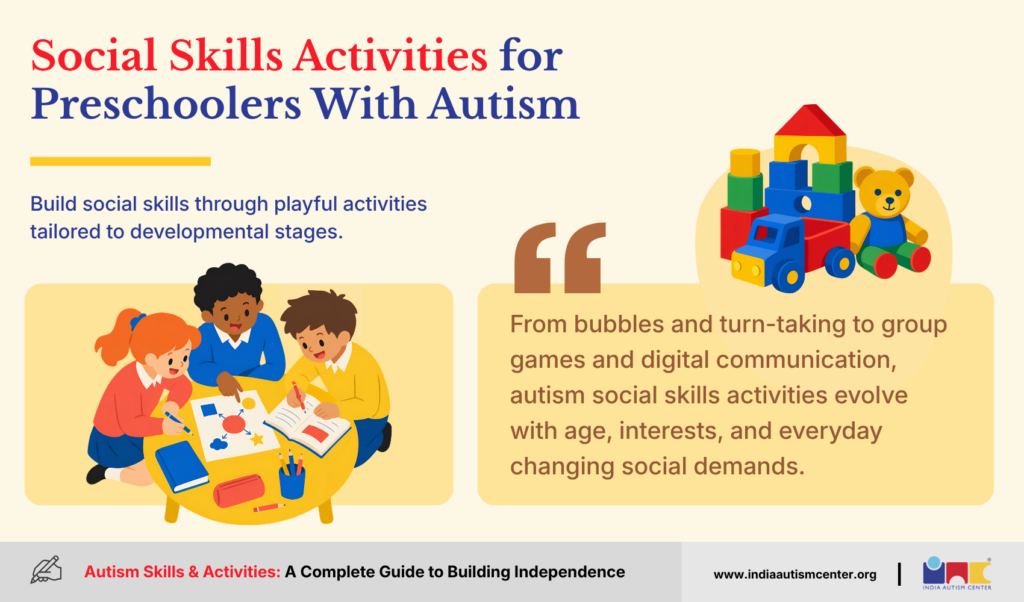
Social skills activities for preschoolers with autism should focus on the basics: eye contact, joint attention, and simple turn-taking. At this age, play is the primary teaching tool. I always recommend keeping sessions short, five to ten minutes, since attention spans are naturally limited.
Good preschool-level activities include:
- Bubble play — popping bubbles together builds joint attention and anticipation
- Simple board games — like Candy Land, to practice waiting for a turn
- Peekaboo and imitation games — build eye contact and social reciprocity
- Sing-along circle time — with gestures, to build group participation
I have seen bubble play work particularly well because it naturally creates moments of shared excitement. The child looks at the bubbles, then often looks at the adult, which is an early form of joint attention.
Other preschool activities I recommend include:
- Copy-me games — imitating simple actions like clapping or waving, to build imitation skills
- Shared snack time — passing snacks around a small circle to build requesting and waiting
- Puppet play — using puppets to model greetings and simple exchanges
- Musical statues — a simple stop-and-go game that builds attention to social cues
At this age, I recommend keeping adult involvement high. Preschoolers with autism usually need a facilitator nearby to model the behavior, prompt turn-taking, and provide immediate praise when the target skill happens.
Social Skills Activities for Children With Autism
Social skills activities for children with autism typically expand to include structured group activities, cooperative games, and early friendship-building exercises. Children in the five-to-ten age range can usually handle slightly longer activities, around fifteen to twenty minutes.
I recommend these activity types for this age group:
- Cooperative building tasks — building a tower or puzzle together, requiring communication
- “Feelings charades” — acting out emotions for others to guess
- Structured group games — like Simon Says, which teach rule-following and attention to others
- Buddy systems at school — pairing the child with a supportive peer for structured activities
I also recommend adding these activities as the child grows more comfortable with basic interaction:
- “Would you rather” question games — build conversational turn-taking with low pressure
- Shared art projects — a mural or collage that requires two children to share materials
- Show and tell — practicing speaking to a small group about a favorite topic
- Board game clubs — small, recurring groups that build familiarity and comfort over time
At this stage, I recommend introducing the concept of “social rules” more explicitly. Simple rules, such as “wait until the other person finishes talking,” can be posted visually and reviewed before each activity.
Social Skills Activities for Teenagers With Autism
Social skills activities for teenagers with autism should address more complex social situations, including friendships, group dynamics, and online communication. Teenagers face higher social stakes than younger children, so activities need to reflect real adolescent social life.
I typically suggest:
- Group problem-solving projects — school clubs, coding groups, or hobby-based clubs
- Structured conversation practice — practicing small talk, texting etiquette, and reading sarcasm
- Video-based social skills training — analyzing real video clips of peer interactions
- Peer mentoring programs — pairing with an older student or mentor
Teenagers often respond well to activities tied to their specific interests. If a teenager loves a particular video game, a game-related club can be a much more effective social skills setting than a generic social skills group.
I also encourage families to address digital social skills directly at this age. Texting, group chats, and social media all carry unwritten rules that are rarely taught explicitly. Useful activities include:
- Text message role-play — practicing appropriate responses to common message scenarios
- Social media etiquette discussions — reviewing what is appropriate to post or comment
- Group chat simulations — practicing how to join and contribute to a group conversation
- Boundary-setting practice — role-playing how to say no or set a limit with a peer
Teenagers also benefit from understanding their own social profile. I often recommend a direct, honest conversation about strengths and challenges, framed positively, so the teenager understands why they are practicing specific skills rather than feeling singled out.
How To Teach Social Skills to Adults With Autism?
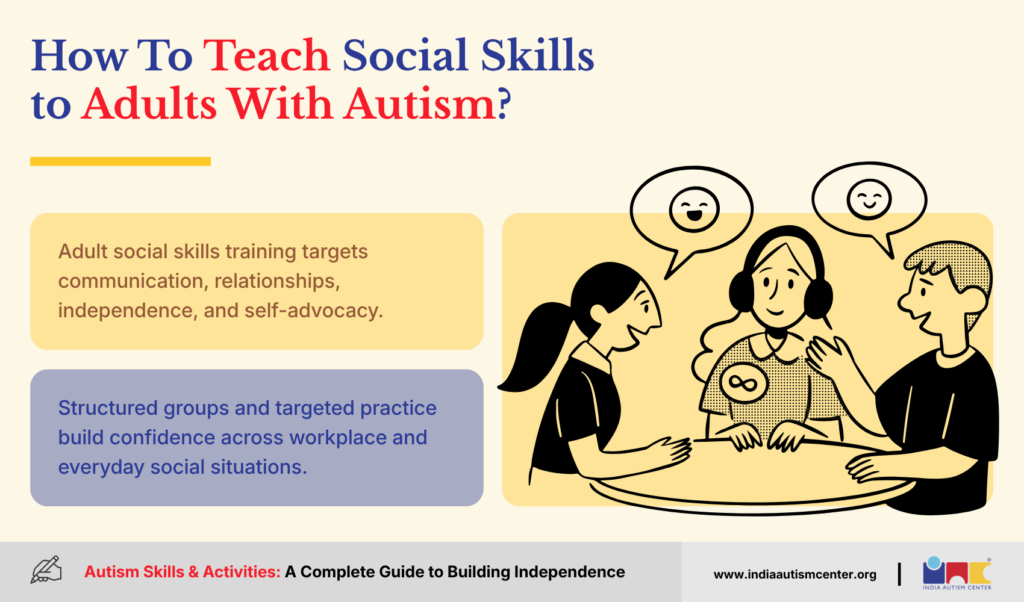
Autism social skills activities for adults focus on workplace communication, romantic relationships, and community participation. Adult social skills training often looks different from childhood training because the stakes involve jobs, independence, and long-term relationships.
Social skills activities for adults with autism commonly include:
- Workplace communication coaching — practicing meetings, small talk, and giving/receiving feedback
- Structured social groups — adult autism social clubs or meetups
- Role-play for specific scenarios — job interviews, first dates, conflict resolution
- Self-advocacy training — learning to explain one’s own needs to coworkers or partners
I have noticed that adults often benefit most from social skills training that is directly tied to a real, upcoming situation, such as an interview or a specific workplace conflict, rather than abstract practice.
What Social Challenges Do Autistic Adults Commonly Face?
Autistic adults commonly face challenges with workplace small talk, reading unwritten office norms, and navigating dating or long-term relationships. These challenges are often less visible than childhood social difficulties, since adult social settings rarely have a facilitator present to offer support.
I recommend adults keep a simple log of specific social situations that felt difficult. This log becomes a practical starting point for targeted practice, whether with a coach, therapist, or support group, rather than trying to address “social skills” as one large, undefined goal.
Social Skills Activities for High-Functioning Autism
Social skills activities high-functioning autism programs address are typically more nuanced. These include understanding sarcasm, reading subtle body language, and managing social anxiety in group settings. “High-functioning” is a term some people use to describe autistic individuals with strong verbal and cognitive skills but ongoing social challenges.
Useful activities at this level include:
- Sarcasm and idiom training — explicit teaching of figurative language
- Body language decoding exercises — using photos or videos to practice reading expressions
- Social anxiety management techniques — paired with social skills practice
- Advanced perspective-taking scenarios — discussing hypothetical social conflicts and resolutions
I also recommend addressing social anxiety directly alongside skill-building for this group. Many individuals with high-functioning autism have learned social rules intellectually but still feel significant anxiety applying them in real time. Pairing social skills practice with simple anxiety management techniques, such as breathing exercises before a social event, often improves outcomes more than skills training alone.
What Are Effective Group Activities for Social Skills in Autism?
Autism group activities for social skills work by creating a low-pressure, repeated-practice environment with peers. Group settings allow the individual to practice skills with real feedback, rather than only with an adult facilitator.
I recommend these group formats:
- Social skills groups — small, therapist-led groups of three to six children or teens
- Interest-based clubs — chess club, art club, robotics club
- Peer-mediated intervention — training a peer to initiate and support interaction
- Structured team sports — with modified rules and clear roles
Group activities work best when the group size stays small. I generally recommend no more than five or six participants, so each person gets enough individual attention and practice time.
How Do You Run an Effective Autism Social Skills Group?
You run an effective autism social skills group by keeping sessions structured, predictable, and focused on one or two target skills per session. I recommend a consistent session format: a brief warm-up, a skill lesson, a practice activity, and a short wrap-up discussion.
A typical fifty-minute session might look like this:
| Segment | Duration | Purpose |
| Warm-up greeting | 5 minutes | Practice greetings and settle the group |
| Skill introduction | 10 minutes | Explain and model the target skill |
| Practice activity | 25 minutes | Apply the skill through games or role-play |
| Wrap-up discussion | 10 minutes | Review what was learned, praise effort |
Consistency in this structure helps participants know what to expect, which reduces anxiety and increases participation over time.
A Sample Social Skills Activities List You Can Use in a Session
I know some readers are looking for a ready-to-use list of social skills activities for autism, similar to what you might see in a presentation or handout. Here is a compact, presentable list you can adapt for a classroom, therapy session, or parent workshop:
| Activity | Age Range | Skill Targeted |
| Bubble play | 2–5 years | Joint attention |
| Turn-taking board games | 4–10 years | Waiting, turn-taking |
| Feelings charades | 5–12 years | Emotion recognition |
| Social stories | All ages | Understanding social rules |
| Video modeling | 6+ years | Imitating appropriate behavior |
| Peer-mediated play | 5–12 years | Initiating interaction |
| Group problem-solving | 12+ years | Collaboration |
| Workplace role-play | 16+ years | Professional communication |
Communication Skills Activities for Autism
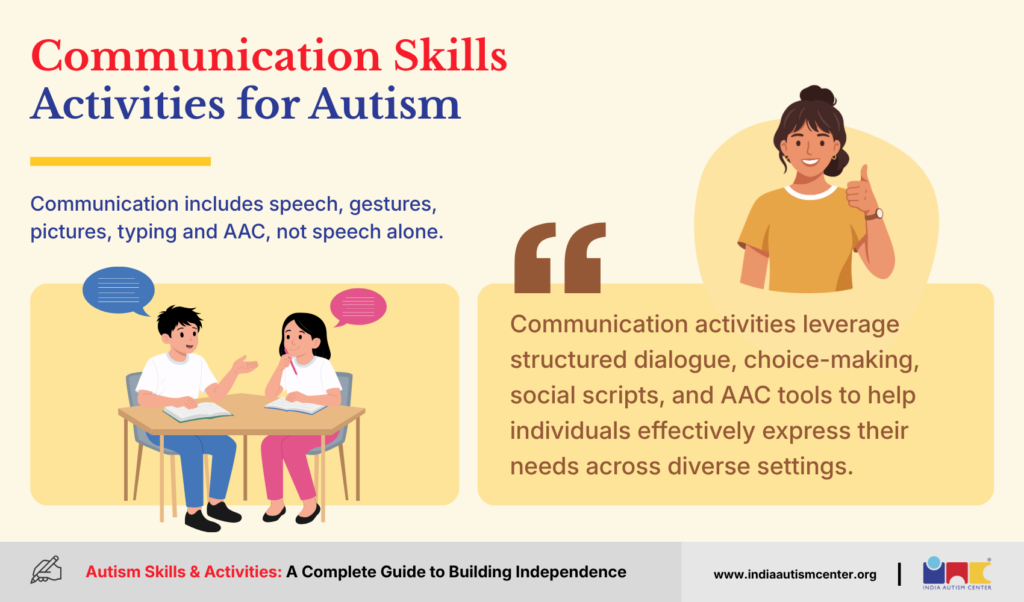
Communication skills activities build for both verbal and non-verbal autism communication, using tools like AAC devices, picture exchange systems, and structured conversation practice. Communication challenges in autism range from being completely non-verbal to having fluent speech with pragmatic language difficulties.
I always start by clarifying one point: communication is broader than speech. A person can be highly communicative through gestures, pictures, typing, or an AAC device, even without spoken words. The goal of communication skills activities is functional communication, not necessarily verbal speech.
You should also read about
Non-Verbal Learning Disorder vs Autism: Differences & Similarities
What Are the Different Types of Communication in Autism?
Communication in autism generally falls into three types: verbal communication, non-verbal communication, and augmentative and alternative communication (AAC). Many autistic individuals use a combination of all three, depending on the context and their comfort level.
- Verbal communication — spoken words, phrases, and sentences
- Non-verbal communication — gestures, facial expressions, pointing, eye gaze
- AAC (Augmentative and Alternative Communication) — picture systems, communication apps, speech-generating devices, sign language
I always tell families that AAC is not a “last resort.” Research consistently shows that AAC does not reduce spoken language development, and in many cases, it supports it by reducing communication frustration.
What Is the Autism Communication Skills Checklist?
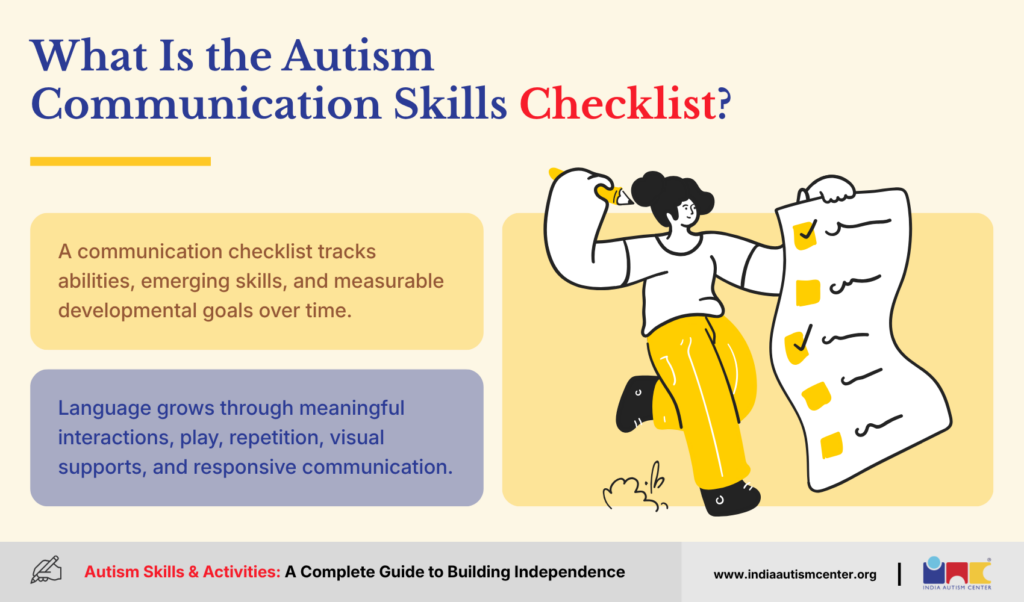
An autism communication skills checklist is a tool used to track a person’s current communication abilities and identify the next skills to target. I use checklists like this to set clear, measurable goals rather than vague ones like “improve communication.”
Here is a simplified version of a communication skills checklis:t
| Skill | Present | Emerging | Not Yet Present |
| Makes eye contact when spoken to | |||
| Responds to their name | |||
| Uses gestures to request items | |||
| Uses single words to communicate needs | |||
| Combines two to three words | |||
| Answers simple questions | |||
| Initiates conversation | |||
| Understands sarcasm or figurative language | |||
| Maintains back-and-forth conversation |
This kind of checklist helps caregivers and therapists agree on a starting point, then track progress over time. I recommend reviewing it every few months, not daily, since communication development can be gradual.
How Do You Use a Communication Checklist Effectively?
You use a communication checklist effectively by focusing on the skills marked “emerging” rather than the ones marked “not yet present.” Emerging skills are the ones closest to mastery, and targeting them produces faster, more visible progress, which helps maintain motivation for both the child and the caregiver.
I recommend reassessing the checklist every eight to twelve weeks. If a skill has moved from “emerging” to “present,” celebrate it, then select a new emerging skill as the next target. This keeps the plan focused and prevents caregivers from feeling like there are too many goals to work on at once.
How Do You Develop Language Skills in Autism?
You develop language skills in autism through consistent, repetitive exposure to language paired with real-life context. Language grows best when it is tied to something meaningful to the child, such as a favorite toy or activity, rather than taught in isolation.
Effective strategies include:
- Narrating daily activities — describing what you are doing in simple language, in real time
- Expanding on the child’s words — if the child says “car,” you respond “yes, a red car”
- Using visual supports — picture schedules and picture exchange communication systems (PECS)
- Reading together daily — books provide repeated language patterns in context
Does Language Development Look Different in Autism?
Yes, language development in autism often follows a different pattern than typical development. Some autistic children develop echolalia, which means repeating words or phrases they have heard, before developing spontaneous language. Echolalia is not meaningless. It often serves as a stepping stone toward functional communication.
I always encourage caregivers not to discourage echolalia. Instead, I recommend responding to it as a genuine communication attempt and gently modeling the more typical phrase back, without correcting the child directly.
A Comprehensive Guide to Speech and Language Therapy for Autism
What Role Does Play Have in Language Development?
Play has a central role in language development because it creates natural, motivating opportunities to use words. A child who wants a toy that is just out of reach has a genuine reason to request it, which is far more effective for language learning than a flashcard drill.
I recommend “commenting more, asking less” during play. Constantly asking a child questions can feel like pressure. Simply narrating and commenting on their play, using simple language, models communication without demanding a response.
What Are the Best Activities for Communication Skills in Autism?
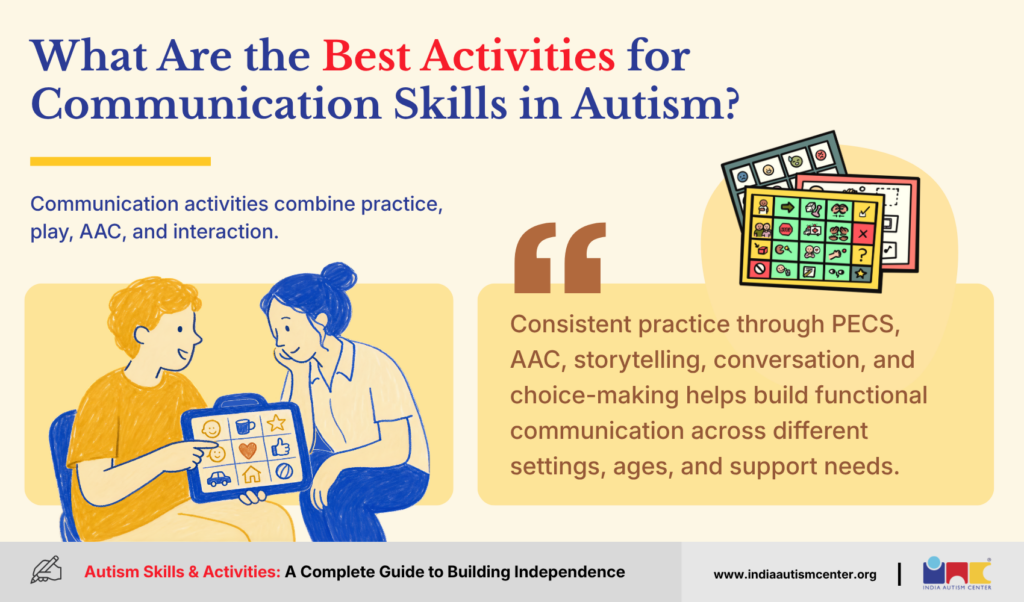
Activities for communication skills in autism should mix structured teaching with natural, play-based practice. I find that combining both approaches produces the most consistent progress.
Activities for developing communication skills in autism include:
- Picture Exchange Communication System (PECS) — using pictures to request items or express needs
- AAC device practice — using a speech-generating device or communication app
- Structured conversation practice — practicing greetings, questions, and answers
- Storytelling and narrative building — retelling a simple story in sequence
- “Barrier games” — one person describes an object or picture while the other tries to identify or recreate it, without seeing it
- Question-and-answer chains — practicing simple back-and-forth question exchanges
- Choice-making activities — offering two options to encourage a communicative response
- Social scripts — pre-written phrases for common situations, like ordering food or greeting a teacher
I recommend rotating between these activities rather than repeating just one. Variety keeps the person engaged and helps the skill generalize across different formats and settings, rather than becoming tied to a single game.
What Activities Improve Communication Skills in Autism the Fastest?
Activities to improve communication skills in autism work fastest when they are practiced daily, in short sessions, across multiple settings. Consistency matters more than intensity. Ten minutes of daily practice usually outperforms one long weekly session.
I recommend this simple weekly structure:
- Daily: five to ten minutes of narrated play or reading
- Three times a week: structured communication practice (PECS, AAC, or conversation practice)
- Weekly: a review of new words or phrases learned, with the whole family reinforcing them
How Do You Improve Communication Skills in Autism for Non-Verbal Individuals?
You improve communication skills in autism for non-verbal individuals by prioritizing a reliable communication system, such as AAC or PECS, before focusing on spoken language. A non-verbal person can still build strong functional communication, requesting skills, and even conversational turn-taking through a device or picture system.
I recommend introducing an AAC system as early as possible rather than waiting to see if speech develops first. Early access to AAC gives the person a voice immediately, which reduces frustration-related behaviors and often supports, rather than delays, spoken language.
Can Communication Skills Improve in Adulthood?
Yes, communication skills can continue to improve in adulthood with consistent practice and the right supports. Adults benefit from communication coaching focused on workplace language, self-advocacy phrases, and clarifying misunderstandings, which are different priorities than early childhood language goals.
Life Skills Activities for Autism
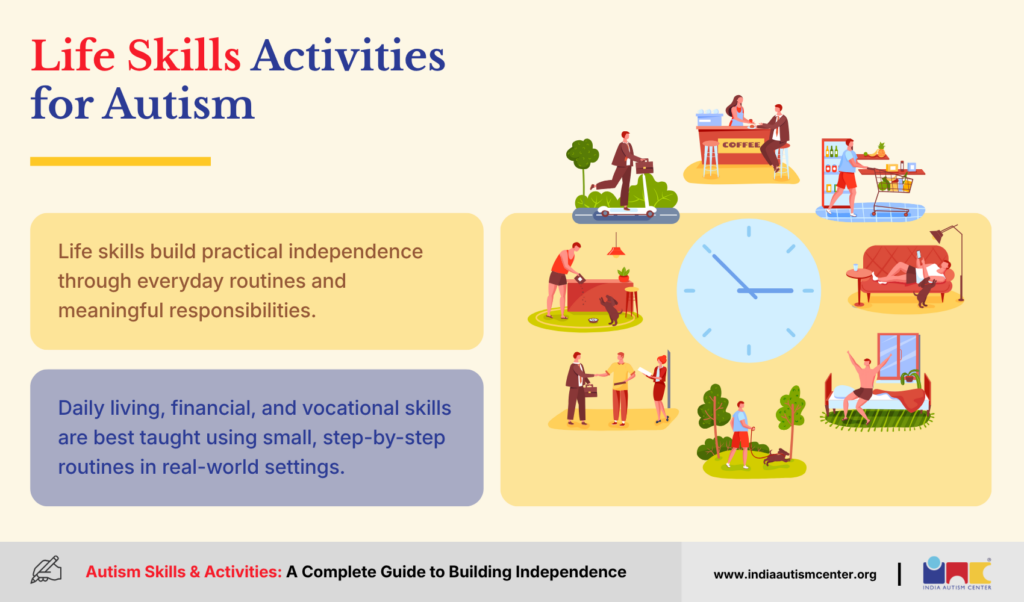
Life skills activities for autism teach the practical tasks needed for daily independence, including hygiene, dressing, cooking, money management, and community navigation. Life skills for independence are one of the most requested areas of support I encounter, especially as children move into the teenage and adult years.
I think of life skills as the bridge between therapy goals and real-world independence. A person can have strong academic or cognitive skills but still need direct teaching in daily living tasks, because these skills are rarely taught explicitly in a typical classroom setting.
Why Do Life Skills Deserve Equal Priority to Academic Skills?
Life skills deserve equal priority to academic skills because independence in daily tasks directly affects quality of life and long-term autonomy. I have seen many bright, academically capable autistic individuals struggle in adulthood simply because life skills were never explicitly taught alongside academics.
I recommend treating life skills as a parallel curriculum, not an afterthought. If a child is receiving academic support, they should also receive equal, structured attention to hygiene, cooking, money handling, and community skills, starting from an early age.
What Is the Difference Between Life Skills and Daily Living Skills?
Life skills is a broad term covering all skills needed for independent functioning, while daily living skills specifically refer to routine self-care and household tasks. Daily living skills autism programs usually focus on hygiene, dressing, eating, and basic household chores.
Life skills, more broadly, also include:
- Money management — budgeting, making purchases, understanding value
- Time management — using schedules, calendars, and alarms
- Community skills — using public transport, ordering food, shopping
- Vocational skills — workplace behavior, job applications, interview skills
I always recommend starting daily living skills as early as possible, even in preschool years, using age-appropriate simplified versions of each task. A three-year-old can begin practicing putting on their own shoes, even if it takes several extra minutes. That early practice builds a foundation for more complex independence later.
What Are the Best Life Skills Activities for Autism?
Life skills activities for autism should be broken into small, sequential steps and practiced in the actual environment where the skill will be used. I always recommend teaching a skill where it naturally happens, such as teaching handwashing at the sink, not on a worksheet.
Autism life skills activities I recommend include:
| Life Skill | Sample Activity | Age to Start |
| Dressing | Practicing buttons, zippers with a dressing board | 3–5 years |
| Hygiene | Step-by-step toothbrushing chart | 3–6 years |
| Cooking | Making a simple sandwich, following a picture recipe | 8–12 years |
| Money handling | Play-money shopping games | 6–10 years |
| Laundry | Sorting clothes by color | 10–14 years |
| Public transport | Practicing a bus route with a caregiver | 14+ years |
| Job readiness | Mock interviews, workplace role-play | 16+ years |
📥 Free download: Printable daily routine chart for autistic children
How Do You Motivate an Autistic Child to Practice Life Skills?
You motivate an autistic child to practice life skills by connecting the skill to a preferred activity or outcome the child genuinely cares about. A child who loves a specific snack may be more motivated to learn to make it themselves than to practice an unrelated cooking task.
I also recommend using visual progress trackers, such as a simple sticker chart, to make progress visible. Autistic children often respond well to concrete, visual evidence of achievement, which can be more motivating than verbal praise alone.
What Common Mistakes Do Parents Make When Teaching Life Skills?
The most common mistake I see is teaching too many steps at once, without breaking the skill down first. Parents often show a full task, like making a sandwich, and expect the child to absorb it all in one demonstration. Task analysis, breaking the skill into small steps taught one at a time, produces far better results.
Other common mistakes include:
- Rushing the pace — moving to a new step before the current one is mastered
- Doing the task for the child — out of time pressure, which removes the learning opportunity
- Inconsistent expectations — allowing the skill at home but not requiring it at school, or vice versa
- Skipping visual supports — relying only on verbal instructions for a multi-step task
How Do You Teach Daily Living Skills to an Autistic Child?
You teach daily living skills to an autistic child through task analysis, which means breaking a skill into small, clear steps and teaching one step at a time. I rely heavily on this method because it turns an overwhelming task, like “get dressed,” into a manageable sequence.
For example, a task analysis for handwashing might look like this:
- Turn on the tap
- Wet hands
- Apply soap
- Rub hands together for twenty seconds
- Rinse hands
- Turn off the tap
- Dry hands with a towel
I recommend using visual supports, such as a laminated picture sequence posted near the sink, so the child can follow the steps independently over time.
What Is Backward Chaining and Why Does It Work?
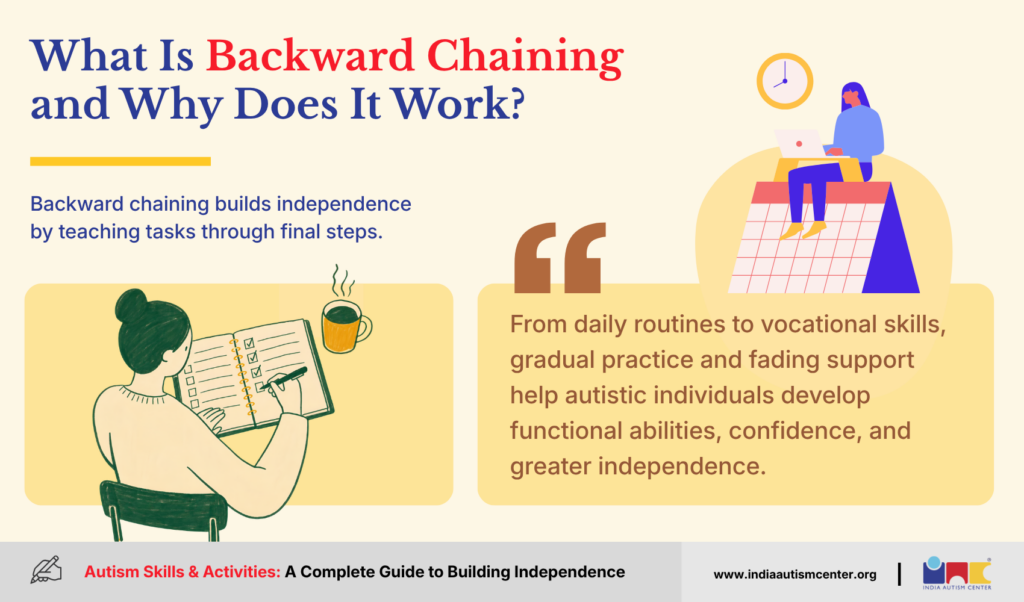
Backward chaining is a teaching method where you complete most steps of a task for the person, then let them complete the final step independently, gradually working backward until they can do the whole task alone. This method works well because it lets the person experience the satisfaction of completing the task from the very first attempt.
For example, when teaching a child to put on a t-shirt, you might do everything except pulling the shirt down at the bottom, which the child does themselves. Once that step is mastered, you would remove your support one step earlier, and so on, until they can do the entire task independently.
What Are Independent Living Skills for Autism?
Autism independent living skills are the higher-level life skills needed to live with reduced support as a teenager or adult. These build on daily living skills but add complexity, such as managing a budget, cooking a full meal, or navigating public transport alone.
Key independent living skill areas include:
- Home management — cleaning, laundry, basic home maintenance
- Financial literacy — budgeting, paying bills, understanding banking
- Health management — scheduling appointments, understanding medication routines
- Community navigation — using maps, public transport, and emergency procedures
- Employment skills — job searching, workplace communication, time management
Read: Empowering Autistic Individuals: Nurturing Life Skills for Independence
How Do You Prepare an Autistic Teenager for Independent Living?
You prepare an autistic teenager for independent living by gradually increasing responsibility across daily tasks, while maintaining a support structure that can be reduced over time. I recommend starting this process well before the teenager is expected to live independently, ideally by early adolescence.
A gradual independence plan often looks like this:
- Supervised practice — the teenager performs the task with an adult present
- Prompted independence — the teenager performs the task with occasional reminders
- Independent performance with check-ins — the teenager completes the task alone, with a periodic review
- Full independence — the teenager completes the task consistently without support
This staged approach reduces the risk of overwhelming the teenager while still building genuine, lasting independence.
What Are Functional Skills for Autism?
Functional skills for autism are the specific, practical skills a person needs to complete real-world tasks with as much independence as possible. The term “functional” emphasizes usefulness in daily life over academic or abstract learning.
I usually group functional skills into four categories:
- Self-care functional skills — dressing, hygiene, feeding
- Home functional skills — cooking, cleaning, organizing
- Community functional skills — shopping, transport, safety awareness
- Vocational functional skills — following instructions, time management, teamwork
What Vocational Skills Should Teenagers and Adults Practice?
Vocational skills that teenagers and adults with autism should practice include following multi-step workplace instructions, managing time and breaks, communicating with a supervisor, and handling unexpected changes to a routine task. These skills are distinct from job-specific technical skills and apply across almost any workplace setting.
I recommend introducing vocational skill practice well before a person’s first job search, ideally starting in the mid-teenage years through structured opportunities like volunteer work, school-based work experience, or supervised chores with workplace-style expectations. Practical vocational activities include:
- Mock job interviews — practicing common questions and appropriate responses in a low-pressure setting
- Task-completion timing practice — completing a defined task within a set time, then checking in with a “supervisor”
- Workplace communication scripts — practicing how to ask for help, report a problem, or request a break appropriately
- Following written instructions independently — a strong predictor of workplace success, practiced through multi-step household or school tasks
- Handling routine changes calmly — practicing a planned, minor disruption to a set task, then discussing how it felt and how it was managed
What Materials Do You Need to Get Started With Skill-Building Activities?
You do not need specialized or expensive materials to get started with skill-building activities. Most of the activities in this guide use items already available at home or easily purchased locally, such as building blocks, playdough, picture cards, a timer, and simple board games.
A basic starter kit I recommend to most families includes:
| Category | Basic Materials |
| Visual supports | A whiteboard or laminated cards, a simple daily schedule template |
| Fine motor | Playdough, lacing cards, child-safe scissors, tweezers |
| Social skills | A deck of cards, a simple board game, picture-based social stories |
| Sensory | A sensory bin (rice or beans), a soft ball, a quiet corner with cushions |
| Communication | Picture cards or a basic AAC app, a visual choice board |
| Tracking | A simple notebook or printed weekly log sheet |
Most of these materials cost very little and can be adapted as the person’s skills develop. I generally advise against investing heavily in specialized products before trying these simpler options first, since engagement and consistency matter far more than the sophistication of the materials used.
Cognitive Skills Activities for Autism
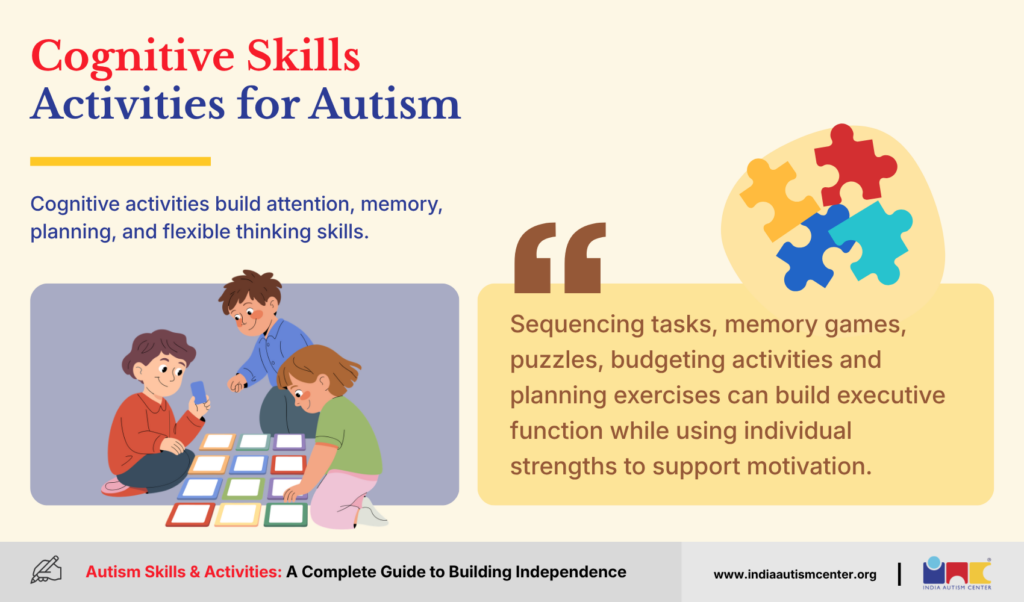
Cognitive skills activities for autism target attention, memory, problem-solving, and flexible thinking. These skills form the foundation for learning, planning, and everyday decision-making. I find that cognitive skill-building often gets overlooked in favor of social and communication goals, but it deserves equal attention.
What Cognitive Challenges Are Common in Autism?
Common cognitive challenges in autism include difficulty with flexible thinking, working memory, and executive function. Executive function covers planning, organizing, and shifting between tasks. Many autistic individuals also show strong cognitive abilities in specific areas, such as pattern recognition or memory for detail.
I always emphasize that cognitive profiles in autism are uneven, not uniformly weaker. A person might struggle significantly with switching between tasks while showing above-average skill in detail-oriented pattern recognition. Effective cognitive support plans account for this unevenness rather than assuming a flat profile.
What Is Executive Function and Why Does It Matter?
Executive function is the set of mental skills that includes planning, organizing, starting tasks, and managing time. Difficulties with executive function are extremely common in autism and can affect everything from completing homework to managing a daily routine.
I recommend supporting executive function with external tools rather than relying on memory alone. Visual schedules, checklists, and timers all reduce the executive function demand of a task, making it more achievable.
What Are Good Cognitive Skills Activities for Autism?
Cognitive skills activities for autism should target one specific cognitive area at a time, using concrete, engaging tasks. I recommend these categories:
- Sequencing activities — arranging pictures or events in the correct order
- Memory games — matching card games, “what’s missing” games
- Problem-solving puzzles — jigsaw puzzles, logic puzzles, building sets
- Flexible thinking exercises — activities with changing rules, like a modified version of a familiar game
- Planning tasks — simple multi-step projects, like planning a small event or meal
I always recommend starting with the child’s area of strength. If a child loves numbers, use number-based puzzles to build broader problem-solving skills before moving to less-preferred material.
How Do You Build Executive Function Skills Through Activities?
You build executive function skills through activities that require planning, sequencing, and self-monitoring in a structured, supported way. I recommend these specific activities:
- Recipe-following tasks — practicing reading and executing multi-step written instructions
- Simple budgeting games — planning a small, fixed “budget” for a pretend shopping trip
- Timer-based tasks — completing an activity within a set time limit to build time awareness
- Checklists for daily routines — self-checking off a morning or bedtime routine
How Do You Build Flexible Thinking Skills?
You build flexible thinking skills by gradually introducing small, manageable changes to familiar routines and games. Flexible thinking, sometimes called cognitive flexibility, is often one of the more challenging areas in autism, since routine and predictability are frequently a source of comfort.
I recommend starting very small. Changing the color of a familiar game piece, or taking a slightly different route to a familiar place, are gentle ways to build tolerance for change without causing distress.
How Do Cognitive Skills Connect to Other Skill Areas?
Cognitive skills act as a foundation for communication, social, and life skills. Strong working memory supports following multi-step instructions. Strong flexible thinking supports adapting to unexpected social situations. I always assess cognitive skills alongside other domains, rather than in isolation.
How Do You Use a Strength-Based Interest to Teach a Weaker Cognitive Skill?
You use a strength-based interest to teach a weaker cognitive skill by embedding the target skill inside a topic the person already finds engaging. A child who struggles with sequencing but loves dinosaurs will engage far longer with a “put the dinosaur eras in order” activity than a generic sequencing worksheet.
I use this approach constantly because motivation drives repetition, and repetition drives skill development. The specific content of the activity matters far less than whether the person wants to keep doing it. Three practical ways to apply this:
- Identify the current strong interest — trains, animals, numbers, a specific show, or a hobby.
- Map the target cognitive skill onto that interest — sequencing, categorizing, or predicting outcomes within that topic.
- Rotate the interest gradually — once the skill is stable, introduce a second, less-preferred topic to build generalization.
Motor Skills Activities for Autism
Autism motor skills activities target both fine motor skills, like grip and hand control, and gross or sensory-motor skills, like balance and coordination. Motor challenges are common in autism, though they receive less public attention than social and communication challenges.
What Are Autism Fine Motor Skills Activities?
Autism fine motor skills activities strengthen hand and finger control needed for tasks like writing, buttoning, and using utensils. Fine motor delays can affect handwriting, self-feeding, and dressing.
I recommend these fine motor activities:
- Playdough and clay work — strengthens hand muscles
- Threading beads — builds pincer grip and hand-eye coordination
- Cutting with child-safe scissors — practicing straight and curved lines
- Tweezers and tongs games — picking up small objects, like pom-poms
- Lacing cards — builds grip control and bilateral coordination
- Sticker peeling and placing — builds pincer grasp and precision
- Pegboard activities — placing small pegs into a board, builds finger isolation
- Cutting collage projects — combines cutting practice with a creative, motivating outcome
How Do Fine Motor Skills Affect Handwriting?
Fine motor skills directly affect handwriting because writing requires precise finger control, hand strength, and hand-eye coordination. A child struggling with fine motor skills may show messy handwriting, poor pencil grip, or fatigue during writing tasks, even if their academic understanding is strong.
I recommend addressing the underlying fine motor skill before focusing heavily on handwriting practice itself. Strengthening hand muscles through play-based activities often improves handwriting more effectively than repeated handwriting drills alone.
What Are Sensory Motor Skills Activities for Autism?
Sensory motor skills autism activities combine physical movement with sensory input to build coordination and body awareness. These activities often overlap with occupational therapy approaches.
Effective sensory motor activities include:
- Balance beam or line walking — builds balance and body control
- Obstacle courses — combines multiple motor skills in sequence
- Swinging and spinning activities — provides vestibular input, under supervision
- Trampoline jumping — builds gross motor coordination and provides proprioceptive input
- Animal walks — crab walk, bear crawl, to build core strength and coordination
I recommend working with an occupational therapist to determine which sensory motor activities suit a specific child, since sensory needs vary widely from person to person.
What Role Does Occupational Therapy Play in Motor Skill-Building?
Occupational therapy plays a central role in motor skill-building because occupational therapists assess the specific fine, gross, and sensory-motor patterns affecting a person, then design a targeted plan rather than a generic one. An OT evaluation typically looks at hand strength, grip patterns, balance, coordination, and how sensory processing interacts with movement.
I recommend an OT evaluation whenever a motor delay is affecting a specific daily task, such as handwriting, buttoning clothes, or using cutlery. Home-based practice works well alongside OT sessions, but it works best when it follows the same targeted approach the therapist has already assessed, rather than a general, unguided activity list.
A Sample Motor Skills Activity Table by Age
| Age Group | Fine Motor Focus | Gross/Sensory-Motor Focus |
| 2–4 years | Stacking blocks, large crayons, finger painting | Crawling tunnels, large ball rolling |
| 5–7 years | Scissors, lacing cards, playdough | Balance beam, animal walks, trampoline |
| 8–11 years | Handwriting practice, threading small beads | Obstacle courses, catching and throwing |
| 12+ years | Typing, precise craft work, using tools | Team sports, cycling, structured exercise routines |
This table is a general starting reference. Actual skill level varies significantly between individuals, so I always recommend adjusting the specific activity based on the person’s current ability rather than their age alone.
Sensory Activities for an Autistic Child
Sensory activities for an autistic child support healthy sensory processing by providing structured, predictable sensory input. Many autistic individuals experience sensory input, such as sound, light, or touch, more or less intensely than others. Sensory activities help the nervous system regulate this input.
Why Are Sensory Activities Important in Autism?
Sensory activities are important in autism because unregulated sensory input can lead to distress, overwhelm, or difficulty focusing. A child who is overstimulated by classroom noise may struggle to learn, not because of a cognitive limitation, but because their sensory system is overloaded.
What Are Good Sensory Activities for an Autistic Child?
Good sensory activities for an autistic child are tailored to whether the child is sensory-seeking or sensory-avoidant. I always assess this first, since the same activity can help one child and overwhelm another.
For sensory-seeking children, I recommend:
- Sensory bins — filled with rice, beans, or sand for tactile input
- Weighted blankets — for calming deep-pressure input
- Swinging or rocking — provides vestibular input
- Textured play materials — slime, kinetic sand, textured balls
For sensory-avoidant children, I recommend:
- Noise-canceling headphones — for sound sensitivity
- Quiet sensory corners — a low-stimulation retreat space
- Gradual desensitization activities — slowly introducing a disliked texture or sound, at the child’s pace
- Soft lighting adjustments — reducing harsh fluorescent lighting where possible
10 Fun Sensory Activities for an Autistic Child
How Do You Build a Sensory Diet?
A sensory diet is a structured, personalized schedule of sensory activities designed by an occupational therapist to meet a person’s specific sensory needs throughout the day. I always recommend working with an OT to design a sensory diet, since the wrong activities can increase distress instead of reducing it.
How Do You Tell If an Activity Is Overstimulating Rather Than Helpful?
You can tell an activity is overstimulating rather than helpful when the person shows increased distress, avoidance, or dysregulated behavior during or shortly after the activity, rather than a calmer or more focused state. Signs to watch for include covering ears or eyes, increased pacing or repetitive movement, or a sudden refusal to continue.
If this happens, I recommend stopping the activity immediately rather than pushing through. Sensory activities should always move toward greater regulation, not away from it. A short break in a quiet space, followed by a much shorter, lower-intensity version of the activity, is usually a better next step than continuing at the original intensity.
Can Sensory Needs Change Over Time?
Yes, sensory needs can change significantly over time, sometimes shifting from seeking to avoiding a specific type of input, or the reverse. A child who loved loud, busy environments at age four may become sound-sensitive by age eight, or vice versa.
I recommend reassessing sensory preferences every few months, rather than assuming a profile identified once will remain fixed. This is especially important during major transitions, such as starting a new school or entering adolescence, when sensory processing patterns can shift noticeably.
Autism and Interpersonal Skills
Autism and interpersonal skills are closely related but distinct from general social skills. Interpersonal skills specifically involve building and maintaining relationships, including empathy, conflict resolution, and long-term friendship maintenance.
How Do Interpersonal Skills Differ From Social Skills?
Social skills refer to the basic mechanics of interaction, such as eye contact and turn-taking. Interpersonal skills go further, covering the depth and maintenance of relationships over time. A person can master basic social skills but still need direct support in interpersonal skills, like resolving a disagreement with a friend.
What Activities Build Interpersonal Skills in Autism?
I recommend these activities for building interpersonal skills:
- Conflict resolution role-play — practicing how to handle disagreements calmly
- Friendship maintenance discussions — talking through how to check in with a friend
- Empathy-building exercises — discussing how a character in a story might feel
- Long-term paired activities — repeated interaction with the same peer over weeks or months, to build a real relationship rather than a one-off interaction
How Do You Teach Empathy and Perspective-Taking?
You teach empathy and perspective-taking by explicitly naming emotions in real situations and discussing what might have caused them, rather than assuming this understanding develops automatically. Many autistic individuals feel empathy deeply but process the cognitive step of recognizing another person’s emotional state differently.
I recommend starting with concrete, visible emotional cues before moving to more subtle or hidden ones. Useful activities include:
- Emotion photo sorting — grouping photos of faces by the emotion shown
- “What happened before this?” discussions — using a photo or short video clip to guess what led to a person’s visible emotion
- Story-based perspective questions — pausing during a story to ask how a character might be feeling and why
- Real-time labeling — gently naming an observed emotion in the moment, such as “your friend looks disappointed that the game ended”
How Do You Handle Friendship Conflicts or Misunderstandings?
You handle friendship conflicts or misunderstandings by teaching a simple, repeatable process rather than expecting the resolution to happen naturally in the moment. A structured script reduces the pressure of finding the right words during an already stressful situation.
A basic conflict-resolution script I recommend teaching:
- Pause — take a breath before responding
- State the problem calmly — “I felt upset when…”
- Listen to the other person’s view — without interrupting
- Suggest a solution — a specific next step both people agree on
- Check in later — confirm the friendship feels okay again
Practicing this script through low-stakes role-play, before a real conflict arises, makes it far more likely the person can access it during an actual disagreement.
Savant Skills in Autism
Savant skills in autism refer to exceptional abilities in a specific area, such as memory, music, art, or mathematics, that stand out compared to the person’s overall skill profile. Savant skills are a distinct and separate topic from the functional skill-building covered elsewhere in this guide.
How Common Are Savant Skills in Autism?
Savant skills are not universal in autism. Research suggests only a minority of autistic individuals show savant abilities, though the prevalence is higher in autism than in the general population. I want to be direct about this because savant skills are often overrepresented in media portrayals of autism, which can create unrealistic expectations.
What Are the Most Common Types of Savant Skills?
The most commonly documented savant skills include:
- Memory savant skills — recalling detailed facts, dates, or information
- Mathematical savant skills — rapid calculation or number pattern recognition
- Musical savant skills — playing music by ear, perfect pitch
- Artistic savant skills — detailed, realistic drawing or painting ability
- Calendar calculation — instantly identifying the day of the week for any date
How Do Savant Skills Relate to Skill-Building Activities?
Savant skills develop differently from the functional skills covered in this guide. Savant abilities are often innate strengths rather than taught skills. I always encourage families to nurture a savant skill if one is present, but not to treat it as a substitute for developing communication, social, or life skills, which affect daily independence more broadly.
Is There a Connection Between Savant Skills and Other Autism Traits?
Yes, savant skills are often associated with other well-documented autism traits, including strong attention to detail, a preference for pattern and repetition, and intense, focused interest in a narrow topic. These same traits that make certain everyday tasks more challenging can, in a smaller subset of individuals, also produce an exceptional narrow ability.
I find this connection useful to explain to families because it reframes a trait like “intense focus on one topic” in a more balanced light. The same trait that can look like rigidity in one context can, for some individuals, be the foundation of a genuine strength in another. This does not mean every intense interest becomes a savant skill. It simply means the underlying cognitive style is related.
Should You Try to “Find” a Savant Skill in an Autistic Child?
No, actively searching for a savant skill is not a productive use of time or resources for most families. Savant skills, when present, tend to emerge on their own, often quite early and quite obviously, without needing to be specifically sought out through testing or trial activities.
I recommend redirecting that energy toward the functional skill domains covered throughout this guide. If a genuine savant ability appears naturally, it is worth nurturing and, later in life, potentially connecting to education or vocational planning. But it should never become the primary goal of an intervention plan, since functional independence has a far greater impact on quality of life for the vast majority of autistic individuals.
How Do You Build a Skill-Building Activity Plan for Autistic Person?
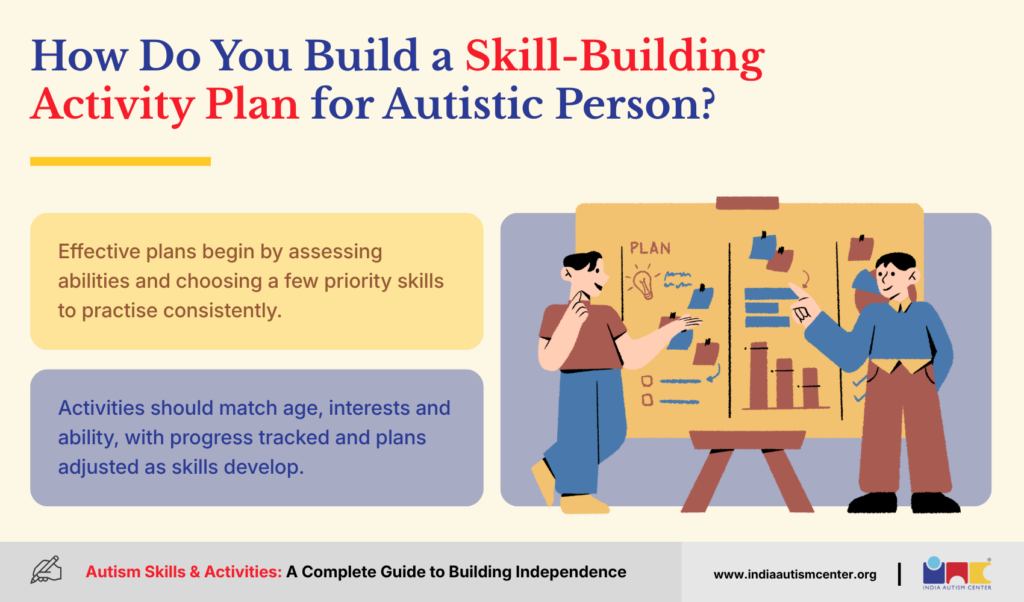
You build a skill-building activity plan by assessing current abilities, prioritizing one or two target skills, choosing matching activities, and tracking progress consistently. I recommend this five-step process for parents, caregivers, and educators:
- Assess — identify current skills using a checklist or professional evaluation
- Prioritize — choose one or two skills to focus on, rather than everything at once
- Select activities — match activities to the person’s age, interests, and current level
- Practice consistently — short, frequent sessions work better than long, infrequent ones
- Track and adjust — review progress every few weeks and adjust the plan as needed
Who Should Be Involved in the Activity Plan?
An effective skill-building plan involves parents, teachers, and therapists working together with consistent goals. I always recommend sharing the same target skill across home and school settings, since consistency accelerates learning far more than isolated practice in just one setting.
How Long Does It Take to See Progress?
Progress timelines vary widely between individuals, skill areas, and intervention intensity. Some skills, like a specific social greeting, may show progress within a few weeks. Others, like flexible conversational skills, may take months or years of consistent practice. I always encourage patience and consistency over speed.
What Does a Sample Weekly Skill-Building Schedule Look Like?
A sample weekly schedule spreads short, focused sessions across several days rather than concentrating all practice into one long weekly block. Here is a template I often share with families who are just getting started:
| Day | Focus Area | Activity | Duration |
| Monday | Communication | Narrated play, choice-making practice | 10 minutes |
| Tuesday | Social skills | Turn-taking game with a sibling or peer | 15 minutes |
| Wednesday | Life skills | Task-analysis practice (dressing or hygiene step) | 10 minutes |
| Thursday | Sensory/motor | Sensory bin or obstacle course | 15 minutes |
| Friday | Cognitive | Sequencing or memory game | 10 minutes |
| Saturday | Social skills (group) | Peer play date or social skills group | 30–45 minutes |
| Sunday | Rest or free choice | Person-led preferred activity | Flexible |
This schedule is a starting template, not a fixed rule. I recommend adjusting the domains and durations based on the person’s current priority goals, energy levels, and existing therapy schedule, so home practice complements rather than duplicates professional sessions.
What Barriers Commonly Slow Down Skill-Building Progress?
The most common barrier is inconsistency, meaning an activity is practiced intensely for a week, then dropped for several weeks before resuming. Skills that are practiced briefly but consistently tend to progress faster than skills practiced intensely but irregularly.
Other common barriers I see include:
- Activities pitched above the person’s current level — causing frustration instead of skill-building. I recommend starting one step easier than expected and building up.
- Lack of communication between home, school, and therapy — a skill targeted in one setting but not reinforced in others generalizes much more slowly.
- Burnout in the caregiver, not just the child — skill-building is demanding for parents too. I recommend choosing a sustainable pace rather than an intense but short-lived push.
- Sensory overload during the activity itself — a child who is overstimulated cannot effectively learn a new skill in that moment. Addressing sensory regulation first often unlocks progress in other domains.
How Does the Home Environment Support Skill Generalization?
The home environment supports skill generalization by giving the person repeated, low-pressure opportunities to practice a skill in a real, natural setting, rather than only in a clinical or classroom context. A skill practiced only in a therapy room does not automatically transfer to home, school, or the community.
Practical ways to strengthen generalization at home include:
- Using the same visual supports at home that are used in therapy or school, such as an identical picture schedule.
- Creating natural opportunities for the skill to occur, rather than only practicing it in an artificial drill.
- Involving siblings and extended family, so the person practices the skill with a wider range of communication partners.
- Keeping expectations consistent across every adult in the household, so the skill is reinforced the same way every time.
When Should You Involve a Professional?
You should involve a professional when progress stalls, when a skill significantly affects safety or daily functioning, or when you are unsure how to break a skill into teachable steps. Professionals bring structured assessment tools and training that go beyond what most home-based activities can offer.
Which Professionals Support Skill-Building in Autism?
| Professional | Focus Area |
| Applied Behavior Analyst (ABA) | Behavior and skill-building using structured teaching methods |
| Occupational Therapist (OT) | Fine motor, sensory motor, and daily living skills |
| Speech-Language Pathologist (SLP) | Communication and language skills |
| Special Educator | Academic and functional classroom skills |
| Clinical Psychologist | Cognitive and behavioral assessment |
I always recommend a professional assessment before starting an intensive skill-building program, since it ensures the activities target the right skills at the right level for that specific individual.
How Do You Adapt Skill-Building Activities for Non-Verbal or Minimally Verbal Individuals?
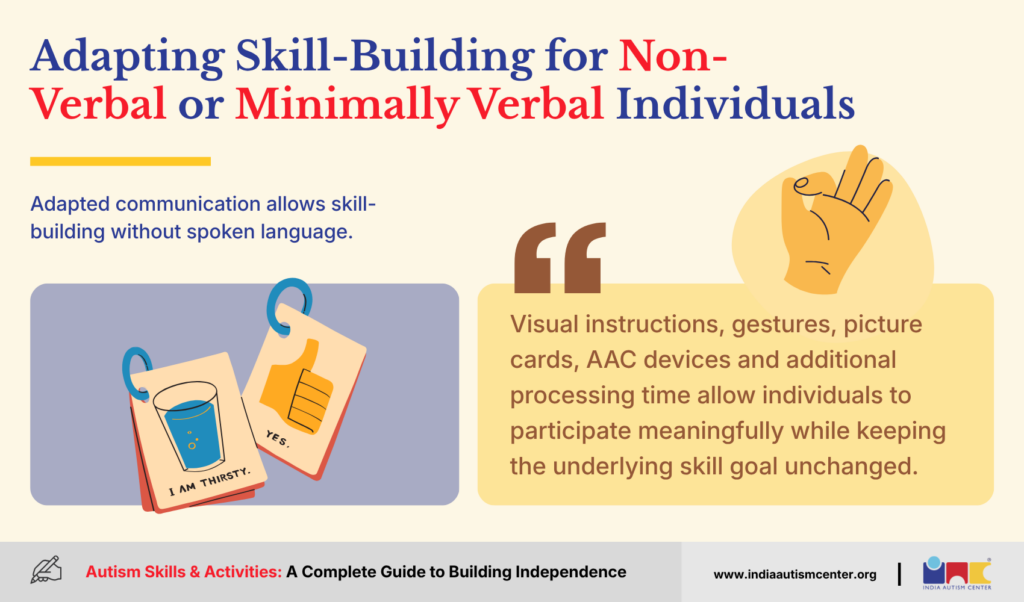
You adapt skill-building activities for non-verbal or minimally verbal individuals by shifting the response format from spoken language to visual, gestural, or device-based communication, while keeping the underlying skill target the same. A turn-taking game, a sorting activity, or a conflict-resolution script can all be taught without requiring spoken words at any step.
I recommend three general adaptations that apply across almost every activity in this guide:
- Replace verbal instructions with visual ones. A picture sequence or short video model can replace a spoken explanation of the steps.
- Accept any communicative response as valid. A point, a picture card, a gesture, or an AAC device selection all count as genuine participation, not just spoken words.
- Build in extra processing time. Non-verbal and minimally verbal individuals often need more time to process a question or instruction before responding. Rushing a response reduces genuine participation.
This approach applies across every domain covered in this guide, not just communication activities. Social games, life skills tasks, cognitive activities, and interpersonal skill-building can all be taught successfully without relying on spoken language as the primary teaching or response method.
How Does the Home and Family Environment Shape Activity Choice?
The home and family environment shapes activity choice by determining which skills are most urgently needed, which materials are realistically available, and which family members can consistently support practice. A skill-building plan works best when it fits naturally into the family’s actual daily routine, rather than requiring an entirely separate schedule.
I always ask families a few practical questions before recommending specific activities:
- What does a typical day already look like? Embedding practice into existing routines, like mealtimes or the walk to school, is usually more sustainable than adding new, separate sessions.
- Who is available to support practice consistently? A plan that only one caregiver can run is more fragile than one the whole household can reinforce.
- What skills matter most for this specific family’s daily life? A family living in a joint household with extended family nearby may prioritize different social and communication skills than a family in a smaller, more independent household.
- What activities does the child or adult already enjoy? Building on existing preferred activities almost always produces better engagement than introducing something entirely unfamiliar.
I mention this because so much generic advice online assumes a single “correct” activity list that applies to every family equally. In practice, the best activity plan is the one that realistically fits into a specific household’s routine, resources, and available support, while still targeting the priority skill areas covered throughout this guide.
Frequently Asked Questions
What Are the Most Important Skills to Teach a Child With Autism First?
The most important skills to teach first are usually functional communication and safety-related skills. A child who can communicate basic needs and understand safety rules has a stronger foundation for learning everything else.
How Do You Teach Social Skills to a Non-Verbal Autistic Child?
You teach social skills to a non-verbal autistic child using visual supports, AAC devices, and gesture-based interaction, rather than relying on spoken language. Social skills like eye contact, turn-taking, and joint attention can all be taught without speech.
What Is the Difference Between Life Skills and Daily Living Skills?
Life skills is the broader category, covering all skills needed for independence, while daily living skills refer specifically to routine self-care tasks like hygiene, dressing, and eating.
Can Adults With Autism Improve Their Social Skills?
Yes, adults with autism can improve social skills at any age through structured practice, coaching, and real-world application. Social skill development is not limited to childhood.
Are Savant Skills Common in Autism?
No, savant skills are present in only a minority of autistic individuals, though the rate is higher than in the general population.
How Do You Choose the Right Activity for a Specific Skill?
You choose the right activity by matching it to the person’s current skill level, interests, and sensory preferences, then adjusting based on their response. An activity that works for one autistic individual may not work for another, so ongoing observation matters more than following a fixed list.
What Age Should Skill-Building Activities Start?
Skill-building activities can start as early as toddlerhood, since early intervention is strongly associated with better long-term outcomes. That said, it is never too late to start, and meaningful progress is possible at any age, including adulthood.
How Many Activities Should You Practice at Once?
You should practice no more than one or two activities at a time, focused on one or two priority skills. Spreading attention across too many skills at once tends to slow overall progress, since neither the caregiver nor the child can give any single skill enough repeated, focused practice.
I recommend a simple test before adding a new skill to the plan: has the current target skill shown consistent progress over the past several weeks? If yes, it is reasonable to add a new focus area. If not, I recommend staying with the current goal a while longer before expanding.
Can Skill-Building Activities Cause Frustration or Meltdowns?
Yes, an activity pitched above a person’s current ability, or introduced during a period of sensory overload, can trigger frustration or a meltdown. This is usually a sign that the activity needs to be simplified, not a sign that the skill itself is unreachable.
If a specific activity consistently leads to distress, I recommend three adjustments in order: first, break the task into smaller steps; second, shorten the session length; third, check whether sensory factors, like noise or lighting, are contributing to the difficulty before trying the activity again.
Do Skill-Building Activities Differ for Boys and Girls With Autism?
The core skill domains and activity types are the same for boys and girls with autism, though presentation and social expectations can differ, particularly around masking and peer social dynamics. Girls are sometimes more likely to camouflage social difficulties, which can make gaps harder to notice without close, specific observation.
I recommend the same structured approach regardless of gender: assess current skills directly, rather than relying on general impressions, since masking can make a skill gap look smaller than it actually is.
How Do You Choose Between Group and One-on-One Activities?
You choose between group and one-on-one activities based on the specific skill being targeted and the person’s current comfort level with peers. One-on-one sessions work well for teaching a brand-new skill, since they allow full attention and immediate feedback. Group activities work well once a skill is partially established and needs real-world practice with peers.
A practical rule I use: teach the skill one-on-one first, then move to a small group once the person can perform the skill reliably with an adult, so the group setting becomes practice rather than initial instruction.
Are Digital Apps and Games Useful for Building Autism Skills?
Yes, digital apps and games can be a useful supplement to skill-building activities, particularly for communication (AAC apps), cognitive skills (sequencing and matching apps), and structured social scenarios (video modeling apps). They work best as one part of a broader plan, not a replacement for real-world practice and interaction.
I recommend balancing screen-based practice with in-person application of the same skill, since a skill practiced only on a screen does not always transfer automatically to a face-to-face setting.
Quick-Reference Index: Which Section Answers Your Question?
I have added this index so you can jump directly to the section most relevant to your immediate question, without reading the full guide from start to finish.
| If You’re Asking About… | Go To This Section |
| Turn-taking, friendships, reading social cues | What Are Social Skills Activities for Autism? |
| Speech, language, AAC, non-verbal communication | Communication Skills Activities for Autism |
| Hygiene, cooking, budgeting, independence | Life Skills Activities for Autism |
| Attention, memory, planning, flexible thinking | Cognitive Skills Activities for Autism |
| Handwriting, grip, balance, coordination | Motor Skills Activities for Autism |
| Sound, touch, light sensitivity, calming activities | Sensory Activities for an Autistic Child |
| Friendship maintenance, empathy, conflict resolution | Autism and Interpersonal Skills |
| Exceptional narrow abilities like memory or music | Savant Skills in Autism |
| Creating a personalized plan, tracking progress | How Do You Build a Skill-Building Activity Plan? |
| Knowing when to seek therapy or evaluation | When Should You Involve a Professional? |
Conclusion
Autism skills and activities cover a wide range of domains: social, communication, life, cognitive, motor, and sensory. Each domain has its own set of targeted activities, and most autistic individuals benefit from a combined approach that addresses more than one domain at a time.
If you take away only one idea from this guide, let it be this: skill-building is a long-term, cumulative process, not a single intervention with a fixed endpoint. Skills learned in early childhood support the more complex skills needed in adolescence and adulthood. A strong foundation in communication makes social skill-building easier. Better sensory regulation makes it easier to focus on cognitive and academic tasks. None of these domains sit in isolation.
I always tell families the same thing: consistency matters more than intensity, and small, targeted steps add up to real, lasting independence over time. Start with one skill, choose an activity that fits the person’s age and interests, and build from there. Revisit this guide as needs change, since the right activity today may look quite different from the right activity a year from now, and that shift is a sign of progress, not a reason to start over.
Disclaimer: This article is intended for educational and informational purposes only. It is not a substitute for professional medical advice, diagnosis, or treatment. If you are pregnant or have concerns about medication use during pregnancy, please consult a qualified healthcare provider. If your child has received an autism diagnosis and you have questions about causes or support, please reach out to a trained specialist or an autism-focused organisation for guidance.
For expert insights, support services, and inclusive learning initiatives, visit the India Autism Center.