 Donate now
 Get a Call Back
 MENU
MENU 12 MIN READ
 SHARE
SHARE


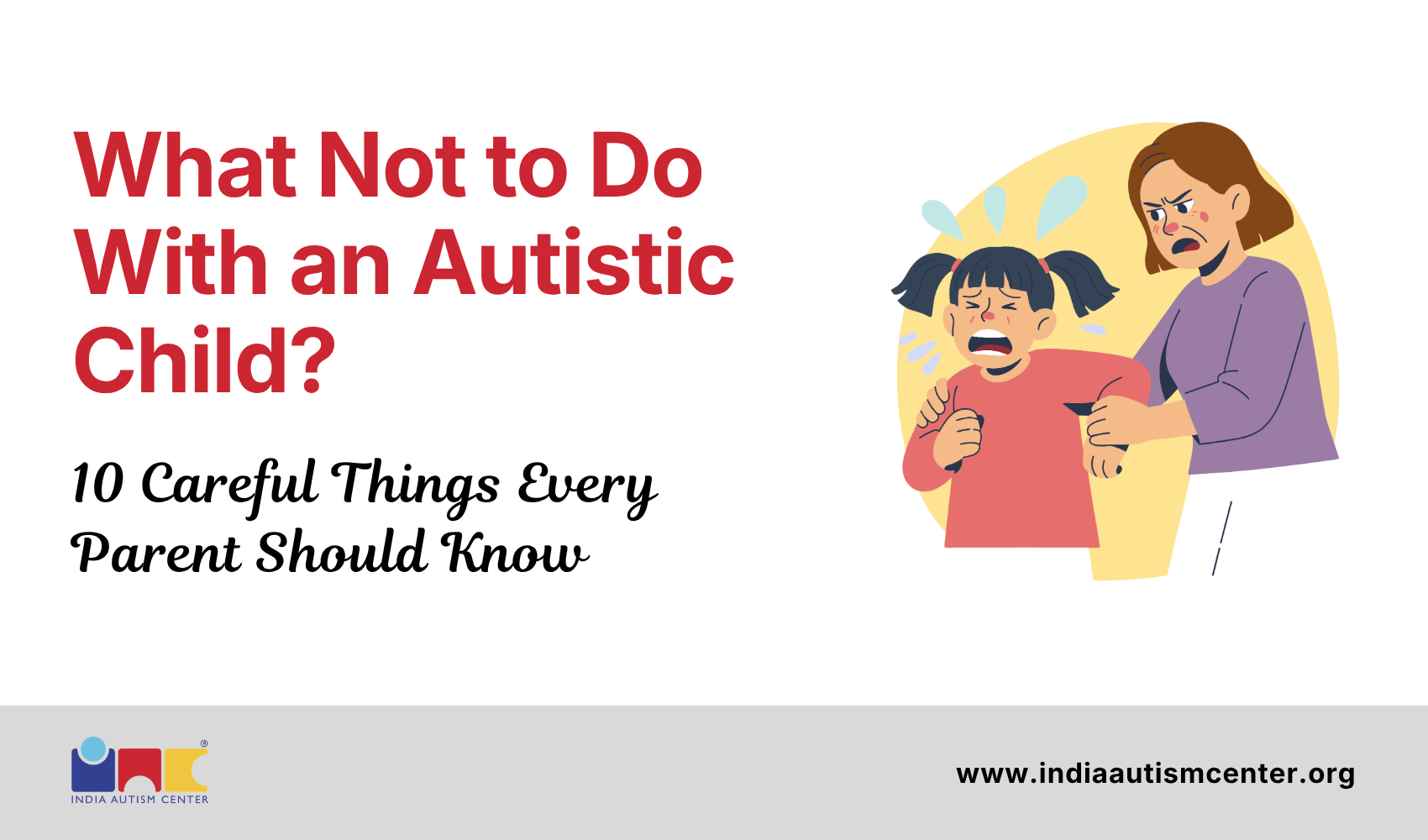
Parenting an autistic child can bring questions that are not easy to answer with a simple yes or no. Should you stop repetitive movements? Should you insist on eye contact? Can an autistic child go to a normal school? What should you do when your autistic child attacks you? And how can you tell whether a behaviour is part of autism or something else?
Although about 1 in 127 people globally are reported to have autism in 2021, autism looks different in every person.
Understanding what not to do with an autistic child is therefore less about following rigid rules and more about recognising individual communication, sensory, emotional and learning needs.
What Not to Do With an Autistic Child? Understanding the Bigger Picture
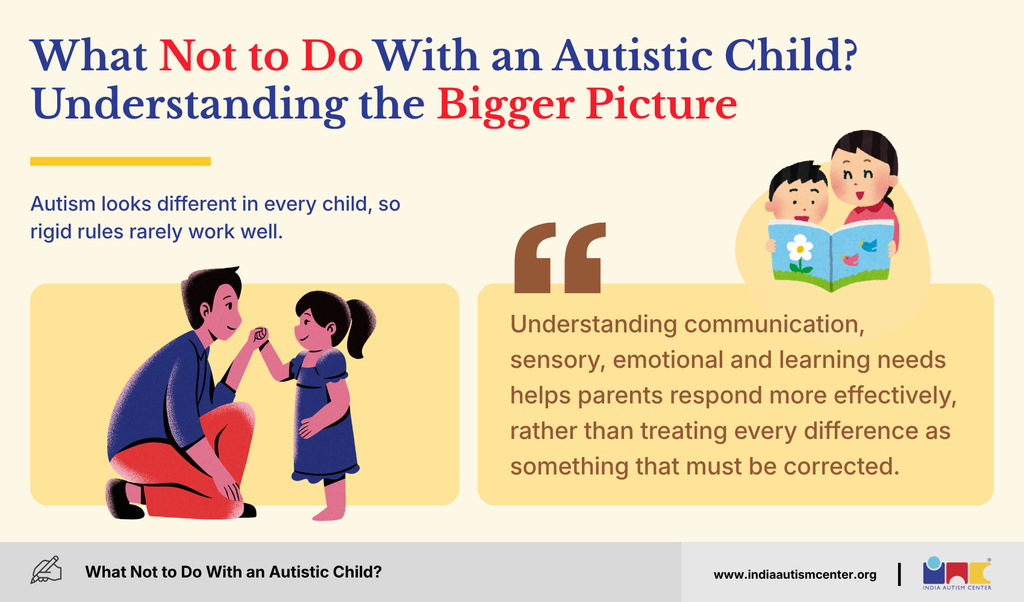
Before discussing specific behaviours, it is important to understand what autism actually involves.
Autism is essentially a neurodevelopmental condition associated with differences in social communication and interaction. It is often associated with restricted or repetitive patterns of behaviour, interests and activities. Autistic children can also experience differences in sensory processing, learning, attention, sleep, eating, emotional regulation and communication.
However, there is no single version of autism.
One child may speak fluently but find social conversations difficult. Another may communicate primarily through gestures, pictures or an augmentative and alternative communication system. One child may be highly sensitive to sound, while another may seek particular sensory experiences.
This is why the characteristics of an autistic child should never be treated as a fixed checklist that every child must match.
Parents are often advised to focus on changing behaviour. A more useful approach is to understand what the behaviour may be communicating.
For example, a child who covers their ears may be overwhelmed by noise. A child who refuses a particular food may be reacting to its texture or smell. A child who becomes distressed during a transition may be struggling with an unexpected change. A child who hits may lack another effective way to communicate distress, pain or frustration.
This does not mean that every behaviour should be accepted without boundaries. Safety remains essential. Instead, it means that the response should address the underlying need rather than punish the visible behaviour.
Here are 10 important things parents should avoid.
1. Do Not Force Eye Contact
One of the most common misconceptions about autism is that autistic children need to make eye contact to communicate properly.
They do not.
Some autistic children may naturally make little eye contact. Others may look briefly and then look away. Some may find sustained eye contact distracting, uncomfortable or overwhelming.
Forcing eye contact can therefore make communication harder rather than easier.
A child can listen without looking directly at someone’s eyes. They can communicate through words, gestures, facial expressions, body language, pictures, writing, signs or AAC.
Instead of repeatedly saying, “Look at me”, try to make communication easier by:
- Using your child’s name before speaking.
- Keeping instructions short and clear.
- Allowing additional processing time.
- Getting into a comfortable position rather than demanding a particular posture.
- Using visual information where helpful.
- Accepting your child’s natural communication style.
The objective should be meaningful communication, not making the child appear more socially typical.
This is an important principle when considering what not to do with an autistic child: do not automatically treat an autistic difference as a behaviour that needs correcting.
2. Do Not Stop Stimming Simply Because It Looks Different
Repetitive movements or sounds are commonly referred to as stimming, short for self-stimulatory behaviour. Examples can include hand-flapping, rocking, spinning, humming, repeating sounds or movements, or engaging repeatedly with an object.
Stimming can serve different purposes. It may be enjoyable, help with sensory regulation, provide comfort or help a child manage overwhelming situations. The NHS specifically notes that repetitive movements can be calming and recommends not trying to change an autistic person’s behaviour unless it is harmful to them or others.
This distinction matters.
If a child flaps their hands when excited and is completely safe, there may be no reason to stop them. If a repetitive behaviour involves significant self-injury, it needs to be taken seriously. The appropriate response is to understand why it is occurring and identify safer ways of meeting the underlying need.
Parents should therefore avoid statements such as:
- “Stop doing that.”
- “Sit still.”
- “That’s strange.”
- “People are watching you.”
Instead, ask yourself:
- Is the behaviour harmful, or is it simply different?
If it is harmless, allowing the child to regulate themselves can be more supportive than trying to suppress the behaviour.
3. Do Not Treat an Autistic Meltdown as a Tantrum
This is one of the most important things to understand about what not to do with an autistic child. A meltdown is not simply a child being naughty or refusing to follow instructions.
An autistic meltdown can happen when a child becomes overwhelmed by sensory, emotional, communication or environmental demands. The child may cry, scream, hit, kick, throw objects, run away or temporarily lose their ability to communicate effectively. During a meltdown, lengthy explanations usually do not help.
The priority should be safety and reducing the demands on the child. Here is what you can do:
- Lower your voice.
- Reduce noise and unnecessary stimulation.
- Move other people away if possible.
- Give the child physical space.
- Remove dangerous objects.
- Reduce verbal instructions.
- Avoid asking multiple questions.
- Allow time for recovery.
Do not attempt to teach a lesson in the middle of a meltdown. The teaching can happen later, once the child is calm enough to process information.
It is also useful to identify what happened immediately before the meltdown. Was there a change in routine? Was the environment unusually noisy? Was the child hungry, tired or unwell? Was a preferred activity suddenly stopped? Was the child unable to communicate what they wanted?
Understanding the trigger can help prevent future episodes.
4. Do Not Assume Aggression Means Your Child Is Being Deliberately Difficult
Hitting, kicking, biting, scratching or throwing objects can be frightening, particularly when directed towards a parent. If you are wondering what to do when your autistic child attacks you, then remember the priority is safety.
The second is understanding the behaviour. Aggression can have many possible causes. Communication difficulties, sensory overload, anxiety, frustration, physical pain, gastrointestinal problems, changes in routine and environmental stress can all contribute to challenging behaviour.
This does not mean that hitting should be ignored. A child should not be allowed to injure themselves or another person. But punishment alone rarely addresses why the behaviour is occurring.
During an incident, try to create physical space if it is safe to do so. Remove nearby hazards and reduce stimulation. Avoid shouting back or escalating the confrontation.
Once the child has recovered, look for patterns. A simple way to do this is to record:
- What happened before? Identify the situation or trigger.
- What happened? Describe the behaviour objectively.
- What happened afterwards? Consider how people responded and what changed.
For example, if aggression repeatedly occurs when a preferred activity ends, the child may need additional support with transitions. If it occurs when they cannot communicate a request, communication support may be important. If it happens in noisy environments, sensory adaptations may help.
5. Do Not Force Your Child to Eat or Assume There Is One “Autism Diet”
Food can become a major source of stress for families. Some autistic children have very restricted food preferences. They may prefer specific textures, colours, temperatures, brands or smells. A child may accept one food but reject another that appears almost identical.
This is why there is no single diet for autistic children that applies to everyone.
More importantly, restrictive diets should not be presented as a treatment for autism itself. A restricted diet can create nutritional concerns, particularly when a child eats a very narrow range of foods. NICE recommends assessing feeding, growth and nutritional problems in children with restricted diets and referring for further assessment when necessary.
Parents should therefore avoid turning mealtimes into battles. Instead, consider:
- Whether the child has sensory sensitivities to texture, smell or temperature.
- Whether there are underlying gastrointestinal or other health concerns.
- Whether preferred foods can be used as a bridge to introduce similar foods.
- Whether mealtimes are predictable and low-pressure.
- Whether professional feeding or nutritional support is required.
The goal is not to force a child to eat everything. It is to support adequate nutrition while gradually building a healthy relationship with food.
6. Do Not Assume Delayed Speech Means Your Child Cannot Communicate
One of the most emotionally complex questions parents ask is: “What are the signs my autistic child will talk?” Unfortunately, there is no reliable checklist that can tell a parent exactly when or whether an individual autistic child will become verbally fluent.
Speech development varies widely. Some autistic children develop spoken language later than expected. Others use a limited number of words or phrases. Some become fluent speakers but continue to experience difficulties with conversational language and social communication.
Parents should therefore avoid waiting for speech before supporting communication. If a child is not speaking, communication can still be developed through:
- Gestures
- Pictures
- Signs
- Communication boards
- AAC devices
- Writing
- Facial expressions
- Other personalised communication systems
AAC should not be viewed as completely giving up on speech. It can provide a child with a reliable way to express needs, choices, feelings and ideas while spoken communication develops or alongside it.
Speech and language therapy may also focus on functional communication rather than simply increasing the number of spoken words. Instead of asking only, “Will my child talk?”, ask: “How can my child communicate more effectively right now?”
That change in perspective can make a significant difference. It also reduces pressure on the child to produce speech to satisfy an adult expectation.
7. Do Not Assume Every Autistic Child Needs the Same School
Parents often wonder: can an autistic child go to a normal school? Yes, many autistic children can attend mainstream schools when the appropriate support is available. Others may benefit from specialist education or another educational arrangement.
The important question is therefore not whether mainstream school is automatically good or bad. The question is whether the environment matches the child’s needs. When considering a school, look beyond academic performance.
Consider:
- Class size and classroom noise.
- Availability of SEN support.
- Teacher understanding of autism.
- Access to quiet or low-stimulation spaces.
- Support during transitions.
- Communication needs.
- Break and lunchtime arrangements.
- Sensory requirements.
- Opportunities for social participation.
- The child’s emotional response to school.
A child who performs well academically may still struggle significantly with sensory demands, social expectations or transitions.
Likewise, a child who needs considerable learning support is not automatically better suited to a specialist school. There is no universal placement that works for every autistic child.
8. Do Not Compare Your Child With Other Children
Comparison is tempting. You may see another child of the same age speaking more, reading earlier, sitting quietly in class or playing with peers and wonder why your child is not doing the same.
But autistic development is often uneven. A child may have strong memory but struggle with daily living skills. They may know a great deal about a particular subject but have difficulty with flexible thinking. They may read well but find conversation challenging.
This is why the characteristics of an autistic child should be considered as part of an individual profile rather than a scorecard.
Instead of comparing your child’s development with another child’s, compare your child’s current abilities with their own previous abilities.
9. Do Not Turn Every Moment Into a Therapy Session
Parents understandably want to maximise every opportunity for development. But an autistic child also needs time to play, rest, explore interests and spend time with family.
Not every activity needs to become a lesson.
- If your child loves trains, play with trains.
- If they enjoy drawing, use drawing to encourage communication.
- If they are fascinated by numbers, incorporate numbers into everyday activities.
This approach can also help when parents are searching for the right focus for an autistic child to study.
10. Do Not Ignore Your Child’s Physical and Emotional Wellbeing
Sometimes behaviour that appears to be “autism-related” has another explanation. Pain, sleep difficulties, gastrointestinal problems, anxiety, changes in routine and other health concerns can affect behaviour and communication.
Parents should therefore avoid assuming that every new behaviour is simply part of autism.
A sudden change deserves attention. For example, if a child who usually sleeps well suddenly becomes distressed at night, consider whether something else has changed. If eating behaviour changes dramatically, investigate possible causes rather than immediately attributing it to autism.
India Autism Center: Helping Families Make Informed Autism Decisions
India Autism Center supports families with reliable, evidence-informed information about autism and practical guidance for everyday challenges. From communication and sensory needs to education, behaviour and developmental support, IAC helps parents make informed decisions based on their child’s individual needs.
The resources encourage understanding, acceptance and meaningful support, helping autistic children develop skills, confidence and greater participation in everyday life.
Conclusion
Knowing what not to do with an autistic child is ultimately about replacing pressure with understanding. Avoid forcing eye contact, suppressing harmless behaviours, dismissing communication differences or treating distress as defiance.
Instead, listen to what behaviour communicates, adapt the environment and respect individual needs. With informed support, patience and acceptance, children can build communication, confidence, independence and a meaningful life.
Frequently Asked Questions
What should you never do with an autistic child?
Never shame, punish, force eye contact, suppress harmless stimming, ignore sensory needs or assume challenging behaviour is deliberate.
What should you do when your autistic child attacks you?
Prioritise safety, create distance, remove hazards and reduce stimulation. Afterwards, identify possible triggers and seek professional help if aggression is frequent or dangerous.
Can autistic children attend mainstream schools?
Yes. Many autistic children can attend mainstream schools when appropriate educational, communication, sensory and behavioural support is available.
Why does my autistic child refuse certain foods?
Sensory differences involving texture, smell, temperature, colour or taste can influence eating. Medical or feeding difficulties may also contribute.