 Donate now
 Get a Call Back
 MENU
MENU 22 MIN READ
 SHARE
SHARE


For many parents of autistic children, the first worry begins with silence. A toddler who doesn’t say “mama” at 18 months. A child who once spoke but then suddenly stops.
The short answer: there is no single age. Research shows that roughly 25–30% of children with autism remain minimally verbal beyond age five – yet a landmark 2013 study from Kennedy Krieger Institute found that 70% of children with severe early language delay still developed phrase speech, and 47% achieved fluent speech, often with a notable burst between ages 6 and 7.
So what age do kids with autism start talking? It depends on the child. But the evidence is clear: later is not never. And early, consistent support makes a real difference.
In this article, we’ll walk through the speech milestones, the factors that shape them, and what parents can do – at home and with professional support – to help their child communicate.
At What Age Do Kids with Autism Start Talking? Speech Development Timelines in Autism
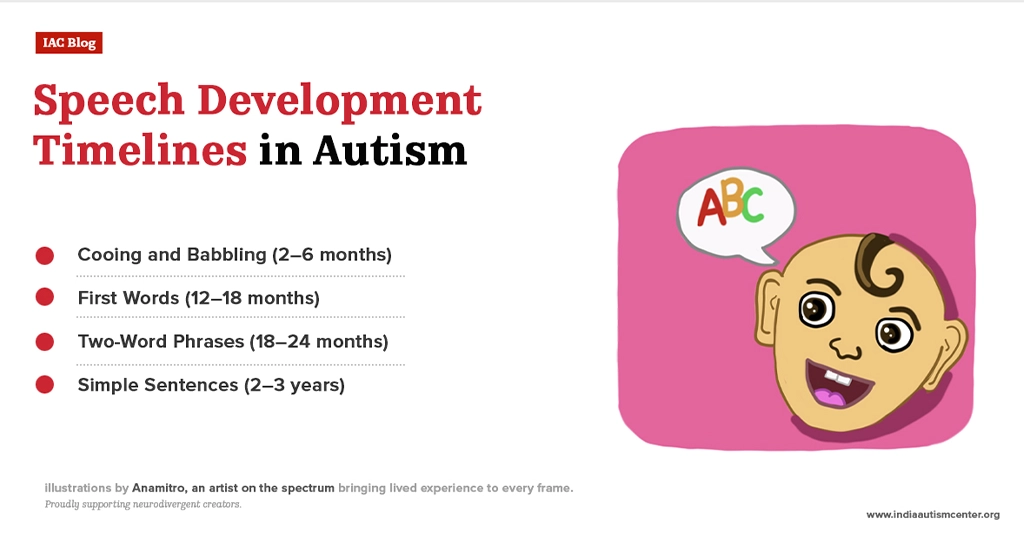
In typical development, speech moves from babbling to first words, short phrases, and then full sentences.
In autism, these stages may appear later, occur out of order, or look different. Sometimes, there are repeated phrases from others, or long stretches of silence followed by sudden bursts of speech. Parents often ask: “When do autistic kids start talking?” The truth is, the answer varies for each child.
Here’s how typical timelines compare with those on the spectrum:
Cooing and Babbling (2–6 months)
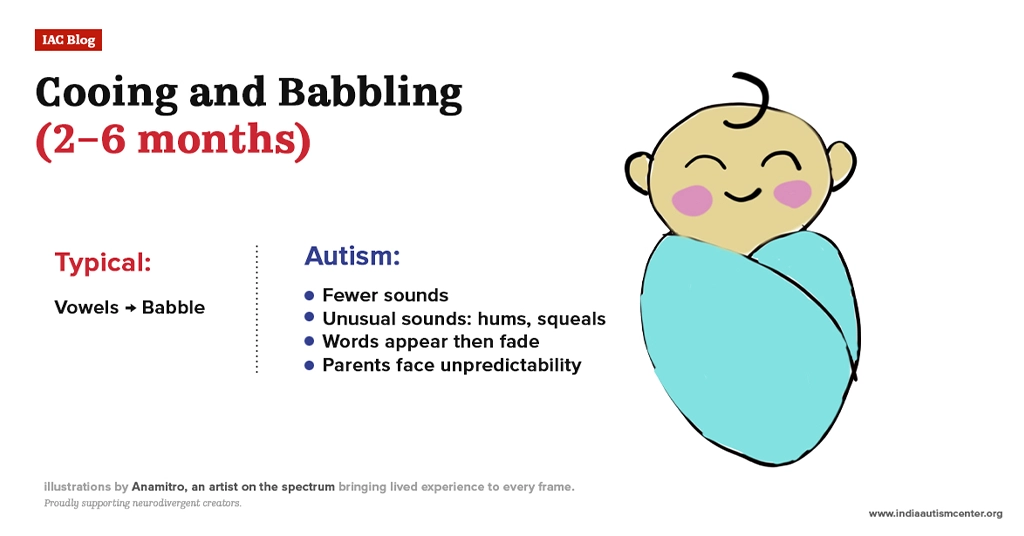
For most infants, the soundtrack of early life begins with rounded vowels like “oo” or “ah”. These soon sharpen into rhythmic “ba-ba” and “ma-ma.”
In autism, these sounds may come later, occur less often, or take different forms such as humming, squealing, or repetitive tones. Sometimes, words appear suddenly and then vanish, leaving parents wondering: “When did your autistic child start talking?”
First Words (12–18 months)
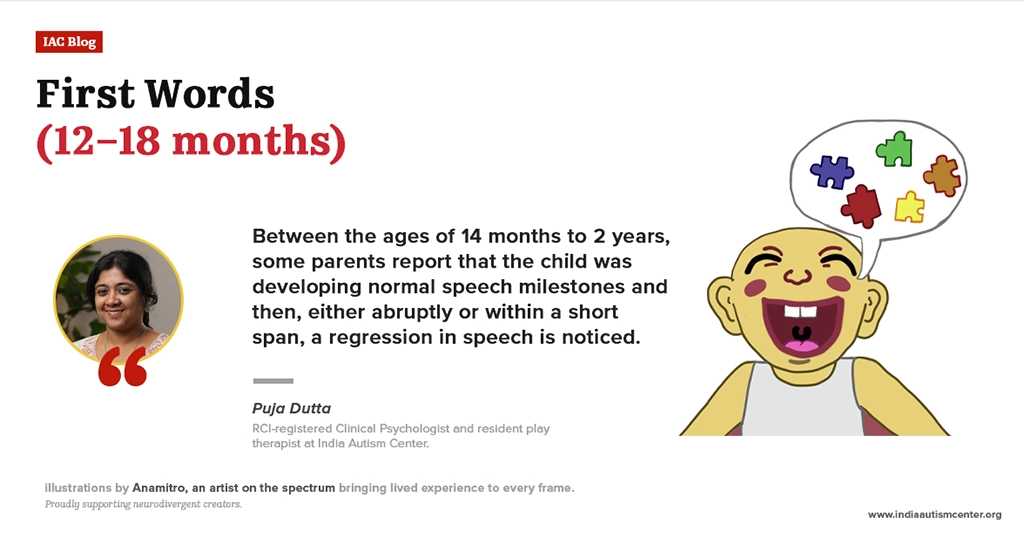
By around 12 to 18 months, children typically begin speaking their first intentional words. Simple ones like “mama” or “ball,” used with meaning.
In autism, however, first words may be delayed beyond age two, appear briefly before fading, or emerge inconsistently. This often leads to the question: “Will my autistic son ever talk?”
As Puja Dutta, RCI-registered clinical psychologist at the India Autism Center, explains,

Between the ages of 14 months to 2 years, some parents report that the child was developing normal speech milestones and then, either abruptly or within a short span, a regression in speech is noticed.
Two-Word Phrases (18–24 months)
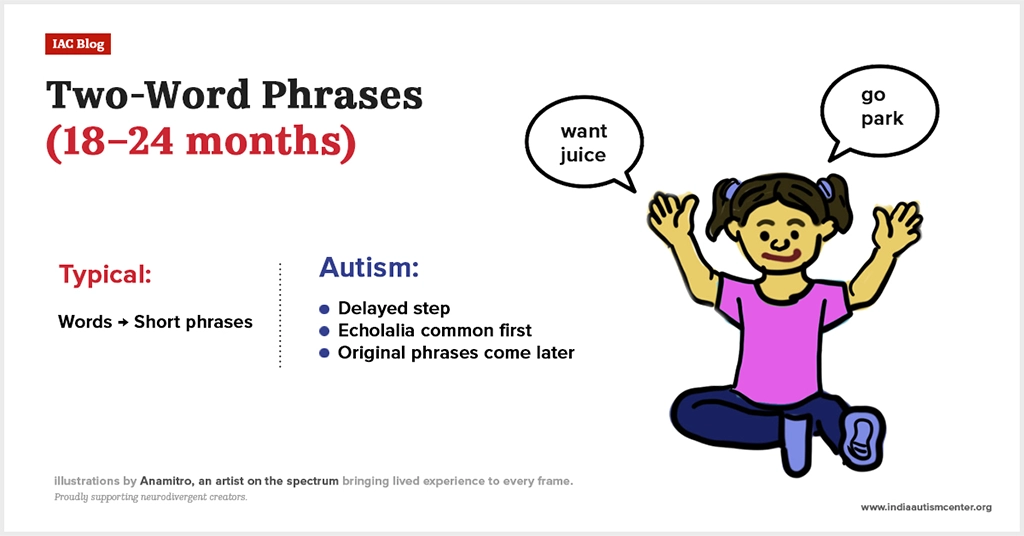
The leap from words to short phrases, like “want juice” or “go park,” marks a milestone in combining meaning.
In autism, this step may be postponed or shaped by echolalia, the repetition of words and phrases borrowed from others, before original pairings begin to emerge.
Simple Sentences (2–3 years)
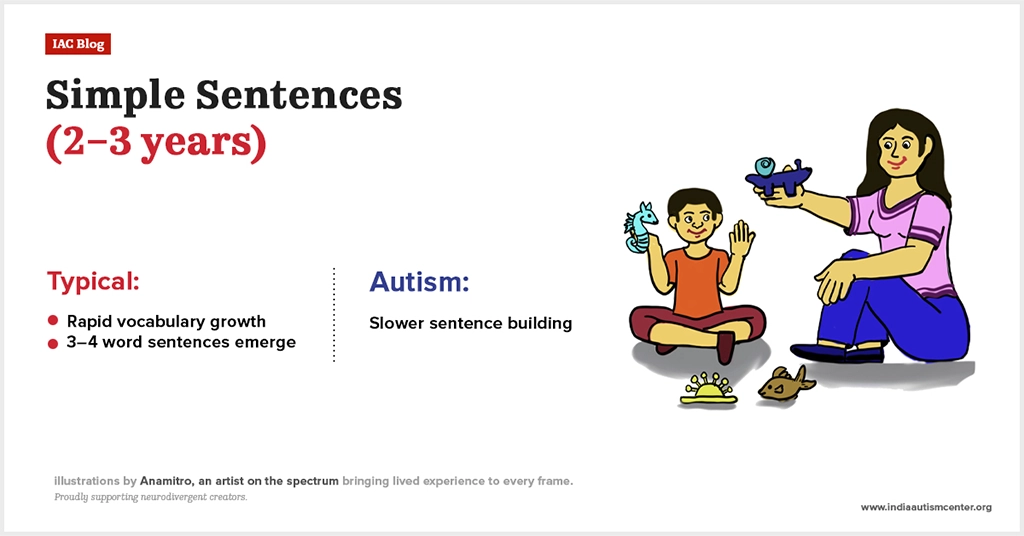
Most children now form 3–4 word sentences such as “I want toy” or “Go see dog.”
In autism, sentence-building tends to be slower, often anchored in concrete language, with abstract or flexible use of words taking longer.
Conversational Skills (3–5 years)
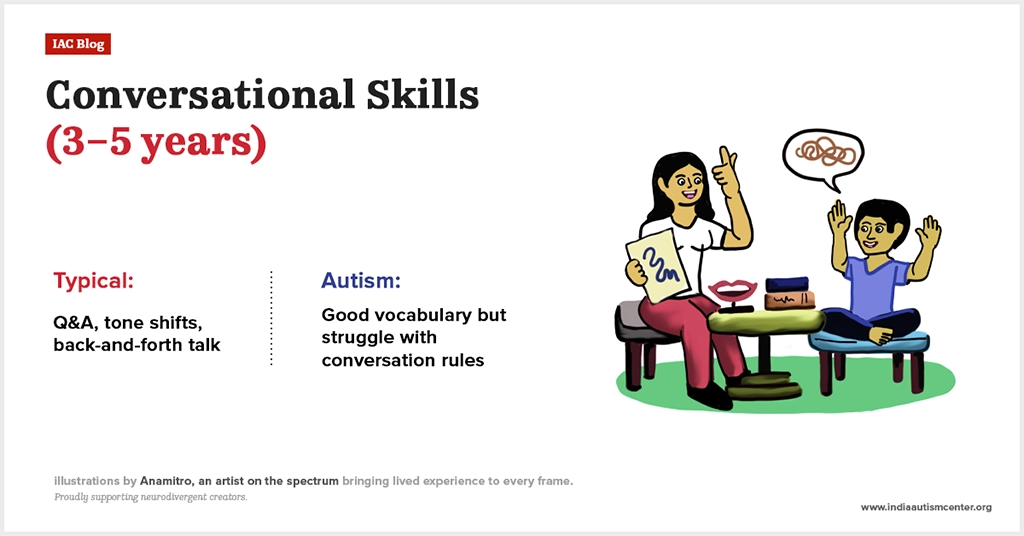
By preschool, most children can trade questions and answers, shift tone to suit the moment, and navigate the give-and-take of talk.
Autistic children may command a wide vocabulary yet struggle with pragmatics. It’s the unspoken rules and rhythms of conversation that are more elusive to them. Parents often ask: “Do non verbal autistic kids ever talk?” The answer: yes, many do, but at their own pace.
Speech Milestone Comparison: Typical Development vs. Autism
This table draws on data from the Wodka, Mathy & Kalb (2013) study at Kennedy Krieger Institute (535 children from the Simons Simplex Collection) and ASHA’s early intervention guidelines.
| Age Range | Typical Development | Autism Spectrum |
|---|---|---|
| 0–6 months | Cooing, vowel sounds (“oo,” “ah”), social smiling, responds to voices | Reduced or absent cooing; less varied vocalisation; may not orient to voice consistently |
| 6–12 months | Babbling with consonants (“ba-ba,” “da-da”), imitates sounds, responds to name | Babbling may be delayed, less frequent, or atypical in rhythm; inconsistent name response |
| 12–18 months | First meaningful words (e.g., “mama,” “ball”); 10–20 words by 18 months | First words often delayed beyond 18–24 months; may appear then disappear; speech regression possible |
| 18–24 months | Two-word combinations (“more milk,” “daddy go”); ~50-word vocabulary | Two-word phrases delayed or absent; echolalia common; ~40% of children are minimally verbal at this stage |
| 2–3 years | 3–4 word sentences; rapid vocabulary growth; asks simple questions | Sentence-building slower; concrete language predominates; some children still pre-verbal |
| 3–5 years | Full conversations; adjusts language to listener; narrative ability | Wide vocabulary possible but pragmatic difficulties common; many children show a language burst at ages 6–7 |
| 5–8 years | Fluent, flexible speech across contexts | Per Kennedy Krieger SSC study: 70% of children with severe early language delay developed phrase speech by age 8; 47% achieved fluent speech |
Verbal and Non-Verbal Development in Autism
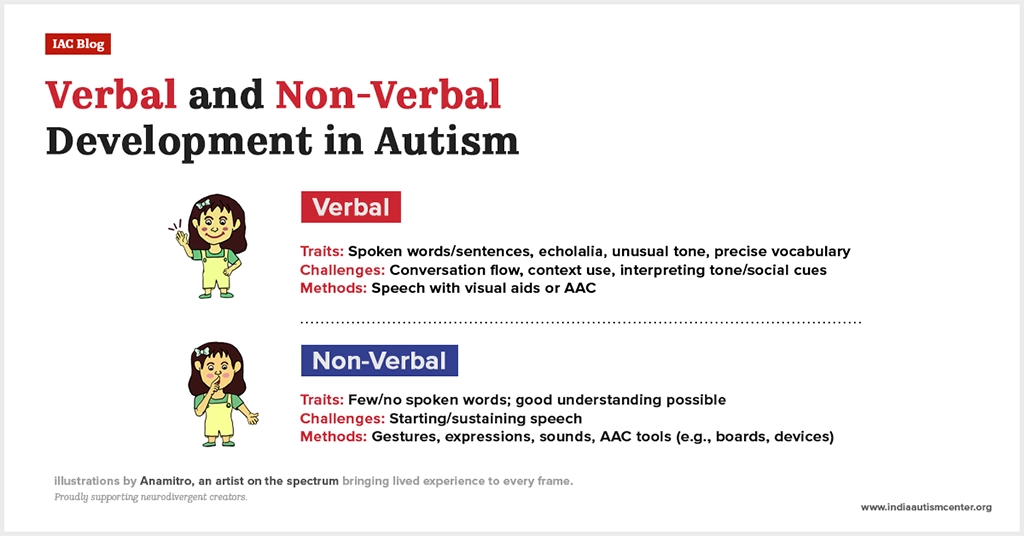
Unlike typical language growth, which follows a fairly predictable path, speech and language development in autism is often uneven. Some individuals on the spectrum speak fluently, while others use only a few words.
At the same time, this raises another concern: “Do nonverbal autistic children ever speak?” Research and therapy show that yes, many may rely on gestures or augmentative and alternative communication (AAC) devices.
Here’s how different communication profiles typically present:
| Profile | Key Characteristics | Common Challenges | Primary Communication Methods |
| Verbal Autism | Spoken words or sentences; may include echolalia, unusual prosody, or highly specific vocabulary | Conversational reciprocity; adapting language to context; interpreting tone and social cues | Spoken language, sometimes supported by visual aids or AAC |
| Non-Verbal / Minimally Verbal Autism | Few or no spoken words; may have strong receptive language skills | Initiating speech; sustaining verbal interaction | Gestures, facial expressions, sounds, AAC such as picture boards or speech-generating devices |
In practice, autistic individuals often blend verbal and non-verbal methods depending on the situation. Communication is fluid, not fixed, and the most effective approach is one that adapts to each individual’s strengths.
Signs Your Autistic Child May Begin Talking Soon
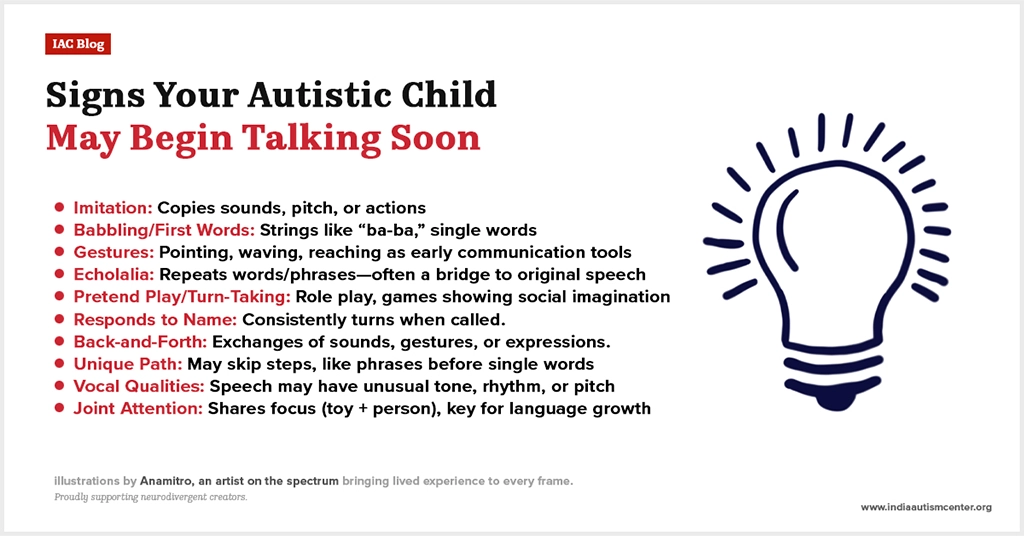
Early signs of language growth aren’t always about words. They can emerge in tone, rhythm, gesture, or shared engagement. Parents often search for clues about when do kids with autism start talking.
Here are some ways your child may show that speech is beginning to take shape:
Your child imitates sounds and actions
Clapping when you clap, humming back a tune, or trying a new consonant sound. All of these show that they’re linking movement, sound, and meaning, laying the groundwork for speech.
Your child experiments with babbling and first words
Playful strings of consonants (“ba-ba,” “ma-ma”) or sporadic single words show that vocal exploration is underway. Speech may come with quirks such as pronoun reversals (“You want cookie” instead of “I want cookie”) or unusual sentence structures. These aren’t errors. They’re milestones in learning how to use language.
Your child uses communicative gestures
Pointing, waving, reaching out, or clapping serve as intentional signals. These gestures bridge the gap between non-verbal interaction and spoken communication.
Your child repeats words or phrases
Children may echo what they hear immediately or repeat it later in a new context. What looks like parroting is actually practice. A way to explore rhythm, self-soothe, or begin forming speech patterns.
Your child engages in pretend play and turn-taking
Tea parties, role-plays, or simple back-and-forth games show your child understands shared narratives. These interactive abilities often emerge alongside language growth.
Your child responds consistently to their name
Turning toward you when called reflects growing social awareness and readiness to connect verbal cues with action.
Your child takes part in back-and-forth exchanges
Whether trading facial expressions, gestures, or playful sounds, these mini conversations mirror the give-and-take of spoken dialogue.
Your child follows a unique path to language
Some children may skip traditional steps. They move straight from silence to whole words, or begin with short phrases before single words. Different doesn’t mean delayed; it’s simply a different path.
Your child’s speech has distinct vocal qualities
Early speech may carry unusual pitch, rhythm, or inflection. While it can sound atypical, it signals that your child is actively experimenting with the mechanics of speech.
Your child shares joint attention
Looking between a toy and you, or drawing your gaze toward an object, reflects the ability to connect experiences with another person. This is one of the strongest predictors of language growth.
Factors That Influence When an Autistic Child Starts Talking
Why does one child start speaking at 2 while another finds their voice at 7? The answer isn’t random. Several well-documented factors shape the trajectory of speech development in autism – and understanding them helps families and clinicians plan more targeted support.
Cognitive Ability and IQ
Nonverbal IQ is one of the strongest independent predictors of language outcomes. The Kennedy Krieger SSC study (Wodka et al., 2013) found that children with typical nonverbal IQ reached phrase speech approximately 7 months earlier than children with lower nonverbal IQ scores. This doesn’t mean children with intellectual disability won’t speak – many do – but it does mean the timeline and approach may differ.
Lower social impairment scores were also associated with better language outcomes in the same study, suggesting that children who engage more readily with others tend to develop speech sooner.
Early Intervention Timing and Intensity
The ASHA Practice Portal on Autism is unambiguous: earlier intervention produces better outcomes. There is no “too young” for speech-language support. Children who begin structured intervention before age 3 – particularly intensive, play-based approaches – consistently show greater language gains than those who start later.
In India, this means acting on concerns as soon as a developmental difference is noticed, rather than waiting for a formal diagnosis. A speech-language pathologist can begin working with a child even before an autism diagnosis is confirmed.
Sensory Processing Differences
Many autistic children experience the world with heightened or reduced sensitivity to sound, touch, light, and other sensory input. When a child is in a state of sensory overload – a noisy classroom, a crowded family gathering – verbal output can drop dramatically. The child isn’t choosing not to speak; their nervous system is overwhelmed.
Recognising these triggers and creating calmer communication environments can make a significant difference. Occupational therapy alongside speech therapy is often recommended for children with significant sensory processing differences.
Motor Planning and Apraxia
Childhood Apraxia of Speech (CAS) co-occurs with autism more often than previously recognised. CAS is a motor speech disorder – the child knows what they want to say but the brain struggles to plan and sequence the precise movements needed to produce speech. This is distinct from a language delay.
Children with both autism and CAS often benefit from specialised approaches like PROMPT (Prompts for Restructuring Oral Muscular Phonetic Targets) therapy, which uses tactile cues to guide the mouth’s movements. Identifying this overlap early prevents years of frustration for both child and family.
Family Involvement and Communication-Rich Environment
Parent-mediated intervention is one of the most evidence-backed strategies in autism speech development. When parents learn to use techniques like parallel talk (“you’re rolling the ball”), expansion (“big red ball”), and communication temptations (placing a desired object just out of reach), they create hundreds of natural learning opportunities every day that no clinic session can replicate.
Studies consistently show that children in language-rich home environments – where caregivers respond to every communicative attempt, verbal or not – develop speech faster and with greater functional use. This is not about pressure or drilling. It’s about making communication feel worthwhile.
Non-verbalism in Autism vs Non-verbal Learning Disorder (NVLD)
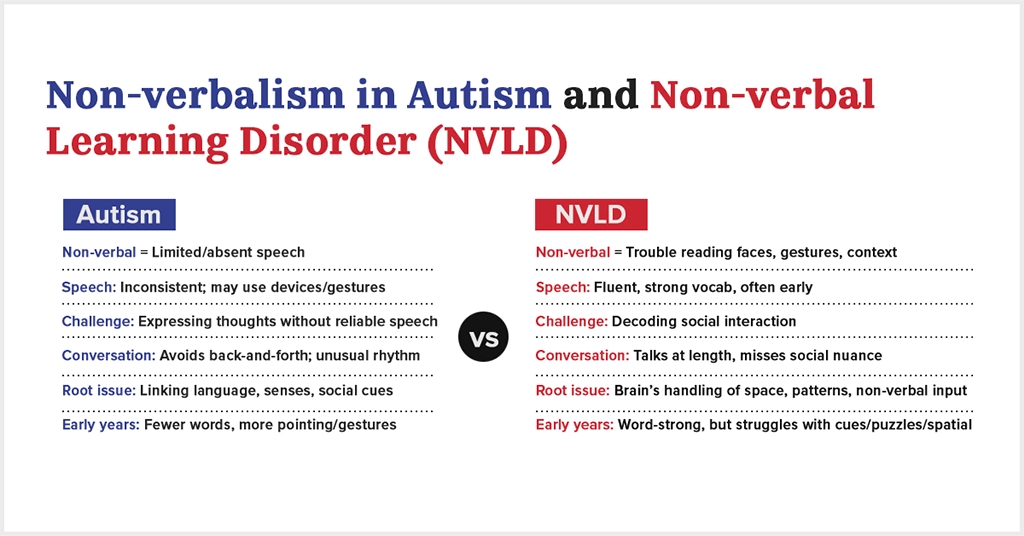
Non-Verbal Learning Disorder can be confusing at first glance. Despite the name, children with NVLD often have plenty of words. Sometimes more than expected for their age.
What’s missing is not speech itself, but the other half of communication. The unspoken layer.
The glance that signals understanding, the pause before answering, the change in tone that shifts a conversation. These subtle cues can slip past unnoticed.
In autism, “non-verbal” tends to mean something quite different.
Speech may be limited, inconsistent, or absent altogether. Communication often shows up through gestures, body language, scripted phrases, or assistive devices. The social frame is present, but the words themselves may take longer or follow an unexpected path to arrive.
Both NVLD and autism reshape how communication unfolds. NVLD leaves the sentences intact but makes the social context harder to grasp. Autism preserves the context but may set words further away.
How Non-verbal Differs in Autism and NVLD
| Aspect | In Autism | In NVLD |
| What non-verbal means | Limited, inconsistent, or absent speech | Difficulty interpreting unspoken cues (facial expressions, gestures, tone, spatial awareness) |
| Speech | Sometimes present, sometimes not; may use devices, gestures, or signs | Fluent, often early; vocabulary usually strong |
| Main challenge | Expressing thoughts and needs when speech is unreliable | Reading the silent language of social interaction |
| In conversation | May avoid verbal back-and-forth or speak in a distinct rhythm | May speak at length but miss the subtle social undercurrents |
| Underlying difference | How language, sensory input, and social cues connect | How the brain interprets space, patterns, and non-verbal signals |
| Early years | Fewer early words, less babbling, more pointing or gestures | Strong with words, but interpreting social cues, puzzles, or spatial tasks can be difficult |
How Speech Therapy Can Support Your Non-verbal Child
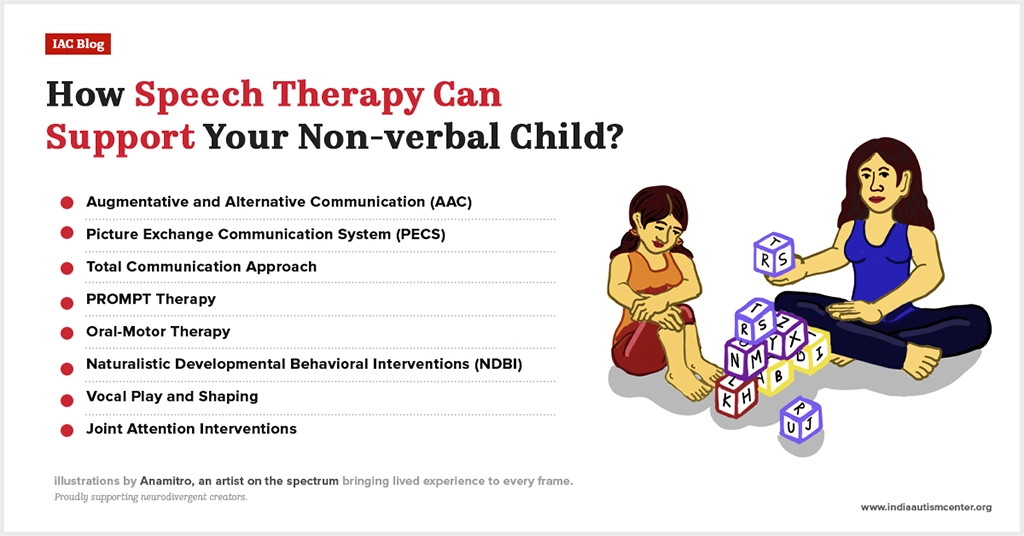
For many parents, the hope begins with a single word. The dream of hearing “mama” or “baba” feels both urgent and fragile. When that word doesn’t come, or when it fades away, the instinct is to look toward speech therapy as the magic key.
But here’s the truth: speech therapy isn’t just about getting kids to talk. For non-verbal or minimally verbal autistic children, it’s about finding their language, whether through pictures, signs, devices, or movement, and building on it. Families often ask: “Do nonverbal autistic children ever speak?” Yes, many do with the right support.
That’s why modern speech therapy rarely looks like a child sitting at a desk repeating words. It’s individualized, layered, and often creative.
A few of the most effective approaches include:
- Augmentative and Alternative Communication: AAC tools ranging from picture boards to high-tech devices that generate speech.
- Picture Exchange Communication System (PECS): A step-by-step program where children learn to exchange images for what they want, laying the foundation for symbolic language.
- Total Communication Approach: Using speech, sign language, gestures, and AAC together—so no door to communication stays closed.
- Prompts for Restructuring Oral Muscular Phonetic Targets (PROMPT) Therapy: A tactile method where therapists use touch cues on the child’s face to guide speech movements.
- Oral-Motor Therapy: Strengthening and coordinating muscles needed for speech, especially when motor planning challenges are present.
- Naturalistic Developmental Behavioral Interventions (NDBI): Embedding communication practice into play and routines, making learning part of daily life.
- Vocal Play and Shaping: Moving from hums and sounds toward syllables and words, often supported with visual or tactile prompts.
- Joint Attention Interventions: Building the foundation of language by helping the child share focus with another person.
Therapy can take place one-on-one, in group sessions, at home with caregiver coaching, or even online. What matters most is that it meets the child where they are, and empowers families to recognize every sound, gesture, or picture as a step toward connection.
Assistive Technology and Alternative Communication (AAC)
For children who are not yet speaking – or who speak inconsistently – AAC is not a last resort. It’s a first line of support. And crucially, using AAC does not prevent speech from developing. Research consistently shows it supports it.
Here are the main tools families and therapists use:
- PECS (Picture Exchange Communication System): Children start by handing a picture card to request something they want. Over six structured phases, they build toward sentence strips and spontaneous communication. PECS is widely used in Indian therapy settings and can be implemented at home with training.
- Speech-generating devices and apps: Apps like Proloquo2Go, TouchChat, or even low-cost alternatives like LetMeTalk (free, Android) allow children to tap symbols that produce spoken output. These give a voice to children who have one – just not yet in the traditional sense.
- Sign language: Indian Sign Language (ISL) or simplified sign systems can bridge the communication gap, particularly for children with good motor imitation skills. Signs do not replace speech; for many children, they accompany it.
- Visual supports: Schedules, choice boards, and “first-then” cards reduce anxiety and create predictable communication opportunities throughout the day.
The ASHA Practice Portal notes there is no minimum age for AAC introduction. If your child is struggling to communicate, ask their speech therapist about AAC options today.
Home Speech Intervention Strategies
Speech therapy may happen in a clinic, but the real magic unfolds in kitchens, living rooms, and playgrounds. Everyday routines, the breakfast table, bath time, or a game in the park, are where language comes alive.
The principle is simple: when a child makes an attempt and someone notices and responds, they learn that communication works. That lesson, repeated hundreds of times in small ways, is what builds speech.
Here are some strategies, backed by decades of speech-language research, that parents can weave into daily life:
- Model Functional Language: Use short, clear phrases like “more juice” or “open door.” Repeat them in context so the link between words and actions becomes obvious.
- Create Communication Temptations: Place a toy just out of reach, or keep the lid on a snack jar. These small obstacles encourage your child to signal for help.
- Narrate Actions (Parallel Talk and Self-Talk): Describe what your child is doing (“rolling ball”) or what you’re doing (“pouring water”). It builds a running language map of the world.
- Expand and Extend: If your child says “car,” you might add “big car” or “red car.” This gently models more complex language without pressure.
- Use Wait Time: After asking a question or making a comment, pause for a few seconds. That extra space gives your child time to process and respond.
- Respond to Every Modality: Whether your child points, vocalizes, signs, or uses AAC, treat it as valid communication.
- Let Communication Have Consequences: If they ask for water (in any form), make sure they get water. That link reinforces the purpose of communication.
One of the most powerful ingredients here is co-attention. It refers to sharing focus on the same object or activity.
Looking at a drawing together, pointing at a toy, or saying, “Wow, you built this tower!” creates a moment of connection. These small exchanges spark curiosity and open the door to new words.
Important: Skipping therapist-guided exercises, routines, or prompts may feel small in the moment, but over time, it slows or blocks your child’s gains. Every repetition counts.
📥 Free download: Printable daily routine chart for autistic children
Parting Words: Beyond Speech Alone
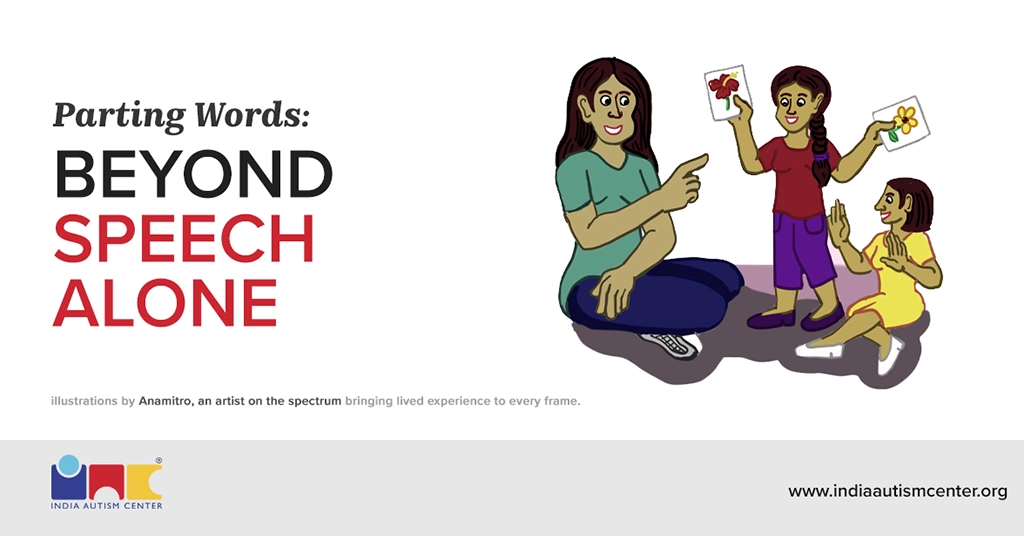
It’s important to remember that when do autistic kids start talking is only part of the story. Some children may never speak fluently, but still develop meaningful communication through AAC, gestures, or devices. Timing, coordination, and repeated practice all play a role.
For some autistic children, additional challenges like dyspraxia or childhood apraxia of speech make producing spoken language even harder.
This doesn’t mean they cannot connect with others. It simply means their journey to verbal communication may take a different path.
When families and therapists recognize these overlaps, the focus shifts from forcing words to opening multiple avenues for communication.
For more information, feel free to contact us.
Frequently Asked Questions
How to know if an autistic child will talk?
There’s no fixed formula. However, some signs suggest potential for speech development:
- Does the child use gestures (like pointing or waving)?
- Do they make meaningful sounds, even if not full words?
- Do they show understanding—like responding to their name or following simple instructions?
- Are they interested in social interaction or imitating sounds/actions?
These are often encouraging signs. Still, some children may use AAC (Augmentative and Alternative Communication) methods instead of spoken words, and that’s equally valid communication.
At what age do autistic children talk?
It varies a lot. Some autistic children speak on time (around 12–18 months), others may start talking at 2, 3, or even after 5 years old.
Some begin with single words, then gradually combine them. Others may have a speech burst later, especially after starting targeted support like speech therapy or play-based interaction.
Do autistic kids talk eventually?
Many do. But not all. Some become fluent speakers, some develop a few functional words or phrases, and others use nonverbal methods long-term.
It’s also common for speech to start and then pause or plateau. This doesn’t always mean it’s lost for good. With the right supports, gains can return or accelerate.
When do autistic kids start talking fluently?
For those who do become fluent speakers, fluency often emerges between 4 and 7 years, sometimes later.
“Fluent” can look different, too: for some, it means full conversations; for others, scripted or echolalic speech may still serve real communication purposes.
Important: Fluency doesn’t always mean social ease. Even verbally fluent autistic individuals might struggle with back-and-forth conversation or emotional expression.
When do autistic kids start talking?
Some start with first words as early as 12 to 24 months, but it’s also common for speech to emerge later, 3, 4, or even 5+ years.
Others may show early speech that regresses or disappears around age 2, especially in children with co-occurring conditions like childhood apraxia of speech.
Do non-verbal autistic kids ever talk?
Yes, some do. “Non-verbal” doesn’t mean “never verbal.”
Many children once considered non-verbal go on to use spoken words—sometimes after age 5 or even 8—especially with AAC support, language-rich environments, and personalized therapy.
At what age does an autistic child speak fluently?
If they develop fluent speech, it’s typically around 4 to 7 years old. But this varies.
Children who speak early might still struggle with conversational fluency or social use of language well into adolescence.
Others may speak fluently in a structured or academic setting, but not in daily social interactions. That’s still valid communication – just with a different style.
When did your autistic child start talking compared to others?
Parents often share very different timelines. Some report their child said first words around age 2, while others mention speech emerging much later, sometimes after 5 years. This variation is normal, and comparing one child’s journey with another’s can cause unnecessary worry.
Do nonverbal autistic children ever speak later in life?
Yes, some do. Even if a child is nonverbal at age 4 or 5, progress can still happen with therapy, AAC devices, and consistent support. Some individuals develop speech in adolescence or adulthood, though others may prefer nonverbal communication.
What therapies help if my autistic child is not talking yet?
Speech therapy, AAC tools, and naturalistic play-based approaches are widely used. Programs like PECS and PROMPT therapy are also effective. To know which option best suits your child, you can reach out to our training center for professional guidance.
Will my autistic son ever talk if he hasn’t started by age 4?
Many children show speech growth after age 4, but others may remain minimally verbal. Progress often depends on early intervention, consistency, and tailoring therapy to your child’s strengths. If you’re unsure, it’s a good time to contact our training center for a personalized assessment.
At what age do autistic children start talking in complete sentences?
Some may form simple sentences around 3–5 years, while others take longer. Many autistic children first echo words or use short phrases before building into fluent sentences. With practice and therapy, even delayed speakers can gain meaningful communication skills.
Disclaimer: This article is intended for educational and informational purposes only. It is not a substitute for professional medical advice, diagnosis, or treatment. If you are pregnant or have concerns about medication use during pregnancy, please consult a qualified healthcare provider. If your child has received an autism diagnosis and you have questions about causes or support, please reach out to a trained specialist or an autism-focused organisation for guidance.
For expert insights, support services, and inclusive learning initiatives, visit the India Autism Center.
Useful Sources
- Wodka, E. L., Mathy, P., & Kalb, L. (2013). Predictors of phrase and fluent speech in children with autism and severe language delay. Pediatrics, 131(4), e1128–e1134. pubmed.ncbi.nlm.nih.gov/23460690
- Kennedy Krieger Institute – Interactive Autism Network: kennedykrieger.org/stories/interactive-autism-network-ian/speech_onset_study
- American Speech-Language-Hearing Association (ASHA) – Autism Practice Portal: asha.org/practice-portal/clinical-topics/autism
- ASHA – AAC in Early Intervention: asha.org/practice/early-intervention-provider-support/augmentative-and-alternative-communication-in-early-intervention
- Anderson, D. K., et al. (2007). Predicting young adult outcome among more and less cognitively able individuals with autism spectrum disorders. Journal of Child Psychology and Psychiatry. psycnet.apa.org/record/2007-11558-008