 Donate now
 Get a Call Back
 MENU
MENU 14 MIN READ
 SHARE
SHARE


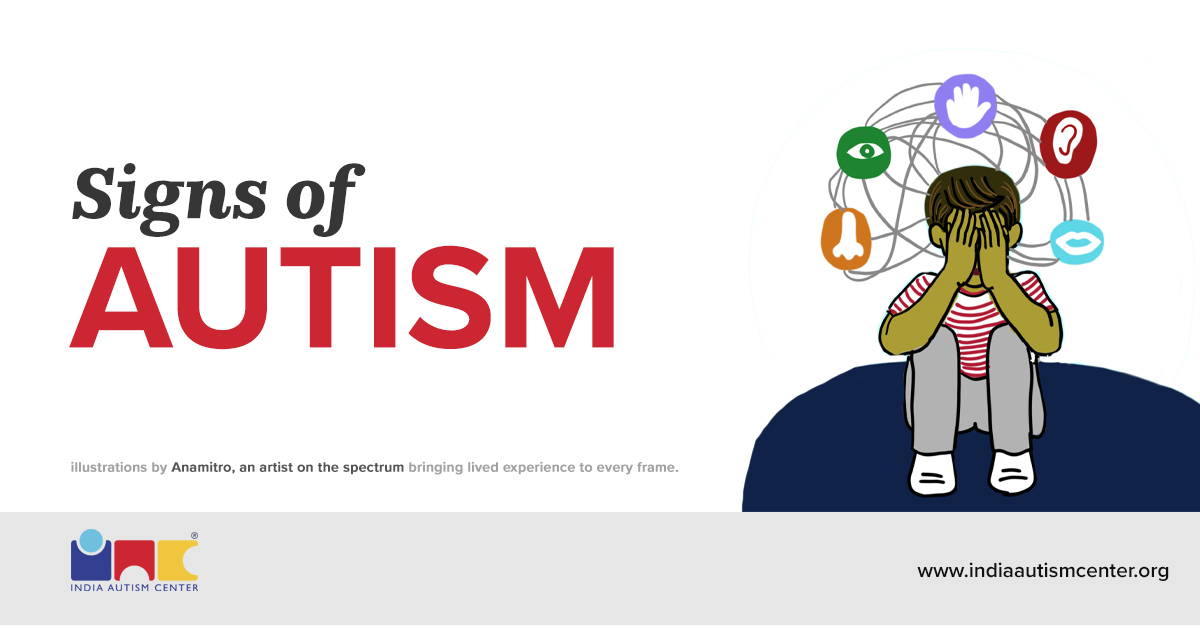
Autistic babies symptoms are subtle. They’re easy to miss, easy to dismiss, and easy to confuse with normal variation. But parents who notice them early – and act on that noticing – give their children a genuine head start.
Maybe it was the way your baby didn’t quite meet your gaze, or a stiffness in their body that felt different from other newborns you’d held. Maybe it was just a feeling – that quiet, persistent worry that every parent knows but few talk about openly.
While autism spectrum disorder (ASD) is most often diagnosed in early childhood, there is increasing awareness of the importance of recognizing the symptoms of autism as early as infancy, including in newborns. Early identification enables timely intervention and appropriate support, which can greatly enhance developmental outcomes and provide families with clearer guidance and reassurance.
What Is Autism Spectrum Disorder?
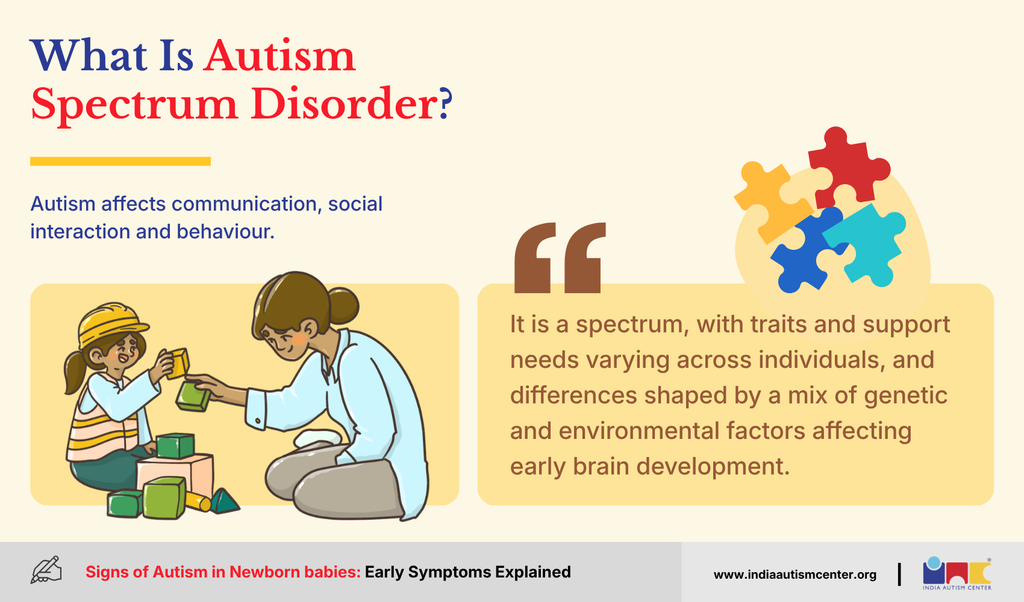
Autism Spectrum Disorder is a neurodevelopmental condition characterised by differences in social communication, social interaction, and patterns of behaviour. It’s called a “spectrum” because it looks different in every person – some autistic individuals have significant support needs; others live and work independently.
ASD is not caused by parenting. It’s not a disease. It’s a different way the brain is wired, present from birth, shaped by a complex mix of genetic and environmental factors. According to the CDC, people with ASD often have challenges with social communication and interaction, alongside restricted or repetitive behaviours or interests.
Can You Tell if a Newborn has Autism?
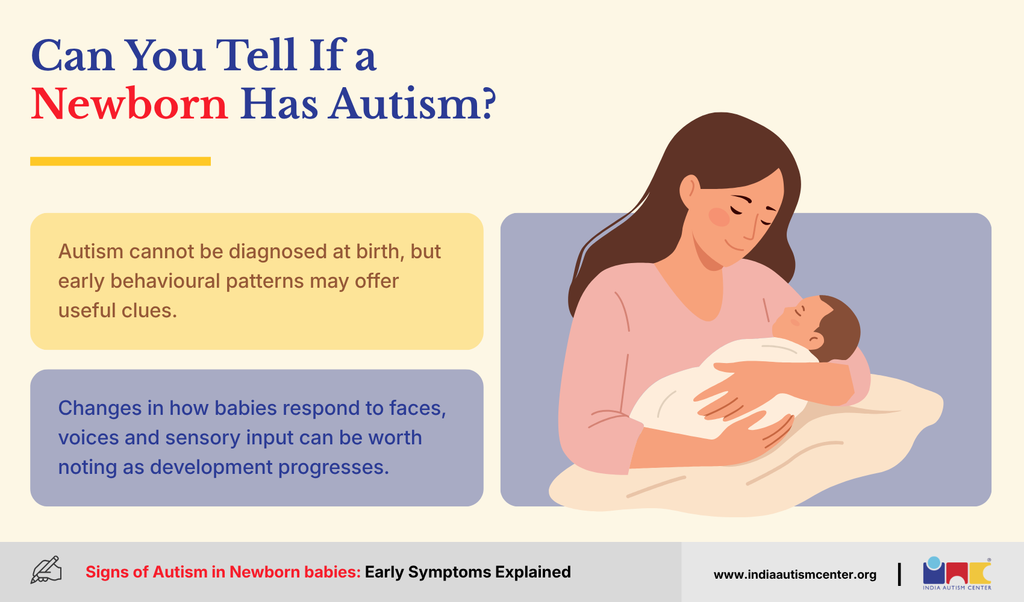
Honestly? Not definitively. No clinician can diagnose autism at birth.
What we can say is this: certain early behavioural patterns – particularly in how a baby attends to faces, responds to voices, and reacts to sensory input – are associated with later autism diagnoses. These are risk markers, not diagnoses. They’re signals worth noting, not reasons to panic.
The signs of autism in babies are almost always subtle in the first weeks. They become clearer across the first year of life, particularly from around 6 months onward, as social and communication milestones become more defined. A single behaviour in isolation rarely means anything. It’s the pattern, the persistence, and the combination of signs that matter.
If you’re worried, the right response is to document what you’re seeing and speak to a developmental paediatrician or RCI-registered psychologist – not to wait and hope it resolves.
What is Autism in Babies?
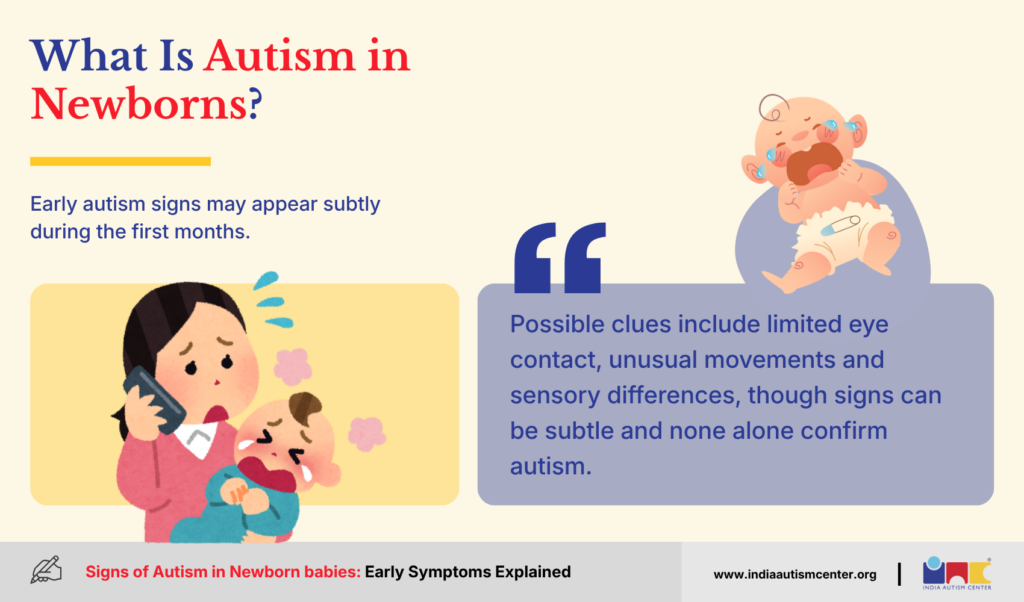
Autism in babies refers to the presence of early signs and symptoms of ASD within the first few months of life. While definitive diagnosis typically occurs later, heightened awareness of potential indicators in newborns is crucial for early intervention and support. The earliest manifestations of autism can often be subtle, making it essential for parents to be vigilant in observing their newborn’s behaviours and developmental milestones.
- Signs of autism in infants may manifest subtly, but attentive parents can pick up on certain cues.
- One of the earliest indicators is limited eye contact. Newborns later diagnosed with ASD often display reduced eye contact from an early age, indicating potential difficulties in social interaction.
- Additionally, observing infants for unusual motor patterns, such as repetitive movements or arching of the back, can provide early clues suggestive of autism.
- Furthermore, a typical response to stimuli, such as heightened sensitivity or indifference to sensory input like sound, touch, or light, may also be observed in infants with ASD.
📥 Free download: Printable daily routine chart for autistic children
Infant ASD Signals
While most children are diagnosed with autism at an older age, some parents notice signs as early as infancy. Keep in mind that all babies develop at their own pace, but being aware of potential signs can help you seek timely intervention. Recognizing signs of autism in infants involves being attuned to behavioural patterns and developmental milestones. Key signs include:
1. Delayed Milestones
Parents should monitor their newborn’s developmental progress, such as smiling, babbling, and responding to stimuli, as delays in these areas could signal ASD.
2. Difficulty with Social Interaction
Limited responsiveness to caregivers’ voices or facial expressions may indicate challenges in social engagement, a hallmark feature of autism.
3. Repetitive Behaviours
Even in infancy, repetitive behaviours like hand flapping or rocking may emerge, providing early indications of ASD.
Want to learn more? Get in touch with us.
Early Signs of Autism in Newborns
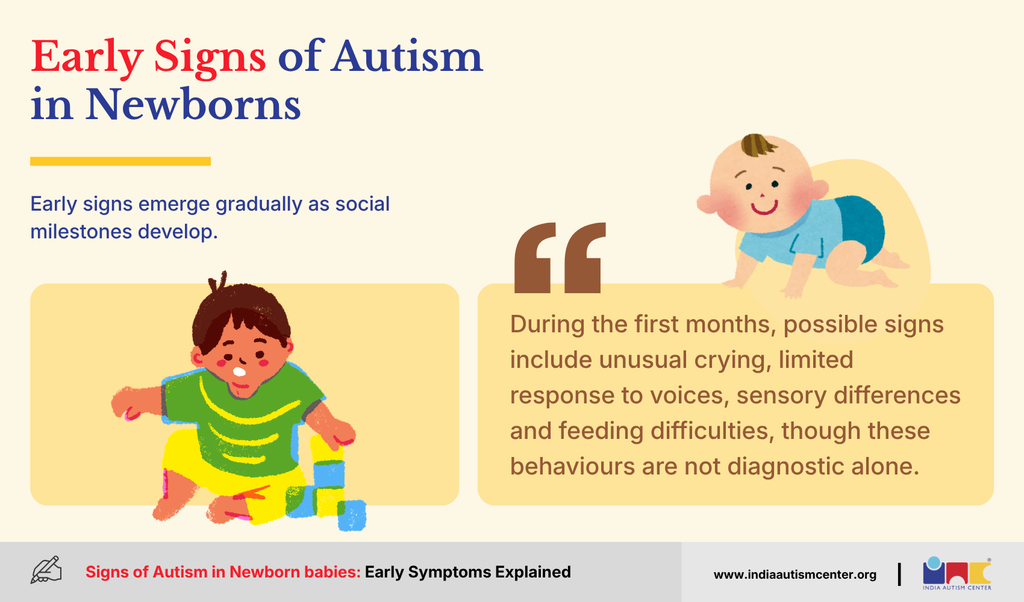
This is the section most parents come here for. The early signs and symptoms of autism in infants don’t all appear at once. They emerge gradually, across different developmental windows. Here’s what to watch for, month by month.
0–1 Month: What to Watch For
The first four weeks are dominated by basic survival – feeding, sleeping, crying. Most autistic newborn symptoms at this stage are extremely difficult to distinguish from typical newborn behaviour.
That said, some parents and clinicians have noted:
- Unusual crying patterns. Crying that is unusually high-pitched, very flat in tone, or difficult to soothe without an obvious cause.
- Limited response to the human voice. Newborns typically show some orientation toward familiar voices – particularly the mother’s – from the first days of life. A consistent absence of this response can be an early signal.
- Hypersensitivity or hyposensitivity to touch. Some newborns who are later diagnosed with ASD show extreme distress to gentle handling, or conversely, very little response to touch or physical comfort.
- Feeding difficulties. Persistent difficulty latching, sucking, or coordinating feeding can sometimes reflect early sensory or motor differences.
Important: None of these alone is diagnostic. Premature birth, illness, and temperament all affect these same behaviours. Note what you see; bring it to your paediatrician.
1–3 Months: Social and Sensory Signals
By 6–8 weeks, most babies begin to smile socially – that first real, responsive smile that lights up a room. By 2 months, most babies make sustained eye contact with caregivers.
This is where some of the earliest research-backed signals appear.
A landmark 2013 study published in Nature by Jones & Klin found that infants later diagnosed with autism showed a decline in looking at others’ eyes between 2 and 6 months of age. Crucially, these infants started with roughly typical eye-gaze patterns – the decline happened over time, not from birth. By 24 months, the autism group looked at caregivers’ eyes for approximately half as long as typically developing peers.
Watch for:
- Reduced or declining eye contact during feeding, play, or face-to-face interaction
- Absence of social smiling in response to your smile by 6–8 weeks
- Flat or limited facial expressions – a baby who rarely shows joy, surprise, or discomfort through their face
- Unusual reactions to sound – either startling intensely to ordinary sounds or showing little response to loud noises
- Difficulty being soothed – crying that persists despite feeding, holding, and rocking
3–6 Months: Communication and Motor Red Flags
Between 3 and 6 months, typically developing babies become increasingly social. They babble, they laugh, they reach toward faces and objects. They start to show joint attention – looking back and forth between an object and a caregiver to share interest.
Autistic newborn symptoms in this window often involve the absence of these emerging behaviours, rather than the presence of something alarming.
Look out for:
- No babbling or cooing by 4–5 months, or babbling that sounds flat and monotone rather than conversational
- Limited or no reaching toward caregivers during play
- Reduced response to their own name – by 5–6 months, most babies will turn toward their name; a consistent lack of response is worth noting
- Unusual motor patterns – repetitive hand or arm movements, persistent fisting of hands, or unusual stiffness or floppiness in the body
- Arching of the back – particularly if it occurs repeatedly during feeding or when being held, and is accompanied by other signs (more on this below)
- Preference for objects over faces – spending more time visually tracking a ceiling fan than a parent’s face
6–12 Months: When Patterns Become Clearer
This is the window where patterns become most visible. The CDC lists several key milestones that, if missed, warrant professional evaluation:
- Not responding to their name by 9 months
- Not showing facial expressions (happy, sad, surprised) by 9 months
- Not playing simple interactive games like pat-a-cake by 12 months
- Using few or no gestures (like waving goodbye) by 12 months
Beyond the CDC checklist, watch for:
- Repetitive movements – hand flapping, rocking, spinning – that appear consistently and seem self-stimulatory
- Intense distress when routines change – more than typical baby fussiness
- Unusual sensory interests – staring at lights or spinning objects for extended periods, mouthing objects excessively
- Limited pointing or showing – by 9–10 months, most babies point at things they want or find interesting; absence of this is a meaningful signal
- Regression – losing skills they previously had, such as babbling or social smiling, is always a reason to seek immediate evaluation.
Want to learn more? Get in touch with us.
Autism Spectrum Disorder Symptoms in Infants – The Full Picture
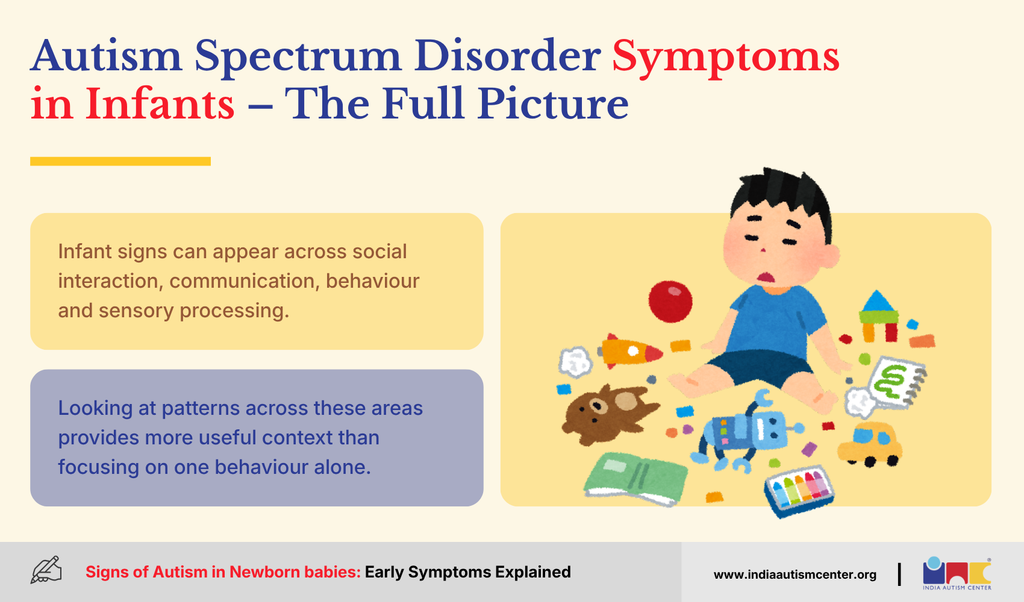
When we look across the full first year, autism spectrum disorder symptoms in infants cluster into four broad areas. Understanding these themes helps parents see the bigger picture, rather than fixating on any single behaviour.
Social Interaction
Autistic infants often show reduced interest in people relative to objects. They may not seek eye contact, may not smile responsively, and may not show the back-and-forth social engagement that typically developing babies display from around 2 months. This doesn’t mean they don’t want connection – it means the way they connect looks different.
Communication
Early communication differences include reduced babbling, a lack of pointing or showing, and limited response to their name. Some infants later diagnosed with ASD babble less frequently, and when they do vocalise, the sounds may be less varied in pitch and tone – more monotone than the conversational babble of neurotypical infants, as documented in research from UCSD’s Autism Center of Excellence.
Repetitive Behaviours
Even in infancy, repetitive behaviours can emerge. Hand flapping, body rocking, and unusual visual fixation on spinning or moving objects are the most commonly noted. These behaviours often increase when the child is excited or distressed.
Read our article on Stimming in Autism: Types, Causes & How to Support Your Child.
Sensory Sensitivity
Sensory differences are among the most consistent early signs. Some infants are hypersensitive – reacting intensely to ordinary sounds, textures, or light. Others are hyposensitive – showing little response to stimuli that would typically elicit a reaction. Both patterns can appear in the same child, in different sensory domains.
The key point: No single sign is definitive. It’s the combination, the persistence, and the pattern across multiple domains that guides clinical thinking.
Newborn Eye Contact Autism: A Red Flag?
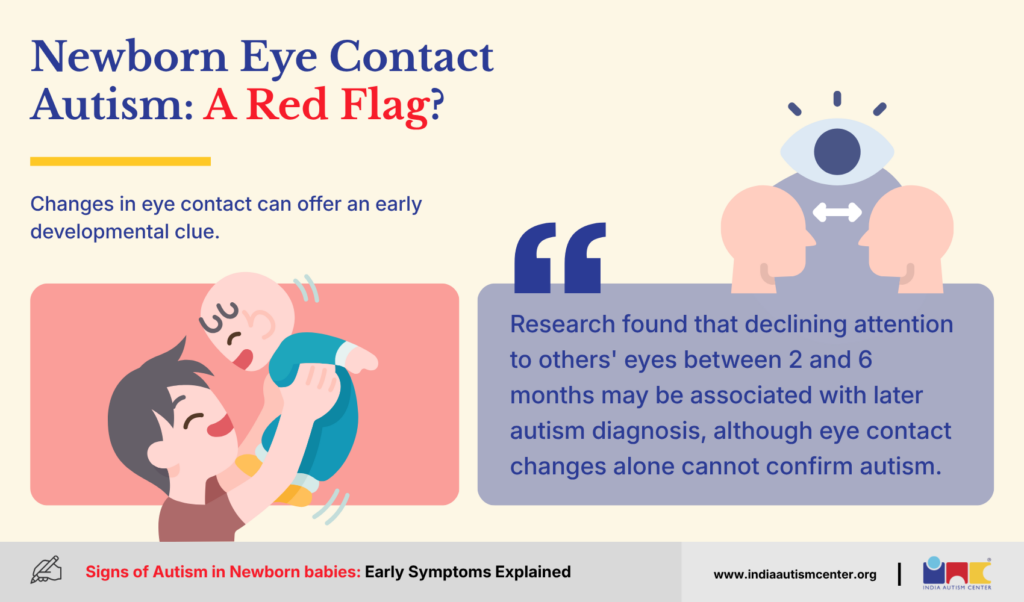
Infant eye contact autism is a powerful form of communication, even in the earliest stages of life. As parents, we eagerly await those moments when our newborn gazes into our eyes, forging a connection that transcends words. However, what if your baby seems to avoid eye contact? Could this be a sign of something more?
Research suggests that eye contact in infants can indeed provide early clues about ASD. Here’s what you need to know:
- Normal Eye Contact Development:
- Babies typically begin making eye contact around 2 months of age. It’s a delightful milestone as they lock eyes with caregivers and explore their world visually.
- However, a study found that a decline in eye contact between 2 and 6 months might signal something significant.
- The Autism Connection:
- Researchers discovered that infants who consistently show reduced attention to others’ eyes during their first few months of life are more likely to receive an autism diagnosis by the age of 3.
- This decline in eye contact serves as an early marker for autism.
- Why It Matters:
- Early detection of autism is crucial. When parents notice subtle signs like diminished eye contact, they can seek professional evaluation promptly.
- Intervention during the early developmental stages can significantly impact a child’s progress.
- What to Observe:
- Pay attention to how your baby engages visually. Is there a consistent lack of eye contact during interactions?
- Context matters: Consider whether the avoidance occurs during play, feeding, or bonding moments.
Remember, every child is unique, and variations in development are normal. However, if you have concerns about your baby’s eye contact, trust your instincts.
Newborn Baby Arching Back and Autism – Should You Be Worried?
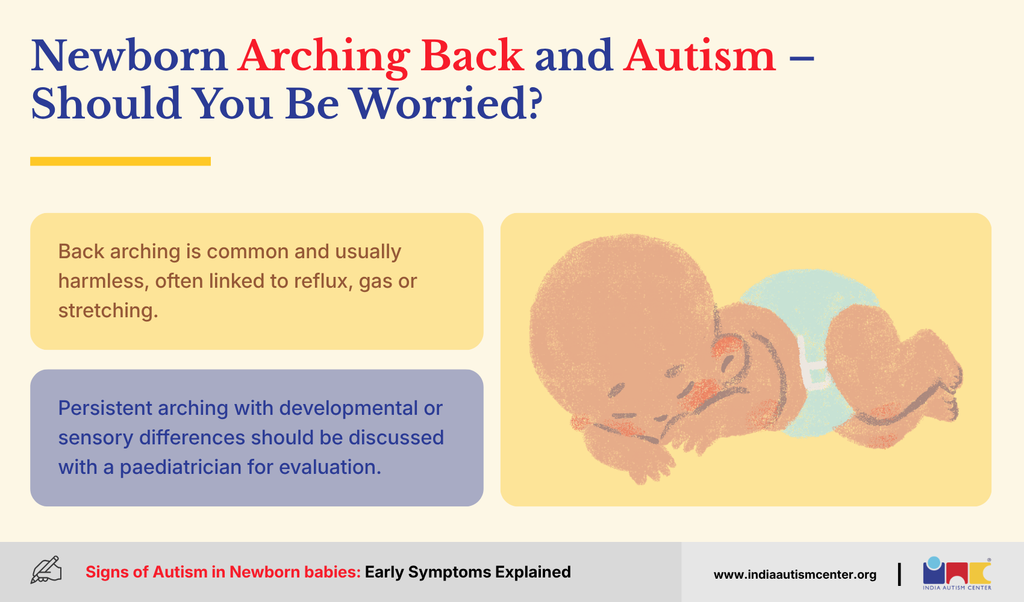
Back arching in newborns is common and usually benign – it can reflect reflux, gas, or simply a stretch. On its own, it is not a sign of autism.
What makes it worth noting is context and pattern. If your baby consistently arches their back during feeding, while being held, or in response to sensory input – and this is accompanied by other signs like limited eye contact, unusual crying, or reduced social responsiveness – then it’s worth mentioning to your paediatrician.
Persistent arching that seems to be a response to physical contact or sensory stimulation, rather than discomfort from reflux, can sometimes reflect early sensory processing differences associated with ASD. But it needs to be evaluated alongside the full developmental picture, not in isolation.
Read our blog on What Not to Do With an Autistic Child? 10 Careful Things Every Parent Should Know
Seeking Professional Guidance
- If parents notice any of the aforementioned signs of autism in their newborn, it’s essential to seek guidance from healthcare professionals specializing in early childhood development.
- Paediatricians, developmental paediatricians, or child psychologists can provide valuable insights and recommend appropriate assessments or interventions.
- Early intervention programs tailored to the needs of infants with ASD can significantly improve outcomes. This is done by addressing developmental delays and promoting social and communication skills.
- IAC is committed to creating impactful change in the lives of autistic individuals advocate for evidence-based practices to improve eye contact by encouraging activities to improve eye contact in autistic individuals.
Conclusion
Early identification of autism symptoms in newborns is vital for initiating timely interventions and support. By understanding the signs and proactively seeking guidance, parents can play a pivotal role in promoting their child’s well-being and developmental outcomes.
While each child develops at their own pace, early recognition and support can make a significant difference in the journey of a child if we can understand the spectrum properly.
FAQs
What are the early signs of autism in newborns?
Early signs of autism in newborns can involve minimal facial expressions, lack of social smiling, or reduced interest in human interaction.
Are there specific autism newborn signs parents should watch for?
Autism newborn signs may include poor visual tracking, limited response to caregivers, and unusually low or high sensitivity to touch or sound.
Can you tell if a newborn has autism?
It is not possible to definitively diagnose autism in newborns. Clinical diagnosis usually becomes reliable as developmental patterns emerge.
How do you know if your newborn has autism?
Parents may notice developmental differences over time, but only a professional evaluation can determine whether autism traits are present.
Is autism in newborns diagnosed at birth?
Autism in newborns is not typically diagnosed at birth. Most diagnoses occur during toddler years after developmental monitoring.
Do newborns with autism show clear symptoms?
Newborns with autism do not usually show clear or diagnosable symptoms immediately, as autism is identified through developmental progression.
When should parents seek help if they notice autism newborn signs?
If parents notice persistent developmental concerns, they should consult a pediatrician or developmental specialist for guidance and monitoring.
For expert insights, support services, and inclusive learning initiatives, contact India Autism Center for more information.
Useful Sources
CDC – Signs and Symptoms of Autism Spectrum Disorder
UCSD Autism Center of Excellence – Early Signs of Autism
Autism Speaks – Study: Eye Contact Declines Early in Babies Who Later Develop Autism
Disclaimer: This article is intended for educational and informational purposes only. It is not a substitute for professional medical advice, diagnosis, or treatment. If you are pregnant or have concerns about medication use during pregnancy, please consult a qualified healthcare provider. If your child has received an autism diagnosis and you have questions about causes or support, please reach out to a trained specialist or an autism-focused organisation for guidance.