 Donate now
 Get a Call Back
 MENU
MENU 9 MIN READ
 SHARE
SHARE


Is autism genetic? Well, autism risk is shaped by three interlocking forces: a child’s own DNA, the indirect influence of each parent’s genes, and environmental factors like maternal nutrition and metabolic health. No single gene causes autism. A landmark 2026 study published in Nature Genetics — analysing over 18,000 families — has now mapped exactly how these forces work together
Is Autism Genetic? What the Research Actually Says
Yes — but not in the way most people imagine.
Autism is highly heritable, with heritability estimated between 70–90%. That means genetics plays a major role. But heritable does not mean inevitable, and it does not mean a single gene is passed from parent to child like eye colour.
Autism emerges from a complex interaction between hundreds of genetic variants, each contributing a small amount of risk, and the developmental environment the child grows in — starting from the womb.
There are three distinct genetic pathways that researchers have identified:
- De novo variants — new gene mutations that appear in the child but are not present in either parent
- Inherited variants — gene variants passed down from one or both parents
- Polygenic risk — the cumulative effect of hundreds of common genetic variants, each with a tiny individual impact
Most autistic children carry a combination of all three.
What Is a Polygenic Score — and Why Does It Matter for Autism?
A polygenic score (PGS) is a DNA-based calculation that estimates a person’s predisposition to a condition based on how many genetic risk variants they carry. Think of it as a genetic risk calculator — not a diagnosis, but a probability estimate.
Large-scale studies have developed polygenic scores for autism over the past decade. What was missing, until recently, was a framework that could analyse these scores in the context of families, taking into account not just the child’s DNA, but the mother’s and father’s genetic backgrounds separately.
That is exactly what the 2026 Johns Hopkins study set out to do.
Want to know more? Get in touch with us.
What Did the 2026 Johns Hopkins Study Find?
Researchers at Johns Hopkins Bloomberg School of Public Health, Johns Hopkins University School of Medicine, and Kaiser Permanente Northern California developed a new statistical framework called PGS-TRI, designed specifically for case-parent trio studies.
A trio study analyses an autistic child and both biological parents together. This design reveals things that standard population studies cannot: specifically, how a parent’s genes shape a child’s risk not through direct inheritance, but through the environment the parent creates.
The team applied PGS-TRI to 18,383 autism trios drawn from the Simons Foundation Powering Autism Research (SPARK) consortium — one of the largest and most diverse autism genetic datasets in the world.
Their findings revealed three distinct layers of risk.
What Are the Three Layers of Autism Risk?
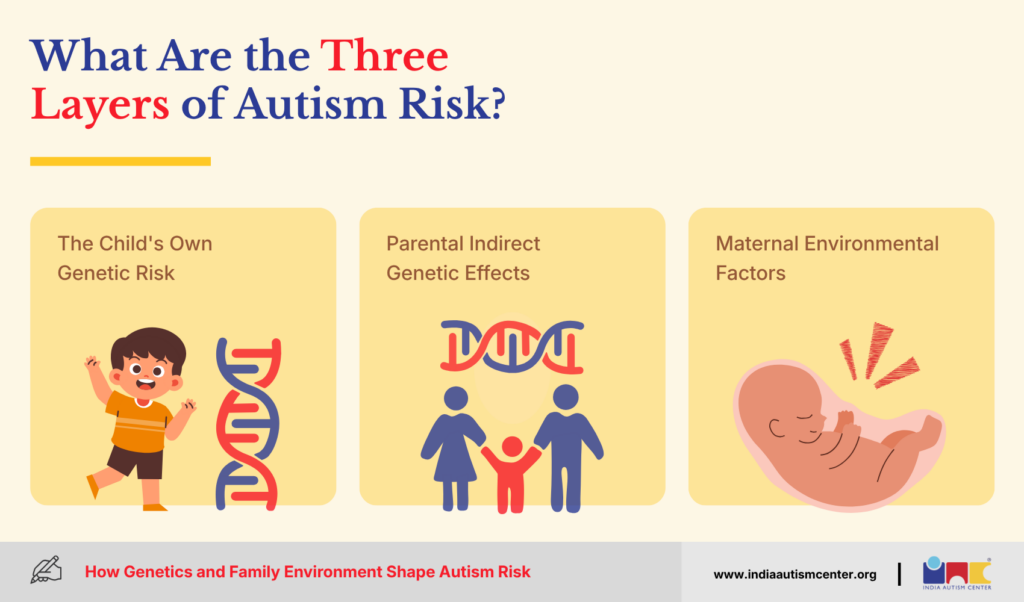
Layer 1: The Child’s Own Genetic Risk
The child’s inherited polygenic score for autism directly increases their probability of diagnosis. This is the most intuitive finding — and it confirms what earlier research had suggested.
But the child’s autism PGS is only part of the picture.
Layer 2: Parental Indirect Genetic Effects
This is the study’s most significant — and most surprising — finding.
The researchers found that parents’ polygenic scores for BMI and several neurocognitive traits had significant indirect effects on their child’s autism risk. In other words, a parent’s genetic predisposition for high BMI or certain cognitive traits influenced the child’s autism risk — not by passing those genes directly to the child, but by shaping the developmental environment.
Here is what makes this important: the mother’s and father’s indirect contributions are not equal. PGS-TRI was built to detect this asymmetry. The data suggests that maternal and paternal indirect effects operate through different biological and behavioural pathways.
📥 Free download: Printable daily routine chart for autistic children
Notably, the study found no significant indirect effect from the parents’ own autism polygenic score — only from BMI and neurocognitive traits. This tells us that what a parent does developmentally and metabolically may matter as much as what genes they pass on.
Layer 3: Maternal Environmental Factors
The framework was also designed to detect gene–environment interactions — specifically how maternal lifestyle factors like diet, weight, and metabolic health interact with a child’s genetic risk.
This is not about blame. A parent’s BMI or cognitive profile is itself genetically influenced. What it signals is that modifiable factors during pregnancy — nutrition, folic acid supplementation, managing metabolic health — can interact with genetic predispositions in meaningful ways.
How Do Gene–Environment Interactions Work in Autism?
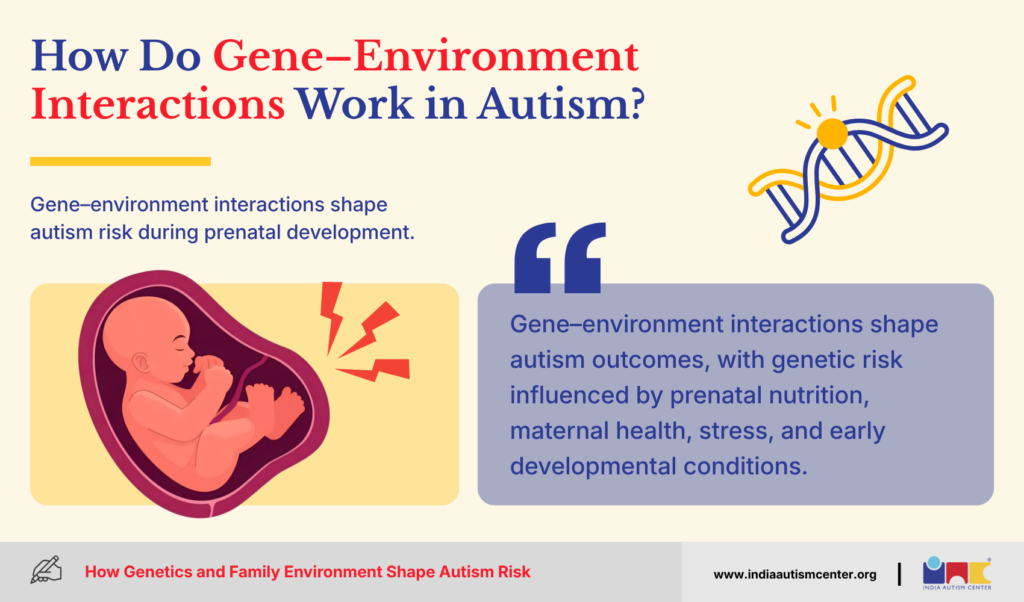
A gene–environment interaction (G×E) happens when a genetic predisposition expresses differently depending on the environment it encounters.
A simple way to understand this: imagine two children who carry the same autism polygenic risk score. One grows in a nutrient-rich prenatal environment with no significant stressors. The other is exposed to nutritional deficiencies or high maternal cortisol levels in utero. The genetic risk is identical — but the developmental outcome can differ.
Known environmental modulators in autism research include:
| Environmental Factor | What the Research Shows |
| Prenatal folic acid | Adequate intake linked to reduced neural tube and neurodevelopmental risk |
| Maternal BMI | High pre-pregnancy BMI associated with elevated autism risk in offspring |
| Maternal age | Advanced maternal age correlates with increased de novo mutation rates |
| Paternal age | Older paternal age linked to higher rates of new genetic mutations in children |
| Prenatal stress | Elevated maternal cortisol may alter fetal brain development trajectories |
| Infections during pregnancy | Immune activation in utero has been studied as a potential risk modulator |
These are modulators, not causes. Autism is not caused by a parent’s diet or stress levels. These factors influence how a genetic predisposition unfolds — nothing more.
Does Ancestry Affect Genetic Risk Scores for Autism?
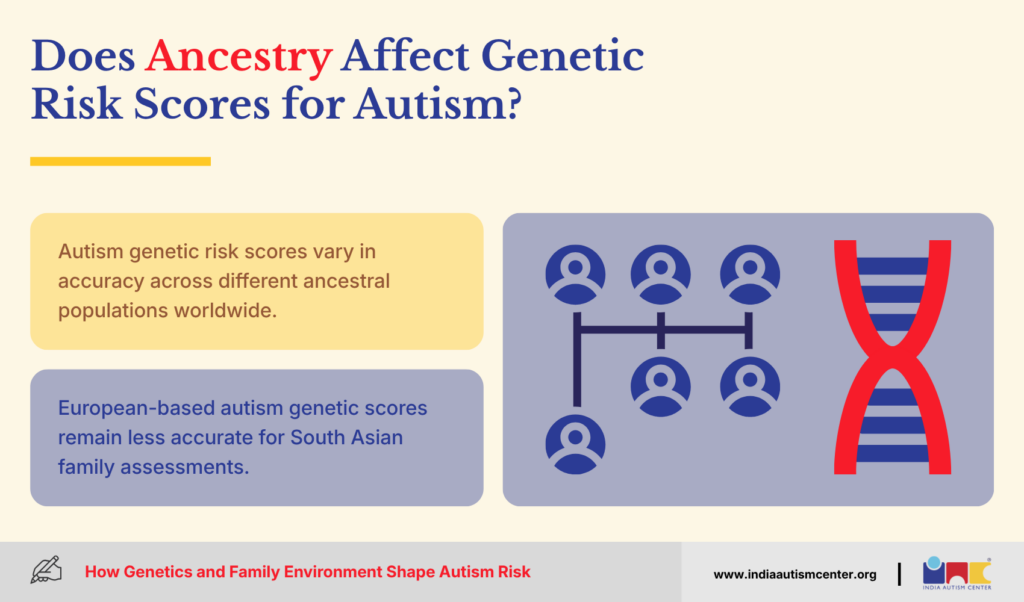
Yes — significantly. And this matters deeply for Indian and South Asian families.
The study found that existing polygenic risk scores predict autism more accurately in individuals of European ancestry than in other populations. The reason: most large-scale genetic studies that created these scores used predominantly European cohorts. When applied to South Asian or East Asian individuals, the scores lose predictive accuracy.
The Johns Hopkins team demonstrated that this drop-off is not random — it follows a continuous attenuation pattern based on how genetically distant the target population is from the population the score was trained on.
What this means for families in India:
- Consumer genetic tests or research polygenic scores built on European data may underestimate or misrepresent autism risk in Indian children
- Clinical diagnosis through developmental assessment remains the most reliable approach for Indian families
- There is an urgent need for South Asian representation in autism genetic databases — studies like these need data from families like yours
This is a research gap, not a permanent limitation. It will close as diversity in autism datasets grows.
Want to know more? Get in touch with us.
What Are the Sibling Recurrence Rates for Autism?
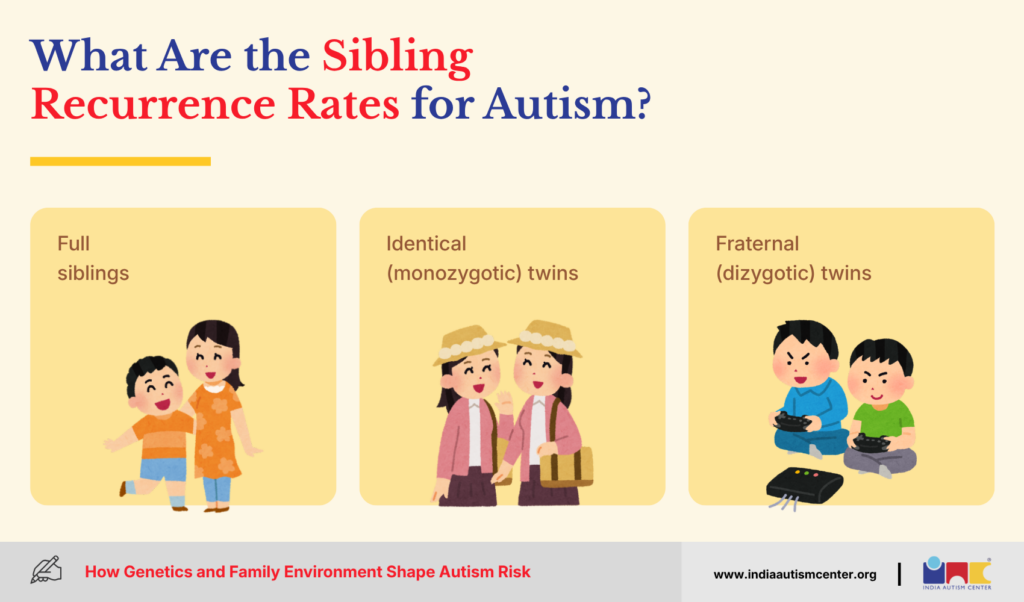
If you have one autistic child, this is almost certainly a question you have asked.
The research is consistent here. Sibling recurrence rates for autism are meaningfully higher than the general population rate of approximately 1–2%. Studies suggest:
- Full siblings of an autistic child have roughly a 10–20% recurrence risk
- Identical (monozygotic) twins: concordance rates of 70–90%
- Fraternal (dizygotic) twins: concordance rates of 30–40%
These numbers reflect shared genetics and shared prenatal environment — which is why identical twins, despite identical DNA, do not show 100% concordance. The environment inside the womb still matters.
If you are planning another pregnancy and have concerns, speaking with a developmental paediatrician or genetic counsellor is the most productive next step.
Should Families Consider Genetic Testing for Autism?
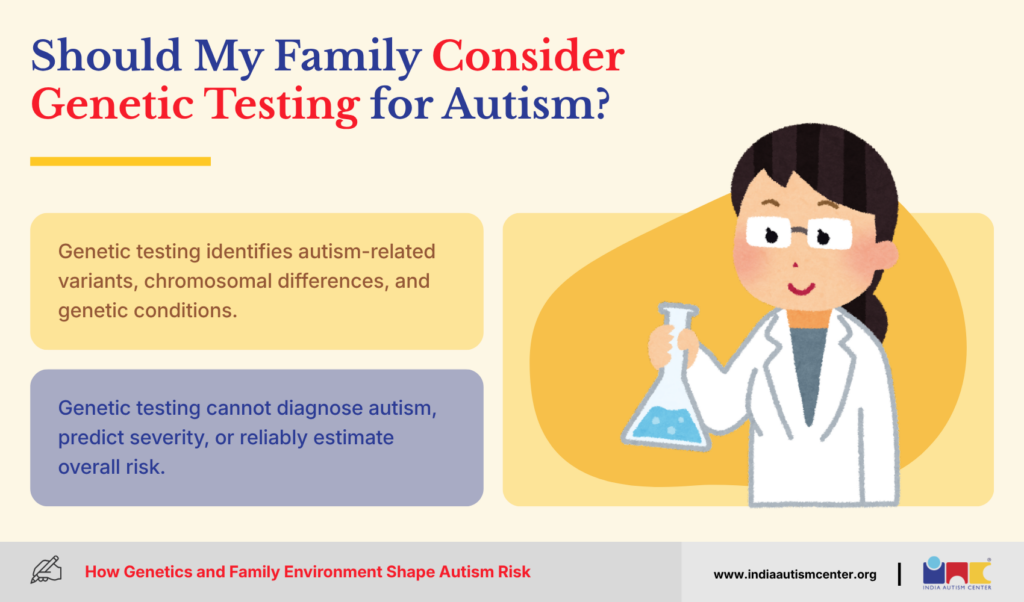
This depends on what you are looking for — and it is worth being honest about what genetic testing can and cannot tell you.
What genetic testing can identify:
- Specific high-impact single gene variants associated with autism (e.g., mutations in SHANK3, CHD8, PTEN, MECP2)
- Chromosomal differences like copy number variations (CNVs)
- Conditions like Fragile X syndrome or Angelman syndrome where autism is a common feature
What genetic testing cannot currently do:
- Confirm or rule out an autism diagnosis
- Give a reliable polygenic risk probability for most non-European populations
- Predict severity or trajectory
Polygenic scores are research tools, not clinical diagnostic instruments. If your child is showing developmental differences, the priority is developmental assessment — not a DNA test.
What Does This Mean for Parents Right Now?
Let me be direct about what this research does and does not imply.
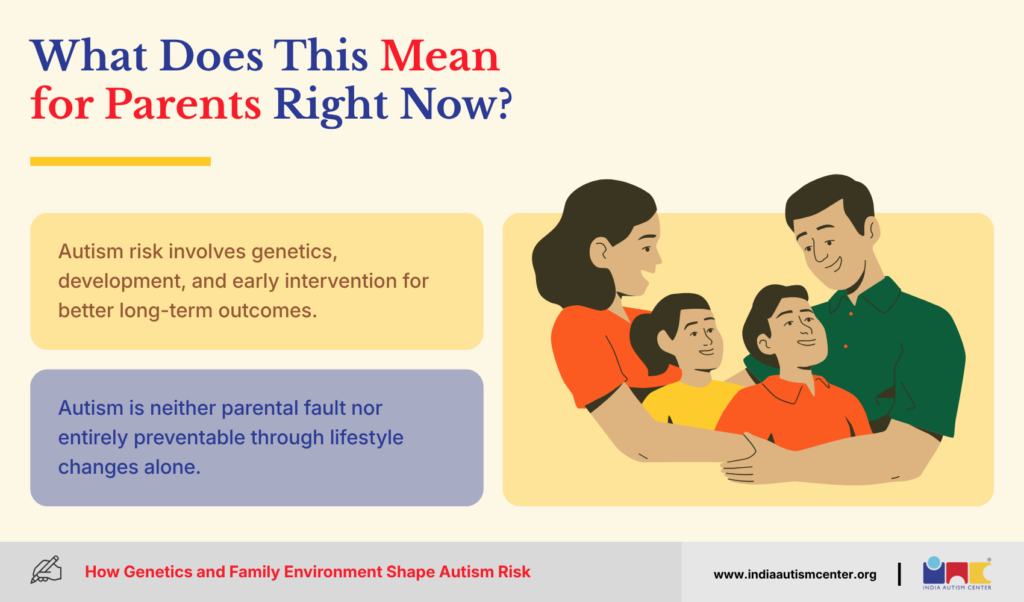
It does not mean:
- You caused your child’s autism
- You could have prevented it with a different lifestyle
- Your child’s autism is a genetic error
It does mean:
- Autism risk is multifactorial — genetics, parental biology, and developmental environment all interact
- Prenatal health — particularly maternal nutrition, folic acid intake, and metabolic health — is worth prioritising in any pregnancy
- Early identification and structured intervention remain the most evidence-based response, regardless of genetic profile
The researchers behind the PGS-TRI framework have stated that their goal is to enable better discovery of risk factors and biomarkers — not to predict or prevent autism, but to understand it more completely so that families and clinicians can make better-informed decisions.
What Is Coming Next in Autism Genetics Research?
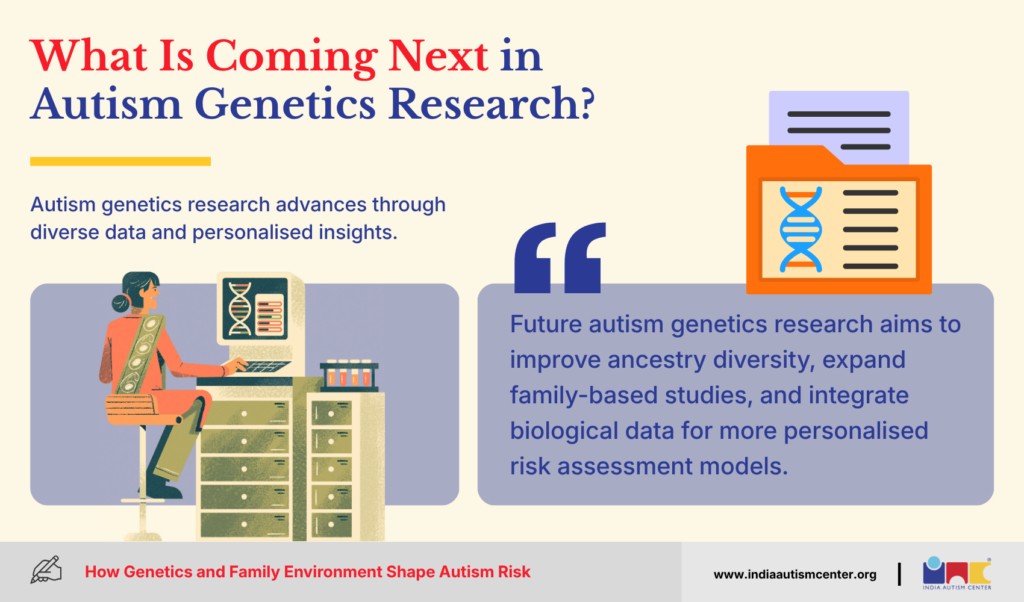
The Johns Hopkins team has outlined several directions for extending this work:
- Applying PGS-TRI to broader family structures — including grandparents, siblings, and extended relatives — to capture more nuanced patterns of indirect genetic effects
- Integrating transcriptomics and metabolomics data (gene expression and metabolite profiles) into risk modelling — the 2026 study piloted this approach
- Building ancestry-diverse datasets so that polygenic scores become equally predictive across all populations
This is a field moving quickly. The science of autism genetics in 2026 is substantially more nuanced than it was even five years ago — and the direction of travel is clearly toward understanding autism as a deeply individual, multifactorial condition rather than a uniform diagnostic category.
Want to know more? Get in touch with us.
Conclusion
- Autism heritability is 70–90%, but no single gene causes autism
- Risk comes from the child’s DNA, indirect parental genetic effects, and gene–environment interactions
- A parent’s BMI and neurocognitive genetic profile can influence a child’s autism risk indirectly — through the developmental environment
- Maternal lifestyle factors (nutrition, metabolic health) are modulators, not causes
- Polygenic risk scores are less accurate for non-European populations — Indian families should rely on clinical assessment
- Sibling recurrence risk is 10–20% for full siblings; family genetic counselling is available and worthwhile
- Early identification and structured intervention remain the most evidence-based response for any family
This article is intended for educational purposes only. It does not constitute medical advice, genetic counselling, or a clinical recommendation. If you have concerns about your child’s development or wish to discuss genetic testing, please consult a qualified developmental paediatrician, clinical geneticist, or autism specialist. Families in India can contact India Autism Center for guidance on appropriate assessment and support pathways.
Source: Wang Z, Grosvenor L, Ray D, et al. “Estimation of Direct and Indirect Polygenic Effects and Gene–Environment Interactions using Polygenic Scores in Case-Parent Trio Studies.” Nature Genetics, June 2026. DOI: 10.1038/s41588-026-02601-2